Mastering SaaS Sales Hiring, Customer Retention, and Growth with OpenAI, Retool, and 20VC
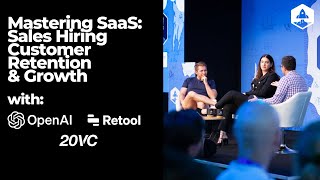
Eleanor from Retool and Dom from OpenAI discuss hiring sales teams that prioritize curiosity over credentials, running rigorous 90-day onboarding to catch mis-hires early, and how AI is reshaping customer education and go-to-market strategy at scale.
Chapters
What do you think are the biggest mistakes that founders make in sales team hiring?
Looking at a resume versus an individual. It's an easy proxy, It's a cheat code. You're a founder, you have a million things to do every hour and you look at it and you think, yes, this is a blueprint for success. When in the early days, curiosity and high slope, high potential individuals can have such an outsized impact.
Dom, what are the biggest mistakes you've made in sales team hiring?
I think there is no uniform profile for how you go in and think about technical sales and even technical post sales. And I think there's all these sort of things that you want to identify which is based on what stage of growth is the company in. You're also thinking about what type of product you have, who is the actual user and you think about those, start working your way backwards and that starts to allow you to start to understand what type of a profile you need.
Thank you so much for joining us everyone. How have you seen your role change over the last 18 months?
So I think it's two things. It's the zero interest rate environment going away in the last two years and having to dramatically change the way you think about sales. And then it's also this advent of AI and this excitement and this eagerness and this desire to use it as quickly and quickly as possible without maybe thinking through what are we going to do, what are we trying to achieve, what are we trying to assault?
How has the zero interest rate environment changed how you think about sales today?
I think it's just much harder. I was thinking through some very fancy answers about what's changed, but at the end of the day, what does that.
Look like we saw with Salesforce in that results that was. I think they need 3x pipeline coverage to hit the same 2x number. Are there specific examples of how it's harder?
I would say the pipeline coverage you need, we used to need about 1.5x. Now it's closer to 2.2.5. I think sales cycles have gotten longer and I think instead of being able to rely on inbound and hand wavy ROI calculators to be able to make a case, you actually we've shifted more to this inbound, outbound version where you have to get religious about intent signals and time to lead and speed to lead and following up immediately. It's. You can't, you have to have a very strong champion who knows how to actually attach to a top level business initiative. And we've always historically said, of course you have to attach to a top level business initiative, but now you actually do. And you need a stronger champion. You need a clearer business case. You need to attach to something that's incredibly important to the company and you have to take a lot more time doing it.
If we just go through the sales lifecycle that we said, we need more pipeline coverage, great. But also companies are cutting back on spend in a lot of cases. How do we think about that? Do we spend a load more in terms of SDR teams? How do you approach that?
I think it's there. There's two ways you can grow. It's the top line as well as the efficiency. And we're focusing a lot more on the efficiency. And so how can we maximize the BDRs we have? Can we give them more tooling? How can we capture every single intent signal? How can we make sure that we're spending our money on brand awareness and education? The awareness and education is almost more important than anything else because you need to work together to find a use case in order to capture that budget.
Okay, so we then increase pipeline. How are we seeing time to sale change and how do we actually shorten that in the face of lengthening time to sales? How do we create urgency?
I think a lot of it is just I spend more time probably managing expectations than shortening the life cycle. But I think both are important. I think a lot of it is attaching to one of their top level initiatives so that you can craft a compelling event around that and also attaching yourself to market trends like AI. And so figuring out how does retool fit into your AI story? Are we how you adopt it? Are we how you prototype? Are we how you can actually get something built and in production for your support team or your sales team or your engineering team faster? And it's understanding very critically what, what the goals are of your prospect or your customer and attaching to them from day one.
Do you think startups do that well today?
I think it's a moving target. I think it's a lot easier said than done and I think that's a lot. What's changed in the past two years and 18 months is there's a ton of noise around AI, there's a ton of noise around the economy. And your job is to create focus and clarity and a path to sale as quickly as possible.
Dom, I'd love to hear your thoughts. We've heard about how people need more metrics, they need more proof points around success. How do you think we see actual post sales Change in this next wave where people want to see more data. Klarna want case studies of effectiveness of kind of effective agent use. How do we see post sales change with the increased demands of customers?
Yeah, I think a lot of what we're focusing on is just being able to learn jointly with customers and so brand new technology, new category, moving really quickly. A lot of what we're spending a lot of time doing is actually the surveying of customers and really understanding what are some of the compelling use cases that we can then apply value and metrics to and then using that to start building out solutions, being able to have a hypothesis by different industries as to what is the impact in the technology. So a lot of what we're doing is working with customers jointly to really understand with them and to guide them on where the technology can be applied. The second thing that we're focusing a ton on, at least within our organization is building out lots of education and that's not entirely just based on the technology, but how to think about the technology. Companies come to us and they're saying what should a responsible AI use policy look like? Has anyone ever written something like that? How can you help us think about that type of problem? So we're working through and building a lot of these frameworks to allow people to be able to actually have the tools to figure out how to deploy the technology at scale.
Where does OpenAI suck at post sales today?
I'd say that a lot of what we have a constant challenge with just scale. We're a really small company relative to the type of demand that we see and we obviously compete with some of the largest companies on earth and we're competing with them all simultaneously. And a lot of what we have to do is honestly expectation setting and that there's. We can only work with what does.
That actually look like? You actually turn down customers?
We have to, yeah, absolutely. It doesn't mean that we don't turn them down from a technology perspective, but it means that we can only work with them directly with an account team at a certain level of scale. And so that's one of the biggest pushes right now is we're just massively scaling our go to market organization. We opened up an office in Japan, we announced we're going to be opening up an office in Paris and we want to be where all of our customers are, but it's going to take us some time to get there.
Has there been a mistake or two that you've made in the post sales learning process and building it out that has most shaped how you think that you think others could learn from.
I think some of the things that we've certainly made mistakes on is just assuming that the market has more knowledge of this technology and that we really do have to create a crawl, walk, run. And a lot more of what we've been focused on is doing that initial education and not making assumptions that people have a strategy around AI. It's been shown actually multiple times that lots of companies have interest in AI, but very few companies actually have a serious strategy in place around how to go in and deploy and make use of the technology. So it's made us shift a lot more towards doing education, going in and working with knowledge workers and explaining what prompt engineering is, how to go in and give these models the ability to retrieve information so they have more context about your business and how it works.
Is it difficult in a engineering centric organization where researchers are like, you know, royalty and GTM is like a necessary evil?
Yeah. Is that difficult?
I don't think so. We work a lot with research like you would a traditional product team. They're delivering innovations to the market. We are then going to productize and then the big part of the mission is to bring AGI into the hands so it benefits humanity. How do you do that? You actually have to have people using the technology. And so we look at the go to market team as very much a part of that mission because it's taking a lot of those innovations, those breakthroughs that are happening in research, and actually bringing them to the market so they can be applied.
I interviewed Brad, your COO and Sam actually in London, and Brad said that the biggest misconception that large enterprises had around adopting OpenAI and your solutions is actually they want to see like line items move around balance sheets. And actually you can't sometimes quantify someone's time in certain respects. And what being said, if I were to ask you the same question, the biggest misconceptions that large enterprises have around adopting OpenAI in your solutions and you were to say something different, what would you say?
I'd say there's a couple of different things that we see traditionally. Like one is that a lot of large enterprises think that the innovation is going to start with their machine learning team or their data science team. And what we're seeing a lot of innovation happen is actually at the line of business level, the people that are closest to the problems and closest to the processes generally have a much better intuition about how to apply the technology. So that's one the other One that I would generally say is that people grossly underestimate the amount of time it's going to take in order to pull off a really successful transformational AI project. And that if you're not really, not only resourcing it top down, but it's part of the company's strategy and that you really have a group of technologists along with some of those folks from the line of business working together, it's going to take a while to pull these projects off. And so when we talk about some of these companies like Klarna or Spotify or Morgan Stanley that have really done something transformational, I think we all have to keep in mind we started those projects probably nine months ago. And it takes time and iteration in order to get something into production.
Can I ask you, Eleanor, Retail obviously was a very fantastic and efficient company pre the AI hype cycle. And you said you have to attach yourself to trends in certain respects. How is a non AI first company, I might get in trouble for that. But non AI first company attach yourself to the trend authentically without being like, oh, and we've got AI slapped on the side.
Actually, I think we're in a really interesting position because if you look at the website, you don't see AI anywhere. You have to dig deep into our docs to actually see where AI fits in. And in case you haven't looked at our docs, which I imagine as many of you, it's in how you build applications and then you can also infuse AI into the applications that you've built.
But do you bring it into customer conversations?
So they bring it in. It actually started with our customers. So a lot of our excitement internally around AI, we're a very customer hypothesis driven organization has come by seeing how our customers have used us. So they've built tools to parse their contracts, they've built a ton of sales tooling so to have messages draft and categorized and to fit in with personalized use cases by industry, they've built a ton of customer health dashboards that use AI to generate use case ideas or to triage support tickets. So it's actually what we've seen is worth what Dom said, where we're closer to the line of business, so we're selling into the people who actually have a lot more intuition about what they need to build. And so by not starting with the machine learning or data science teams, by actually starting with the pain points in a business with a practical application of how do you bring AI to solve a problem that we Face today. That's the pull we felt from our customers and how we've evolved our AI strategy and enabled our sales team to start to use that messaging upfront.
You mentioned zero interest rate environment being a challenge and a new thing to get one's arms around. Sales forecasting is even harder. Today we saw Salesforce I think miss projections by 40 million and lose 50 billion in market cap. How do you think about effective sales forecasting today? Because it is harder than ever, it would seem.
It's very challenging. We actually built a retool app that's we have a lot of playful names internally it's called the pipeline profit and it is continuously learning. So it looks at close rates, it looks at create and close in quarter, it looks at open pipeline and it looks at all of the individual reps stack on how they historically can close the pipeline that they have. So we do a blend right now of bottoms up forecasting, which is more standard where AE submit their forecast calls, managers submit their forecast calls, we roll that up, we looked at our weighted pipeline and then honestly, the pipeline profit has been within 10% of accuracy every quarter. And so while I'd like to pretend that I'm a forecasting savant, I usually end up going with what that says.
I'm on quite a few boards and quite often the conversation it just fell into next quarter, fell into next quarter and I'm always stuck like, okay, what should I say to that? What is the right answer?
I think you set a goal for how to get the slips down. I think one thing we have gotten quite good at is execution and so much of forecasting identity. It's all expectations, management with your customers, internally with your product team, with yourself. And in terms of deals slipping it, asking yourself in every single deal review, if this doesn't close by this date, why will that be? And being ruthlessly intellectually honest. And the pipeline Profit takes slipping into account, so it does account for that. But for the most part it's just a lot of discipline and oversight and intellectual honesty with yourself and your team.
For founders listening, how often do you do deal reviews and what's the difference between a good and a great deal review? What do you know now as a sales leader that you're like, God, I wish I'd done this in my first deal review.
There's a few things we do deal reviews pretty programmatically. When a deal that's over a certain dollar threshold hits stage three, we do an early stage deal review.
What's that dollar threshold?
50K, 50k theirs would probably be a little larger. When it hits stage five, we do a late stage deal review and for me the biggest thing has been building that discipline and predictability that I know when we hit stage three, which is for us, you're entering a proof of concept that we're going to inspect. Have you met with the economic buyer? Have you sold beyond just a use case? Do you have a platform vision in place? Do you know what problem they're trying to solve? Do we have a compelling event? And most importantly, what top down initiative are we attaching to? Because every deal, even if it's not a head to head compete, is a compete because you're competing for budget and you're competing for mindshare. And when OpenAI has to have companies move budget line items around in order to justify the spend, we certainly have to do that as well. There isn't usually a line item that we can directly replace. We have to create a compelling enough vision to get the budget.
How do you keep morale high when deal cycles slow, when things just seem harder?
I think it's pretending that it acknowledging the reality of the situation and I do think there is a lot of glory in the struggle and it's finding the early wins. It's not just celebrating the output, it's also celebrating the inputs. We do a weekly standup every Monday with the entire dota market Org where we talk about the wins from the previous week. What did we close? What did we renew? What customers did we activate? What sales qualified opportunities did we generate? We do a weekly shout out. What? Something amazing that happened. What's a disaster that happened?
Dom, can I ask you, you sign a big customer, right? And as those teams say, hey great, here's Adam Klarna. How does it happen? Seriously, how does it happen? Do you sit down with that head of sales and do the handoff and then like how did that happen? And when you get given a customer. Yeah, what happens then?
It depends. So one thing that's interesting about OpenAI is we have different business models. So we have ChatGPT Enterprise and you could say that's very analogous to a hyper scaling B2B SaaS organization in the productivity space. So people are looking at ChatGPT Enterprise and they're saying, hey, we want to AI enable our workforce. We want to allow people to start using these tools and become more productive. And that's very much something that's sold to a cio. It looked at as part of the productivity suite of the company.
How intelligent are the buyers in terms of their decisions. Have they said, hey, we've actually already done the work and we've realized we wanted OpenAI over Mistral and lom. Or is it like you're the only one?
So I think it depends. Like we would never be competing in ChatGPT Enterprise with a Mistral because this is something that's a package software application. On the other side is the models themselves and those are all available through API. And that's where yeah, people are going to look at a bunch of different factors when they're evaluating models. One of them is going to be what is the model's intelligence and reasoning capability. There's all sorts of different ways that we benchmark those. The other is the price point and then the final piece is the latency. So how fast is this model on the input and the output? And generally what people will try and do who are really sophisticated is they'll optimize for each one of those dimensions as they're building the product. So maybe they'll say for this part of the product we actually need very high reasoning and high intelligence, but for maybe this other part of the product we actually really want to optimize for cost and latency. And then you can even do things which a lot of companies start doing, which is you start and validate with the most reasonable and the most intelligent the frontier model, in our case GPT4O. Once you've validated that the use case is possible, then you try and cost optimize and look for if you can still accomplish that with the same relative performance with a more cost effective model, something like maybe 3.5 that's fine tuned.
So I read about, and this may be completely unfair, but I read about like PwC's like massive rollout.
Yeah.
And a massive contract. How on earth do you do onboarding education for PwC? I think it's a 30 million a year contract. It was rumored to be with thousands of seats. What does that look like?
Yeah, we very much are doing the train the trainer approach. So we're working with global project managers, we're doing a lot of the best practices in sharing. And then we started staffing enterprise account teams. So we have a customer success team. We've got solution architects that can help with integration patterns and we work with them through the journey and we do a phased rollout. So you know, something like PwC will probably do it over time to get to that number and that's both for them to be able to make sure that they have the level of enablement within their workforce and then also to make sure that we're going in and validating some of the value in the use cases and being able to advertise those. Build the champion network, continue to go in and make sure that we have the type of sponsorship to make those rollouts successful.
To what extent do you set the benchmarks for success versus they set them?
I think that we try and arrive on some joint metrics for sure and that's the ideal state. I do think that there's a lot of companies right now that and this is a luxury to be in this position, but for something like ChatGPT Enterprise, they are purchasing without a defined use case in mind because they're saying, look.
Do you not find that quite nuts?
Yeah, no.
Oh yeah, sure. Here's a couple million bucks. I don't really have a use case for this.
I think what people are trying to figure out is this technology has the capacity to be transformational, yet I don't have intuitively a ton of in house expertise. I could go about trying to work with analysts to get that expertise. I could go in and try and do the research or I could just get the technology in the hands of my workers and then try and start really deeply understanding where the value is.
What role do you think AI services companies have? Accenture posted $2.4 billion in generative AI revenue. I tweeted a year ago that AI services would make more money than AI companies and they announced 2.4 billion and openly added 2 billion. To what extent do you partner with them on the customer education process as well?
Oh, absolutely. So we look at a lot of those companies and work with some of those because large companies obviously partner with them to do a lot of implementations. We generally when we're talking about companies that are interested in building things on the models, we target the either end of the market in that we work with really large companies that want to do something transformational. PwC is one good example. And then we work with a lot of startups. So we really do think that there are companies that are being created today that are going to be implementing the technology that could disrupt a lot of technology sectors, a lot of ways that we think about products. And so we make an outsized investment in making sure that those companies know how to leverage our technology to the fullest.
I want to talk about building sales teams themselves. This is a component that every founder has to do in terms of hiring, management, firing. When we go start at the lifecycle of sales team hiring. As crazy as it can or specific as it sounds, what are the must ask questions when you are hiring a sales team to identify the quality of candidates?
I actually think there isn't a silver bullet must ask question. I think the key when you're interviewing salespeople is when you ask a question you have to go five layers deeper on the answer because they're salespeople and in an interview they're selling their favorite subject, which is themselves. And it's very easy to have a charming answer to a question. But the reality is in a sales cycle like ours, where you have to be incredibly good at cultivating champions, where discovery is the most important skill set, where product mastery matters as well as sales skills, you need to go really deep and you actually need to test the depth of their knowledge. So it isn't the specific question so much as you have to go five levels deeper every single time so you can understand how deeply does their expertise, how credible are their answers and like how authentic is their grasp of this information.
Do you bring other people into the process?
Oh, absolutely.
How do you do that?
So we, our post sales team is very much involved in the sales interview process. In the early days we absolutely had product and founders involved in the sales process. So we'll do a technical screen which is someone outside of the sales team. You want your culture screen to happen from someone outside of the sales team as well because you want someone to be able to actually assess their cultural fit unless I really think they're going to close deals. So that's more important. So you create the balance to make sure that you're getting a fair opinion.
What do you think are the biggest mistakes that founders make in sales team hiring?
Looking at a resume versus an individual.
What do they get wrong in the resume? They just rely on logos.
I think if you rely it's really easy. It's an easy proxy. It's a cheat code. You're a founder, you have a million things to do every hour and you look at it and you think yes, this is a blueprint for success. When in the early days curiosity and high slope, high potential individuals can have such an outsized.
Would you rather someone sold a certain size deal or they've actually sold in your vertical before?
I would say it depends on the life cycle and the more mature when you become a growth stage company, the ability to have closed those large deals and to be in front of a C suite and to multi thread is honestly a little more important than the product expertise. In the early days when you're in market share Mode, when you want to close as much as possible and more importantly, you want to learn as much as possible, then the vertical experience matters more.
Dom, what are the biggest mistakes you've made in sales team hiring?
No, I think that the thing that certainly one of my mistakes that I've made is that I think there is no uniform profile for how you go in and think about technical sales and even technical post sales. And I think there's all these sort of things that you want to identify which is based on what stage of growth is the company in. You're also thinking about who, what type of product do you have, who is the actual user and you think about those, start working your way backwards and that starts to allow you to start to understand what type of a profile you need. Like one quick example, because I've been now at multiple companies that have gone through the hypergrowth journey, you generally find that earlier stage, some of the things that make people really successful is. And the, the. The analogy of an old HBR article from 2006 would say the Renaissance sales team and it's the team that's able to operate in a lot of ambiguity and they have a high tolerance for that because a lot of times you have to start creating the playbooks. No one knows what the sales process is. No one knows what the deck is and how that it should be organized. No one knows what the value proposition and some of those metrics are. You need people that are capable of creating that and that's a very different skill set than when you're starting to scale the organization. Those have all been defined and you really need people to run the play and do it scalably and effectively. And those are different types of skills. So even the same role, depending on the stage of growth at the company and you might isolate for different factors.
Do you worry about the motives of people coming into teams? Like OpenAI is a hot company now. Everyone wants to come work at OpenAI, especially in sales.
Yeah, I think you have to screen for that. Another thing that I did was I posted when I got the job at OpenAI. Hey, I've got this job at OpenAI. I'm incredibly excited about it on LinkedIn. I posted all these roles at any other company that'd be probably a pretty reasonable thing to do as a manager. And I think I had 900 inmails within 4 hours of posting that. And you realize there's a certain level of scale and brand recognition at this company that you're going to have to start thinking about. Even things like the hiring process a little bit differently because now how you even sort through those, how do you even start understanding who are the people that you should be making that outreach to? And one thing that we have done is we've shifted a lot of the hiring process and things that you would normally do more at an on site. We've shifted that earlier because we have to inherently do a lot more screening.
What.
What is that?
Elements that you've shifted things like we.
Do a take home assignment and normally you would do that more interns with the inter. With the actual on site. But we want to shift it up because we need some of those disqualifiers a lot earlier because we just have too many candidates to be able to.
I'm always struck with taking home assignments because people sit in different camps. Do it with the company that you're hiring for. They can build up some skills or. That's unfair. There's asymmetric information that people hire them, have so much knowledge and they have none. Which one's the right one?
I think it depends. And that's going to be the answer to a lot of these. There's been times.
Come on.
No, what I would say is in our situation, I do think it's the right thing to do. That even though there's an asymmetric information and potentially there's going to be factors that maybe some candidates don't have the ability to be able to show up as well as they could. The reality is that we've got to be able to go in and do those screenings earlier. And if people have the time to be able to show and do some of the research, that's a really good case that this is going to be a strong candidate that they've gone in and taken the time to learn a little bit about our industry as opposed to just raising their hand.
I also think it's really easy to get excited by a brand or a product or by traction. And if you have to do a take home that's tied to that company, it'll actually show. Do I have the capacity to learn about this? Was I excited while working on this take home? I always tell candidates, if you enjoyed this take home, you're going to really enjoy selling this. But you have to enjoy it and this is signal for you just as much as it is for us.
On.
If an open ended platform sale is.
What excites you, how quickly do you know when you've made a mis hire?
First 90 days.
Yeah, there's variability, but yeah, I'd say within the first 90 days. If you haven't been able to make that diagnosis, then there's something wrong with either your onboarding or the way that your managers are conducting one on ones or the way that you're evaluating people as they come into the organization.
What have you found are the most common first signals that someone is not making the grade?
I think follow through. Do they do what they say they're going to do? That bizarrely manifests itself pretty quickly. So ownership and their ability to act like an owner, I think can show up really quickly. And that's usually one of the biggest signals that it's been a mis hire. And then you just start to see, are they ramping? Are they hitting you have some internal milestones to show? Are they grasping the material? Are they ready to take that first call? Do they need managers on their call for longer than you'd anticipate?
How quickly do you put new reps, SDLs, BDRs, you name it in front of customers?
Two weeks.
Two weeks. Does that vary on deal size? Do they go with someone else?
We, you'll have a buddy on those first few calls, but for the most part, in the first two weeks, we do a certification process where we ramp them. If they don't pass their certification, we will have them redo it and we'll give them another week. So sometimes three. If they miss their certification twice, I think that's another pretty strong signal that you might have hired the wrong person.
How quickly do we expect them to.
Sign a deal for their first deal? Completely varies by segment. So if they're working with zero to 100 employees, they should close their first deal within their first two months. If they're working in the enterprise, if it happens in the first nine to 10 months, that's still completely normal.
Dom, what are your thoughts in terms of, for you, the clearest signals that someone isn't performing or is a mis hire?
Yeah, I think it goes back to what Eleanor said. You should clearly define what success looks like. You should have competencies and a clear learning path. And if it they're not being able to ramp or be able to grasp the information or be able to grasp the role or the customer journey, you should have the ability to have those checkpoints where you can make those assessments. And that doesn't mean that the person's immediately failed, but it means that we're giving them the chance that here's where our expectation is. We need to see this or that and give them the chance to succeed. Of course, but you're Going to be using those to be able to set up and understand whether that person does have the capabilities to do what the Rolling Corp requires.
Final question before we do a quick fire. But like how do you think about the verticalization of sales teams? Where you think about okay, we've got healthcare, we've got fintech, we've got, you name it, whatever we want to choose professional services. How do you think about verticalization? Because some people say that's super expensive, massive change for organizations. But some also say actually you can test it much more efficiently, give it a go.
I mean, I think that there's a scale of verticalization. There's, hey, we have a New York team and let's inherently use verticals as a proxy to regionality and just say we're going to start having some members of the York team focus on financial services. Maybe in the Bay Area we'll have a tech vertical and maybe within the Midwest we're going to have a manufacturing. And it's really more just aligning them to the types of customers and the majority of the companies that exist. And that's one level of doing a vertical strategy. There's another level which is we're going to go in and start bringing in vertical managers and we're going to have people that have 20 years of experience in media and entertainment or financial services and we're going to start verticalizing and have tracking that specific number for that particular vertical with the assumption that we're going to grow it, that's very different. And so I would say one of, I guess my hot takes, I think companies rush to verticalization a little too early. And I do think you have to really understand what your overall value proposition and get your core sales motion going before you just rush to verticalization. Because the challenge that you have is that vertical is not just a go to market strategy, it's also a product strategy. So if you suddenly just say we're going to go after financial services and then suddenly you realize your product doesn't have the certifications, the regulations to be able to operate at scale in that environment. Now you've got a conflict between your product team and your sales team and your go to market team. And so I do think that you have to go in eyes wide open that this isn't just a go to market strategy. You have to have the corresponding backing of the product team, which means that you're probably going to need to stack, rank which verticals that you really want to go after. Be really thoughtful about. What does it mean and how much we're going to commit to each of those. And it's something that really needs to be thought about as something that's jointly owned across product and go to market.
I was going to say the product and go to market piece as well, because that's very true for us. In terms of whenever we think about verticalization, it has to be an entire company decision because the integrations that are required by a typical large bank are very different than what you're going to see from a legacy enterprise software company or from a regional manufacturing company or a rubber manufacturing company in Canada. In addition to that, it's thinking through which motion does it make sense. If you're working with zero to 100 employees, the sales cycle looks pretty similar across the board. But if you're looking at, say, a strategic segment where you have a rep that only works with three or four customers and you have ODD with a bdr, you have a technical account manager, you have an ae, verticalization makes a huge difference because you live or die on the success of those small number of companies and accounts and your ability to deeply understand their business and draw transferable conclusions from one customer to another is a force multiplier. It's not down market. So a lot of it is verticalizing at the right time with the right segment and knowing that you're why you're starting there and what problem you're trying to solve. Is it acceleration of deal cycles? Is it ability for the product team to focus on the integrations that really matter? And when you're aligned on that, I think it makes a lot of sense. And I always think that upmarket is the right way to start with verticalization.
Finger stamps for that.
So I'm gonna do the quickest quick fire ever. Dom, what makes Sam Altman so special to work for?
I always say, like when you're looking for a great founder, you look for someone that has product strategy, that can be customer facing and that can be visionary. And if you get like one of those, you generally get a pretty good founder. If you get two of those, it's someone who's an amazing founder. And I do think if you get all three, someone who truly is a special founder, I think he's great. He's a culture carrier. He's very honest. And even though the mission is incredibly important, sometimes the mission's incredibly daunting. He's really has a level of humility and transparency that anyone that works at the company appreciates.
Elna, final one, what advice would you give to a founder hiring their first sales leader or you can choose the sales leader starting their new job tomorrow. What would your biggest piece of advice be to them?
Back channel that would be my most direct one. I think meet in person and spending a lot of time together is so important. I've realized that first sales leader CEO relationship is an incredibly important one and almost in the same as any relationship. Communication and expectations management is so important and if you are in a really successful one that's humming you've developed a shorthand because you know you're both optimizing for the same things and you can't identify that unless you spend a lot of time together in person. So I think it's spend time together in person check references, back channel really get to know someone and what motivates them.
Listen, I cannot thank you both enough for doing this. Thank you so much everyone. This has been great.
Thank you.










