Morphing into a Rocketship Learning to Love Sales
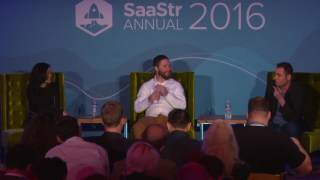
Panel discussion (moderated by Malin Yen) with Fred (CEO/founder of Rainforest) and Farlan (VP Sales) about Rainforest's journey from early struggles (Seedcamp firing, YC 2012) to 2015 growth. Key themes: iterating on hiring the right first sales rep, proving product-market fit before scaling sales, four pricing increases that raised ACV from ~$10k to ~$56k, moving up-market (closing large deals including a $250k deal that delivered ~ $750k value by offsetting headcount), building a simple sales process and outbound motion, growing the sales org from ~1 to ~12–13, and preserving company culture while scaling.
Questions this video answers
May 2012.
January 2015.
Four times.
From about $10,000 to about $56,000.
Closed a $250,000 deal (cash paid up front); reported to save that customer about $750,000 in one year by offsetting ~10–12 heads).
Chapters
Good morning. Glad everyone made it this morning after last night's party. I'm Malin Yen and I am thrilled to be here today with these two guys.
We are thrilled as well.
So I work at a company called RPX, which we founded about eight years ago and took public in 2011. Jason likes to call it patent protection as a service, but what we do is we reduce risk from patents as well as insure against patent trolls. So we have large companies from like Cisco and Google to small, little tiny startups. So I am so happy to be moderating this session and I think I asked these guys to write me an intro and I will only read parts of them, but Farlan is the VP of Sales at Rainforest. He's worked at five startups, two were acquired, one went public, and he's currently working as the VP of sales. So he's been here, he's been in mobile and SaaS and web for over 12 years. And prior to Rainforest, he was a VP of Sales at Upsight. So Fred is the CEO and founder of Rainforest. And it says here that he's Jason Lemkin's favorite founder. So outside of Rainforest, he likes more hobbies than he can afford, apparently involving high speed. So. Okay, yeah, and we'll try and save some time for questions at the end. So before we dig in, Fred. Yes, and Fred sort of inadvertently insulted me backstage with something, but I think I'm going to still be kind to him. No, it was harmless. So before, tell us real quick, what does Rainforest do?
So Rainforest is. We call it QA as a service. You could basically think of it as like an on demand QA team. And the mission of the company is to replace the QA team over the next kind of 5, 10 years. So to build world class software, you do not need to become world class at qa. That's the objective.
So in watching Fred over the past year or so, what strikes me is that from the outside, what Fred has done looks incredibly easy. Right? He graduated in 2010, which makes him like 28, and graduated in 2010 with an econ poli Sci major. Right? And then you have a couple jobs here and there and you find yourself as an intern at Seedcamp for seven months. Then he decides to leave and a month later he finds himself at YC and moves to the Bay Area, has a great product, gets funding from the Saster as well as others, finds this great VP of Sales and then ends up with. With growth like this, as well as tweets like this, I don't know if you can actually see this. Are they too small to actually read?
It's just Jason saying we're amazing.
That's basically what it basically says. Congratulations. Yeah, you actually can't read this, can you? If we had rainforest when we started echosign, I'd have 30% more hair. That would have been good. I'm also Jason's wife, by the way. So, you know. But this, right, This. I mean, how easy was that? Y Combinator, right? Oh, well, forgot about Heavybit in there. You end up with this great VP of sales, and boom. Right? Here you go. So tell us what the real story is, though.
Well, you should probably go to the next slide. So we started the company in.
May.
Of 2012, and so if you look at just 2015, it looks really amazing, right? We built the best company ever. So easy to grow.800% or whatever it was. But all of the stuff that happened. And we'll get into it. I mean, I guess that's the point of this talk. But all of the stuff that happened in 2015 was a result of the previous three years of struggle and pain. And so, for example.
But share some of that struggle and pain with us, will you?
I like how malicious you look when you ask that question. So, yeah. So, for example, I was at Seedcamp. Seedcamp is like a European accelerator. Probably some people have heard of it. And I was fired from Seedcamp, and so I didn't.
For what?
I mean, gross negligence. Probably being a horrible employee. You know, I mean, they. They should have fired me.
I see.
Good job. That they did. But, you know, like, I was fired from Seedcamp, and for most people, that would be a huge, you know, life fail. And me being the person that I am, you know, when they fired me, they were like, you're a horrible employee. Never come back. But we heard you've been working on this thing with your. With this guy Russell, and we'd like to fund you. And so me being, again, the person that I am, I was like, fuck you. Wait, I'm not allowed to swear, am I?
You know, there's a lot of that word going on upstairs.
Okay, great. I was like, fuck you guys. I was so pissed. I was so pissed that they fired me.
I was like, I can't imagine.
Yeah, well, you know me a bit now. I was like, fuck you guys. Like, I don't want your money. We're going to yc. And so I just claimed it. I just fully claimed it. I was like, we're in. We got into yc. I Don't need you. We're in, like, the better seedcamp. Love to my seed camp homies, if you're watching. So I claimed it. I claimed it. And we hadn't even applied to IC at the time. It was a complete, like, not even a half truth. It was just like a straight up lie.
And you were just, you were just angry.
I was angry. I tend to lie when I'm angry. Not true. This is so incriminating.
You channeled that anger into something positive.
Yes, exactly. That's the right way to put it, Marlon. And so, yeah, basically me claiming it like that made it my life's mission to get into yc.
Well, you better get into YC right after that.
Yeah, yeah.
Because all these people thought we were going to ICE already. So, I mean, you know, it's not necessarily an example of the adversity, but I guess another one is, you know, we got to ic. And the thing that I always tell to people who get into IC or another, like, top tier accelerator is like, when they. And I've helped a bunch of people since get in. And when they get in, I tell them, enjoy this. Like this one or two or three days after you got told you're in, this is the last time you'll be truly happy, and this is the last time you'll be truly happy until the company's done. And, like, I'm serious about that. And everyone here who's an entrepreneur or who's a founder who started something themselves knows, like the true emotional rollercoaster, right? And every hour, every day, you go from being like, I'm the bloody king of the world, this is the most amazing company ever, to being like, I'm an idiot, they should fire me. This is going to be a catastrophe. And so you're constantly going through that. And if you imagine that was like three. Three years of that until we got things started picking up in 2015.
So let's talk about that. Yeah, that's a straight line right there.
Yeah, a flat line is usually cool.
And so then you end up. So you realize that maybe you need to do something different in sales. Is that safe to say?
Yeah, that's very safe.
And so tell us how you first started. How did you start the sales process? I mean, you. You were hired as what, employee 10ish or something like that?
Six in San Francisco. 10 to 13 overall.
Yeah.
Which is really early to hire a VP of sales who seems to be doing well. But tell us about how did you learn to love sales? Because clearly during that flatline you weren't loving it and it clearly wasn't loving you.
Yeah, yeah, that's fair to say. I mean, so I think one of the, one of the Lemkinisms that we really took to heart was this idea that you should ab test your first salespeople and you should sell yourself as the founder until you get to a certain ARR number and that you shouldn't rush into hiring like a big VP of sales who's going to try and hire out this whole organization before you've even proven anything about the sales model. And so that all sounds very rational now. Like back in the, you know, back when I was going through that, it just felt like pure chaos, you know, all of the lumpiness, all of that bullshit that was me trying to be good at sales and failing essentially. And so far was actually our fourth first sales hire. We hired three first sales.
Like having four first wives.
Exactly. Yeah, it's exactly like that. And you know, and you know, those are all good people. They've gone on to have good careers after us and they had good careers before us. But, you know, that was all about learning what is the right profile for this kind of first salesperson.
So before we get to what is apparently the right wife, what made the first three not.
Well, I can give you just like an anonymized version of their profiles. The first two were ses. One was from Twilio, one was from Cisco. So, you know, guess what, Great company. Yeah. But guess what? SE is not going to build your sales organization from scratch. Right. I know this now. At the time, I didn't. And the third one.
But did you expect when you hired that first salesperson that you needed someone to build a sales organization from scratch or you just needed someone to do sales because you weren't really hitting your numbers?
Yeah, I mean, that's what I thought. I just thought this person could do it better than me because I'm a professional. So fuck it, let's try. And I did that twice. It didn't work out.
Then we went to like, wait, tell me when on this line.
So we fired off. We hired our first salesperson about at the end of Q1 of 2014. And so we fired them at the end of Q3, and then we hired another one and we fired them by the end of Q4. Well, I guess you fit three. There's three people in 2014, essentially. And the third guy was like proper enterprise SaaS. And so it was much closer. You know, it was like a Super experienced enterprise SaaS. Salesman. But he came from selling basically widgets. Right, he was the widget salesman. Hey, look at this amazing washing machine. It does X, Y and Z. And that forced the learning that Rainforest is a solution, not a widget. And so you need to hire a salesperson who has been selling solutions for the last five years of their life.
Did you view Rainforest as a solution before that?
I mean I thought it was just like blog bullshit that you say solution instead of product and it makes it more expensive. That's what I thought. But then later on I learned it's.
The actual thing and it actually kind of works. Yeah, right.
Yeah.
Okay, so the third one wasn't right. So then you have Farlan Farland. You have a lot of experience, a lot of startups, a lot of success. How did you end up working with this guy?
Last year? January 2015, I was just getting back after a 3 month mini retirement. Finished my gig at Upsight as VP Sales and wanted to just travel and it was amazing and got back and said alright, I'm ready to do the next one. And I literally talked to at least 50 to 70 companies through networks, through cold pings, through who's hot. And then I found these guys at Heavybit. We had a whole bunch of connections in common and yeah, started the conversation from there.
So what made you pick Fred and Rainforest?
So three things. Product, product and product. And it was absolutely clear when I looked at the opportunity. You had an eng first founded company with what would be me as the first business person in the company through the due diligence process. I just saw the way that they were selling and the way that they were interacting with customers. I could help right off the bat but, but more so I saw a massive market opportunity and they're selling a commoditized product, which I certainly did in analytics the three years previous and it was super fun and we had a lot of success. And then they're selling a non commoditized product and the fact of the matter is we have, we have zero comparables. We had that when I started. We basically have that now in terms of direct head to head competition. That's an awesome opportunity. And then I get to work with like crazy English founders and Fred is absolutely crazy and it's been awesome.
So that was. So you joined in.
He joined literally where the 20% growth starts.
Okay, so that's what people want to hear about. So what did you do? Like how did you drive that growth?
Next slide.
So a couple of things.
Oh look, there's a slide.
How we did it a couple of things, so I'll give you a few tracks. This is the how we did it. The first one you'll see in bold. So everybody see that? What does that say in the back of the room? Can anybody see that? Yell it out. I want audience participation. You guys paying attention? Pricing increase. We increase price four times. So we went from an ACV of 10k to an ACV ending January at 56k.
Okay, so that's easy. We should tell everyone, just raise your prices. Yeah, right. But how'd you do that and keep your customers?
We two things. We created a lot more value through the product and we went up market. Okay. So when we started and I came in there we were a lot of YC friends and family deals. And it's a very different scenario to sell this platform into a startup as it is to sell it into a mid market company where you can have a real remarkable difference on how you can impact their QA organization. And it's the difference between in a startup being their first hire for qa or offsetting 10 heads. Right. So we could talk a little bit more about that, but those were two that really affected price. And one of the main themes in terms of what we did overall, if this is helpful for VC backed founders that are in the audience is I really kept it simple. So I did two things. I came in and said we need to put a process around how we're selling deals. Before I came in, you had Fred doing an awesome job talking to customers that were inbound on hangouts and talking product. But there was no real system to take a deal from start to finish. And if anybody is a professional buyer and CTOs are, and we sell to CTOs, they know how to do a dance. They have multimillion dollar budgets. It's not their first rodeo with a vendor. And you have to have a process to take them through a proper deal cycle. Right. And then you have to mirror that in Salesforce. Now, I didn't come in and say, okay, we need these systems, we need this platform, we need to set this up to scale. I basically said let's keep it simple, let's do the bare minimum and let's put cash on the board. I started on April 8th and on April 30th we had booked whatever it was, 100k plus a new ARR and grown the rev stack 20%.
What did the team look like when you joined? What did the sales team look like?
It was me plus Fred who was an awesome sales engineer and help out wherever I could get it from, Russ. But it was me. I got on after two weeks. Fred was like, all right, you've got the inbounds run with it.
Also, from the founder's perspective on the price increase, something that I've seen with almost every founder that I know, is that we were not buyers of enterprise software in a past life. And so like the, like the most that I have ever paid for, I'm part of the pirate generation, right? So the most I ever paid for anything is like 10 bucks a month. And so to go out there and say I built this thing and I spent a year building it with my co founder and it's just some random little thing that we built in a garage in Mountain View and you should pay ten grand a month for it. I mean, that's a pretty weird thing psychologically. And so of course most people don't, right? And so I think the other side to it was like, yeah, professional sales process is super important. Understanding how to like message the value to the buyer is super important, but also just frankly having the balls to say, yeah, it's worth this much and shut up. Like either buy it or you don't buy it because that's how much it's worth. And that's something that is very, very hard to do just as a founder. And I think that's something that's really, really helpful when you get someone who's like, has a benchmark of how much people are willing to pay for enterprise software, which is obviously in our case, fun.
And you can take an objective view right when you're talking about the product. It's your baby when I'm talking about it. It's a platform that can have a remarkable difference on your business and save you literally hundreds of thousands of dollars a year. And I'll show you an example of that as we go up the chart here. So that's kind of in the beginning and you know, when I got in there, we were just doing free trials and, and free trials for the platform. It is not a self serve platform. It's an enterprise onboarding. We had to hunker down, put a roadmap together, get a CSM onboarding in place. So you're really building up value as you take customers on properly. So we had three really good months. We were really happy. We were like, wow, I can sell this. And that's all I came in to do. I didn't come in to be a VP of sales. I didn't want a big title. We didn't negotiate some big package.
We said, in fact, that wasn't your title coming in.
I said, okay, cool guys. Seems like you have something cool. I like you, you like me. You're from England, I'm from Canada. Let's see if we can sell this. And we did. And then, so cool. Everything's awesome. Then what do you do? Right? The chart starts to go like that. What do you do? Shout out, give me an answer. What do you do when you got one guy? You start to scale. What's your next move? Hire more sales. Bang, stack them in, stack em and rack them. Let's get 20 sales guys in, let's flood the market, let's jam them in, right? And it happens all the time. And I've seen it before and most times it sucks because when you bring sales guys to the table, what do they need? They need food. You have to put food on the table, right? So I hired 2 SDRs. Now, h hiring 2 SDRs in an Eng first organization is not a given. So this is where understanding the company and culture that you're in is really important. So it's like, hey, we're not going to hire two guys to do spammy marketing stuff. We're going to hire a couple of guys who are super intelligent and they were super curious and they were very experienced as SDRs and get some proper cadences together and see if we can do an experiment and get some traction in outbound. We're pinging VP sales, we're pinging VPN CTOs. And it was amazing. After a month, a month and a half, I was doing eight demos a day. Now usually when you get on an outbound demo, it's a really hard conversation. Here's how the conversation goes. Okay, I gave you the time. What do you got? But it wasn't. I would get on the phone and there would be CTOs that would say, I've never responded to a cold email in my life. But this is very timely. And part of the reason that outbound works for us is because QA is really hard. Nobody's really good at it. It's a pain in the ass. And there are two things that are absolutely certain today that are keeping CTOs up, especially as you move up market. One, websites are getting much more complex. Would you not agree? Right. Web apps are getting much more complex. Feeds in, feeds out. And also they're deploying more often. That is like a perfect storm. So it's interesting, when I got in there, I saw, wow, QA folks are allergic to this product. That is disruption and change. And B, we're riding the wave of continuous deployment. And any potential billion dollar company ask those two questions. What are you really disrupting? Is it bullshit or is it real? Right. And what wave are you riding? And so outbound has been awesome for us. Like in Q4, we had an amazing Q4. You can see the graph really go up remarkably there. I'll tell you. In December, we eclipsed our entire rev stack that we had when I started in April. Okay. And half of that was from outbound. So from starting outbound in June to July, that graph, if we didn't do it, that graph just kind of goes like that.
So to be clear, how much outbound did you do before you started, Started your outbound effort?
Zero. Great question. Zero. We had a steady drumbeat of inbound leads that I was able to convert. And then we said, we're gonna need more. So you do two things at that point, right? You can say, all right, let's hire marketing. And then our inbound SQLs are gonna go like that. But I wouldn't assume that that's not a given. Right. So I wanted to have control in the business. And I knew that if I was gonna build a repeatable machine and a predictable sales model, which is what you need and where most companies go wrong in terms of. All right, here's our FY 2016 plan. And then they just assume leads are gonna be there. I wanted to have some control in the business. So it's been a boon. It's been awesome. The second thing I'll highlight is the team. So we have SDRs that started and have grown into account executives. We had one SDR who's amazing and he was there for five months and he became an account executive in December and closed a couple hundred thousand dollars in business. That's a true story. And that's awesome to see that. That's, to me, like the juice of this graph going up into the right. I hired our first sales executive. I was lucky enough to get our number one sales exec from my previous team. And he started around September and he had lots of leads to convert.
Which one is he? No.
Yeah, right. The one with no, don't do it, don't do it.
The blue, blue vest doing that thing.
Recruiters stay away.
True. Yeah.
He wouldn't leave anyways. So the themes are sales, system increase, acv. And it's interesting, right? Like in April, we grew the RevStack 20% and closed nine deals. In December, we grew the Rev Stack 20% and closed nine deals. Right. And so that ACV going up didn't mean we had to close 30 deals in December, which we would have at the April ACV to grow that number. So. And then you can see we moved up market, we closed a $250,000 deal. That's cash paid up front and that's awesome, right? But what the really cool thing there is the value. We saved them $750,000 this year, offsetting 10 to 12 heads. Right. So we're seeing phenomenal value as we move upmarket. And it's funny, when I look at these things, I almost have to pinch myself. Those 30 outbound SQLs, those are very transferable into what those are in terms of SQL dollars, what our close rate is and what that's going to bring us in 78 days, which our average close rate. So then you can start to build that predictable machine today.
What was your average close rate before you started this process?
30 days. Ish. Yeah, 30 days back in June, July, you know, June, July, ish. 30 to 45 days. And those sales cycles get longer as you get those deal values going up. But yeah, we moved up market and we went from a sales team of 1 to 12, 13 as of Monday, next Monday. But we've done it in a methodical way. And I'd say that's the fourth point is that these graphs are really fun, but in the scheme of things, this is a spurt, right? This is a growth spurt. We're not a unicorn, we're not a rocket ship. We barely lift it off the ground. So where my head is at is building a sales team and a sales foundation that you can actually grow from thinking about 2017, 2018. You can see I pointed out there sales ops and recruiting. We hired Sarah, who is amazing to our organization in terms of keeping the trains running on time and having that infrastructure and having that onboarding and having that recruiting funnel. So we're talking about building a proper base and for folks in the audience who are in sales or looking for their next gig, whether it's sales, engineer, director, sales, whatever it is the company you're talking to, ask them what are the values in the sales culture. We have values that we've put together. We have three very defined values that are purpose driven and we have a very tight knit, collaborative, non lone wolfie team that fits into the overall culture. So that's the biggest challenge is figuring out how do you actually build a sustainable platform. Otherwise yeah, you could be like a weightlifter. Hire 20 sales folks, jam them in, pump up the number, you know, pump yourself full of steroids and then where are you a year later?
Right, so the theme of the last day of the conference is Zen learnings. So you've been through a lot, Fred. And so what is your role now with respect to sales? And also share some Zen learnings with us, please.
Wow. So. Well, I was going to say what Farm was just saying reminded me of something which is that a lot of my. So we were in YC Summer 2012 and so we had like Instacart and Coinbase and Matamark and all of these other companies that were like, Bang, 10 mil ARR, one year out the gate. We're not very close to 10 mil ARR right now, let me tell you. And the common thing not to single out any of those companies. Absolutely not. But in general, the common thing that I've seen is that once founders feel like they have a product market fit, but they're not like a sales founder, they're more like product oriented founders like me and Russell. They are like, okay, shit, now we have to bolt on sales. And they just have this like Glengarry Glen Ross thing in their mind. They're like, well, fuck it, we may as well sacrifice the culture to make lots of money. And I've seen every single time that happen, it just happens every single time where the founder is like, well, these are just salespeople, so whatever, you know, we'll just put up with it. And I think not to say that we have the answers, but something that we absolutely have not done is accept that. And so like it's reflected in file and you probably get a sense of that in him talking about the sales team. But you know, I think the culture of the company is so amazingly important and sales is part of that culture. And I know so many companies where they're like different flaws. Sales and engineering, it's like, how the fuck can you sell the product if you don't speak to the engineers at lunchtime? You know, like, how can you truly have a cohesive, coherent company when these two parts don't even speak to each other? And so I think that's probably like the one. I don't know how Zen it is, but it's the one major learning for me, which I'll definitely take to the next company, is that culture is what matters first and foremost. Because to be a great long term company, to build huge value over the long term, it's just about people. And to retain amazing people, you need great culture. And A lot of those companies from our YC cohort who are now, like, breaking out and in the unicorn stage or whatever all of the early employees have left. And why is that? It's because they sacrifice culture at the altar of revenue. And that's something that we're not interested in doing. Because I think ultimately it's a short term, short term opinion.
So I'm going to ask Farlan in a moment what his Zen learning is, but then after I ask him that, I'll open it up for questions. So if you have questions, put up your hand because someone's running around with a microphone. Farlen, any Zen learnings?
Yeah. Keep it simple and have fun. And that's what I tell the sales team every day.
Very sense.
I told I would when our first two SDRs were on. It's funny, I don't call it their names because recruiters will go after them because they're amazing. You know, we'd be sitting in a sales meeting, the three of us, and I'd say, guys, just remember, these are the good old days. Like, enjoy it, you know, and they are like, every day is just. Is awesome. Like, up and to the right, like, yay, this looks really fun. But, like, the juice for me is the sales team that I get to work with, and they're just like, super awesome. It's awesome to see them grow. It's awesome to see them learn new things, close deals. You know, that's been the juice for me and that, you know, I don't get out of bed every day and be like, yay, let's go. Attack the day. I don't. But on my way to work, you know, I'll jump up and like, click my heels certain days and be like, this is really cool. I get to go and work with an awesome team and do this. And we are not click your heels. We'll never like that.
A Canadian thing.
It's kind of. It's not Zenith, you know, we're never going to compromise that. We're just looking for awesome, curious people. We'll never have a gong. Fuck that. But, yeah, thank you.
All right, so we have time for probably a couple questions. Does anyone have questions they'd like to ask? Right there. Is there a microphone or just. Okay, thank you.
Just shout it out. Shout it out.
Yeah, you can go ahead and start, but you can hand it to everyone.
Thanks.
Okay.
Thank you so much.
So, really great talk.
And I love the things that you said.
I hope even my company sees that growth.
But here's a question.
So you came in and you increased the pricing.
Right.
Would you do that even if the product is still not ready as compared.
To the competition out there? So I'll take the question. I wouldn't hire sales if the product's not ready. Like you know what he said? He wasn't just being a facetious salesperson like product, product, product. You need the product market fit like pouring like for me a salesperson is just like fuel that you pour into that engine, you know, and the engine is like the product in the market. And so if you don't have product market fit, then adding a salesperson, you're either going to get crappy salesperson, you know, because they, great salespeople don't want to sell something that doesn't have product market fit because they don't make their commission or you're just going to do a whole bunch of unsustainable selling and then you're going to have churn. But I guess it depends how harsh you're being with yourself.
But legit, legit sales, you should, you should hire when you have something that's kind of product market fit. So one of the criteria I looked at before I joined any company was have the founders or the sales champion internally CEO, have they closed like 10 deals? I want them to feel the pain, I want them to feel viscerally the pain of what it goes through to close a deal. If you started a company and they don't know about that, she's smiling in the middle. And they've been using consultants non starter. Right. So at your stage it might be embryonic business development maybe, but I would go close them deal.
So I'm curious Fred, on that chart, when did you view the product as ready?
I mean, you know, so when we raised money from Jason, which was the end of 2014, the premise was, I mean frankly speaking, we had like two months payroll left. We weren't very good at checking our bank balance. So that was kind of a surprise to us. And you're laughing, but it's not a joke. And it's funny though. And at some point we were like, well at the moment when we looked at the bank balance we were like, oh shit, we're going to run out of money. We're not anywhere near a numbers so you know, what the fuck are we going to do? And the premise was we have amazing product market fit. There's, you know, if anyone knows qa, there's like no competition that is meaningful in the space. And our customers were very happy. And so we Were like, we think that we're good at the product stuff. We're just shit at this business stuff. And so that was the premise when we went out and raised money and, you know, I guess Jason believed it. What was the question though? Was that when did you raise?
No, you're good.
How did you raise?
Okay, sorry.
We are actually out of time, but thank you very much. This was a lot of fun. Thank you so much.
Can we get one more question? I'm on your right.
Okay, one more.
Yes, of course.
Helen says it's okay.
These things always go over.
I already had the microphone in my hand, so it felt a little bit gypped. I'm sorry.
No worries.
So it seemed like you guys use price increase increase a lot to help grow the company. And I think that it really helps your sales team when your price plans are like worth thousands of dollars. Because it's like each sale is. There's a lot more money tied up. Do you think that there's a price floor or like a minimum price plan that you have to offer to make a sales cycle work? Like that depends.
Depends who you want to work with, I think. So by tweaking price and running pricing experiments, we were self selecting who we wanted to work with. And as we took away the minimum price, there were four when I started. We just have like one price in an enterprise plan now because it's just much more simple. As we raised price, the inbounds went up market just automatically. We legitimized ourselves to, you know, not to companies 50 and under, but to 50 to 100 and then to 100 to 200. And now we're in the mid market. And so price will be also be a determinant of who will talk to you.
Yeah, but it's also, it's really true that price is like a legitimizing thing. Like when you speak to someone and you're like, hey, here's this Solution and it's 500 bucks a month. They're like, go fuck yourself. That's not a solution. That's just some little thing that you built. But if you're like, it's 10,000amonth, then miraculously they're like, oh, you're for real. Okay, I guess we have to pay it.
CTOs want to do big deals too. It's funner for them.
Great. Well, thank you guys.
Thanks.
Yeah, thank you, thank you.
More from Jason

Claudeforce vs. Replit vs. Lovable. Our Agents Pick Our Vendors Now. Who Wins?








