Nick Mehta CEO Gainsight + Jason Lemkin CEO SaaStr on "The Latest in Leveling Up Customer Success"
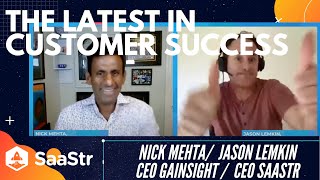
Recorded conversation (Jason M. Lemkin with Nick Mehta) about SaaS customer success and the upcoming SaaStr Annual conference. They cover Sastra Annual logistics (Sept 27–29 at the San Mateo County Fairgrounds; 5,000 attendees; outdoor, vaccinated-and-tested requirement; ~$700k in tents), the rise and power of net dollar retention (NRR) and recurring revenue, how gross retention and expansion trade off depending on company stage, pricing-model effects on churn/NRR (usage vs. subscription), and the need to invest more in post-sales (customer success, account management, product). Case studies referenced include EchoSign/Adobe (2011 sale and ARR growth) and Algolia (pricing changes to reduce churn).
Questions this video answers
September 27–29 at the San Mateo County Fairgrounds (San Mateo County).
Approximately 5,000 people.
All attendees must be vaccinated and tested.
About $700,000 worth of tents.
Sold to Adobe in 2011; approximately $10M at signing and $12M ARR when the deal closed; later cited growth to about $250M ARR (over ~9–10 years) with high NRR.
Chapters
All right.
Hello, Jason Lemkin. How you doing?
I am great, Nick. Thank. Thank you so much for having me join you. It's great to be here.
Awesome. So for. For those that don't know, Nick Mehta, CEO of Gainsight, and I'm here with my longtime friend Jason Lemkin, who needs no introduction. If you're in SaaS, I don't think you could possibly not know Jason Lemkin. But in the. For the one person that doesn't, Jason is a. One of. One of the original SaaS entrepreneurs, became an investor, started Saster, and really has helped build this amazing SaaS community, which is going to culminate in a conference coming up very shortly called, which I'm very excited about. So it's awesome to have you here. Jason, thanks so much.
Yeah, thanks. Thanks. And thanks, Nick, for being very original. Part of the Saster Annual. We were at the very first one, which we literally. I just saw on my Facebook. You know, I really only use Facebook for the memories now, but it was seven years ago today. We launched the first Astra Annual, and you were kind enough to come and be. And be a host. And it was funny. You did a panel. You did it with three entrepreneurs that were at a million in ARR. And all four of you are unicorns and Decagorns.
Wow.
So it's interesting. It was you, Tiago from Talk Desk, Nicholas from Algolia, and Daniel from Greenhouse, and all were growing well. Right. But none of them were past more than a couple million in revenue. But it's interesting going to our talk to the predictability of recurring revenue, isn't it? Because all four of you, including our Moderator Nick, in 2015, all became unicorns. Sort of. There's not a lot of luck in that. There's a lot of hard work. But four out of four is not luck, is it?
That is insane. Well, that's a great stat.
Yeah.
It's funny when you look at all the speakers in general from Saster in the early days, it's amazing where they've all gone. So let's. Let's. Let's start there. I got an icebreaker question, because first of all, give everyone the dates, the logistics for Saster Annual. What are the dates?
Yeah, it's September 27th through 29th. We are completely outdoors for the 7th annual. We're at the San Mateo County Fairgrounds, where you guys did a pulse, which was a lot of work to do outdoors. But the good news is we all know how to do this. So we're on 50 acres. We'll have 5,000 people. Everyone has to be vaccinated and tested, and everything is outdoors. So it's tough to do much more in 50 acres. So it'll be fun. We'll learn, right? I mean, doing this festival style instead of in a building will be different with tents. You know, we're building $700,000 worth of tents and there'll be weather, but it should be fun. It should. There should be probably more mentorship and more hanging out and less sitting in windowless conference rooms, but it'll be interesting.
It might make a better conference, potentially. Huh. That's interesting.
Yeah. Well, you know, I mean, here's the thing. Like the feedback loop since March of 2020, I don't know. I mean, we know what's happened in SaaS, which is 95% of SaaS companies benefited either a little bit or a lot. A handful haven't. But the IRL world, I mean, we haven't gotten back. Right. So we don't know. And not only we can talk about events, which matters for marketing and all this, but even we all became distributed companies, which take a pause for a minute. That's crazy. Yeah, it's crazy. It's crazy. I remember sitting, even our little team sitting with Amelia, who runs most of Sastra now, kept before in 2020, I kept saying, how can we be distributed? This is so lame that we drop. We can only hire SF people and we drive to San Francisco every day. No one lives in San Francisco. How could we fix this? And I remember talking with Wade from Zapier. He's like, you got to lock the doors. He's like, you got to lock the doors for two weeks. Not forever, but for two weeks and not let anyone in. Not let the CEO in. And then if you lock the door for two weeks, you'll learn. We all lock the doors for 20 months.
Yeah, right.
Not literally, but close. Right?
That is such an interesting analogy. Yeah, it's interesting because you. I actually went to my first post or not post Covid, because we're still in Covid, but in Covid, first conference this, earlier this week, it was a smaller event, but it is, you know, if you do it right, which you guys are definitely doing, it feels great. So I think folks that are watching definitely go to Sastra Annual. It's going to be awesome. I'm going to be there. Really excited. What are you most looking forward to at the event? What are you excited about?
Personally, I just want to learn what the new world will look like. I want to learn what getting together means for five. You know, it'd be 10,000 if the international wasn't blocked. That's interesting. But what will events mean? What will gatherings mean when we're all distributed and intuitively it should be more important. Right. And our limited hints, I think that we've seen recently suggest that. Right. But we don't know. It's so new that they get togethers. We're doing the lunches. Salesloft just had 500 people at their all hands meeting, all tested. Lots of folks are kind of doing these smaller things. Intuitively it seems if we're all distributed, we're all, we're all going to get together every quarter somewhere and it's going to be more impactful. Right? But I don't know. But what I do know is that things like events, which, which you and I have spent a lot of time on, they do need to be completely rebooted for a distributed world. Like completely rebooted completely. And I, and I'll be honest with you, I do not have any of the answers. But we get. This is the only B2B event with 5,000 plus people happening this year. And certainly in the Bay Area. Yes, forget maybe Vegas and Miami, but in the Bear. So we can use this as an experiment and we can all learn from it. What will the world look like? Because the only thing I don't think we're going to do because it's been so long is all go back into these windowless rooms in Moscone jammed in. In the dark. I don't think we're going back to the dark. Right. I'm not saying we're not going inside, but that paradigm is in the past.
I think we're not going back to the dark. That sounds like a song waiting to be written. I like this something.
There's something. But I think it's all got to change. It's all going to change. And I'm excited what bringing people together can mean. Right. When you were at the first sester annual 2015, it wasn't meant to be an event. It was a community gathering. We said, hey, let's get 1,000 people like the Knicks and the Layla's and let's just get together for a whole. A whole day. That was a whole. And it was jaw dropping for an entire day. Right. So long ago. So now it's time to hit the reboot button and maybe see what do 10,000 founders and executives mean. And we'll learn. We'll learn. September 27th, 29th and then we'll redo it next summer. Yeah, and we'll learn, but I know it won't be the same and I just, I'm not smart enough to know for sure. But we'll, we'll learn.
Well, kudos to you for being the brave first, first pioneer. We're going to all learn together from you than you. And you know, one thing, one thing we'll definitely be talking about there, because I'll be there, is customer success. I can't not talk about it. Jason very kind enough to give me a session and actually he inspired the the title of the session, which is going to be about what's changing in customer success and why you should change too. Because the truth is it is evolving. Right. You think Back to like 2013, 2014, 2015 and you know, what customer success was then and what we think about it now. So I'd love to hear a little bit, maybe just give people some of the history. You are not. This isn't your first rodeo in terms of thinking about customer success. You've been writing about it and Churn and all that from the beginning. So like why did it matter to you early on in sast or why were you thinking about then and then maybe how's it changing over time?
I mean, if you want to go, you know, we've been doing. I've been writing SaaS content for nine years. It's crazy, right? Since 2012. And you're right, some of the stuff and we did a lot with gainsight, maybe 30% of the original content, which now is table stakes. But second order revenue and champion change, people would read this and their jaws would drop. You're like, wow, you're right. Like this does the second order revenue really does happen and champions go to other companies and how things scale and how NRR works. But there wasn't enough. We knew these but there wasn't enough time to see it in practice. Right. Because it takes years to see the impact ndr, NRR Churn and CS takes years. Right. But my personal passion was, you know, very specific to me, which is after selling what's now Adobe Sign, Echo Sign to Adobe, some things went well after the exhibition, but some things did not go well. It was a big company and a small acquisition and what I saw quickly and it was sad in a way, but like certain things couldn't be killed. You could not kill reasonably happy large customers. Okay, the free edition was ripped out. Terrible decision. Other features were ripped out the day I left, but the big ones that the ones that were 150, 250, even a couple approaching a million ACV that were reasonably happy. Not only did they renew, which we used to worry about, but they would grow somehow. You would think, hey, there can't be another seat left at some big insurer or cable company. And yet next year, somehow there's 20 more seats. 20% more seats. And I didn't get it until I had the. And then I realized, my God, like you could get to from 10 to 100 million in revenue. Now this is somewhat obvious. I realized when I had presence of mind, you get to 10 to 100 with almost no sales team. Not quickly. Not quickly.
If you have big customers. And it's sticky. Totally.
And high nrr. And high nrr. So I just started writing that because no one got it. No one actually even understood the power of recurring revenue, I don't think till 2017.
No, I agree.
And you know, in 2015, Aaron Levy came one week after the IPO box, which very early in this way, I was there.
Totally. I remember there.
And I asked Aaron of the folks on Wall street, how many that you pitch understood. Recurring revenue is like a few. A few, Right. And now every prospectus that you read today, you know what the headline metric is? Nrr, ndr, right there. Every single company, it's their. It's their headline metric. Right.
It's so interesting because I think what recurring revenues like a lot of things in life where I don't think people get it till they experience it. Like you talked about the second order revenue and all that. It's like when you experience your business like slow down because turns a headwind or speed up because of nrr. When you experience your renewal base being bigger than your new business, all the things that you've seen over and over, that's when you feel it, right? I think I feel like there's a lot of CEOs who have felt it now firsthand, not just read about it, you know.
Yeah. Let me give you a crazy statistic if you want to go back in time a little bit. So we sold EquuSign Adobe Sign to Adobe in 2011. 2011, it was 10 million at the time we signed the deal. It was 12 million AR when it closed and we had 28% market share. Okay. Today I'm guessing it's less than half that 13%, but okay, so that's a lot of. That's a lot of. That's a tough drop, but it's 250 million of ARR. So think what 9 years does or 10 years does. So even if you lost mark, you don't even have to gain market share if you have 120% NRR. That 120% R carried a $10 million business to 250 million. Even with market share loss. Right. This means you can like build, you know that would be at least a ten or billion dollar company today on its own. Right. And that's with a market share loss but with high nrr. Right, with high nrr. And so it's, it's beyond powerful and it's, it's why we, you know I continue with the startups I work at now. I, you know, I continue the best advice is invest more in post sales. Not even we can talk about customer success but really I think the next frontier is post sales. Customer marketing, customer success, account management, it doesn't matter. We're all under investing after the deal closes. Right.
Well let's talk about how you measure that, the advice you give people. So one of the questions is always okay, do I focus on churn and the kind of leaky bucket, the loss side of it when or net retention overall which I get expansion. But sometimes net retention can hide a little bit of a churn issue. How do you talk about that at the board level?
Well, I mean I could ask you the same question but I will tell you the more tactical thing I've learned about this. Okay, so your question is where should you focus on NRR or churn or like this, this trade off. I tell you what I've learned and it's true. And it's also true in sales which we counted because they're related. You got the generals, you got. Okay. And I would say in CS there's roughly two types of folks. There's the CS professionals have a little bit of the salesman person in them or a little bit of the fail to. And they love to hunt and they love to schmooze at the customer event and fly that customers on the helicopters and get the upsell. And they love being part of the sales team but not having to do sales. Right. They love an NRR number. You say to them, listen Linda Bobnick, your job is to go from 110 to 120 NRR. Okay. That's your job this year. When you hit that you're going to get a 50k bonus or you're going to get 5% of the upside. That works. Okay. There's another Persona where they just, all they like to do is worry about the customer and make them happy. They hate sales. They think sales is yucky. They don't like these numbers. And if you give them an NR number, they'll do it. But they'll melt. Yes, they'll melt. Right. It doesn't work. And it doesn't work as a KPI and it doesn't work for variable comp either. It just doesn't work. They don't internalize it and they feel uncomfortable. That's not why they're not in sales. That's why they're in post sales. So we could talk about the pros and cons, but it's your, it's, it's your general. Right. And the same thing in sales. Like should sales, should sales own customer success? I'm against that. Should sales own this or that? But your general. Like, some sales folks just want to close. Some want to get more into the life cycle of the customer because they see the upsell. But you can't change a general too much. Right. They already learned their playbook in the last war.
I love that. That's such a good, good leadership lesson in general. And I'll kind of tie it to what I think about this trend versus not retention, which is, I think what ends up happening in a company's history is there's different periods where there's more to be gained on focusing on reducing loss versus increasing gain and other times where it's more about. Yeah, it's about growth.
Right.
And so it depends on where you are. So for example, you're a SaaS company, you're 20 million of AR, you're selling to Enterprise and your retention is 78% gross. Work on your retention. Right? Like. Yeah, right. But if you're a SaaS company and you're selling to SMB and your retention is. Gross retention is 90%, 92%. Work on expansion.
Right.
Like you, you can't get that much better. So where are you in that efficient frontier?
Right. Yeah.
And I would say work on gross churn for a while and at some point then you've got good at that. Now you get the general who can do the expansion. I agree with you, by the way. Often it's a different person. Sometimes the person can change, but for the most part it might be a different person to take you into that growth phase. The worst thing you can do though is have the wrong playbook for where, where you're at. For example, you have a 77% gross retention and you're selling to big companies and, and you're focused on, you have A the sales oriented general trying to expand some of those customers but missing that like most of your customers just bleeding out.
Right.
That's bad. Right. And the same way you've got this super sticky business and you can't really increase retention anymore. You got to expand, but you've got this protector type person, doesn't want to talk about sales at all. Meanwhile R and D shipping new modules and wondering why is nobody buying them? Right. So you really need the right, like you said, the right general for the right battle.
I think the one thing, and I'll give one comment just to add on to you, but let me add the one thing we've learned the last couple of years on this, this, this turn versus nr. The one thing I would add is now that there's so many public SaaS, companies, you know, 130, however you define it, you got to be top quartile.
Yes.
What I mean is we can go, there's blog posts are on SaaS or all over it, figure out what your comp is. Are you like squarespace? Are you like datadog? Are you like whoever? It doesn't matter if your churn and all that is in the zone of theirs. Focus on nrr, right?
Yeah.
If your churn is below the comps and sometimes it's okay because you have time. Some of these companies did not have the wonderful churn they had before the S1. Right. You know, the HubSpot, even the HubSpot in the Shopify took a while to get to 100%. Right. But if you're not there, get there because it's the number one thing you can do. Focus, engineering and time. And what I've learned is when you do that, what happens is. And I'll give you engineering gets involved.
Yes.
Okay, so the question is, does engineering get involved? And when you say, guys, look, our comp is Zendesk. Zendesk has hit 120% NRR. Now let's slice it for the SMBs. It's 105. Okay. How are we gonna get to 105 and I. And instead of it being something that support does or you layer on top of gainsight, it's like now I get, I get three of my best engineers.
Totally.
That's when magic happens. But you have to have these comps to align the company and then all of a sudden you do that, right. You figure it out with best of breed engineering and so figure out if you're in the top quartile and take action. And then related to that, I think what we didn't intuitively know until there's more. So these companies went public and we could see what happened from 100 million to 1 billion ARR is it's key for the vast majority of not all, but the vast majority of SaaS companies is you need a second product to drive up nrr. Okay. Box is one of the. Actually old. Old box is one of the most dramatic examples. Their NRR varies from 90 to 130 depending on how many modules and products you use. That's a big variance at Box. We see it with Datadog. We see it all across the board. And this is kind of the next frontier, especially with SMBs. When you talk about SMBs, what I've seen, both public but also private, is the way you get above 100% NRR with SMBs is multiple products. Look@bill.com, look at folks like that. Right? And that's the key. And so we got to think about this thoughtfully, but earlier than we used to is that's the way we drive it all up. Right. It's not all zooms and steak dinners. It's multiple products adding exponentially more value for the customer. Right?
Yeah, that's so right. And it's interesting because that's when people talk about who owns nrr. Sure, the customer success team is part of it for sure, but the product team and building new products is a bit like you said, a big part of it. And then sales being able to sell those products. And I think that a lot of companies get stuck where they are, a one trick pony. And you know, that gets you so far, maybe gets you to 20 or 50 or 100 million of AR, but you've got to find a way to have a portfolio. I also find, I don't know what you've seen, Jason, that it also helps your gross retention because you got multiple products in there, you're just more sticky, you know, you're just like you're. Unless the customer is less likely to abandon you altogether, you know?
Yeah, I mean it is for, for, I think at least for CEOs, you gotta, you gotta monitor your gross retention carefully. Right. And it's interesting, I did, you know, I caught up. You know, one of my early investments was Salesloft too. Right. I mean pre revenue. And when they crossed 100 million, Kyle, and you might have heard the same thing, the number one thing Kyle was getting from Wall street is what's your grr? Your NRR is great, we get it, but we don't care. Right. Because you're in the zone, right? You have enough bigger customers. What's your grr. What what, what? How well are you keeping these gross customers and how are you bringing in new customers so that you're not masking, you're not masking a tried to growth. Right. With higher nrr. Right. And that is just, I don't know, I don't know how many KPIs a startup can handle. I think if you get, if you make everyone responsible for, for gross retention and net retention, they're going to bang their heads on the table. You got to pick a CEO like what's more important? And it's got to be net retention, right? You have to pick, it has to be right. Yeah.
I also think that there's something of like what's the long term metric? And then you can still have. For this year we're going to focus on X. But what's the long term thing we're focused on? One related point on that is you talked about obviously part of net retention and gross retention is you know, customer experience, customer success. Part of it's how many products you have and if you're cross selling them. Another part though is the pricing model.
Right.
And so you know, some pricing models are usage based pricing and they sort of naturally have this organic growth because your customers use more. Twilio being the ultimate example of that. And some of them are like you sell everything up front, a whole bunch of licenses and maybe there's a little bit of growth. So how do you think about pricing models fitting into net retention and what's changing about pricing models?
I think the first where I saw this in practice, I'll give you a case study. So that first panel you were on in 2015 was with Algolia Search as a Service API developer. Focused. Right. But focus with multiple stakeholders, with marketers and other people buying and they just crossed 100 million accelerating. Okay. And about 60% growth. And they, Bernadette came in as the new CEO and they did an incredible job before but she, she had a fresh sheet, she had a fresh perspective and learned a couple things from her. One, one tactical and one strategic on this. Right. First she went and talked to Wall street, you know, years out from IPO but to get ready at 100 plus and said what do you think? How much of our revenue needs to be subscription versus per. Per. Per usage? You know, they said all we care is that your NRR is north of 130.
Yeah, that's interesting.
We don't care where it comes from. And this is the change from. It's not just Twilio, it's fintech. It's everything.
Yeah.
Doesn't error. For better or worse. For old timers like us, there's no R in the middle of ARR anymore annual revenue. The R is fake. Right. And that still drives us nuts. Right. But it's true because we're all. Look@bill.com the majority of Bill.com's revenue is no longer from software. Same with Shopify. The majority of these companies are fintech software hybrids. And. But what's key is that the blended revenue, you know, bill.com has gone from 110 to almost 130 since IPO. That's pretty fast. By having multiple products, but it's less of its software. So that was a learning. And then what Bernadette did at Algoli, which was interesting, they had spent years debating as a developer focused company whether to go all in on usage based.
Right.
And they'd done the opposite. We were a bit old school. It was usage based. But then you'd hit these tiers and you'd have to come in and see us and sales would have to come in and kind of upsell you to the tiers. And what they saw in the data was even though the overall NR was good, the churn was very high at these tiers. Very high. It was a natural point where not only did the pricing go up, but it created friction. Right.
So the customer say they want to just do something different then. Yeah, that's interesting.
Nick saw it for years and they debated it internally. But the data also said to be risky, to change.
Yes. Right.
And so Bernadette, it's just interesting because they're both great. Bernadette came in and said, look, I'm new here. I'll take the, I'll take the arrow in the back. We are abandoning these random tiers. We're going to go more developer centric. And they're basically gone. And there was no downside. No downside. Right. So I think we're all moving to pricing that is more customer centric. Right. Every customer we have buys over 100 SaaS apps. They've demoed over a thousand SaaS apps. And the person, you know, maybe this isn't the question you're asking, but you have to give the pricing model the customer wants, but just make sure it's easy and that you have that top quartile nrr, even if it's not really.
Yeah, yeah, exactly. That revenue, there's no recurring in that. So, yeah, I like that.
I mean that recurs as a corpus. Right. But it doesn't. The contract doesn't always recur. Right.
Recurring is really a state of mind. It's not a mind, it's a. So, okay, so you also get to meet lots of like little new baby companies, you know, like the Algoli and Gainsight were back in 2015. What do you see that's different about the way they talk about CS and stuff like that when they're starting than way back when we were little companies? What's, what's different about early stage companies?
You know, it's a good question I was thinking about. I would ask you. I. The main thing, I don't, I don't. I think only two things have really changed that I can think about. I'm sure there's more than I'm thinking. First of all is hyper awareness early on of how critical CS is. Right. I hired CS very early, but I, back in the day I wasn't really sure what it did other than make my big customers happy. Right.
Yeah.
My view of CS or in the early days when you got started Gainsight is it was an evolution of you got to make your big accounts happy. We've always had account managers, right. And now they need tools and now we understand there's nrr. That was the difference. So we have account managers, we have nrr, now we have CS which needs tools and systems. But everyone gets that and everyone. The instrumentation that I see early stage is shocking. The data, the metrics, their insight, their cohort. I still don't even know how to do a cohort analysis myself. Their ability to do that in year one to segment Churn by category. Right. They get it and that's the biggest benefit. The other challenges I just think is, you know, recruiting's tough and everything. Right. So the biggest downside I see versus the old days is folks stick with to junior A team for too long.
Yes, totally. You talk about this all the time.
Junior team for too long. And so it's so true.
I see it all the time. You know, I know we're almost up on time. I'll. I'll do a close out word association just to get you out on time and everyone watching as well. I always like to do these. So first thing that comes to your mind when I see these words, Churn.
Fix it. Fixable. Fixable.
Very much. NDR Net dollar Attention.
Magic.
Magic. Yeah. It is like magic when it works. I'm throwing in a new one here, by the way, just listening to us talk product led growth. We didn't talk about a lot, but obviously it's a hot word. What comes to mind when you hear product led growth?
Is it real?
Is it real? Interesting because it is a little bit of pixie dust right now. We'll get to learn more about that at Saster Annual Customer success.
Not enough.
Not enough. People aren't doing enough. Not investing enough in post sales. I heard that. Saster annual last one. What's the thing we should think about with Saster annual?
Have fun. You deserve it. Yeah.
What a great way to close out. Have fun. You deserve it. By the way, Jason, I hope you get to have fun there. You deserve it too. And I mean that. Everyone in the SAS community, thanks so much for everything you do, man. Love seeing you as always and I will see you in two weeks.
All right, man. Thanks for all the time. We'll talk to you soon.
Bye. It.










