Playbook to Scaling Effective Internal Communication in a Hybrid Workplace | Guru VPM + Asana COO
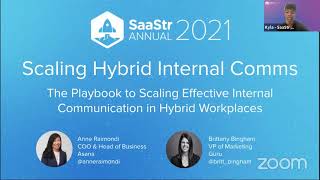
Panel discussion (SaastA Annual 2021) where Ann (Asana COO) and Brittany (Guru VP Marketing) explore scaling internal communications for hybrid work. They frame the problem (increased channels/noise, inequitable access, digital overload) and present three actionable reminders: 1) Tie individual work communications to company mission and customer impact (citing an IDC finding that clarity about who is doing what by when correlates with higher speed and +72% employee satisfaction); 2) Intentionally recreate 'missed moments'—praise, informal feedback, and inclusion practices to counter imposter syndrome and loss of nonverbal cues; 3) Be deliberate about cadence and channel: default to asynchronous work where possible, use synchronous meetings only when uniquely needed, and set channel SLAs/expectations. They close with examples (Asana 'Ask Me Anything' project, using video cameos for celebrations) and offer to share deeper frameworks/resources asynchronously.
Chapters
Awesome.
Fun to see people joining.
Welcome.
Absolutely. We'll go ahead and kick things off. Welcome to Saasta Annual 2021, everyone. We are thrilled to have Ann and Brittany, Anna's COO and head of business at Asana and Brittany is VP of Marketing at Guru. Today they will be discussing scaling hybrid internal communications. There is room for Q and A at the end, so you can drop your questions into the Q and A feature throughout the session and we will address those. Join me in welcoming Ann and Brittany. Thank you, ladies.
Thank you.
Awesome. Thanks. So happy to be here. Good morning, good afternoon, whatever time it may be for you. I'm super excited to be here with the absolutely incredible Anne. We're going to spend some time discussing the nuances and the complexities of internal comms in this world of remote in office hybrid work. And really, I think the thing that's exciting for us is that it's really going to be a discussion. We're looking at the potential blind spots in a hybrid environment. Before we jump in, I want to hand it over to Ann and she can do a brief introduction. I know she already got kicked off here, but I also want to understand what makes this a really exciting topic for you or a particularly relevant topic for you to talk on today.
Yeah, thanks, Britt. When you reached out and said, hey, this is the topic, I was like, oh my God, I can't wait to talk about it. Because I am literally four weeks into a new role here at Asana and we are all still distributed in different forms of hybrid or all remote. Just given we're a global company and depending on the situation with each of the offices, we've been erring on the side like so many companies on just making sure employees are taken care of and are healthy and have the flexibility during these times. So joining in this kind of situation, as you can imagine, also as a new leader, internal communications is a huge part of, well, one me diving in and getting to meet everybody and understanding what our priorities are, but also trying to navigate doing that in a very kind of mixed mode. So. So it's been really top of mind for me and I know it's been ongoing top of mind for so many leaders over the last year and a half. So excited to dive in with you to talk specifically about things that we're learning and seeing are working and give people tips that they can take away today and use.
I love that and I feel like I have a very similar story, just flashback about a year ago and so I'm super excited to Hear your fresh perspective on what it's been, you know, onboarding in this hybrid work environment as well. So let's get started unpacking it. We plan to highlight three key reminders that help us be aware of potential blind spots in communication with the hybrid workforce. But prior to doing so, we thought it might be helpful to quickly frame the problem that we're facing today. And I don't think any of this will be a shocker to any of you all, but I think it's really important that we talk through it a bit. So we know that the overnight transition to distributed work was tough. Everyone here is like, thank you so much Brit. That's new information. We have never heard that before. But I think it's fair to say that the move towards a more sustained hybrid workforce could actually be even harder. We have to face inequitable communication channels. So think some people are in office and other people can't be. And so how do we manage for that? And then in addition to that, we're operating in a world where there's way more noise and way less signal. So this idea of digital overload is very real and it's climbing. On the left hand side here, what you're actually seeing is a 2021 Work Trend Index that was conducted by Microso purple section. The top is meeting minutes per person and the bottom is chats per person. And really that starting point on the far left is the beginning of the shelter in place or the pandemic. And what we've seen is that there's just this growing kind of increase in both of those buckets, save for the holidays, that's leading to much more noise for employees all over. This also results in a world of ever growing surplus of information and communication delivered and only some of that can actually be consumed. But I think the more component of this is that only a portion of it is actually understood, retained or used. And the overhead required to actually access that information that's really helpful to you becomes even harder because it's neither timely nor potentially available to you when you need it. And so net net is that it's all hurting employee engagement a lot. Forrester actually notes that the lack of access to task critical information is the top reason that employees burn out. But I think it's also really important to note that it's not all doom and gloom. And we know that the shift actually comes with a ton of opportunity. So in July of this year we actually teamed up with Loom and the folks at Deep Analysis to pulse check the Impact of hybrid work on 500 plus software professionals. And I think we all went into it thinking that everyone would say quite the contrary to this, but working from home did not actually have a negative impact on productivity or working relationships. Actually, far from it full 48% of those surveyed told us that compared to working in office, working from home actually improved their working relationships, and almost 51% that they encountered fewer distractions while working from home than working in the office. So it actually increased productivity for some. And in the same study, respondents also said that they would be 58% more productive if their tech stack were improved. And so we know that there's critical technical investments and processes that you can make to help make it a more productive environment, whether it be like unification of tech stacks or deployment of communication and workflow tools, kind of all those things. And both Ann and I actually have worked on material or companies have actually published material that helped you that we can actually share with you asynchronously. We'll talk about that a little bit today that can give you some tactical tips to improve it. But we thought the more valuable point of the discussion today is to focus on the blind spots, the idea that even with the best tools, if it doesn't resonate with the team, it's not going to scale. And so beckons the question, what gets lost, risked, overlooked in this environment and how might you mitigate that risk? And so we boiled it down to three kind of major tips and I'll hand it over to Ann to kick us off with the first one.
Yeah. So Britt, you highlight so many important things, which is there's been more communication than ever, which in some ways we had to. Right. Because we didn't have those kind of casual conversations in the office anymore. And so everyone skewed towards sort of more communication across more channels. But the issue really that employees are facing and we're all experiencing, right, is all communication isn't created equal. And so some things that are really important for us to remember is some of the most important communication for employees during this time of hybrid or remote or a mix is how their work connects to the purpose of the company and your mission. And in our hurry to communicate, sometimes we miss this very, very important connection, which is are you communicating how work is impacting your end customers? Are you highlighting where employees projects are actually delivering for the business? And just more stories about customer success I think is both more engaging and more inspir. At Assan, I've recently partnered with IDC to do a study on Especially around, like you mentioned something from Forrester. Right. Which is, like, people struggle to find that information around the tasks at hand or the projects at hand. And I think there's also a bigger picture of not only that, like, information related to what they're supposed to be doing, but more importantly, how that connects to the company's mission, purpose, goals. So in our study with idc, what we found is when people have that information of, like, who's doing what by when and why, they're that much faster in executing their particular projects. There's 72% higher employee satisfaction, which we all need more of right now. And so, again, making sure that in every communication, you're tying, hey, what are you doing? To why it matters, but would love to hear, especially around the information. You all have done so much. I grew around having employees really know what information matters and what's accurate.
Yeah, yeah. And when you're talking about this idea of tying it to customer stories, I immediately index high on our value that every role is customer facing. And I think we really live and breathe that. And it's even showcased by taking quick chorus clips and actually sharing those out on an ongoing basis of statements shared from our customers and ensuring that we're delivering information in a really timely manner and surfacing it that allows our end employees to actually consume it at any time that's best for them, but allows them to stay close to the information that matters. So I love this. This one is near and dear to my heart.
Awesome. Yeah. And then our second point is also kind of being really thoughtful about the missed, what Britt and I call it kind of the missed moments of communications and internal communications. Recently, as I was diving in with employees and all, again, all primarily via Zoom these days, I just asked in one of our conversations, it was particularly focused on the topic of many people joining during the pandemic have actually felt imposter syndrome more acutely than at any other time because of these missed moments of connection to colleagues. Feeling like, hey, I'm, you know, is what I'm doing matter? Am I doing a good job? And so something to call out here is all those things that, you know, even in a meeting when you're in person, right. You can read the room and you can see like, oh, is my point landing? Or I can kind of make eye contact with someone who maybe has been quiet and invite them to participate. Those are all harder online. And so that means that we have to, we need to go out of our way and make sure we're having those moments of sharing appreciation, noticing who's talking who's not and inviting them in and sharing positive feedback. People are missing those. Like after a meeting, you're walking in the hallway and you're like, that was great. I really liked what you did. We just click off right the meeting now and like you don't get those few minutes. So really making sure you're intentionally putting those in. But Britt, I would love to hear any kind of insights and thoughts and things that you're doing around this as well.
Yeah, yeah. I immediately go to this idea that those really critical, nonverbal pieces of communication are missed. I think even just a very simple example of it is the idea that you get these affirmations by way of not actually words or phrases, but like, yep. That you know that you're bringing the group along. And in a team of. Or zoom of any more than three to four people tend to be. Be muted at all times because they don't want any background noise or any sort of their environment to come into these meetings. And so as a byproduct, I might be sitting over here actually kind of guessing along with you, but unless you're staring straight at my screen when we have our screen shared, it's hard to see the people. You're not actually going to get that. And so I've always like set the standard that I want to be very intentional about making sure that I'm unmuting myself just to say thanks or unmuting myself just to agree with something or dissent if that's the case as well. And that's really something that can help the speaker feel like they're being encouraged and making progress in the conversation and getting reaction. And then I also make sure that I do things like react to it via some of the reactions that you have in zoom. That's something that we do really well at. Guru is using the chat and the reactions to really follow along in the conversation and then also sharing public feedback in many of our public channels as well. It doesn't necessarily need to be one to one, but it can be in some of the larger groups too. And all of that really kind of brings you back to this feeling of like the shared enthusiasm around the conversation that you just had. Anything else that you try out, Ann?
I think it's also just making sure you're sharing praise. You know, people need that more than ever. Like the things if you, if you can't catch it during the meeting or in chat, it's just making sure you've got time in Your calendar every week where you just go through and like, what were some great things that happened across your team that you really want to just make sure people know?
I love that.
Cool.
And then the last recommendation that we have today is really about being intentional about the cadence and the utility of your internal comm strategy. And so there's this intersection of when you do something or why you do it or where you do it. And the overnight necessity for distributed work led us to build processes and systems for remote communication. But Ann, I think you said it best when we were actually chatting through this session in advance. We all lost control of creating flow and structure in our day with that because essentially other people now dictate when you need to tackle a task or when you need to be able to access information because you're working in a way that requires a ton of synchronous conversation. We also know that people are working in different time zones on different schedules. And there's this dreaded feeling of waking up and already being behind that is like the hardest thing to navigate when you're working in a different and later time zone than some of your peers. So we're obviously aware of the synchronous. So like all the live in real time, think zoom as we're here today, as well as chats, but there's also asynchronous mediums of work where and many people have defaulted to synchronous work, which actually trains team members. And so I'd encourage us to say how do we shift our thinking to default to asynchronous? Then you synchronous intentionally. So ask these questions like what are meetings distinctly and uniquely suited to achieve and how do we make each attendee of those meetings feel as though they've contributed or learned or collaborated or benefited from actually being live in that meeting and what could actually of that have been consumed or reviewed or actually contributed to, collaborated on asynchronously prior at a separate time. And then finally, like one of the harder things that we have to lean into is if we are shifting to this idea of asynchronous work, so work from any time and anywhere with the same shared information. How do we hold our team members accountable for actually consuming that information? Because really this idea of like flexibility, it's no longer a nice to have, it's a must have for a high performing team when we're all working everywhere. And the idea of asynchronous work by default enables that. So give the team permission to create flow and structure in their day and own the time in their day. And so the idea that meetings or the absence of meetings can actually add value to them as well. So I get really charged up about this, as you can tell, but it's super important for us to feel like we can actually build our day in a way that's really helpful and productive for us. Anything else that you have to share on that, Anne?
Love that point. I want to make sure we have time to answer a couple questions. So the only thing I'll add to that is, like, give people permission to evaluate, Evaluate and reflect on what's working and what's not and make changes. That's sort of the best way to make sure you're being intentional and design flow into your day, into your week. Great. It looks like we've got some questions.
Yeah. Awesome. And then I have fun questions for you too, if we don't fill our time with the audience questions. Okay, Anne, we'll start with this one. For internal comms. How do you Decide between email vs Slack vs Zoom? Any tips there? And then also I'll combine this one with how do you think about asynchronous versus asynchronous? Like, how do you make the decision when you choose between those two?
Yeah, those are great questions. We actually do all our. Not surprisingly, we do all our internal comms at Asana. On Asana. Part of it, yeah, part of it is not wanting things to get lost. Right. And then also being able to see people's reactions related to that announcement or that message. And so I would just say of the different, you know, there are so many different channels, but part of it is like, you know, who's the message for? What do you want them to get out of it? How important is seeing feedback related to that piece of content and then picking the forum as well as ahead of time telling people, hey, this is where you can find what, when, and why we're using the particular channel that goes a long way so that people aren't like, oh, did I miss something? Or why is it here? What do I have to check? If they just know on a weekly basis, this is the kind of message. This is where you find it. This is the feedback we want. It just reduces that cognitive load.
Yeah, I think setting the SLA for each channel is super important as well. Even things like with our slacks, really? Unless, you know, otherwise, people feel like slack has to be real time. Like, if I have 100 slacks, I need to go through and answer 100. And so the idea that you can actually Add a demarcation on it that says, I need a response in three days or something to that effect. Just really setting that expectation for the team is so, so valuable and so helpful. Okay, we're running up against time, and can I ask you.
Yeah. There was a great question around communication frameworks, so why don't we find a way to share those out? Because I think we both have, like, content and frameworks that go in depth. So, Alex, thanks for asking that question. We'll work with the Saster host to find the best way to post some of these. So you've got them.
Yeah. Awesome. Okay. Well, Ann, can I sneak the last one in here?
Sure.
What's something creative that you're doing or trying out to make you feel connected in this hybrid workspace?
Well, as a new member of the Asana team and wanting to have a chance to, like, get to know everybody and for people to get to know me, we created a project in Asana and Rift on. Well, it was based on a wonderful suggestion by an employee at Asana, but we riffed on the Ask Me Anything theme. And I have a project at Asana called Ask Me Anything. So anybody can ask a question and I answer them Async. And it's been so fun to see what's on people's minds and just be able to have these conversations. How about you? What's something fun that you've been doing during these times for your team?
I love it. I know we're close on time. The very short version is I find ways to kind of get creative in doing things that we would have historically done in person. So, for instance, I actually promoted one of my employees by way of a cameo video because he's got a celebrity doppelganger that has been a running joke. And I thought, no better way to have a very tenured and excellent employee know that he's going to be promoted other than from his celebrity lookalike. So we get creative here, right? We try to keep it fun and personal.
All right, I need to find some. I need to find some famous people on Cameo to deliver messages. Now, that's my takeaway from this.
Yep. Yeah. If you heard nothing else, you heard it here. Awesome. Well, thank you so much, Ann.
Thanks, Britt. So fun. And thank you everybody for joining. We really appreciate it.










