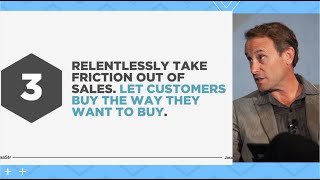
Jason M. Lemkin advises startups to remove friction in the sales process to accelerate growth from $1M to $10M ARR. Core recommendations: let customers buy the way they prefer (free trials, pilots, utility or flexible pricing, downgrades), empower founders to remove obstacles in sales calls, and prioritize making buying easier than deploying. He supports these with examples (Okta app counts, Twilio/SendGrid/Mailchimp/Stripe utility pricing) and argues pilots often convert at high rates (many report 80–90% when onboarding is good).
Chapters
You have to take friction out of your sales process to go faster from 1 to 10. Okay? There's so many vendors out there, there's so many products, why are they gonna buy from you later? Maybe at some point between 20 and 100 million, you will go through a phase transition. At some point in your life, leads will no longer be precious. Believe it or not, you will hit a point in life when you have too many leads to count. Okay. And when you hit that moment in time, your sales team and the rest of your team, it will be about what's the most revenue I can get out of a corpus of 10,000, 5,000, 1,000. But I don't think there's many people in this room that wouldn't like more leads each month everyone wants more leads. 10, I want 20, 100. I want 150, 200. They're friggin precious in the early days, right? And what can you do to take advantage of this? Let people buy the way they want to buy. And this was something from Okta. In enterprises, the average Okta enterprise Customer has used deployed 163 SaaS apps. This is what Okta says, who has the best data for SMBs? Maybe it's 70 to 80, depending on your data source. Your customers have already bought 100 B2B apps. They know what you should cost. They know what they think the value is. They know whether they want a free trial, they know whether they want to pilot. Just do it the way they want to do it. If I've bought 163 SaaS apps and I paid $20,000 for an app that looks and feels like it provides the same value as you. Just charge me $18,000, it'll be a good deal. Charge me 40,000. It's too much. But customers are smart. So think about what you would want to do if you're buying an app today. Like for example, when Slack. Many developer tools do this, but Slack still today, except for as big as accounts, auto downgrades. How many of you liked a downgrade? Nobody. I mean, it's so hard to close a customer for $100 a month, $500 a month, $800 a month. But imagine if you bought an app. You knew you weren't going to get ripped off. You knew that if you only used half the seats, your bill would go down. Would you stay with that vendor longer? Of course you would. We bought this 20 year old piece of software at Saster. I won't name it, it's for event management. It's over 20 years old. It's owned by Vista. I won't name it. Someone without telling me signed a two year contract and we never used the product. We never once used it. Now we might use it again, but someone from their back end department is yelling at us and said they're going to sue us for $30,000 if we don't pay them for year two. Yes, Vista, which is I don't know how many billions of revenue managed. There's some small chance they're going to lose 30,000 next year. But they've alienated me forever. I'm too smart. I bought too many apps. Don't do this. Let people downgrade. Another one that like beware of the Internet utility pricing. Like people think all your revenue has to be recurring like 100%. Well, Twilio's doing pretty good. I don't know if you've seen they just crossed a billion in recurring revenue growing 80%. They are growing probably faster than most of people in this room at $1 billion. They just passed it last week. Twilio, unless you're one of their largest customers, you can pay less the next month. You can pay per minute. Most of their services have variable pricing. They bought SendGrid for 3 billion. You know what? True with SendGrid and Mailchimp that just spoke, you can pay less the next month. Right? They all have floors. I mean mailchimp has a floor for some customers. But if Your customer in 2019 has already bought Twilio or Mailchimp or SendGrid and they like or stripe, Stripe's done pretty good. They're 20 billion adyen. It's all utility pricing. Let them buy the way they want to buy. Some products are perfect for a flat rate each month. Some products that are miraculous that way. But others are utility pricing. Do not listen to VCs and other folks that tell you that every dollar has to be recurring. It doesn't. The fourth one, and this one is people that have been doing SaaS for more than five years, especially salespeople will hate me when I say this one. But listen to me as founders. Pilots are great. Pilots are great. You know why salespeople hate pilots? Because they gotta sell twice. With a pilot, you work so hard, the lead comes in, you do 10 demos, you do the qualification call, you sell to four different people in power, you close the deal and then the pilot 60 days and then they're like, well, I don't know, I have to sell it again. That's like a salesperson's nightmare. Selling it twice. Okay, cry me a river. Imagine you're out there buying from a vendor you haven't used before. Do you want to buy a two year contract? Absolutely not. Of course you should be able to try the product. If you don't have a free or a freemium version that doesn't work for your product and someone says, I want to try you for 60 days before I decide, as a founder, you have to make that. You have to stand behind your product. And what I can tell you is everyone in sales hates this. Everyone disagrees with this advice. I'm right. And what I can tell you from the companies I work with most closely, folks that do this, where the product is high, NPS, it is loved. It does work. They get 80 to 90% conversion from their pilots. You want to pay your sales rep a spiff or whatever, but it's going to work itself out. If your product and your onboarding is great, there's a couple companies I work with that have like 20% conversion. Okay. If you see that you have a problem, you're miss selling. You have an onboarding problem, your product's too hard to deploy, you're misrepresenting your product in the market. And that's good to know too, right? Or maybe your marketing department's too good. You're getting into deals you shouldn't be in, and your sales team is so slick that you're acquiring leads and closing customers you shouldn't. A customer that's going to leave you in two months or one year doesn't matter. The good news about recurring revenue is if you do it right, it lasts a decade. Right? The flip side is they're going to churn. Let them go. Because if they're going to churn in a year, you're still going to lose them from your Amura base. If you want to get to 100 million, does it matter whether they churn this week or next week or next year? It doesn't matter because if they're off your base at 100 million, you never had them as a customer. They disappeared. So let them go early. By all means. Let them go so that you don't have to support them for a year or have a fake customer. And torturing your team to do more pilots will make your software better, your sales better, and your company better and you will grow faster. This year just takes friction out. And as a co, if you don't sit on an every sales call. Listen. What will it take you, Linda, to buy this deal today? I'm nervous. I'VE never heard of you. I don't want to pay $25,000. Well, what if we did a 60 day pilot for 2000? Would that make you comfortable? That would be great. That would be great. Jane, close the deal. Just close the deal. Close it this week. Time kills deals. And this is the very last point. If you want to take a mantra back to your team. I do this exercise with teams and the output out of it shocks you. Buying should be easier than deploying. Okay? It's like the cocktail in a restaurant or the ice water or the bread. If the bread is crusty and stale and the butter isn't just right, there's no way you're going to believe the steak's going to be any good. If it's the worst cocktail and it's watery and it's terrible, it's too sugary, you're never going to believe you're in the best restaurant. Buying should be easier than deploying. We bought 180 apps. I want to know, is this a headache? Is this going to take me two years? Is this a piece of junk software? I just want to know. It's risky. And if buying is easier than deploying, it's like magic. All of a sudden, I believe this is elegant software, right? And so think about this with your team, is buying shorter, easier and simpler than deploying? If it is, you've done magic in your sales process. You take friction out of it and I guarantee you more deals will close. More deals will close if you take it out.