Ringing the Bell on Competition with Chime's CEO Chris Britt
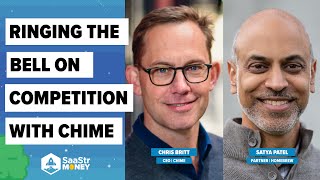
Chime CEO Chris Britt discusses how the fintech company pivoted from rewards to primary banking, grew to become the top downloaded banking app, and makes money through transaction interchange. Key products include Spot Me, an overdraft alternative, and Roundup Savings.
Questions this video answers
Up to $200 negative balance without an overdraft fee (for members on direct deposit).
On average, over 40 points improvement.
Almost half of new accounts each month come from word of mouth and social.
Chapters
Hi, everyone. Welcome to Saster Money. We are so thrilled to kick off this morning or afternoon, wherever you're tuning in from, but we're really thrilled to be kicking off today with Chris Britt, CEO and co founder of Chime. He's going to be in conversation with Satya Patel, a partner at Homebrew, and they're going to be talking about ringing the bell on competition with Chime. We're so thrilled to have you both. Before we get kick, I just have a couple of housekeeping reminders for everyone tuning in. Drop in the chat where you're joining us from. We love to hear where everyone's tuning in from. We also are going to have time for plenty of questions for Chris and Sadia at the end of the session, so please make sure to drop all of your questions in the Q and A button right at the bottom of your toolbar. We're here with these guys for 50 minutes and as I said, they're going to have plenty of times for Q and A, so please make sure to join the conversation. And then just as a reminder, all of our sessions are recorded today. It will be available post event, our YouTube channel. So we hopefully we hope you can share with anyone on your team who may not be able to join today. So without further ado, Saadia and Chris, I'm going to pass it over to you to take it away.
Thanks so much. We are thrilled to be here this morning to tell you a little bit about the Chime story and particularly how Chime has gone about fending off intense competition in the fintech market. And so I'm joined by Chris Britt, CEO of Chime. I'm Satya Patel, a partner at Homebrew. We were one of the seed investors in Chime and have been fortunate to be on the journey that is still partway in the building of Chime and the impact that the company will have on the financial lives of many here in the United States. So with that, I want to kick off the conversation. Chris, awesome to see you as always. The Chime story is so rich with so many important moments along the way. Maybe you can start just by telling us the founding story and how you decided that this was the business that you wanted to spend the rest of your career on.
Thank you. It's great to be here. Thanks for the invitation. Always great to reconnect with you. You and Hunter were really our earliest backers, so it feels full circle to see you and talk a little bit about the founding story. I just wanted to note though, you Tweeted last night that we've now beaten the competition and I just want to state the facts. We are just getting started. No one is doing a victory lap. We're a very humble company. We've got a long way to go relative to the competition we have. But I appreciate the kind words.
The investors are always getting ahead of the founders, so nothing new there.
But I appreciate the enthusiasm. Look, the founding story. I came out to Silicon Valley in the late 90s, got involved with some startups that had some success. I worked at Flycast, I worked at comscore, one of the first employees there and really just enjoyed working at small, fast paced companies with small teams, with grand ambitions to try to disrupt industries and knew that I always wanted to start my own thing at some point in time. I got involved with payments and banking. I worked at Visa for a little while. I really got to know payment systems processing and all the nitty gritty of how to make programs and card issuance work and so forth. I ultimately worked at Green Dot for a few years where I was head of product and Green Dot was a wild success and I've got a ton of respect for the company. But you know, towards the end of my time there, I sort of realized that there was a much larger opportunity than just trying to deliver financial services to the unbanked. While we certainly at Chime welcomed the underserved into our community with open arms, I didn't want to create a product that sold and a business that solely served that segment, that there was a much larger opportunity to serve everyday Americans, all Americans that are frustrated by traditional banking relationships. And so I got lucky. When I met Ryan in the very early days as me and a couple of investors were bouncing around ideas and we knew that we always wanted to address the fact that there's a huge segment of Americans that have a lot of anxiety around their money. And we thought that there was an opportunity to develop a set of services and solutions that were actually helpful and had their best interests in mind. That's always been the vision from the early days.
Yeah, I can definitely let people know that that absolutely has been the vision from day one, at least when we heard it. So it's been very consistent. You talked about meeting Ryan Core to any startup success story is the founding team. Talk a little bit about what you saw in Ryan that led you to believe that he was the right co founder. For those who don't know, Ryan is co founder and CTO of Chime and Ryan and Chris have been partners since day One. And so I'm always curious about the founding story of the founding team.
There are very few people that have been more important in my life than Ryan and making the connection with him and his family and Jennifer and my wife Alex. We're sort of a tight tribe that have been working on this for so long. The story of how we connected is kind of funny, I guess. We had some investors poking around trying to fund this. I think even before we met you, we hadn't raised any money, but I needed to find a technical co founder. That's what any generalist business person. That's the unicorn you're trying to find. I got introduced to a, to a recruiter and I said, look, I don't have any money, so I can't. I'm not going to pay you anything, but if you have any ideas of someone I might want to talk to, that'd be awesome and I can promise you we'll work with you going forward. And a recruiter introduced me to Ryan and the rest was history. It turned out we had both worked at Sequoia companies in the past, so we had that connection. We both had had some amount of success in our prior experiences and we were ready to swing for the fences and start this delicate infant company at really a crazy time. We both had little babies and we were just getting started in life. It really was not the ideal time to do it, but it ended up working out really well. And I mean, to this day, Ryan and I talked about every day, obviously, and we're arm in arm and have just developed a great working relationship. He has an incredible ability to not only be usually the smartest guy in the room technically, but he's been on every investor pitch. He can sell ice to an Eskimo if he needs to, but it's always, you know, an incredible leader and importantly, an incredible recruiter of this, you know, amazing team that we've been able to develop.
What's always struck me from the very beginning is the strong cultural alignment between the two of you. And I know culture is kind of foundational to the building of Chime. Can you talk a little bit about kind of how you decided what the culture should be and how you articulated that for the company at the beginning?
Yeah, I would say, you know, and it's a few people like you, like our cmo, Melissa Alvarado, who is so critical in the early days of building this company. You know, culture in some ways is sort of like brand, you know, your brand. It's not exactly one thing. It's kind of like it's just the foundation of how you operate, how you roll, what you're known for, how you. How you're going to operate as a team. And from the earliest days, we've been lucky in that the people that joined us for this mission shared this common goal of creating a company that was actually focused on being helpful authentically and knowing that there's a huge portion of America that is not well served by traditional institutions. And, and so being member obsessed has always been sort of our number one core value. But in addition to that, it's things like being human and working as a team and always striving to simplify and reducing friction and making things very easy, being results oriented, making things happen. You know, we're going to measure success based on using data to gauge results. And then we're going to refine, improve and optimize and we're going to do all of that while making sure that we're respecting the rules. You know, we operate in a highly regulated industry and we can't be a renegade company and we can't just launch stuff without having it be in coordination with our bank partners and approved by regulators. So we take all that stuff very seriously. And it's not sexy at all. It's like the least Silicon Valley core value you can have. But we have on the wall, respect the rules, and it served us well for the past few years.
Yeah, I want to come back to that a little bit later, but I want to pick up on something about startups. In the beginning, you've been part of a number of startups and you know that startups really finish where they start and you haven't been shy about telling the chime story and kind of how business evolved over the time. Talk a little bit about the early product vision and how that's morphed over the course of time.
Well, I think we always had the same vision, which is that we wanted to be the primary financial relationship for millions of Americans. The way that we got to that goal certainly evolved over time. You know, when we got started, those were the days when Groupon was all the rage and deals and savings and. And so we were part of that trend a little bit. We thought that, well, first of all, there's a massive secular trend over the past 20 years for people preferring to pay with debit. There's more debit transactions in the US than there are credit. But the value prop around debit cards had not really evolved. All the sweet rewards are on credit cards. So we thought well, there's an opportunity. What if you had a debit card that had great rewards? We spent a lot of time working on the platform to be able to facilitate that. What we found is that with a very, very heavy rewards positioning, it was pretty good way to open up the top of the funnel and get a lot of people to sign up. But we weren't as effective in getting people to engage with us as their primary way to bank through our app. So we still think rewards are important and. But it's not sort of the primary value prop that it was in our earliest days, but we've evolved and really just focused on a suite of services that more squarely addresses the pain points people have with their banking relationship. And I think that's really worked well for us is just simplifying the message, not trying to sort of reel someone in with this value prop and then try to get them to do their banking through us. Just be very clear, like we think that we've got a better way for you to do your everyday banking and a set of value props that allow you to do that.
When you got started with Chime, the competition was really incumbents and in fact, most people had to be convinced that there was a market opportunity at all. And so I'm curious, how did you convince people that there was a real market opportunity and that the earlier failures that had come along in the market were isolated incidents. And what was the path to becoming the market leader that you are now?
Well, as you know firsthand, you were right there arm in arm with us in the early days. It was not an easy road. We were not the bell of the ball by any means. I mean, think about to 2012, 13, 14, those early days, simple had a lot of momentum and they had a cool product and cool vision. A lot of we have a lot of respect for what they were trying to accomplish. And in many ways a lot of what we've created is we share a lot of values with what they were trying to accomplish. But I don't know, you probably remember these companies like Clinkel and Tilt and Card Spring and no one cared about Chime, right. We had so many investor meetings and it was really hard. I think some of these prior attempts, I think the feeling was like, well, if they couldn't make it work, why would these guys be able to make it work? I think you and some others largely just bet on a team that knew a little bit about the category and had some experience that was probably worth making a run at it. But yeah, in General, I don't know. There's probably lots of reasons VCs don't necessarily feel the pain points that our members feel. I think that is a very real element. I mean, I think. I can't tell you how many times I share the fact that there's more debit card transactions than credit in America with a VC who almost fell off their chair and had no idea that. I mean, a lot of these guys think that it only works at the atm, right, to get cash, so. So it's hard to convince people that pay with Amex Black cards that, you know, a no fee debit card and checking account with high Yield Savings that has a lot of automated features to help get your finances in order is a, is a thing that would be impactful and important to a lot of people. That story just didn't really resonate from the early days. So I think what we had to do is execute. We had to show that we could make it happen. And when we first did our Series A financing, we had close to, we had a lot of signups. We had almost no one on direct deposit, the recurring payroll into the account. But we made a lot of progress on that over the years. And by the time we got to our sort of Series C, I guess you could say it was very clear that the model was working and we had a highly effective funnel to not only get people to sign up, but then transition all of their banking services to us. And at that point, once we proved that that could work and that the unit economics worked, suddenly there was a lot of interest in investing in the business.
Yeah, I think I remember that pretty clearly. It was not obvious till it was. And it was around that Series C. And that's the point at which it became much more clear that you had the opportunity to be the market leader. Now you clearly are the market leader. I won't say you've beaten the competition, but you clearly are the market leader. How do you think about maintaining that leadership? What are the keys to that from your perspective for the company from any number of standpoints?
Well, first and foremost it's around creating a culture that people are true on the team here. Our chimers are really obsessed with solving problems for our members and particularly the most acute problems for everyday Americans, which a lot of time just boils down to short term liquidity, making life a little bit easier, helping them get through to the next pay period, not nickel and diming them on things, trying to create an app and an experience that fosters a sense of community and Connection with your friends and your family and that sort of thing. So first and foremost, it's designing products that are actually meeting the needs of the segment we serve. I think importantly, for one thing that I think about now is when we hear accolades such as you've just shared, which we appreciate. On the one hand, that's great to hear and it draws a lot of attention to the company. On the other hand, last thing we want to get is hire a bunch of people that just assume that we are the anointed winners in this category. We're barely getting started. We are a rounding error on a JP Morgan income statement at this point. So we have so much more to do. So it's important for us to continue to hire people that share the hunger and the passion and the grind that we had when we were working on 6th and Folsom in the early days in a shared working space over there. So making sure that we're screening people who are authentically passionate about this mission and this opportunity. And don't just assume that you joined Chime because we already won. We feel like there's still a very long road ahead of us here.
Yeah. A lot of companies talk about being customer, or in your case, member obsessed. Talk a little bit about who the member is that you're serving, because I remember that being very unique in terms of how you talked about the market opportunity you're addressing, even at the seed stage. And I think it's been very consistent throughout the development of the company. And then how does obsession around that member translate into how you operate as an organization?
Yeah, I think there's naturally a bias for entrepreneurs to create products that solve problems that they have or their family has, or their former younger selves or whatever. And the reality is, we used to struggle with this, even with you in the earliest days around, like, well, how do we create the. How do we tell this story? And I said, well, I wish I had a story that I got hit with, you know, 100 overdraft fees and decided to solve it. It just wasn't the reality. So, so, and we're not gonna, you know, fib on things like that. Not that you were asking me to fib, but I think that what we've been able to do is just empathize with this mainstream middle income consumer that we serve. And so we're deliberately not trying to solve banking problems for the Silicon Valley engineer who works at Google and makes six figures. And, you know, a lot of those guys have perfectly good relationships with Wells Fargo and Chase and Those institutions love having that type of person as a customer. What we're focused on is the 70% of Americans that don't have large balances in a checking account. So they're not that desirable to a traditional bank because the traditional banks are focused on generating net interest income and they want to do loans for increasingly higher credit score people. There's this huge segment of Americans that are simply tolerated by the big banks.
I guess that's the Dallas Mavericks fan. Right?
Right. These guys are not necessarily interested in innovating for, for this middle income consumer which is most of America. And so that's really our opportunity. And I think that that's probably been our superpower as a company, is that we know who we're trying to serve. We empathize with the challenges that they have even if we don't personally face them day to day. But we do things like everyone uses the product in the company. Everyone. You know, we got a Slack channel called Chime Time that, you know, we're just, people are peppering in issues like this needs to get better. This could, this could be better optimized. You know, we're obviously keen listeners on social media. We're constantly, you know, in a never ending feedback loop with our members to figure out ways to reduce friction and make sure that we're being helpful. So, and that's.
Yeah, you touched on. The question I wanted to ask is because you are not the customer, how do you get into the customer's shoes and really understand his or her needs? And it sounds like you've got a number of different things there that you do. And then how do you translate an understanding of those messages and that feedback into a product roadmap that allows you to differentiate or address those needs in a unique way?
Yeah, I mean, we do all the things that you'd expect. We, we do research, we do survey monkeys, we are constantly asking questions, we're doing focus groups and we're getting a good sense of what the key day to day challenges and opportunities there are for us to play a role in helping to solve them. We found that historically a lot of it has been around just making access and visibility and connection with your money easier and simple. Of course, that's the foundation making the app really easy to use, having it not rely on fees so that we actually have aligned interest with our members. And yeah, I think the team's been really good at uncovering sort of what's next. We added an overdraft alternative called Spot Me that if you're on direct Deposit, you can go $200 negative in the account without getting charged an overdraft fee. That's a big innovation. It's a big differentiation. There's lots of companies that claim to offer that type of service. All of them charge between three and five bucks for the instant access to that benefit. So we offer that for free to consumers who elect to bank through Chime. We also last year added this new credit builder card which allows our members to, in a safe and secure way that doesn't get them into spiraling debt, doesn't charge them any fees, allows them to build their credit scores and on average we're improving their credit scores by over 40 points. So these are highly impactful services that, you know, perhaps a typical VC doesn't really get. The fact that that is, you know, these sorts of things can be life changing for people. But we're listening, we're being responsive and working really hard to continue to innovate and launch these things at a, at a rapid clip.
If I remember correctly, and arguably the first product that you built that really took off was Roundup Savings. And that product had existed in various forms and other products in the market from incumbents for a long time. Why do you think it works so well for Chime and why do you think it resonated so strongly with the member base?
Yeah, and you and I talked about this a lot. I remember as we were figuring out a little bit of our positioning pivot and we were trying to not just be around rewards, rewards, rewards. And I remember you and I having that discussion on making that or trying that as one of the key value props. And man, it works so well. I mean we had something like of all the savings accounts we would open, we'd get like 90 plus percent of people to sign up for automatic savings. And the reason why we were so successful at it is because we just made it simple and easy and it was positioned as like the default way to use our product. And so when it's positioned that way and it's in the flow and it's, you know, we're very clear, like if you want to get the most benefit from Chime, you should turn this on. You end up getting really high levels of usage and that's just very different than, look, there's a lot of things that traditional institutions already had, but the friction that they, that they, that's required to turn the particular feature on and off, it can be mind numbing so they don't get used. You need an instruction manual. I mean, think about Even trying to find your routing and account number at a traditional bank website, I mean, it's really hard, right? So it was really just about that particular feature, was about just making it super simple to turn on, to turn off. And then we got great feedback right out of the gate because there's so many people. I won't cite the stats, but you guys know all the stats around how many people don't have a whole lot of savings for an emergency. You know, people suddenly look in their savings account and say, oh my God, I have like $150 saved. I've never had any money saved in my life. This is amazing. And then they would tell their friend. And so it ended up being one of the core value props in the early days. Now it's a value prop, but it is not the value prop anymore.
Obviously, alongside kind of building the right features and the right product when it comes to financial services, trust is an important component of it. And you talked about kind of the aha moment of seeing savings and that engendering some trust. But how did you build trust from the outset and get people to believe that turning their financial lives over to a digital product was something that they should be comfortable with?
Well, look, I think it starts with the fact that if you look more broadly across the landscape, the reality is most of these traditional institutions are not held in particularly high regard to begin with in the segment we serve. So we sort of had that going for us, as do others in the industry. But beyond that, traditional banks put big pillars in front of their branches to make you feel safe and secure and know that you can come in and talk to them if you need. We obviously don't have that benefit, so the way to prove it is through actions and then creating a community that is really supportive and feels like they're part of the mission to change the way that financial services works. And so, so much of it is the social proof that we get from people that say, no, no, this is, you know, if you see a chime tweet on, hey, try out our, check out our credit builder card. You're going to see 50 people under that tweet say, this is legit. I've increased my credit score by 100 points or whatever it may be. And so that's really most important is just delivering on the promise that we make to our members and then hopefully getting enough excitement where they tell their friends and vouch for us and the actions that we take day to day with them. And it's working. We still get Even to this day, at the size and scale that we're operating at, we still get almost half of our new accounts every month from word of mouth, inorganic and social.
So.
It seems to be working.
Yeah, no doubt. You talked about understanding the member needs and designing product experiences. And obviously you've built a lot of products that traditional banks, as you said, charge for, put gates in front of and make difficult to access. So how do you kind of make all that available, easy and inexpensive and still build a business that makes money?
Look, we definitely have an advantage being a digitally native company. Traditional banks, the operating expense on a, in terms of the overhead, excluding marketing costs, just the overhead to operate their businesses on a per checking account basis is something like $400 per customer per year. So it is extremely expensive for these traditional institutions to deliver just basic banking services. So the result is that they need to focus on whales. It is a whale hunting business. They want your mortgage, they want big, big top 20, 25% of consumers. They're going to spend a lot of money to make you feel like a private client and give you a nice chair to come in and lollipops and all these sorts of things. That's great for them. We're focused on everyone else and the way that we're able to do this is by really first and foremost not being a financial services asset based company. We're a technology company. So we operate the vast majority of our technology stack in house for the parts that we don't operate in house. We continue to take more of that over time. That allows us to operate at an extremely low cost. And we designed a business that allows us to monetize really just through the transaction activity that comes off of the cards on a monthly basis. There's total alignment. We only are able to monetize relationships if we drive high levels of love and engagement with the product. So we wake up every day trying to get people to use us for their morning coffee or their Amazon purchase, whatever it may be. And if we're successful in that, then we're able to develop a good business model. So I think operating at a very low cost, allowing a lot of service to happen, you know, through the app, with a suite of services that are, you know, super intuitive, that, that obviously helps us as well. At the same time, this is your money. We need to answer the phones. We have close to 24 7, you know, availability for if someone needs to talk to somebody live. And of course all, all those sorts of things are important, but we're able to optimize it and do it in a way that, that creates very attractive unit economics.
And as you mentioned earlier, you're trying to do all this in the frameworks that exist around regulation and compliance and all that. So how do you balance true product innovation that allows you to be member obsessed with the rules and regulations that you have to abide by?
I mean these are just the rules of the game. It is what it is. Would we like to be able to move faster on things sometimes? Sure, but who wouldn't? But the reality is that we offer fdi, FDIC insured checking accounts that have reggie protections and the same set of, you know, subject to the same set of rules, regulations, you know, provisional credits on disputes, literally the exact same regulatory framework that any major bank checking account has. So in order to do that we got to play by the rules before we launch any product, it gets reviewed by the fdic and in terms of how it's all structured, that is shepherded by our bank partners that actually are the ones that hold the underlying deposits. And I think it's a good partnership that we have. And I think having regulation is, having some amount of regulation is of course a good thing. This is consumers hard earned money and it can't just be some renegade unstructured set of cowboys out there running people's and managing people's money for them.
Let's turn from the past and what you've built today to the future. There's a lot of change happening in the fintech markets. A lot of activity along many different dimensions. One of the most popular areas right now is crypto and it's an area that you seemingly have not spent time in. While almost every other fintech is doing something related to crypto. Talk a little bit about how you think about crypto in the context of chime.
Well, we like crypto. We've talked about this before and I think there's so much innovation going on in and around that segment. I think it's really exciting and I think there's going to be major disruption to the way financial services operates as a result of it. And you see the trend around the world, corporations getting involved, governments and so forth.
So.
We'Re not sticking our head in the sand and pretending that that's not a real trend that's happening and should be monitored. Look, our customers are mainstream middle income consumers. A lot of them don't even have any investment accounts. So I think it's natural over time for us to get into additional areas of financial services products. I think naturally lending Investment services, insurance and so forth are all exciting opportunities for us to pursue. We probably won't start with crypto. I don't think that's probably the best way to start someone's investment path or journey, but it should probably be a part of someone's investment portfolio over time. But if it, if you're just getting your toes wet into investing, I'm not sure that's the best place to start. And I imagine that people that started buying crypto in mid April feel that way as well.
Right. You touched upon getting into lending and investing, all these different areas. I think in the broader fintech market we're seeing this evolution where companies started with a specific product or use case and are adding on other products and services to mimic more traditional banks. We talk about it as the great rebundling of fintech. Are you seeing the same thing and what does that mean for CHIME as you think about competition and continuing to be member obsessed?
Yeah, of course. I mean we've been joking for years that every consumer fintech has the same 5 year or 10 year roadmap. They can do checking accounts and savings accounts and investment and crypto and everything. Right. So I think there's, it's a great time to be a consumer. There's lots of innovative options. We really like our starting point for a couple reasons. Number one, you know, I think we've been very successful in capturing primary account relationships. It's a very, very deep relationship we have with our members. They do direct deposit. The majority of our members are doing direct deposit, recurring direct deposit into the CHIME account, into their CHIME account every month. And we are rewarded with their spend close to 40 transactions a month on average. So very high levels of engagement. And when we survey our members, 75% of them want additional products and services beyond the spending and the saving account services that we've got. So I think what's exciting about having that primary relationship is there's not only an opportunity to add additional products and services, but there's an expectation that you will. So I really like the starting point of the direct deposit. That is, you know, we're sort of the furthest upstream and so I think when we launch additional products and services, we have a very high likelihood of adoption. In fact, most of our services that we've added, we have over 50% adoption from, from across the portfolio. So we're really excited about that. And then I think probably the number two point I would make on this is the starting point of the foundation of this direct deposit relationship. This high level of engagement and monetization that we have allows us to deliver a suite of services that does not rely on fee income. If consumer fintech has been part of the narrative here is like, oh, the big banks charge a bunch of fees and so fintech can disrupt all that. Well, look across fintech, most of these consumer fintech companies, the majority of their revenue come from consumer fees.
So.
Are they part of the solution of the problem?
Yeah, you clearly have your answer to that question. Thinking a little bit about fintech broadly, again, it seems that there's an incredible amount of appetite in the public markets for fintech companies. Without commenting on Chime's plans, because I know you won't, why do you think the public markets have all of a sudden become receptive to fintech companies in a way that they weren't half a decade, a decade ago?
Right. Well, there's definitely a lot of interest in the category. I think fintech is, if not the hottest, it's certainly one of the hottest categories. Why is that the case? Well, look, financial services is one of the last categories that continues to be largely an analog based business model. Most of the big companies in this space are not technology companies, they're balance sheet businesses. I think investors are looking at the fact that financial services as a category in terms of market capitalization is one of the biggest categories other than information technology. I think it's probably, if not the biggest, one of the top handful of large categories globally in terms of market cap. I think there's a recognition that there will likely be a handful of companies. Some of These companies, like PayPal, are already massive. Right. But I think there's an acknowledgment that there will likely be a number of major players that create really big businesses that serve new segments in ways that are transparent and easy. And we want to be one of those companies and we want to be a brand that's known for authentically helping people move their financial lives ahead. And so I think there's just recognition that there's, there's lots of companies that are endeavoring to do that in new transparent ways.
It sounds like in addition to hopefully being a public company at some time, you obviously have a very long vision for where Chime is. What does success look like over the next five or 10 years? You talked about just getting started and being a rounding error on JP Morgan's balance sheet. If things play out as you hope, what does Chime look like down the road?
Well, we're in a fortunate position right now. Feels like we've got the wind in our sails. We open up hundreds of thousands of new checking accounts every month. We were the number one most downloaded banking app in America last year. I think success, if you look out a few years, look at all the major banks in America, they have 30, 40, maybe 50 million active mobile users every month. We think that we should be able to get to those levels with primary account relationships with tens of millions of Americans using us for their everyday transactional services. And then like I said, over time there's clearly some opportunity for us to help them in other areas of their life. Setting up an ira, getting into investments, helping them with short term lending, maybe some elements of insurance. And we don't have to do all these ourselves. Some of them may be in partnership, but we have this very active, highly engaged members base that we think that we should be able to add a whole host of new products to beyond just our sort of core payments and savings services.
I know we've been focused on looking ahead, but before we turn to Q and A, I have to ask, as you look back on the Chime journey over the last almost 10 years now, what has surprised you? What is the thing that has struck you as man? You never would have expected that on the path to success that you've been on.
Wow.
I mean, I don't think Ryan and I ever. What was it? I think it was Bubba Watson when he won the Masters and they asked him what he thought about it and he said, I never thought that far ahead in my dreams. So I don't know. Yeah, it's probably something like that. I mean, we just put our head down every day and get to work. But of course, the last few years has just been an amazing experience for all of us at Chime and the level of recognition that we've received from, from consumers, from pundits, you name obviously feels really good. And I'm very proud of the impact that we're making. I mean, look at the changes that are happening in this massive category, all these. And I'm not saying it was just us, so I'm not trying to take all credit, but look at the movement that a lot of these big institutions are making to, to change their fee policy and try to become more consumer friendly and the narrative they have on this topic. I'm really proud of the small role that we've played in helping to facilitate that. And I think there's a long way to go and I think that overall, I'm hopeful this makes for a better industry and not just helping small consumers who may be overlooked, but we're an important partner to small banks too. And we think we can play an important role in helping them be more successful in acquiring low cost deposits and operating their businesses. So we think we can have a positive impact for consumers, for the industry and hopefully for our country as well.
Awesome. Well, with that we have time for just a few questions. Let me start by asking, and you've touched on this a little bit because you made it clear that Chime is not a bank, it's a fintech company. So what is the link between a bank and a service that helps you do banking? And does that distinction matter?
Well, I think the lines are blurring to some extent. I think we are close part. I mean we literally are connected technically and on phone calls and zooms with our bank partners literally every day. They are really good at the sort of core services that they provide, managing the money, making sure that these are accounts that are safe and sound and being a close partner of ours in monitoring how we do things like KYC and complying with the Patriot act and making sure we're doing our regular anti money laundering processes and so forth. So I think they are true experts in their domain. We work with Bancor bank and Stride bank and we think it's a nice complementary relationship. We are not heavy. You know, we're a consumer technology company. We build all the services that the consumer interacts with. We make it easy. We operate the backend technology at a very low cost which allows us to deliver these services and basic banking without having to rely on a whole, whole host of fees. And the banks use these deposits and they fund their local commercial lending efforts. And it's a good complementary relationship. By the way, all this said, we wouldn't rule out someday becoming a bank. But at this point in time, the way our business model works, we're really just a transaction based business model. So we like the relationship between, we manage the consumer relationship really monetized through the transaction activity. And then our banks benefit from the deposits that they hold onto in these FDIC insured accounts and they can fund their lending operations, which isn't really the business that we're in today. So I think the model works pretty well.
There's a question from Arianna who's asking about geographic expansion plans for Chime. You're seeing Nubank obviously expand throughout Latin America. What is Chime considering, if anything outside.
Of the U.S. yeah, those guys have been an amazing success story and we've got a ton of respect for what they've been able to accomplish. Right now we're squarely focused on the domestic market. I think that's been helpful to us. You've seen a lot of other fintechs that have tried to expand into a whole host of different markets. And the reality is the more you get into, the further away you are from the needs of the various segments within those markets. So we think we're still at the very early days of there's something like 150 million Americans that we estimate that are in our sweet spot of mainstream middle income, largely living essentially paycheck to paycheck that could use a service like the one that we provide with our bank partners. So I think we still got a long way to go here in the States, but naturally moving into Canada, into Mexico, some of these geographically adjacent areas could be something that we think about pursuing at some point in the not too distant future too.
It looks like we have time for one more question. Looks like Pianpian has a question about being early stage founder and kind of prioritizing. What are the two or three things you think early stage founders should be spending their time on? If you had to prioritize, don't run out of money.
Somebody taught me that once. That's right.
Once or twice, yeah.
I mean, sorry, but that is kind of important. Look, you gotta, you need to be thoughtful about your finances. And when you do your financing, you really have to think about, okay, what is the milestone or two or three that I need to get to in order to get to that next round of financing? And if you're really deliberate about that and you have a plan to do it, that's probably most important. In order to do that, you need to be very good at hiring people and highly talented people that share your, your values and work ethic. And that's something that Ryan and I have been very lucky from the earliest days is I just feel like we continue to strike gold time after time in terms of the, not just the leaders, but all levels of the company. So, yeah, make sure you have enough money, make sure you're really thoughtful and work with your earliest investors. They should help you. I mean, how many meetings did you and I have, Satya, over in the early years in particular, like thinking about how to get to the next milestone and. What story would be able to tell about the traction that we actually had achieved and making sure that you're thinking about that, that's critically important. And then at the end of the day, especially in the early days, investors are going to invest in teams. Satya invested in me and Ryan because Ryan was this amazing technical talent and I knew a lot about payments. I wasn't just making it up. I actually worked at Visa. I worked in Green Dot. I knew a few things about the category, and so we were probably worth placing a bet on. So become an expert in your category, too. That's certainly important.
All right, we gotta wrap up, but I obviously have to ask, from one New York Giants fan to another 17 game season, what's your record prediction?
Well, Saquon's back. Eli is also back in some sort of managerial public relations role.
Right.
That's good. Mojo. I don't know. I don't think it's quite. I don't think we're quite there yet. So I would say, optimistically, I'll go with 11 wins.
Wow. That's more optimistic than I thought. I'm going to say nine and eight.
Okay.
All right. But thanks, Chris. Always great to chat with you. I think the thing that people should really take away is kind of member obsession and really understanding who your customer is and what the unique needs of your customers are. Because that was, in my mind, critical to both the early and ongoing success of Chime. And I know it's going to continue to be an important pillar of what drives the success going forward. So thank you for joining me today. Thanks for letting us be on the ride with you and best of luck continuing to build what is going to be an incredible business with incredible impact on the financial lives of Americans.










