SaaStr AI Day: Accelerate Production Deployment - How to Embed Trustworthy AI with IBM
George Kreitler from IBM explains how to deploy trustworthy AI in production. He breaks down IBM's generative AI stack, from data platforms to fine-tuning and hybrid deployment, and shares metrics: IBM's Ask HR handles 94% of employee requests, while watsonx code recommendations get an 85% acceptance rate.
Please join me in welcoming George Kreitler. He's going to be joining us this morning and talking about how to accelerate production, deployment, embedding trustworthy AI into commercial solutions. So George is joining us from IBM where he runs AI partnerships. So please take it away. George, we're so excited to have you.
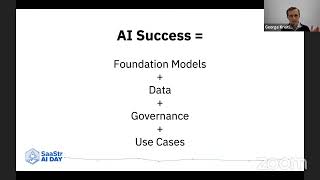
Awesome. Thanks, Jesse. Good morning, good afternoon, good evening, delighted to be here with you all. Like Jesse said, my name is George Kreitler and I lead our AI Partnerships group over at IBM. So today we're going to talk about a couple of different things. We're going to talk about the paradox of AI. We're going to talk about three equations. We're going to do a little math to help guide the next decade as it relates to AI. And we're going to talk about top use cases that we see and the importance of responsible AI in general. So let's take the technology aside for a second. Let's talk about what we're seeing from a macro perspective. So we're seeing a couple of different things. We're seeing populations really across the globe declining. I think there's probably five countries in the world that are experiencing, that are going to experience population growth over the next 20 to 30 years. We're seeing productivity variability, especially in developed countries where productivity is relatively low. There are countries out there that are seeing tremendous amounts of productivity, areas like the Middle east and Indonesia, where IBM is investing very heavily to build AI skill sets around there. We're also seeing that we're kind of leaving this world of zero percent interest rates, right? It's going to be a lot harder for companies to be able to allocate capital using debt. And all of these different variables are having an effect on GDP growth in general. So what makes up GDP growth? Well, it's really three things, right? It's population growth, it's productivity growth, and it's debt growth. So we know that population growth, we're not going to see that for the medium to long term. Right. With debt growth, we think that at least for the foreseeable future, that's not going to be a real catalyst for us. So that leaves really one area, one variable that we can leverage, and that's productivity growth. So this is a challenge that we're going to face over the next few decades. Right? And it's something slightly different than anything that we've ever faced over the last hundred years. We're going to be very reliant on productivity growth. And that's why we at IBM are so excited about all of the great work that's going on in the AI space, and there's a lot of folks out there that are skeptical about AI, about what it's going to do as far as displacing workers. How are decisions that are AI driven being made and how are those, how do we know the data underlying those AI decisions? Those are, those are all things that we are going to, as a collective, are going to have to attack head on. And it's fundamental that disruption and responsibility, they must coexist in order for us to be successful in moving forward. So what makes up AI success today? Well, it's a couple of different things, right? Most of the folks on here may be familiar with foundation models, right? Where now we're able to build AI models much faster than we were in the past. Now we at IBM, we fundamentally believe that it won't be one AI model to rule them all. It's going to be a variety of different models that are fit for purpose, that are focused on specific tasks that will ultimately provide the most value to enterprises. What else do you need for success? Well, you need data, right? If you and your top competitor are using the same foundation model and you're not using any of your own data there, then you really don't have a competitive advantage in this space. So data is going to be fundamental to differentiating yourself and being able to incorporate that into your own AI models is going to be fundamental for long term success. Also with long term success comes some sort of an approach towards governance, right? And that includes data governance, but it also includes AI governance, right? How does this AI come to the dis, the certain decisions that it did? What is the end to end model life cycle? And how do I know that these AI models are operating in a trusted and a transparent way? And then lastly, you need use cases. You don't need one use case, you need many, you need as many as possible. And that's where we've spent a lot of time working with partners that are all in various stages of this sort of AI journey. How we help them unlock value from AI. It starts with focusing on the right use cases, not just about where AI fits, but also understanding where it may not fit. And that can sometimes be more important. So putting the models aside, there are different components that we believe make up an overall generative AI stack. So starting with the middle layer here, it's fundamental that there is some sort of an AI and data platform. Now at IBM, we've launched Watson X. That is our approach towards a data AI Platform, we are predominantly focused on business, business to business type of activities. But this is the platform where you can do all of your model training, your development, your deployment, your prompt tuning, your fine tuning, that end to end model lifecycle. But also understand that it's being done in a governed and transparent way where you have full line of sight to explainability of how models come to the decisions that they do. Going up a stack higher, it's crucial that you've got a number of different software development kits and APIs that help you embed that AI into specific applications, products, solutions, et cetera. And then going up one level higher, think about fine tuning or tuning a specific model to address a specific task. And then these AI assistants are really how you interact and solve different tasks. Leveraging that model, sometimes called assistants or co pilots. That's going to be fundamentally how the majority of the world interacts with AI, going sort of that level below. For a lot of enterprises, it's about the data services that ultimately make AI, AI effective or not. Right. So being able to collect, organ, organize, manage the different data that you have across your enterprise, that's going to be fundamental as well, right? At IBM we say that there's no AI without ia, right? Some sort of an information architecture. So being able to, if you're not able to leverage all of the data across your enterprise to, to analyze it and use it for AI, then you're doing a disservice to yourself in the long term. Then underpinning all of this is a focus on running AI in a hybrid environment. Right. It's not about, it's about running it across public cloud, across private cloud and across at the edge. Right. And that, that's tending to be a really interesting area where lot of partners are coming to us and they're saying, I want to be able to run your AI and do inferencing from a device. So that's going to become more and more the norm for how folks interact with AI. So hybrid and AI are going to continue to be somewhat synonymous moving forward. So let's talk a little bit about the use cases. Right. I think about 70% of what we see today falls into these top three categories. It's around digital labor, it's around customer experience, and it's around app dev and IT ops. So if you think about customer experience today, how do I automate a lot of those front end interactions that I'm having with different organizations? So customer service type activities, how do I focus on those high frequency, low complexity types of tasks? That AI is particularly good at and let our agents focus on higher value activities. So with agents today, they may be going into their day to day work and dealing with monotonous asks that are somewhat tedious and not very fulfilling for them. So this allows them to focus on a lot of those higher value type of activities. Similarly, across digital labor, we think that there's an incredible opportunity to apply AI towards areas like talent and hr, towards finance, towards supply chain and procurement. Within IBM, we have internally adopted AI across our entire organization, touching on all four of these different categories. So for instance, we have AI built into our HR process where we've built our own Ask HR application, which is how the vast majority of IBMers interact and get questions answered around HR requirements, hiring, compensation, etc. And as of today, this Ask HR application is handling 94% of requests that are coming in from IBM employees. So 94% of the time they're getting their different tasks answered or, or fulfilled. Right? Digital labor seems to be fundamental with things like AI plus automation, right? Being able to not just interact with a virtual agent, but be able to execute and orchestrate different tasks, that's going to be fundamental for the future. And then the last area is around app development and IT operations, or for lack of a better word, code, right? So this involves doing things like app modernization, code generation, being able to translate code, to generate code, to summarize code. Those are all different areas where AI today can be applicable. So today our Watson X platform, about 85% of the time that it provides a recommendation to a developer around code, that recommendation is accepted. So 85% of the time that it recommends a developer accepts that recommendation. So this is only going to get better and better over time. And it's an area where we're seeing a tremendous amount of growth. Underpinning all of that, like I said, right, is AI governance, being able to design responsible AI where you have explainability across the end to end model lifecycle and also the ability to transform your data to collect it, organize it, etc. So that you're leveraging what is really your differentiator, which is your enterprise data. So I'm going to talk about two examples, right, that are, that are kind of, you know, interesting areas when we talk about partnerships where folks are getting value from AI today. So the first is a company called Ovum Medical. So Ovum was really created because they saw that there was a disparity with regard to the care that women were receiving as it related to fertility. And for them it's all about elevating the level of consistency and objectivity by which they provide care to patients across the world. So they offer a telemedicine platform and they have watsonx built in and running on the front end of that. So WatsonX is able to answer questions about healthcare, about insurance, about fertility, about setting appointments and meetings. And I think what's really important here is this is not something that took months and years to develop and roll out. These are things that we can get done in a matter of weeks. So in this case, they had this fully integrated, running on their website in less than two months. The second one I wanted to talk about is a company called crushbank Technology. So they came from the IT support space where in the past they were running strategic outsourcing, they were providing staff to do IT support for different enterprises. And somewhere along the way there was sort of a light bulb that went off that said, what if we could do this with AI? What if we can leverage AI to accomplish this? And from that they've been able to roll out AI to interact with agents while they're handling IT support issues. It's obviously crucial that the first time a customer reaches out, they get their. Their questions answered and they get their tickets fulfilled. And what they're seeing is support engineers are onboarding faster and they're increasing the number of help desk tickets that they're able to close while also decreasing time to resolution. So two completely different examples where they're leveraging AI underneath the covers to solve different business challenges. So in closing, it's all about finding the right balance, right? It's about being a leader in this space where you understand the risks, you're not scared by them. And, you know, companies that are leaning into AI are the ones that are delivering faster growth. Today, it's about skills, right? Skills today might be around prompting AI. It may be around showing how. Showing AI how to mimic different actions. And then in the future, it might be about managing a fleet of different AI agents to solve different challenges. These are all skills that people need to acquire in the future. Lastly, it's about being open. We are the only company out there that has our own proprietary foundation model that we publish the underlying data that was used to train that model. So open in that sense, but also open in the sense of open source. There's new models coming out every single week and it's important to stay on top of what's coming out, how you can leverage them, how they differentiate from things they're using today. So thanks very much for joining us today. I know I'm a little bit over. I will be attending the upcoming London and San Francisco Saster events. I really look forward to connecting and meeting you there. Thanks again.
Thank you so much, George. And thank you for everyone who attended this session. This recording will be available on our social channels so you can reference it back. And we hope you join us for more AI Day sessions. Thank you, George.










