SaaStr AI Day: How to Navigate the Shift to Generative AI with PagerDuty's CEO and SaaStr's CEO
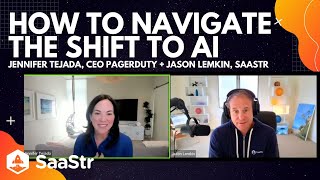
Jennifer Tejada, CEO of PagerDuty, talks with Jason Lemkin about how generative AI is changing enterprise work. PagerDuty built AI-generated status updates and a feature called Catch Me Up. She explains why enterprises demand proof of ROI and trust before adopting AI, and how humans shift to higher-value work as automation handles routine tasks.
Chapters
Day we're going to go even bigger at Saster annual this year on our journey to understand really how AI is going to impact business workflows. And I couldn't be happier to have our kickoff guest be Jennifer Tejada, CEO of Pager Duty, a multi time part Saster guest and community. Now looking back, I think Jennifer, first time she joined us, it does not seem like yesterday, but I think in 2016 you joined around 2016 you joined PagerDuty and came to maybe the second SAS triangle right after that. Does that sound right?
That sounds exactly right.
Right. Okay. I want to talk about AI for a lot and I think actually PagerDuty is so early to automation. I think it's one of the best companies in the world to talk about it. But, but let me ask you one meta question. 2016 you joined pager duty.
Yes.
Okay. One bit of advice to the world. How do you keep going? I don't mean that like it's just, it's hard. Right. And we are seeing, you know, in 2021 we had, as you've talked, we saw the great resignation, the great this, we're seeing more CEOs leave now. I'm seeing a quiet acceleration of CEOs. So any advice to bucking up and going long? What have you learned? You're coming into what, the eighth year of running pager?
Yeah, I'm in my eighth year. I always joke like I'm eight years into a three year gig. You know, I think that one it starts with like, what are your motives and why did you want to be a CEO? Because if your motives are for power and fame and authority and financial gain, that's a short game that's just not going to serve you over the long haul. But if your motives are around growing people, making markets really building value for others, then the last several years, while in some cases exhausting, and I think there is such a thing as crisis fatigue, they've also intellectually really stimulating. I mean, some of the most interesting moments I've had in my career were early in the pandemic when a number of SaaS, public company SaaS CEOs and I were getting on a call weekly to try and figure out how to navigate this thing where employees were coming to us for advice on health and safety for their parents, for instance, as opposed to, you know, what do you need to do at work this week, what are our strategic priorities, et cetera. So like, if you can embrace the intellectual learning curve and find joy in the steepness of that Curve sometimes it's actually quite invigorating. The other thing that I connect to is one of the reasons I still do this for a living, and I've been at it for several decades, is I love to see a person achieve something they didn't think was possible for them. And as a CEO, you're often asking people to do something they initially think sounds ridiculous or impossible or completely unreasonable, and then they achieve it. You know, you have to enable them and support them and empower them in doing that. But that sort of joy and that personal growth in that sort of surprising themselves in their own potential to me, like, that fills my cup. And so that, that enables me every year to like get up and reinvigorate myself over our strategy or our company kickoff or, you know, like, how many sales kickoffs have I done? How many achievers clubs have I been to? It's a lot. But what makes each of them different and more fulfilling is the people and watching people really change and develop over time and also make these markets. I mean, you know that When I joined PagerDuty, everybody thought it was a feature, not even a product, much less a platform or a company. And I think we proved them all wrong and we're still early in our journey. So it also like, comes down to what you truly believe and what you're willing to, to stand behind over time because people will always test your conviction. And that's just part of your day job as a CEO.
Yeah. Maybe even half of it over time is watching what the great people, what you sort of help empower the great people to go do. Right. And that if you, if you build a great culture, that happens every year. Right. There's a bunch of great people that spin out of that. It's, it's rewarding.
And sometimes they spin out of your company and they become CEOs elsewhere or heads of comms or product leaders, you know, et cetera. Like, that's also fun to see what our alum are doing out in the world and how they've taken the culture that we've developed here and demonstrated that like, you can be high performing, you can be diverse, you, you can be like innovative and serve a community that you really care about in different ways. Right. So for me, it's a lot of fun, but you know, it has had its moments the last couple of years, I'm not going to lie.
All right, we could do a whole session on that, on going long. But let me talk about AI and let's step back for a minute. There's so much in the media about AI, but I think so much of it is focused either on text to cartoons or on almost consumer ChatGPT. And that's great, but let's step back from it. When I think about business workflows, I think about AI is becoming workflow on. I almost hate this term, but workflow on steroids. It is the next generation of workflow. And when I think about PagerDuty going back to the old days, I remember, I don't know when pager do. I mean it was a disruptive. Even the very early version was disruptive because it took automation to the next level. So where's the line between automation and AI? How are you thinking about this? Am I thinking about that? Right?
I think you're thinking about it. Right. It's a little blurry for people. And you know, we've had a very long history with AI itself because we used analytical AI and started building a foundational data model even before I got here. It was one of the things that attracted me to PagerDuty was the three co founders were collecting all this data in hot storage that enabled us to move from just helping companies respond more effectively to incidents, to predict them, prevent them from happening and in fact solve major incidents faster with the benefit of historical context as well as technical context. And you know, context is magic, but it's often very hard to come by when you're solving really complex problems. And so I think that when we talk about generative AI today, there's a lot of low hanging fruit in reducing some toil and having a co pilot or an assistant that's going to take some of the crap off of your desk for you so you can do more fulfilling work. There's some of the neat consumer applications that enable you to make yourself look prettier in your Instagram avatar or you know, generate your first draft of your resume. But I think the real value is surfacing deep context that helps humans to do more incredible things at a much faster rate and much faster velocity. And I think that's where the true automation will be in like the disruptive work that people are either freed up and enabled to do or enable to do more effectively and more quickly. And as the result of having the assistance and this rich context, the head starts that we talk about through first drafts and like having that toil removed. I think you and I were talking about the skill shortage earlier, like there's still a major skill shortage in technology. It's getting worse as a result of generative AI. And so you also need to find ways to keep your employees engaged. And they don't want to do toil like they don't want to have to deal with a lot of menial crap that is hitting their virtual desk. They want to do the fulfilling work, the innovative work, the work that helps them grow as human beings and as leaders. And so this also helps to remove some of that layer that you have to get through that is necessary in building a business. But I would also say when you're thinking about it from a startup perspective, there's a few ways to look at it. There's how do I leverage generative AI in my operations to become more efficient? How do I leverage generative AI in my product to drive competitive advantage and to drive more value for my customers on a much shorter time frame? And then how do I think about supporting my customers in enabling generative AI? Most of our customers are enterprises and, you know, they're in varying places on the continuum in their journey in terms of how they are adopting generative AI. And I think that's also, it's also really important to remember that as startups or as tech companies, we come at this from a very different perspective than maybe 150-year-old Fortune 100 Enterprise Co. That has a lot of legacy, a lot of incumbency and a lot of regulation and risk they have to manage on a day in and day out basis.
Yeah, and I want to dig into that. Let's, but let's. I want to spend just one more minute on the enterprise. When you talk with enterprise executives, leaders, you know, CIOs, VPs of engineering, CEOs and big companies, do they. Where is the line between automation and AI and AI versus generative AI? What's the real dialogue happening? It's because it's not the same as on Twitter or X. Right? Yeah, but there is excitement, there's trepidation, but also the excitement's real. So what are you being asked to do? What are the real conversations in the enterprise? And is it really AI automation? Is it, what are they really talking? What are you guys really talking about?
I think generative AI is absolutely accelerating the appetite for automation. A year ago, prior to the sort of dislocation that we saw in the macro from an economic standpoint, CIOs that were protecting their empires, that had headcount sitting in network operations centers or security operations centers or customer service centers, that they were holding on tightly because budget and people meant power. And now they understand that if they don't figure out how to use automation as a lever to both improve their margins but also improve the customer experience. And most importantly, like innovate more with less resources. They'll be the ones without jobs at the end of the year. So what we're seeing is a very different openness and appetite on the part of technology leaders, whether it be CIOs, Chief Digital Officers, COOs, Heads of Revenue, saying actually help me figure out how to replace some of the work that my human beings are doing with generative AI so that I can either free them up to do the value, move them up the value chain to do the value added innovation work that I need them to do. Because by the way, I also have to innovate faster. I have to improve my innovation velocity and every day or every month, or help me figure out how to improve my margins so that I still earn the right to be here as a leader in a few months or a few quarters. So that shift in appetite is very pronounced. I think the willingness to experiment is very pronounced. And also the expectation that generative AI will do more than just automate the simple stuff that eventually we, we will see generative AI build its own code, repair its own code, manage customer conversations in a way that the customer might not be able to tell whether they're talking to a human or a bot. We think that's all totally realistic. But most of the generative AI we see being adopted now and in the next several quarters is we call human in the loop. There's still a requirement for oversight, for judgment, and there's still a lot of experimentation and learning that has to happen. And we need, you know, the smart and strategic employees monitoring how their AI is working so that they can also improve the product to market fit, improve the application, improve the safety of that application for their customers.
And what do you think? I'll tell you a sad story for a minute. I'm not going to name names, even though it's so when my last startup got acquired, I resisted and resisted. But eventually our DevOps team got assimilated by the acquiring company and we had a true sev one. Okay. On I think it was the last Friday of the month. Not good for a sales focus tool, is it? Last selling day of the month and I think it was 12-29-3031. Their team took the week off. We were down for four days. Jennifer. Yes, four days. Okay. So you can see why I have. I always had a passion about the space, but you can see why. So the question is what can AI do that, that you're seeing that people just won't do, don't want to do? Like we can talk about human in the loop, but I think it's interesting. Let's come back to that. But what can AI do that people just don't want to do today? Right? What, what people do? What, what are you seeing there that AI can literally do better? Because people don't. They don't. I literally can do it better in 2024. What can? Sure.
I mean, like we've already launched a number of generative AI features within the Pagerd platform that our customers are really excited about. One of them is AI generated status updates. So when you have a major incident running, right, there are a whole bunch of stakeholders within your business and outside of your business and your customer base, your partner environment, etc. That need to know what's going on. Right. Because their businesses rely on you or their jobs rely on you, or there's risk to manage or compliance fines that could be, et cetera. So one of the features, one of the early features we launched was AI generated status updates. And what happens there is the generative AI operates like an assistant watching what's going on in the incident response and drafting those updates for you. So then you just go in and double check them and release them and you're able to keep that cadence of communication much more efficiently and much more effectively. But what you don't have to context switch out of problem solving mode in those moments that really matter. Another example, another example is something we're working on called Catch Me Up. So oftentimes, to your point, some of these major incidents, and we've seen them with airlines, we've seen them with streaming services, we've seen them with mobile network providers and banks, right? They go on for hours and hours and days. And so you have handoffs, you have operators or incident commanders or troubleshooters that are rolling in and out of these incidents and they have this handoff process that's pretty arduous and a lot of context is lost in that manual process. So the idea here is this concept of catch me up, I've shown up, I'm on call, here I am. Catch me up on what's happened really quickly. And again, I think I said this earlier context is magic when you are trying to problem solve another area that I think, you know, really replaces human beings because humans remember things in their own context and in their own perspective. In the past we've looked at the difference between what a human being says happened in a postmortem versus what actually happened in the time series. Data that we track is often meaningfully different. Right. So even servicing what happened in a previous similar incident, the fact that a similar incident actually occurred and this incident's not a snowflake, it's often supposed to surprising to people surfacing how that, you know, the playbook or the automation automated runbook on how that last incident was solved and giving you a radio button to just run that play and see if you can solve the incident quickly. Like these are huge time savers, they're toil reducers, but they weren't possible, they weren't entirely possible without generative AI. Some of the pattern matching was possible, some of the workflow automation was possible, but the speed with which we can incrementally improve the diagnostic or iterate on the recovery is meaningfully different. And also like every time a user tries one of these features and sees that it works, the adoption rate is fast. It's faster than what we've seen with previous features.
That's an interesting point. Yeah, that's what we are seeing if it works.
And that comes back to sort of the consumerization of generative AI, which I think is an important thing for us in businesses in some ways. At PagerDuty we think of generative AI as a super intuitive window into all the things our platform has always been able to do. But that was harder for users to discover and now they can just yell at it or ask. You know, it's like you see your teenager yelling into their phones all the time and doing everything voice to text. Like imagine what's possible when people get really good at prompt engineering or when the AI starts to improve your prompts for you. So I think it's the consumerization is also important in terms of how you drive usability and how you drive uptake of these features and services.
Let's talk about what enterprises want today. You made a super interesting point that when they start using pager AI, the adoption's really fast, right? It rips through the enterprise. Basic question on the flip side, is it utterly table stakes today? Can you even be competitive as a vendor if there's so much energy around AI, right? Can you be competitive if you don't have an offering?
The way I think about it? Well, it kind of depends, right? It depends on the utility of your product and your platform as it is. I mean, one of the things that we knew right away was going to be important to us was fidelity. So our customers trust that when they are orchestrated into an incident process that it's not gonna be a false positive and it's not gonna be a false negative. So if you suddenly start spraying AI generated junk at them and reduce the integrity of the entire platform, that's not a good thing. So we told our customers early on that we would likely go slow, to go fast because we wanted to make sure we could tune models and not be shipping them garbage on any given day. And, and eroding that trust that we built with customers. And by the way, delivering that level of fidelity at scale is a really technically an architecturally hard problem to solve.
For it's a 10x harder than the problem before.
Totally. So that was the first thing is understanding what your customers expect from you already and making sure that your race to get into the game doesn't erode the customer trust or the value proposition that you already have in place. The second thing is I think there's a lot of stuff that generative AI can do that falls under the low hanging fruit category, but is also low value. And we may see a little bit of a glass cliff on that. That kind of stuff's going to become table stakes really quickly. Right. But where we're seeing really interesting innovation in our customer base and even within our own teams, it often comes from the teams that understand the business problem the most and don't have the most data. Scientists don't have the most experience, experience in AI, but like actually can really articulate a big hard problem and start chipping away at how generative AI can help them solve it. And so you know what I hear from a lot of my CEO peers or customers in the enterprise and the Fortune 100 is that some of their least technical teams are coming up with the most interesting applications for AI. Now, we just commissioned some research and launched a survey with Fortune 100 CIOs today. And one of the things that we heard was that 100% of them, not a single CIO was an outlier on this, have concerns about the security risks, the privacy risks, the data risks of this technology. And part of that is because they're regulated and they can lose their jobs and their reputations. These are human beings that have to run these businesses. So I think as startups and as tech leaders, we have to be careful in having empathy for where they're coming from as opposed to what our starting point. Like I can take a much higher risk in a less regulated industry than my peer in a, in a investment bank can. Right. Or my peer in a healthcare or pharma business can. Over half, 51% said that they will only adopt generative AI after they have the right guidelines in place. And those guidelines are still evolving. Right. In terms of how you create a framework, I've heard Julie Sweet from Accenture talk about this a lot. How you create a framework for responsible AI in a company that has tens of thousands or hundreds of thousands of employees that are going to do, do things, experiment at their will. Right. Almost 100%, 98% actually paused their AI experiments to establish policies, and yet only 29% feel like they have the right guidelines in place. And so I share that because it kind of tells you how early the big businesses are in this journey. And I think again, like I used to have developers that would tell me I know everything I need to know about our customers. I'm a developer, they have developers, it's the same. And I'm like a developer in a 150,000 person bank, has a different remit than you do, has to work within different constraints, is working on different things with different tech stacks. So I'm not sure that's entirely true. When we asked tech leaders like, what's keeping you up at night? One of the big things is sensitive information disclosure, like making sure that my proprietary material, non public information doesn't actually turn up in someone's LLM somewhere. Yes, right. And data privacy violations. And this, I could spend a day talking about this, but you should probably find like a corporate securities lawyer to come to that event. I mean, if you look at all the different jurisdictions in their approach to data management and data privacy, that's a minefield. There is very little consistency. And so when Julie says you have to build a framework for responsible AI, she's not just talking to the large companies we are going to have to staff. The ability to manage this from a privacy perspective, from a security perspective, from a data management perspective. And we have to expect that there's a whole set of new use cases around major incidents that are going to come through those vectors. Then the last thing that I'll say that comes up a lot is that my peers, the leaders in Fortune 100, Fortune 500, the Global 2000 companies out there, know that the cyber criminals are getting increasingly more sophisticated and they can leverage generative AI too. And so the attack vectors are increasing at an unmanageable rate and the sophistication of attacks is changing. And so zero trust isn't enough. Right. I mean, I think this is going to continue to evolve from a cybersecurity perspective. But as developers, as tech founders, we have a huge responsibility to anticipate what some of those new threat vectors and vulnerabilities will look like and help to sort of design them out of our use cases, out of our products and services and help our customers along the way there.
From sort of a nomenclature perspective, if zero trust isn't enough, what's. How are, how are CIOs and others, what's beyond zero trust? Like what's the next? What's the next?
How you respond, how you respond.
Is there a term, is there an area, is there something beyond question?
I should coin a term. The way we think about it is anticipating the unexpected. Like your job is to anticipate the unexpected and be ready for it. And one of the things that customers talk to me all about is, is it's not downtime and outages, it's disruption. It's someone getting access and sitting dormant for a while until they decide they want to blow you up in within a supply chain attack, for instance. So it's anticipating that and being prepared to respond to an event quickly to prevent an event from becoming a material business impact. Right. And that's why, you know, we believe the incident response TAM is really underestimated because we see the types of material impacts that are coming up and also the sort of value chain of derivative impacts to a business that come behind that. So for instance, companies are now public, companies are now required to file within four business days after they've had a material event of any kind. That's not just a cyber event. So even just figuring out what the definition of material is on the fly, while an event may be running from the moment that event starts, and you can define that event as material, the clock is ticking on your four day filing. Right? And so even how we, how we classify these things, how we communicate to our constituents the potential impact, how we give other customers a heads up if we're having a problem that they could see in the future. So it's different than just building a moat and trying to keep everybody out, which was kind of the mindset around security. It's different than simply improving how many nines you have in your availability. And looking at what is the cost of disruption in a business, how much does. There's an old saying that trust is gained in droplets and lost in buckets, right? How much does trust leakage actually cost your business over time, in customer loyalty and subscribership, in margin, et cetera? And so I think there's a lot of derivatives that we're still really early days in trying to figure out here.
It's a good point about growing tam. I find that sometimes the line between automation and AI or is reactive versus proactive. What folks want out of AI is don't just identify the problem. Right. Don't just act on something but use AI to seek it out before it happens. Right. To find the root causes before they rise to the surface. I think that's some of the dream is to move automation to proactive before it happens.
And there are a lot of examples of it that exists. We launched an AIOps product over four years ago and one of the primary goals was to consolidate all the telemetry that's coming in because it's coming our customers are spending millions of dollars in observability and still learning about more than half of their incidents from their customers. Right. And so how you that makes me.
Cry a little bit.
The customer is telemetry, right. So how do you capture all that signal from your social listening environment, from your customer support environment, from you know, from all of your observability and your telemetry tree from your people and recognize which events are signal that you know can signal real problems. The canary in the coal mine. Which events are noise and remove. That's toil that we were that AIOps removes for people but also how certain events conspire to become major incidents and disrupting that those events from becoming a business a material business impact that is predictive and proactive. And that's where all of our customers are trying to go. We've been at that now for many years and we're now improving it with generative AI. But one of the things that takes customers a little time is they also have to change their culture. They have to change. I often say our customers have this operations chasm to cross. They have modernized a lot of their tech stack. They have even modernized some of their people. But the way they work looks a lot like it did after World War II. It's a military designed command and control authority at the top. That's where decisions get made. Stuff has to go through approval loops, tickets go through queues. Like that is not the way consumers think. Consumers want a perfect experience right now and if they don't get it, they go somewhere else. Right. So we have to cross this chasm between the old way of working and the way consumers expect you to work. And generative AI is one of the only real answers there in terms of speeding that up. And to your point earlier, taking steps out of the workflow. Like how do you. Instead of having a system that recognizes events and then orchestrates those events through people and captures the process and troubleshooting, how do you get from event to code? Right. Code new change injected in the CICD process. I mean, one of the things we're working on is how do you have less people involved in events? Pretty simple thing. But a lot of expertise is often required. A lot of organizations don't know who their experts are, don't know who their service owners are. Importantly, one of the big questions I get asked all the time by CIOs is help me prioritize my technical debt. What within my.
That's a big project.
What within my list of technical debt is driving the most fragility in my system.
I see.
Right. And AIOps can help you do that. So those are some of the things that.
Well, that would grow your TAM a lot. That's highly valuable.
Highly valuable.
Highly valuable. Right, Highly valuable. Those are the things I think we're all trying to unlock is that it feels like there's a lot of budget going to AI in the enterprise. We can see it in Nvidia and Azure and others, but it's murky where it's flowing. It's murky where those dollars are flowing.
Yeah, it's murky where the winners are in the value chain. And while there's a lot of budget moving to AI, there's not huge growth in IT budgets globally.
Yeah, that's. That's the. Almost the conflict or the confusion. Right. And so growing. It is growing, but not at the rate that AI spend is growing.
Exactly. So the challenge that CIOs have is this conflation of I have to free up resources and capital to invest in generative AI or I will fall behind or be disrupted. In order to do that, I have to leverage generative AI in my business or automation to find other efficiencies. And so, you know, we see our customers are worried about three things. Protecting revenue. Right. Or growing revenue by increasing their innovation velocity.
Yeah.
Improving their margins, because margins are now more important than growth at all costs and mitigating risk. Those are the three things. You can apply automation to all those things. Right. To free up resources so that you can invest in generative AI in your products and services. But there isn't like a structured roadmap for doing that. And there's a lot of noise coming at these decision makers in terms of where they're going to get value or where they're going to see true benefits. From automation and where they can't. So one recommendation I would have for like every product leader out there is make sure that you have a way to surface value realization in product. There's nothing worse. When someone comes to me with a PowerPoint slide that says, here's the ROI you received from the $4 million you spent with us in the last four years, and I'm like, why isn't it like doordash, where it tells me I saved $12 on every order right there in the app. Right. Surface the value realization so that your customers can keep score of their benefits. Right? They can.
Yeah. We just, we just, it was, it was just accepted as a given and through about 2022. Right. You didn't have to show that.
Yeah. Oh, yeah. Now everybody wants you to put your money where your mouth is when you.
Talk with CIOs and senior leaders. The conversation you're having a CEO, did they push you a lot more on seeing direct RI, even from PagerDuty, or are you the mission critic? Like, how are the conversations changed? The last 18 months, we talked a.
Lot about this during our earnings calls. And one of the things that we noted were sales cycles got longer because there were more approvals.
Yeah, that's for sure.
Decisions were centralized. So the distributed decision making and bring your own tool to work like that, jig is up. And you know, CIOs that have done the work and CFOs who have done the work to centralize the decision making around technology investments, they're not going to redistribute that autonomy anytime soon because that control gives them margin leverage. Right. So I think the centralization of decision makers and decision making is important. We saw customers being much more cautious and so not buying ahead of their needs and not being able to anticipate things like headcount growth or budget certainty as effectively as they had in the past and even a little PTSD there. Like if I made a commitment to a vendor and then found out next quarter, quarter that I had to reduce my run rate, my operating expense run rate, that my only choice was to lay people off, which is the last choice that, you know, you want to have to execute on. And so a lot of them are keeping powder dry in case their budgets get cut.
That's interesting.
And so, you know, one of the things that you need to train your salespeople to do is really try and uncover that budget certainty. Like, is it really there? How long will it be there? Who really is going to have to sign off on this I mean, for the first time in many years, I wouldn't say not in my career because I've worked through a few recessions before. I've been banging around here a long time. But for the first time in many years, we saw a lot of contracts go all the way up to the CEO for signature because public company CEOs.
You almost can't believe it. In some cases, you can't believe this deal had to go to the CEO. Doesn't she or he have something better to do with their time?
Yeah, you almost can't believe it. Until I'm asked to text a CEO the night before the last day of the quarter to say, hey, you're not going to believe this, that your page of duty contract is sitting on your desk and you better have a good relationship with that guy or gal before you have to send that text like so. So the way we, the way we engage with our customers has changed. And likewise, you know, not at renewal, but six to nine months before renewal in QBRs, they're asking, like, show me what the returns have been because I need to be able to show my boss this. I need to be. I need to be able to, you know, continue to justify this, not just justify it once the contract signed. And then. And then you're in.
Yeah, it's funny. We. We just did a super meetup in Miami with a few hundred folks and Adam Gross, who's now interim CEO of Vimeo, was there. And it was. He's like. And this was, this was a, this was a teaching moment for me. He's like, I, I've gotten here. And he said, I still think there's at least 30 to 40 SaaS apps we have that I have no idea why we have. We don't need. So it was two. Two learnings. One, I was surprised there was still a second app of scrutiny. A second. Rather a second round. I thought the app layoffs were kind of behind us. You know, there's only so many efforts. You can get everyone in the room and say, what do we need? What do we don't? Two, I was surprised the CEO cared. Yeah, I was surprised that Adam, he's got a big job, right? He's just dropped into a 400 million ARR company. Why does he care if we have 40 more apps than. But, but like your point, texting like this is. This is tough. Like selling these. Selling's harder if you've got to go up to the CEO level.
Well, and, and, and again, like, the CEO is trying to figure out how to reallocate capital to invest in generative AI experimentation and product development. Right. I mean some of the things, it cracks me up. Some of the things our customers get excited about because we, we also do workflow automation. It's not just incidents, it's any type of unstructured time, critical, high value work that a customer's dealing with. And so like Ryanair got really excited because they saw 90% reduction in the time they spent collecting data for SOX audits, Sarbane Zox, like who wants to do that as their day job?
Like, nobody who even will do it.
But there's real money. Yeah. Who will do it anymore? There's real money to be saved that can be reallocated to a developer or reallocated to a data science. Data scientists are reallocated to advertising so that you can build your brand spec savers. They found a 90 or 75% reduction in the amount of time it takes them to train a service analyst by using generative AI. I mean, one of the sort of easy, low hanging fruit opportunities is just how do you help your customers support themselves more effectively and not have to use customer support people and not have to train customer support people to do that? By better leveraging your knowledge bases and making them more available to customers in a more intuitive way. With generative AI, I also would say it's not all gloom and doom. Right? I mean we, we have customers like the large semiconductor and chip manufacturers who are a big and important part of this generative AI value chain and they're trying to find ways to automate so they can go faster. Right. Even when you think about someone who's building chips for a GPU consumption, like anything they can do to improve the efficiency of their supply chain to be able to deliver those GPUs is huge.
Mass, massive, massive ROI.
And that's where we've seen a lot of expansion with some of the chip manufacturers. Right. It's helping them to improve the efficiency of their supply chain. And we don't have an ad out there that says pager duty makes your supply chain more efficient. Right. But it's, but it's this anticipating the unexpected, the demand, the surge of demand on their products and services has created like an untenable supply chain environment that historically has a lot of manual interplay in it. And we're automating some of that.
All right, Two last things I want to get because I have you before we run out of time. Humans in the loop you talked about, and if you'd asked me even Late last year I would have said humans in the loop for every category. Humans, like what AI is going to do is going to make everyone better. It's going to make it, but it's always going to be human. You can't replace a sales rep, you can't replace a marketing manager. I'm less sure now, even with the CIO conservatism, which if we had more time, I'd like to dig into more. Do you see fewer and fewer humans in the loop in 2025, 2026, 2027? Because the pace of innovation is so furious right now.
The way I think about it is that there will be humans in the loop and less jobs to be done, right? So if you look at a role, that role is going to evolve to higher value work over time, right? So let's take a software developer for instance, because the question we get all the time is like, are there going to be less software developers and therefore in your C based license model, less need for pager duty. And if you look back in history at every other disruptive like automation or technical step change that we saw, whether it was the, the smartphone or cloud computing, distributed computing, containerization, etc. Like every time we saw disruptive automation, we just saw developers step up their game and build more creative, interesting things with software. And over time, like everything in the industry sort of runs on software. So in our view, you just see more and more of those jobs to be done over time will need less and less supervision and that will free that smart person up to do higher value order things, right? To think about what can software automate? What can we.
Software has to be better to make.
Better software, what new problems are going to be created that software needs to solve? Like for instance, we can already see in our platform that generative AI is driving a faster proliferation of complexity into the ecosystem. Guess what that means? More events, more incidents, right? So that complexity is good for us in that regard. And over time generative AI should help reduce some of that complexity. I think it's more about how as leaders do we evolve these roles for people ahead of the jobs to be done being subsumed by the generative AI. Because if you can tell someone, hey, yeah, that generative AI is going to do more and more of the job that you have today, but the job that you have in three months is so much better because these are the things you're going to be able to do, right?
I'm with you. I haven't seen in the time I've been building software, everything from APIs to automation. It hasn't we. I haven't seen any great companies with fewer engineers. I've just seen the engineers build better software. Software's gotten so much better the last 5, 10, 15, 20. And I think AI is going to make it. Literally it's going to be a step function in quality. But I don't think we're going to have a lot of one person billion dollar companies.
No. And the sophomore. I mean the other thing I think we need to think about is software showing up in a lot of new and different places. Right. That we didn't expect it. Right. Even, even you think about like how consumers respond to like autonomous cars and things. Like again, the culture has to change along with the technology. The car can drive itself, but a passenger has to be among the willing to sit in the backseat and hope for the best as that's happening. And just like humans are imperfect, software is imperfect. So I think we're also going to see the use cases evolve dramatically. And you asked me at the beginning of this discussion, like, what keeps me interested and invigorated and excited doing this. This is one of the most interesting moments in our time and not just for the technology, for what it means for society, for what it means for child development, what it means for health care and cancer. There are so many ways that this could be profoundly just a step change for us as a humankind. But there's also a lot of stuff around it that we got to figure out because there are big problems coming alongside of this thing as there is with any new technology. And you know, I'm. That I make a living solving big problems, so that's good for us.
All right, well, Jennifer, I think we're just about out of time. This was so amazing. Is there, is there any one last thing that we missed that we should have chatted about it for AI pager otherwise, any one last thing to close on. I think we have.
That's a. I think that, I think that leaders have a really unique opportunity in the role that they play in not just making sure that we're staffing and resourcing generative AI, but that we use our experience and our intuition to imagine what AI could do for our customers, our employees, partners and our shareholders. Sometimes I think we leave that imagination up to other people or we wait for our customers to tell us, or we have our product teams try and figure it out, et cetera. And there tends to be like an iterative incremental approach because they start with what they know, as a CEO, you have broader visibility than everybody else in the company. So you could start with, like, what could be possible. I was talking to a friend of mine who's the CEO of a tech company the other day, and she said the thing that excites me the most about my job right now is the stuff we're doing with Generative AI. And she's like, it's fricking scary scary, but it is fun. And, you know, that's. You're. You're the Chief Innovation Officer as the CEO, even though you've got other people who either have that in their title or responsible for that. So unleashing the imagination of your organization is one of your number one jobs in a tectonic shift like this.
Yeah, that's a great. That's a great thing to close on. That is our. That is every leader's job. And you should use this moment in time to get everybody together right? Be hyper creative. Be excited. It is exciting, right? And not. Not everything's doable today, but there's some magic that we can do in every. At every and every. Everyone in business. There's some magic we can all bring in. Right? It's pretty. All right, Jennifer. This was a plus. I know we're at the end of time, but I think we all learned a lot and we will. We will catch up with you on this journey. I want to see where the co pilot is in, like, 12 months. I want to see where humans are in the loop in about 12 months, and we'll see where we're all at on this journey.
Looking forward to checking in. Thanks, Jason. And nice to see everybody today.










