SaaStr AI Day Streaming Live: How the AI Era Has Impacted Sales and Marketing with Snowflake
Snowflake's CMO Denise and former CRO Chris explain how AI is reshaping sales and marketing. They cover concrete use cases like campaign agents, sales agents, and pipeline forecasting, plus Snowflake's internal tools like Raven, a go-to-market assistant built on Snowflake Cortex. The core requirement: a unified, governed data foundation for safe enterprise AI.
Questions this video answers
Over 10,000 customers.
About 450 marketers.
Approximately 90%.
About 30 people.
GA announcement planned for November 4 (year of transcript).
Chapters
We are live. Hello everyone. Welcome to our next session for Sasters AI Day. We're very excited about this next session. It is how the AI era has directly impacted marketing and sales with Snowflake. It's been a great day for Snowflake so far, so this will be a very timely session. So, so excited to have Chris and Denise here with us today. For those who maybe don't know our next project presenters, Chris was employee number 13 and the very first sales hire at Snowflake. He recently retired as CRO, so he now advises Snowflake and is on the board for about eight or so companies, many of them AI startups which he can talk about too. And after taking three other startups public. Wow. Denise joined Snowflake as employee number 120 back in 2016 and she is still actively the CMO. She's also spoken at Sasser before, so we're so great to have her back in the mix and bring Chris so they could do a bit of sales and marketing together. They have solidified the data cloud market category which has resulted in many great things for Snowflake, including the largest software IPO in the history of Wall street in 2020. And then for those who I'm going to flip one slide up because for those who want to know more, Denise and Chris are going to cover a lot. They've got a lot of great learnings they're going to share today about getting into the IPO with sales and marketing and also how AI has impacted all that. So a lot of great learnings they're going to cover today. But for things they don't cover. For things you want to know more on. They just released Make It Snow. So this is the book to read recommended to all of you here today. It captures all the lessons, the near misses and stories in the book. It's available everywhere. But we're again, we're super grateful to have them here today to do a deep dive on how this is impacted in the area and the go to market lessons you can apply. So without further ado, we'll also do Q and A at the end. So drop your questions in the chat and I'll help moderate questions with Chris and Denise. But with that, Chris and Denise, thanks for joining us.
Super excited to be here with this Sester community today. It's always fun to be on the.
Event and likewise, thanks for having us.
All right, yeah, let's jump into it. I know again you guys are our most enterprise speakers for today. You've got over 10,000 customers so let's kick off with setting the tone for the day. How do you succeed with so many customers and with AI in the enterprise?
No, I think we wanted to start just by talking. What are the things we are seeing out there in terms of which customers are succeeding? AI, you know, how are they succeeding? And a lot of these learnings are applicable to us here at Snowflake internally as well. And the first thing is around in a company culture, culture matters in a big way. I mean, it's really a make it or break it factor for AI success. You really need to have a culture of curiosity and an environment where people are really a courage to experiment. That is not the case, you know, for, for every company. And you can't have a culture where people are waiting for a top down rollout. And in many cases that we're seeing also at Snowflake, I mean, the best ideas are really developed by those individuals that are closest to the problem and they often see opportunities way ahead of any leader or manager. And it's really been true here at Snowflake as well. And on the marketing team, we have an AI council with representation from every marketing function and their job is really to go out and learn from others and test new use cases for their function. And on a quarterly basis we host an AI day for marketing and then the council share what they have learned, the use case that we plan to implement internally more broadly, and also all the tips and tricks for how to use Gemini or ChatGPT and on a daily basis. So we have that quarterly in a forum for the entire organization, market, organization, to learn from the council. What we haven't seen working well is really to go out to ask everyone on your team to tell everyone to go out and test new things. It really, really creates a lot of unnecessary duplication of efforts and also, I mean, chaos as well. So we asked all leaders to really identify those who are super interested and really curious about testing new use cases and new tools across all functions.
Denise, I just want to add, I know it's not supposed to be part of the presentation, but I do want to double down on the culture matters as a foundation. One of the things that I had the luxury of doing when I joined as employee number 13 was getting to know the engineers who built the product. And what I found, what the engineers were super curious on was, you know, getting feedback around Snowflake's product of how, how we were being adopted in the field. And candidly, as I'm an advisor to some of these AI startups, A lot of these AI founders are not encouraging that collaboration between sales and marketing and sorry, sales and engineering. So I would just double down on what Denise said on Culture Matters as a foundation in a big way and collaborating amongst the entire company.
Again we're definitely seeing kind of the best ideas coming from again, those who are the closest to the problem. But it's also important to have an executive mandate at the same time. If we look at Snowflake's customer base across the board, those companies that are the most successful are those who are really combining that top down leadership with the bottom up innovation. And if the CEO doesn't put AI as a top strategic initiative for the company, it's not going to be seen as a priority for employ either. So it's really important that AI needs to be one of the top priorities really coming from, from the CEO. It can't really, if it is perceived as something in optional, you know, you're basically sending the signal like that this isn't strategic enough for our organization. So yeah, another thing is around really balancing you know, quick wins with long term, you know, bets. We're releasing the importance of that. It's great to have the quick wins in terms of saving times on anything from your interview scripts to content generation because everyone sees the immediate impact, but the real transformative impact is really coming from when you embed AI into your core business and including it in the development of new products and customer experiences. And those are the initiatives that really needs to be run from a top down perspective. And another also important thing is really around looking at business outcomes before trying new tech. It's so important to fall in love with the latest shiny toy out there. But if it's not really going to tie into a true outcome for the business, it's going to be a waste of time as well.
So you know what we found? AI hit came super fast, like a fast moving train out of nowhere. And so at Snowflake we had a lot of customers asking a ton of questions about how they were going to deal with this AI train as we started to partner with our customers to help them deploy AI with within their Snowflake environment. The thing that Snowflake was super hyper focused on since our earliest days was making sure that we stored the data and protected the data that they want to do analytics, the customers want to do analytics on in a centralized location in Snowflake and then making sure that it was trusted and governed. And I think that's key to this day of, you know, customers are especially large Enterprises are super nervous about sending their data out to random AI tools out there because they don't want personal identifiable information, PCI data to make it out to these AI tools that then can get published to who knows who. And so a lot of what we had, the conversations from the earliest days is making sure that you had a data foundation that was ready for AI. And so really to this day Snowflake is partnering with all of their customers, 10,000 plus customers, on making sure that there is this solid foundation of a secure organized data set that is really ready for the enterprise to then take advantage of AI. So we've talked about it before and I've said it before, but AI is only as good as the data that it gets. A lot of times customers in a large enterprise, Snowflake enables any large language model that the customer wants to use to get access to the data. But the customer has to approve those large language models. If an end user within a large enterprise decides to bring in a non compliant LLM, Snowflake will lock that down and not let them do that. And that's really by design. What's super important is that the data that the customers are getting is something that is allowed to be accessed by the AI tools and the quality of that data is good because also using these large language models can get expensive and so making sure that the tools are, are being used in an effective manner against the appropriate data. And so I think what we focused on at Snowflake is initially we focused on when we were early in 2013, 2014, building a data warehouse. And now Snowflake has built this all encompassing data platform that can do structured, unstructured, semi structured data and allow customers to do not just analytics but AI. Apply AI across all of the different data sets that sit and reside within Snowflake and obviously support the external data sets as well.
All right, let's talk a little bit about the use cases that we use AI for on the marketing organization. Again we also have larger cross departmental initiatives that are implemented across marketing, but then also we have the kind of bottoms initiatives that are more marketing use case specific on a daily basis. Now 90% of our market organization are using AI on a databases. We have about 450 marketers on the Snowflake team around the world. We have seen in the range of 90% time savings for a lot of different tasks that we've been able to use AI for. Instead of two of our bigger projects that we've implemented include two agentic models that are specifically built for marketing and one is a campaign agent that is helping us run all our campaigns. It doesn't automate every step of our campaign process yet, but it really provides real time ROI data on every single campaign we have running. And it's helping us in real time to optimize all our channels, especially our digital ad spend that we can really optimize in real time, which has been pretty game changing for us. It saves us a lot of money and have increased the ROI of our ad spend significantly. It also helps us with all our customer and prospect segmentation as well. In addition, also, we have built a complete agent and it's really been developed both for us on the marketing side and the sales team. It really gives us real time answers on how to position Snowflake in the most effective way in every compete situation. And it gives all the talking points back to the sales team. If they're saying, okay, I'm competing against this company for this use case in this company, the agent will give them the whole talking points in the back. And that's pretty game changing. And I think many of you here in B2B can relate that it's really hard to enable both the market organization and the sales organization to compete against every single competitor at every single use case and at every single industry level. For instance. So that agent has been pretty game changing for us. We also use AI for use cases like pipeline forecasting. That's a use case that we have been running for years. And also in B2B, the ability to be able to forecast exactly where your pipeline is going to be six months from now, that has been game changing for us. Also many of you in B2B can relate, right, that you're suddenly in the quarter and you realize, okay, we don't have enough pipeline in let's say, California this quarter. And from a marketing perspective, it's pretty much too late at that point, right, to do something about that. Every initiative, every program we're implementing now is really all about in a building pipeline for the quarters coming ahead. So that ability to really see where pipeline is going to be in the next kind of six months, that has really allowed us to completely then reallocate and resources investments to make sure that every territory is in good shape. Also for lead scoring, we're generating millions of leads now on an annual basis. So the ability to score those in much more, more granular and effective way, that has been really game changing in terms of just optimize our whole, you know, journey as well. Of course, like many of you, you know, we're using AI in for assisting us to create, you know, copy. We also use it for localization at Snowflake Marketing owns localization for the entire company. That includes, you know, documents and for product and everything. So localization has been a big use case for us, both from a cost efficiency and also from a speed of execution as well. Also drafting interview scripts, video scripts, we do a lot of customer interviews. We have our own TV channel data cloud now for them. They have seen that they're saving 90% in terms of time savings for creating their scripts and preparing for interviews and everything. And also that everything around digital ad optimization, that has been a really critical use case where we now really, in real time can see how channels are performing and we'll be able to, you know, shift to different, you know, channels in, in real time. And I also started out talking about our AI Marketing Council, which has really been instrumental to the success here. We've started out by really identifying those folks that really leaned in, in a big way and that we're really curious in terms of experimenting, you know, with AI. And that's about. We have about 30 people on that AI council representing every function. And that also alleviates a lot of stress for the rest of the team because they know, okay, we have a team who's in charge of this. On the marketing side, I can go on with my day to day work. And then again on a quarterly basis, we have that AI day where we're kind of rolling out new tools and use cases to the tin.
Jeez. I want to ask you a few questions that have come in from the chat and the live stream, just on a few things you said here. That's okay. Before we move on to sales, the AI Council that you've mentioned, a few folks are asking, like, how, how did, like who started it originally and then how did you determine. You just mentioned it's cross functional now. Like how did you determine the folks that should be who started it and then how did you determine the folks that should be on that council now?
Yeah, I mean, it was something that was initiated by myself from the beginning, but it's led by Hillary Carpio who is also runs.
She's been in Saster too. Yeah.
Yes, she's been on Sasta too. Hillary is also a person who loves to kind of innovate with new technology. That's kind of. She's really passionate about that. So she was really the best leader to run this group. And then there were a lot of people that raised their hand. We announced, we're launching the countdown. So who, who would like to spend 10, 20% of their time to really dive deep into this. And again, these folks that joined the council are similar to Hillary, right. They were really, really, you know, curious and excited about what AI can do for their function. So they get to spend, I mean about 20%, you know, of their time just on, on looking at what are the use cases we should implement. They also collaborate as also.
Right.
You cannot just do all this in isolation. Right. I mean AI has impact on the entire team and also sometimes the entire company. So a lot of the new technologies we implement have to go through security review processes, for instance. It needs to meet in all our governance regulations as well. But again, most of these people, I mean I would say all of them, they raised their hand and we send them to different conferences, they're attending events like, like today. So we also invest in their, in, in learning.
Right.
For them to go out and learn from peers, go to conferences and, and.
Then test new things and related question, does the AI Council also own all of the AI budget or do they just have a say in how like the budgeting and tools that are used?
Yeah, I mean the good thing is that some of these tools and use cases are, are for free in some cases.
Right.
Cases too. So it's not always that there is a cost, you know, you know, tied to it, but there is the budgets is within the different departments. So let's say if there is an application for the creative team, that budget is most likely in that team. So they, it would be.
Yeah, got it. Makes sense. And then another question on the these slides would be for the agentic mod for the agentic models that you mentioned. So you guys have two, one that is able to chat and with your marketing team more so and report on campaign. So you mentioned adspend, you mentioned copy. Is that a proprietary model that you guys have set up or did you use any third party tools to help you set that up at Snowflake?
Yeah, that's a great question. These are proprietary models based, you know, using Snowflake Cortex. And then we're using various large language models to build these agents that could be, you know, it could be anthropic, you know, could be, you know, OpenAI, you know, and other models, you know as well. But we again we're of course a little bit unique situation that we are a data and AI company ourselves. But for that reason as well, we need to push the limits more because a lot of this use case that we're Developing. We're also taking them to our customers as well. But these models are developed by our. We have our own intelligence team, you know, here at Snowflake and we actually it's a shared team between all our go to market, you know, functions. A year ago we had all. We all had our own intelligence and data teams. Right. We had one within sales, there was one in marketing. Everyone has their own. But also we saw that there were some duplication of work there as well and some specific competencies that we wanted people to use across the board. So this team is now a shared team across all of GTM and they're really focused on helping us develop different agents, for instance for different department use cases. But these two are specific to marketing and Chris is going to share as well what we have on the sell side later.
Yep. No, that makes a lot of sense to consolidate, not to duplicate efforts. Make total.
I have to add, I haven't looked at the dashboard in a couple of months now. I don't think I ever want to see your dashboard again. The ability to just go in and interrogate your data. I can now get answers to things that often had to slack someone. Hey, can you look into why did this happen? Right. Or can you share this data with me? And now I can just go in and ask absolutely any question of all our data and get, you know, answers, you know, back. So it's very much like, it's very much like ChatGPT but for all your internal information. And we actually this, this product, right. That is a Snowflake product is coming out in ga in November. So there will be a big announcement on November 4th. Anyone who's using Snowflake is going to be able to use this agent for their use cases as well.
Okay. Yeah, I think it's great. You guys were your own first, first users. Right. Of okay. We'll build it for ourselves and then if it works and it's safe, we'll roll it out to other folks.
Yeah, we're always customer zero right on this and.
Exactly. Yeah, yeah. There's a related question in the chat for that science team you mentioned that's now consolidated, that's building these in house models. A question from David in the chat is what is. Can you share a little bit more about the composition of that team? Is it it mostly product? Is it more AI technical people? Do you also still have salespeople on it to be more forward deployed? Can you share a little bit more about that?
Yeah. Again, this team is run by Anaita Tasvi. Who's our chief data officer at Snowflake. And there are no marketers or anyone from the sales team. They have people sort of assigned to work with us to truly understand. Right. What, what are the business problems we're having.
Right.
They need to really be. They're embedded in our organization. They don't report to us. So I hope that answers the question. They actually worked within our teams before.
Right.
So they know the individuals on the team. They have been living right, you know, the day to day work, you know, we do here both on the marketing and sell side. But there are now some centralized under one team. They're mostly coming from a BI background or data scientists. So it's a combination of data scientists and also product folks. Not Snowflake product managers, but product folks from their developing data and AI applications that we use internally. So it's product data scientists and analysts.
To Denise's point, we used to have a very siloed type of data teams within each group. And when Sridhar came in, one of the things he brought in was Anahita as the chief data officer. And we took any kind of data analyst or business intelligence people that were on my team and moved that into this centralized team. And Anahita's job was still to support Denise and I from a business standpoint. But, but really we consolidated those resources so there was not any siloed applications and stuff like that, which was, was really helpful as we scaled out the organization.
Yep. A related question that will take us straight into the sales use cases as well, which we'll get into next. Is there still a rev? And you guys can both speak to this. Is there still a rev ops team at Snowflake or has this new intelligence later replaced it?
Yeah, I mean there, yes, there is a RevOps team. There's still a ton of work for them to do. But, but the intelligence team is, is kind of there to support the RevOps team. So think of the, the RevOps team as the, the business stakeholders, the people coming to the data office saying I need the these things. And they, and then they collaborate with the data office to make sure and this intelligence team, they collaborate with the teams to do that. So I think that's all really been helpful because again, anything that Snowflake deployed in sales was deployed in marketing, in marketing and sales were looking at the same data that maybe the CFO was looking at that as well. Okay. So, you know, as, as Snowflake started to scale out our organization even more, you know, and I'll give Sridhar Ramaswamy Snowflake CEO A ton of credit on helping us, you know, pay attention to what's important from the, from the pre sales engineering team. We used to call them sales engineers and they're now called solution engineers. And one of the things that we did was, you know, Sridhar asked a good question, how do you know if your sales engineers are good? And, and so we, we, you know, which I couldn't really directly answer when he first asked me that question. And, and so one of the things we focused on was certifying every single sales engineer or solutions engineer all the way up to the senior, the person running the organization. So it wasn't just like the individual contributors in the, you know, running, running on all the sales calls. It was every senior leader, fourth line leaders and below had to actually get certified. And that was really important. That was an important first step on building out the organization and the, and the technical credibility of the, of the solution engineering team. And then as we, as we started to do that and we certified, you know, there were some people that were that excelled at that certification, others that realized, oh geez, I need to, you know, up my skills. And that was, and we obviously helped them do that. I think one of the cool things is now we have a really, really technical pre sales or solutions engineering team. And so in just six weeks, we were able to roll out cursor AI to create custom demos and custom content a whole lot faster across the entire solutions engineering team. And that allowed for iterations in the field. So as you all know, that AI is moving so quickly. So making sure that the people that are in front of customers, giving them tools that allow them to customize and change on the fly is incredibly important. And it's important that you have that skill set in the pre sales team. So that was really a big thing. And again, I will give Sridhar and Snowflake's solution engineering leader, Madonn a ton of credit on really bringing that to bear and bringing that expertise in that. So as Denise indicated, Snowflake is always customer zero. And so as we looked at rolling out different solutions across Snowflake, rolling out AI across Snowflake, we looked at areas where we could actually save time. And I think the way I view AI in a lot of ways, and I don't want to offend anyone, I view it as a task automator. I think it's something that if the, there's mundane tasks or things that humans have to do, I think AI is doing a great job of automating that And I think as Denise indicated in the beginning of the presentation, there has to be a return on investment. And so I think as we roll out tools, we have to actually see cost savings as well. Otherwise it won't live in the real enterprise. Customers won't buy something just because it's AI. Initially they would, but over time that's changing. And you feel that across the enterprise there are some tools that are, hey, they're cool that I'm using it, but what's the actual business reason I'm using it? Is it generating more money or is it saving me more money? Those are the two things that ultimately we feel we're seeing in the enterprise and that's important for everyone to kind of recognize. So as we rolled out our AI tools across our global support team, we saw 418 hours per week saved. That's a big deal. I mean that's a huge deal. And allowing our support engineers to be, to do things that matter more with customers. So again, on the task automation things, it was incredibly important. And as Denise said about dashboards earlier, Snowflake built a go to market assistant called Raven. And if you go talk to any sales leader, you talk to anyone that interfaces with a customer at Snowflake, they literally can go to Raven and ask questions of Raven of like, hey, I'm going to see XYZ customer, tell me about, you know, what's happening, give me a 360, you know, view on, you know, how are they, how, how's their consumption going? Are they a happy customer? Is there a bunch of support tickets? What opportunities are they looking at from a use case to adopt at Snowflake? And or what are the detractors of Snowflake? And there's a lot of stuff because it's looking across structured, semi structured and unstructured data. It's really giving the person that's interacting with that customer really a full understanding of what's happening. And so it's also a productivity gain because in prior lives you'd have to go through multiple systems, you'd have to go to a dashboard over here, you'd have to go to Salesforce over here. And it wasn't as easy to find that information. But now instead of doing that, going to that dashboard, going to that of this, you know, Salesforce or whatever application, you're looking at this centralized tool that we call Raven that's, that's built on Snowflake intelligence to really help give the sales team a more accurate view and real time view of what's happening. In the customer. So it's important also to note that like, because, and I, and I talked about this earlier because stuff like focused on security, like our customers are super worried about the security of their data. We also focus on making sure that these tools that we use internally that we will roll out to our customer base, they're governed and they're highly secure. And again, I have to overemphasize that customers, especially a large enterprise, care so much about that. And so does Snowflake because we have these obligations to our end user customers and we want to make sure that we're protecting their data and our sales teams are governed with these tools. So I think it's great to give a tool like Raven out to these customers and allowing them to interact with the data in real time, but in a secure and governed way.
Yeah.
And Raven is used across all departments by our leadership team as well. So another use case is our CEO Sridhar Ramaswamy. Right. He probably meets with at least 10 customers every week.
Week.
And the sales team would have to create this five page brief through him. Right before. Right. I mean what they ask is for Schweder, all the information about the customer Shredder, he just brings up his phone, right. 30 minutes before he asks the questions and he got all the answers he needed about that account. And I think when a lot of people think about Snowflake, people will think about data structure data. That's for this.
Right.
And with Snowflake today, you can query any type of data. So you can query images, you can query videos, you can query PDFs, you know, documents. So for, for with Raven, right. You can ask any question of essentially all your intelligence in your company.
That's great. There's a few related questions for both of you which will be good to finish on before we go into your guys's closing thoughts. So you guys both mentioned like AI tools across sales and marketing that they're using. Denise, you've got this set on this slide of, you know, 90 of your marketing team is using it daily. How do you guys govern the indivi. The tools that individuals are using? Because you also mentioned experiment. You want to foster experimentation of how people can use AI. So how much of that comes from Snowflake and how much of that do you let folks implement themselves if they want to use it?
Yeah, again at Snowflake, I mean, first of all, security is the number one thing for first for Snowflake and keeping our data. You know, of course, customers in a data, it's the One thing that is the top priority here. So like Snowflake and many other larger enterprises, we cannot just go out and implement any application.
Right.
They have to go through security reviews here. And that's why, again, it cannot happen in isolation here. Maybe they can go and experiment with different applications, but implement in production at scale. It takes longer time here and it's very similar to many other larger companies. And I just came back from Adweek in New York yesterday. The number one priority and that everyone talks about is of course, privacy. Right. The trust you have with your consumer in regards to how you're using your data when they are actually being so generous with you, giving the data to you.
Absolutely.
That's really, that trust you have between vendors and consumers. There's going to be. There's nothing important here from an AI perspective. So, no, we cannot just implement any application in production, you know, at scale. It takes time here to get those reviewed. There are many AI applications that are already built on top of Snowflake, right. Those we can use immediately. And what we're seeing more and more now is that those AI applications are being developed directly on the data. So there are hundreds of different applications just in marketing that are developed on top of Snowflake. And that is what customers are asking for. Because especially for larger companies, they don't want to now their marketing departments, sales departments, just to go loose and bring in hundreds of applications. Right. It's a nightmare to manage from a governance standpoint. So we're seeing more and more of those applications again being built directly on Snowflake and distributed through our marketplace.
One more question for both of you before you get into final thoughts from the live stream, which is how has the AI era impacted hiring across sales and marketing?
I think what's most important today is to look for people that are really always eager to learn, that are really, really curious about trying new things. If we have learned something over the last couple years, not just during all the changes we had to go through Covid, but also now with AI. Adaptability is a superpower of business today. You need to be able to adapt fast. You need to embrace change. You need to be a lifelong learner and curious. And since everything look at skill sets, it's more important to hire for aptitude. You can learn the skills today. If you're a curious life learner, you can learn everything, right? Changing so rapidly, anything. So the things you know five years ago are not relevant today is that I'm looking for aptitude. I'm always asking people, how do you learn, how do you go out and advance your craft? Right? I mean, how do you innovate yourself? I mean those are the questions I ask. Those are the type of people I'm looking for.
And I would just add that I'm now officially an advisor to different companies now and I advise a lot of AI companies. And what I'll tell you is that there's a ton of, especially the younger people, they're super interested in working in companies that are AI relevant. And I think of the folks that used to work for me at Snowflake. Snowflake is a really AI centric, focused place. There is, they're able to hire wonderful talent and I think that's important. And I think I'm advising another small company called Factory. AI and Factory, they just hired a head of sales and the same thing he thought he came from another company called Mongo and he thought it would be hard to hire at early phase. And he's like, I have no shortage of people who want to come work, work at an AI relevant company. So I think it depends on how you market your company. I think Denise obviously has done a wonderful job of working with the executive team at Snowflake to making sure that Snowflake is well positioned in the AI world. But there's a ton of interest. If you're an AI relevant company and you have a good story, you have a return on investment. As we talked about earlier, people in general are wanting to come join the AI revolution and, and you go into San Francisco nowadays and it's incredible to see how many AI companies are out there. It is the Mecca for AI and it's super exciting to see San Francisco come alive right now.
Yeah.
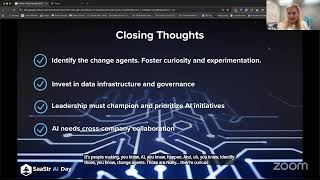
Just a few closing thoughts here on a summary from the conversation. Again, we talked about people a lot. In the end of the day it's people making AI happen and identify those change agents. Those really, they're curious, you know, to lean in from, from all your different departments and have them kind of lead the way. But at the same time it's so important to have a top, top level endorsement and engagement. You know as well, again there's no AI strategy without a data strategy. You need today to have all your data unified in one place in a governed in order to build this AI experiences and on top of your own enterprise data. And also again, leadership really needs to put AI as a top priority. I also advise some companies sit on board of companies and there are some companies where the leadership mandate doesn't come from a leadership level and nothing is happening in those organizations. The CEO really need to say this is one of our top priorities for the company.
Yeah. And for those who missed it, Sridhar actually did a session at our last S3 annual event, so I dropped it in the chat if you guys want to go back and watch that one. He also talks about AI. It's a really great companion piece to this one if you haven't seen that one yet. And then I know we're just at about time. And so for folks who have missed anything in this deep dive or want to learn more, just a reminder, Chris and Denise just put out the book Make It Snow so you can grab it now. It's available everywhere. You can Amazon it. It's makeitsnowbook.com I dropped it into the chat there for you guys. And with that, Chris and Denise, thank you so much. I know we've had, we've been so grateful to have Denise, you come before disaster annual and street art this year. And it's so great to always hear from the Snowflake team and what you guys are doing and innovating on an AI in the space, especially with data and keeping it all safe. So thank you so much. And for, for any folks that want to maybe get in touch with your team, what's the best way for them to do that?
Yeah, well, LinkedIn is probably the best way to reach me. Thank you all for attending today. We really love the Saster community.
Yeah. Thank you guys both for joining and for those who are staying on in our AI day, go to sastraaiday.com, you can see the next schedule of sessions. And thanks again, Chris and Denise. We'll see you again soon.
Thanks. Bye. Bye.
Thanks.










