SaaStr AI Live: Redpoint's AI Guide to Investing
Jacob Efron from Redpoint, an $8B VC firm, explains how falling model costs and rising capabilities let AI startups scale faster than traditional SaaS. He uses a three-question framework to evaluate AI companies: Is there an effective wedge? How much more can you build from it? Will quality matter? He walks through Abridge and Lagora as examples.
Chapters
AI Live. We do these on Wednesdays. We've been kind of solidly talking about AI for a while now. Post post Saster Annual. And so we're excited to have today's speaker and topic to present to you guys. I know we typically do try and mix up our workshops Wednesdays slash. Saster lives with, you know, B2B SaaS speakers talking about AI. But then also we wanted to do something from the investment side. I know it's been a big question, and so we thought, why not have Jacob Efron, who's the new managing director at Redpoint, to do just that. He's made a lot of AI investments already, which he's going to talk about today. He's going to go through their whole approach to investing in AI. I saw the slides are really good. So without further ado, Jacob, thanks for joining us live today.
Yeah, thanks so much for having me. Excited to get to do this. Big fan of the podcast. So excited to get the chance to chat.
Super fun. We'll let you share your slides, but just as a reminder to our audience in the meantime, if you have any questions for Jacob as we go, drop them in the chat. I'll be back at the end to help moderate questions. We'll do some live, but with that, Jacob, tell us your approach to investing in AI.
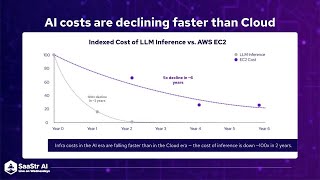
All right, the big question of the day, maybe I'll give a bit of background first on myself, and then we can kind of dive into it. So I'm Jacob Efron. I'm a managing director over at Redpoint. Redpoint is an $8 billion venture capital firm based in Silicon Valley. We've invested in companies like Snowflake, Stripe, Twilio, Ramp, Hashicorp, and I help lead a lot of our AI investing. I also run an AI podcast on supervised learning. So if you find any of this interesting, definitely check that out. But today I'll talk a little bit about what we're seeing in the AI world, how it informs our investments today. And maybe I'll start with some backdrop that I imagine it's familiar to most of you, but maybe help set the context for what we're seeing as VCs. And so to kick it off, I thought one slide that nicely illustrates what's going on is we're seeing a massive decline in model costs today. So what does this slide show? Basically, for a given benchmark of model capabilities, the cost per token of those models is going way down, way faster than it was in the cloud era. And so what I think that means for AI application companies is a familiar pattern where basically we get a set of frontier models that have new capabilities, we discover the wild things they can do, and then those capabilities become cheaper and cheaper until they can kind of be wrapped into the vast majority of products. And so even in the past year we've seen some wild new capabilities from models. Obviously they've gotten way better at coding. I think voice models have gotten a lot better. And that's then spawned a ton of different startups in these spaces. I think the implications of that are, as we think about things, we're super focused on what's the end use case and how powerful is that with AI? And a lot less focused on what do the gross margins look like today. Because these models just get cheaper and cheaper over time. I think the natural byproduct of the, of people playing around with these models for longer periods of times is we continue to just find more and more use cases and get more and more usage of these underlying models. And so what this slide shows is just the insane increase in usage of AI models, which is a lot faster than happened in the cloud era. And we'll talk a little bit later about some of the use cases that are driving this. But I think there's this pervasive feeling in the investment community today that even if you froze the model capabilities, there's trillions and trillions of dollars of applications just waiting to be discovered here. And obviously for some of the most cutting edge reasoning models, we've only had six, nine months to experiment with what these models can do. And so I think over time there's going to be more and more. And what that means is basically the power of these models, the increased usage, the fact that they're pretty cheap, is that when these startups find product market fit, they're just scaling way faster than traditional SaaS counterparts. And so this is some great data from Stripe that shows how fast AI companies are scaling and this pace of adoption, I mean, it breaks a lot of rules about traditional startups. As I, you know, think about some of the classic rules of SaaS investing. It was, you know, maybe don't go against some of these horizontal incumbents or, you know, don't sell into hospitals or law firms or banks. Those are customers that take a long time to buy. But we're seeing, you know, a lot of these rules be broken by just the 10x better product capabilities that a lot of these models are able to provide and like insanely fast scaling. And so, you know, what does that mean is these budgets are only, you know, only going to increase? I think, you know, maybe in the early days post ChatGPT, there was a little bit of skepticism from enterprises about, you know, what some of these models would actually be able to do. But there's, you know, the combination of kind of actual real world impact these models have had, plus just everyone watching the pace at which they've gotten better, I think has led to real deep, deep interest from enterprises. So I think these budgets are only going to get bigger and at the same time, the models are going to get better. Right. And I think with each generation of model improvement, we unlock a whole new set of capabilities. And obviously a lot of the focus now is around models that can do tasks for longer periods of time. Right? And so this slide is really around how long can you let a model go and act and actually execute something? Anytime we get excited or interested in a category, there's 10 plus startups in that category that pop up. And so that is a really interesting market dynamic. The second thing we're seeing is, and I'm sure folks have seen headlines and whatnot, the prices for these companies are definitely increasing. There's a lot of investor excitement. And so we looked at data of all the kind of series B and C companies we'd looked at that were non AI and then AI. And as you can see, the AI companies, they're raising larger rounds, they're raising those rounds at higher prices. Now, admittedly, a lot of that is justified by the higher growth rates that these companies have, the kind of step change in adoption. But these prices and the sheer number of companies definitely make for a challenging investing landscape to navigate today. And so maybe I'll share a few observations on the broader market before I talk about how we think about navigating all this. The first thing I'd say is these products are hard to build. Yes, there's a lot of companies that we see in each space, that 10 plus in each category. But I would say a common trend is that in any category we look at, there's really two to three of them that rise to the top and they're providing a better user experience, they're scaling faster. And I think the reason is, as you'll see on this slide, of the many things that application companies have to get right, there's not a ton of tooling that exists for a lot of these problems below the line here. And so companies are building their own scaffolding around the models and, and with the pace of model progress, that scaffolding has to change. Really quickly. And so it's actually quite challenging to build effective AI applications. And we see a real difference in what some of the best companies are able to do. The second point I'd make about investing in the space is our thinking on what makes an interesting application company and what application companies need to do evolves over time. I feel like there's just, just a fire hose of new progress in model advances. And it's important for us to have strong opinions on what makes for interesting AI applications, but we have to loosely hold them in this period of rapid change. And I think maybe one example of this that could be interesting is the idea of building and fine tuning your own models for a specific domain. Immediately post ChatGPT, there was all this buzz around, hey, you know, enterprises sit on tons of data. What if they pre trained a really large model that was specific to finance or law or health care? And so famously, I think Bloomberg trained a model, Bloomberg that outperformed the latest OpenAI model of the time. And then three months later OpenAI shipped the new model and it was way better. And I think that consensus has kind of been, hey, you know, massive pre training for an individual domain doesn't make a ton of sense. And for a while even fine tuning was somewhat effective, not super effective. And it felt like the game was all about just building really good workflows on top of the model APIs. But the market does evolve and in the Last few months OpenAI shipped reinforcement fine tuning, which is a new way of fine tuning that they offer and it's actually quite good. It actually is starting to seem again like being able at least to not pre train, but fine tune data on a specific domain could be really helpful for a lot of these application companies. And so it's just a constantly changing and evolving landscape and one we're always trying to stay on top of what's happening. I think one of the most important things as we think about what's happening is what's actually working. And so maybe to kind of hit on what we've seen really work today. I'd say broadly there's four types of applications that have, that have real fit and then we see them applied in a ton of different ways. The first is chat. If you've used ChatGPT, you're certainly familiar with this, but it's a great use case for these. LLMs works really well in the customer support space. The second is the ability to basically search over documents and summarize those documents. And so you've seen that in the Horizontal space with companies like Glean, but also in verticals, Legal AI companies like Legora or construction companies like Trunk Tools. And then these models are really good at speech to text and text to speech. And so you've seen that in the healthcare space, companies like Abridge that are transcribing medical visits, as well as companies like Liberate and Assort that are doing kind of the front door of insurance brokers or medical clinics and being able to field more calls than folks could before. And then the last bucket is coding. These models are unbelievable at coding. They're only getting better. You've seen the explosion of companies like Cursor and Cognition, Poolside, sourcegraph, a whole host of companies in that world. And so I'd say to date the categories that feel like they've worked best are coding, customer support, legal and healthcare. But I think we're still just in the very early innings of applying this amazing set of capabilities to a ton of different end industries. And so there's inevitably going to be a bunch more applications or end industries that emerge over time that have great use cases with these model capabilities. And then the thing that we're always thinking about is every few months it feels like the models get better. So what's the set of use cases that's going to get unlocked as these models get more reliable? They have longer term reasoning and memory and we're constantly trying to figure out what that set of applications is. And so I guess the theme of this was our investment framework and how we think about investing in the AI world. And so I thought I'd put together kind of a simple three part framework. As a former consultant, it always has to be three, but kind of three questions we're always asking ourselves as we're evaluating these applications. So the first is is there a really effective wedge for AI? And I would say that generally the bar for what product market fit and what an effective wedge looks like has gone up in AI because you've just seen explosive growth for companies when they do have them. And I think there's this interesting thing we see in AI today where there's clearly a huge top down mandate for companies to invest in AI. Boards are telling their CEOs what are we doing in AI? So there's a lot of willingness to experiment with AI products today. And I think one of the key things we have to do is when we see a company that's growing really well is this just, hey, a company's messing around with what AI can do. And maybe this is something that they adopt. Maybe it's something they don't adopt, but they're willing to pay some money just to see what the product does, or is it something that the end users really love? And so we're always trying to talk to the folks who are actually using the product and figuring out is this a game changer or not. And you can really tell. There's just some products that people absolutely love. And as you think about this kind of race to be, I think there's a race right now to be the strategic partner to hospitals, to law firms, to banks, to insert any kind of company. And I think a key part of that race is finding the right wedge where AI can just deliver a 10x better experience, a killer use case that everyone just loves using. So we really look for that. And that's kind of a prerequisite to us looking at any kind of company. The next thing we do is we think about how much more a company can do from this wedge. There's a few things behind that. One of them is I think in larger industries there's generally more that AI can do over time. And so we like kind of healthcare, legal, finance, large industries versus some of the more niche ones. And then I think also there's a question of are there 10 other use cases within this industry that this set of models is really well poised to go automate? And so I think that one way you could think about this is there's lots of great wedges that exist, but maybe in smaller markets. So you could imagine. One thing I would love is I'm sure you could make a great AI product to write sourcing emails to reach out to a bunch of companies. For venture capital firms, this would probably be a great wedge that could get you some initial scale pretty quickly. The issue with that, obviously is there's only so many venture capital firms, that industry is only so many, so big. And at least today it's not totally clear what else models could do within a venture capital firm. Maybe they could do a bunch. I'm sure over time they'll replace plenty of what we do. But at least today I think that's a great example of a potentially very compelling wedge that doesn't actually translate into a really interesting company to invest in. And then the last bucket I'd say we think a lot about is the extent to which quality will matter. The reason this is important is, like I said before, in any category we look in, there's always going to be a bunch of players building there. There'll always be Somebody who's going to say, hey, for 10% of the price, we'll sell something that's 50% as good. And the markets that are most interesting are ones where you would rather have the higher quality product. Maybe an interesting observation has been that in some ways some of the easiest things to sell AI products to today or Automate are things that maybe have already been outsourced that business processor organizations are doing already. The interesting thing about that is they might actually have a real race to the bottom in pricing. We're really focused on things where quality of the end application really matters and people will pay for best in breeding. And so I figured it'd be fun to take these three questions and take a look at how they apply to a few investments that we've made in the AI application space. So there's two that I'll talk about that on the board of One is a healthcare AI company called Abridge and the other one is a legal AI company called Logora. So let's start with Abridge. Abridge. We co led their Series C. They recently raised a series E at $5.3 billion. It's an incredible company. What they basically do is they offer a product that records a visit between the doctor and patient and then transcribes that visit into the electronic health record in a way that the doctor doesn't need to spend a ton of time writing the note themselves. The insurance company gets the information on what happened in a way that is effective for billing. And the patient gets the doctor's attention as well as can kind of get a summary of what happened in the visit. And this is, if you think about that three question framework on the wedge, you're not going to find a better wedge than this. It is like truly an incredible AI use case because doctors used to have this thing called pajama time where they would spend, you know, three hours at the end of a really busy day just typing up a bunch of notes late at night in their, in their house in their pajamas. And it was one of the things that was just leading to massive doctor burnout. And so for the doctors, this is really a total lifesaver of not having to do this extra work and being able to focus on the patients in front of them. For the patients, have you ever been to a doctor's office and they're typing away at their computer the whole time not looking at you? It's a way better experience when the doctor is able to focus on you. And then for the hospitals themselves, the ability to correctly Document what's going on and then get paid for the services they provide is also really interesting. And so this is a use case that has just spread like wildfire. And if you talk to any doctors that use a bridge, I've never heard people speak so positively of about a product. And so incredible wedge. What also makes Abridge a really interesting company is there's tons to build on top of that down the line. And so Abridge's CEO Shiv Rao always says that everything in healthcare flows from the doctor patient conversation. And it's totally true. And Abridge is basically creating this net new data and they have an amazing opportunity to just build a ton of interesting products on top of that data. And I think what Abridged us so effectively is they sell this scribe product that's here today that people love, that works, but also paint this really compelling future vision of all the different things that they can do down the line and then that third bucket on quality. I think healthcare is totally a space where quality really matters. I mean, who would want to go to a health system where they said, hey, we're using the cheap AI that's 50% as good, but 10% the price. Health care is really a space where quality matters. And I think Abridged has done a really great job of kind of leading the science of what does it mean to have a high quality medical AI product And how does that, you know, how does that basically, you know, how do you evaluate whether these products are hallucinating, whether they're recalling everything that's happened in the visit correctly? These things have major consequences if they're done wrong. And so I think they've done, you know, a really great job doing that. And basically in being early to build these products, getting cutting edge science, they've really gotten an incredible distribution flywheel going, which has been fascinating to watch. And I think it's a great example of a really successful AI company. The second company I want to talk about is a legal AI company called Logora. We led the Series A here. They recently raised a great Series B. What Lagora basically does is it's an end to end platform collaboration platform for lawyers where they can review all of their kind of documents and work they're doing. They can draft and compose net new legal documents as well as do kind of research on whatever it is they're digging into. And so I think again, if you go back to the three part framework, what makes Logora so interesting is this wedge is really compelling. There's some things that models do really well. We talked earlier about search and summarization. Kind of bulk document review is a really good fit for models today. Research over a bunch of different cases or documents as well as kind of drafting and writing. So a great wedge that lawyers find a lot of value in today. And then I think over time there's clearly a feeling that, hey, legal is this text in, text out space. There's going to be more and more that models can do over time and that it feels like this is an industry that's fundamentally going to change with AI. And there's a lot more that a company like Legora can do. And then similar to abridged, that third question, quality really does matter. The top companies in the world, the leading private equity firms or tech companies, they use law firms and they want their law firms to be using the highest quality tools, right? And so again, whoever builds the best product in this space, I think really has a right to win that category. And it may be an interesting data point for our listeners. I mean, one thing I think is fascinating about Lagora is they've been a really successful second mover in this space. So Harvey was really the first company in the legal AI space and Legora started afterwards, but has really caught up and built an incredible product. And I think what's enabled that is a few different things. One of them is we're still in such early days of what these legal AI products can do. I think today whatever these products can do is probably 5% of what they'll be able to do down the line. That there really is an opportunity for a leapfrog as these capabilities continue to improve then the second thing that was interesting is one of the challenges of coming to market later is sometimes people want to pigeonhole you into, hey, we already have an end to end solution. You just do this one thing or that one thing and it's hard to build an end to end product when you do that. Logora is a team out of Sweden and because it was started in the Nordics, actually had a real opportunity to, early on in the company's history, work with these leading Nordic law firms and build out an end to end product there. They were able to build this really effective end to end product and then bring it to the rest of the world. And I think as we think about what makes for really effective teams in the AI space, the Lagora team is about the fastest team you can find in terms of just shipping new things, getting the capability of these models into the hands of their customers and building just really compelling workflows on top of the models. And so these are two amazing AI companies we've had the privilege to partner with that really, I think, fit into this overall framework. And so before opening it up to questions, maybe I'll just end with some basic thoughts on some of the things we've learned so far and seen in investing in AI applications. The first is it's amazing how fast people can build brands and become almost incumbents in the AI application space. And just the compounding advantages that come to that. And so, you know, if you ask someone on the street name an AI coding company, they'll probably say Cursor or Support Sierra or Healthcare or Bridge. And that's, you know, it's just amazing to see how fast these companies can move and build those brands. The second thing I'd say is, you know, velocity is probably the most important thing we look for. The market just changes so fast. And it's both a race to build the sheer breadth of all the different things these models can do for end industries, but then also a race to, hey, a new model or new capabilities come out. How do we figure out how to translate whatever GPT5 can do to an end industry? And teams that are just shipping incredibly fast have a real advantage in doing that. It really compounds over time. And then the last thing I'd say is a lot of what differentiates these products is really the thousand little things that make one product delightful to use over another. So it's the UX that's way easier to use. It's latency that's way faster. So every time you're doing a review, it comes back quicker. And the interesting thing we've commented on as a firm is that in many ways, a lot of what makes AI applications really strong is similar to what we looked for in SaaS businesses in the past. And I think over time, a lot of these companies have only been building on these models for a year or two. As they're building out for four or five years, I think a lot of these differentiation that we've seen in the SaaS world of really products that are just delightful to use and are really industry favorites, I think that will only continue to compound as folks build longer. And so with that, I think building out for four or five years, I think a lot of these differentiation that we've seen in the SaaS world of really products that are just delightful to use and are really industry favorites, I think that will only continue to compound as folks build longer. And so with that I think that's kind of how we think about things generally. Would love to open up any questions that folks have.
The wrong button. Thank you for that, Jacob. Super helpful. There's a few questions in the chat and I'll kind of help, I think frame them in a way that is more helpful for like broader categories as well. A few things you mentioned here, let me stop your screen sharing so you're bigger. There you are. Okay.
Okay.
Awesome. Okay. Yeah, thanks for that. Okay, so first thing I kind of want to question you on is so on the last slide, I know we typically start intros on like, who have you guys invested in lately? Ligor is a good one. I'm glad you mentioned the Europe portion of it because I think that's an interesting differentiation. I know Harry and Rory have talked about it on their on the 20 BC podcast too, about Lagora. Do you feel. Because I want to tie it into like security, which there are some questions about like more broadly, like do you feel like because they were started in Europe, they actually had to go through more like security protocols at building an AI company than maybe companies you see now that are building in the us?
Yeah, no, it's a great question because I do think this, you know, the ability to be enterprise ready and obviously, you know, these enterprises that use these tools are taking huge risk. Right. In bringing these tools into their environments, into and letting their people use them on a day to day basis. And so I think it's hugely important that the application companies that are building in these domains are incredibly focused on both building that into their products and then also providing visibility for the companies themselves that are using them. And I think, I think the Lagoa team has always been super focused on this, whether that is a Europe specific aspect of it or just the fact that ultimately large law firms are incredibly focused on this. And so by necessity from day one, it was something the team had to get right.
Yeah. Another related question here in the chat is how are you balancing now? Like we've worked with Redpoint for so long now. You guys have come to so many Saster events and done like podcasts and different things with us. Like how are you guys now thinking about the balance of investing between, let's say maybe more traditional like B2B SaaS companies versus ones that are like AI first. Like I would argue Lagoa and a bridge or AI first. Yeah, Yep.
Yeah, no, it's an interesting, it's an interesting question. You know, I think one, one maybe funny anecdote is that for A While in our CRM, we used to like, distinguish between like, we're like AI companies, you know, and this one's a SaaS company and we've now collapsed that distinction. And so it's almost meaningless at this point. Like any SaaS company is building, you know, they're all kind of building their own AI features, right? And certainly, you know, you have companies that have come of age in this AI era and maybe are moving faster or leaning into that more. But, you know, I think there's, there's tons of, you know, any, any kind of more traditional SaaS company we look at is still figuring out ways to, you know, to, to give AI to their end customers. And so, you know, I think that on the application side we're, you know, we're, I think almost any opportunity we look at, whether it was founded post ChatGPT and is purely like, you know, an AI wedge or maybe is a company from five, 10 years ago that has incorporated this stuff in AI is definitely a part of the story. And so I think that, that, you know, I'd say almost universally that is true of the application companies we invest in.
And to put it maybe more high level. Do you think it's a red flag? Like, if you, I'm sure you get a lot of pitches, maybe you can share roughly how many you get now in the age versus before. Do you think it's a red flag if you get pitches that don't mention AI at all? You're like, I'm not even going to look at this one.
I never hold rules that, that, that, you know, that, that solidly. But I would say, um, I think.
If you, I'm sure you get a lot of pitches, maybe you can share roughly how many you get now in the age versus before. Do you think it's a red flag if you get pitches that don't mention AI at all? You're like, I'm not even going to look at this one.
I never hold rules that, that, that, you know, that, that solidly. But I would say, I think there's, I think it would be a red flag if the team hadn't deeply thought about, you know, and there's, I think it would be a red flag if the team hadn't deeply thought about, you know, and tried like, hey, what can these models do in our domain now? Like I said, it's, it's very possible that you have a really sophisticated vertical SaaS company. They've looked at a bunch of different, you know, applications of AI. They said, hey, some of this stuff is, is 10% helpful or 20% helpful, but it's not actually tried like, hey, what can these models do in our domain now? Like I said, it's, it's very, maybe there isn't a 10x use case yet in our, in our domain. And that's, you know, that might be the case. Like I think, you know, despite all the hype around AI, it's not like in every industry already there's some AI application that scaled incredibly fast and found this amazing wedge. But I think the risk of, you know, of not thinking about that stuff is over time as the models get better, there will be a 10x wedge from AI in pretty much every industry. Right. And so, you know, these companies would risk being disrupted by someone that was doing that and if they're not keeping their fingers on the pulse. But there's, I think it's totally legitimate that maybe that 10x opportunity doesn't yet exist in a certain end industry.
Yeah, makes sense. You mentioned something on vertical SaaS I want to dig into which we've been talking about this a lot on SaaS for two, from your perspective as an investor. Would love to get your take on this. Do you think there's risk of just vertical integration after vertical integration by the bigger model providers? Right. Like the openaisanthropics, the Google's, the Jet. Like, do you, I mean we've already seen it a bit, right? Like OpenAI has all these different features and agents that they just keep coming out with and you're like, oh, I had a separate app for that, that was just a vertical tool. Like, how do you think about this? Like vertical integrations as an investor?
Yeah, like the risk of the foundation model companies just kind of building. No, it's a great question. I think that like, you know, I honestly think that in many ways the vertical AI applications are, having seen a bunch of them, I think are pretty safe from the foundation model. I think having seen just the amount of work that is required to take these models off the shelf and make them actually work in a domain and all the domain specific context that's required to make those work, the integrations that are specific to that, just the bodies on the ground training people how to use these tools, I worry a lot less about the model companies just out of the box being able to do a lot of things these companies do. Because I think that so much of the magic of these vertical AI companies is tailoring what these models can do to the specific workflows of how these different places work. And so I think one of the reasons that I think investors are so interested in vertical AI is it feels the most protected from the improvements in model capabilities.
That was interesting.
I think the horizontal tooling is much more in the strike zone of what models can do.
Horizontal tooling is interesting too, because I feel like none of these, having used maybe 10 of them now, and we use maybe 10 on a daily basis at sales or at scale, like none of them talk to each other. I don't know if you've seen this too, as an investor. I don't know how many tools you've seen that will finally aggregate all these desperate tools and softwares together, but it's the number one problem we see. Like, I asked her, like, I don't know how many tools you've seen that will finally aggregate all these. Like, I talked to a lot of CMOs, zeros, VP's, of sales, CEOs even, and that's their desperate tools and softwares together. But it's the number one problem we see, like I said, they're like, okay, we, oh, like we're going to maybe copy some of the tools Sasters using. We found these other tools we want to use. And I'm like, yeah, but then you end up with 10 totally.
Like, no, I mean, I think that's certainly the case today. And I feel like, you know, look, a lot of the horizontal software companies are pitching, you know, hey, we're, we're getting in the organization with this and we're going to, you know, everyone agrees that over time, either, you know, through one company kind of driving a lot of enterprise use cases, or just like, you know, through MCP or something else, just an easier ability to share information. These applications all need to work together in a more seamless way. But then you've also seen things like, you know, what Salesforce has done with Slack and it's not totally clear that everyone is incentivized to so, you know, talk about things we pay attention to as investors. I think how liquid this data is going to be within companies is, is going to be fascinating, right? For the opportunity startups have.
I think data and security is like maybe under discussed in this AI era. I know we've talked about it a little bit more. I've talked mainly on the data side. I know Jason has talked more on the security side of, of AI applications, but everything we talk to and all the tools we use, there's so much data you need to either feed into it or it's also going to start collecting the moment you turn it on that is a little bit scary. You're like, okay, do I need one, all this data even just to get started with like practical AI tools and models for my company? And two, now that it has all this like what do I do? Like it makes it. It's a little bit of a moat in a way that like it's harder to turn off these AI products like if you already get started with one or you know. The reason I think Salesforce has had an early lead on Agent Force is they have a lot of data already. Like they already so much of your sales data, so much of your customer data. That's their kind of like incumbent advantage is they already have your data and those signals versus if you go to a new separate company to do some of this, they don't have any of that. They're probably going to want to plug into. Salesforce might not like probably won't do it because Salesforce has their own thing. Right. Like that they're trying to do. And so it becomes just like an interesting mix of we. Most people I would say today that I, we've talked to end up with so many different systems.
Yeah, no, I mean I think that's certainly true because these models are incredibly hungry for context. Right. Like any context you can give them makes them perform so much better. I mean it's like, oh like a rule of thumb. It's like if you think about it just like as another employee, like imagine asking one of your employees to execute all these tasks with no access to Salesforce. They could be, you know, the greatest go to market person in the world. And if they don't have access to anything specific about your accounts, how are they going to know what to. What to target one of your accounts with? And so I think that will definitely to be successful. These applications need access to both the context of how an organization does its work and then the data within that organization to feed into these models.
Yeah. Let me try and hit a few more questions on the chat before we run out of time. I wanted to selfishly ask you those.
Yeah, please.
To dive back into some of our themes. Quick question from the chat. Do you feel like fresh AI companies will overtake any of these like vertical fast companies that can maybe innovate faster than let's say like a Lagora or, or in a bridge like ones that.
Are started after them?
Yeah. Like would you invest today like in another vertical, like if something came along in healthcare or legal that was seemingly better, would you invest?
Well, I'M obviously a firm believer in abridging Laguaro, so I would not invest in any competitors to those two specifically. But I think the broader question of, you know, he is, I think what's fascinating about this AI era is every 3, 6 months can kind of be almost like an existential event for any company, not even just an AI company, because of this improvement in model capabilities. Right. And so I think for any of the leading AI application companies, it's essential that they're always the fastest and most effective at translating whatever the latest model capabilities are to those end customers. Like, we're going to get GPT5 soon. And let's say there's an amazing thing that GPT5 can do in the finance space, right? And Bloomberg and some of the incumbents are slower to figure that out, and someone new figures that out and builds a great product that's a great wedge for them to now suddenly get the chance to compete. Now, it doesn't mean that whoever uses the model most effectively will win, but it at least provides an opportunity to get in the conversation. And so I think anytime a space is changing this fast, that's why I keep going back to just the velocity of these teams is so important to always be at the cutting edge of what these models can do for their end customers.
Yeah. Related question, right? Because you're personally deep on vertical SaaS is how you must have maybe let's say a few hundred look or is and a bridges came up to you before you decided on those two. It sounds like speed, innovation are quality factors for you. How much of that also plays into the founders at the end of the day, are you like, okay, some of, let's say two of them look super similar. I'm just going to bet on the founders because there's just too many AI tools now. Like, how do you like, what's your final kind of like, differentiation?
Yeah, I mean, the founders are more important than ever. I mean, to be clear, as I said in the conversation, I think anytime we look at a space, there is definitely differentiation on you. Talk to end users that have tried these things or compare them to each other and you can do all your customer calls and figure out, hey, this one seems like it's really the best product in the space. But also like, because of how fast the space develops and because of how competitive these markets are, everyone feels like, hey, there's going to be an iconic health care AI or legal AI company built. You're going to get a lot of smart people coming into the space. Right. And so, and like I said, you know, I think for both these companies, what they do today is hopefully 5%, you know, not even of what they do over time. And so you're really betting on a team that, you know, there's a few things that team has to be exceptional at. One is just, you know, obviously the speed of shipping and covering, the just breadth of all the things that models can do in a category they need to be exceptional at this marrying of like, here's what the models can do today and here's kind of the journey we want to take you on and how do they kind of get enterprises to go on that journey with them? And then obviously, I mean, there's never been more intense for talent these days. Right. Like the people, great engineers can go work at a whole bevy of incredibly exciting startups. And so the ability to bring that talent in again, I don't think any of this is like, I think you would have said something similar five years ago if you were talking about a SaaS founder, but it feels like it's all just amped up in an incredibly more intense environment. And in the case of those two companies, lucky, you're not going to find better founders than Chip and Max. So that definitely is a huge part of what got us excited about investing in those companies.
Yeah, makes total sense. Next question from the chat. How important would you say a moat is to today?
It's a great question. I think the reality is we may have somewhat unrealistic expectations around moats. So like I was saying earlier, if you think about the reasoning models, they've been out since what, like September, People have been building on them for nine, 10 months. In SaaS world, nobody would say, hey, after nine, 10 months of building a SaaS product, like, you really should have this defined moat. I think it's really important that there's a path to a moat and that this isn't. And I think that's why we talked about quality and some of these other things that might help you. There's all sorts of other creative ways folks are building moats and I think it's important that you can see that on the horizon. But I think it's unlikely in such a short period of time that there's going to be. And these moats are often at this stage, the thousand small things that they don't always sound the smartest. I'd much rather converse and be like, the reason there's a mode is they train the best model and no one else can do that or they have data nobody else has. And I think in the early days of AI everybody wanted that to be the story, but it turns out again, training your own model, certainly pre training it, not helpful. Yes, you need data to fine tune, but it's not actually a ton of data. And so a lot of people have access to that. And so in many ways the differentiation that I think will continue to compound is like these thousand little things and then what you can do as you get scale, partnerships, other things like that.
There's two more in the chat I want to get your, your take on before we run out of time. And then we'll, we'll ask you at the end how folks can reach out if they have more questions. Yeah, and maybe we'll do a follow up at like the end of the year because some of this changes. So.
Yeah, and then we'll see, we'll see how many opinions. Like I said, you have to have the strong opinions but loosely held in AI world. So we'll see what, what, what changes.
It changes overnight. Man, this is a fun one. Do you think AI in marketing is so saturated? I think this is a fun one because I actually haven't seen and you guys can feel free to blow up my LinkedIn box and prove me wrong. I haven't seen a really, really great AI marketing tool yet that can do, you know, like I haven't seen a really, truly great one that could write the email, sort my contacts for me, figure out the best time to send that marketing email. As far as I know, I haven't seen that yet. I don't think it exists yet. So I want to get your take on this one. Do you think AI marketing is saturated? I don't think so. But what do you think?
I'd say definitely not saturated. Right. I mean you can kind of tell just by like the, you know, I feel like we're, they're still so early in like which of these tools people are actually using.
Oddly early. Yeah, yeah.
And I think that like, and there's whole new categories that are, that are popping up. Like there's this entire new category now of like basically the equivalent of SEO for, for ChatGPT perplexity. And this is an entirely net new category that's starting great companies like Profound and Bluefish and Folks building in that world. And so I think there's both new categories of marketing that didn't exist before. But I don't think I would say that's one of the categories I'd categorize is actually still in the early innings. Not that there aren't a million companies that are building in that space, but it's still very early in terms of what's broken out.
I'm with you on that one. I'm with you. I also think they're. Yeah, I'm with you on that. I, I do think a lot of them and what I have seen is like, promising, but none of them are quite there yet. And it's crazy to see, you know, Lagoa and Abridge are so almost seemingly so far ahead for market. I don't know what it is about marketing. It feels more behind than sales. Vertical SaaS, customer success. Somebody help us. Marketers, we're all behind here. Okay, last question. Question before we gotta wrap. If you had to invest in a. Let's say this is from the chat. If you had to invest in a pure AI company that was a new company, or you have the chance to invest in a mature industry leader, like an incumbent that's going heavy in AI, which would you choose?
Yeah, it's definitely context specific and I think there's opportunities we've liked in both those categories. But I would say it has been surprising just, I mean, it's the classic startup thing, just how fast you can move as a startup when, like, you are laser focused on like the set of products that, that are newly enabled by AI. And so I think maybe relative to two years ago, you know, in the beginning of this generative AI wave, it felt like, hey, God, these incumbents are so well positioned to layer in these products. I would say over time, you know, the last few years, startups have just done a wonderful job moving really, really quickly in putting this stuff in. And so I'd say, like any good VC investor, probably a slight bias toward the startup world though. Certainly. I mean, incumbents, some of the largest tech companies have done a wonderful job of getting this stuff in.
Fair enough. All right, I know we had some more questions in the chat, but we've got to run. So for folks who want to reach you, I get with a question, let's say namapish. What's the best way to reach out with questions to you and your team?
Yeah, so my, my email address is just jacobpoint.com, really easy one. And yeah, if you found any of this interesting, I'll plug.
Sorry, you're going to get some pictures now from that.
Yeah, that's fine. And I'll plug if you got any of this interesting. I do host an AI podcast, Unsupervised Learning, which you can find if you just Google unsupervised learning Redpoint. And we talk about a lot of this stuff. So, yeah, this was a ton of fun.
No, it was ton of fun. We'll have you back again. This is so fun. We'll get an update in a few months, see where we're all at. Maybe like at the end of the year. We'll check in with you again, see where we are heading into 2026. Thanks so much, Jacob. This was super fun.
Thank you. Thank you so much. And thanks.










