SaaStr CRO Confidential: Founders Fund Partner Sam Blond + Gong VPS Jameson Yung + Jason Lemkin
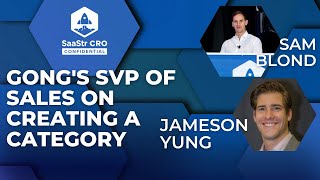
A recorded SaaStr CRO Confidential panel (Dec 7, 2022) featuring Sam Blond (Founders Fund partner, ex‑CRO Brex), Jameson Yung (SVP Sales, Gong) and Jason M. Lemkin. They discuss how Gong created a new sales‑tech category (rapid time‑to‑value, low deployment friction), go‑to‑market choices (pilot vs PLG motion, hiring senior reps, strong content/brand), lessons learned vs competitors, and tactics for managing sales teams and renewals during economic downturns.
Questions this video answers
December 7, 2022.
Generally set up in 30 minutes (time to first value within 1–2 weeks).
Gong had "10 years of Runway plus" (company stated financial position).
Moving away from a pilot/business-assessment motion toward a more PLG-like approach; they later reverted to pilots.
Chapters
Foreign.
Welcome to episode three of the CRO Confidential series. I'm Sam Blonde, your host. I'm currently the new partner at Founders Fund, investing in primarily B2B software companies. Prior to joining Founders Fund, I was CRO at Brex for almost five years. Today we have two incredible guests. Normally we stick with one, but one very special guest here to boost the ratings. We'll start with the first guest, Jameson Young. Jameson and I have known each other for nearly 15 years now, which is crazy. We started as friends in San Francisco. He joined me at Echo Sign, where we sort of competed as reps number one and two on the team for closing Echo Sign business. I was fortunate enough to have him join me at Zenefits for a number of years. And now Jameson is the SVP of sales at Gong, a company most recently valued at something like seven and a half billion dollars, where Jamison leads the entire customer life cycle for the majority of Gong customers. So acquiring customers and servicing them. Really excited to have you here today, Jameson, and welcome to the PODC podcast series.
Glad to be here. It was very uncomfortable for me to hear you say that. Many nice things about me in a row. I appreciate it.
All true. And, you know, tough act to follow, but if there's anybody that can do it, somebody that we have known for as long as Jameson, you and I have known each other. I've known Jason. We referenced Echo Sign, of course, the CEO of Echo Sign, the leader of Zaster. So excited that you're able to join us today, Jason, and thank you for being here.
One quick anecdote just for fun, and then I'll be more of a wallflower. But I remember after we were acquired by Adobe, Sam, I think you inherited about 20 AES from Adobe, right? Something like that. Right. And I remember Pre Gong, you made this comment to me one day. I'm like, I can't believe what these guys say on the phone. That's so terrible. It was like an epiphany for me and Saster of like, understanding what these broader teams do, that like our quad, the quality had declined. Like you, it was. I think this was Pre Gong. So I don't know how you listen to their calls. I'm curious, right? But that was the moment when I realized this, this category, and obviously GONG has a lot more surface area today than just listening to. But that, that initial idea was transformational. When I heard you say that, you're like, oh my God, they send the dumbest emails and they say the worst things on customer calls. The dumbest Things.
Yeah, well, you know, pre Gong, all that you could really do is join calls live.
Yeah, shadowing.
And the thing that you're referencing, Jason, that was a huge takeaway for me is it makes such a huge difference which sales rep gets the lead in terms of the probability of that deal closing, like you would think, is what matters. But there is so much variance across the team that the customer experience or the buyer's experience can be radically different despite the product being the exact same product. And so, you know, attempt to. And has a. A huge impact on leveling the playing field a bit there.
I mean, the scary part is those are only the things that they were dumb enough to say while you were on the phone too. I'm sure it's even worse if you weren't there.
I can't imagine.
Yeah, they were.
They were certainly trying their best. So I think that perfect, perfect segue, the thing. So back in the days of Echo Sign and even in the days of Zenefits, there was. There was this tech stack that existed for within sales and that sales leaders would implement. And it included things like, you know, CRM and tools for prospecting that had contact information and a number of these different. Just sort of like staples that came along with the tech stack. And when I think of gong, the first thing that comes to mind is better than any company I've seen over the last, let's call it eight to 10 years. Gong has really become now a staple in the sales tech stack for tech companies. And for you all, you really created a category here. You're not an alternative to a CRM. You're not one of these other types of companies. And so you really did this creating a category as well as anyone. I'd love to learn what you think you all did well at GONG to be so successful at accomplishing this.
I mean, appreciate that. And I think you're right. I think we did create a. We had to create new spend, essentially. Right. It wasn't. We didn't replace something else that people were using previously. Thankfully, all the things you guys just described were problems that people needed to solve. I think we did a decent number of things. Well, I think one is what we talked about a minute ago, which is I do think that we had a very compelling story early on on why, like the current world was broken and it's based on opinion and why it didn't make sense. I think we had a really strong content engine early on as well with young labs, which I think was helpful to kind of proliferate through LinkedIn. But honestly, if I'd say there's one thing that we, that was most important that we did best, it has to do with the product that we had. We have this product that has this very short setup time. I mean, this can be set up in, generally set up in 30 minutes. And the time to value is so fast. And so you could, you could turn this thing on and in a week or in two weeks, it could tell you answers to questions that you've never been able to answer before, right? Like understanding what your real competitive set looks like, how it's affecting revenue, all that kind of stuff. And I think that was key because the bar that our sales team was selling to wasn't like, hey, give us a bunch of money for something that you've never used or don't understand. It was more, hey, turn this on, we'll do an assessment of your business, right? And if it makes sense, then we can continue. If not, then don't. But the fact that that bar was so low, it really helped us get into organizations and prove value pretty quickly. That's interesting.
I was going to ask the same. I noted one of the many fascinating things about Gong is it's a budget expander, right. And in the old days when we were working together, I had a rule, this is dated, that maybe you could get 20 to 30, maybe 40% of your salesforce ticket in additional apps, right? So back then, folks were spending 150 bucks in Salesforce, so we had like a 330 to $50 a month window. That was tight. That was tight back in the days because there's only room for two or three apps now. It's like 2x Salesforce and it's an expander. But it's very interesting that maybe that one of the secret sauces is being so easy to deploy that you don't have to have all the budget expansion discussions on day one, do you? To get in there, you can, you can sneak in there by the team being champions before you even ask for the big check. At least in the earlier days.
Well, you could at least, you at least get to push that, like prove value convers to later when, when the value is more apparent. And in the case of us, we actually had enough data to prove the value at that point. Whereas if we had to do that all pre sale, you had to write a check before you turned it on. Like, we just, we didn't have that kind of data set did that.
Sorry to monopolize them, but it's so interesting. Did that in your time, did it flip, in other words? I went, I went the other day to buy a customer support app and I found that all the ones that used to have free trials are now caught contact sales and that's okay because the brands are big. Did that, did that almost Pl. GS motion. Did it fade when everybody uses Gong today? Did you flip it around from a sales perspective?
So we were never like plg as in you like click a button and then we turn on you turn on Gong. It was always talk to the sales team first to turn it on. Mainly because there's a million different things that you can answer with this. But if you're not focused in the way that you. You deploy it and the way you think about deploying it. So we had to, to do some stuff. But I will say we did, you know, a year ago or whatever, if we were more established, we started trying to move away from that pilot motion or that business assessment motion. And honestly it was a mistake and we've gone back to it more heavily now, especially in the current.
That's interesting. It wasn't despite Gong's brand today. Right. Which is dominant. It was a mistake to move away from that ease of pilot motion.
Yeah, I think we got some quicker deals out of it in some cases. But I just, I think that us trying to solve for time to close was the wrong thing to be solving for. It's interesting.
It's interesting.
I'll.
I'll reinforce this concept a little bit with my experience. And Zenefits was similar in that we were sort of creating a category as well. We were displacing and Jameson knows as well as anyone, we were displacing insurance brokers. And Zenovitz did not look like a typical insurance broker. We look like a tech company. And so again like reinforcing this concept of making it very easy to buy. Well, Zenefits monetized through health insurance commissions. And so first of all, we were perceived as sort of like a free product. But the second thing that made us so successful and part of our value prop. Part of our sales pitch was just as easily as you make us your broker and you get to try this incredible software that comes along with doing so. The next day, the next month, 60 days from now, you can go back and sign back over to your prior broker, no questions asked, no cost whatsoever. And so just like removing barriers to being able to use your product when you are in this, creating a new category, not a well established space I think is the primary takeaway from, from Those two examples now, Gong and Zenefits, at least with this crew, how can.
You de risk it? Right?
Davison, since we're so lucky to have you from the very early. I mean, running sales from so early, can I ask. Can I sneak in one question, Sam? Because you're one of the few people, guys like us are some of the few that can be objective. Why did you guys beat chorus? Just being objective about it. I know, I know. I'm sure they're all. And they're. But now you can be more objective about it, right? Because I think the core product, like the very nuclear product, was good at both.
Right.
I mean, both. Both easily could transcribe a call, do a little bit of. A little bit of analysis, sentiment analysis, and send you an email and record your zoom. Right?
So.
So maybe being objective, part of it was the differentiation maybe was modest. Right. At some level. Right.
I mean, you're right. Right. You know, at the time, I wouldn't have said that our products were similar, but at the time I joined, they were pretty similar. Now they're demonstrately different and teams are different sizes, et cetera. But. But at that initial inflection point when I joined, in fact, we didn't even really know what our differentiators were yet. It was like, you know, we. We tried to plug it in and we started trying to figure it out as we went. I think a few things helped us. One is, I think the sales team that I. Early on, I came in and I raised quotas and raised comp and hired a sales team that was, you know, probably a level one or two levels above what I think we originally thought we were going to put in place. And one of the main reasons for that is you're talking to CROs and VPs of sales. You can't have a really junior sales rep on the other end of the phone. And so raised quotas, raised ote. And so I think the sales force that we built early on and the people that joined early to help sell were just. I think we were outselling them. I also think our marketing engine was different. I joined. One of the things that brought me there was this whole concept of sales is not all art. There's a science to it, and we're able to start to expose the science that's behind it, and that's what a lot of the content was. And I think that content still on LinkedIn has just this massive impact. So I do think our brand, even from the beginning, carried a little more weight. Just people now got on the phone and thought that we were like a forester or something and doing content. They didn't realize what we were, but at least they recognize the name a little bit more.
So that air cover, the first one was hire more experienced reps. Right. Which is something we think about. Right. Cause there's pros and cons, but you leaned all in on folks that could confidently sell to a CRO, not the nervous kid. Right. And that played out well for you. Right, well.
And it wasn't the field rep that's in a suit and has been selling for 20 years. It's not that version of I still needed really scrappy people that wanted to come in and figure this thing out. But it also wasn't the you've been selling for a year or two rep. You know, it was in between those two things.
Yeah. And the second one's interesting, which is air cover. Right. Marketing gave you guys good. You looked even bigger in sales processes than you were, which is what a great marketing and sort of effort can do is like, whoa, you're a dominant vendor when you were probably 40 people at the time or something like that.
Yeah. People always thought we were bigger than we were actually back at the time. And you wouldn't correct them. You'd go, yep.
Just don't ask for the financials. Other than that, yeah, we're huge.
No more questions.
My interpretation of what Jameson just said, and correct me if you think this is reaching or something like that, but in an environment where products are at relative parity, like sort of nuanced differences go to market can make the difference between winning and losing.
Yeah. I mean, I think the fact that we won go to market as early as we were, that allowed us to continue to invest in the products, grow the team, et cetera. So it kind of started feeding the differentiation of the product as well. And we figured out differentiation and what resonates because, you know, we were learning that on the phone. I did look crazy when I came in though, and I jumped quotas up suddenly because there were a couple of reps there. I think there were three reps ended up being one that stayed. But because I had to justify that ote, I was like, look, I think we can jump quotas up in order to justify. And it worked, thankfully.
I see you increased quotas so that you could justify paying higher market salaries to the AES. Right? You had, you had, you couldn't. You couldn't wave your hands and just do it with venture capital then. Right. So that was the trade off. Right. But you had to sign up as the leader too, because that had to roll up into your commit, didn't it? There's no free lunch, I mean 100%.
But at the same time, if it didn't work, it didn't work for me. So, you know, whether.
So lots of, lots of things went well in creating this new category. One thing like despite Dong being one of the most successful businesses of this sort of tech generation, as all of us on this call know all too well, nothing is perfect. And what are some of the sort of lessons learned throughout this process? Maybe things that didn't go so well. Anybody that's listening in, in this environment where they're trying to create a new category, things that may save them some cycles.
I mean, you heard me happen to reference one earlier, which is like we tried to move away from a motion that was really comfortable to us at one point and recognize, you know, that moving away from pilots and moving back. So that's one. I actually think a bigger one though for us. From the very beginning when you put gong in the hands of users, they went crazy for it. Like we call it raving fans. But it's like, oh my gosh, I don't know how I operated without this. Sales reps would feel that way. Sales managers, we didn't recognize how powerful that was early. And I don't think we did a good job of, I mean, simple things, right? We would have people that were at one organization and sales people are transient. You know, you stick around a SaaS startup job for a couple years, that's pretty long time. We did a good job of tracking when they went somewhere else and using that to start our new sales cycle and leveraging the fact that we have these power users moving around. And I'd even say one thing that Chorus did better than us is they did a really good job of getting advisors pretty early. I think they got through giving them some equity, but they insert these champions inside of decent sized organizations that would block us out pretty well. And we never did that actually, but I think they did. And honestly looking back, I think that was something we should have done. It would have given us more traction faster.
That's because there's so many stories on the Internet that hey, advisors don't do any value, right, that they just look good on a slide for raising venture capital. But it worked. They literally were such strong advocates for Chorus that they were able to lock you out of some key accounts early.
On, at least early on, early on.
When you're both emerging vendors, right? When no one knows. No one really knows right now.
I have no idea how many advisors they actually paid and how many of them helped them. But, but you know, we certainly saw some that were helping.
Did you guys, on a sales or marketing side when these, when you're these raving fans. And we all didn't realize now that I don't think any of the three of us realized in the early days when we worked at an app with raving fans what it's like not to. Right. That's the, that's the reason you didn't get it is because we didn't know, we didn't know what it was like on the other side. Right. We took it, we thought it was table stakes that all apps, like how could you even sell an app that people didn't love? But it turns out not to be the case. But did you track them through marketing CRM triggers? Did you figure, did you, did you proactively, like have a team go after, you know, champions that change to other orgs?
So we started to get to that point. There's a company called User Gems that, that will actually help you do this. That, that, that I'm not affiliated with in any way. But we used to do some of this stuff. But before we were using them, it was, I mean, we were just using really good SDRs that were hungry and were using LinkedIn to hunt in the right ways and they'd spot it and start those conversations.
My learning from the Zenevitz experience, and again like kind of this concept of category creation was.
A little different.
Could be unique to Zinovitz, but I'll roll with it anyway. So we really embraced this identity of the fastest growing tech company ever, ever. And I remember I'd have had a bunch of in person conversations with people largely in the Bay Area. You know, I work at Zenefits, I've heard of Zenefits. Nobody knew what Zenefits did. And so embracing this identity around sort of like fast growing tech company raised a bunch of money. That was a, that was a mistake. And I think the right thing to do or what to try and do is associate your company with what you do. Had we been known as, you know, the best health insurance broker or the first tech enabled health insurance broker or something like that, it would have been so much more valuable to us as a business because while so many people had sort of heard of the brand, no one knew what we did. And we were associated with, you know, raising lots of money and fast growth, but not with a quality of our product or anything like that. And, Jameson, I think that Gong has done a really good job here where, like, you talked about these raving fans. I know almost no one in the opposite camp. I've never heard anyone sort of talk negatively about their experience with. With Gong. And the first thing that comes to mind for most people is, like, I couldn't live without it. Um, and so I think, like, you know, kudos to y' all on something that Zenevitz probably could have done a better job of just in terms of embracing a different identity.
I think the other place that that showed up to that identity. I agree with you, Sam, that it also showed up in, like, what the salespeople that we hired, like, cared about. Because the minute we started slowing down, you started seeing a team get pretty upset that, you know, I thought they weren't fast growing, that there weren't promotions quickly. And so I think it also showed up in. And the people we ended up attracting and in turn when they started being.
Dissatisfied, I think that's a good segue. So one very topical thing for us to consider. It's a tough time for tech right now. Seems like everyone is talking about the economy. Companies are doing layoffs. Lots of talk about extending Runway. I don't think we will spend much time there or add any color on what to expect in 2020 tech economy. But one of the more conversations that I am having with founders and sales leaders right now is, okay, it's either we've done layoffs or we're in a fortunate position where we don't need to do layoffs. Regardless, quota attainment is dipping across the team. We're missing our company revenue targets in Q4. Morale is starting to turn negative. What should we do? Common conversation. I'm hearing a lot. Would love to learn how you've approached this new environment at Gong.
Yeah, I mean, I should probably preface it with, like, we're lucky enough to be in the group that has not had to do layoffs at this point. We've got 10 years of Runway plus, and so we're in a good financial spot, but just 10 in the current world, at least. We'll see how that world looks in six months, I suppose, but. But I can certainly relate to the fact that Q4 payment is going to be lower than it was in Q1 of this year. And participation from reps, the number of people that are going to be over target is going to be lower than it was in Q1 of this year as well. And I think, obviously we were through the same thing not that long ago in Covid. It was painful and we expected it to persist longer than it did. Ended up being a faster recovery. But either way, you're not sure what the future holds. And still today we're not. And I think one of the most important things is just not to make some massive radical change. You still want to stabilize the team, but at least in our world, it's a conversation with the team to go, hey, we know things are rough. We don't know how rough they're going to be and for how long, but trust us and we'll make sure people are taken care of in the appropriate ways. Unfortunately, I think we've earned that trust because we did the same thing during COVID and we had to make some people whole when it made sense. But we are trying not to kind of do anything that's really hard to undo, like changing people's quotas and changing comp plans that are really drastic. The other one I'd say is that first part's important in order to do the second part, which is once people are stabilized, it's like getting people to pay attention to the things that they can actually control. Right. Like you might not be able to control the fact that a CFO isn't going to sign right now because, you know, the budget's completely locked up, but the inputs that get you there, you can control. And so getting the team focused around those, in some case, maybe spiffing some of those things to get to put extra focus there, but just getting people to look at the things that they could still have an impact on. And then I'd say the last one is everybody wants to feel like they're winning. Your whole company wants to win. And when the winds aren't showing up in the scoreboard, you need to find ways that they are winning and push those and amplify them across the organization. And we did that a lot during COVID We're doing that a lot now too. It's, you know, people are still winning every day. It's just they might not be closing the same number of deals that they were.
Let me ask you a follow up question. I mean, you. It's interesting you compared Q4 of this calendar year, or fiscal, whatever it was, to Q1, right?
Yeah.
But here's what I'm trying to get my arms around. Q1 was frigging insane. Like, we've never seen anything like this in our careers. And I keep saying, having done Sasquare, I think times are pretty darn good. It's just the comps are atrocious. If you Compare yourself to Q1, this is going to look like the world. But roll back. Is this a gong Gong has made is grown so incredibly. Is this really so bad compared to 2019? Right. Is it really so rough? I'm asking you. I don't know the answer, but I feel like people don't have sometimes have perspective because 2021 was insane. It was insane, right?
I think that's true. And I also think that we don't know how every company around you is doing right now. Right. So you might be doing very bad compared to yourself three quarters ago. You might be doing really good compared to your peer set. But you don't find that stuff out usually until either from your board or you find it out retroactively. It's like, oh, wait, it actually wasn't as bad as we thought it was. And so I think you're right. There's some perspective that's missing.
I think you gotta, I think you gotta find out how your competitive set is doing. You gotta do what, whether it's your board, whether it's, whether it's a rogue, whether it's tracking whatever you can. You gotta know how your peer set is doing. Because if you don't, you don't actually know how you're doing in these environments. If you're growing faster than your competitors and you've got 10 years of Runway, everyone should get a Christmas bonus. If you have, if you are 10 years of Runway, hooray. But you are growing more slowly like then your competitive set, you can hide, you can say, oh, it's the economy, but actually you get an F. You get an F, right? You got to know, you got. I know it's not. We kind of forget about this area of competitive intelligence, but I think we got to get good at it in tougher times. We got to know, otherwise we don't actually know we're performing.
My personal experience, both making my personal experience, both thinking about me as a sales rep and then also as a leader. People on the team, folks, have short term memories. And so, Jason, you asked about sort of like 2019 or sort of like steady state or average performance across long time intervals. We may be more likely there. I think it's just people got so used to the performance in the attainment and the, the bonuses, the commission checks from the last. What now has really been sort of like Q3 of 2020. I mean, that's when, that's when the, like the, the crazy performance started. Q2 was this like, and then Q3. And so we're going on two years now of, you know, the boom times or however we want to.
Well, we got soft. Let's be honest. We got. We got soft. We got soft. We got soft. And the folks that are newer have always been soft. I know they think that. I know they think that the woe is me, but they forgot that SaaS is hard. SaaS is hard. It is. Even at iconic companies like Gong, it's always every deal is hard, isn't it? I mean, 80% of deals are hard today.
Right.
And I remember, like, at our competitive set of DocuSign, I talked to this kid in like May of 2020 that joined. Okay. And she said it was the best job ever. She closed six deals her first day. That was a window of time we couldn't leave our houses. Right. And so that's her first sales job. She closed six deals at DocuSign her first day. She'd never done sales before. I bet she closes zero a quarter today, don't you think? Not that it's not a great company, but I bet she's zero. I bet she's zero.
Right?
Funny illustration. I. I wonder if she's looking for a new role. She sounds great.
She might be great. I mean. I mean, I'm serious. This was her first job out of college. It's two years. She could be. But I just think she grew up in an environment where she doesn't understand the frame of reference.
Right.
It's not her fault. But imagine. Oh, my God, SAS is great. I close Dad. I have mom and Dad. I closed six deals my first day.
I think the hard part about that is, like, giving someone perspective is just very, very difficult. Right? You just sound like an old man. It's like an old man. It doesn't work. So if anybody has a good way to do that, I'm very interest.
And back in 2008, Echo Sign, it was. It was harder sledding than 2021 anywhere. I'm sure Echo Sign included 10x.
Yeah, 10x everywhere.
Jameson. So really helpful and insightful answer. Just sort of like repeating what I heard to take away because again, this is like a daily occurrence. Whether I'm talking to a VP of sales, a founder, describing this environment, it's like, what should we do here? Should we change quotas? How should we motivate the team? And my takeaways were like, cooler heads will prevail on this. Don't make a bunch of drastic changes because the change fatigue will Just add to the already low morale, find the wins that are happening and emphasize those wins. One other thing that comes to mind for me that I found really helpful, and it's absolutely true, is that.
So.
Many leaders are born out of the tough times. And you can message that to the people on your team that there will be people that today, this quarter, next quarter, however long this lasts, they step up, they are positive, and they're a positive influence on their teammates. They perform, they hustle, they do these things. And this is a very long game. We are going to go through cycles indefinitely as we have historically. And you have to perform at all times. And so those that perform when times are tough are the ones that ultimately have the best outcomes with their careers. And hopefully a message like that is motivating to the people that see themselves as future leaders.
I mean, effort and attitude are more important right now than they've ever been. You know, an attitude. A lot of that is just how it's affecting the rest of the people around you. It's, you know, I don't know.
Let me catch you one, follow up before I move on, Jameson, to the next topic.
Sam, just.
This is what I'm seeing and I just. When I have a market leader, right, but still an emerging market leader.
Right.
I mean, GOG's not that big, right? I'll give you an example and then I'll ask you what there are there. I've. I've invested in two companies that are pretty. They're. They're adjacent.
Okay.
They're not direct competitors, but they're pretty similar. One is north of 100 million. I think it's seen its growth slow from like 70 to 50. Okay. The other one's at 10 million. It's seen its growth slow to zero. Okay. And I think there's a few root causes of it.
But what I.
One of them, I think is that today when budgets are tightened, they're going to brands, they're growing to brands. Because if you may not, you may have a myopic. And I'm curious if you see GONG as relatively stronger than upstart sales startups. I see a lot of upstart sales startups, newer ones like 10, 20 million, 500. I see them being slaughtered in today's environment. I don't see it with the leaders. I don't see it with the ones that have broken out. I don't see them decelerating to nothing.
Yeah, I mean, I guess it'd be hard for me to have perspective on that. I think it's I think generally you're seeing people pull back on risk. So if you're being perceived as risky then you're probably always in a more difficult spot. Whereas if it's, you know, you're a brand that several of your friends or counterparts are saying, yeah, we use them, they're great, we've been using them, they know the name. I'm sure that's helpful right now.
Yeah. Jason, we talked about this a little bit. Where we may be in an environment where there's cost cutting and in that environment you sort of got to pick and choose who is being cut and there are a number of factors that influence that. I think to your point, hard to cut, we'll use the like biggest sales tool. Hard to sort of justify cutting Salesforce or something like that. That's as a, as a brand as.
No churn at Salesforce. There was no churn in 2008, 2009.
There was none.
But, but NRR shrunk. Right. But there was no churn. There was no churn in the work.
But they're user based models so of course they're NRR shrinking. Right. When you're no longer hiring. Right? Yeah, exactly.
And so it probably, you know, there's, there's sort of like levels to this or a spectrum and Salesforce on one end you have gong somewhere in the middle and then you have this new thing that a sales leader thought would be fun to try six months ago into this new company. They're probably just, just by that nature like higher on the chopping block than the more established brands. Exactly. As you mentioned, that, that, that seems intuitive, right?
I think so. Jameson, has your, has your renewal playbook changed in the last six months? Are there some interesting learnings from like how the messaging's changed for renewals?
I mean, certainly, I mean messaging has changed from, you know, we're going to help you three extra team and onboard faster to how we're making you more efficient. Thankfully we do well at both. But, but the message has to change. I think the other one too is, you know, to what you talked about earlier is there's just a higher bar for value right now and so helping your, your customers recognize the value you're providing that they might not recognize on their own. Right. The fact that people love it isn't enough to keep something right now. And so tying it to true impact is something that, you know, we're very, very focused on and able to do, thankfully.
But are you doing things? I'm just curious, like I would imagine it gong today. I mean, everyone's under some pressure, right? But I would imagine no CRO or VP of Sales wants to lose gong. There's no benefit to them. The last thing I want to do is I don't want to lose one of my key arrows. Are you talking directly with CFOs or others in re and are those. Because those might be radically different conversations. Right. Than when they're part of that process. Right.
And you're right. I think no one wants to lose it. It's like, you know, you're going through a storm right now and you're about to lose all the radars that are on in front of you. Right? So it's like the last thing people want to get taken away. But to your point, something has to go. And we're not the cheapest thing in the tech stack either. So there's definitely a target that's associated with us. So, yeah, we're involved in a lot of CFO conversations and we're also involved in a lot of arming. The way you prove value to finance and the way you prove value to a CRO or VP sales are different. And so that's part of where the changes come in. I mean like the efficiency talk, track the efficiency measurements. That's, that's to help the CRO move through the CFO and help the CFO understand.
And Jameson, what about like the relationship angle here? Are you encouraging the folks on your team that are supporting your highest revenue generating customers? Are you encouraged go visit these people in person, spend more time developing relationship. Any thoughts around that?
Yeah, 100%. You know, if you can visit them. Absolutely right. Like making sure you're doing executive business reviews where you're, you're kind of aligning on value becomes super important right now. So all of those things.
Guys, I think we are approaching time. This has been a blast. So first, Jamison, thank you for gracing us with your presence. And Jason, thank you for doing the same and helping boost ratings. It's awesome to see both of you to sort of be in the same virtual room for the first time in a few years. But it's awesome that we're all back together after something like 15 years of close friendship. So great to see you guys and thanks for.
Well, Jameson, if you're, if you're in the Bay Area in September, make sure you come to sas Daniel, and do this again live. You can teach us all how we do it.
Sounds good. I'm in.
All right, very good.
Thanks, guys.
Thank you all.
Thanks everybody.
Sam.










