SaaStr CSS Speaker Series 001: Christoph Janz/P9 + Mathilde Collin/Front
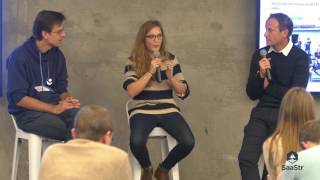
Front co-founder Mathilde Collin and investor Christoph Janz discuss building the company from Paris to San Francisco, raising a $10M Series A, and shifting from small team deals to six-figure enterprise contracts as the startup scaled.
Questions this video answers
December 8, 2016 (SaaStr CSS Speaker Series — YouTube recording).
$10 million.
About 25% week-over-week during initial months.
About 10 people moved following YC.
About $400 per month (early largest customer).
Chapters
All right, well, thanks everyone for coming. We had an unofficial event here before we opened with Rainforest qa, which was fun, but we kind of opened up here before Thanksgiving. But this is the first week that I've been in here and I thought this would be a particularly fun group of my friends to kick it off with Christoph and I. You probably guys probably read his blog. Does it have a title or is it. What is your title of the blog?
Title of the blog? Yeah, it's the angel of vc.
Yeah, the angel vc. I'm sure a lot of you guys read it. Raise your hand if you do, or pretend that you do. Okay, very good.
Wow.
Excellent. And do you guys know this napkin? Did you read this iconic thing and have it. All right. Okay, so we have some fanboys. That's good. And Mathilde's one of my favorite founders. I was fortunate enough to be a small investor, but more interestingly, I think we met a long time ago. Right, Just when you were pre revenue or pre anything. So I've had, I've had a fun seat watching her scale and watch front take off. And then coincidentally there's this fun. They raised 10 million a couple months ago. Right. I got to kind of watch that round happen quietly in the background. I watched three term sheets come in in 36 minutes or 36 hours or whatever it was. And I watched that process and this article was fun. So I thought the three of us have known each other a long time and no scripted content, but it would be fun kind of to take the pulse of a couple things, take the pulse of SaaS and startups, the economy, maybe a few learnings of coming to the states and other things and just where kind of SAS is today. So we'll dig in that in 60 seconds just on the space. Thanks for coming. This was the first week we had a couple great companies move in this week already. We'll have a couple more at the end of the week and then we'll have a bunch in December. But we're definitely looking for a couple more Great. What's that right here? We're looking for a couple more great full time folks from ideally, you know, minimum of 8k in MRR that are scaling with teams from 2 to 10. So we're looking for a couple more of those. And then ultimately what we also want is we have, we have about 20 desks that we call bamboo or halftime for folks from outside of the Bay Area that are coming here. So my initial idea was that we'd have like, I think we'll have infinite demand eventually. But I'm looking for a couple more great companies like that because that's a resource that, you know, especially being European. You get it. Everyone sort of needs a place when they're coming in, have revenue, and nowhere to be. Mattel forced her whole team to move from Paris. Right. 100%. But much more common is being split. Right. And being. Being distributed. And why did you force everyone to come, by the way?
Yeah. So what happened is that we started the company in France. I had never been outside Europe when I started this company, so I had no idea it would come to the.
US but never been outside of Europe.
No.
No. All right. Outside of France.
Yeah.
Yeah. Okay, Very good.
I could speak English.
Yes, that is true. Fair enough. I know the accent's affected, right? I know. Late at night it all goes away. It's like Westworld. It's just. Drop the accent. Yeah, yeah. Okay, so you've never been outside of Europe.
But the first. The first users that we had were from California. So I flew here for the first time and I spent 10 days, realized that I did more in 10 days than I did in three months in France. So then I moved here. So for us at that time, it was just three people, so it was easy. My co founder and our first employee that had three kids, a wife, and I had to convince him that he already had been in a startup, which was a big move. And then I asked him, can you move your whole family to San Francisco? It was like, not really.
Did you ask or require nicely?
Yeah, I asked.
You asked? Yeah.
So then I thought the best way to come here was to go to an accelerator. So we applied to Y Combinator. So then we got accepted. We moved for three months and we. Everyone loved being here. And so then we moved. And so then we moved 10 people.
Yeah. So I think there were 10 people after YC.
Yeah.
Yeah.
So we hired a bunch of engineers while we were at YC and designers, and then we moved them.
And remind me that the next seven, were they French?
Yes.
Yes. And they moved. But they moved, didn't they?
All of them.
So you got the next seven folks to leave Paris or wherever and all come out here to the cheapest cost of living, like every. How did you get. So you got the one guy with all the kids, which I don't even understand. How'd you get the next seven to all come from Paris?
I mean, other ones had kids as well.
All of them. We've got like 50 kids running around the new office. Right. The Pitter patter of young feet.
But the funny thing is most of them had either a boyfriend or a girlfriend. And to move they had to get married so that the way forward their husband could.
You created like seven weddings out of those first seven boys.
I created a lot of weddings. So I feel like I have a huge impact on their life now.
Wow.
But, but so far so good.
And did you. But it also, I mean these are great stories, but it's not easy to do. What is the secret? You're a great CEO? Is it doing a good sales process? Did you hack who already like had done graduate school here? How did you get seven more folks to move?
Yeah, I mean, I think for all of them, their motivations are different. The reason why I moved everyone is because I feel like one of the greatest things of creating a company is to create the company that you want with the values that you want and the culture that you want. And to me, we experienced being split between the US and Paris for six months and I was not happy. And I don't think they were happy either. And so that's why I decided to come here. And it's not a rational choice because it's more expensive. My engineers will be pushed by Google and Facebook, et cetera. But ultimately I think it creates a better company. And so I always want to aim for the best company I can create. Yeah.
I think Mathilde has a secret ability to make other people just do what she wants.
There is a secret. There is a secret power here. Not just ability. There's a secret power.
The thing. So like she has the ability to make people like leave their lives behind and move to the U.S. she also has the ability to get money from any investor in the world at any evaluation that she wants within a couple of hours. So there is some kind of magic happening here.
Some kind of magic. Yeah. Yeah. So then let's go back. Let's. And then I want to talk about a few of these things with Christoph. But so let's keep the story going. So you come out of Y Combinator and you're a pretty hot company out of yc. So what's your. What is hot mean? Like, why were you hot?
I still don't know. Because three years after we're still hot and I'm.
Yeah. Why? Well, so you come out, you know, you're anointed one of the companies with the higher pre monies in yc. Right. Which just somehow happens. Right. I don't, I don't know how the whole. The wizard of the wizard of YC works. But you're one of these ones that can raise infinite money at a pretty attractive valuation. Right. Christoph invests. Then he's like, why is this the most expensive deal I've ever done for this amount of revenue? Right. Was it your most expensive deal ever? Yes, Yes, yes. Always a good sign. When they're most expensive deliver, they're smiling. Which actually means it's probably going to be his cheapest deal ever. Right. In the long run. So you don't know why you're hot?
No, I know why I think so. A few things. One is we were making revenues and we were growing 25% week over week. So it doesn't mean anything because we started at zero. So at the very beginning, for the first four months, it's quite easy, but it's still really good. So I think that's one, two. I think so. I don't know if you know what front is, but we're trying to reinvent email for teams. If it works, it will be big. And I feel like at that stage, people don't want to miss an opportunity. So if there is a company innovating in a huge space with some traction, you'd rather invest. And the last thing is, not only we had revenues, but even now, we focus a lot on engagement metrics. And I think we. Even at that time, we had really good engagement metrics. So people were spending hours per day on the app. Not a lot of people turned. The ratio of DAUs and MAUs was really high.
Yeah.
So I think that's probably why.
And just. Just one fun question for the audience. When you went from yc, you raised like three and a half million bucks or something like that. How did you pick that number? Right.
I think I said I don't want to be diluted by more than 20%.
Okay.
And 3 million would be cool. So the valuation will be.
All right. That's how you. That's how you pull it out. Okay, that makes sense. And drew the line there. Yes. And so. And then. And then this fun Business Insider story. So then. And then. And then you'd spend very little of the money. Right. And then woke up one day and decided to raise $10 million.
Yeah, exactly.
Kind of. Right.
So what happened is everyone had told me that getting to 1 million in AR was what I needed to raise a Series A.
Don't you read Kristoff's article? Call me with your cute little one when you're ready to scale. You. Right. Is it. You really think of a million as Magic. Looking back on it, you still do.
You told me.
Yeah.
All right.
Oh, that's what I said. All right. So you hit a million in revenue.
And then so people.
You had all the, you had millions of the three and a half million in the bank.
Yeah. So we still had three millions in the bank, but. And so people were telling me, you have to raise. And I don't know why I couldn't feel like I could raise. So I was just not confident in the business enough. I was confident, but not enough. And I think one day I just. A lot of things were going well, so we signed this big deal and I made this great hire and I don't know, just woke up and thought, I'll raise money.
Yes.
And I could feel like I would be convincing when pitching investors. And so I made a first meeting. And after the first meeting we got a term sheet. And so then I called Mamoon from Social Capital and Ilya from Index and they both gave me a term sheet. Then I called you and I said, who should I pick?
I said, they're both great. I said, I love them both. I said, I love all your term sheets equally. I said, I said, just flip a three sided coin. And here's. I just happened to have one in my pocket and just pick this odd Dungeons and Dragons style three sided coin that was.
I will never see.
Yeah, one, one last question on this and then let's talk about some, some related stuff. But. So you raised. The fundraising was fairly effortless. Right. Do you feel more pressure now with the 10 million to do better? Is it the same pressure? Is it irrelevant?
So naturally we, I mean, I chose Mamun from Social Capital as an investor because I had a good relationship with him and I think he trusts me and I trust him. So our board meetings are just me and him.
Yeah.
So I don't feel like I have a lot of pressure, but I think throughout the history of runs, I put a lot of pressure on myself and I don't think anyone can put more pressure than I do. So I'm pressured, but I don't feel like I'm more pressured now because I've raised more money.
So let's talk about some other stuff, but Christoph, for fun. So this was your most expensive deal, Right. Just between us, us in the room. Right. What, what convinced you from a, you know, as a vc, put your VC out and what convinced you what was special about the investment at the time? What's the lesson learned for other folks in the round room?
Good question. It's Been. It's been a little while. I have to refresh my memory. What was. Except for like the magic power of Matilda.
Maybe. Maybe that was it, right?
Maybe that was. Maybe that was it. Yeah, yeah. I mean, I think you mentioned already it's a clearly large, large market, so.
Better with the microphone. All right, just put it like really close like this.
Okay, no problem. I mean, we've been actually, we were aware of the company before you went into yc and obviously, with the benefit of hindsight, we were really stupid to not try to invest before YC because after YC, the valuation, I don't know, was probably five times. Well, it was before 5x.
Yeah, just 5x.
So I think we liked what you were up to even before yc, but you just proved a lot of the assumptions during those couple of months and then it just became more clear and more and more interesting. Unfortunately, many other investors thought the same. And yeah, in the end, like we thought it would be, well, we have tiny shareholders in the company only, but we thought it would be better to at least own a little piece of this great company than nothing at all.
It's always a good testament. So this morning, Christoph and I were with the CEO of Zendesk, which was your first material investment. First investment ever or first material one?
First material one.
Okay, we can like massage the story a little bit. Your first investment ever, but it's Certainly first material one, right?
First SaaS investment.
First SaaS investment, yeah. I'll tell you the founder story and then I come in and Mikhail gives Kristof the biggest hug in the world. Like, you don't see that with your late stage VCs. Right? Just that that relationship that you have with your early investors is different than the mezzanine ones. It was pretty great. And we were talking about the way SaaS used to be all those years ago. Like when, 10 years ago, when did you invest in Zendesk?
2008.
2008. So what, just for fun, what, by the time you decided to invest in front, because we happen to have Frontier. How did you think about SaaS differently. Fast forward today at all differently.
I think maybe the best points in time to copy our is maybe like today and like eight years ago. And I mean eight years ago was a very, very different world. I think at that time what Zendesk did like turn like move a piece of software to the cloud that was already somewhat innovative in Salesforce has been around for a couple of years, so they were not the first to be doing this, but it wasn't like the default solution yet. And then just making it really beautiful and having a free trial and having a great onboarding experience. All the things that we take for granted today. They were innovative at that time and they framed my like my, my pattern recognition in the subsequent years. So I made a number of additional SaaS investments. One of being Front looking for companies that, that did this like consumerization of enterprise applications, making end enterprise apps really beautiful, easy to use, offer an easy onboarding. And I think today that is not enough to differentiate anymore. So I think when we're looking for new investments today, we're trying to look for. And we can talk about that in a minute. We're looking for other ways how the companies differentiate so that the table stakes have just increased a lot over time.
Yeah. And when. How. This is something I think about a lot now. How much better is Front as a piece of software than Zendesk was as a piece of software when you invested? My guess is significantly better. Right. It's not like Front is Palantir, but I think software has gotten better. And so I think the bar maybe I just for fun to think back from today, but I think the bar has gotten higher. Like software has to be better, maybe. You don't think so?
Yeah, it's a difficult question and I think we have a product manager from Zendesk in the room, so.
All right. Yes, that's all right. Zendesk is, you know, we're going to talk about the Saster annual getting to a billion in revenue by 2020, right?
Yeah, I mean it's. I think Zendesk always had a great product for the time.
Like for the time. Great product for a browse for the time where browsers were in 2008.
Exactly. And then they did a complete rebuild of the UI in I don't know, 2010 or 2011. So I think they. They managed to keep the product fresh.
Yes.
And I. Yeah.
So.
So maybe fron like when, when did Front launch The initial version? 2000. Just two years ago. Okay. Yeah. Well then like then the original Zendesk product from 2008 was probably quite lame compared to front two years ago in terms of the responsiveness of the app and in terms of just the look and feel and how many page load it requires to do something. Yeah. So I think that's a fair observation.
Yeah. And when we were chatting this morning with Megha, he was reminiscing about how hard the Series a was. Right. Versus then the B with benchmark took like 90 seconds or something. Right. What's the Mathilde clearly hacked the whole non Bay Area founder fundraising building. Like you hacked it. Right. How much of what's the key here and how much of a disadvantage? I'll tell you what I think, but how much of a disadvantage are you as a non Bay Area like staple same as every company founder. Well, how much of a disadvantage are you coming from Europe or coming from wherever?
Yeah, I think it depends on whether you're like in Europe and trying to raise money in Europe and you're trying to convince investors to invest in your European company. I think then you are at an incredible disadvantage because 99% of the Bay Area VCs just won't consider you at all. If however you are in the process of moving to the US and this is a real credible plan and not just an idea, then suddenly that whole universe of Bay Area investors becomes accessible to you. I think at that point in time when you are in the process of moving, I would say you're not at a huge disadvantage compared to like first time entrepreneurs in the Bay Area. I think you're still at a disadvantage compared to second time entrepreneurs. Like people who've done it before. We have for sure decades of experience of relationships with Sandhill Road investors. Obviously this is, this is a different, different story. But other than that I would say like you can go for it.
Let me ask you a question. Zendesk. Zendesk. I think that Ilia and Index did that thing in medium like how quickly companies got to 100. I think Zendesk got there as fast as Salesforce. 200 million, which I didn't even know. That's pretty insane. But a relate but a question I want to ask both of you and start with Matilda, is what's the bar in 2016? And you nicely put your entire deck on Business Insider. So I wouldn't, I wouldn't have brought it up otherwise. But since it's there, I reread it and one thing stood out to me. We talked about this before was you had your plan for 2017 and it was 3 to 10. Like going from 3 to 10 in one year. And who's planning to do better than that next year? Just quick show of better than 3 to 10 next year. All right, that's good. I mean it's pretty good, isn't it? I think I went from 3 to 6.01 and and almost killed me. But is that the bar? What's the bar? What is the bar for X? We can't all be slack. Right? But what do you think? What have you learned? What's the bar today to be a pre breakout but post 1 million AR company, what's the standard?
I mean the truth is the figures that I put on that and I told you is I asked a few VCs what's expected. It's my first company, so I had no idea I had to reach a million in AR to raise a series A. I had no idea what to do to raise a series B. And so I just asked around and I feel like they told you that's.
The bar 3 to 10.
They told me 1, 2, 3, 3 to 10, 1 to 3, 3 to 10.
But your model tied to it, didn't it? There was a model underneath it that tied to it. No, of course there was. No. None of these fancy pants series abvcs ever got a, got a Google sheet with your model and all of that. She's even more magical fundraiser than we I possibly could. I won't even touch a company with any revenue without a model, so.
So.
But you didn't have a lot. It's a good learn.
No, yeah, yeah, I made this. Truth is. Yeah, truth is.
Well, a model at 3 million ties to your trailing velocity too, right? I mean if you've been growing 3% month over month, you can't possibly project 3 to 10 no matter what a VC tells you.
But yeah, yeah. I think the easy math behind it is if I grow 10% every month, I will go from 1 to 3 and from 3 to 10.
Yes, okay, that's it.
But yeah, I mean we did a model, I think before. So for our seed we didn't do any model and I think it was fine because at that point you just need to make a good product, sell the product and that's it. And don't optimize for anything. But we did one and I think from one to three it's still fine. I didn't have a plan for 2016. That's the truth. I didn't know how many people I would hire and people were asking me all the time, so what's your growth for 2016? And I was like, I don't know, go from 1 to 3, but I don't know how many people I need to do that. And when I needed people, I hired people, which doesn't work after 3 million because if I don't anticipate I will never be able to go from three to 10. So now I need to do one.
So I want to ask Christoph that question too. What the bar is. But you brought up something I want to have you looking at 3 to 10. And we were briefly chatting about this. I say, what do you. What are your biggest challenges, stress points for this year? How many you got? How many employees now?
30, 22.
What does your gut tell you you need to be at the end of next year? 50, 60, 70.
50, 50.
So what are the. I usually find for most SaaS companies, the management debt catches up with you somewhere around 4 to 5 million in revenue. Because that. The stuff that got you to a million, if you work more nights and you get your deal size has gone up. Right. The team gets better. So what works at one still works till about three. And then I usually find if you haven't put the perfect management team at all, you keep some kind of plateau, even if it's not in the mathematical growth rate. So what. What keeps you up at night now? Anything?
Yeah, I mean, I think so. I really think that I'm experiencing a new phase of a CEO and I'm not good at it yet because I didn't realize I had to switch everything I was doing. So basically from, I think from zero to three, I was involved in everything. I was a product manager. I was selling the biggest deals. I was. So we don't have a marketing team today at France, so I was reading all the blog posts so that we could have leads that would sign up. I would do events like this. I would.
Head of marketing, head of enterprise sales, head of product. Head of product or product Kibitzer.
Yeah.
So three. You're three VPs.
Yeah, because I was interviewing every person that we would consider hiring. So. And I'm still doing all of that today. And so now if you look at my calendar, it's crazy. Like, I really don't have time to do that. And Now I'm managing 12 people, I think, which doesn't make sense.
12 direct reports.
Yeah.
How much of your time now are you spending trying to recruit VPs and directors? How much of your time?
So during Thanksgiving, I realized that I had to spend more time, so I blocked some time in my. But I will really spend probably 50% of my time just doing that.
50% of your time recruiting.
Because I still need to manage the team that I have, and I still. There are still a few functions missing in the company, so you still have to work on a few things. But, like, 50% of my time is a lot of time because. And so I just had to think about which executive I should hire first and then go one by one.
And do you Feel like with you feel like you can do it sequentially or do you have to do it in parallel? Can you hire more than one VP at once?
I feel like I'm doing two right now. Two searches and I feel like it's enough.
Yeah, well it's 50% of your time. Right. That was the Thanksgiving wake up call. I've got to spend half my time recruiting. Most of us don't spend. Most of us don't spend enough time recruiting. And then we really hit a wall around here because we just don't have the. The management to carry us the next level. Right. So. So Christoph, let's look it up. Who has his napkin? Let's look. So what is. It's all this is the answer to everything. What's the bar today? What? What is the bar? So let's see what happened here with front but we can talk about other companies. Algolia, that's here or Talk Desk or others. But precede one to three. This is what a European always writes like. It's going to be like one. That's why these European they're so successful. But let's talk about what the give us the high level so we can use front as a case to use other companies. But what's the bar here today?
Well, I think the advice which Mathilde got from a number of VCs I think is pretty much spot on. I think for some reason the investor community has agreed that like a great startup should be like get a great SaaS company should be getting from zero to about a million in ARR in about a year or one and a half years and then you should triple and triple again. There is also this, is this triple twice, double three times framework. Is it from Mamoon?
Niraj?
Oh, okay.
Yeah. I won't tell you who he took it from, but we'll just give that one to Niraj. He's a very good investor so we'll let him own that one.
Yeah. So I think this is kind of what the investor community is looking for. And it's probably just a function of like supply and demand of capital for SaaS companies. So the best companies just seem to be able to grow at that trajectory, which I think is extremely difficult, extremely impressive.
So if I hit a million in ARR and I'm growing 6% a month, not 10, and I need money, what should I do?
I think it's not impossible to raise, but it's probably impossible to raise from Benchmark or Sequoia or Emergence or Matrix because. Because they Just they get the best deals, they have the best deal flow, they have the like the toughest filter. Yeah, I think you can still raise, but it'll just be. You just have to knock on a lot more doors and maybe you can make it, maybe you can compensate it if something else is just awesome. But like the numbers are just the easiest thing to get investors either excited or not so excited.
And what. And one. And just two other questions and let's open it up so you guys can ask some questions. What if. So one. One thing founders struggle with is I hit the. The ARR milestone one, but I'm not quite growing at the fast enough rate. Right. And what about the. What about two types of tweeners? What if I need to raise money at 30k, MRR, 40k and I'm in this gap between your napkin. Should I worry about it? How do I do that? I'm still doing fine, but I'm a tweener. How do. How do. How should founders think about being a tweener?
I think it's quite frequent that companies raise not only one seed round before they get to a Series A. So I think it happens all the time that a company.
When is a second seed good? When can you pull off a second seed and when can't you?
Good question. It depends on so many factors. Like when we invest in a seed round, we. It's quite rare that we have the expectation that this company will just shoot straight to the series a 12 months later. Usually there is not so much traction. There is no predictability. It's not a rocket ship that has already started.
Do you assume you might have to write a second check when you go in explicitly?
So I think it's probably happening in more than 50% of the cases of those that eventually raise the Series A. So I think there is a market for that. And yeah, so I think not the.
End of the world, but that's you writing a second check. How do you. If you're a tweener, how do you get a new investor to write a check if you're a tweener?
Yeah, I think you.
I've done a few and they've worked out okay. But what's. What do you think? What's.
Yeah, I think signaling risk is an issue then. So if you are in that situation and if none of your existing investors wants to put in any additional money in you, then it makes. That makes it much, much more difficult if you're like existing investors are somewhat confident, want to put in a little bit of Money, I think then you have a fair chance of getting somebody else on board, maybe even to lead. And then also, at least in Europe, and this might be different in the us the bar for the Series A is so high also because there are just so few investors in Europe. I don't know if it's how many of you are from Europe or if it's to how many of you this is relevant at all. But, like, if you get three or four rejections in. In Europe, you're basically, you're done.
You're done. You've run the table there. Right.
So. And therefore, there is a pretty large number of companies, I think, that are somewhere between the seed and the Series A, and they somehow have to figure it out. But I guess what I'm also trying to say is if you fail to raise your Series A, especially in Europe, it doesn't mean you're a bad company. It just means maybe for some kind of reason, you haven't convinced one of the four or five people in Europe who can write a check.
Yeah.
So you have to find a different way.
So I do want to open to questions. I want to hear just one other thing because I think it's fun for the audience. So Matilda says you've been pretty transparent since I got to know you, which was pre revenue, you've driven your largest deal size up. Right. And so when Christophe invested, what was your largest deal? What's your largest deal today? And what have you learned? What are the top three things that have changed as you've. I think maybe your average. You had maybe like $500 of your customers when we met. Right. And now you've gone up almost 100 times, right? In some cases, yeah.
Right. So I think when we raised from you, our biggest customers was paying probably like 400amonth.
400Amonth. A 5K ACV deal, right?
Yeah. And last month. No, this month, we signed two deals for above 100k and we're working on a deal for 400k.
So it's a big change.
It's a big change, right?
From four figures to six figures.
Yeah. I think. I mean, for us, we had two options if we want to grow that quickly. Either we have a lot of customers or we send big customers. And I think it depends on the product. I feel like when you have a product as easy as slack, you can grow your number of customers quite easily. For us, we're doing email. Email, you have a workflow in place. Even without using front, you were replying to your emails before and now you have a new way to reply to it and you need to have your team adapt to it for something they're using many hours a day. So there is a lot of friction in using front. Like I can't have 100 new customers every day.
It's business process change. You have to change the way I run my business a little bit.
Yeah, right. So I think it was. I mean, I've just been. Very early on in 2016, I realized that if I wanted to go from one to three, I had to send bigger deals. And so then I went into bigger companies, talked to a lot of them, asked about the workflow and realized that the product was relevant for them and built the features accordingly. So this year we built SSO and SLAs and our data are in Europe, et cetera.
So did you change onboarding and customer success and those functions too?
Yeah, I mean, a little bit. But for example, I'm just starting to work on the onboarding right now. Got it.
Yeah. Interesting. All right, cool questions guys. Let's take some until I'll.
Yeah. So a question about tail, but one that can kind of be generalized across the preview. You mentioned before that you chose Momolin because you liked him the best. You had a pretty distant relationship.
Can you give us a little bit.
More context around how you form that relationship with VC investor before they invested? So where any companies have a series A investor in mind and they're not at that stage yet, how do they get a series ABC investor interested in advance of fundraising? Yeah, I think it's a good question because I feel like it's a right. It's a hard balance to get one. You don't want to spend too much time chatting with investors because you have so much to do that if you'll spend a lot of time doing it. And they always want to meet with you more often and have more metrics. Right. And see how you are doing. So I think first of all, even if you want to build that relationship, I met with Mamun probably three times a year and that's it. So it's not two years, one year, two years, a little bit less, 18 months. And how I chose Mamoon is I asked my. I know a few people that are creating SaaS companies and I asked who are the great investors. And I feel like it's pretty easy to get a first meeting because that's their job to source good companies. So if you have a good. Like if someone great introduce you to Mamoon, Mamun will do a meeting with you. And most of the time, that's true. So then it's your job to make that meeting interesting enough for him to be willing to meet with you four months afterwards. So getting a good intro, I think will make it. And then I think the hard thing is you don't want to give too much information during those meetings, because if you tell this person, okay, so we are at X in revenues, and then for some reason, you're not growing quickly enough for the next meeting. So I would just pick the metrics that I wanted. And, for example, I never shared revenues because I knew that it was the ultimate. No. So I said I signed this. Big deal. Yeah, exactly. So I would explain how this company is using front and show them how they're doing it. I would tell them about a few metrics that I had picked. So, for example, I don't know engagement metrics, the number of hours, because I knew it would not evolve a lot. Like, it will maybe go from three hours to three and a half hours. But whereas I think revenues is. I know that in SaaS, people will really want to know how quickly we've grown. And so I just wanted to make sure I could tell the right story for our Series A. And so I had to give it. Cigarette?
I think you're. What was Gustav's term? Magic. What did you say? Magic. Magic. What was your magic?
Magic.
Cover engine.
Yeah, magic something.
What was the magic power?
Magic power. So I'll tell you a story. Probably almost exactly a year ago, I was in Palo Alto and I bumped into Mahmoud on the street, and I said, we're trying to pick the final speakers for the Sasa Rango. Who do you recommend? He's like, I think Tanium's really hot. Like, they just raised it a billion. Stevie, do you know him? I don't know. Like, who else? Like Mathilde. I'm like, oh, I know her. And that's the fact that that was the second person that he suggested. When you're. A year ago, you're doing a revenue, that suggests you hacked fundraising fairly successfully.
Right.
And that was the second. He didn't say Stuart Butterfield, who spoke the year before. He didn't say Owen McCabe. You were the second on his list. And so I don't know how you hacked that, but it was interesting that that was the second one he told me.
Yeah, I think. I think it's. Yeah, it's hard for me to tell why, but I think something that I've done well is people have been willing to help me And I feel like it's also a hard balance to find when you want to be confident enough so that you inspire confidence, but humble enough that people want to help. And ultimate. Yeah. So for example, Mamun has always helped me a lot. And that's also why I picked him, because it had been helpful. And I feel like it's.
That is an art, asking folks for the right type of help, not being a burden.
Yeah.
And knowing where they can add high ROI help, like something that someone can do in five minutes that can have profound value for you. Not asking for five hours of ORI work. That's a great bonding experience.
Yeah. And I think it's true for like, in terms of help. I feel like I would have never succeeded if people had not helped me. And I think something I did well, for example with our investors were at the beginning when I raised our seed and I was rating an investor update every month. I was like, so I want more customers. I want to hire all these people. Can you help? And of course they can't because they will not spend time to think about what customers could use. And then afterwards I said, okay, so who knows people in those companies. Who knows? And be super specific about what you're asking. And I feel like for even now, when I want an intro, I will look at the LinkedIn profile of this person, see who this person is connected with and say, here is the email. Just forward the email. They will do it and otherwise they will not do it.
And I think it's actually another hack. If you send these emails to your entire investors, have everybody on cc. But then, because then you basically start a competition, like everybody wants to be the most value add investors on board. So you get multiple introductions to your customer. So it's email and you're saying six figures, seven figures. Can you explain value proposals? How do you get hundreds, thousands out of email applications? And you're in the enterprise space. Right.
Can you just tell a little bit.
About your value problem?
Yeah. So front is an inbox for teams. So when you. The basic idea is if you have multiple people managing one inbox, front is probably the best solution. So the good thing about it is everyone has this issue. The bad thing about it is it's everyone has different pain points. And so I will not pitch the product the same way to a transportation company or to, I don't know, broker. But that's two industries, for example, where we were really successful. But the basic idea is email was not designed for teams. So there are lots of inefficiencies with email, you CCBCC replay all four, you make mistakes, you replace twice the same email, etc. And with front you make sure that when you never drop the ball, you never duplicate work again. And for industries where email is really how most of their people get work done, changing how that works has a huge impact on their productivity. So it's. I know it's not a good sales pitch because. But I think what's. Yeah, so what's interesting is last year I went to London pitching a company because it was a big deal and I arrived in this company, it was a ship, so very traditional. And they were pitching their firm to me rather than me pitching the product. And I was like why are you telling me all of that about your company? And they were telling me, we did a survey last year to the entire company and asked what's bad about their job. And the number one thing is people feel inefficient because they have inefficient tools and they feel like information is siloed and it's really hard to find the information they want and it's in multiple places. So if you can find a pain point that's, that's high, then I think you're into something that could be big and then you need to execute well.
On the deal size.
What you asked can you talk about.
A little bit on how you move from the smaller deal size to the bigger deal size. Whether you added more different products or you stopped doing small deal size and compounds and how does the transition?
So the way we did it is we have a product for teams, so we sold to one team, then we expanded within other teams. So for example mailchimp, they started to use the product the day after we launched. So two years ago, now they have 13 teams. That's how we learned what it takes for a company to have 13 teams using the product and what features we need and that's how we learned it. And then we checked with a few other companies and we built the right features and and now when for example our account executives, they used to try to close one deal like for one team, even if it was small, and then try to lend and expand and now they've changed and they try to sell to like the largest possible scope. So then we change who we are selling to. We used to sell to a team lead so head of whatever BB of whatever to now 80 minutes managers. We do, but we try to have those being self served.
You have a pre trial. Have you tried to experiment with this.
And have you Tried different goals for sales deals, service deals.
Yeah. So first thing we trade is having a free plan. So that was a really bad idea because, first of all, people don't like paying for email. It's associated with something free. So because we had a free plan, they tried to stick in the free plan, and so they didn't get the value of the product. Plus, we were a team of, I don't know, 5. It was creating a lot of feature request support. Yeah, exactly. And so. And also I think ultimately we had maybe just 20% of our users were free users. So that's not the right freemium model that you're looking for. So we killed it, and then we changed. So one thing is we change our pricing at least every month, and we look at the cohorts and we look at how it evolves. And I feel we've invested a lot of resources in making sure we could test those pricing. And I feel like it was a good choice because honestly, I keep increasing the prices and conversion is the same, so I feel like I can keep up. And most of the time, as a founder, especially early stage, you feel like your product is so bad that you can't charge that much money. So at the beginning front was $9 per user per month, and that was the only price. And now the average. On average, they Pay, I don't know, 34 per user per month. So it's much higher. And I mean, of course we build more features, but also we sometimes get the same feature, increase the prices and people would buy. So we don't have a. But we have a free trial. The thing that we experimented with is putting a phone number as mandatory or not Today it's mandatory. So that's because of the. Yeah, I'm a real enterprise, but that's because of the friction of the product where we need to hold. Hold their hand and tell them how to use the product. That's the way we did it.
When you experimented, because it is friction. It's a business process change. Did they have low CSAT and a bad experience when they tried to do it on their own?
Yeah.
Yeah. So you got to create the gate. Right. My question is for Chris. Chris, this wonderful metric that you used as a funding metric and stuff, but all I'm seeing is numbers and. Or information about those numbers traction. How does the story of a product or to any B.C. i was hoping that pre seal or angel level or seat level story is more important because numbers would eventually emerge.
Yeah, you're right. And if you look at it like you see that in the pre seed column there is actually there aren't that many numbers. I think like for the first money that you're trying to raise, which will probably help come from friends, family, angel investors and the like. You obviously you don't have a lot of numbers to show, so you might have no revenue at all, maybe no users at all. But I think that this story is maybe, maybe I should mention this more explicitly. I think like without a great story and without like the great idea and the vision to build something big, you, you can forget about all about this. I think like this is the underlying assumption is that you want to, you have identified a big pain, you want to build a great company and then you're trying to prove that you're really onto something with some of these metrics and proof points. So I think you need both.
We're still early, but we've been charging more based on feature set versus per user. Have you looked at other or what.
Made you decide to go per user.
Versus other tiers or levels?
Good question. I think for us it was. So we chose per user per month because it was normal in that space. So help desk would do that, email clients would do that, Slack would do that, etc. But we challenged that a few months ago and to see. And then we just run like a deep analysis on why people are paying more. Is it because they use more features? Is it because when do they get more value? And what we've seen is if you have more people in front, you get more value and that's where we charge per user. Also I think it's super important to have a pricing that people can anticipate, like so they can know what, how much they will pay. And I feel like before using a product you never know which features you need, but you know how big your team is or will be, so that's easier to project.
So I guess it's a bit of a follow up to the last question on this. But like what.
So what did you feel? I mean, so we heard like from.
The spot, from the start, these two guys. How did you feel you were able to push this idea before you actually had like lots of great numbers say before yc and I mean how did you convince yourself even about the product and I guess the market was versus wow, is that something A big one.
That you can get is.
But I mean what are things that you.
So. Good question. Because as an anecdote we got accepted to yc. I flew there and the first meeting that I had was with Kevin Hill and he told me, you're my favorite company. I love what you're doing. And I was like, I was sure it was not talking about front end, talking about another company. So I was not convinced at all that we had a great product. And even during my batch at YC where we had not launched yet, I was telling my batchmate they wanted to use the product and I was like, use another product. It's not good yet. So truth is, it's. I mean, you always need to inspire confidence to everyone, to your customer, to your employees, to your future investors. But when you're that early, I was really not sure I was onto something. But it just that. I don't know, I did a act of faith where I said, I will try hard. I think there is something to be done. And so I really tried hard. So, for example, I think one thing that we did well is as much as I could, I launched the product on product hunt, I did pr, I wrote blog posts and I had thousands of people sign up to the product. And most founders would tell me, you should keep that for later when the product is ready. And I knew the product was not ready, but I wanted to have as many people try it so that I could understand what they didn't like. And I think we had in our beta, we had 3,000 companies that signed up to the product and one ended up using it. So it's a lot of effort for just one person using the product. But I just said, okay, I'll try my best to do something and I will not challenge every other week what I'm doing. And I think there is something to be done in that space. So I'll talk about it. People will trade, they will tell me what they like, they will tell me what they don't like, and that's how I will learn. But I think I got even when we raised our seed, I was not that convinced that it was a great idea. But now I'm to your credit, when.
I met you very early and it was pre. I mean, you had some products, right? But one thing that was smart that you did, whether you knew it or not, was when you met with someone like me that had built software myself, you distilled front into one simple problem, which is how to share support@mycompany.com anyone that had run a SaaS company like me understood this was not a fully solved problem. Now, front is a much bigger solution today than that. But if you I didn't need you don't need 20 PowerPoint slides to explain this insertion point for front, which is how the hell do you get one email address to be effectively used by multiple people? And you don't. In the early days, you don't have to get everyone to see that. You need a couple people to say yes. That's a fascinating white space. I want to learn more.
Yeah. And even like a month. I remember a month before raising our Series A, I kept on sending those monthly email to our investors and one of them replied for the first time and said, how are you going to make a big business out of this small idea? And so I think even our investors were not believing that much in what we were doing. And that will happen all the time. But especially early on, it's not because we were hot or it seems like front is an easy story and it's still super hard. And especially at the beginning, I was not convinced at all that it was a great idea and if it was obvious, everyone would do it. That's the thing. So what you're doing is not obvious, but you have to put an act of faith and try to do it until you have too many pieces of evidence that it's a bad idea.
The strategies take two more questions so we can. So congrats.
So beyond increasing the size of your.
Deals and hiring, like, are you going after a specific ecosystem?
I'm thinking like, you know, email Microsoft Outlook or Zendesk.
I mean, are you trying to tap.
Into an ecosystem right now, or is.
It something you're thinking about, or is.
It something you tried before that could.
Change the trajectory and the growth?
Not. Not really. So first of all, I think so. I think partnerships early on always looks great because you're so small and that company is so big. But I've rarely seen companies where they've had successful partnerships. So we've tried and we failed, I think so. Part of our product is to build integrations, and so we do it and that drive leads and revenues. But for the moment, we're not part of the.










