SaaStr HQ Live at SaaStr Build
Michael Pryor from Trello and Jason Lemkin discuss what sticks after the pandemic: remote work, mentorship in distributed teams, and how tools like Gong changed sales coaching. They debate why some brands like Trello last decades while others fade, and share stories about building customer loyalty, including how Slack went viral through NPS.
Chapters
Sam.
Hey Sasser Community, welcome to Saster build 2021. We're excited to bring you this incredible digital mega event on March 9th and 10th. We'll have more than 10,000 revenue leaders joining us for the event as we share the practical advice you need to build better, faster and stronger products. Throughout the course of the two days, you'll hear from our speakers or SaaS celebrities as we like to call them here, and they'll be sharing their playbooks for building to 100 million ARR. Some of our incredible speakers you'll be hearing from include Jeff Lawson, CEO at Twilio, Denise Pearson, CMO at Snowflake, Ivan Zhao, Co Founder and CEO at Notion, both co founders of Monday, Roy and Aran, Beth Tolan, Head of Product at Asana, Joe Thomas, CEO at Loom, and many, many more. Be sure to click above to check out the full schedule and register for any of the sessions you want to attend. In addition to the speaker lineup, we're also really excited about our Saster Community Networking. We're doing this in a few different ways this time. Now that you're in the platform, head over to the Community tab to see who else is attending. VIP ticket holders have full access to the networking opportunities and can network with anybody in the community. If you're a free ticket holder, we place you in a cohort alongside similar community members with similar job titles and revenue stages. Either way, be sure to dive into the community and get to know somebody else attending Zaster Build Another thing we're super excited about is our incredible one on one matchmaking. So for VIP attendees, Team Saster has personally handpicked attendees we think you should meet with during Saster Build. You'll get this one on one matchmaking suggestion via your notifications, so be sure to check them out by clicking the bell icon in the top right hand corner.
Alright everyone. Now before we get you on your way with Saster Build, we have to thank our incredible sponsors and partners for supporting our community. Be sure to check the Sponsor hall above to discover the latest SaaS technologies that'll help your company build to $100 million faster. Thank you to our super gold sponsors, Capchase, CenterCode, Pendo, Sizu Data and Twilio. Also, a thank you to our Bronze Sponsors, Assembled Demostack, the UK Department for International Trade and of course swapcard. If you have any questions throughout the event, please feel free to chat us at any time or visit the Saster booth in the Sponsor hall to get in touch with our team. Enjoy Saster Build.
Welcome to Saastra Build this is a video on how to use the virtual Event platform. After you register, you will receive a confirmation email with a link to join the platform. Just click on that link and it's going to automatically log you in and take you to the homepage. Like what you see here, in the center of the page you'll see an image followed by various feature icons that we're going to run through. And below that you'll see links to some of our top sponsors and partners. So if you look on the left hand side column, you'll see your profile. This is the data that we've collected from you during registration, so feel free to come in here and update it with the data that you would like to share with other attendees when you're networking with them. Let's start with the schedule. So when you click on the agenda, it will show you all of the upcoming sessions. You can run filters to narrow down the sessions that you're looking at. If one session is particularly interesting to you, just tap on it, hit register, and that will add it to your agenda. Come back when the session starts and the video for the session will automatically display. While the video is going, you'll have access to this live discussion. In the bottom right, you'll be able to chat with your fellow attendees, ask questions of the speakers and moderators, and respond to polls that are being asked of the audience. Down below on the left you'll also see recommended sessions. So this is our AI recommendation engine that will learn more about you as you use the platform and hopefully refer you to other sessions that you may want to attend. If you want to explore speakers, just tap on the speaker tab. It'll show you all the speakers of the event. And if there's one that you're interested in learning from, just tap on their profile. You'll be able to read about them, see their bio, their social media links, and from here you can send them a connection request or an appointment request. The great thing about the appointment request is all of these times are mutually available times for you and the person you're going to meet with. So just write them a little note of why you'd like to meet with them and send them the request. If you'd like to explore our sponsors, just tap on the sponsor hall. You'll see all of our sponsors that are coming to the event. If one of them is offering a product or service that you're interested in, you can just tap the little bookmark icon and that will add them to your bookmarks or Tap on the company name, it'll open up their profile. You'll see everything is kind of rebranded to them. From here, you can learn more about them, view their videos or images, see any sessions they're sponsoring, and also see their team that are joining the event and connect with any of their individual team members. On the right hand side, you'll have this chat box where you can actually submit questions, real questions, to the staff of this company and even request a video call. Once you've been using the platform and you started connecting with other attendees and creating your agenda, you can tap on my schedule. It'll show you all of your scheduled sessions and meetings, your bookmarked companies, and it'll give you the option to export this to your calendar or download it. If you have any questions during the event, please visit the Saastra booth and submit questions and we look forward to seeing you at Build.
Evan, John and I started Twilio 11 years ago. Back then, communications was just inaccessible to software developers. And so we started with a simple idea. We said, why isn't that just an API? And this simple idea that communication should be in the tool belt of every software developer in the world. And if it was that together we would create the future of how people and companies communicate. If you don't have a big vision and bold ambitions, you won't know where you're going. But if you don't follow customers at every step of the way, you can get lost. 160,000 companies who trust Twilio with their communications. To engage your customers with the developer first approach, what you're really doing is putting a new tool in the toolkit of the world's developers so that when one day they're at work and they realize there's some problem that needs solving, they're now able to say, aha, I know how to do that. Yeah, it's Twilio.
We're generating so much data that we want to use, but all that data is right siloed across our company. Data cloud is really mobilizing that data for you. It brings all that data together to everyone in your organization that needs it. You know, we simply have an incredible product that solves problems that people never thought anyone would ever be able to solve. Product is basically like magic. It's also about having access to data from your partners. Data becomes more valuable as it's combined with other data sources. As a marketer writes, a dream come true is to really be a part of creating an iconic realm. When the going gets tough, the tough gets Creative because a lot of ideas are not invented at the headquarters.
Right.
They're coming from the field. How do we know our customers better than anyone else? How do we stay more relevant, more helpful data?
Last year there were seven cloud IPOs in total.
Bessemer was an investor in four of them.
Our secret sauce is our road mapping process. The firm will have 20 to 30 active roadmaps. Part of our predictions that used to be internal roadmaps we now expose to the world. We're thrilled to be unveiling our annual State of the Cloud report. We're going to try to talk about where we've been, where we're at and.
Then where we think we're headed.
You essentially now have a playbook to how to go out and build your great cloud business. You now have a peer group and.
A support group not just for online.
Communities like Saster, but through a pure CEO set that is absolutely world class.
You're not alone.
You don't need to figure this all out for the first time, as people did 20 years ago. The two things that I love the most outside of just the general value Prop 1, it's the story and the product is personal to the founder.
Just understanding where you differentiate and how you're going to win, being able to clearly articulate that is really key.
We can't wait to see what you're going to build. Keep kicking ass. Thank you.
So Monday is essentially a platform that.
Any team can manage.
Pretty much everything we provide, very flexible.
Very dynamic building blocks.
They basically allow you to build whatever.
You want, whatever makes sense for you as a company.
People build unbelievable stuff.
On Monday we have clinical trial research, people building airplanes, construction firm architects, hotels. You can build your own process and manage the team the way you like to and at scale.
You need everybody in the company to.
Make decisions in order to be ahead of the game.
How do you pass ownership to people that they feel they make an impact? It's very important that everyone will know.
What'S happening in the business, otherwise they wouldn't be able to help us drive it forward.
In the office we have hundreds of dashboards showing every metric, how much money we have in the bank, ARR new sign up everything.
People are going to see your numbers, your metrics.
Aren't you afraid if we're better than them, you know they're going to be scared to death and if not, we got a problem and it's not the dashboard.
My name is Ivan, I'm the co founder of Notion.
Notion is an all in one productivity tool.
It's extremely flexible. You can almost mold it into any.
Type of tool you want for yourself.
You design a Lego now the community takes the Lego to places that you never imagined. Sometimes I wonder like what makes a software product timeless? It has to have this long term healthy symbiosis with its users.
Building software is kind of like making art.
The office vibe we're going after is.
Kind of less like an office, more like an artist studio. Fundamentally, notion is a tool. It's just like I'm holding a pen here. How good the pen is depends on how well it feels in your head.
Our mission is about that romance of computing.
If anybody can customize their own tools.
The positive second order effect on the world is huge.
I can't imagine doing anything else but building this.
The dream and romance is can we.
Create a tool that democratizes this medium.
Welcome to Sastra Build this is a video on how to use the Virtual Event platform. After you register, you will receive a confirmation email with a link to join the platform. Just click on that link and it's going to automatically log you in and take you to the homepage. Like what you see here, in the center of the page you'll see an image followed by various feature icons that we're going to run through and below that you'll see links to some of our top spots, sponsors and partners. So if you look on the left hand side column you'll see your profile. This is the data that we've collected from you during registration, so feel free to come in here and update it with the data that you would like to share with other attendees when you're networking with them. Let's start with the schedule so when you click on the agenda it will show you all of the upcoming sessions. You can run filters to narrow down the sessions that you're looking at. If one session is particularly interesting to you, just tap on it, hit register and that will add it to your agenda. Come back when the session starts and the video for the session will automatically display. While the video is going, you'll have access to this live discussion. In the bottom right. You'll be able to chat with your fellow attendees, ask questions of the speakers and moderators, and respond to the polls that are being asked of the audience. Down below on the left you'll also see recommended sessions. So this is our AI recommendation engine that will learn more about you as you use the platform and hopefully refer you to other sessions that you may want to attend. If you want to explore our speakers, just tap on the speaker tab. It'll show you all the speakers of the event. And if there's one that you're interested in learning from, just tap on their profile. You'll be able to read about them, see their bio, their social media links, and from here you can send them a connection request or an appointment request. The great thing about the appointment request is all of these times are mutually available times for you and the person you're going to meet with. So just write them a little note of why you'd like to meet with them and send them the request. If you'd like to explore our sponsors, just tap on the sponsor hall. You'll see all of our sponsors that are coming to the event. If one of them is offering a product or service that you're interested in, you can just tap the little bookmark icon and that will add them to your bookmarks. Or tap on the company name. It'll open up their profile. You'll see everything is kind of rebranded to them. From here you can learn more about them, view their videos or images, see any sessions they're sponsoring, and also see their team that are joining the event, and connect with any of their individual team members. On the right hand side, you'll have this chat box where you can actually submit questions, real questions to the staff of this company, and even request a video call. Once you've been using the platform and you started connecting with other attendees and creating your agenda, you can tap on my schedule. It'll show you all of your scheduled sessions and meetings, your bookmarked companies, and it'll give you the option to export this to your calendar or download it. If you have any questions during the event, please visit the Sastra booth and submit questions. And we look forward to seeing you at Build.
So let's start with being a solo founder because it's incredibly hard to start a company. And tell us about why you decided decided to go it solo.
Yeah, so when I started a company 2011, I was already 41 years old, but I still feel I was very young. So. And that's okay. So again, so, because when you start a company, every company is different, right? Because you know, I learned a lot when I was at WebEx for sure. If I was 24, 25 years old when I started a company, I ideally have two co founders or three co founders. And when I started a company already 41 years old, I really think I can handle the pressure and my left brain can help right right away. So. And for sure there's a pros and cons Right. You have a, you know, multiple co founders for sure. Whenever you have something very important you can discuss with your co founders to collectively make a decision. But also as a sole founder, quite often you also can make this decision in a very timely manner. I do not need to talk with any other co founders cuz speed is everything. Especially learning. When I was at WebEx not only for the product side, but also for sales and marketing side. Yeah, it really depends if you think you have, you learn a lot. You were, you know, before at other companies. You really can start as a sole founder. I do not think that's a problem.
So. Well, you clearly have done something right. So you were an engineer by training and then you became an engineering leader with the CTO of wet and then you became a CEO. And I would say you've made that transition pretty well. In fact, Glassdoor last year named you number one CEO on top of folks like Marc Benioff and Jeff Weiner and Satya Mandela. Just saying, you know, I think you figured it out a bit. So tell me how that transition was.
Between being an engineer to saying, okay.
Now I'm a founder, but now I'm also I'm a CEO.
So you know, to start a company company, you know, product is everything, right? If you have engineer background, I would say it's probably is much better because you really understand the product right? And otherwise you need to have a co founder to help you to drive the product side. And to be an engineer really can help you because you really understand what's going on in the market. However, transition from engineer to engineer manager probably instead straightforward. But if you transition from engineer manager to the CEO and it's not that easy, not that straightforward, you got to learn a lot about the sales, about marketing and otherwise you need to hire a lot of other people around you to help. And another thing is to be a CEO is not only the product side, you also manage the overall the business. I think as long as as you think you can do it and learn as fast as you can, also keep working hard, I think you will get it there. Don't think about, hey, my background is engineer. I do not think I can be a CEO. I do not think that's the case. I see lots of great company like Facebook. Mark Zuckerberg, he's an engineer background, Yahoo and Facebook. So Yahoo, Google, same thing. I think to have an engineer background and we will help you to transition to be a much better CEO because you really understand the product.
So a lot of the folks out in the audience. A lot of the founders are first time CEOs. And so is there any advice that you would give them in terms of how do you get up to speed and how do you become an effective CEO?
I would say be patient. So, you know, everybody knows that to build a successful company is a long journey. You don't think, think about overnight success, keep working as hard as you can, be patient and every day think about what you can do differently to improve. And then I think you will get there down the road.
I got some data obviously on where acquisition has essentially gone.
And this is again, not to say.
That you're not going to spend half that budget. It is to say though that when we look at an actual balanced growth, some of the best companies in the world, they're taking advantage of all of these growth levers. And so what we did is we built a little model for about 1,500 SaaS companies where we essentially isolated these three main growth levers, acquisition, monetization and retention. And we wanted to figure out if we improved each of these by the same relative amount, what would be the impact on revenue.
And we found that if you increase.
Your leads or your conversion volume by about 1%, you can actually expect about a 2 to 3% boost in your revenue. And this is essentially going down over.
Time as we take different snapshots, you.
Know, a decade ago or even further ago.
But if you improve your revenue per.
Customer, your monetization or your overall retention by about 1%, you're actually going to see about a 4-8x impact on your revenue.
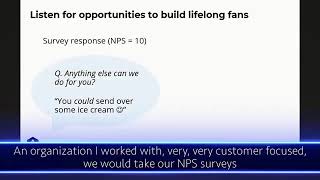
An organization I worked with, very, very customer focused. We would take our NPS surveys and through an integration with Slack, feed them directly into a private Slack channel. That was a channel that I monitored, along with the head of customer success, various members of the customer operations team. And we were monitoring it, of course, for both good and for bad. Right. We wanted to know if somebody was really unhappy, what had gone wrong with that interaction, what should we do differently? Should we actually reach out instantly to make things right? We also chose to monitor that channel for things that were going ridiculously well. And this company actually was tended to have very loyal and happy customers. And so we had a lot of nines and tens, tens pouring through that Slack channel. And every now and then I'd go in and we'd scour that channel and look for these nuggets. And this is a real nugget. So we'd ask the question in the survey of is there anything else we can do for you. And the real answer came back, well, you could send me ice cream if you want to. So, you know, we sent ice cream to Toronto in the summer and this was already a super happy customer. But you should have seen the Twitter explosion that occurred after that, right? We took a happy customer and we sent them into delirium. And it was just a moment of humor, a moment of finding that nugget, extracting something from that stream of information and going out of our way to show the customer that we were listening and that we cared. And to this day, that customer remains what I would call a rabid fan of that prior organization. And it cost us about 20, 25 bucks. So, ice cream for the win.
What do you do for your champions?
Well, actually, we have this one champion at Segment who has been with us since the very beginning, always good, giving us feedback. Every company this person goes to, they take Segment with them. And it's something that we've learned about our champions, is that they do, once they become positive and they become getting meaningful use and value out of the product, that they will not only advocate to people they know, but they will actually take the product with them to other companies. And one champion, every single Segmenter knows, and he's almost like an icon in our company. Whenever we talk about the champion, we talk about this particular person. And I think those are great. And I think that too, having those people come and be part of your company activities, for instance, like we have customer champions and customers come to our company, all hands, and talk about how they're using Segment. And I think that helps the company see that these people mean a lot to us and the that this is what we're all working for. We're working to make sure these people have helpful experiences and it makes it more vivid.
Probably going to reuse some of your hacks about the Champions later on when I go back. Yeah, inventing your customers at events, internal events, is a good thing. We actually had a couple of them coming to an off site we did last week, sharing their experiences. That was really valuable. Maybe another thing, it may be a little more controversial, is how do you respect your early customers? Of course, if they get to use the product more, getting new features, it's normal they would upgrade to new plans. But if they don't, if the product they signed up for is still the right product for them, why would you ask them to pay more? Whereas they actually trusted you, took a risk on you when you were much smaller. So maybe that's a kind of philosophy here, actually, earlier today I was in the speaker lounge speaking with another speaker and he just said, hey, we've been customers of Algolia for more than four years. And like, wow, I had no idea. And having that feedback and knowing that they still love us was so good to hear.
Yeah, the original customers, right? The people. I love that idea that these are the ones who do the risk on you before, you got to be where we're growing to be today. And I think that that's just kind of a form of loyalty. It's really, it's nice.
I probably invested in 15 to 20 unicorns and as a VC, probably 5 to 10. So far, the thing that stands out is there's at least one founder who has this ridiculous spark of, you know, you're in the presence of like potential greatness. It's like finding a high school basketball player that looks a little bit like LeBron James. You can tell that the person looks a lot like LeBron James in High school. Doesn't mean they're going to be LeBron James. They might get injured, they might, you know, all kinds of things can go wrong. But there's this spark and the person may be only 18 years old or 19 years old or they may be out of some field, like I came as a lawyer, so they may be totally off central casting, but you see this spark that you just don't see in normal people. And for me to make an investment early, before there's a product or before there's metrics, there's a spark. And I just like of saying I don't even know if I buy the idea but man, this person is incredible and I sort of be lucky to work with them.
And so that's what usually leads to.
A very early stage investment versus a more mature Series B which is based upon fundamentals, business fundamentals, metrics, cohorts.
Hey, Saster community. Welcome to Saster build 2021. We're excited to bring you this incredible digital mega event. On March 9th and 10th, we'll have more than 10,000 revenue leaders joining us for the event as we share the practical advice you need to build better, faster and stronger products. Throughout the course of the two days, you'll hear from our speakers or SaaS, celebrities as we like to call them here, and they'll be sharing their playbooks for building to 100 million. ARR. Some of our incredible speakers you'll be hearing from include Jeff Lawson, CEO at Twilio, Denise Pearson, CMO at Snowflake, Ivan Zhao, co founder and CEO at Notion both co founders of Monday.com, roy and Aran Beth Tolan, head of product at Asana, Joe Thompson, CEO at Loom, and many, many more. Be sure to click above to check out the full schedule and register for any of the sessions you want to attend. Now, in addition to the speaker lineup, we're also really excited about our Saster Community networking. We're doing this in a few different ways this time. Now that you're in the platform, head over to the Community tab to see who else is attending. VIP ticket holders have full access to the networking opportunities and can network with anybody in the community. If you're a free ticket holder, we place you in a cohort alongside similar community members with similar job titles and revenue stages. Either way, be sure to dive into the community and get to know somebody else attending Saster Builds Another thing we're super excited about is our incredible one on one matchmaking. So for VIP attendees, Team Saster has personally handpicked attendees we think you should meet with during Saster Build. You'll get this one on one matchmaking suggestion via your notifications, so be sure to check them out by clicking the bell icon in the top right hand corner.
All right everyone, now before we get you on your way with Saster Build, we have to thank our incredible sponsors and partners for supporting our community. Be sure to check the sponsor hall above to discover the latest SaaS technologies that'll help your company build to $100 million faster. Thank you to our super gold sponsors, Capchase Center, Code, Pendo, Sizudata and Twilio. Also a thank you to our Bronze sponsors assembled Demostack, the UK Department for International Trade and of course swapcard. If you have any questions throughout the event, please feel free to chat us at any time or visit the Saster booth in the sponsor hall to get in touch with our team. Enjoy Saster Build.
Sam.
Hey everybody, it's Saster. I'm here with one of our good friends and my good friends for me since almost inception in SaaS and for you guys since the earliest days of SAS. For Sam Blond, now Chief Sales Officer at Brex, one of the great innovators in finance and before that head of revenue stints at Flexport, Rainforest, Zenefits and others and going dating ourselves are going back in time the rock star pretty much everything at Adobe Sign and Echo Sign and I really wanted to bring someone back, a good friend to talk about what's happening in sales post Covid right. I mean we're coming out of this, we're coming out of this. The vaccines are going out. Texas is for better or worse at 100% capacity. And we've been selling from home for a year, haven't we, Sam?
It's crazy to think about it. It was sort of like January, February 2020 is over. But it's now been here since all of this started and crazy to think about that. And thank you for having me. Jason, awesome to see you and excited to be here.
So, so much. I want to learn. But let's, let's start off with some framing. Like how much of your sales team today have you hired since COVID and how many of them have you met?
So we've hired, we're accelerating hiring. We slowed down in a lot of 2020 when we were just figuring out, especially on the go to market side, just figuring out like what, what is the impact of COVID and all this stuff. And we, we make a lot of money on credit card spend. And so it's reasonable to think credit card spend would come down given things that you think about when people spend on credit cards. It's travel and it's restaurants and it's all these things that sort of disappeared. That said, our revenue did the opposite of what we were a little bit concerned about, which was accelerate. Because the spaces that we're selling into are tech and E commerce and these companies that spend a lot on things like software and servers and ads and things that a bunch more money is coming into today.
Yep.
Hiring. So it's accelerated in 2021. The folks that we have hired since COVID began in the sales organization, I don't think I've met a single one of them in person.
Of course, not even a manager, not even a manager for a walk and talk or anything like that.
You know, so we've made, we do a lot of internal manager promotions. We do an external manager hire. It's actually somebody that we brought back. Former, former Brett's employee that we rehired her.
She's.
She's great.
Her name's Maddie. So I have met her in person despite the fact that she was sort of a post Covid leadership hire. And so, you know, let's say we maybe made 20 hires, met all of them over zoom and none in person. And it seems to be going well. But I know we'll go, we'll go deep into a bunch of these sort of subtopics.
Got it. And so, and I want to go on the topic. Okay. But so, so you've. You. There was a brief slowdown. It Seemed crazy. But then Brexit's on fire because your customers are in tech and E commerce. Right. The two, the two biggest beneficiaries of COVID And I think, I think Enrique moved to. Moved out of San Francisco too. Right. The founders of Brexit are gone. Are you going back to the office? Are you going to go back to floors of endless AES and SDRs like in the Zenefits and others days? Are we ever going back to floors of AES in San Francisco?
Lots to unpack, I think. So Rex, sort of specific, we made the decision very early on. I think it's really paid off for us. We made the decision very early on that we are going to go fully remote even after Covid ends.
Yep.
So that allowed us very early, let's say back in the sort of like June or July timeframe of last year to begin hiring anywhere, at least in the United States, is primarily where we're focused. And had we, you know, sort of hemmed and hot about the decision and not really made our mind up, it would have, it would have forced us to continue hiring where we have office locations. So we are fully remote. You alluded to Pedro, Enrique, they're taking advantage of it. So they, they now live in Los Angeles. Our head of product moved to Austin. I have my head of sales development, she moved to Dallas. And people in the company are moving all around. And one of the things that you and I just caught up on, there seems to be one theme and that is lots of good weather. So sort of like Florida, Southern California, Texas, mostly warm weather states. I'm not seeing a lot of new addresses in Minnesota.
Got it. And do you even care where hires live now? Is it relevant at all to the hiring process?
Interestingly, yes. We have a bias towards new hires that actually aren't in San Francisco, New York, Los Angeles, what we categorize as tier one cities because there's cost savings associated with hiring people in lower cost locations. So of these new hires that we've made, lots of them do come from non San Francisco, New York type places. And you mentioned one thing that I forgot to touch on it was this sort of like, are the days of sort of like endless rows of SDRs and sales reps within San Francisco? Are those over? I think probably like never say never. And the reason that I think probably, I think this just accelerated something that was already starting to happen, which was oftentimes companies would start in San Francisco, founding team would be there, you start growing and then when you really reach a point where you're scaling and you have a process in place, you then sort of outsource and open up a second location in a lower cost. So Zenevitz did it in Phoenix, Brexit done it in Salt Lake City. And so what you've got in San Francisco are like the sales forces of the world. And maybe these companies that grew to be really big a long time ago, but I don't know that there are examples of more recent companies that are hiring that way in San Francisco anymore.
So let me go back to a point you made about tier 2 cities being more cost effective. And I'd like to understand what you've learned. On the one hand, that makes intuitive sense, right? You have to pay people more in San Francisco both because of cost of living and competition. On the other hand, a traditional, at least AECOM plan with an OTE tied to a quota. How does this tie into salaries being normalized across the country? Because let's say you have a 250kot for a million dollar quota. Just to keep it simple, right? Does it really matter whether you're in Antarctica or San Francisco or Pensacola, Florida? How does that make it more cost effective in a traditional AE comp structure?
Well, I think there's, I'll say two things and I may not be answering the question directly, so we may.
That's okay.
Two things that do come to mind. One is like, how do we do this? And then the second is some things that it unlocks for us that we didn't necessarily have previously. So the first is how do we do this? We work with our people team and they have different cities and they peg them based off of a tier and it's all cost of living related. And so you mentioned if There is an AE in San Francisco with a $250,000 comp band, what we do is if we're hiring them in Denver, It's a tier two city. So we look at the Denver comp for 250 and sort of like peg that to the San Francisco rate. And it may come down to, let's just say 200. These are illustrated. And so then that's how you structure their comp. And it's a 5050 split. And so they have the same target. They're just making money based off of where they live and not the exact percentage of what they're contributing to the company. So that's sort of how we structure the compensation. And then in terms of some doors that this opens for the business, we've found that having humans and we can say it's sales or we can just say it's some form of support. But having humans focused on driving behavior and specifically customer acquisition or product adoption, that when we put humans there, it has a huge impact. And there becomes a point where the cost doesn't support putting humans on specific tasks because it's too expensive.
Picking up the phone is the one that drives me nuts. You got to pick up the phone, right? You do.
And if you. And if you're picking up the phone and paying somebody, you know, $10 to pick up that phone, they can only do so much to pick up that phone. There are certain activities that they can do with that. If you make it five, they can actually do a lot of different activities. And so what we're finding, as we expand outside into the United States, there's actually more things that we can put people on, and then that even becomes more exaggerated. And one of the things that we're thinking about doing this year is something like expansion into Brazil, where we have a lot of our founders from Brazil. Lots of employees are from Brazil. And so if we can get a office in Brazil that allows us to pay people based off of cost of living there, the activities that those people can do to drive additional business, it just opens up a lot more to us.
I love that. I want to just pick on or follow up on one thing and then push on one other. But I love that you're using the cost savings to invest more in support and customers. Right? Because that's the biggest tragedy to tech companies. They pay so well, they make so much revenue, but they can't afford to pick up the phone. They can't afford to have humans. I think we've all learned we want more cs, don't we? We want onboarding to be better and easier, and humans make it better. Software alone can do it. And the fact that you're doing, which I implore anyone listening to this to do, which is invest some of those savings in more people to make your customers happy, right? More people that do not have to make six figure incomes, prima donnas that can actually make them, that's about the best investment you can make, even if your product's the easiest to use in the world, right? I'm a Brex customer. I rarely need any help, but I want help in five seconds. Like if I have a problem and I don't want to have to always figure out the website, right? Maybe it's too specific an example, but this is magic for mps, isn't it? And customer happiness is magic for retention. Right.
You nailed it. I mean like everything that you just said totally nailed it. We're doing right now an exercise of a bunch of people on our executive team. We're building what's called a flywheel.
Yes.
And a big part of, I'm sure everybody's flywheel, we haven't gone over them yet, is sort of like inspiring customer love. And rather than maybe taking the savings that you get by hiring in a lower cost location and putting those towards like the bottom line of the business instead, if you can reinvest that in things that benefit customers, that's a big part of what we're thinking here with what going remote opens up for us.
Yeah. Funny story. Sam and I are both investors in a company called Gorgias, which is sort of like a Zendesk for e commerce. It got a huge boost after Covid and the last board meeting. I love the whole team, but one of the sales leaders kind of complain, never complaints. I mean he's great, right? But he said, how come now we have three times as many people in CS as sales? I said, well, look what happened. Your time to deployment went down from. From 30 days to one day. And all these CS folks, they're not in the Bay Area. Right. They're in Europe. They're in low cost centers of Europe and the rest of the U.S. i'm saying that's, that's where you invest the money. That's magic. The fact that you have three times as much CS as sales should warm your heart as a sales leader. Right. Because that's going to be your magic to getting your NRR up, isn't it?
You nailed. So as you're saying, sitting here talking about this flywheel and the investment in CS that you just talked about to gorgeous, it's going to make the customer experience so much better.
Yes.
That's helpful to the brand and that's helpful to the reputation and that makes selling easier. And so the fact that they are investing so much in CS and making the product that the customer experience better, it's actually benefiting the sales team.
Yeah. Let's just finish that point. We could talk about forever, but people get this wrong. If you, if you have cost effective, high quality humans, that is the single best investment you can make in software. It's totally not obvious, right? But if you have folks that are cost effective that can improve your. There's always gaps. There's always gaps from trial to deployment, to onboarding, to renewal, to questions. And humans can fill those. You'll Never solve all those gaps with software. Right. Even Zoom doesn't do it. Right. You'll never solve all of them with software. And you will have happier customers if you put people right at prop. Put people on problems. Right. It always works, doesn't it? People on problems. Right.
The right people.
The right. It has to be the right people. Yeah. There's nothing worse. There's nothing worse. Right.
But you'll almost never have a worse outcome if you put somebody good on a problem and say improve, Improve the numbers here.
Yeah.
Very seldom do they come back and it actually got worse. You put me on this and I made it worse.
Yep.
All right, let's just go back to one last thing and then let's move forward. But I. Because so many, so many founders in particular really try to work on their sales compliance. So let's talk about this Denver versus SF thing. And SF is almost. Doesn't even exist for Brexit anymore. Okay. But we've had salary differentials since the dawn of time. Right. The federal government pays different salaries. No matter what anybody says. Big companies are never going to pay everybody the same everywhere in the globe. At least the majority aren't. Some will and more power to them. But most of that's going to go away by 50 or 100 employees. And it's nothing new. But where I get a little confused is around accelerators and incentives. So let's imagine you have a rep in Denver vs SF. The 200 vs 250 OT. In theory makes sense, right? In theory makes sense because normalized they're the same. And let's be simple. Let's say the quote is 4x. Well, let's say it's 800k. Right. But if you get into the bonus, if you get from. Instead of doing 800, you do a million that's so valuable to the company. Does the Denver person not keep as much of the extra 200 or do the accelerators have to normalize even if the bases are lower?
So I'll tell you how we do it.
Yeah.
It doesn't mean that that's the right way of doing it. And maybe, maybe we could drive different behavior by doing it differently or so certainly could be debated. The way that we do it though is we believe that $200,000 in Denver feels like $250,000. Again, these are illustrative. I don't know that these are the exact numbers, but $250,000 in San Francisco feels like $200,000 in Denver. In terms of cost of living and where the home that you're able to rent with that and, you know, food prices and whatever else. Um, and so when people overperform, an extra 10% is 10% on each of those. So if somebody gets an accelerator at the 250,000, they may make 275 and in Denver they make to 220. It's 10% of what your salary is and not necessarily the hard dollar value. So the person in San Francisco that's over performing, they do receive more hard dollars, but they receive the same percentage increase.
I guess that makes it after, you know, after costs and taxes, it's the same, right? Or sort of. Right. It makes sense. I have to noodle on it because I like things simple. I don't like two folks making different amounts for the same activity. But on the other hand it's logically consistent. Right. That way is the simpler way to do it, isn't it?
Well, and it's the same whether you're in sales or anywhere else. Right. Like people in support, they're likely measured on, you know, how many, how many tasks they can complete or whatever the metric is. And we should expect the person in Denver to complete the same number of tasks as the person in San Francisco. And the salary is going to be different. So it's universally applicable that you are getting paid less for producing the same depending on where you're located.
All right, let's chat a little bit about training and onboarding. Right. And I'll tell you where I get. I want to hear what you've learned to improve training and onboarding in general, like with the distributed team. But first let's talk about SDRs. Right. I find that entry level SDRs straight out of a two year program or whatever. I mean, we have trained them since the 18th century by osmosis. Right? By folks that have 7,000 questions a day, turning around rapid fire, asking questions, making mistakes. How do you train these folks over Zoom and Slack? How do you make that work? It's so different than the past, isn't it?
This is when you and I emailed about chatting on this topic. This is the group of customers that came to mind, or this is the group of employees, I'm sorry, that came to mind. This is for sales, it's going to be SDR for other departments. I think it's just sort of like your most junior employees, the entry level stuff.
Right. Mark Zuckerberg said those are the ones that have to go back to the office. He said everyone else can work from home, but at Facebook, the newbies have to come in, right?
Totally. And when. So when Covid first started, and then when we made the decision to go remote, this was what was on my mind. And it was on my mind because I remember I joined echo sign in 2008, and I was shortly out of college, 22 years old. And just thinking back, like, if I didn't have the forcing function of needing to be in an office and sort of, like, appearing there, and I had a manager that was sitting next to me, what would I have done with my days? If I woke up in the marina in San Francisco and maybe I'd gone out that Thursday night before, what would Friday look like for me? So that was my big concern. And I think my thinking has evolved a little bit, and then we can get more tactical in terms of what we should actually do. My thinking has evolved a little bit. And accountability is less about sort of showing up, and it's more about performance. And so that line of thinking is incorrect. Now, I've come to the conclusion that that line of thinking that these people, they're not going to work is not correct, because I think what's going to be motivating in what they'll be accountable to is hitting certain numbers and not necessarily being in an office for a certain period of time. We've actually found that to be true. We haven't lost productivity with this group of employees. I mean, the question would be best answered by Ashley Kelly, who's our director of sdr, and Maddie, who's one of our SDR managers, in terms of, like, tactically what they're doing. But I see a lot of times on calendars where people are doing the same activity. And if everybody's on the same page, let's say there's a prospecting block for two hours in the morning, and you get everybody. And maybe you're even on a zoom call in the background where people can sort of, like, unmute and chime in. Hey, has anybody ever seen this before? Do you know how this product, like, this system works or anything like that? But if everybody's doing the exact same activity, you've got a Slack channel that people can type in. You know, successes, celebrate those sorts of things. If you keep everybody doing the same sort of thing for specific time blocks, that seems to be something that's really valuable.
Well, that is a big change from the classic throw a bunch of SDRs at a random list or. Right. Have. Have structured blocks where everyone's doing essentially the same thing at those times.
Structured days.
The same. Yeah, structured days. Yeah.
And ideally, you know, there should be a period of time and this may differ by time zone, but there should be a period of time that cold calling is the most effective. All right, let's have our cold calling block from, you know, 9 to 11am I see.
Get the whole team together. That's what we're doing. From 9 to 11 we're just doing our cold calling, right?
That's exactly right.
Get it.
Get everybody rolling in the same direction, doing the same activities. And then a lot of what used to be the sort of like tap your neighbor on the shoulder, encourage just a ton of communication. Whether it's over zoom, over slack, whatever the sort of medium is, it's just in reinforce that at the leadership level. So lots of pings like how's your day going? Anything I can help with and just sort of like constant communication.
Yeah.
Have to take place when you're in office.
And if you found. I've only seen this anecdotally, I don't have the data, but I found that for sales folks in particular. True of anybody, but especially sales and some extent marketing folks, it's much harder for the mediocre to hide now. Right. In the old days we're just driving from the marina and hanging out in the office. Got you 20% of your brownie points. No one cares anymore for someone that shows up to the zoom and smiles. Do they? Have you seen that impact sort of like maybe the just below mid pack group. Have you seen them stress out in the situation or have you seen better performance from folks like that? Or is this you not seeing this behavior?
I think what I'm seeing, which is maybe related is in the office there are a lot of personal relationships that existed and I think also a lot of the shift to remote has I think more than ever made the sort of perception of performance very data driven. It's less.
Exactly right. Yeah.
You're so I'm in data so much more and so much less going to lunch with people and developing these sort of like personal relationships that can make performance evaluation far more subjective. When you know somebody, they're a great person and like, you know, you really like them and all of these. Instead it's much more seeing how people are stack ranking and you don't get as much of that sort of like one on one going to lunch. Now there are advantages and disadvantages of that, but I think it does shine a much brighter light on the sort of like performance of people because that's all you're seeing and less the sort of personal relationships that often exist in the office.
So even at your level, at the top, you are, you're finding that you're judging folks even more quantitatively than you did before, right? Yeah, I think that's the thing. There's always this Persona of Bob who everyone likes in the office that's not that great, but he skates by. Right. Because of his Persona. I find Bob's are not only not skating by. I'm, I'm finding they're deeply struggling now. They're deep because they're, because their toolkit doesn't work anymore.
Right, that's, that's true. And you know, I think before oftentimes we would bake in excuses for Bob.
Like Bob endless. Everyone has an excuse for Bob. Right. He always makes it two more quarters than he should have, doesn't he? He always lasts two more quarters than he should.
He's trying so hard.
He's such so hard.
Yeah, he's in the office at 8am every day. Do you see that? He's, that he's sitting. And so every day that, that, that.
More time that goes away.
And so the other thing, and it's sort of related is there are people who, and this is maybe less true in sales, but it does exist. They're less comfortable, sort of like asking for help. They're just not, they feel like they're intruding or they're taking so many time. Those types of people will struggle more and what.
But we all have, even I have some of that. Right. What's your top learning? How do you encourage people to ask for more help than they're used to before distributed days?
Well, I think it's a two way street. And what I mean by that is we have to encourage people to ask and say like you're not going to be successful if you don't. And if you put it in terms of success and failure, there aren't asterisks. You know, talk about this data that we're looking at. It's people's performance. There's not an asterisk next to Bob's name. That said, Bob reached out to his manager a bunch this month to get help to get to his number. The numbers are the numbers and you put yourself in a better position to be successful if you do seek help. So like we encourage that. That said, it's a two way street where we need to tell Bob to seek help, but we also have to set Bob up for success and create an environment where help finds its way to Bob. And it's more constant communication. It is more of the proactive. What can I help with? Anything that you need. Let's get on a quick. Even if it's just like a five minute call, I want to check in and see how your day is going. Those sorts of things really make a difference.
There's two more things I want to make sure we get to before out of time. But curious your feedback. The one thing I've tried to do with folks to improve some of this, the questions and the onboarding is and just curious your thoughts as a leader is much more shadowing. So the new idea I like is for the first 30 days, no employee has to do anything but shadow. There is no quota, there are no sales. You should not even do your own call. You will not get a lead. You are paired with Sam or Abigail or Jody in any role, but especially sales and marketing. And you're not. We're not expecting anything out of you the first 30 days. And all I want you to do is find. And then if you're lucky you end up with an inadvertent mentor. Right. And all you do for 30 days is you join them and we're not. And then on day 31 we'll be well then, then let's talk about new stuff.
I really like that and that's actually a takeaway I'll probably, you know, on. On my next sales leadership team meeting there will be a line item for a discussion topic. Jason Lemkin idea on shadowing for the first 30 days. We do a variation of that but I think I might like yours better. Yeah, everybody. Everybody. And this was actually true in office too. Everybody's assigned a onboarding partner and that's somebody on their team, likely somebody that has been successful in the role that they're in addition to their manager encouraged to sort of go to and that gives the person currently in the role. Also it's helpful to teach people you can learn a lot yourself and it's a positive experience from a learning in terms of like, you know, leadership type roles. You sort of pair the success together. I think there's lots of like positive benefits. We don't do that though where we could say your job is just shadow this person for 30 days.
Yeah.
What we do is this is your buddy or whatever we want to call it and you two need to meet twice a week and there's like a document that sort of outlines that stuff, but it's less sophisticated than what you just described, which I kind of like. There is one thing that we do in addition that we haven't done before. So we just added, in addition to managers and in addition to these buddies, we now have a team lead or a coach that is the top performing individual contributor on our team. 25% of his number is now tied to the performance of the team. And because of that, it's now part of his job to join the calls of other reps on the team. So we are adding just more support than we ever really needed to in the office environment.
It's a different point in the shadow, but I like this. That's a good. I like that simple heuristic for. We all end up with a team lead. Right. That they naturally gravitate around these leaders that may not be ready to be the manager or the director. Right. And tying 25% of their comp if they want it to the team. It's just about the right ratio, isn't it? It's just about the right to be their number two. Because then it's your number two job, isn't it?
Yes. And I think totally. And one thing that was happening before is this person was already recognized as the. The top rep because people see the leaderboard, right? And so periodically, especially newer AES, but periodically newer AES, and then maybe sometimes in big deals, people would sort of like, slack him and be like, hey, you know, quick question on this account. And I think there was this. We talked about it with potentially people not seeking help, but I think that there was this, like, am I taking too much of it? His name's Bobby. Am I taking too much of Bobby's time?
Yep.
Bobby. Bobby doesn't want to, like, Bobby's got his own stuff to worry about. He wants to be number one on the leaderboard. Am I pinging him too much for help? And by delineating Bobby as team lead and tying 25% of his comp to the performance of the team, that's now Bobby's job. So, like, you're actually helping Bobby do his job by pinging him. It's his job to join the team.
It's a good point. Yeah.
That was an important distinction. And by the way, what's today?
The fourth?
We're four days into this.
This experiment. I like it. I like it.
I can't report on results just yet.
We'll do this again and we'll talk about the shadow a bit more too. All right. Two last ones, because this is great. There's a lot I'd like to ask you, but two last ones. One might be a big Topic. But let's simplify which is have you found now that you can recruit anywhere and over zoom. Have you been able to build a more diverse sales team out of this?
We have been able to, I can say definitively we are building a more geographically diverse sales team.
But have you been able to take bias out of this by, by having a more technologically focused recruiting process? Has it benefited you in terms of overall diversity? Have you found ways to leverage that?
Yeah, so, so I think where we are are continuing to have done well and continue to do well. And then I'll talk a little bit about maybe a downside of what the way that we do this also. So we are becoming far more diverse geographically. I think as you become more diverse geographically, you inherently become more diverse with sort of like thought, you know, people in different parts of the country, they're different, they are different from one another. So I think that adds certainly we've always been, I would say good, not great on gender diversity. We have several really amazing women leaders in the sales organization. We can probably do a little bit better with our individual contributor hiring. This does open up the candidate pool so much wider such that we now can be more thoughtful about like you know, making sure we've got a ratio that we're comfortable with where I think, and this is something that I've talked with you about, I think and certainly talked about in some of my recruiting conversations, we do a lot of referral based hiring and that remains as pros.
And cons here, right? It has pros and cons here, right. You get people that look a lot like who you already have is the downside, right? It's a big downside.
We do.
And the upside very much mitigates risk.
Way lower risk like order of magnitude lower risk with referrals. Right.
I mean and there's all sorts of second order things. The person that makes the referral really takes that person under their wing and makes sure that they're successful. Because the reflection on them and like all of these positive I think or not, I think I'm pretty certain that it doesn't help diversity.
It is classic anti diversity. Right. The first time you go to manager school you learn you have to stop hiring your friends or no one else will. They'll only be like you. Right? That's the problem. Non managers only hire their friends. That's who they bring in. Right. That look act talk like them went to the same school, went to the last company. Right?
That's true. And so we, we, we can do.
Better There it's a tough trade off. Right. It's a, you know, I think it's like promotions. In a perfect world, you'd have 50, 50, you have 50% of your managers from within and without. Right. To get the best of both worlds. And a perfect world, half would be referrals. And then you would balance that out with going even further to make your team more diverse. Right. Rough idea. 50 50s are nice in these things.
I think you're right.
And.
Again, we have solved for the risk mitigation historically. And so this will give us an opportunity, I think, more than ever because again, like, the candidate population that we can hire from today just grew exponentially. We had offices in San Francisco, New York and Utah. That's a small percentage of the United States. We can hire anywhere in the United States today. And so that just means that the candidates that we can hire from, it just grew exponentially. And we can then filter in for the highest quality and do a combination, I think, of mitigating risk, but also not just taking from referrals.
All right, last question. And this may be more for your ecosystem and friends and peers. Right. But catch me up on where the topics. Will the top executives work for a CEO based anywhere today? I was skeptical for about six months after Covid, I was skeptical that a top CRO CMO wouldn't wait, wouldn't. Look, look, I'll work from home, but after all this, I want to be in the office with. With her, with my boss. Right. And then about three or four months ago, I saw this fall apart and I saw top folks that we knew start to take jobs with companies in Europe in particular, because I've worked a lot of European. I'm like, what, what, you're joining a CMO for a company based in Norway or London? Is this temporary? If I'm a CEO based in wherever in the world can I hire a San Blonde today?
I'll give my sort of like biased and personal experience perspective on this one. So I suppose it's a strong opinion that's loosely held. So I think it depends on the stage of the company. And what I mean by that is there is so much value to having the early team be in an office together. I think not just developing relationships, but also the like, you know, eight o' clock at night, everybody's still in the office. Oh, this thing came up. Let's all jump in the room and whiteboard out. Like how we can accelerate, you know, next month's revenue twice as much as we think we could before like what would we do differently? And I don't think those types of conversations happen in a remote world where the executive team or whatever is fully distributed at an early stage. I think as companies get larger, that becomes less relevant. Those types of things don't happen as much anymore. And so to answer your question directly, I do work for CEOs that are in different locations and may or may not be in different locations once we're done with COVID And I would, depending on the company, company size, sort of like removing myself from the situation. I think people, the expectation is they will. I think we're in sort of a new world here and for larger companies they're going to have distributed executive teams. But again, if I were starting a company today, I would want that first core group of people to be in an office together. And you know, maybe it's just the first 12 to 18 months or something like that, but I just, it felt like there was so much value that we gained whether it was at Brex or at Zenefits or I'm sure you remember at Echosign, just by being able to pull people into to rooms and have those ad hoc.
For sure. Well, let me, let me just summarize it at the end and then we'll break. Let me ask a specific scenario, right? Just for cross execs, you know. Right. And folks, you know, a 5 to 6 million ARR SaaS company doing really well. Okay. Growing triple digits, great product, good customers, based in Sweden, based in Italy. Okay. Based in, I don't know, not Paris and France, some other city based in, maybe even Brazil. Can they hire Bay area SAS VPs today? Like, and should they, should they almost. Should they, should they not have any worries and should they go for it? Should they, should they not be where they can hire the best folks that have spun out of SF tech companies? What's your thinking on that? Will folks, you know, go work for those companies? So.
I'll give a very Switzerland answer. I think it depends on. But I think generally speaking, yes.
If.
There is a really hot, fast growing company that is located outside the United States, I think that's fine. And yes, I think what matters more is the quality of the team, the growth of the business and less where is the founder or founders located. I don't think that that is sort of like at the top of the priority list. All of that said, there's some nuance in terms of like if they're in Italy and all the customers in Italy, does it make sense to hire somebody leading sales in the United States?
No, no, I'm assuming it's a global as a global customer footprint, right?
Assuming you know that, yes. I think like if customers and go to market is primarily concentrated in the United States, I think it makes sense for both, both the company and the individual to have somebody out of the.
U.S. well, thank you Sam. This was incredible. I'm sure we'll touch base on all this again in the coming months. We'll have you at another Saster event and we'll dig in a bit more. But thanks again and congratulations on everything.
I can't wait. And congratulations right back to you. It's been awesome to see Sastr evolve over the course of the last 12 months now into something bigger and better than it's ever been. So awesome to see you Jason. And congratulations as well.
Welcome to Sastra Build. This is a video on how to use the virtual event platform. After you register, you will receive a confirmation email with a link to join the platform. Just click on that link and it's going to automatically log you in and take you to the homepage. Like what you see here, in the center of the page you'll see an image followed by various feature icons that we're going to run through and below that you'll see links to some of our top sponsors and partners. So if you look on the left hand side column you'll see your profile. This is the data that we've collected from you during registration, so feel free to come in here and update it with the data that you would like to share with other attendees when you're networking with them. Let's start with the schedule. So when you click on the agenda it will show you all of the upcoming sessions. You can run filters to narrow down the sessions that you're looking at. If one session is particularly interesting to you, just tap on it, hit register and that will add it to your agenda. Come back when the session starts and the video for the session will automatically display. While the video is going, you'll have access to this live discussion. In the bottom right, you'll be able to chat with your fellow attendees, ask questions of the speakers and moderators, and respond to polls that are being asked of the audience. Down below on the left you'll also see recommended sessions. So this is our AI recommendation engine that will learn more about you as you use the platform and hopefully refer you to other sessions that you may want to attend. If you want to explore our speakers, just tap on the speaker tab. It'll show you all the speakers of the event. And if there's one that you're interested in learning from, just tap on their profile. You'll be able to read about them, see their bio, their social media links, and from here you can send them a connection request or an appointment request. The great thing about the appointment request is all of these times are mutually available times for you and the person you're going to meet with. So just write them a little note of why you'd like to meet with them and send them the request. If you'd like to explore our sponsors, just tap on the sponsor hall. You'll see all of our sponsors that are coming to the event. If one of them is offering a product or service that you're interested in, you can just tap the little bookmark icon and that will add them to your bookmarks, or tap on the company name. It'll open up their profile. You'll see everything is kind of rebranded to them. From here you can learn more about them, view their videos or images, see any sessions they're sponsoring, and also see their team that are joining the event and connect with any of their individual team members. On the right hand side, you'll have this chat box where you can actually submit questions, real questions to the staff of this company and even request a video call. Once you've been using the platform and you started connecting with other attendees and creating your agenda, you can tap on my schedule. It'll show you all of your scheduled sessions and meetings, your bookmarked companies, and it will give you the option to export this to your calendar or download it. If you have any questions during the event, please visit the Saastra booth and submit questions. And we look forward to seeing you at Build.
Evan, John and I started Twilio 11 years ago. Back then, communications was just inaccessible to software developers. And so we started with a simple idea. We said, why isn't that just an API? And this simple idea that communication should be in the tool belt of every software developer in the world. And if it was, that together we would create the future of how people and companies communicate. If you don't have a big vision and bold ambitions, you won't know where you're going. But if you don't follow customers at every step of the way, you can get lost 160,000 companies who trust Twilio with their communications to engage your customers with the developer first approach, what you're really doing is putting a new tool in the toolkit of the world's developers so that when one day they're at work and they realize there's some problem that needs solving. They're now able to say, aha, I know how to do that. Yeah, it's Twilio.
We're generating so much data that we want to use, but all that data is right siloed across our company. Data cloud is really mobilizing the that data for you. It brings all that data together to everyone in your organization that needs it. You know, we simply have an incredible product that solves problems that people never thought anyone would ever be able to solve. Product is basically like magic. It's also about having access to data from your partners. Data becomes more valuable as it's combined with other data sources. As a marketer, a dream come true is to really be a part of, you know, creating an iconic brand. When the going gets tough, the tough gets creative. Because a lot of ideas are not invented at the headquarters.
Right?
They're coming from the field. How do we know our customers better than anyone else? How do we stay more relevant, more helpful data?
Last year there were seven cloud IPOs in total.
Bessemer was an investor in four of them.
Our secret sauce is our road mapping process. The firm will have 20 to 30 active roadmaps. Part of our predictions that used to be internal roadmaps we now expose to the world. We're thrilled to be unveiling our annual State of the Cloud report. We're going to try to talk about where we've been, where we're at, and.
Then where we think we're headed.
You essentially now have a playbook to how to go out and build your great cloud business. You now have a peer group and a support group, not just through online communities like Saster, but through a pure CEO set that is absolutely world class.
You're not alone.
You don't need to figure this all out for the first time, as people did 20 years ago. The two things that I love the most outside of just the general value Prop 1, it's the story and the product is personal to the founder.
Just understanding where you differentiate and how you're going to win. Being able to clearly articulate that is really key.
We can't wait to see what you're going to build. Keep kicking ass. Thank you.
So money is essentially a platform that.
Any team can manage. Pretty much everything.
We provide very flexible.
Very dynamic building blocks.
They basically allow you to build whatever.
You want, whatever makes sense for you as a company.
People build unbelievable stuff.
On Monday, we have clinical trial research, people building airplanes, construction firms, architects, hotels. You can build Your own process and manage the team the way you like to and at scale.
You need everybody in the country, company.
To make decisions in order to be.
Ahead of the game.
How do you pass ownership to people that they feel they make an impact?
It's very important that everyone will know what's happening in the business.
Otherwise they wouldn't be able to help.
Us drive it forward.
In the office we have hundreds of dashboards showing every metric, how much money we have in the bank, ARR, new signups, everything.
People are going to see your numbers, your metrics. Aren't you afraid if we're better than.
Them, you know they're going to be scared to death. And if not, we got a problem and it's not the dashboard.
My name is Ivan, I'm the co founder of Notion.
Notion is an all in one productivity tool.
It's extremely flexible. You can almost mold it into any.
Type of tool you want for yourself.
You design a Lego.
Now the community team take the Lego to places that you never imagined. Sometimes I wonder like what makes a software product timeless? It has to have this long term healthy symbiosis with its users.
Building software is kind of like making art.
The office vibe we're going after is.
Kind of less like an office, more like an artist studio. Fundamentally Notion is a tool. It's just like, like I'm holding a pen here. How good the pen is depends on how well it feels in your hand.
Our mission is about that romance of computing.
If anybody can customize their own tools.
The positive second order effect on the world is huge.
I can't imagine doing anything else but building this. The dream and romance is can we create a tool that democratizes this medium?
Okay, hey everybody, it's Saster. I'm with one of our, our old time favorites, Michael Pryor from Trello who joined us live several times at Saster annuals on stage, on his own. We had one of my favorite sessions where we did almost a board meeting for Atlassian with Michael Cannon Brooks, which I promote all the time. If you want to watch two Cos together, there's really nothing better than that. And one of my favorites because I've used Michael's built many products over the years. He's been building software I think since he was 6 or 13 or young. But I've used many of his products. Many of you won't even haven't heard of before Trello and then I had some fun looking up I actually the first in the first two months of Saster back in 2012 the first and only product review I ever wrote was about Trello. I said it was great and I had been exposed virally. So I don't know in 2012 how many Trello use. We have 50 million today. How many think we had in 2012, Michael?
Yeah, I don't know. A couple thousand maybe.
A couple thousand, that's pretty cool. So I'm old school, I'm OG Trello.
I guess there's a special URL you can go to that will tell you which. What you're like, what user number you are.
Oh, is that right? They have that for LinkedIn too. Wow. Okay, I've got to look. Yeah, maybe hopefully I'm in the quadruple digits. Probably not definitely in the five digits. My first and only software review. Trello's cool. And so one star, right?
You were like one star Trello.
No, five stars. I realized quickly after that I don't think anyone wanted to hear product reviews for me. But I did, I did, I did do the one. But anyhow it's always been one and it was interesting to me. You know, I got exposed virally which we'll chat about and so much has changed. But let's chat about that before we get to the genesis of this is I want to talk about going enterprise. Right. And we seen a little thing that you guys had achieved Fedramp authorization, which, which we'll talk about maybe second. Right. Going up market because it takes a while to start doing some of that stuff.
Right.
And we think of the old days of a. A cool developer focused project management Kanban tool now selling to the federal government. It's a lot of change. But we're eight years into Trello, right? Ten years. How many years are we into Trello and where is it going in the next decade?
Yeah, I mean I think from the genesis of the idea we're probably coming in on a decade. And I think that's a. It's been a great time for us to sort of step back and think like how do we evolve this product for the next 10 years and what do we want to do to change it? And I think within that backdrop you have to understand what are the things that people love about this product? Why did they decide to use it in the first place? What's gotten us to that 50 million number which at this point is a really old number. But you know, because big public companies, but yeah, public companies, there's some schedule to when you can say these numbers, but it's a lot higher than that now. 50 plus, yeah, you know, you have to take the essence, the product principles that made you succeed, the brand, and you can change it and evolve it. And I think that's for a lot of products. The general journey is they talk to their customers, their customers tell them about more problems, and they create features, they create sort of geography of their application that solves more problems for those people. And essentially you build a product that is more powerful, it's more customizable, it does more things, but it also becomes heavier. Right. In the. In the sense of what is the affordance that I use this product for. So, you know, I think like, there's a lot of productivity apps, there's a lot of project management apps, there's like this space is really big, and while you could use a lot of them, you know, to plan your board off site, or you could use a lot of them to run your financial quarterly close for your company, People tend to gravitate to different tools for certain jobs. I think of why would you use PowerPoint for something versus just putting word in landscape mode. They both let you put pictures and text. A lot of the features of apps are very similar, but there's sort of a space that people go to where they gravitate to and they realize that they want to use that app for those types of activities. And I think that what goes into that is those product principles that you're using and how you're applying them to your product. And so there's this kind of special place where it's like, how do I add power while keeping the simplicity? You know, it's almost like this holy grail, and it's almost an impossible thing to do. And we spent a lot of time thinking about that and trying to keep the mental model of what Trello does simple, but add a lot of power to the way people organize things. And I can go into that if you want to talk about that, but it's.
Well, can we tease into one vector of that keeping it simple as the feature set expands? It's a classic challenge we've all talked about for a long time, right? Yeah, but I actually think that is easier than a related challenge because, look, if you have a core UI that's easy to use like Trello, and you stick to that, which is hard to do. Right. But if you stick to it and you have a good team, I think you can keep an easy to use product for a while. What I find more interesting is as you compete more broadly. So, as you said, there's a lot of project Management tools out there. And notwithstanding that maybe you're approaching 100 million users, people use other tools. So I would say I'm not an expert. I do use Trello. I haven't used a lot of other tools, but they're more complicated. Many tools are more complicated. But as you get pulled into that, how do you handle that balance of actually building a more complicated app intentionally so that you can close that million dollar deal or attach to that big Jira deal or confluence deal. How do you think about that piece?
Yeah, this is just one way to think about it. But I think about it like grammar, right? Like what are the words that you use in your application and what's the dictionary that somebody would have to, to have in order to understand what your app does? And the smaller the sort of dictionary is, the easier it is for people to understand. So I sort of focus on like the words that you're using because obviously you could just create a list of pages in your app or like new places to go, right? Like you'd be like, we added okrs to Trello. You go to the OKR page.
You know, we added traditional way to do it.
There's a, you know, that's on the admin page, Right, sure, exactly. And then the problem becomes your PM struggle because they're like, we don't get any people going over to this other place, right? Like that. It's very, it's easy to create these other destinations where you can kind of put those features. And I think that that is one way to solve it. But it's, there's sort of a question of design and an artfulness to like try to figure out how you can do that within the framework that you already have, or what's like the minimum size set of inventions that you can come up with or new words in order to do it. So let me, I'll give you an example here. So we in Trello we have boards, which you're very familiar with, and boards hold cards, right. And above boards are these things called teams. So boards live inside teams, but it's actually probably not the best word for it. We're probably going to name it workspaces because everyone uses team, that term for that type of thing, the container for your items. I think a lot of apps have solidified on that. So imagine you have workspaces inside your workspaces, your boards, and within your boards you have cards. And that's pretty much like the gist of Trello. Like if you can understand those sort of three things, you can really figure out how to, how to use Trello. And one of the things that we were trying to understand is people are using their cards to represent all these, you know, tasks that they're working on or mini projects and they're expressing them in different ways and they want to look at them by, you know, their due date, or they want to look at them on a map, or they want to look at an encounter. They have all these just sort of pivots of the information. And you've probably seen this in a lot of applications where you can kind of take your board and you can go through these different views of the board. So you can look at it in the typical Kanban view, you can switch to the calendar view, you could switch to the timeline view, you can switch to the map view. You know, there's sort of like this extension of views at that board level. I think anybody that's familiar with Trello or familiar with apps that compete with us has probably experienced that and understands that. But one of the things that we're going to do this year was to extend that view metaphor up to the workspace level. If you imagine you're down at the board, you're looking at your project at the 5,000 foot level and you go up to the workspace, now you're up at the this 10,000 foot level and you want to get, you know, you're looking at more information, you're looking at multiple projects, a whole portfolio of things that's happening. How do you extract information from that? And so we're going to use that same metaphor that we use at the board level, which is, hey, you want to look at the timeline or the calendar or the, you know, the map or the canvas of all those boards, right? Not just a single board, but you're zooming out, you're getting the 10,000 foot view and you're looking down. And then that's great because it gives you this high level overview which you were talking before. Like how do you kind of create more advanced use cases or kind of like people are using it for higher quantity of information or more, you know, complicated tasks which you can add automation in there. We have an automation engine in Trello, so you can do a lot of things there. But then I think the one thing that is sort of inventive that we're doing is if you go down to the card level, we're also going to give people new views of the cards as well, which actually I don't think I've seen anywhere else. And you know, it takes a little bit of an explanation to explain what I'm doing there. But if you think about Trello, you know how there's like the card and you can write some text on it and you can click and open it and you get the card back, which has all these conversations, attachments, it's got files, it's got pictures that you can add to it. It's sort of like a big project. There's like a lot of information. When you close the card, you just see the front. When you're looking at the board, you're just seeing a summary of the project and it's within this context of all the other work that you're looking at. But it kind of gives you a hint like, oh, behind, you know, behind the other back, on the back of the card there's like all this density of information. And so one of the things that we're going to do is add new views to those cards. So, for example, a card could actually be another board or a card could be a mirrored card from another board, right? So a card could be a checklist from the back of the card could appear on the front of the card, or a card could be like a JIRA ticket from another application. You can make that card appearance, a piece of information from the other, from the other app.
You could even make like that part of managing bigger accounts and integrating broader with the Atlassian suite. Are those the drivers?
It's, it's kind of. We're thinking about the jobs to be done and what people do. So one thing that we've been experimenting a lot with lately, because we're all working distributed, has been, you know, everyone's on zoom. You're using your communication tools, you're in Slack. But one thing we've been trying to do is use asynchronous video a lot more. So things like Loom or just recording zooms and then distributing to people so that they can consume them at a different time, right? And you realize if you're ever in a zoom and there's like 20 people, but like one person's talking the whole time. It's like you probably could have just recorded that and then put the link in Slack or, you know, distributed some other way. So that Async video, I think is a really cool new opportunity for distributed working, right? It's like it's somewhere between that real time communication and Slack. And I think you even see this with Slack. They're adding, what do they call it, Stories. It's kind of like TikTok and Slack, right. So they're adding this and we've had this debate internally of like, whether, you know, is that, is Async video like Loom, is that a product or is that just a feature that every app is going to kind of have?
Isn't that what people at big companies think about? Yeah. While loom races to 50% of the Internet. Yeah. But it's.
Then you ask the question like, why, what is the, what's the interesting thing here? What are you unlocking by giving people this technology? And so we ran this, we were talking about that internally and you're thinking about like, hey, we, you know, when we do a stand up for like you do a stand up in the morning, a lot of teams, they'll have the zoom on and they'll be screen sharing the Trello board, right. And they'll go through and people will talk about what they're working on or whatever. And you'll go around the room on the zoom and you'd sort of start to think like, oh, Async video, that's a cool use case for a stand up. Actually, if everyone records their little status update, then you can just consume that whenever, you know, you don't have to do it real time. You can kind of like just especially.
As the organization scales, right?
And so we were like, oh, could you do that with Trello? Can you solve that job with a list and a card for, you know, every person on your team? And they just make a video card, right? And they just record the video and it shows up in the list and then there's like a play all button at the top or something and people can just watch them down. So thinking about, I think the reason that we thought about different card types or card views is because we realized that the sort of behaviors that people were doing inside Trello, we could kind of solve new jobs to be done. But the trick was, how do you do that without kind of just making a whole bunch of new nouns in Trello, right? And just complicating that dictionary of terms that people would have to understand. And like, you know, your help docs are basically just this giant nested, you know, thing of all these new, these new terms that you made up and people have to learn it. I think like, you know, there's a lot of tools that are very vertical tools that are super powerful, but that onboarding into that tool becomes a really high hurdle. And so you're only going to do that if it's like part of your job Right. Like, you're only going to figure out how to use Salesforce if it's like, that's. You're a salesperson, so you have to do that.
Right?
So people that are just like, hey, I just need a little CRM, I'm running a little business most of the time. You're not going to jump into one of those vertical tools that has that huge hurdle to jump in order to understand it. Because the amount of work that you have to do is disproportionate to, like, what you need to do to get your job done.
Right?
And so that's the balance. I think when you're building a horizontal tool like Trello, that's our job is to keep that dictionary really small and make sure that the ramp to understand the application is as low as it can be for people to onboard.
Well, that's interesting. With this new expression of cards, you want to make it as sophisticated as you can with no training, the minimal onboarding headache, right? So that anybody can use TRECTO, like back 10 years ago or eight years ago. That, that's. That may be the most existential trade off, right. Is how can you add this complexity and add no additional burden in terms of usage and onboarding, right? Because I'm still trying to figure out how to use Salesforce. It's been a few years, and it's powerful, but it is powerful, no question.
Right. I think the behavior that happens a lot of times is PMs get in there, they add the feature because they just need to do it. And so they just build it. They build it in a new, you know, space. They give it a term. And so then this problem comes where it's like, well, people don't understand it or they can't learn it. So they see that as an education problem, right? And they're like, well, I guess my job is to. I have to explain it to you and I have to, like, make you watch a video or I have to put a bunch of words on the screen and like, you know, people don't read, right? They don't read.
Maybe it works in the enterprise if you have to use it, right? But if you need a wig, you.
Do the training, right? So then it's like, okay, yeah, now you're gonna do the training. But if you're an app where your pitch is like, no, there is no training, you're just gonna understand this. It's just gonna be innate in. In the way that you use it. And you're kind of gonna, oh, yeah, it works. The way I expect it to work, you know, there's more sort of a burden on the design and how you think about what you're doing versus just hey, just. I need to get three engineers to build this.
Yeah.
Video feature.
But I have a new challenge I do with founders which is no matter how enterprise your app is, it should have a self service component because if it does, you will be able to figure out how to get to the atomic element of this app without training. Right. If you have no self service, you can, you can skip. You could have as many explainers and trainers and I don't care. People think self service is a marketing tool or a viral tool. No, it's just a usability tool. Build a self service, even if 3% of your customers use it, your product will be twice as good.
Yeah, I think that that's a funny. That's a debris. I agree with you. I've had this debate before and been on both sides of it, which is like you're sort of saying like, oh, if you build this self service enterprise funnel. But then the retort is but no one's going to use it because anybody that was trying to buy an enterprise tool, if they're going to spend five figures or six figures on a deal, they're not going to stick their credit card in to buy it. So you're always going to be human. But it comes back to this thing where it's like, but if it's there, it forces you to get rid of all the of friction in your process. So you sort of have. You're almost like forced to deal with it. Whereas if you don't the what happens inside your organization is just use humans to.
Right.
You're just like, well, it's complicated. So we just have a, you know, onboarding engineer that like walks them through it and it's just like you can do that. Right. Like, and it works. And I think like then the only risk there is that you end up.
Building.
You build a more sales led organization than a product led organization.
Right.
Like there's a lot of. There's two types of enterprises companies. There's the companies that are like I build enterprise software and then 60% of the people that work at the company are enterprise salespeople. Right. And then there's other companies where you have a tiny percentage of the company is the sales team but they still sell enterprise software. I think like lasting is in that latter group. Right. Like we are the percentage.
What if you could do both? Yeah.
And that's.
Yeah, that's something that's iconic.
Right, right, right. I mean, I think that's the. That's the idea.
It's doable. It's doable.
Just enough sales because they certainly people do expect. They do want a human to be there, they do want somebody to reach out to. They do want to talk to those people. And so it's like, okay, well, what's like the minimum margins we can have in order to. For the maximum revenue, I guess, is.
Sort of the goal.
Can I go back to something you talked about on the morning Standup where they're firing up Zoom and looking at Trello and going through the cards and all that? Because I don't know this. What has changed, if anything, in terms of where people want to interact with Trello? Like back in the day, I think like portals have died and blogs have died and I think to some extent standalone apps are dying. Because now we all. You know, most enterprises have over a thousand cloud apps deployed. Right. Most departments have over 100. And that's a secret of Slack, right, Is you can run your apps inside of Slack. So where are the majority of Trello folks still logging into trello.com to manage projects or how has that changed over the years?
I think probably the majority, yeah. I think you still end up with like a kind of land, you know, in the app itself. But like, for example, Microsoft Teams has a design where you can add tabs into teams, so you can have like your chat window in the channel, so you're in a channel and then you have your chat and then you can add a tab that's the Trello board, for example. So it brings it right into teams. You know, Slack has much more of a messaging interface. So you kind of like your app kind of exists within the timeline, so it's kind of like posting updates or, you know, it's sort of within the feed of messages. So people definitely have that kind of interaction too, where they're coming from their messaging app, which I think is probably the bedrock of that distributed communication, the distributed way of working. Right. Like is the tools that are at that communication layer, like Teams and Slack and Zoom. And then on top of that becomes. Next you get your work management tools like Jira and Trello and the others. And then you kind of have other tools like your collaboration tools, or you're talking about documentation and those sorts of things, or like brainstorming tools. Like, I think you've seen a lot of people picking up things like Mural and Miro tools like that where you're Kind of whiteboarding and investigating and ideating and doing those sorts of activities. So I think probably the change over the last couple years has been an increase, certainly in the way that people are interacting with information from other tools. To your point, I think there's this term Cambrian SaaS, just kind of like there's all these SaaS apps. And in order to compete, you want to make sure that you play really well with all of them. And especially at that communication layer, it's really important because that's just. I think that's like the place that people go. Is that like the talking layer.
That's the part we probably underestimated a little bit. Right. Is how much that would explode. It seemed like it was always there, but it was a side. It was a window before it was a side part.
Yeah. I think it was like. I used to describe it as a triangle. Right. Where I would say, like, one piece of the triangle is communication. One piece was work management and one piece was documentation. But I think really it's like more like, you know, Maslow's hierarchy of needs. Right. Like the base layer is. This is the chat communication layer. It's like, it's the bedrock. Like, that's where people just start and they need that and then they start to layer on top. So I think it's probably actually really. And I think that was Slack's. That was their pitch. Right. And that was the idea behind the app and part of their success. And also teams trying to do the same thing. And I think that's pretty compelling because it does become that place that you go to first in order to then go to these other places and do the work.
Yep. So one other thing, I wanted to just go back to the past and I wanted to stay connected to some of these things in the future, like. Like distributed companies and going up market. But it is with cloud being bigger than ever, and this is a rough term during a pandemic, but having a viral app is so critical. Right. It's not the only path to success. When I discovered Trello, if you look at that Saster post, it was virally. I don't know how much is viral today, but what have you learned about viral growth in productivity apps and cloud apps? And has it changed over time how viral exposure works?
I don't think it's much different than it was, you know, 10 years ago. I think like, any kind of collaboration app that you have is subject to like the weakest link, I'll say. You know, it's like in order for it to succeed, everyone has to buy into it or it's not going to work. So if it's just becoming this system of record where every Friday you log into it to post your status update so that your boss can read it because it's their tool, right? You know, like, it's like they're, they're like, I require that you put your, you know, weekly updates in here, then it's not. Yes, you might be using it, you might count as a monthly active user, but you're not really adopting the tool into your workflow. So people had to be able to see how they can use it themselves in order to really kind of be able to propagate within an organization. Right? So you have like, hey, this little tool this team uses can spread virally to these other teams within the organization. You know, people can take it from work to home, they can use it for things at home and then they go to a new job because they got fired and they bring it over there. That's been the nice thing about Trello is I think it's a tool that you can kind of can stay with you throughout your life because you can kind of see how you can use it for stuff in your home life. You can use it for stuff at work. You could leave that company, go to new company and you're like, I'll just take my board boards. And you know, there's sort of this, like, it's not, it's not like, I don't know what I mean, it's not like there's. There's a category of tools that's very much driven by the. The company has decided to standardize on this tool.
Salesforce isn't viral, right? Salesforce is not viral.
Yeah, right, exactly. And it's like the companies decide. It's like, you know, company decided to use workdays. So you go into workday and log all your stuff. Like it's just sort of, it's one of those things. You're not really bringing it into an organization. So we benefit from that. I don't think that that has really changed that much.
But if you're north of wherever you are, I know Atlaskin's public company, you're north of 50 million users, hundred or whatever it is. Roughly speaking, the viral contribution to growth. Are there no limits? Can that stay consistent with your user base as it grows? I mean, at some point you have every user on the planet, but yeah, fail or does it actually accelerate over time? Does the viral component for planning?
I don't Know, I don't know yet. I mean, I don't know if there are limits.
You're only eight years in. Yeah.
I mean, and I think, like, what you see is actually, you know, from a year ago, the total addressable market just grew. Right. Like, it just went nuts back in March.
So.
We'Ve always been talking. It's funny because you talk to the journalists and I think hot topic, like three years ago was, what's the future of work?
Right?
And it's like up.
We're in it. Like it just came like a boom.
Five years. Turbocharged. Yeah.
Like, it would.
It was happening. People were adopting it. People are playing with it. And it was like, nope, everyone has to do it. You have to figure out how to.
Work in a distributed way.
And so it just accelerated that for the companies that could. Right. Like, not everyone is in an industry where you can do that, but for the companies that could, they figure out how to make it work. And it was just like, you know, this March versus last March, I think signups were like 75% higher this March than they were the prior March from the year before. You know, it was just like this super big influx. And then people, you know, kind of found how they were working. And, you know, it started interesting because there's also these macro trends where the economy is doing different things, right? Like, a lot of small businesses are out of business. Like, there's restaurants that are shut down, and you see them every day, shut down, shutting down. And then there's other places that are doing great. Like, I bet Instacart is crushing it right now. You know, it's sort of like, so there's both winners and losers. And obviously you could not have planned for a pandemic proof business like that wouldn't be. I don't think many people were thinking about it like that. But I do think that that future has come and it will probably, you know, many people will go back to the office when we can. There's just great things about working together in person. There's great things about being able to work from home and not having to commute. And I think the nice thing is people kind of got a taste of what are the good things about working remotely. And we'll be able to kind of keep some of those things to get around the nonsense of, you know, things that just weren't really causing productivity, but they were just the way that we did things. So we just kept doing them that way.
Right.
Like, it's like, you know, this, you know, you just it was just a behavior that we had adopted and the way that we worked. And so now we're able to develop new behaviors. And people can be like, oh, actually, I'm getting more done this way, you know, Or I have this. I used to work in an office where people are sitting right next to me, and now I have a whole, whole room to myself, you know, and I can concentrate and write a ton of code or draft documents or whatever it is that you do. I have some lawyer friends, and I think, like, there was definitely a sense of, you can't work from home when you're a lawyer.
Right.
And I'm like, but why? And they're like, you just can't. Like, they just don't want you to. But then, you know, it's like, now they have to. And it's like, of course they can work from home. Like, most of what they're doing is like, looking at documents, emailing clients. Like, it's all distribute. Like, it's all asynchronous type of work or ability to do it not in a central location. And it's. So it's like, I think there's certain industries that it'll be really interesting to see what happens when they can go back to work.
I want to chat about that one sec. But there's one thing that I think a lot of folks are thinking about. You talked about how the. You had a step up in reg of about 75%, right? Whatever the number is, do you see it as a step function? What I mean is, especially folks in E commerce, which you talk about Instacart, but other times, like, what we saw in productivity software was crazy. What we saw at Shopify was broke, broke the mold, like Zoom. But is it. If the future is pulled forward five years, is it a new normal? Will growth, return to normalcy after this? I mean, have we stepped into 2025 and now we should have normal, or are we still seeing acceleration? Do you have a sense of the boost is over from COVID I don't. I don't.
I mean, I think it's too early to tell because I don't know. There's probably a cohort of people that are just working like this because they're forced to, and when they can go back to working the other way with the old tools that they have, they will.
Yeah.
And there's probably a cohort that is new. And I definitely think there was, because it was a moment in time. I do think that there was a, you know, kind of front loading Right. Like you pushed a whole bunch of people very quickly into like, you know, April didn't, wasn't 73% over the previous April. So it was sort of like, you know, it was definitely higher, but it was. March was like this huge surge. And then, but the growth, it's, you know, it's kind of like if you took Covid out of the picture, you've definitely stepped up higher and it's. I don't know if the growth rates are faster now.
Right.
Because the question is, and we got, we were talking a little bit about this before, but it's like, how many people are starting businesses now? I don't know.
Right.
Like has that sort of slowed down. Are you able to just like recruit people if you can't see them in person? Like, you're like, oh, I'm gonna do a startup and I'm going to hire 10 people. Like is that. Has that influx kept going right there as many small businesses that are being created? And I'm not, I don't know. But I, but I would guess, my guess is like there's some restriction on, you know, the, that flow in of, you know, I don't know. It's hard, I guess. I guess there's probably a lot of people with great ideas and seeing problems, problems that are happening right now and they know how to solve them. So they're like, yeah, like you said, the Shopify thing where you have a whole bunch of merchants. I wonder if the thing is that those are people that didn't previously have a business versus people that had a brick and mortar business and needed to get online. Right?
Yeah. I don't know. We should know. I mean, the E commerce thing is substitution. Right. I have no store anymore.
Right.
I have to be online.
Entrepreneurship is up. The new the Trellos and the Adobe signs that are being started, that's up. Whether small business across the country as a whole is up, I'm skeptical. The macro effects, I think, you know, brands have benefited. It's not just that blasting and Trello's, the KFCs and others have benefited and the non brands have been hurt. Right. The non brand. It's a flight to not. It's a flight to what we trust during a pandemic. Right. Every trusted brand has gotten a boost.
Right.
It's hard to create a new source of trust within the pandemic.
Right. It's hard. It's hard. It's hard for recruiting. Like even in venture capital, you see these incredible rounds, but they're all still with Known people, right? Everyone that's getting the big rounds are all going, you know, if Trello was a private company now, you'd raise 400 million because they knew you, right? They've known you for 10 years. You'd be like, I can't believe this deal. I'm taking it. But.
And it's sort of.
It's.
It's sort of interesting because then that means that there's like, there's capital there. I'm sure there's tons of people with ideas. But then that kind of says that there's something about the fabric of how we. We, you know, live that's so social, right? Like, that's such, like, reliant on us being in, like, kind of, you know, like, if you're trying to figure out, like, what's the difference between before and now, it's like, well, people just can't get together as easily in person. They can't travel. So you wouldn't. You're like, well, but we have Zoom, we have Slack. We have all these tools that let you work asynchronously, but some piece of that relationship forming, you know, whatever it is, making your own business, trying to, like, build excitement or whatever, must. Something in there must be at some stage being restricted by the inability for us to get together in person.
Well, it's funny, I moved my office. You know, we have an office in San Francisco for Saster, which is basically abandoned, right? Because San Francisco is abandoned. But we took these little offices in downtown Palo Alto, which is very cute, and they're safe. Everyone has their own office. There's no shared door. We have these pods ringing downtown Palo Alto. And so I'm there a lot. And, you know, there's a lot of founders pitching VCs walking around and at lunch. And I think, what's changed? Well, I do know it's changed, even with my own investments. For a while, there were no physical meetings. Right now they're further down the funnel, right? And we may stay in that world to some extent, right. We may not need to meet as much the first time we meet.
Right.
Michael and I might not need to meet in person. We can meet on Zoom, and maybe it's the third or fourth time, but that may be still be critical that we meet. We just may not need to do as much time first, you know, knocking on the doors piece and maybe. But maybe the human piece is still there. Maybe that's more efficient. Maybe it's great that we can do three Zooms before we meet in person instead of Three meetings and then Zoom afterwards.
I don't know, I'm going to sound like, probably like a crazy person to say this, but I think that with the place where we've only begun to discover the capabilities here, and maybe this only works while we're all stuck in our houses, but I started playing with VR with like the Oculus Quest and just playing like mini golf with some friends. And that experience is so much fun. Like, the difference between being able to see someone in VR versus on a zoom. There's just something about the spatial representation that makes it feel totally different. So we tried the other day, for example, at work, I got a couple of the people together and we did a meeting in this app called Spatial with the VR goggles. But like, we spent the whole time, like, you can. You can kind of summon these objects. Like you could summon a cat or a pencil or like an airplane. And so the problem was the whole meeting was everyone was just like summoning things and making them really big in the room and like, you know, I guess this weird. Just playing. But it was, it was interesting because we actually brought up a browser and we're actually talking about a real problem that we have. We brought up a browser and we were like going through these charts and one of my co workers was, you know, pointing at the chart with his hands and like pointing stuff out. And I was like, I kept turning my head to look at him, you know, and he's like looking back at me. And we're just, we're not, you know, we're all in this VR world. And it was. There was something there. Like, I don't know what it is. I don't know if people are going to want to put these headsets on once Covid goes away. But right now, at least, and I don't think that this has really gotten mainstream, but there's something very cool that does capture some of what's missing from the very two dimensional computer screen interaction.
Yeah, there's something about presence that we're still in the early days of on the Internet. Right. That presence, that green dot in Slack or Teams is not enough. Right. That's not presence, is it? And you're teasing at a piece of it when we can cross presence. Maybe in the old days of, you know, ICQ and Yahoo messenger, it felt more like presence. Now we're surrounded by this stuff. But when we do that, maybe that's the hurdle. I don't know, maybe for all collaboration, other tools, it's presence.
Maybe.
I don't know.
Let's hit one, just maybe one and a half things related to this before we, before we run out of time. But let's talk a little bit about that. Distributed world. And you noted when we were chatting before, I guess I knew this, but I forgot that Trello sort of led it lasting and being distributed. Right. Cause you were distributed from the beginning and helped the company. And you made a comment which is I've heard different versions of different people that a lot of things are better distributed. But mentorship's harder, right? And sometimes for junior people, things are harder. And the more senior folks I talk to, the more they're doing fine here. And the more junior folks I talk to have just taken their first job, they're struggling to have that experience. So what have you learned around mentorship and having everyone distributed?
Atlassian yeah, I think that there's, you know, everyone we used to pitch this as like, is remote better or is in person better? And it's like the answer is, you know, it depends.
Right.
Like, of course, obviously. And there's a lot of great things about working in a distributed way, and there's a lot of great things about working in person. And so I do think when you start talking about people that. And I don't know if it's always, if it's always people at the beginning of their career or, you know, if they're just new to the that particular job or role, but it's, I think it's definitely harder to start at a new place and form the trust and connections with the people inside the company without some of the serendipity that an office provides. So, for example, you might form deep relationships with the people that you work directly with. So it's like there's some set of work that you have to do and you have to, you know, you're in the chat rooms talking to your direct team and trying to figure out what you're on the zooms with them. And you sort of develop a relationship with those people. And you can make time to even, like one of the things we tell people is like, make time to even meet with those people. Not about work, right? Like, just to talk about random stuff. Because that would happen if you were in the office. You know, you talk about what the TV shows you're watching or whatever. And there's some, there's some camaraderie and trust that develops from those conversations that aren't directly related about work. But I think the really difficult part is how do you form that with people that you don't work directly with. Because now you're not even gonna see them. Right? Yeah. And they might be in your slack workspace, but you're not in the channels with them, so. And you're not in a zoom with them. So now it just. It feels like it's harder to form those kinds of connections. So if you're starting at a new company, that would be hard. And if you're, you know, earlier in your career and you're trying to kind of pick things up, like, imagine a new salesperson. I think, like, we saw this a long time ago at Stack Overflow when we were hiring salespeople. If we would put physically just put a junior salesperson next to somebody that was really good. Like, just sit them seated at their desk next to somebody that over time, the junior person would ramp better than if you put all the junior people together. Yeah, we sat together.
Right.
Like, there were some. There was serendipity, osmosis.
And sales has been known, Right?
Yeah.
They'd overhear it.
Right.
They'd overhear the more senior person the pitch that they were making. Or maybe the senior person would overhear their pitch and be like, you know, what you should do is maybe talk more about security or whatever.
Right.
Like, you're just. There's this sort of informal conversation going and learning going where it's not. It's not a formal training thing, it's an informal thing. It's like a critiquing that's happening throughout the day. So I think in a mentorship situation, like, there is a lot of that, and that happens to have to take place better in person because you can't necessarily plan it out. If you can plan it. If you can plan it out, if you're like, oh, I'm going to call a customer and I want you to listen and then give me feedback. It's like, sure, you can do that.
Right.
And that's probably what you do right now, because we're distributed. But having that sort of flexibility to just be seated next to somebody and it's like, oh, I overheard you talking and you said this thing. But maybe if you had said it this way, you're not going to be present for those kinds of conversations. And so I do think that some of that mentorship probably is easier to do in person than it would be distributed.
Yeah. The sales change is, you know, it always seemed like the very last frontier to change. I remember when I met back at Trello, your head of marketing, JD Said, you know, my whole team. Marketing team's Distributed. I said, that's not possible. I said, I get that the rest of the company, but no way. Your revenue team is like, yeah, this.
Guy Michael, he makes us do it.
But seen sales. But, you know, we have a pandemic. And it's fascinating to watch tools you may not use, like Gong and Chorus, which Gong just raised a 2 billion. Because every single person now they can't. They're not in the pit. They listen to the Gong and Chorus calls of the top sales reps. But you need a slightly different DNA. You need to have a more curious mind, don't you? To listen to the calls rather than sip your coffee and hear Laura next to you. So you need a different rep. But it's. We're just beginning to see how sales and marketing have changed. And it's crazy because engineering already. Whether engineering teams were distributed or not, our whole career is. We've had different offices for engineering.
Right.
Whether they work from home, we've always been globally distributed.
Right.
Just not always working from home, but sales and marketing. So anyhow, last thing I want to. Oh, sorry, go ahead. Well, just.
I was just going to say that it's sort of interesting you brought up that behavior where you can kind of like now it's actually, in some sense, it's even easier because you're forced to use these tools that are digital. We can record things, right. Like, it's just like, well, naturally, like you and I are talking and the zoom is recording, right? Like, it's just like that actually becomes. Now there's a behavior that we're doing that's much easier than if we were having a meeting in person. Because now if we record it, we can distribute that to way more people.
Whenever we're asynchronous communication. It's just audio here. It can video too. Yeah.
So it's amazing to your point, like, some of the salespeople could do better in this case because now if you had tried to pair up one junior person with one senior person, maybe for whatever reason those two people, that mentorship wasn't happening. But now it's like, hey, I recorded my call. I can reach out to, like anybody that wants to give me feedback on this call and you can listen to it and it's like there, you know, for anyone to grab.
Everyone just sends out the best calls to their wholesale team.
That's the.
My goal to close the biggest deal today. Here's his call. Listen to it. Homework.
So if you change the. So maybe ultimately when you change that behavior and the tools are there to support that, then maybe the things that we did in person aren't actually the most efficient, you know, like, in the scheme of things. So there's. I think there's.
That's what I think. I think this is going to last too long. And guys like you and me think that mentorship in person matters, but in person is going to matter a different way when we go back. It's going to take too long, right? It's going to be a different in person.
Yeah. Yeah, right, Totally. And I agree with you. I think that that's probably right. Like, it's like as you started talking about those tools that are available for salespeople and started triggering my memories of us playing with those things before I realized, oh, yeah, if you start from scratch and you're using those things, like, you don't experience any of the pain that I was talking about. Right. That mentorship pain.
You're right.
Like, it's actually even a better. So it's. It's a. Or the old farts now.
Sorry about that.
Stuck in our old ways, but.
All right. Last thing I want to hit before. Right. At a time, because we hit about this. We started with Trello going into its second decade. Right. And this is the biggest surprise for me is how long brands last in small software. Right. That Trello's coming. I mean, Atlassian's coming up. When was Atlassian founded? 2002 or something like that? Something like that, Right.
Yeah, it's like 20 years ago.
Yeah. And it's just getting going, right. As a brand. Right. And so these software. We used to think things would come and go, but brands, at least in software, can last 30, 40 years, which is stunning to me. So how do you. How you. What have you learned there? What are you thinking about that for Trello for 30 years or other products? How long. How long should we go as founders? Should we go forever? Should we be building software when we're 100? Should we stick. Are you still excited about building Trello as a product?
Yeah, as long as there's. I would say you keep going as long as there's cool problems to solve. And I think that there's. I see a lot of opportunity over the last year. A lot. Like, we're just. I mean, that was the whole podcast, right. We were talking about how people's behavior changes, what's, like, the future going to bring. And there's so many more people coming into these tools in these markets. Like, you remember years ago, where the sophistication of an Average person, we used to call, I think we say techies or something like that, right? This term where. And it's like everyone's a techie now, right? It's just like technology is just so pervasive. So the software did eat the world, right? And it's just everywhere. So it's a different question now. It's sort of more of a question of how much time and energy is this person going to spend in order to figure out your tool and then what are the benefits that they get? So I think back to your question about, like, can the brand last for decades? And it's like, yeah, of course, right? Like, that's the connection with the customer is what's inherent in the brand, not necessarily the tool itself. And something that jobs that you solve for people today might be completely different jobs that you solve for them next year. Right? Like, if you took a lot of tools that have been around that long, go back, like, I did this, I've done this occasionally where you go find the old screenshots of Facebook, you think about what it did when it was first started and who it did it for. And, you know, just sort of the evolution of. And there's a lot of dead ends there, right? There's a lot of things that they added and they just realized actually people don't want to do this in Facebook and even things that Facebook already did, but they weren't just really delivered in the way that people wanted to do them. We've seen that with Instagram and TikTok. So I think that what you're talking about is more about the longevity is the relationship with the customer and the type of people that you're going after and how you talk to them.
Right?
Like, what's your, what's the tone of your brand?
Yeah.
Is it. Is it fun? Is it, you know, getting shit done? Is it, you know, we're efficient or whatever? And that's. That's the audience that you're going to continue to talk to for. And as long as that audience is growing, then your business is growing because the pie is just getting bigger. And if more people are entering it, like, that's awesome. That's good news for you. And I think you've seen that, like productivity software and project management software has been around for longer even than 20 years. And I still don't even see like an end in sight for how big this can get, right? Because it's just every year there's more and more people that are changing the way that they work and entering the space and picking up new tools, and it's just creating new industries right around it. I mean, like, I think this, even this pandemic is creating new, new business opportunities that will persist after.
We go.
Get back to what will be the new normal.
Right.
It won't be the old normal, it'll be the new normal.
So let's just wrap this one up with maybe just two super easy questions for founders that maybe are a few stages earlier. They're having some challenges.
Right.
It's 2020 now. What are the odds that Trello is, as a product around in 2030? I already know the answer, but what's the odds it's around in 2030?
100%.
100%, of course. What about 2040? What do you see in 2040? What are the odds?
Yeah, well, that's it.
Then you get into the question of is it a product or is it the.
What are the odds Trello is around in 2040?
Trello, the product or the brand?
I don't know. Whatever. That's why I say Trello. I'm not adding anything after it. I don't know if it's a gerund or a noun or an adjective.
I don't know. I mean, I don't know. That's so like, am I around in 2040? You know, like, this is a very existential question.
It is an existential question. It's the journey we're on in life, isn't it? Should we build four Trellos in life or one, should we look to the Caribbean or should we push on?
The world got turned upside down this year, and that ended up being. Not that. In fact, it was probably, in some ways kind of brought new customers into the space. So, you know, we benefited from that change. But then some years, you know, there's probably change that you never saw coming. And I guess the only way that you survive is a software product where every year the barriers to entry are getting lower and lower and things that you. I mean, I remember 10 years, 20 years ago, I remember spending like years building a payment gateway system to process credit cards. And it's like if you did that today, you would spend zero time because you would just go to stripe and.
It'S three to four minutes.
Just use it.
Right?
And so that will just like building software and creating solutions is just getting easier and easier and easier. And so the challenge is, it's a different challenge now. It's like, what's the. How are you doing it? How well, how you stand out? Right. Like, it's not like, did you write a blog now? It's like everyone writes content on the Internet. It's like, how are you going to get anyone to read it? So the challenge is always new and I'm still excited about what we're doing now, so I think I'll give you 90% in 24.
All right, Michael, well thanks for all this time. It's always great catching up and it's exciting. It's exciting. I hope you're going to send me the OR element. I hope I'm a four digit trello user. That's three digits. I'm worried I'm not going to but four digits. We're going to do some sort of a VR celebration if I am, which is going to be excited. All right, thanks my friend.
Thanks Jason.
Hey Saster Community welcome to Saster build 2021. We're excited to bring you this incredible digital mega event. On March 9th and 10th, we'll have more than 10,000 revenue leaders joining us for the event as we share the practical advice you need to build better, faster and stronger products. Throughout the course of the two days, you'll hear from our speakers or SaaS celebrities as we like to call them here, and they'll be sharing their playbooks for billing to 100 million ARR. Some of our incredible speakers you'll be hearing from include Jeff Lawson, CEO at Twilio, Denise Pearson, CMO at Snowflake, Ivan Zhao, co Founder and CEO at Notion, both co founders of Monday.com, roy Naran, Beth Tolan, Head of Product at Asana, Joe Thomas, CEO at Loom, and many, many more. Be sure to click above to check out the full schedule and register for any of the sessions you want to attend. Now, in addition to the speaker lineup, we're also really excited about our saaster Community networking. We're doing this in a few different ways this time. Now that you're in the platform, head over to the Community tab to see who else is attending. VIP ticket holders have full access to the networking opportunities and can network with anybody in the community. If you're a free ticket holder, we've placed you in a cohort alongside similar community members with similar job titles and revenue stages. Either way, be sure to dive into the community and get to know somebody else attending. Zaster Builds Another thing we're super excited about is our incredible one on one matchmaking. So for VIP attendees, Team Saster has personally handpicked attendees we think you should meet with during Saster Build. You'll get this one on one matchmaking suggestion via your notifications, so be sure to check them out by clicking the bell icon in the top right hand corner.
All right everyone, now before we get you on your way with Saster Build, we have to thank our incredible sponsors and partners for supporting our community. Be sure to check the Sponsor hall above to discover the latest SaaS technologies that'll help your company build to $100 million faster. Thank you to our super gold sponsors, Capchase, CenterCode, Pendo, Sizudata and Twilio. Also, a thank you to our bronze sponsors, assembled DemoStack, the UK Department for International Trade, and of course, SwapCard. If you have any questions throughout the event, please feel free to chat us at any time or visit the Saster booth in the Sponsor hall to get in touch with our team. Enjoy Saster Build. Sa. Sam.
So let's start with being a solo founder because it's incredibly hard to start a company. And tell us about why you decided to go solo.
Yeah, so I started a company 2011. I was already 41 years old, but I still feel I was very young and that's okay. So again, so because when you start a company, every company is different, right? Because you know, I learned a lot when I was in WebEx for sure. If I was 24, 25 years old when I start a company, Ideally I have two co founders or three co founders. And when I started a company already 41 years old, I really think I can handle the pressure and my left brain can help right away. And for sure there's a pros and cons, right? You have multiple co founders for sure. Whenever you have something very important you can discuss with your co founders to collectively make a decision. But also also as a sole founder, quite often you also can make this decision in a very timely manner. I do not need to talk with any other co founders because speed is everything. Especially I learned a lot when I was at WebEx, not only for the product side, but also for sales and marketing side. Yeah, it really depends if you think you learn a lot. You were, you know, before at other companies. You really can start as a sole founder. I do not think that's a problem.
So. Well, you clearly have done something right. So you were an engineer by training and then you became an engineering leader with the CTO of WebEx and then you became a CEO. And I would say you've made that transition pretty well. In fact, Glassdoor last year named you number one CEO on top of folks like Marc Benioff and Jeff Weiner and Satya Mandela. Just saying, you know, I think you figured, figured it out a bit. So tell me how that transition was.
Between being an engineer to saying, okay.
Now I'm a founder, but now I'm also, I'm a CEO.
So you know, to start a company, you know, product is everything, right? If you have engineer background, I would say this property is much better, you know, because you really understand the product right? And otherwise you need to have a co founder to help you to drive the product side. And to be an engineer really can help you because you really understand what's going on in the market. However, transition from engineer to engineer manager probably straightforward. But if you transition from engineer manager to CEO and it's not that easy, not that straightforward, you got to learn a lot about sales, about marketing and otherwise you need to hire, you know, a lot of other people around you to help. And another thing is to be a CEO is not only the product side, you also manage overall the business. I think as long as you think you can do it and learn as fast as you can, also keep working hard, I think you will get it there. Don't think about, hey, my background is engineer. I do not think I can be a CEO. I do not think that the case. I suppose lots of great, you know, companies like Facebook, Mark Zuckerberg is an engineer background. Yahoo and Facebook, so Yahoo, Google I think to be, to have an engineer background and we will have you to transition to be a much better CEO because you really understand the product.
So a lot of the folks out in the audience, a lot of the founders are first time CEOs. And so is there any advice that you would give him in terms of how do you get a speed and how do you become an effective CEO?
I would say be patient. So you know, everybody knows that to build a successful company is a long journey. Don't think about overnight success, keep working as hard as you can, be patient and every day think about what you can do differently to improve. And I think you will get there down the road.
I got some data obviously on where acquisition has essentially gone.
And this is again not to say.
That you're not going to spend half that budget. It is to say though that when we look at an actual balance growth, some of the best companies in the world, they're taking advantage of all of these growth levers. And so what we did is we built a little model for about 1,500 SaaS companies where we essentially isolated these three main growth, acquisition, monetization and retention. And we wanted to Figure out if we improved each of these by the same relative amount, what would be the impact on revenue? And we found that if you increase your leads or your conversion volume by about 1%, you can actually expect about a 2 to 3% boost in your revenue. And this is essentially going down over.
Time as we take different snapshots a.
Decade ago or even further ago.
But if you improve your revenue per.
Customer, your monetization, or your overall retention by about 1%, you're actually going to see about a 4-8x impact on your revenue.
An organization I worked with, very, very customer focused. We would take our NPS surveys and, through an integration with Slack, feed them directly into a private Slack channel. That was a channel that I monitored, along with the head of Customer Success, various members of the customer operations team. And we were monitoring it, of course, for both good and for bad. Right. We wanted to know if somebody was really unhappy, what had gone wrong with that interaction. What should we do differently? Should we actually reach out instantly to make things real?
Right.
We also chose to monitor that channel for things that were going ridiculously well. And this company actually was tended to have very loyal and happy customers. And so we had a lot of nines and tens pouring through that Slack channel. And every now and then, I'd go in and we'd scour that channel and look for these nuggets. And this is a real, real nugget. So we'd ask the question in the survey of, is there anything else we can do for you? And the real answer came back, well, you could send me ice cream if you want to. So, you know, we sent ice cream to Toronto in the summer, and this was already a super happy customer. But you should have seen the Twitter explosion that occurred after that, right? We took a happy customer and we sent them into delirium. And it was just a moment of humor, a moment of finding that nugget, extracting something from that stream of information, and going out of our way to show the customer that we were listening and that we cared. And to this day, that customer remains what I would call a rabid fan of that prior organization. And it cost us about 25 bucks. So, ice cream for the win.
What do you do for your champions?
Well, actually, we have this one champion at Segment who has been with us since the very beginning, always giving us feedback. Every company this person goes to, they take Segment with them. And it's something that we've learned about our champions, is that they do, once they become positive and they become meaningful, getting meaningful use and value out of the product that they will not only advocate to people they know, but they will actually take the product with them to other companies. And one champion, every single segmenter knows, and he's almost like an icon in our company. Whenever we talk about the champion, we talk about this particular person. And I think those are great. And I think that too, having those people come and be part of your company activities, for instance, like we have customers, champions and customers come to our company, all hands, and talk about how they're using segment. And I think that helps the company see that these people mean a lot to us and that this is what we're all working for. We're working to make sure these people have helpful experiences and it makes it more vivid.
Probably going to reuse some of your hacks about the championship later on, like when I go back. Yeah, inventing your customers at events, internal events, is a good thing. We actually had a couple of them coming to an off site we did last week, sharing their experience. That was really valuable. Maybe another thing, it may be a little more controversial is how do you respect your early customers? Of course, if they get to use the product more, getting new features, it's normal they would upgrade to new plans. But if they don't, if the product they signed up for is still the right product for them, why would you ask them to pay more? Whereas they actually trusted you, took a risk on you when you were much smaller. So maybe that's a kind of philosophy here. Actually, earlier today I was in the speaker lounge speaking with another speaker and it just shared, hey, we've been customers of Aldolia for more than four years and like, wow, I had no idea. And having that feedback and knowing that they still love us was so good to hear.
The original customers. Right? I love that idea that these are the ones who took the risk on you before you got to be where we're growing to be today. And I think that that's kind of a form of loyalty. It's really, it's nice.
I've probably invested in 15 to 20 unicorns, and as a VC, probably 5.
To 10 so far.
The. The thing that stands out is there's at least one founder who has this ridiculous spark. You know, you're in the presence of, like, potential greatness. It's like finding a high school basketball player that looks a little bit like LeBron James. You can tell that the person looks a lot like LeBron James in High school. Doesn't mean they're going to be LeBron James. They might get injured, they might, you know, all kinds of things can go wrong. But there's this spark and the person may be only 18 years old or 19 years old, or they may, you know, be out of some few fueled like I came as a lawyer, so they may be totally off central casting, but you see this spark that you just don't see in normal people. And for me to make an investment early, before there's a product or before there's metrics, there's a spark. And I just, like I'm saying I don't even know if I buy the.
Idea, but man, this person is incredible.
And I, you know, sort of be lucky to work with them.
And so that's what usually leads, leads.
To a very early stage investment versus a more mature Series B, which is based upon fundamentals, business fundamentals, metrics, cohorts. All right, hey everybody. Here with a special treat here with Brian Halligan, CEO and co founder of HubSpot. And Brian has been kind enough as well as his co founder Dharmesh to join us many times at Saster over the years. But this is a special one. HubSpot just crossed 1 billion in AR and 100,000 paying customers. So congratulations, Brian.
Thank you. Jason. Thank you for having me. It's a real honor to be here. I'm a giant fan of yours and Sasters.
Well, thank you. I want to kind of do. We've been doing this five interesting learning series on Saster where I pick out the five things as a founder that I think are interesting about HubSpot. And it was fun that you want to do this live and chat about it. But before we get there, did you. I know in the early days it's hard to even see at a billion, but did you think you would get there with 100,000 paying customers? Did you think it might be a million? Was this the ACV and the type of customer makeup you thought you'd have when you got to this stage?
Honestly, we never thought much about what the makeup would be when we get to a billion dollars because we weren't thinking much about getting to a billion dollars in the early days. We were looking to get to product market fit and go to market market fit and really focused on just growing in the moment. So somebody, I was on somebody else's podcast and they were asking me, well, back in the day, when did you think you'd get to a billion? And when we started the company, we hoped we would get here, but we would have put very low odds on it. And so I'M not sure we really thought a lot about the mix. Having said that, The ARPU of HubSpot hasn't changed that much over 14 years.
Yeah, that to me is very interesting. Right. You've added a lot more functionality. You've added got much broader. Much broader. But the ARPU is the same. So what are the learnings there? You've got CRM, you've got support, you've got this whole suite now and it's still $10,000.
Isn't is. And it's because the denominator is so much bigger. We leaned hard. We pivoted halfway through HubSpot from a marketing app to a CRM platform and we're still kind of halfway through that pivot. And when we did that, we decided to go heavy freemium and we decided to go with make it easier to start. If you're a little tiny startup, there's two of you getting going and then you get to 20 employees. We want a price point that you can get into it with a starter edition, then a pro and an enterprise. So we introduced that starter edition inside of HubSpot at a relatively low price point and you could buy our whole starter suite now for $50 a month. So it's a little deceiving. If you took the starter suite out, the ARPU would have gone way, way up over time.
Okay, that's the subtlety I'm missing.
But what we really did, and it's a little car intuitive because everyone always moves up market upmarket. Upmarket. We actually kind of slid down market for a little while and we just want to make it easier for people to buy and easier for startups to get in early and then scale with us versus buy some other crappy, then have to switch to HubSpot somewhere along the way.
And did you just going back a little bit. And I want to talk about kind of the revenge of the SMB, which is what I think we're seeing in 2021. Right. But back in the day when you saw folks like Marketo and Eloqua take off and I know we're dating ourselves a little bit. Right, but you weren't tempted. I know you got leads from some of their biggest customers. They came in. Right. They must have seen, look, HubSpot's better for me. Or at least you're in the deal. You get in the deal. You weren't tempted a bit to chase those bigger ACVs.
Everyone around us was tempted. All our investors were tempted. Our board members were tempted.
I bet they were your investors.
Were, we were not. And there's. I reread. So I'm not a big fan of Peter Thiel's politics, but he said something really smart in his book way back when. He said you have to be right about something for a long period of time that everyone else thinks you're wrong about. And I think we were right about our target market. Everyone else in the world still our big investors, like, well, when are you going to go sell to the Fortune 500? We always thought that there'd be a giant market down below that Fortune 500 for startups that wanted to scale from two employees to 2,000 employees and build a killer product for those people. And our thesis was that historically no one made money in that because you couldn't sell to them, you couldn't market to them. You needed this field salesforce, you had to fly people. It's just the cost to acquire is too expensive. And our thesis was really obvious in retrospect that you could dramatically drop CAC by using consumer like marketing techniques, inbound marketing, content marketing, freemium to get to these people. And so I think we were right about that for a long period of time and lots of other people are wrong and a little bit of you have to get the math right to pull that off. And it took us a long time to get the math right, but that's kind of how I think about it. I also, I'll just tell you personally think Dharmesh feels the same way. I grew up in my career in enterprise software, selling to the Fortune 500, selling to the CIO. And it's like it's a hard life. I mean it's just not super fulfilling. And I wanted a life that was a little bit different than that. I didn't want to have to be chasing CIOs around for the rest of my life. So we wanted to bring a consumerization that people have been talking about consumerization of enterprise software for 150 years. It finally happened over the last couple.
Yeah, it's interesting. We've seen when I've done these five interesting learnings, I've watched some folks like pagerduty which eventually went up market slack. We know the majority of their revenue as they crossed a billion, HubSpot's at a billion. As they crossed a billion, more than half their revenue became enterprise. And we can remember using Slack in the early days and it was almost dev focused. Right. But if I look at your numbers, I mean your growth this last quarter was 30 some odd percent. Right. Which I think Was even up over year over year, quarter over quarter. Right. Accelerating with SMBs. Right. So what does that mean? Is it just SMBs finally getting to use these SaaS products? Is it just because it's not just the cloud getting big. This is SMBs in particular. This is not CIO budget. What's happened? Did it just take SMEs a while to get here? Why? Why beyond HubSpot being a world class product, are SMBs accelerating now?
I think these products are getting easier to buy, easier to use and approachable for SMBs. And that just wasn't the case for the longest, longest time. The market is there. If you add up the number of SMBs, it's a giant number. And if you add the arpu of what someone would pay, it is an absolutely ginormous market. And the good news for HubSpot is we're like 2% into that market. That market is very, very big and they're just waking up to SaaS that they can use it in most of this market. The market today versus 14 years ago is very different. The buyer of HubSpot 14 years ago was kind of a Luddite. They did press releases and they did sort of brochures and stuff like that. The buyer has changed and they're pretty technical and they're very savvy with software and they're very fast with software. And that's been a sea change in our buyers that our original buyer was someone we called Mary Marketer. And Mary Marketer was kind of a Luddite. Didn't really understand, didn't understand technology well, didn't use it well. We had to teach her how to use technology. Our buyer today is very, very different. It's pretty savvy actually with technology. Maybe they're not writing code in the middle of the night, but they know how to use software and they know how to deploy and get value out of it.
That's an interesting inversion of the typical early adopter phase. Right. Where the early folks like in Slack are super techie and then eventually you get to marry or mark whatever his Persona is. But that's been flipped around in the case of HubSpot a little bit.
Yeah, we never had that Crossing the chasm curve. I've read and reread Crossing the Chasm so many times. We never had that early adopter techie type. It was more we went after Mary Marketer and Mary Marketer, gosh, she was in a lot of pain. Like she was doing trade shows and she was doing press releases and brochures and the world was changing under her feet and she was trying to figure it out. And part of what the magic of Hubza was, we built an app that was easy for her use. We created content for her, we created training at a university, and we helped create that new profession, that new marketing profession, and we helped make her, you know, progress in her career. So it's a little bit of a software play. It was also very much a community and content and training play.
Yeah. And did now thinking back of that transition from. From. From Mary and Mike to the more tech focused did that was. Was going freemium later in life correlated to that? Did you need. Did you want to go freemium in part to get into more. More tech focused customers, or is that just a coincidence?
Well, first of all, it's not really even tech focused. Like your average liberal arts graduate that's 28 years old is pretty fast with technology.
Well, they're fluent in the web. Anyone in the next generations is fluent in the web, right?
They're fluent. They're fluent. It's like myself, like, I'm fluent in the web. I know how to use it. And so we're not even going after deeply technical people. Just your average person who's 28 years old today is pretty good at using technology. Your average person who's my age now is pretty good with technology. Your average person 14 years ago, whether they were 28 or my age, was pretty bad at it. So, yeah, I guess I would just say that it's just remarkable how much it's changed there. Like used to teach people how to reset their password and stuff like that. It's amazing how much it changed and I forgot your question. Ask the question.
Oh, it's more just. It's one of the things. There's a couple things that are not unique to HubSpot but are interesting. And one is going freemium later, not starting there. And I know it's the case, but I don't actually know why. And if that is tied to the change in some of your buyer Personas, it was.
So about seven years ago, we pivoted from being we're a marketing app, inbound marketing, marketing automation, content marketing, websites, all that kind of stuff. And we pivoted to, we want to solve a different problem. We want to be a CRM platform. We want to help people create awesome, disruptive experiences for their own customers. And so we very much pivoted at that point. When we pivoted our vision for the company, we said we wanted to pivot our business model and have not only a disruptively easy product, but make it disruptively easy to buy relative to the big incumbents in this space. So we said, let's make it freemium. No one else was doing freemium in the CRM space. Let's make the product so easy to use that somebody who's in a startup in their garage comes in, just starts using HubSpot. They get all their contacts in there, they're emailing out of it, they build their website, next thing you know, they're on HubSpot and we grow with them. And so it was really at that time when we pivoted our business model and our product strategy. So it was very. The other thing about HubSpot, we're always very rooted in this idea of you want to match the way you go to market with the way humans actually shop for things and buy things. The way humans shop and buy has changed so much in the last 14 years. And whether you're selling, I think, to the Fortune 500 or you're selling to a two person startup, I think freemium is the way to go in almost any model. Because no one wants to talk to your sales rep anymore. They really don't. They just want to try it themselves and set it up. And yeah, you'll talk to your sales rep later on down the road once they've figured out that it might be a good fit. They want to figure out the packaging and they want some detailed questions answered. But you want to match your go to market with the way people actually want to buy stuff today.
Yeah, it's interesting. Let's tie that a little bit to another thing that is not uncommon but is very interesting about HubSpot, which is partners in the channel. Right. So I might not want to talk to a sales rep the day I try HubSpot, CRM and marketing. Right. But clearly, if 40% of your revenue comes from partners in the channels, I want help deploying a world class marketing CRM solution. Right. I want. And when I see that there's. Because there's, there's almost. There's not a conflict, but there's an overlap between freemium product and solution. And as you become more of a solution, most businesses want help, don't they? I don't want to do all the heavy lifting. Right. I want someone to help me do this work. Even if the software seems to be easy to deploy.
Okay. It turns out it's about 50, 50 across our customers. 50% just want to do it themselves and they buy directly from us. And they set it up themselves. We teach them how to do it, teach them how to fish. 50% of them need a bunch of help and they'll buy through an agency partner or a CRM implementer. We have like 5,000 of these partners. They're terrific. And they know our product cold. And they go in and they do big consulting projects and they set the thing up, they may use it for them, they may run it for them. And so it splits like 50, 50. And so we have a good sized channel and that channel takes really good care of our customers. In fact, the retention rate of our customers that come through our channel is a little bit better than the retention rate of our customers that, that come through the direct channel.
Well, maybe. And there may even be more coverage. There may be more people working in your channel than there are at HubSpot itself. Right?
Yes, yes. So our channel, like we do a billion in revenue. Our channel's five. If you add in the partners, it's five billion.
That was the question I was at. What's the most. Like how much, how much does. On a 10k HubSpot deployment. I know that's an average, so it's a little misleading. Probably the partners drive it up a bit, but how much more do they. Do you have a sense of how much more they pay the partner to do the work. Is it 1x or 2? Oh, it's 5x. It's 5x. Got it.
If you look at SAP, it's like 50x and we're about 5x. Yeah.
And I know the answer is no, but just looking back, were you tempted to bring more of that revenue in house? Salesforce obviously didn't want it. Right. But you look at others, like Qualtrics, that IPO'd, right. They really like having that revenue in house because they made it profitable. Were you ever tempted to do more of that work or just you never, never had any interest? Right. Even if you can make it profitable?
So I'll tell you something weird about valuations. Historically, the way someone would value a company like HubSpot that has 95% software and 5% services, and let's say the software gross margins are 82 and the services are. Whatever it is, we're a little bit negative.
30. 30, right.
Let's say it's 30. Whatever it is, they would value the software revenue at, call it 10x whatever. And they value the service revenue at 2x for whatever reason. They don't do that anymore. And they just.
No one cares.
They don't care. And the canonical example of that is Shopify where they have this fantastic growing SaaS business that valued an unbelievable multiple because it's growing really fast. They have this giant payments business that is low margin business and larger. It's larger incredibly fast. They just blend them together and they get SaaS multiples. So the world has changed the way to think about it. So when we started HubSpot, it was very much in that old world. So for one, that was one big reason we didn't want a lot of services. Revenue 2 is one of the early. One of our early board members had started a marketing automation company and failed. And the lesson he gave us was marketers like services. I mean you look at any marketing budget and there's so many agencies doing different things. Like you can very easily get wrapped up in doing all of this services. And our early customers wanted us to do all like can you write our blogs for us? Can you do our social media posts and all? They wanted us to do all that stuff but we could have easily done it. But we said, we kind of flipped it and said actually can we turn this into an opportunity and build a partner channel and build a big community around this which is a big moat and enable them to just sell it. And so that's kind of how we.
I could imagine you like you're saying you probably, and sometimes founders see this today too. You could almost have been sucked into being a super agency, right? People would have wanted you to do all. Okay, I have this agency and there's software. Just you do, you guys do it all for me. You, you write my blog, you do my actual SEO engineering, you do my ads, you do every. I want everything from you right now. Pay you 100 grand a year, right. Instead of 10 grand a year if you do everything right.
I'll tell you an early story. We had so you, you know our first sales guy, it's a guy named Marco Bear. She spoke Big Seer conference and stuff. And I remember the first customer he signed up, Jason was a company called CEO dad and I don't know if he's still around ceodad.com and he was a professional, he was a professional comedian and his professional dad joke guy. And Mark signed him up and we didn't really know what we were selling at the time. This guy was like our fourth customer and Mark said no problem, we're going to have our founder rate your jokes.
For you and oh man, he'll say.
All your shit for you.
Throw anything into the deal.
Yeah, yeah. And he said no no, no, no. He doesn't have to write the jokes for me, but I love to work. And so I remember my first call with him. It was the night he purchased, so ding the deal. And that night I was out to dinner at 8 o' clock at night. There's a restaurant down the street from my house, and I got a call, and I never really get calls on my phone. And so if I get a call on my phone, I assume it's urgent. So I picked it up and it sure enough was CEO Dad. And I say, hey, nice to meet you, whatever. And he said, oh, I need your help right now. I'm like, all right. And so he said, look on your phone. I just sent you my first blog article. Said, okay, I'll read it tomorrow. No, no, no, you got to read it now. I was like, okay. I started reading the article and he said, no, no, no, no, no. Read it out loud. Okay. So I'm on the sidewalk reading his article out loud on the sidewalk, and I'm about halfway through it, he said, what are you doing? And I said, I'm reading your article. He said, you're not laughing. I said, it's not funny. That was the kind of stuff I was getting sucked into.
I could take your 60 hours a week right there.
Totally. And then anyway, I went back and forth on his damn blog article and then I posted it on Reddit.
I don't know.
It was a disaster. I'm like, mark, stop doing that. Just don't sell software. That was one of the early formative moments. I was like, this can't be my life for the next 20 years.
You know, a little bit of scar tissue can focus you as a founder and lead to a great outcome. Right? You could have had, you could have been more enterprise if you just didn't have this little bit of scar tissue.
We could have easily built a giant services company, Dharmesh. And I knew a lot about services and. Or a lot about how to do SEO and content marketing. We could have easily done it.
Could have done it, but it would.
Have been a bad move.
Let me just pick. I don't want to spend all our time, but this, this, this 50% from the partners and the channels and doing so you didn't want to be enterprise, right? But you did embrace agencies, which are quirky and a lot of work. And I've learned a lot about this. I don't know how many folks in marketing do this probably, but I've learned in the Shopify ecosystem, all the winners in Shopify do this. All the winning Shopify partners partner with the Shopify agencies. You got to do it. The Clavios and the Gorgeouses. So just two questions for folks thinking about that. One, I'm curious, do your part. Are they, are they HubSpot only shops in terms of just you as an application? Do they do other competitors, do they do other products? Right. Do they specialize? And how do you keep them? How do you invest in them?
The vast majority are selling. They're not selling Salesforce and Dynamics and Adobe. They're selling HubSpot and servicing HubSpot. But you know, I'd say 10% of them and some of the bigger ones support all of them. Oftentimes they're building a solution with HubSpot. So they put in HubSpot, they put in gong, they put in, you name it. You know, we have thousands, we have many hundreds of partners that plug into HubSpot. So they'll plug all kinds of stuff.
Into HubSpot with HubSpot as the hub though. So they want, do they want to webify their business or do they want to automate customer? Like why do they go to the agency? Right?
Any number of reasons. Like they may start with, hey, we want a new website and they build them a new website.
A new website, got it.
And then they say, oh, you know, we want to, we have this database, it's a mess. Can you clean up our database? You can segment it and then, oh, can you help us with account based marketing with HubSpot it's like, oh, our CRM, like we never really use our CRM. We get this old CRM and like our reps, maybe we could just use HubSpot for that. We can train our reps how to use it. Like it kind of grows from there and they can kind of come in at different angles but they typically HubSpot is the hub, not let's say Salesforce or Dynamics. And Salesforce has a lot of great partners in Dynamics too. And they're pretty dedicated. I think it's hard for them to have multiple hubs. It's just a lot to keep in their heads.
It's a lot. It's a lot.
It is. But they typically are building a solution with lots of different apps. Most of our HubSpot customers now, decent sized customers, will have 20 other applications plugged into HubSpot and running workflows and they've got SurveyMonkey and they've got Eventbrite and they've got Bevy and they've got all this different stuff that they're plugging in and they kind of Run use.
HubSpot as their hub is 20 and just 22 on this. And then one last question for one of time but is that the stack? Do folks run 20 apps integrated with HubSpot? Is it one plus 20? Is that a typical, a typical deployment?
You see it really varies on the company size but if you're, you know we have lots of HubSpot customers that let's say are 100 employees or so they'll have 20 apps plugged into HubSpot.
And do you have a sense because it isn't. Do you know what their total deployment for SAS offer might be for the all of that? Like what are they. Because HubSpot then is just. HubSpot actually is a small slice even if it's the hub of that overall it's not like Salesforce where it's often half like if you take Salesforce plus deployment that can suck up half your budget, right. In some cases. But if I'm doing 10k on HubSpot or 15k and more to deploy, but I got Gong and Bevy, I'm spending hundreds, 100 plus thousand dollars on top of it, aren't I?
Gong is expensive, really expensive. So if they're using Gong it's expensive. But if you're using Bevy or you're using Hopping and you've got SurveyMonkey and you plug it in, you've got your NetSuite connected into it. It kind of depends on what's going to like. NetSuite's expensive but maybe you've got QuickBooks plugged in. That's inexpensive. So you know, when we look at that, we look at the 5 to 1, it's like 2 to 1 on other software products plugged into HubSpot.
That's interesting. Twice the expense on your partner ecosystem, right?
Yes.
So if I hit it, if I hit it as a HubSpot partner I can make a lot of Money because that 2 to 1 is much higher than something a Workday or Salesforce or even a Shopify. It's much higher than Shopify. Right. That's a huge multiplier if you're a top 10 top 20 HubSpot ecosystem app, isn't it?
It's huge and the ecosystem has evolved. There's different types of partners in your ecosystem. Like we always have Facebook and Google, these giant ones and then we have like the venture backed startups and like Hoppin and Bevy are good examples of that because they're top of mind. But then we're starting to see more and more companies just start on HubSpot. Like there's a great company called Org Chart Hub and they make it really easy within the CRM to build an org chart that you can use and share within our CRM. Like more and more entrepreneurs are sort of building their whole business around HubSpot. The other thing that's happening that's interesting is a lot of these partners we work with, like we have software partners and we have services partners. These services partners. I mean with the advent of JavaScript, your average sort of developer that doesn't have a CS degree can do amazing stuff now. And so they're using JavaScript and extending HubSpot in amazing ways with one off things you're building on top of HubSpot that is mushrooming on top in our ecosystem as well.
Got it. I didn't, I didn't completely realize why there's affinity with Zapier and similar applications. So now I get it. Right, because they can make HubSpot so much more extensible, right? Yeah. All right, last question on this and I want to just do one last one on sort of free channels, but so these like how, just for everyone to learn how defensible. Because I view these agencies and partners, if their HubSpot shops right, you have to invest in them because if you treat them poorly, they will go away eventually. But if you treat them well, I find it one of the quiet biggest moats out there. Right. When you go to that agency and they're a shopify shop right on their door, that's a big deal. That's a big deal. Right. And is it a moat for HubSpot? Is it defensible? Is it something people should try to pull off when they can?
I don't think it's quiet. I think it's a loud moat.
No, I know it's a loud moat, but I think folks that have only sold direct, I don't know what percent of SaaS companies have no third, but it's a lot. Right. It's not a part of the playbook that everyone gets is my point. Not everyone sees it. Right. I think it's a giant moat, isn't it?
It's a giant moat. It's a huge competitive advantage. They're largely wedded to us. They build their whole business around us. So you think of HubSpot as a billion dollar company, but the HubSpot of Sphere is this $5 billion entity and there's thousands and thousands of people outside of HubSpot who deeply understand the product. They're strongly incented to go sell it and make their customers happy. It's a huge moat. You know, the company who's fantastic at this is Microsoft, has a huge community of partners around them.
We don't get it. Unless you've seen it, you don't get it. It doesn't make sense to you. Right?
And I grew up, and I have a weird. I grew up at this software company called PTC CAD software company. And I spent a bunch of time in their direct channel and we had resellers and implementers and I spent a bunch of time in there. And I was like, this model can work inside a HubSpot. It was basically a reseller model we had, sort of similar to AutoCAD. People know more about AutoCAD. They go through resellers. And so it was sort of in my DNA because I worked in the channel for a long, long period of time.
Yeah. I continue to learn. I was listening. We were talking about Clubhouse before and Harley talking about. So president Hubs of Shopify a few years ago when they were neck and neck with BigCommerce and another. Right. And today it's vast. And he was talking about how ease of use and onboarding were the reasons. And I'm sure they are. I mean, he's been there since the early days. Right. But when I, as a, as a student of this look, I think it's the partner ecosystem.
I do, too.
It's a platform because good God, when I now that I've invested or worked with some folks in the shop, you can't. Like, it is. You cannot get in there. Right. These Shopify shops there, you know, it's a big. I got to go online tomorrow, Brian. There's Covid's hit. And if you're a Shopify shop, I almost don't. I don't care, like, get it done for me. Right. And I'm not saying it's the same at HubSpot, but it's. It's an amazing mode if you can do it and understand it. Right. And people don't get it. People don't get why Microsoft wins here. Right. I didn't get it. And it's powerful. Right.
And it lowers the risk. Let's say you're. Let's say you're Sasser and you're looking for a CRM and you're like, I could go with HubSpot or I could go with Salesforce, but I'm working with this agency who's Built a whole bunch of stuff for me on this other side. And they're HubSpot and they know how to implement HubSpot. It just lowers the risk for you.
It lowers the risk for you. Right? And I think the other interesting line we could talk forever is what you know as Sastor Inca as an essay. We're a big enough SMB that I'll. I'll throw money at deployment now. Like, I have more money than people, right? So I talk with these vendors like, like eventsoft. We're talking about events. We've qualified like four digital event software, right. And like, stop talking to me about what your ACV is. Here's our needs. We're at scale, right? I will pay you more money if you solve these. I really don't care whether it's 10 grand or 20 grand or 40 grand a year. I want you to solve my problem. Right? And there's. There's an SMB line that HubSpot plays in this space at your ace. But it's a tough spot, isn't it? It's tough to solve those problems. Those people aren't good at it until it's 100k or more. Right. It's real work to do that.
Yeah.
But your partners can help you do it. The partners give you that lift, Right? At last.
One of the things that's been interesting about our partners is our partners pull us up. Like if you look at our largest ECB deals, like Lemonade is a customer. And we got a whole bunch of big companies that are customers now. SurveyMonkey and other folks are usually it's our partners pulling us in there that are. They're in there doing other work and they pull us into a bigger deal. That's often. They're sort of a gravity pulling us up. But you were talking about, how do you take care of your partners? So we do Net Promoter score on our customers. Net Promoter score on our employees, network Motor score on our partners. We obsess over raising those. And we listen very carefully to our partners. And what partners want is they want to grow their business. So they want an ecosystem that's growing the stuff going on. And they can find ways to make money. They want, if they do well, to get tiered. And it's like, amazingly, how important tiering is. Napoleon said this something interesting. He said, it's amazing what a soldier will do for a little piece of colored cloth on their shoulder. Tearing is really important. And if you're an elite tier partner with HubSpot, you get unbelievable benefits. The People who deal with those partners are really important. We have a certain ratio of our partner managers to partners. The quality of those people and the engagement is really important. The training you give to partners. So we train the heck out of them. Not just on HubSpot, but like, how do you do retainers? Right. How do you hire? Right. How do you build a culture? Like teach them how to build a services company. That in fact, Jason, is really what enabled it to take off. At the beginning, they all were interested in inbound, but they were all interested in our theories on how to run an agency properly. And we built a whole methodology and how, how to run an agency. That was really key for us in the early days.
Yeah, until you see that. I remember the first time I walked into a software company back in the day that was training their partners and they're like in a huge room with like, I'm like, what is this room for? Why, why did you fly out 200 partners into your company? I didn't even get it. It took me a while to figure out what was going on. Right. But if you do that, it's powerful, right? It is so powerful.
Right. And these partners want help. They're typically like 20 person companies and the CEOs doing a lot of the selling. They're busy, they're baggage, and they're like, can you help me grow my business? And our answer is yes, we're going to teach you not just about implementing HubSpot, but we're going to teach you about how to grow your business. That's been a key secret for us.
All right, last one. I love this partner discussion because it's so it's under discussed. Right. It's so interesting. The last one I just want to hit is, and I'll tell you why is I think in your last quarterly announcement, not this one, but the last one, you said that 60% of your customers come from free channels. Right. That 33% came from Word of mouth. If I got this a little wrong, you can correct me or ignore it, but 33% from word of mouth, 26% from SEO and Google, and 13% still from your blog. Right. So the reason I bring this up is as founders, we try to learn the case studies of other companies. Right. But we have to make sure we get them right or we copy them the wrong. We learn the wrong lessons. So 60% seems like a lot. Right. And I think this might be the secret sauce to why HubSpot's business model works. Because I think for at a 10k ACV with a sales driven model. If you had to pay to acquire all these customers, I don't think the math would work right. It seems to me this is a magic engine. Is this free? Maybe 60% is consistent with those, but I haven't seen it broken out the way you guys broke it out. Right between word of mouth, SEO and blog.
We have a few, I guess we have a few little engines that work. One is ye olde content marketing, inbound marketing, writing blog articles that are interesting. Creating research content that's really interesting. Getting links into it, ranking in Google, trying to make that content super compelling so that everywhere people go, whether they're in Twitter or they're on Instagram or they're in Google, they're just seeing our content everywhere and we're building up a lot of credibility with people and then. So that's an engine that's just doesn't.
Seem to have a limit. Even at a billion in ARR, it doesn't really seem to have a limit, does it?
That's something we talk about it internally. Like the amount of traffic we get through Google. We always think well that was it, that was.
It's got a plateau, it's got a plateau, right? But it doesn't.
The problem with it, it takes a long time. You got to build up tremendous amounts of domain authority over a long period of time and it's, and you know, it's easier venture backed startup, you just got a big round give the money to Google and Facebook versus give it to a content creator. That great content that will build you up sustainable moat over a long period of time. That's one thing we have going for us that's super sustainable. The freemium product. Like we think of ourselves, we want to. The thing that's different about HubSpot than Salesforce or Adobe or Microsoft or Oracle, all the other CRMs, they started with Salesforce Automation and they just bought a whole crap ton of other companies and glued them together and built a CRM that way. And it's a tried and true way of doing it, but I think that's gonna, I think this is something that we're right about, that we're gonna be right about for a while that everyone thinks we're wrong about. But we're building ours from scratch. Like every line of code is ours that we're building from the ground up. And we're building it to be Apple, like easy to use, like really easy to use, super scalable on the back end. And we're building it all from Scratch. So we're handcrafting it versus cobbling it. And I think that's gonna really benefit us because we do it that way. We can actually do freemium. Like, if one of those companies wanted to do freemium, it would fall down on itself. Cause it's hard to stand that darn thing up. It's really hard to use. It's really hard to set up. And so we try to lean into our strengths where maybe our competitors have weaknesses. And so we're trying to zig a little bit where everyone's at. So just the premium in the ease of setting it up is a real key for us in growing our business. And the partner channel is a real key to growing our business, our culture, and our being a really good place to work. That's a real key. So we have, like, five or six things that we're really, really good at. We suck at a whole bunch of other stuff, but five or six things that are hard to replicate and take time and energy that we've really kind of mastered.
Yeah. And it takes a lot of that. I think maybe the takeaway from this, it's interesting, is a lot of that takes more patience. Right. It takes a lot of the real reason. I mean, you're building. You're building rather than buying. And the first time I met Dharmesh might have been in 2014 or 15, when you guys were thinking through some build buy decisions. It takes longer. Marc Benioff doesn't want to waste time. He wants to hit scale. And that's not necessarily wrong. But the patience of build. I mean, it's years. It's years. You get behind to get ahead of that J curve, but if you get it right, you come out ahead on the other side of the J curve. Right. But it is like SEO or other things. It's a long bet. Right?
It's a long bet.
Right?
And I'll tell you about that bet. So we did we have some debates about that bet a few years ago. Like, everyone around us is saying, one, go to the enterprise, and two, start acquiring. Just start acquiring. It's like, you have your words.
You have the brand. You have the brand. So go plug stuff into it. Right?
And you've got a $23 billion market cap. Let just. Let's put it to work. And we debated that one a lot. And then we said, we're just going to bet on ourselves. We're going to go the opposite way everyone's telling us to do. We're going to build something that is beautiful, that we're going to love. Our customers are going to love. Our NPS is going to be sky high. And the reason we're accelerating today, as you mentioned, our revenue is accelerating, it's that we made a bet two and a half years ago that we were going to build and we did a bunch of stuff at the platform level and we're getting a return on it today. That's why upspot started to re. Accelerate this year.
Well, good. Well, listen, Brian, thank you for this time. Congratulations on re accelerating. It's wonderful to see. It's inspiring, I think, to all of us to see that and to watch that. It's fun. Now you can. I know you're a public company, but out there on the horizon is 10 billion. Yeah, it's out there. You can squint. You can squint. But at 33%, you can see it, right? You can see it, right? And in fact, you can't tell Wall street, but there's actually a date on a spreadsheet you have within a couple quarters where, where if things go just right, you can see 10. It's crazy that you can see 10 billion out on the distant horizon, isn't it?
It is crazy. I just, I want to say thank you to you. I love your content. I'm a big fan of your conference and everything you do. You're. You're fantastic. We had. We love Sasser. I love your Twitter feed. You are the man. I appreciate you very much.
All right, Brian, thanks for the time and good catching up.
All right, cool.
Welcome to Sastra Build. This is a video on how to use the virtual event platform. After you register, you will receive a confirmation email with a link to join the platform. Just click on that link and it's going to automatically log you in and take you to the homepage. Like what you see here, in the center of the page you'll see an image followed by various feature icons that we're going to run through. And below that you'll see links to some of our top sponsors and partners. So if you look on the left hand side column, you'll see your profile. This is the data that we've collected from you during registration. So feel free to come in here and update it with the data that you would like to share with other attendees when you're networking with them.
Them.
Let's start with the schedule. So when you click on the agenda, it will show you all of the upcoming sessions. You can run filters to narrow down the sessions that you're looking at. If one session is particularly interesting to you, just tap on it, hit register, and that will add it to your agenda. Come back when the session starts and the video for the session will automatically display. While the video is going, you'll have access to this live discussion. In the bottom right, you'll be able to chat with your fellow attendees, ask questions of the speakers and moderators, and respond to polls that are being asked of the audience. Down below on the left, you'll also see recommended sessions. So this is our AI recommendation engine that will learn more about you as you use the platform and hopefully refer you to other sessions that you may want to attend. If you want to explore our speakers, just tap on the speaker speaker tab. It'll show you all the speakers of the event and if there's one that you're interested in learning from, just tap on their profile. You'll be able to read about them, see their bio, their social media links, and from here you can send them a connection request or an appointment request. The great thing about the appointment request is all of these times are mutually available times for you and the person you're going to meet with. So just write them a little note of why you'd like to meet with them and send them the request. If you'd like to explore our sponsors, just tap on the sponsor hall. You'll see all of our sponsors that are coming to the event. If one of them is offering a product or service that you're interested in, you can just tap the little bookmark icon and that will add them to your bookmarks. Or tap on the company name. It'll open up their profile. You'll see everything is kind of rebranded to them. From here you can learn more about them, view their videos or images, see any sessions they're sponsoring, and also see their team that are joining the event and connect with any of their individual team members. On the right hand side you'll have this chat box where you can actually submit questions, real questions to the staff of this company and even request a video call. Once you've been using the platform and you started connecting with other attendees and creating your agenda, you can tap on my schedule. It'll show you all of your scheduled sessions and meetings, your bookmarked companies, and it'll give you the option to export this to your calendar or download it. If you have any questions during the event, please visit the Sastra booth and submit questions and we look forward to seeing you at Build.
My name is Kyle Porter. I'm the founder and CEO of SalesLoft. We Help inside sales organizations and sales teams that are driven by sales development convert more prospects into qualified opportunities. It didn't start off as this, you know, this wonderful journey. Really what happened was start the company 2011, 2012 into the year, boom. Like Tang pow. I had to start the company over from totally scratch. Like we hit our head up against the wall really, really, really hard. In the first 14 months, SalesLoft has raised $100 million. That puts our valuation at 1.1 billion. If you're out there and you have a sales process and it doesn't require significant sales skills, then you should be skeptical.
Welcome, everybody. I'm sorry. Super excited here at our fun SAS University Day to have good friend and one of my favorite founders, Kyle Porter, CEO and founder of Salesloft. Kyle, thanks for joining us.
Oh, well, thanks for having me. I'm incredibly excited about today and I know we've got a great audience and looking forward to sharing our story and Salesloft.
There's so many ways Salesloft's interesting. I don't know how many generations of SaaS we've had. Kyle and I met early through Saster, maybe 2013 or so. My generation, when there was one unicorn, it was Salesforce. That was all there was of my generation. When Salesloft came out, we saw that SaaS was picking up, but we still didn't know, we didn't know how big it was. Salesoft's now worth 1.1 billion. But that was almost a dream when we met. Right. We didn't have any of these companies to look up to. And the market, we didn't know how big the markets were. Right. The overall, we weren't sure. How many, how many products does a sales team really need? How big can these markets be? And it was murky. And we look at today and it seems like every niche can be a billion dollar niche. Right. So you went, we went through this phase. You went through this phase where we just didn't know how big a new market could be. Right. And you're helping create a new market which is fun and scary, but you've never lost your commitment or enthusiasm to the mission, which. Which is tough. So there's a couple things I want to talk about today, but maybe let's skip to that point first because talk about just a little bit. What's the journey? Where did you start? What was the initial vision? How has Salesloft changed and how have you tilted? Like, how has your customer changed, your Persona change? Your deal size changed?
Yeah, well, great. Thanks for asking. So, I mean, there's been so many things that have changed, but there's one that has stood the test of time since the very beginning. I had been in sales my whole life, going back to my childhood, and I had always sold in a different way where I was really trying to add value and connect with my buyers to deliver excellence for them. And so I had this vision that with technology and the Internet and all these tools that existed, how are salespeople still stuck in the dark ages of the way that they deliver experiences to their buyers? And I wanted to create a world where sellers were loved by the buyers they served, where they work to understand them in unique ways and delivered excellence in terms of value. And what would happen is that would allow them to maximize their revenue potential. But that never changed. We talked about sincerity in sales and then everything from there changed. What are the specific problems, how are we solving them, with which products? And that's just morphed a ton, as you know, of course, and happy to share more. But that's kind of the essence of the beginning of that is clear visions never changed, but lots of navigation through making that a reality.
So let's go back a little bit just for fun. So in the beginning, you actually had to drop a $7 million product line, right? A $7 million. Not only was it doing 7 million revenue, but despite issues, it was insanely profitable, right? It was generating massive amounts of free cash flow and you dumped it entirely to build what is Salesloft today. So what are the lessons learned looking back on that?
Well, there's an old proverb, right? Like a wise man built his house upon the rock, someone else built it on the sand. And I think that was a product built upon sand. And I remember there was an era of these companies that were the feeds for the social networks like Gnip, and there was a couple other ones that was before us, of course, and they had these big aspirations and valuations. They went away. And we were leveraging data that existed on social media to help companies generate lists of contacts to communicate with. And we knew from the beginning that this wasn't the long term play for us. But it went from zero to 4 million in less than two years. And then in the year that we shut it down, it went from 4 million to 7 and a half million that year. But earlier in the year, we had built this new product that is now our core of Salesloft. It's the cadence product and it's what is now defined as sales engagement. But we realized the Old product didn't have legs, it didn't fulfill our mission the right way and we couldn't build a billion dollar business under that product. So I think it was when you introduced me to Jason at Emergence, the old product was a $3 to $4 million ARR business and the new product was like 150k barely off the ground.
Barely off the ground.
And I said, hey, I've got this product that's doing really, really well, but I want you to invest in this new product because this is the future. And you know, it worked out. I remember we had a candlelight vigil for the old product and we sang a few songs and lit some candles and you know, sent it on its way. So, you know, you kind of go through some interesting milestones on the journey.
And who and from there and just because what folks these days are actually more interested in the early days because now everyone believes they can do it. When you and I met, no one was really sure we could do it right. So people just wanted to know what it was like today. But they, but people now want to learn the stories because they believe. So when you started talk a little bit about how the buyers and Personas changed, right? Because in the early days, you know, we were all, we were all excited about how we could do email automation for sales professionals. Right. But in the early days, and I think today it's always been almost impossible to sell to the AE or the sdr, Right. I mean they have no budget, right. And they don't spend anything. How has all of this changed? How is the size that like the size of customers, the deal size, the stakeholders in a deal, Right. The roi, how's that changed from the early days?
Tremendously, of course. I mean in the very beginning we were selling the data and it was marketing that was buying a lot of it and they were slamming it in those marketing automation grinders and turning the wheel and spitting out all that email spam and seeing what would hit and if there was a response or if someone clicked, it would raise a score. But we knew that wasn't right and that didn't create that environment where sellers were loved by the buyers they serve or delivering that buyer with an incredible experience. So the next wave, while we were still selling data was kind of email merge and there was Toutapp was out at that time. I think they were the Hottest1 and Yesware and I remember we used these.
All seemed slick at the time, right? They all seem slick, didn't they?
Yeah, yeah, but they also were one channel and they were thinking about it in a very automated way. And what we did is we started chair siding with people, great reps, and we would see how they would connect with their buyers. They had these spreadsheets with all the touch points they wanted to make. They were doing it multi channel. They were researching them to get information and value so that when they connected with the buyer, they wouldn't be seen as spammy or they'd be seen as relevant and potentially helpful. And so we wanted to map all that out. How do you create a multi touch cadence that's not just email, that injects relevancy into that messaging so the buyer receives it warmly. And the original mission for that was let's be the application of record for SDRs. Because this new thing of SDRs and you saw predictable revenue come out and people were jumping on that bandwagon, but it was SaaS companies and it was series A, B, C kind of. That was the sweet spot early on. But that just kept morphing and morphing. And today Salesloft's the only complete sales engagement platform in the marketplace. There's companies that sell cadences, there's companies that sell conversation intelligence, there's companies that sell deal management. But only Salesloft brings all of those together in one platform. And companies don't want to go to three different providers for data security, legal privacy integrations, phone, email, calendar, best practices, change management, all those things. And so we're growing very rapidly. So we serve big tech companies like Google and LinkedIn, we serve industrials, manufacturing companies, healthcare, financial services in the states globally, but also still serve small businesses. So it's really expanded. And it's not just SDRs, but it's AES, frontline managers, CSMs even.
Okay, I really want to dig into that platform question because it's super interesting. But before I do, I don't want to forget that. Go back in time a little bit. When you talk about products a generation or two ago, ToutApp and Yesware, that were very slick in their time. Right. I mean, these were things that people hadn't done before. Right. But what's interesting is I don't think that one of those products was built by someone that really understood email marketing. Right. From the marketing side, I know the other background. But your point about. I should know the term sidecarding with AES and SDRs. Talk about that a little because that's where you learn, right? So you went out and sat next a little harder during COVID but you can do it on Zoom or whereby. But you sat next to 2100 reps and really learned what their problem was.
Yeah, I mean, you know, one of our early investors, David Cummings, and he built the Atlanta Tech Village, which was really the first great accelerator incubator in Atlanta. And so we were there with 15, 20 other startups that had more capital and more traction than we had. And so we would just go sit with their teams and watch them and literally. And then we'd be like, go here, click this, download this thing that we just created, and I'm going to come back tomorrow and see if it's added value or ask you why you didn't use it. And so we did a lot of that really early on and, and we still do. I mean, we've got value engineering teams. When we're engaged with an enterprise customer, they're doing chair sides early on and they're doing them often because we want to really be able to paint that picture for how we're going to transform your organization. So, yeah, I think there's a ton of value in that. And it's, you know, the company that cares the most about the problem they're solving is going to be the one that wins and that is going to figure out how to solve it the best. And so that's what we know. That's kind of a hallmark of the way we operate.
Yeah, I think I get so concerned when I see entrepreneurs that think they understand a domain but don't do the chair side one way or the other, however you do it. So that is, that's a super interesting case study about one way to break out. So platforms, platforms, it's interesting, right? I mean, it used to be a bad word. Right. But buyers are fatigued. Right? Buyers are fatigued. And yet, and yet we still, when something I want to come to this next, you can still break out if you have something that hasn't been done before. Right. But talk about a platform. I mean, the truth is I've talked about this with lots of folks from Dharmesh with HubSpot, we talked about it as they're expanding their CRM and others. But the platform can't be perfect at everything, right? Not every module can be as great as a standalone vendor. So how does that matter? Where do you need parity? Where do you need to break out? What are buyers thinking and what's the trade off there for buyers today?
Yeah, great question. I mean, I think one of the things, maybe we got lucky and there's definitely luck involved in it, but this cadence Engine, which is the communications platform that sits on top of whatever CRM you have and holds your reps accountable to all the actions they need to take. It becomes the cue for them to execute on all those activities. Phone, email, social, other. That has become really the core of this kind of new wave of digital sales technologies. So we're fortunate that that's one that we evangelized and helped create the category for. So that's been great, right? And then there's been a bunch of others that have come into the space and, you know, Conversation Intelligence is a great example. These solutions help you record and analyze the conversations you're having with customers. They transcribe them to text, they give you a place to play them back. You can have libraries for reps to get onboarded, coached. You can share with the product and implementation teams. We saw that and we said, hey, we'll build integrations with the providers. Our customers started using them and loving them. We didn't see that as a standalone category. It had a lot of dependencies on sales engagement, on our product. So we went out, acquired one and built it, and now it's part of our offering. And so, you know, if you want to buy Conversation Intelligence, Cadence, you know, product, and if you want to buy a deal management product, you've got to go buy from three different providers. If you don't buy from us, and we make it easier on our customers by offering that. And really, at the end of the day, it's like the empathy for the customer, understanding of their problems, be in the best place for them to solve them. That's what we want to do and be focused on. So that's where the platform comes from.
Now, do I chat it about a little more? But let's flip it around for a minute. And I admit I'm a few years out of date, but Salesforce introduced a broadly competitive product, at least for Cadences, didn't they? What's it called? I forget what it's even called.
Salesforce High Velocity Sales Cloud.
Okay, now I could flip and I actually have never used the product, but in theory I could flip that around. Maybe. High Velocity Sales does not do as much as you do, but it's part of the product. It's built in. It's one sku. It's one. It's one bundle. It works out of the gate. Maybe it doesn't do as much, but I'm flipping that argument around because there's a. There's a little piece, not all of what you do. There's a Piece of what you do that is in another platform that you attach to. Right?
Yeah.
Any thoughts on the other side? How much better do you have to be than that?
Built in.
How much better do you have to be?
Yeah, you have to be. You know the reason I mentioned we got lucky on building the sales engagement, the cadence piece, is because you have to be. You have to be best in class at the core. And so we're best in class of the core. We've got years and years and years of edge cases and staying super close to the customer and being very nimble and moving fast. I mean the Salesforce HVS is one of 20 plus SKUs. Right. And they've got tableau to digest now. They've got slack to digest. It's going to be hard for them to. And they got hundred million dollar deals they're out there doing with their other products. So it's difficult. I think it's two to three years behind and not moving as quickly as we do. But Salesforce is a great business and they've got a great CRM and other products. We just don't see them as a super competitor. Given the speed that we move at and how close we stay to the.
Customer do you find? When I got to know Tiago at Talkdesk, that was just after Zendesk had introduced what seemed to be a competitive product. And when we talked again, he said his heart just dropped when he announced it. And then quickly it became a massive source of leads because the Zendesk product worked, but it was very feature poor. Right. Does the Salesforce product generate leads for you when customers try it out and see they need more? Does that not happen for Salesforce?
Not really. It's not. They haven't put a ton of marketing behind it like they may have with Einstein or some of the other things that you've seen from them in the marketplace, I think. And they sell it to, they try to sell it to CIOs and CFOs versus kind of the business line leaders and the sales leaders and revenue leaders. So it'll come up in evaluations. We've had companies that were using it, it got bundled in on their renewal and then they wanted to move to us. So that's been helpful. But it's not as much. I don't think it's as marketed as some of the other things you might see like that.
Okay, makes sense. And then let me go back to a point you talked about today with both serving The Googles and LinkedIn and manufacturing companies and others. For some apps I can imagine that's pretty easy to do. Right. At the end of the day, the zoom use case is similar. Right. For, for those industries I would imagine for salesloft, the exact workflows and features are quite different in some of these organizations versus a traditional IT worker. Right. That's literally sitting in like living remote. The remote lifestyle we're living. So have you had to branch the product in a bunch of ways and how do you, how do you deal with the pull from different industries?
Yeah, I think it's actually been less of an issue than in some other categories because there's best practices in how you communicate with your customers and prospects via phone and email and other channels. And we're helping them adopt these best practices and we're kind of bolting right into their playbooks that they're building from consultants or even us or best practices on the web. So we fit in really nicely with the way companies want to sell. So we haven't had to do a lot of one off integrations or custom development. One of the things that you don't.
Need to work with funky vertical CRMs or other things that you wouldn't have.
Thought not at this point. We've made the API very open and extensible. So we have companies that do integrate to their own CRM, but they do the work themselves versus us deploying to make that integration work. But the thing that we've seen the most of is enterprise security needs. As we've scaled, that's where we've really spent a lot of effort, time and attention. And that was, you know, a learning lesson for me. But it's been an awesome one. You know, we deployed a product. So one of the things about sales engagement and most of these kind of sales tech companies is they want to integrate with your email server. Right. They want to help you kind of send the right messages to the right customers. And that's important because if you use the mailchimp or the, you know, part Eloqua Marketo, that's a transactional email server that's picked up transactionally. It looks like it came from that type of system. So using the email server is really important. We developed this product in partnership with one of the very large enterprises out there to allow them to have a middleware where all their server traffic would come to the middleware and then all of our sales off capabilities would come there as well. So we wouldn't have full access on fetter to their email server. But they've been able to get all the benefits. And that's been a big differentiator for us with these large enterprises. So I think a lot of enterprise stuff has happened from a development perspective, but it's scalable out to the other.
Companies and rough and tough. Can you, by becoming more enterprise, doing everything from security all the way to this sort of more protection for data, can you drive your deal size up by that? Will enterprises in essence pay more to get the level of enterprise grade software that they want?
Yeah, and they're also paying more by nature of the fact that they have more seats. Right. So we're charging by seats. So a company that's got, you know, 2,000 sellers is going to pay a whole lot more than a, you know, 10 person team. I think one of the big challenges when you're looking at enterprise needs is, you know, Salesloft is SMB to enterprise. Can we keep the usability, the functionality, the ease of use for the SMB as we're also building for enterprise? And that's been one of those things like if you go back to board meeting after board meeting after board meeting, that's always been a discussion should we see the lower end of the market or should we stay that way? And, and I've always said we're S and B to enterprise because we want to serve this entire market. We want to own this category, we want to transform this profession. Oh by the way, the Googles of the world are going to call on those Series B excellent sales operators to come join their firm in their organization too. So we want to, I think by the way, the first ever Saster blog post I read was about second order revenue. I never forgot it. I was sitting in Cummings office at Pardot with the CEO of Rigor who just sold his company to Splunk and he goes, you got to see this. And he turned his laptop. That was the first time I knew of Jason Lipkin. It was second order revenue. And so I never forgot about that. But I think that's been a big reason why we've stuck to making sure that we deliver for all sizes of companies.
And how do you do you segment your sales team? How do you deal with internal conflicts with natural energy going to enterprise? Right there is. Even if you want to stay in the market, which as you know I'm the biggest champion of. Right. Because when you leave the bottom you never go back do. But how do you allocate resources, both sales and marketing and engineering resources?
Well, I mean that all comes from being operationally healthy and you know that's a. I think if there's, you know, this is a game of creating differentiators. Once you've picked the right problem and category and you're executing, it's all a differentiation game. And for us, the number one differentiator we have is organizational health. You won't find another company with the amount of reviews in sales tech that has the same Glassdoor reviews that we do, period. They just won't find it. And what that means is that we're very rigorous about. Okay, we're coming into the year. Here's the theme for the year. Here's our vision, mission values, here's the core strategies for the 18 month core strategies with the goals and here's the way we're refining those metrics and then we're refreshing those through OKRs on a quarterly basis. So enterprise is not just running away with the show. They get that segmented planned approach that follows with the, you know, the projects that are assigned to it. And there's no core values that matter more. There's no core strategies that matter more than be the best place to be a customer of. And that's across the whole board. So that takes priority over everything else and then be the best place to work and then enterprise, international partners, things like that happen. But I think it's all through the planning process and you know, the company planning has to feed right into the product, product strategy and planning, which is all the execution and you just gotta be aware of what things are that are most important to you and make sure you don't do too many things.
Well, let's dig into that. It is. I'd missed the Glassdoor thing, although I'm not surprised you'd be so high rated on Glassdoor. It's definitely an investment, right. I always said in the early days people would ask me about Salesloft and you and I obviously recommended you to quite a few people. And I said people are always gonna wanna bet on Kyle. Right? It's a compliment. But what I really meant is the investment that you were making in Kobe culture and people was always high. Right. So. And I wanted to queue off that I had a question. You know it's a competitive category you're in, right? It's not. There's, there's not infinite competition, which is interesting. It is interesting. But you are the highest ranked vendor on G2. What? Let me flip that around. Where. What you talked a little bit about enterprise and platform. What are maybe some things you wish you'd done earlier? Like you'd gotten in earlier than you did.
Yeah, I think about this a lot. You know, when you ask questions like that, it's always hard to answer them because you never know if you would have been the company that you would have been if you would have changed things dramatically. But one of the things is I didn't ever expect that it would grow, the category would grow as fast as it has. And so I would have invested more money into it. I would have moved into enterprise sooner, I would have moved international sooner, I would have moved into vertical sooner. You know, it's kind of like Monday morning quarterbacking in hindsight, of course, but I would have just invest. Every time that we raised a round of capital, we raised it not fully knowing the size of the market as we know it now. And we also raised it not knowing that the economy would thrive the way the economy has thrived. And so from that perspective, we were always, you know, we weren't hesitant or resistant, but we also weren't like, out over our skis. And so we'd raise the capital that we thought we needed to get to the next milestone. But I tell everyone how much bigger this market's going to be than I even imagined it to be. I remember you always had this thing, you said, hey, if you want to raise money, predict the future for me. And I think I sent you an email once and it said, predicting the future. That was like the subject line. I was like, here's what's going to happen. And I don't think I thought as big then as I'd be even realizing now. So I think that's probably the big one.
Let's take that to the other end. Now that you are a unicorn, which is just a milestone today, we can chat about a little bit. But now you can see the future even more clearly. Maybe not 10 years, but certainly three to five years out. Right. So when you're a $3 billion or $10 billion company, right. Which now you do believe. Right. Maybe back then it was murky. What do you look like? Tell me what you look like at a $3 billion company. Right. And then a 10 billion. What do you want the product to do? What's going to change? How's the market going to change? Right. Yes. It's bigger, but it's dynamic.
Right.
The market isn't static, is it?
Yeah. I mean, there's a way to digitally sell, and that's the way that we will adopt over the coming three, five, 10 years. And so companies will have a digital sales application of record, and that's not going to be the CRM because the CRM is really an enterprise database. But that digital sales application of record will cover all revenue activities from the top of the funnel SDR that's converting an inbound lead into an opportunity all the way through to the CSM who's renewing, upgrading, cross selling and engaging with their customer. And all of those things that they're trying to achieve will be boosted by the set of technologies that we've baked into our platform. Whether it's the sales engagement, that's the communications queue, the conversation intelligence which is capturing the voice of the customer, the deal management that's helping you walk through your pipeline and forecast and all open ops so that reps can always stay on task and management can have visibility into everything. That's the essence of what we're seeing here. And it's every company who sells to their customers and prospects via phone and email.
Right.
And that's every vertical and global. And so it's a multi billion dollar ARR category and our mission is to change the profession and be a longstanding independent business in this space.
Are there one to two big pushes that you have on development, product, market insertion, any big hills you want to climb to get there?
Yeah, I mean I think the big one for everyone is how are you using data and how are you using data to accelerate the way people act? And I think there's some flawed views in this space. And you've seen a lot of companies that have really been bet on AI for sales really heavily. You see a lot of marketing from them, you see less results and those companies have petered out or not really made a big impact. And so I think it's all about really looking at how do you use data to ameliorate the role of these sellers, not to eliminate it. Now you're eliminating some of their function, but some of their workload, but you're elevating them to deliver a better experience to the customer. And I think that's where people have gotten kind of things wrong, is that they've thought about automating more than they've thought about exposure accelerating. We always talk about you've got Terminator and then you've got someone like Iron man or Tony Stark. There's two totally different scenarios there. Terminator is just independent on its own robot, but Iron man or Iron Woman, we're humans inside of a robotic exoskeleton with the brain and we've got the ability to empower these things and they've got the ability to power us. I think that's the way that we look at the future of sales and so massive investments on leveraging data to really accelerate our customers ability to deliver excellence to their customers in my view.
I don't know why people think you can get rid of sales folks or they'll be obsolete. I think technology should enable them to provide more value and spend less time in lower value activities. The one I would ask, I mean it sounds like you agree. The one that this whole AI thing, I'd be curious your thoughts because you're forefront despite all the tools in the stack we have, which is great, right? We can use Salesloft and Zoom and a million other tools and pipedrive and Salesforce. But I still watch every group of sales folks I work with. Even our tiny little team at Zaster. There's so many inefficiencies today. Lead scoring, has it really advanced anywhere.
Right.
Time management, we're still sending crazy unpersonalized breakup emails. We're still having the wrong person talk to the wrong prospect with the wrong messaging. What is the role of AI? I feel like just like back in the day, just even scheduling an AE was amazing. Like best of breed five years ago was NAU rolled into the office where we don't go anymore and their calendar was full. That alone was amazing, right? That alone, rather than doing it literally, they'd have six. They could do six demos instead of three. That was groundbreaking. Shouldn't there be an AI? Even though a lot of this is Sony baloney, why shouldn't not only the AE have six meetings, but they're the perfect meetings. Why shouldn't they be the perfect demos? How are we going to get there? That to me is the nirvana for data and sales, isn't it?
Yeah. I mean it's empowering the rep to know A, these are the right target accounts and customers that we should be talking to and then B, here's the messaging that we should take when we engage with them because it's relevant to that customer.
Right.
I think those are the big things. And I love the idea of, you know, I love the concept of meetings as a center point of, you know, a sales process. It's like that old Billy Bean, you know, the Billy Beane story where they come in and they say, you know, you've been trying to buy players, you need to buy wins. And the way to buy wins is to buy runs. So they start engineering to buy runs. And so I like engineering to buy the right meetings and to buy it with the right messaging. But Sometimes you need the right messaging to get those meetings in the first place. Right. So it's the targets and it's the approach.
Yeah. I still feel like we're in the at best and first base on all this AI stuff. And it's not. It's not some magic app. It's got to be the step. It might take five years, right? Maybe it takes five years to have every comp. But imagine every conversation was the perfect conversation. That's how sales adds more value, isn't it? If every conversation is the perfect conversation, they're delivering the right solution at the right time on every call. You could be twice as productive or three times as productive.
Well, one thing that's unique is if you go back to every time we've sat in an investor's office and raised a round of capital going back five, six years ago, the investors would say something along the lines of AI is not here right now for sales, but it will be in two years.
Right.
And that's been the message every year since then. It's not here yet, but it will be in two years. It's not here yet, but it will be in two years, eight years later. You know, so that's an interesting kind of perspective.
That was mobile in many ways, right?
That's right.
Okay, let's. Let's talk about some other fun tam things. So we talked about how Salesloft building a platform is a big deal. Right. We could spend the whole time on that because I think it's a fascinating conversation. Even when you and I met, I almost thought there were too many sales apps. Right. It seemed like I've been doing this for so long. I remember when you could literally look at every app on the app Exchange and that was your universe. Right. Today I read TechCrunch and there's like 30 prospecting automation data. I just can't keep up. Right. I think it's like what marketing went through like five years ago. Right. But what's going on? Can you still break out and what's the budget like? How much are your customers spending all in for their sales professionals? Not just for sales, but for Salesforce, Sales Loft, everything else in there's it stack. How much are they spending per AE and how much. How much is there to go get?
Yeah. I mean, I've heard that number has gone up dramatically over the last few years and I've seen north of 300.
Per month per usual.
But none of that really matters in relation to what are the results. Right. I mean, when we have conversations with our customers about the price of sales loft. It's all about the value of what we're achieving with it. And I think that's where the most important focus should be. But I don't know if you can break out now if you're another company. I mean, I guess there's a way. There's always a way. Right. I remember seeing your post and you nailed it. It was way back in the day. You were like, if Salesforce is this big and they're under serving this much, then there will be another CRM billion dollar company. You know, there'll be this many billion. And you just, you just had this experience right. With Pipedrive.
Yep.
And so I imagine there's some of that going on. But you know, I'd way rather be in our position than be a brand new sales tech company.
Right now it is. Are you budgeted today and how often are you budgeted?
Yeah, hard to say. It'd be a great answer for our CRO or a great question for him.
I think.
So I know we come in kind of. We try to get ahead of all of it.
Right.
We try to be the one who helps them set the budget. So it's hard to say like when it was there or how much we added, but it is definitely. Companies are saying we have to have this and now more than ever. And it's a lot of the consultants out there have done a great job with this and the advisory companies like Forrester, Topo is a fantastic one. Gartner and. And they've got. I think they've. And then all the marketing that we've all done. I think there's a point now where people are saying it's a must have.
Yeah. And is that especially with coronavirus. Well, how. Yeah. And how has that changed things? Talk a little bit about that. What's the evolution since March for you in Salesloft?
I mean it's been wild. I mean I thought, hey, the economy's gonna crash and the sky's falling. And we had a month of craziness. We lost our conference about the same time as yours. And so we had to go through all that. But we bounced back with a vengeance after that. I think it was. So our Q1 ends April. Q1, the end of Q1 was murky and rough and then Q2 just shot back up and Q3 was the biggest quarter. Q4 will be the biggest quarter ever. And so really you had these trends already happening. If you go back years, for the last five years, inside sales have been trending way faster than field. The rise of all these types of technologies and collaboration tools, the need for sellers to have digital at their fingertips to give the customer a better experience. So it just accelerated all those things. It's almost like, you know, this was gonna happen. And it's almost not even a surprise that it's happened. It's just surprise of what was the thing that caused it to happen.
Yeah, like if you compare Slack and Zoom, right. Iconic are iconic companies. Right. Slack got. Didn't really get a Covid boost. Right. Because. And why? Well, I mean, I asked Stuart when we did our first meeting, but intuitively we were already slacking. Right. Zoom obviously got the biggest boost of all because it was a paradigm change. Where did. How did sales teams and sales law fit in? That did. It did sales teams and revenue teams working from home. Was there a Covid boost from that? And what will that look like when we're all vaccinated?
Yeah, there certainly was. I think, you know, what happened was that companies that typically would take a year long to plan out their purchase or what they wanted to do strategically to change their organization, their people went home and they said, now it's an emergency. And I got to go now. So we saw sales cycles reduce by 35%. It just happened faster. So there wasn't as much deliberation, there wasn't much to bring in the consultant, there wasn't as much. You know, what else do we have to do while we're doing this? It was just, let's go get this solution that helps our reps stay accountable to executing on the right actions and stores everything so that we can see how we're being successful.
And I think we chat about this before, so I don't think you have the data yet. I want to get it from here. How many customers do you have altogether?
Over 3,200.
Okay, well, that's enough to do a survey. So what are. What do you know, our sales teams, are they going back to the office after this? I had, I wrote a post recently qualitatively saying most of the veterans I've talked to, the veteran CROs and SVP's of sales said they like. They. At first they didn't like it, but they like it this way better. They get better data, there's better accountability. The reps are accountable daily instead of monthly. And they like to recruit across the country rather than have offices. And. But I got flamed a lot by saying no. God, I so missed the pit, the sales floor. Right. So what do you have data. What are you seeing? What, what's this sales floor going to look like after all this?
Mine's only qualitative as well, and I'm seeing some of that from executives. I do see more of a desire to be in the office with colleagues for the reps themselves, especially the inside reps and the SDR teams. You know, when we hosted, opened our office up and we let folks come in, we have two days a week we're in the Atlanta headquarters where it's called Covid mode and you can come in and you've got to kind of go through some process. And we track the numbers and keep them low. But it's more salespeople than other departments inside the organization.
So folks are coming back to the office in Atlanta.
Very few and it's Atlanta, you know, but it's not a lot. I mean, I think we're hitting like 25 was the max that came in in one day. And we've got, you know, 400 employees in Atlanta, probably so, you know, less, you know, 5%. But the desire and the surveys have shown salespeople more than some of the other roles. We'll see. I mean, you know, it's hard to say. We'll learn a lot over the next few months.
Have you learned, especially in sales, when training entry level folks, junior folks, is so hands on. Have you, have you guys changed how you do onboarding and all of that for entry level folks during all this? For veterans, we get it right. We know what to do. But what about the newbies?
Yeah, well, I mean, we've always drank our own champagne. Meaning that newbies are going to have a process in playbook, day one in Salesloft and they're going to have a library of customer calls that they can view to kind of catch up to speed. So of course, you know, kind of leveraging that. But yeah, it's work. I mean, it's bigger playbooks, it's more intentionality. It's not just show up at this meeting at 2 on Tuesday at 9am and we'll get it all done. It's, you know, you got to put in the work up front.
Yeah. So the new folks. Because when Mark Zuckerberg talked about going, he said when we go back to the office, the new engineers still have to come in. Right. But the veterans don't have to. You haven't had any trouble getting the new folks up to speed in sales and otherwise during all this?
Not really. And we've also kind of had that Covid push with the Shorter sales cycles and easier deals and more inbounds. So that's probably helped some of the new reps as they've come in to get off the ground running fast. But yeah, we'll see what you know, I don't have too much challenges from that perspective. We're about to host our first sales, our sales kickoff.
Right.
So that's going to be in February or that's going to be in early February and that'll be all digital. So it'd be interesting to see how that goes because that's always a thing you like to do in person.
Yeah. And the one we were commenting before we started, certainly what I. No matter where we go, everyone's. Everyone knows that if the customers want to visit you, we're still going to be doing field, aren't we? We're still going to show up to their offices after all this, aren't we? Or are we not folks think we're still closed. Million dollar deals over zoom. Is it still going to happen after all this?
We might just show up and take them to dinner. Don't even come into the office, just take them to dinner. I mean, we were talking about it, Right. I saw the survey and it said how many sales reps want to go back to customers and the numbers big. But then how many customers want to host a salesperson in their office and the number's not as big.
Yeah, I think what we seem to have seen both. And it's in venture too. Let's briefly talk about raising the last round before we run out of time. But I don't know whether you met in person for your last round. But the meetings tend to be at the end of the funnel instead of the start. Right. And I think we're going to see that more in bigger deals. Right. We're still going to visit the customer, but not to schmooze. But they may not want us to schmooze, but when we're vaccinated, it may make sense for Kyle to fly out for a million dollar deal. Right. Right before it closes. It may make sense, right?
Yeah, absolutely. I mean, you mentioned the fundraising never left the house for the entire time. And there's some positives to that for sure. I think some of the positives are they get to meet all, you know, anyone that they wanted to meet. On our team, it was easy. I got to meet people at their team. I get to meet, you know, other partners easily, you know, just. And just it's a lot less taxing course to be on a plane all the time miss the closing dinner. That would have been a fun one to have, but we can do that another day, another time. But yeah, it was definitely a different experience. But I think the positives outweigh the negatives.
So let's chat with that for just a few minutes and then feel free to throw a question or two into the Q and A. But we will run out of time. Did the investors you met for this last round, were they all folks that were still tracking you pre Covid or were they a lot of them raw relationships that came out? Because a lot of these deals, yes, it's done over zoom. But we met Cal before. Right. Or we'd known the company for a while. Were these, were there raw relationships that got to a pre term sheet or term sheet level?
Well, the fund that led the deal, Owl Rock, we had one of the gentlemen who had joined the fund. We had met at a different fund.
Prior but you had met.
Yep. And it wasn't the partner, it wasn't the lead partner, but it was one of the individuals in the firm and he came in with a message. You told me three years ago these were the things you were going to do with your business and you did them all. So that helped us. Right. Does help that help build trust. But a lot of them were crossover investors that are pre and post ipo public investors that I hadn't spent as much time with over the course of the Salesloft journey. But we started meeting them about the last round. So some of them were folks that are on the journey with us. Mark Suster has the lines not dots analogy. I think that's a really good one. And so we work hard to build those lines with great investors and keep those relationships going. But we also started doing the Morgan Stanley roadshow where you meet the public investors. And that's been really cool doing that and getting to meet them and learning a different angle of investing what they care about and sharing, really helping that crystallize the sales loft game plan for our long term outlook.
What's the I did a chat with Bernadette Nixon from Algolia just as they're crossing 100 million ARR. And her biggest insight from doing those, which is obvious if you read like our five interesting learnings is the public markets are okay if you have consumptive based revenue as long as it looks like recurring revenue. If you have 140% NRR, no one cares where it comes from. Right. Whether it comes from Bitcoin, 20 year contracts, 6 second contract. So that was her learning. What are your. Any new learning you had talking to folks that are writing these huge checks that you didn't know before?
Yeah. I mean it may not be an insight for some, but the value of the partners that are going to stay with you long term that aren't just going to kind of come in and buy and sell, I think that's really important. We always knew that net retention and gross retention are so important. I think I went through a journey where I was so focused on net retention and not as focused on gross. And I think probably about a year and a half that clicked to where gross mattered more because I realized what that would do to the future of the business.
Hold on, slow down and explain that. I claim to know a lot about SaaS, but tell me why you switched your thinking there.
I think net retention for us was kind of a vanity metric that we could really.
Because you feel so good about, you feel so good about being in the triple digits, you think you're achieving what you need to achieve. Is that the point?
That's right. Yeah. And you can always affect it by selling more to current customers. But gross is literally just keeping your customers happy and not losing them. Right. And so I think that one became a more important metric for us. We actually saw something happen with Coronavirus early on where gross dollar retention, gross logo retention stayed good but gross dollar went down a little bit. And what we found is more downgrades were happening than ever before because people were letting go of reps. And that was an interesting moment where I thought, I never really thought about that. You know, always usually gross logo and gross dollar just kind of stay the same. But that happened. But yeah, I mean it's, you know, gross retention is the number one metric for me in terms of, you know, making sure that we're delivering our customers an incredible experience and helping them see the outcome outputs of using salesloft. And so yeah, that happened. I think that was kind of started to be clear through the conversations I had on that roadshow.
So gross and so is Gross. Boy, I should know this. But when you're talking with crossover investors and pre open investors, gross revenue attention is a core KPI for them that they're tracking. Oh yeah, yeah. I mean we've seen so many companies, I've done this five interesting learning where they have the 140, 150% revenue retention and they're growing 40% and you can see that it's not totally Apples app. You can see 70, 80% of the growth is from the base Right. It's true of Salesforce. 70% of their growth is from the base. So what is, how do you think about what goals do you set there for gross revenue retention? I haven't set goals there yet. How do you think about it?
Well, first on the mix, on the mix we want to be less than 50% bookings from current customers to just kind of give you that mix perspective.
It forces the team, it forces the team to spend the time on newer deals versus milking the base. Right?
That's right. And then in the gross dollar retention, it depends on the segment. So the higher up the segment we expect to be closer to 90% gross retention. So enterprise needs to be 90% and then the lower, it's okay to be in the low 80s, I think, you know, SMB and emerging being in the low.
Classic. That's classic. And let me just push on that for a minute. So because this is super, I think it's super helpful. So you have, you have gross ARR retention and then you have logos and you're, and you're pushing ARR over. I mean you have to pick, you have to force rank. Right. You're picking ARR over logos. Right. You want to maximize. And these are, it does hide the conceit because 90% as good as it going to get, right? It's going to, it's about as good as it's going to get. And 80% for, for true SMBs, as good as getting maybe in very small business it could be 60% or 70%. Right. So it keeps you honest, doesn't it? And then that interesting ratio, that 50%, I guess you have to calculate what you want, right. Do you find it changes folks behavior? Do you have to change sales comp plans so they're not constantly chasing Google and LinkedIn to buy more from you? How does that change behavior when you, when you do that? 50. 50.
Yeah.
You do that by, you know, titles, roles and assigned accounts, I think. So that's happened strategically at the, at the, you know, executive level of how that's all distributed, you know, so reps are, you know, you've, you've got it baked into the mix of your reps and what they're responsible for.
Yeah, it is a, it is such an interesting because it could, it could force so many, it's like, it's like how much do you want to, how much the more you push on nps, the more you change behavior. Right. From everybody. Right. If you make it. And I'm a fan of that at least especially in the early days, because it aligns the company. Right. Forcing folks to hit 50% or more of their revenue from new accounts even after 20 million. Think back on time. That could radically change behavior if you make it a top goal, wouldn't it?
Yeah, absolutely. I mean, although I think that I mentioned gross retention as a primary objective. Another one is how well is the customer succeeding with your solution? I heard this story once from an investor that was working with DocuSign where they brought a bunch of consultants in and they were trying to find the most important metric for DocuSign. And ironically, and you've been in this category with Echo Sign, they came up with the conclusion that the most important metric was docs signed documents signed.
Right.
Yeah, they took some consultants to do that. And so for salesloft, it's kind of.
That's just like a million dollars to get that answer right from whoever it is or McKinsey. Yeah.
And so for sales loft, it's sales lofted, if you want to call it that. Right. It's how much did we help our customers create new opportunities and close more deals? And so working on that's a lot harder metric to calculate because every one of our customers has a different environment. But that's really the ultimate metric for us as a business. And I think every company out there has got to find that one. You know, how do you know when your customers are successful? Metric. And it's not just retention, it's not just nps, it's not just CSAT or anything else you might find. It's not the anecdotals, you know, it's actual data. It's not engagement. You know, there's something bigger than all of that, I think.
What about since you took us on this? Maybe this will be like our penultimate question, but that is an interesting topic. What about time to deployment? Right. I find that this, this is, this, this solves for so many other issues if folks can get up and going instantly versus later. Right. How, what, what metrics you use there and how has that evolved over time, if at all?
Yeah, it's got, it's gotten a little longer over time. Since it used to be you just download it online, click and go. Now we're integrated with more systems now. There's some change management and some process and best practices. You know, we have an implementation process. We always work to be faster than cpq, Way faster than cpq, way faster than marketing automation, you know, way faster than a customer success platform that's going to do a bunch of instrumentation of your usage data. So I think that's kind of. But, but it also ranges from size of company and what the scope of what doing we're we're doing is. We've got one of the 10th largest companies in the world who is not running a traditional CRM and they're building the integration to sales loft with their own CRM and our team's helping and assisting. That's going to be the longest time to go live of any deal that we've done. But it'd also be the most worth it and very sticky when we're in there. There's examples like that. So it ranges from we can get a emerging company up and running in a day or two. Enterprise can sometimes take six months if they're doing big integrations and stuff.
It's business process change. Right. I found that you opened my eyes to the idea that NRR can be a cheat. Right. Because it can obscure other things happening. Right. I found that most CS teams, most companies, CEOs too are shocked when they find out their real time to deployment in production. They're shocked. They all think, everyone thinks their MPS is a little higher than it is. If they don't measure it, they're like, oh, I just talked to Jane at LinkedIn, she loves us, but you're missing, you're missing. So you think you're a 60, but you're not. And I also find a lot of CEOs things get busy. They assume that deployments are rapid outside of outlier clays and they're like, oh my God, it's 62 days to go live. And if you measure it, and often you have to segment it right? Small, medium and large. And you make it a core goal to drive that down. Magic happens. Magic happens. If everyone knows like we gotta go from 60 days, this is product salesloft, it's easy. We gotta make it 30 days. And it just radically changes post sales behavior. It radically changes it because people, their intuition is wrong.
Well and for us and maybe many other companies, there's kind of two go live dates. There's a technical we can use it date and that happens way more sooner than now. We're using it the right way with the right systems mapped to what we were already doing. So there's kind of two dates in there. I mean the day of like the reps can start executing and it's very simple. But now it's. Is everyone trained to, you know, separate?
Does that date even count? Does it even count at the end of the day? You, if you want to get that NRR up and that renewal you want, you need to go live across the whole organization, don't you?
That's why we have, you know, we, we really harp on having graduation metrics. When these metrics and milestones are hit, engagement across users, volume of usage of these modules in the product, when those get hit, then that's a graduation date and that's when implementation can say we've done our job. Yep.
Yeah.
All right. I know we've gone long. Let me just make sure I grab one or two questions from just so we have a few that aren't just me. Right. Since you talked about this one, since you talked about you wish you'd gone more international even earlier. A mistake I made too. Right. Because when you see it in your base, lean in, I think is learning. Right. If you have organic growth, just lean in. And so this question, what global markets do you think have the best potential for the space? What are the best markets either you're in or you want to go in that have the biggest run here?
Yeah. So we have a lot of success in emea, English speaking and non English speaking Europe. And that's an area where we've seen double digit growth, I mean, I'm sorry, doubling in growth, significant growth there. So we're investing heavily. We see Australia as an opportunity because it's English speaking, it's easy. We have a bunch of customers there already that have just bought from our teams as is. And then you start looking at apac. I think that's the next move for us at some point in time. And we've got customers there but we don't have any sort of feet on the ground, if you will. But it's ultimately a global business of companies that want to communicate with their customers and prospects via phone and email. So it's just a matter of kind of picking the right times.
And I should know. But how localized are you and what'd you do on that decision making process?
Somewhat, I think there's always room for improvement and you know, it's get as far as you can with English and then, you know, and then, you know, get dragged into it by big, you know, high paying customers.
That does make sense. All right, one last one. I actually don't know what this one means, but it could be interesting. I probably should. There's a lot of definitions around relevance in sales. How do you define relevance?
Yeah, I think the way I'll talk about this is there's a lot of best practice, you know, people that are Training salespeople, folks online, especially LinkedIn, of what they should say when they want to communicate with customers and prospects to get an email to get a meeting. And you see a lot of junk of like, we shared the same high school, or I like this football team. And that stuff's like personalization, but it's not relevant to them achieving the objectives of their job. So what we like to do is coach our customers to understand the vocation that their buyers are in, what are the best practices and the problems faced with that vocation. I'm a digital marketer. I'm a cfo, I'm a lawyer. I'm, you know, whoever I am in the organization, you're probably facing these challenges. Here are some of the solutions that we've seen be wildly successful. And so being relevant means helping them out in their job versus just being personal and saying, we both like the same sports team. So when I talk about relevancy, I talk about a seller who is delivering an experience to a buyer. And when the buyer feels that they sense, oh, this is not just another seller, there's a chance this person can add value to what I'm doing. Maybe they hypothesize my needs correctly and I've got trust to learn more about them. Right, because that's really what you want to do, is you want to establish trust to take the next step. You want to earn the right to get a meeting. You want to earn the right to ask tough questions. You want to earn the right to present your feelings and thoughts and insights to them. And so I think that's what it's all about, is relevancy is, you know, how relevant are you to me? If someone calls me today and they say, hey, Kyle, I know that you are focused on creating a public company before you're a public business. And these are three of the things that I've seen 10 other CEOs just like you struggle with and solve. And here's the answers to them. I'm take that meeting. I'm going to listen. I'm going to take that meeting because it's relevant to me. So that's what I mean.
All right, one last one, but I'm going to tweak it and make it a different question. This question's around growth marketing. But since I have you, I want to ask, are you the cmo? And when we how long are you the cmo? And I don't mean this literally, but in the early days, you are always marketing, whether it's rogue stuff, hiring Marc Benioff impersonators, throwing money, guns off the thing, creating it, being a public Persona, interviewing me on the podcast and the videos. But many CEOs really are the CMOs, and a lot of CMOs have told me they have to be thoughtful about it. Right. And take their direction. Are you the CMO of Salesloft too? And. And how does that, how does that impact everything?
I'm not the CMO of Salesloft, but I didn't drop the hat until a little too late. I waited a little too long to drop the hat even after I hired a cmo.
Got it.
That makes sense. So Sydney joined and I wouldn't fully give her the role, and I should have done it earlier, but now I have, so I've learned that. And she's incredible. And having, you know, someone that's fully capable of running this entire function and department now she listens to my crazy ideas and sometimes they're stupid and sometimes they're good, you know, So I think giving me an opportunity to still be consultative from an ideas perspective and weighing in, that's really helpful. And she's done an awesome job and I owe her for sticking with me on the journey and letting me evolve to delegating over time.
Yeah, we all need to let a little bit of that in market and product go if we're good at it. Because it gets too complicated. Right. You get your shtick is great, but is that the right shtick for enterprise customers or for other segments? And our intuition. There's too much going on for intuition to be accurate at scale, isn't it?
That's right. And the segmentation has been one of the areas where she's really shown me, you know, how world class marketing works.
Yeah. We tend to just do one. All right, Kyle, this was a great catch up. Anything. I think we hit a million things. Anything we didn't hit that you wanted to touch on?
Well, you know, I just want to say thanks to you for all that you do for the SaaS community and, you know, we wouldn't be where we are at sales off without you. I think you introduced us to Jason Green at Emergence. He introduced me to Teddy Wardy at Insight, and those are our two big institutional investors. And you do a lot for the community and, you know, for everyone out there. Stay tuned to all this content because it helps you get where you need to go. I mean, one of my things is always learn faster than the rate of my own experience. And being able to see other experiences and hear them helps me do that. So thank you.
All right, good. I'm going to insist then, since we checked in at a billion, that we're going to do the same thing at 3 billion and then the same thing at 10 billion. Going to the points. We're going to do it within a week of the public announcements and we'll do this will be like a pat, you know, like that British series. Every seven years we're going to go 1, 3, 10 and track the journey. So, Kyle, thanks for taking the time out and the next time we'll talk, we're going to start to be on the other side of all this, right?
That's right. Thank you.
All right, see you soon, everyone. Thanks.
Welcome to Sastra Build. This is a video on how to use the virtual event platform. After you register, you will receive a confirmation email with a link to join the platform. Just click on that link and it's going to automatically log you in and take you to the homepage. Like what you see here, in the center of the page you'll see an image followed by various feature icons that we're going to run through. And below that you'll see links to some of our top sponsors and partners. So if you look on the left hand side column, you'll see your profile. This is the data that we've collected from you during registration, so feel free to come in here and update it with the data that you would like to share with other attendees when you're networking with them. Let's start with the schedule. So when you click on the agenda, it will show you all of the upcoming sessions. You can run filters to narrow down the sessions that you're looking at. If one session is particularly interesting to you, just tap on it, hit register and that will add it to your agenda. Come back when the session starts and the video for the session will automatically display. While the video is going, you'll have access to this live discussion. In the bottom right, you'll be able to chat with your fellow attendees, ask questions of the speakers and moderators, and respond to polls that are being asked of the audience. Down below on the left, you'll also see recommended sessions. So this is our AI recommendation engine that will learn more about you as you use the platform and hopefully refer you to other sessions that you may want to attend. If you want to explore speakers, just tap on the speaker tab. It'll show you all the speakers of the event. And if there's one that you're interested in learning from, just tap on their profile. You'll be able to read about them, see their bio, their social media links, and from here you can send them a connection request or or an appointment request. The great thing about the appointment request is all of these times are mutually available times for you and the person you're going to meet with. So just write them a little note of why you'd like to meet with them and send them the request. If you'd like to explore our sponsors, just tap on the sponsor hall. You'll see all of our sponsors that are coming to the event. If one of them is offering a product or service that you're interested in, you can just tap the little bookmark icon and that will add them to your bookmarks or tap on the company name. It will open up their profile. You'll see everything is kind of rebranded to them. From here you can learn more about them, view their videos or images, see any sessions they're sponsoring, and also see their team that are joining the event and connect with any of their individual team members. On the right hand side, you'll have this chat box where you can actually submit questions, real questions to the staff of this company and even request a video call. Once you've been using the platform and you started connecting with other attendees and creating your agenda, you can tap on my schedule. It'll show you all of your scheduled sessions and meetings, your bookmarked companies, and it'll give you the option to export this to your calendar or download it. If you have any questions during the event, please visit the Sastra booth and submit questions and we look forward to seeing you at Build.
Evan John and I started Twilio 11 years ago. Back then, communications was just inaccessible to software developers. And so we started with a simple idea. We said, why isn't that just an API? And this simple idea that communication should be in the tool belt of every software developer in the world. And if it was that together we would create the future of how people and companies communicate. If you don't have a big vision and bold ambitions, you won't know where you're going. But if you don't follow customers at every step of the way, you can get lost 160,000 companies who trust Twilio with their communications to engage your customers with the developer first approach. What you're really doing is putting a new tool in the toolkit of the world's developers so that when one day they're at work and they realize there's some problem that needs solving, they're now able to say, aha, I'm not how to do that, yeah, Page Twilio.
We're generating so much data that we want to use that all that data is right siloed across our company. Data cloud is really mobilizing that data for you. It brings all that data together to everyone in your organization that needs it. You know, we simply have an incredible product that solves problems that people never thought anyone would ever be able to solve. Product is basically like magic. It's also about having access to data from your partners. Data becomes more valuable as it's combined with other data sources. As a marketer writes, a dream come true is to really be a part of creating, creating an iconic brand. When the going gets tough, the tough gets creative. Because a lot of ideas are not invented at the headquarters.
Right.
They're coming from the field. How do we know our customers better than anyone else? How do we stay more relevant, more helpful data?
Last year there were seven cloud IPOs in total.
Decimer was an investor in four of them.
Our secret sauce is our road mapping process. The firm will have 20 to 30 active roadmaps. Part of our predictions that used to be internal roadmaps we now expose to the world. We're thrilled to be unveiling our annual State of the Cloud report. We're going to try to talk about where we've been, where we're at and.
Then where we think we're headed.
You essentially now have a playbook to how to go out and build your great cloud business. You now have a peer group and a support group, not just through online communities like Saster, but through a peer CEO set that is absolutely world class.
You're not alone.
You don't need to figure this all out for the first time, as people did 20 years ago. The two things that I love the most outside of just the general value Prop 1, it's the story and the product is personal to the founder.
Just understanding where you differentiate and how you're going to win, being able to clearly articulate that is really key.
We can't wait to see what you're going to build. Keep kicking ass. Thank you.
So Monday is essentially a platform that.
Any team can manage.
Pretty much everything we provide very flexible.
Very dynamic building blocks.
They basically allow you to build whatever.
You want, whatever makes sense for you as a company.
People build unbelievable stuff.
On Monday, we have clinical trial research, people building airplanes, construction firms, architects, hotels.
You can build your own process and.
Manage the team the way you like to and at scale.
You need everybody in the company to.
Make decisions in order to be ahead of the game.
How do you pass ownership to people that they feel they make an impact? It's very important that everyone will know.
What'S happening in the business.
Otherwise.
Otherwise they wouldn't be able to help.
Us drive it forward.
In the office we have hundreds of dashboards showing every metric, how much money we have in the bank. ARR, new sign up everything.
People are going to see your numbers, your metrics. Aren't you afraid?
If we're better than them, you know.
They'Re going to be scared to death. And if not, we got a problem.
And it's not the dashboard.
My name is Ivan. I'm the co founder of Notion.
Notion is an all in one productivity tool.
It's extremely flexible. You can almost mold it into any.
Type of tool you want for yourself.
You design a Lego.
Now the community take the Lego to places that you never imagined. Sometimes I wonder what makes a software product timeless. It has to have this long term healthy symbiosis with its users.
Building software is kind of like making art.
The office vibe we're going after is.
Kind of less like an office, more like an artist studio. Fundamentally, Notion is a tool. It's just like I'm holding a pen here. How good the pen is depends on how well it feels in your head.
Our mission is about that romance of computing.
If anybody can customize their own tools.
The positive second order of effect on.
The world is huge. I can't imagine doing anything else but building this.
The dream and romance is can we.
Create a tool that democratize this medium?
Hey Saster community. Welcome to Saster build 2021. We're excited to bring you this incredible digital mega event. On March 9th and 10th, we'll have more than 10,000 revenue leaders joining us for the event as we share the practical advice you need to build better, faster and stronger products. Throughout the course of the two days, you'll hear from our speakers or SaaS celebrities as we like to call them here. And they'll be sharing their playbooks for billing to 100 million. ARR. Some of our incredible speakers you'll be hearing from include Jeff Lawson, CEO at Twilio, Denise Pearson, CMO at Snowflake, Ivan Zhao, co founder and CEO at Notion, both co founders of Monday.com, roy and Aran Beth Tolan, Head of Product at Asana, Joe Thomas, CEO at Loom, and many, many more. Be sure to click above to check out the full schedule and register for any of the sessions you want to attend. Now, in addition to the speaker lineup, we're Also really excited about our Saster Community Networking. We're doing this in a few different ways this time. Now that you're in the platform, head over to the community tab to see who else is attending. VIP ticket holders have full access to the networking opportunities and can network with anybody in the community. If you're a free ticket holder, we place you in a cohort alongside similar community members with similar job titles and revenue stages. Either way, be sure to dive into the community and get to know somebody else attending Saster Builds Another thing we're super excited about is our incredible one on one matchmaking. So for VIP attendees, Team Saster has personally handpicked attendees we think you should meet with during Saster Build. You'll get this one on one matchmaking suggestion via your notifications, so be sure to check them out by clicking the bell icon in the top right hand corner.
All right everyone. Now before we get you on your way with Saster Build, we have to thank our incredible sponsors and partners for supporting our community. Be sure to check the Sponsor hall above to discover the latest SaaS technologies that'll help your company build to $100 million.50 faster. Thank you to our super Gold sponsors, Capchase Center, Code, Pendo, Sizudata and Twilio. Also a thank you to our Bronze Sponsors, Assembled Demostack, the UK Department for International Trade and of course swapcard. If you have any questions throughout the event, please feel free to chat us at any time or visit the Saster booth in the Sponsor hall to get in touch with our team. Enjoy Saster Build. Sa. Excited to have one of our all time most beloved and upvoted speakers and CEOs back. Therese Tucker, founder and CEO of Blackline. I did not know that much about Blackline back in the day. I should have, but I didn't. I am interested in anything about buy side sell side accounting financial I didn't know much about Blackline, but then I saw in 2016 you'd filed to go public. Something like that. And I immediately reached out. I said well can Therese please come to Saster Annual? And the team said she really wants she hasn't had a vacation in 15 years and she needs to go on a cruise and we're not allowing her to come. Okay, well maybe she's deserved it after 17 years. Whatever, she needs a cruise. But we begged her to come back and she came back in 2018 annual, which after this pandemic seems like 20 years ago or something, doesn't it? It seems like a decade ago, but it Was. It was two years ago. And people's jaws dropped at this session. It's one of the. She was the number one rated speaker this year. And people still watch it today, talking about how everything's sort of the same building unicorn and yet it's different. Right. And the differences. And people love it. The craziness, how to. How to bootstrap, how to hire people when you have no money, how to break the rules, how to be a mother of starting something at the time. Right. A lot of things in this speech and it still resonates. So I'm super happy to have Therese back. And this will be a very interesting time because after 19 years or something, you're moving upstairs to chairperson. Is that what happening next year?
Executive chair.
Yes. So how do you know? How do you know when it's only been 19 years? How do you know when it's time?
I think there's a couple of ways to know. You know, if you have an honest self assessment, you can say, I'm a little tired. I have been going full board, 200% for a very long time, and I'm a little tired.
Yep.
When you also recognize that you don't really have the right skill set to take the company through its next phase. We believe that Blackline can have a billion in revenue. Our market's that big. I'm not a person who has scaled a SaaS company before.
Yes.
And then, you know, most importantly, it's when you find the right person. I hired Mark Huffman almost three years ago, and he and I have worked together very closely during this past several years. And I'm completely convinced that he's the right person. But having the right skills and having the values that don't mess up the cultural DNA of the company is critically important. When you think about when is it time to hand it over, hand over that mantle to someone else.
Yeah. And Mark came from Netsuite and has worked at scale. Right.
He was there from 3 million to over a billion in revenue.
Yeah.
So he's got the whole broad spectrum. And he came in, it was so great. Jason, he came in and he was like, oh, I see what's happening here. We had that problem at NetSuite. Here's how we handled it. And he did that over and over. Because the needs of a company, I mean, it's, you know, when we were very small. You take incredible care of your customers. Right. I mean, I'll pick up the phone with any of them.
Yeah.
When you have more than several thousand customers, that's no longer sustainable. How do you still deliver that quality in a way that is efficient, is cost efficient, but also still personal?
Yes.
I don't know. So his skill set is completely. Well, now I do because I've learned, but his skill set, that's very different than mine. So super critical in that regards.
Yep. And let me just. The first one, let me challenge you a little bit because that one of the most honest things that I think founders don't. We don't talk about enough, but is getting tired. It is. There's nothing harder than being a founder CEO, is there? There's nothing harder on planet Earth. There's Nothing.
You're on 24 7.
I do think that being a parent is maybe more important. Right. But I actually think it's easier than being a founder CEO. You could challenge me, we could have a little fun. But you get these breaks as a parent. We were talking about your one year old grandson. You get these breaks when things are the pressure's lower. Right. When you can just go enjoy yourself at Disneyland or whatever it is. But as a founder CEO, it's always with you. Right. But you have to find a way. So you've been doing this almost 20 years. What have you done to reinvent yourself or not get tired, not get burned out. Because I think four to five years is when everyone hits a wall. Right. And this might be your fourth time. Right. As you're going to chairperson.
Oh, fourth time. I would say more like 20th time.
20Th time.
I mean, you know, and in the early days, those. You hit the wall a lot more often.
Yeah.
I can remember going on walks with my husband and saying, I, I just don't think I can keep doing this. And he would say, I think you're almost there. Just give it a few more months. So having someone who encourages you, especially if you have great mentors, those are super invaluable. Just people that can encourage, but also they have the wisdom of having done it. That's a big, big deal. Just to keep you going. Okay. This is not all for naught. I'm not going to be homeless when I'm 45. Right. I mean, that's, that's kind of a, you know, like, all right, I can keep doing this as long as it's got somewhere, it's going somewhere. So the encouragement piece is big.
So your husband gave you a little bit of a kick to keep going or encouragement. And then mentors. It's. So this is so key to breaking through that wall, isn't it? Is getting mentors and it's different than advisors, it's different than helpers, different than people that will answer an email. It's someone. What type of mentors did you find that have helped you at the different stage? Like what backgrounds and how much time did you get from them or what did you seek out from them?
You know, it's interesting because there's not a lot of women in technology. All of my mentors are kind of, God bless them. I hope they don't mind me saying this. Middle aged white guys, okay? And who had been very successful in business on their own, who were not. They're measured, they're wise, they're honest, right. I mean, I have one particular board member who is still my mentor and he, you know, when we brought on private equity in 14, he would absolutely say to me, oh, 13, sorry. He would absolutely say to me when I would get all wound around the axle, like, look, they're being very reasonable. This is how private equity operates. Stop. Essentially, stop being so hysterical. And because I trusted him, that allowed my relationship with the private equity people to be really healthy, right? I mean, you know, and other times he would say, no, you're right. Stick to your guns. And I'd be like, okay, I'm digging in, you know, because I think this is the right thing. So having that wise view that. Because so often we get down in the weeds, right? And we can't really. And we get, I don't know about other people, I'll get emotionally attached to a certain outcome or a certain approach. And to really have somebody just say, you know what, you need to set that aside for the benefit of the company, that's a good. And having that person be someone you trust is phenomenal.
I think many of us, certainly you and I both, we're so passionate about what we do, right? Sometimes our mistakes can come out of that passion, right? And when you go to like a private equity buyout or an M and A or even an IPO and you all of a sudden you have all these stakeholders that have no passion, right? They have belief, they have belief and faith, but they don't have that passion. And I've made some of my biggest almost mistakes dealing with that. When they come into, when they butt heads, these two things, your passion. And the private equity folks come in and now they kind of are telling you what to do. And their ideas are very, they're very nuts and bolts and they're very spreadsheet oriented. And you're like, but it won't work. And without a Mentor. I've said things I shouldn't have said. I've gotten frustrated, I've expressed. Only out of passion. Right, Only out of passion. But you, that's one. Getting a mentor to ground you as you have more stakeholders is alone. Is high value, isn't it?
Incredibly high value. And I cannot under emphasize how great it is when you do have a really healthy relationship with your investors. Yeah, I mean, our private equity groups that were involved with blackline, they added tremendous value. I mean, just, they helped me scale, they helped me grow, they helped the company grow. They earned their money.
Yeah.
Maybe not quite as much as they made, but they earned a lot.
We always look back when you have a good outcome and feel like they had it a little bit easy. Right. The time maybe didn't seem that way. I mean, they invested in one. 2013. Right. And so things were, we knew, we knew things were good again. Right. Because we could see in the numbers, but there were no cloud IPOs. None of this had come back box IPO'd shortly after. And people thought SAS was terrible. It was a dud. Right. They didn't know. So in all fairness, maybe they didn't get quite it. Maybe they got a better deal than any of us thought. Right. On either side of the table. You know that comment about trusting your investors, it's an interesting one. I certainly say the same thing. And I made, I made bad decisions as a founder when I didn't trust investors. And I've. And as an investor, I've tried to do that too. But do you really know, did you have enough time? You did a private equity transaction where you sold the majority interest. Right. It's great to hear that. But do you really have that. Were you really able to make that determination at the time that this was a trusting relationship that you had?
Well, one of the things that I did in the private, in the whole process was I decided that I was going to be extraordinarily transparent about what I thought was good about the company and what I thought were its challenges. And so I, you know, many times people are trying to put lipstick on a pig. Right. They're trying to cover up everything that might be bad and, you know, just present perfection. I knew from the beginning that I wanted to have a very clear understanding on what was going to happen right after the document signed. And so in order to do that, I showed all the warts, I highlighted the problems. I had in depth discussions about the problems. Now we had 14 bidders for Blackline.
Oh, you did. It was a Real process. You had 14 offers, I see.
Yeah, yeah, we had 14 offers, sealed offers. And so it was a real process. And we did not, I did not have that level of conversations with all of them, but there were several that, you know, immediately they had done their due diligence, they understood the business, they had called customers. I mean there were a few out of those where I had those, a lot of in depth conversations and it was sort of like, you know, paring it down to, you know, you're only going to date three guys until you figure out which one you want to marry. And so yeah, it was a little bit of a bachelor thing. But you know, once we did that and really, really spent a lot of time with those, just several, it was a really good process. And even the ones that I did not pick, I still have good relationships with today.
Your comment about. I found that the very best founder CEOs, the very best ones, are very transparent about their weaknesses and their gaps and the issues. Right. For a whole bunch of reasons. Maybe it's honesty and passion, it's simpler to be transparent. Right. And it inspires trust and confidence. But I, you know, I think curious if you have anything to add to the story, but I think for advice for folks, sometimes especially early stage founders want to hide things. Right. They want to hide bad things. They want, they make up numbers. Like a lot of times I think see things like quarterly MRR and sort of churn, excluding big customers. Like, yeah, my churn's low, but I lost blackline. But apart from these, apart from blackline, Slack and Google, our churn is almost non existent. It's natural or even sometimes misleading how small you are to big customers. Right? That's natural. Like a big customer asks you for your balance sheet. Your bootstrapped. What's your balance sheet look like? A black line? There's nothing. My credit card statement. It never pays to hide it, does it? It never pays.
Does, never pays. And most people hide it out of insecurity.
Yeah.
Right.
So, and that is a failing in and of itself because if I can go to you and say, I have this great business, we have a huge market in front of us and by the way, we really stink in these four areas. Can you help us? Yeah, we're gonna, we're gonna, you're gonna, you're gonna respect that, you're gonna teach me what you know and show me how to get through that and we're all gonna learn and be stronger as a result. But if you've got that insecurity Like, I've got to look bigger, I've got to look better, I've got to look perfect. You're never going to overcome those things.
Let's chat about something related. Just after 19 years of running Blackline, you started in 2001. Right. Which I think was a Black Swan event. Right when the Internet ended. Right. Today we have another Black Swan event. I reflected on this. I found in my career they happen about every five years. So these Black Swan events are not quite the individual ones don't seem to recur. Right. This recession we're in now didn't happen to software, did it? It happened to other categories. We all thought in March software would dip for a day. But how do we. How have you thought about dealing with Black Swan events or even plan for them in contingencies? How do you get the team through these Black Swan events?
Well, you know, if it was precisely every five years, it'd be so much easier, wouldn't it?
I haven't found us that far off, but I'm with you.
Yeah.
You know, I think about the one that really hit us was the 2008 financial crisis. We just decided at the end of 2007 that we were going to be SaaS only going forward, which actually turned out to be a great decision. But I would say there's a few things around this. Nimbleness is key. The ability to react and address customer needs and cut costs as you might have to. But that nimbleness, you can't just sit there paralyzed. You've got to be able to address it and deal with it. A cash buffer is going to reduce stress for hard times. Now, I've often said, you know, I don't think it's a great idea to go out and raise a bunch of money just for the sake of raising it if you don't have to. Because you give up control, you give up ownership. But having a little extra cash in the bank is such a blessing in hard times, because even at the scale that Blackline's at now with this pandemic, we saw customers take a lot longer to pay, period.
Just to pay.
Right?
Just to pay.
Just to pay. Yes. And I mean, completely understandable. Everybody's focused on cash because we don't know what the macro environment is going to do. So having a cash buffer is really very helpful when you have one of these events. And then lastly, I would say look for opportunities. Okay. I mean, we saw a couple in this last pandemic. One was we saw an opportunity to build tremendous goodwill with our Customers. We did customer relief, we did additional customer training. We gave away free products. We worked with people to do a better job of closing their books remotely. We had all kinds of ways of building goodwill with customers, and we viewed that as a very valuable outcome. And secondly, because we have a very healthy balance sheet, we, we viewed it as a tremendous opportunity to invest heavily in R and D where many of our smaller competitors sort of pulled back. Right. Because they were very worried about where the future was going. We said, great, let's double down. Let's make sure that we get some great product development done. Let's increase our lead during this time because we have the resources to do that. So look for the opportunity opportunities in the Black Swan events. They're definitely there.
Let's dig in on just a couple of those points. One, on the relief side, right, you guys, I should know more of the details. We can chat about it. But when, when, when Covid hit, you provided customer relief. If you need longer to pay, if you need more time, we'll give it to you. Right. And now, now that we're a ways into this and we can see what's happened with public companies, Shopify just released their numbers and they went from a 14 day trial to 90 or longer, as long as you needed during the pandemic to Shopify. And they grew faster. They grew faster from it. We talked with Stuart Butterfield a while back. They had better conversions from free to pay because of extending it. Zoom. Seen it. Right. So we've learned that being hyper customer centric works, but sometimes it's scary because the sales team, the CS team, there is a theoretical impact on the spreadsheet, isn't there for doing these things like theoretically, it's scary, right?
Yeah.
So outside of going for it, any advice to founders that are struggling between those short term impacts and the longer term gains?
We actually, I have just a world class CFO and Mark Parton and he did all the modeling ahead of time. I mean, he modeled all the different ways that we could do relief.
Yeah.
All right. And we didn't necessarily in every case do it without any benefit besides goodwill. So for example, let's say that somebody was on a one year contract and didn't want to have a price increase or needed to drop something and they would go back and go, okay, great, let's make this a four year contract in exchange for this.
Got it.
He actually having a really savvy CFO to model what the impact is ahead of time to figure out, you know, if you can't afford it. Right. If you can't afford it, it's not scary. But if you don't know, then yes, scary. So we knew ahead of time going into this, what we could offer, what we should offer. How much, you know, how many? About 25% of our customers are in impacted industries like travel and entertainment and others.
Yeah.
Okay, so it is. Our customers have had some real difficulties with this and we want them to be customers for the next 15, 20 years. So this is just a short term trade off for that longer benefit.
It's good learning and to model it thoughtfully. Related one on the you talked about having an extra cash buffer during tough times, which is advice a lot of folks will give. How did you do that as a bootstrap company though? Were you getting this extra cash hitting up your long lost uncle or where did you get this rainy day fund when you were bootstrapped?
Oh my God. You know, during the financial crisis, we, as I mentioned a minute ago, decided not to sell any more On Prem software. Now the beautiful thing about on Prem software is you get a big chunk of money right up front. Big chunk up front, yeah. And so we also had to forego that. One of the decisions that we made at that time to help bridge that was we billed a year in advance for the SaaS subscription. And so that was a help with cash. But frankly, you know, the reason I say it'll reduce stress in hard times to have a cash buffer is because I had a lot of sleepless nights.
Yeah.
Okay. I never had in the early days the buffer that I wanted. And you know, I'd probably look 15 years younger right now if I hadn't had those hard days in the beginning.
Well, it's funny, two follow ups on that. My rule or my advice is to founders is figure out how much money you need. Bootstrapped, venture backed, whatever. Do it on a spreadsheet, do it carefully, then be conservative. Then add 25%.
Yeah.
If you raise that extra 25% and then it's the right amount. It's the right amount. I need $4 million. Well then raise 5. I need 10. Raise 12.5. That's the conservative version. And then it then it forces you to take that little bit of extra dilution, lose that little bit of control. But it's the right amount. Right. That buff.
Yeah. Or another way, when we used to do sales forecast, I had a very wise board member who would say cut it in half and take it out twice as long.
That's conservative. But yeah.
Well, with sales, you Know.
No, no, that works for sales, right? Yeah. For how much to raise? An extra bit. But yeah. With you. Yeah. It's interesting on the. I'm not, you know, the. On learning this from not having the buffer. Now that you think back for founders Today, I mean, SaaS is so much hotter. Right. There's so many more startups. The founder that I've invested in that maybe has been the most successful, almost bootstrapped, raised almost no money and was proud of it, managed to become a billion dollar company being a majority owner and then raised after that and said, boy, I should have raised more. And it was the stress and it was not, it was not making the hires, especially the enterprise level hires. Right. So do you have any more nuanced views of if you, if you're doing Blackline today, would you have invested more, raised more, versus today to go bigger to reduce the stress? Any thoughts? Because bootstrapping isn't always a choice. It wasn't a choice for you in the early days. You had no choice, right?
That's right.
It wasn't a lifestyle decision.
Yeah, exactly. You know, I love the fact that I retained an enormous ownership percentage of blackline.
Yeah.
To this day. Right. To this day, I'm still the largest shareholder. Frankly, that would not have happened had I raised money much earlier.
It wouldn't have happened.
Right.
You would have. Especially then. We've taken so much dilution. So much dilution. Right.
So.
I am not displeased with that. That level of stress is not for everyone. Okay. I mean, it really isn't. I mean, just being able to, you know, deal with that. Here's the other thing, though. When people go to raise money, they put so much time and energy into the raising of the money. I mean, the books and the travel and I mean, my God, I must have gone to, you know, at one point, 200 offices along Sand Hill Road. Right.
I mean, sounds like everyone.
Right. I mean, and, but the amount of energy that went into that, you know, you should put that into building your business and making something that customers want to pay for. So it's not like you can do them both at the same time and get the same results. Nobody has that kind of bandwidth. All right? So if you've got the opportunity, if you can, if you cannot take the money, wait as long as you can.
Yeah. Sometimes when I meet with a founder, that's early stage, but post revenue, one of the flags, the saddest things I hear is when they say, I'm just like, well, we had three great Months. But the last couple months have been rough. I'm like, why? I've been fundraising and I'm like, well, it's not an excuse. It's not an excuse. And you're right, it's very distracting, right? Especially if you're not hot. When you went to raise the private equity round, you had 13 offers. So it was easier. I mean, it was work. But they came to you, right? You were established, but yeah. Okay. Two things I want to make sure we hit with the time we have. One is recruiting and evangelizing in. In maybe a more pedestrian space like accounting. I've done it. I've lived this life early in E signatures and contracts, which is hot now. But back then certainly wasn't SAS alone. Wasn't even hot until a couple years ago. Right. It was even hard to get folks to go to SaaS instead of a consumer company, especially in Southern California, until just a few years ago. Now we look at Zoom and Slack and the kids all want to do business software, right? Especially accounting. How do you get folks excited? Who do you recruit if you're not a hot company in a hot space? Right. It's almost a two by two. Are you a hot company? You can be a hot company in a boring space and still get people excited, right? But you almost have to be in that two by two to get the average mercenary hire to want to join you. Right? You have to be a hot company and a hot. You have to be the Airbnb or the Slack at the right moment in time. So what have you learned here?
But wasn't that an interesting term that you just used? The mercenary hire?
Yeah, the mercenary.
Okay. Because that's not the guy that's going to be there when things do get tough, when you do need somebody to work on the weekends to fix a problem. And I would say we don't go after the mercenary hires. One of the benefits of being in Southern California is that there are less places for software engineers to work, but better weather. And I think that we've always focused on, we want our employees to be long term employees. And so you provide the great pay, the great benefits, the stock options, the great culture, you know, a growth path of how they're going to learn and grow and get better and a couple career path. I mean, by being a great employer, you don't attract the mercenary hires, you attract the younger talent and they stick around and they grow and they end up having enormous amounts of tribal knowledge that they can share with others. And so that's been our Approach. We've tried to stay away from the mercenary hires.
And who for your E staff over time, your direct reports. You're very charismatic. But every CEO is distinctive. Right? We all have distinctive styles. What edge did you have? Who did you try to recruit to work directly for you? Selling accounting software. Right. Maybe there are folks that just wanted to sell accounting software, but it's probably more. Right. They wanted to work for you.
I don't know about that either. But after we do did the private equity in 2013 at the end of 13, one of the first things that I was tasked with doing was hiring a whole executive team, frankly. A CRO, a CMO, a CTO, a Chief Legal Officer, a CFO.
So you had none of these for the first 12 years of the company, you had no C level officers?
Not really. I had people filling those roles, but they were not. They sort of, you know, might have been the receptionist that I met at Starbucks or the baristas.
You were late to build out a traditional management team. Actually you were very late. Very late given. Very late to build out.
I really was.
Yeah.
So we did. And having the private equity there really helped with being able to recruit that team. Okay. And. But what's super interesting even about that now, I think they probably came for the options and the potential and they've all done very well over time, which is great. I want them to. But what's really interesting is that even that team from four years ago, most of them are not here. Okay. Four or five years ago.
They're not. Most of them are not there.
No. Yes. We've subsequently, in 2018, we essentially rebuilt the executive team again. Okay. And. And it's super interesting because the group that gets you to 25 million is not necessarily the group that gets you to a hundred million.
It's stage based. They got you the four year schedule, but then you needed a different set of skills to get to a billion and a half million. Right? Yeah.
Yep.
And how do you know if someone. It's that. That's such a. It's. I mean we all go as. It sounds like your first team use maybe stuck with too long.
Right.
Which is a mistake. A lot of us make 12 years. I mean not all of them, but. But you, you waited. Right. Then you, you learned to stage appropriate them. How do you know if someone can go the distance? What do you look for? What do you. What do you look for? Whether they have the capabilities to run or where. Whether they're hitting too many limits. How do you know where that line Is, do you have any, any insights to share?
You know, it would be very interesting because over the years, you know, you can see when a particular area isn't functioning as it should.
Yeah. The laggard area, lagging area.
And so you have that conversation with the leader of that area, you say, hey, you know, this doesn't seem to be working quite, you know, what are we going to do about that? And to a person, I knew that we had outgrown the executive when the answer was do more of the same.
Didn't have the ideas.
Now.
Didn't have the ideas.
Didn't have the ideas. Had sort of reached the end of their creative road.
Yeah.
And, you know, let's throw more bodies at it. Well, wow, we did that last year. It didn't quite work. What are we going to do instead? And so, and that's, that's across all areas. And so, you know, and I've often said to my board, how do we know that you have an outgrown meat? All right, I said that many times over the years. You know, is it. Am I a dinosaur here? And one of the things that they always said was, you know, look, as long as you keep asking that question, then you're probably not, I mean, you know, how do I continue to grow, Lead better, you know, see a little further, you know, do something more creatively that will add value. How do I do those things? So it's, it's truly, you kind of know that you've outgrown someone when, you know, it's sort of like the definition of insanity. Right. Keep doing the same thing and expecting different results. And of course you don't get different results.
Yeah, that's a powerful insight. When they don't have ideas to get to the next level and when the answer is people just more bodies. That's a one last one on this, the one I add to the list. But maybe, maybe you would disagree. But I see is when I smell too much fear in the role, when I see that they don't believe, let's say I'm at 10 million this year and the goal is 20 million next year. And they just, even though they did an incredible job this year getting you from 3 to 10, they don't believe they can do it. Right. And as a leader, your job is to make them believe they can. But if they don't believe, it's impossible, isn't it?
Yeah. Oh, my goodness. As soon as you said that, Jason, I just flashback to a couple of conversations where people were fearful, fearful like I can't. Yeah. And the smell of fear. That's a great way to put it.
Yeah. I feel bad and when I smell that, I want them to stay. They just need to be topped or be in a different role. It doesn't mean they're not to going. Maybe they're a director or more junior vp. But that fear, I've never seen it cured. I've never seen that fear of the next year's number. You should have anxiety, but that's not fear. Anxiety is. I don't know if these five ideas will work, but I'm going to try them. They should work.
Yeah. Yeah. All right.
The last one I want to hit with you because it ties back to your first Saster annual presentation was rules. What rules can do you have to keep and break. And you talked a lot about versions of this when you spoke about rules. And now you've seen more companies go public. Right? We see Zoom one founder. Right. I'm not even sure if Blackline's one founder. Did you have co founders or another one founder? Slack's a gaming company. Right. Mailchimp not only bootstrapped all the way to mailchimp will bootstrap to infinity. Right. And so a lot of these rules we have, we're seeing them broken more and more. Where you need to start companies, right? I mean, forget you started in la, which was hard enough. The bear. What does the bear even mean? Maybe the bear is a way of thinking today. I don't. I don't know. So what advice can you give folks? What rules should be broken, maybe what shouldn't. Any extra thoughts you want to add here about rules?
You know, I always. I have never been a big fan of any rule, so I've never been good at following rules. So it's great to listen to everybody else. It's great to listen to this podcast and learn what you can, but at the end of the day, you've got to trust your own gut. You've got to believe in what you're trying to accomplish, and you've got to be all in on that. And so, you know, it's. It's great. Like I said, it's great to spend your time listening to podcasts, but if you're not doing it while you're commuting, then you're not really focused on what you should be focused on. I mean, it's, it's, you know, don't. And that goes along with the raising of the money, which we already talked about. Right? Wait as long as you can and then know that it's going to be an enormous distraction and take up a lot of time and energy and. And that's going to hurt the business. So again, wait, you'll have more ownership, more control, don't. You know, one of the things that's great about entrepreneurs in general is that they identify a need that is not being addressed commercially right now. If. And you will get many people that sort of poo poo your idea. In early days we talked to.
It's hard to hear that.
Yeah, well, we would talk to VCs and they would be like, what is that? And who cares? Right? And it would be like, no, no, this is really important to companies financials. And they'd be like, yeah, no, you know, so I think it's really important to hear what the experts have to say. But the reason you're an entrepreneur is because you have an idea about something that nobody else has actually developed and you can't listen to their rules or their poo pooing if you ever want to get anywhere. In fact, if you do, you should just go get a paycheck somewhere.
You probably should. Right? It's easier at the end of the day. Or actually the best job of all is to be the number two or number three. That's the best job of of all. You get a lot of the benefits without the next level stress of the founder, CEO. Right. That's the smart play. You want to be the SVP or the coo. Therese, this has been great. Is there any last thoughts we should hit or that you want to share?
Nope. I think. Well, I will say this. I think that actually having a successful enterprise is really the epitome of the American dream. Right? To build something out of nothing and to build it into this vibrant enterprise that has employees that make livings and are joyful and customers that are happy. That is about the most satisfying thing that you could possibly do. And that's true whether there's a pandemic or a Black Swan event or whatever. So, you know, words of encouragement to the people that are really trying to do something hard. It's hard, but it's so wildly enriching when you get through it.
It's a great inspiration. You're coming up on 20 years of doing this right at Blackline and the reward of building an enterprise right in this society, of providing thousands of jobs and of the story not ending. Right. How long do you want Blackline to go on for? Another 20 years? 50 years? 100 years?
At least another 30?
I would hope it's another 30. That's a good reminder. And I'm personally, I remain haunted a little bit of selling both my startups. Right. It has pros and cons. Right. But the benefits that they last forever, don't they? As long as if your enterprise grows, then the reason we did it is as relevant to you 20 years on as it was in 2001. Right. Is the takeaway. Right. So keep. Go long. Right. If you can go on.
And I'm having a blast right now mentoring some Gen Z women tech founders. It's a ball, right? To just see the up and coming generation who are fierce about doing some cool things. Very fun.
Are we. And I know we're almost over, but since you brought up the mentoring of the next generation women, how are we doing? Are we doing any better than two years ago when you were at Saster? Are we making progress? Sometimes I even worry we've lost a little bit during the pandemic because there's less serendipity. Right. And there's more a flight to knownness, to known brands, to known people. But are you optimistic that we're doing better on inclusion? Are you optimistic in 10 years from. For my daughter, for your grandson, how are you feeling? How are we doing? How are we trending?
You know, I am optimistic. I am probably more optimistic about the younger generation. I see millennials have a lot of angst, which is difficult. The Gen Z's, they've also lived through some incredibly difficult times. Right? I mean, if you think about millennials, they've had 9, 11, they've had the financial crisis, they've had the pandemic. I mean, life is difficult. Gen Zers tend to be super fierce. They're not more optimistic, they're just fierce about what they're going to accomplish. And that gives me great optimism.
That's good.
Okay, well, thank you, Therese. This is great. We're super grateful. Anyway, Saastr can help you or anytime you want to come back and join us in any capacity, we are here for you. And thanks and congratulations on the 1st. Almost 20 years. And no matter what, I want to check in in 24:40 and we'll chat and we'll look back and we'll see what we learned back then. Blacklight will be here, but it may be a very different company then, right? It may be very, very different. Right? Well, it may not even be SaaS. We don't know. We'll find out.
Welcome to Sastra Build. This is a video on how to use the virtual event Platform. After you register, you will receive a confirmation email with a link to join the platform. Just click on that link and it's going to automatically log you in and take you to the homepage. Like what you see here, in the center of the page you'll see an image followed by various feature icons that we're going to run through. And below that you'll see links to some of our top sponsors and partners. So if you look on the left hand side column, you'll see your profile. This is the data that we've collected from you during registration, so feel free to come in here and update it with the data that you would like to share with other attendees when you're networking with them. Let's start with the schedule. So when you click on the agenda, it will show you all of the upcoming sessions. You can run filters to narrow down the sessions that you're looking at. If one session is particularly interesting to you, just tap on it, hit register and that will add it to your agenda. Come back when the session starts and the video for the session will automatically display. While the video is going, you'll have access to this live discussion. In the bottom right, you'll be able to chat with your fellow attendees, ask questions of the speakers and moderators, and respond to the polls that are being asked of the audience. Down below on the left you'll also see recommended sessions. So this is our AI recommendation engine that will learn more about you as you use the platform and hopefully refer you to other sessions that you may want to attend. If you want to explore our speakers, just tap on the speaker tab. It'll show you all the speakers of the event, and if there's one that you're interested in learning from, just tap on their profile. You'll be able to read about them, see their bio, their social media links, and from here you can send them a connection request or an appointment request. The great thing about the appointment request is all of these times are mutually available times for you and the person you're going to meet with. So just write them a little note of why you'd like to meet with them and send them the request. If you'd like to explore our sponsors, just tap on the sponsor hall. You'll see all of our sponsors that are coming to the event. If one of them is offering a product or service that you're interested in, you can just tap the little bookmark icon and that will add them to your bookmarks. Or tap on the company name. It'll open up their profile. You'll see everything is kind of rebranded to them. From here you can learn more about them, view their videos or images, see any sessions they're sponsoring, and also see their team that are joining the event and connect with any of their individual team members. On the right hand side you'll have this chat box where you can actually submit questions, real questions to the staff of this company and even request a video call. Once you've been using the platform and you started connecting with other attendees and creating your agenda, you can tap on my schedule. It'll show you all of your scheduled sessions and meetings, your bookmarked companies, and it will give you the option to export this to your calendar or download it. If you have any questions during the event, please visit the Sastra booth and submit questions and we look forward to seeing you at Build.
Foreign.
Hey Saster Community welcome to Saster build 2021. We're excited to bring you this incredible digital mega event. On March 9th and 10th, we'll have more than 10,000 revenue leaders joining us for the event as we share the practical advice you need to build better, faster and stronger products. Throughout the course of the two days, you'll hear from our speakers or SaaS celebrities as we like to call them here, and they'll be sharing their playbooks for billing to 100 million ARR. Some of our incredible speakers you'll be hearing from include Jeff Lawson, CEO at Twilio, Denise Pearson, CMO at Snowflake, Ivan Zhao, co Founder and CEO at Notion, both co founders of Monday.com, roy and Aran Beth Tolan, Head of Product at Asana Jones, Joe Thomas, CEO at Loom, and many, many more. Be sure to click above to check out the full schedule and register for any of the sessions you want to attend. Now. In addition to the speaker lineup, we're also really excited about our saaster Community networking. We're doing this in a few different ways this time. Now that you're in the platform, head over to the Community tab to see who else is attending. VIP ticket holders have full access to the networking opportunities and can network with anybody in the community. If you're a free ticket holder, we place you in a cohort alongside similar community members with similar job titles and revenue stages. Either way, be sure to dive into the community and get to know somebody else attending sastervilt. Another thing we're super excited about is our incredible one on one matchmaking. So for VIP attendees, Team Saster has personally handpicked attendees we think you should meet with during Saster Build. You'll get this one on one matchmaking suggestion via your notifications, so be sure to check them out by clicking the Bell icon in the top right hand corner.
All right everyone, now before we get you on your way with Saster Build, we have to thank our incredible sponsors and partners for supporting our community. Be sure to check the Sponsor hall above to discover the latest SaaS technologies that'll help your company build to $100 million faster. Thank you to our super gold sponsors, Capchase, CenterCode, Pendo, Sizudata and Twilio. Also, a thank you to our Bronze sponsors assembled Demostack, the UK Department for International Trade and of course swapcard. If you have any questions throughout the event, please feel free to chat us at any time or visit the Saster booth in the Sponsor Hall. Call to get in touch with our team. Enjoy. Saster Build. Sa.
Welcome to Sastra Build. This is a video on how to use the virtual Event platform. After you register, you will receive a confirmation email with a link to join the platform. Just click on that link and it's going to automatically log you in and take you to the homepage. Like what you see here, in the center of the page you'll see an image followed by various feature icons that we're going to run through and below that you'll see links to some of our top sponsors and partners. So if you look on the left hand side column you'll see your profile. This is the data that we've collected from you during registration, so feel free to come in here and update it with the data that you would like to share with other attendees when you're networking with them. Let's start with the schedule so when you click on the agenda it will show you all of the upcoming sessions. You can run filters to narrow down the sessions that you're looking at. If one session is particularly interesting to you, just tap on it, hit register and that will add it to your agenda. Come back when the session starts and the video for the session will automatically display. While the video is going, you'll have access to this live discussion. In the bottom right you'll be able to chat with your fellow attendees, ask questions of the speakers and moderators, and respond to the polls that are being asked of the audience. Down below on the left you'll also see recommended sessions. So this is our AI recommendation engine that will learn more about you as you use the platform and and hopefully refer you to other sessions that you may want to attend. If you want to explore our speakers, just tap on the speaker tab, it'll show you all the speakers of the event. And if there's one that you're interested in learning from, just tap on their profile. You'll be able to read about them, see their bio, their social media links, and from here you can send them a connection request or an appointment request. The great thing about the appointment request is all of these times are mutually available times for you and the person you're going to meet with. So just write them a little note of why you'd like to meet with them and send them the request. If you'd like to explore our sponsors, just tap on the sponsor hall. You'll see all of our sponsors that are coming to the event. If one of them is offering a product or service that you're interested in, you can just tap the little bookmark icon and that will add them to your bookmarks. Or tap on the company name. It'll open up their profile. You'll see everything is kind of rebranded to them. From here you can learn more about them, view their videos or images, see any sessions they're sponsoring, and also see their team that are joining the event and connect with any of their individual team members. On the right hand side, you'll have this chat box where you can actually submit questions, real questions to the staff of this company, and even request a video call. Once you've been using the platform and you started connecting with other attendees and creating your agenda, you can tap on my schedule. It'll show you all of your scheduled sessions and meetings, your bookmarked companies, and it will give you the option to export this to your calendar or download it. If you have any questions during the event, please visit the Sastra booth and submit questions. And we look forward to seeing you at Build.
Evan, John and I started Twilio 11 years ago. Back then, communications was just inaccessible to software developers. And so we started with a simple idea. We said, why isn't that just an API? And this simple idea that communication should be in the tool belt of every software developer in the world. And if it was that together, together we would create the future of how people and companies communicate. If you don't have a big vision and bold ambitions, you won't know where you're going. But if you don't follow customers at every step of the way, you can get lost 160,000 companies who trust Twilio with their communications. To engage your customers with the developer first approach, what you're really doing is putting a new tool in the toolkit of the world's developers so that when one day they're at work and they realize there's some problem that needs solving, they're now able to say, aha, I know how to do that. Yeah. Page Twilio.
We're generating so much data that we want to use that all that data is right siloed across our company. Data Cloud is really mobilizing that data for you. It brings all that data together to everyone in your organization that needs it. You know, we simply have an incredible product that solves, you know, problems that people never thought anyone would ever be able to, you know, solve. Product is basically like magic. It's also about having access to data from your partners. Data becomes more valuable as it's combined with other data sources. As a marketer writes, a dream come true is to really be a part of, you know, creating an iconic brand. When the going gets tough, the tough gets creative. Because a lot of ideas are not invented at the headquarters.
Right?
They're coming from the field. How do you do we know our customers better than anyone else. How do we stay more relevant, more helpful data?
Last year there were seven cloud IPOs in total.
Bessemer was an investor in four of them.
Our secret sauce is our road mapping process. The firm will have 20 to 30 active roadmaps. Part of our predictions that used to be internal roadmaps we now expose to the world. We're thrilled to be unveiling our annual State of the Cloud report. We're going to try to talk about where we've been, where we're at, and.
Then where we think we're headed.
You essentially now have a playbook to how to go out and build your great cloud business. You now have a peer group and a support group, not just through online communities like Saster, but through a peer CEO set that is absolutely world class.
You're not alone.
You don't need to figure this all out for the first time as people did 20 years ago. The two things that I love the most outside of just the general value Prop 1, it's the story and the product is personal to the founder.
Just understanding where you differentiate and how you're going to win, being able to clearly articulate that is really key.
We can't wait to see what you're going to build. Keep kicking ass. Thank you.
So Monday is essentially a platform that.
Any team can manage. Pretty much everything.
We provide, very flexible.
Very dynamic building blocks.
They basically allow you to build whatever.
You want, whatever makes sense for you as a company.
People build unbelievable stuff on Monday we.
Have clinical trial research. People building airplanes, construction firms, architects, hotels. You can build your own process and manage the team the way you like to.
And at scale, you need every in.
The company to make decisions in order.
To be ahead of the game.
How do you pass ownership to people that they feel they make an impact? It's very important that everyone will know.
What'S happening in the business.
Otherwise they wouldn't be able to help.
Us drive it forward.
In the office we have hundreds of dashboards showing every metric, how much money we have in the bank, ARR, new signups, everything.
People are going to see your numbers, your metrics. Aren't you afraid?
If we're better than them, you know.
They'Re going to be scared to death. And if not, we got a problem.
And it's not the dashboard.
My name is Ivan, I'm the co founder of Notion.
Notion is an all in one productivity tool.
It's extremely flexible. You can almost mold it into any type of tool you want for yourself.
You design a Lego that the community.
Takes the Lego to places that you never imagined. Sometimes I wonder like what makes a software product timeless? It has to have this long term healthy symbiosis with its users.
Building software is kind of like making art. The office vibe we're going after is.
Kind of less like an office, more like an artist studio. Fundamentally, Notion is a tool. Just like I'm holding a pen here. How good the pen is depends on how well it feels in your head.
Our mission is about that romance of computing.
If anybody can customize their own tools.
The positive second order effect on the world is huge.
I can't imagine doing anything else but building this. The dream that romance is. Can we create a tool that democratizes this medium?
Welcome to Sastra Built. This is a video on how to use the virtual event platform. After you register, you will receive a confirmation email with a link to join the platform. Just click on that link and it's going to automatically log you in and take you to the homepage. Like what you see here, in the center of the page you'll see an image followed by various feature icons that we're going to run through and below that you'll see links to some of our top sponsors and partners. So if you look on the left hand side column you'll see your profile. This is the data that we've collected from you during registration. So feel free to come in here and update it with the data that you would like to share with other attendees. When you're networking with them. Let's start with the schedule. So when you click on the agenda, it will show you all of the upcoming sessions. You can run filters to narrow down the sessions that you're looking at. If one session is particularly interesting to you, just tap on it, hit register, and that will add it to your agenda. Come back when the session starts and the video for the session will automatically display. While the video is going, you'll have access to this live discussion. In the bottom right, you'll be able to chat with your fellow attendees, ask questions of the speakers and moderators, and respond to polls that are being asked of the audience. Down below on the left, you'll also see recommended sessions. So this is our AI recommendation engine that will learn more about you as you use the platform and and hopefully refer you to other sessions that you may want to attend. If you want to explore speakers, just tap on the speaker tab. It'll show you all the speakers of the event. And if there's one that you're interested in learning from, just tap on their profile. You'll be able to read about them, see their bio, their social media links, and from here you can send them a connection request or an appointment request. The great thing about the appointment request is all of these times are mutually available times for you and and the person you're going to meet with. So just write them a little note of why you'd like to meet with them and send them the request. If you'd like to explore our sponsors, just tap on the sponsor hall. You'll see all of our sponsors that are coming to the event. If one of them is offering a product or service that you're interested in, you can just tap the little bookmark icon and that will add them to your bookmarks or tap on the company name. It'll open up their profile. You'll see everything is kind of rebranded to them. From here you can learn more about them, view their videos or images, see any sessions they're sponsoring, and also see their team that are joining the event and connect with any of their individual team members. On the right hand side, you'll have this chat box where you can actually submit questions, real questions to the staff of this company and even request a video call. Once you've been using the platform and and you started connecting with other attendees and creating your agenda, you can tap on my schedule. It'll show you all of your scheduled sessions and meetings, your bookmarked companies, and it will give you the option to export this to your calendar or download it. If you have any questions during the event, please visit the Sastra booth and submit questions. And we look forward to seeing you at Build.
So let's start with being a solo founder, because it's incredibly hard to start a company and solo.
Yeah, so when I started a company 2011, I was already 41 years old, but I still feel I was very young, so. And that's okay. So again, so. Because when you start a company, every company is different, right? Because, you know, I learned a lot when I was at a website, for sure, if I was 24, 25 years old when I started a company, ideally have two co founders or three co founders. And why is that a company already 41 years old? I really think I can handle the pressure and my left brain can help right away. So. And for sure there's a pros and cons, right? You have a, you know, multiple co founders, for sure. Whenever we have something very important and you can discuss with your co founders to collectively make a decision, but also as a sole founder, quite often you also can make this decision in a very timely manner. I do not need to talk with any other co founders because speed is everything. Especially I learned a lot when I was at WebEx, not only for the product side, but also for sales and the marketing side. Yeah, it really depends if you think you have. You learn a lot. But you were, you know, before at other companies, you really can start as a sole founder. I. I do not think that's a problem.
So. Well, you clearly have done something right. So you were an engineer by training.
And then you became an engineering leader.
With the CTO of WebEx and then you became a CEO. And I would say you made that transition pretty well. In fact, Glassdoor last year named you number one CEO on top of folks like Marc Benioff and Jeff Weiner and Satya Mandela. Just saying. Yeah, I think you figured it out a bit. So tell me how that transition was.
Between being an engineer to saying, okay.
Now I'm a founder, but now I'm also I'm a CEO.
So, you know, to start a company in a product is everything. Right. If you have engineer background, I would say it's probably is much better because you really understand the product. Right. And otherwise you need to have a co founder to help you to drive the. The product side and to be an engineer really can help you because you really understand what's going on the market. However, transition from engineer to engineer manager, probably straightforward. But if you transition from engineer manager to the CEO and it's not that Easy, not that straightforward. You got to learn a lot about the sales, about marketing and otherwise. You know, you need to hire, you know, a lot of other people around you to help. And another thing is to be a CEO is not only the product side, you also manage the overall, the business. I think as long as you think you can do it and learn as fast as you can, also keep working hard, I think you will get it there. Don't think about, hey, my background is engineer. I do not think I can be a CEO. I do not think that's the case. I learned a lot of good, great company like Facebook. Mark Zuckerberg has an engineer background, right? Yahoo and Facebook, so Yahoo, Google, same same thing. I think to have an engineer background and we will help you to transition to be a much better CEO because you really understand the product.
So a lot of the folks out in the audience, a lot of the founders are first time CEOs. And so is there any advice that you would give him in terms of how do you, how do you get up to speed and how do you become an effective CEO?
I would say be patient. So you know, everybody knows that to build a successful company is a long journey, right? Don't think about overnight success. Keep working as hard as you can, be patient and every day think about what you can do differently to improve. And I think you will get there down the road.
I got some data obviously on where acquisition has essentially gone.
And this is again not to say.
That you're not going to spend half that budget. It is to say though that when we look at an actual balanced growth, some of the best companies in the world, they're taking advantage of all of these growth levers. And so what we did is we built a little model for about 1000.5 SaaS companies where we essentially isolated these three main growth, acquisition, monetization and retention. And we wanted to figure out if we improved each of these by the same relative amount, what would be the impact on revenue. And we found that if you increase your leads or your conversion volume by.
About 1%, you can actually expect about.
A 2 to 3% boost in your revenue. And this is essentially going down over time as we take different snapshots a decade ago or even further ago.
But if you improve your revenue per.
Customer, your monetization or your overall retention by about 1%, you're actually going to see about a 4-8x impact on your revenue.
An organization I worked with, very, very customer focused. We would take our NPS surveys and through an integration with Slack feed them directly into a private slack channel. That was a channel that I monitored, along with the head of Customer Success, various members of the customer operations team. And we were monitoring it, of course, for both good and for bad, right? We wanted to know if somebody was really unhappy, what had gone wrong with that interaction. What should we do differently? Should we actually reach out instantly to make things right? We also chose to monitor that channel for things that were going ridiculously well. And this company actually was tended to have very loyal and happy customers. And so we had a lot of nines and tens pouring through that slack channel. And every now and then, I'd go in and we'd scour that channel and look for these nuggets. And this is a real, real nugget. So we'd ask the question in the survey of, is there anything else we can do for you? And the real answer came back, well, you could send me ice cream if you want to. So, you know, we sent ice cream to Toronto in the summer, and this was already a super happy customer. But you should have seen the Twitter explosion that occurred after that, right? We took a happy customer and we sent them into delirium. And it was just a moment of humor, a moment of finding that nugget, extracting something from that stream of information, and going out of our way to show the customer that we were listening and that we cared. And to this day, that customer remains what I would call a rabid fan of that prior organization. And it cost us about 25 bucks. So, ice cream for the win.
What do you do for your champions?
Well, actually, we have this one champion at Segment who has been with us since the very beginning, always giving us feedback. Every company this person goes to, they take Segment with them. And it's something that we've learned about our champions, is that they do, once they become positive and they become meaningful, getting meaningful, meaningful use and value out of the product that they will not only advocate to people they know, but they will actually take the product with them to other companies. And one champion, every single segmenter knows, and he's almost like an icon in our company, whenever we talk about the champion, we talk about this particular person. And I think those are great. And I think that, too, having those people come and be part of your company activities. For instance, like, we have customers, customer champions, and customers come to our company, all hands, and talk about how they're using Segment. And I think that helps the company see that these people mean a lot to us and that this is what we're all working for. We're working to make sure these people have helpful experiences and it makes it more vivid.
Are we going to reuse some of your hacks about the championship later on? Like when I go back? Yeah. Inventing your customers at events, internal events, is a good thing. We actually had a couple of them coming to an off site we did last week, sharing their experience. That was really valuable. Maybe another thing, it may be a little more controversial, is how do you respect your early customers? Of course, if they get to use the product more, getting new features, it's normal they would upgrade to new plans. But if they don't, is the product they signed up for is still the right product for them, why would you ask them to pay more? Whereas they actually trusted you took a risk on you when you were much smaller. So maybe that's a kind of philosophy here. Actually, earlier today I was in the speaker lounge speaking with another speaker and. And it just said, hey, we've been customers of Algolia for more than four years. And like, wow, I had no idea. And having that feedback and knowing that they still love us was so good to hear.
The original customers, right? The people. I love that idea that these are the ones who took the risk on you before you got to be where we're growing to be today. And I think that that's kind of a form of loyalty. It's really, it's nice.
I probably invested in 15 to 20 unicorns, and as a VC, probably 5 to 10.
So far, the.
The thing that stands out is there's at least one founder who has this ridiculous spark. You know, you're in the presence of, like, potential greatness. It's like finding a high school basketball player that looks a little bit like LeBron James. You can tell that the person looks a lot like LeBron James in High school. Doesn't mean they're going to be LeBron James. They might get injured, they might, you know, all kinds of things can go wrong. But there's this spark. And the person may be only 18 years old or 19 years old, or.
They may, you know, be out of.
Some fueled, like, I came as a lawyer, so they may be totally off central casting, but you see this spark that you just don't see in normal people. And for me to make an investment early, before there's a product or before there's metrics, there's a spark. And I just, like, I'm saying I don't even know if I buy the idea, but, man, this person is incredible. And I, you know, sort of be lucky to work with them.
And so that's what usually leads to.
A very early stage investment versus a more mature Series B which is based upon fundamentals business fundamentals metrics Cohorts.
Hey Sasser Community welcome to Sasser build 2021. We're excited to bring you this incredible digital mega event. On March 9th and 10th. We'll have more than 10,000 revenue leaders joining us for the event as we share the practical advice you need to build better, faster and stronger partners products. Throughout the course of the two days you'll hear from our speakers or SaaS celebrities as we like to call them here, and they'll be sharing their playbooks for billing to 100 million ARR. Some of our incredible speakers you'll be hearing from include Jeff Lawson, CEO at Twilio, Denise Pearson, CMO at Snowflake, Ivan Zhao, Co Founder and CEO at Notion, both co founders of Monday.com, roy and Aran Beth Tolan, Head of Product at Asana, Joe Thomas, CEO at Loom, and many, many more. Be sure to click above to check out the full schedule and register for any of the sessions you want to attend. Now, in addition to the speaker lineup, we're also really excited about our Saster Community networking. We're doing this in a few different ways this time. Now that you're in the platform, head over to the community tab to see who else is attending. VIP ticket holders have full access to the networking opportunities and can network with anybody in the community. If you're a free ticket holder, we place you in a cohort alongside similar community members with similar job titles and revenue stages. Either way, be sure to dive into the community and get to know somebody else attending Saster Build. Another thing we're super excited about is our incredible one on one matchmaking. So for VIP attendees, Team Zastor has personally handpicked attendees we think you should meet with during Saster Build. You'll get this one on one matchmaking suggestion via your notifications, so be sure to check them out by clicking the bell icon in the top right hand corner.
All right everyone. Now before we get you on your way with Saster Build, we have to thank our incredible sponsors and partners for supporting our community. Be sure to check the sponsor hall above to discover the latest SaaS technologies that will help your company build to $100 million.50 faster. Thank you to our super gold sponsors, Capchase Center, Code, Pendo, Sizudata and Twilio. Also a thank you to our Bronze sponsors assembled Demostack, the UK department for International Trade and of course swapcard. If you have any questions throughout the event, please feel free to chat us at any time or visit the Saster booth in the sponsor hall to get in touch with our team game. Enjoy Saster Build.
Sam.
Hey everybody, it's Aster. I'm here with one of our good friends and my good friends for me since almost inception in Sass and for you guys since the earliest days of Saster. Sam Blond, now chief sales officer at Brex, one of the great innovators in finance and before that head of revenue stints at Flexport, Rainforest, Zenefits and others and going dating ourselves are going back in time, the rock star pretty much everything at Adobe Sign and Echo Sign. And I really wanted to bring someone back, a good friend to talk about what's happening in sales post Covid, right? I mean we're coming out of this, we're coming out of this. The vaccines are going out. Texas is for better or worse at 100% capacity and we've been selling from home for a year, haven't we Sam?
It's crazy to think about it. It was sort of like January, February 2020 is over. But it's now been here since all of this started and crazy to think about that. And thank you for having me. Jason, awesome to see you and excited to be here.
So, so much. I want to learn. But let's, let's start off with some framing. Like how much of your sales team today have you hired since COVID and how many of them have you met?
So we've hired, we're accelerating hiring. We slowed down in a lot of 2020 when we were just figuring out, especially on the go to market side, just figuring out like what, what is the impact of COVID and all this stuff. And we, we make a lot of money on credit card spend and so it's reasonable to think credit card spend would come down given things that you think about when people spend on credit cards. It's travel and it's restaurants and it's all these things that sort of disappeared. That said, our revenue did the opposite of what we were a little bit concerned about, which was accelerate because the spaces that we're selling into are tech and E commerce and these companies that spend a lot on things like software and servers and ads and things that a bunch more money is coming into today. Yep, hiring. So it's accelerated in 2021. The folks that we have hired since COVID began in the sales organization, I don't think I've Met a single one of them in person.
Of course, not even a manager. Not even a manager for a walk and talk or anything like that.
You know, so we've made. We do a lot of internal manager promotions. We do an external manager hire. It's actually somebody that we brought back former, former Brexit employee that we rehired her. She's great. Her name's Maddie. So I have met her in person despite the fact that she was sort of a post Covid leadership hire. And so, you know, let's say we maybe made 20 hires, met all of them over zoom and none in person. And it seems to be going well. But I know we'll go, we'll go deep into a bunch of these sort of subtopics.
Got it. And so, and I want to go on the topic. Okay. But so, so you've. You. There was a brief slowdown. It seemed crazy. But then Brexit's on fire because your customers are in tech and E commerce. Right. The two, the two biggest beneficiaries of COVID and I think, I think Enrique moved to. Moved out of San Francisco too. Right. The founders of Brex are gone. Are you going back to the office? Are you going to go back to floors of endless AES and SDRs like in the Zenefits and others days? Are we ever going back to floors of AES in San Francisco?
Lots to unpack, I think. So Rex, sort of specific. We made the decision very early on. I think it's really paid off for us. We made the decision very early on that we are going to go fully remote even after Covid ends.
Yep.
So that allowed us very early, let's say back in the sort of like June or July timeframe of last year. To begin hiring anywhere, at least in the United States, is primarily where we're focused. And had we, you know, sort of hemmed and hawed about the decision and not really made our mind up, it would have. It would have forced us to continue hiring where we have office locations. So we are fully remote. You alluded to Pedro Enrique. They're taking advantage of it. So they now live in Los Angeles. Our head of product moved to Austin. I have my head of sales development, she moved to Dallas. And people in the company are moving all around. And one of the things that you and I just caught up on, there seems to be one theme and that is lots of good weather. So sort of like Florida, Southern California, Texas, mostly warm weather states. I'm not seeing a lot of new addresses in Minnesota.
Got it. And do you even care where hires live now? Is it relevant at all to the hiring process?
Interestingly, yes, we have a bias towards new hires that actually aren't in San Francisco, New York, Los Angeles, what we categorize as tier one cities because there's cost savings associated with hiring people in lower cost locations. So of these new hires that we've made, lots of them do come from non San Francisco, New York type places. And you mentioned one thing that I forgot to touch on, it was this sort of like, are the days of sort of like endless rows of SDRs and sales reps within San Francisco? Are those over? I think probably never say never. And the reason that I think probably, I think this just accelerated something that was already starting to happen, which was oftentimes companies would start in San Francisco, founding team would be there, you start growing, and then when you really reach a point where you're scaling and you have a process in place, you then sort of outsource and open up a second location in a lower cost to city. So Zenevitz did it in Phoenix, Brexit, done it in Salt Lake City. And so what you've got in San Francisco are like the sales forces of the world. And maybe these companies that grew to be really big a long time ago, but I don't know that there are examples of more recent companies that are hiring that way in San Francisco anymore.
So let me go back to a point you made about tier 2 cities being more cost effective. And I'd like to understand what you've learned. On the one hand that makes intuitive sense, right? You have to pay people more in San Francisco, both because of cost of living and competition. On the other hand, a traditional, at least AECOM plan with an OTE tied to a quota. How does this tie into salaries being normalized across the country? Because let's say you have a 250k ot for a million dollar quote quota. Just to keep it simple, right? Does it really matter whether you're in Antarctica or San Francisco or Pensacola, Florida? How does, how does that make it more cost effective in a traditional AE comp structure?
Well, I think there's, I'll say two things that I may not be answering the question directly. So we. Okay, two things that do come to mind. One is like, how do we do this?
Yeah.
And then the second is some things that it unlocks for us that we didn't necessarily have previously. So the first is, how do we do this? We work with our people team and they have different cities and they peg them based off of a tier and it's all cost of living related. And so you mentioned if There is an AE in San Francisco with a $250,000 comp band, what we do is if we're hiring them in Denver, It's a tier 2 city. So we look at the Denver Comp for 250 and sort of like peg that to the San Francisco rate. And it may come down to, let's just say 200 these real estate. And so then that's how you structure their comp. And it's a 5050 split. And so they have the same target. They're just making money based off of where they live and not the exact percentage of what they're contributing to the company. So that's sort of how we structure the compensation. And then in terms of some doors that this opens for the business, we've found that having humans, and we can say it's sales or we can just say it's some form of support, but having humans focused on driving behavior and specifically customer acquisition or product adoption, that when we put humans there, it has a huge impact. And there becomes a point where the cost doesn't support putting humans on specific tasks because it's too expensive.
Picking up the phone is the one that drives me nuts. You got to pick up the phone, right? You do.
And if you're picking up the phone and paying somebody $10 to pick up that phone, they can only do so much to pick up that phone. There are certain activities that they can do with that. If you make it five, they can actually do a lot of different activities. And so what we're finding as we expand outside into the United States, there's actually more things that we can put people on and then that exaggerated. And one of the things that we're thinking about doing this year is something like expansion into Brazil, where we have a lot of our founders from Brazil, lots of employees are from Brazil. And so if we can get a office in Brazil that allows us to pay people based off of cost of living there, the activities that those people can do to drive additional business, it just opens up a lot more to us.
I love that I want to just pick on or follow up on one thing and then push on one other. But I love that you're using the cost savings to invest more in support and customers. Right. Because that's the biggest tragedy to tech companies. They pay so well, they make so much revenue, but they can't afford to pick up the phone. They can't afford to have humans. I Think we've all learned. We want more cs, don't we? We want onboarding to be better and easier. And humans make it better. Software alone can do it. And the fact that you're doing, which I implore anyone listening to this to do, which is invest some of those savings in more people to make your customers happy. Right. More people that do not have to make six figure incomes. Prima donnas that can actually make them. That's about the best investment you can make. Even if your product's the easiest use in the world. Right. I'm a BREX customer. I rarely need any help, but I want help in five seconds. Like if I have a problem and I don't want to have to always figure out the website. Right. Maybe it's too specific. Example. But this is magic for mps, isn't it? And customer happiness is magic for retention. Right?
You nailed it. Everything you just said totally nailed it. We're doing right now an exercise of a bunch of people on our executive team. We're building what's called a flywheel.
Yes.
And a big part of, I'm sure everybody's flywheel, we haven't gone over them yet, is sort of like inspiring customer love. And rather than maybe taking the savings that you get by hiring in a lower cost location and putting those, you know, towards like the bottom line of the business instead, if you can reinvest that in things that benefit customers, that's a big part of what we're thinking here with what going remote opens up for us.
Yeah. Funny story. Sam and I are both investors in a company called Gorgias, which is sort of like a Zendesk for E commerce. It got a huge boost after Covid and the last board meeting. I love the whole team, but one of the sales leaders kind of complain, never complaints. I mean, he's great, right? But he said, how come now we have three times as many people in CS as sales? I said, well, look what happened. Your time to deployment went down from 30 days to one day. And all these CS folks, they're not in the Bay Area, Right. They're in Europe. They're in low cost centers of Europe and the rest of the U.S. i'm saying that's where you invest the money. That's magic. The fact that you have three times as much CS as sales should warm your heart as a sales leader. Right? Because that's going to be your magic to getting your NRR up, isn't it?
You nailed. So as you're sitting here talking, thinking about the spy wheel and the investment in CS that you just talked about to Gorgeous, it's going to make the customer experience so much better.
Yes.
That's helpful to the brand and that's helpful to the reputation and that makes selling easier. And so the fact that they are investing so much in CS and making the product that the customer experience better, it's actually benefiting the sales team.
Yeah. Let's just finish that point. We could talk about forever. But people get this wrong. If you have cost effective, high quality humans, that is the single best investment you can make in software. It's totally not obvious, right. But if you have folks that are cost effective that can improve your. There's always gaps. There's always gaps from trial to deployment, to onboarding, to renewal, to questions. And humans can fill those. You'll never solve all those gaps with software. Right. Even Zoom doesn't do it. Right. You'll never solve all of them with software. And you will have happier customers if you put people right at. Put people on problems. Right. It always works, doesn't it? People on problems. Right.
The right people.
The right. It has to be the right people. Yeah. There's nothing worse. There's nothing worse. Right.
But you'll almost never have a worse outcome if you put somebody good on a problem and say improve, improve the numbers here.
Yeah.
Very seldom do they come back. And it actually got worse. You put me on this and I made it worse.
Yeah.
All right, let's just go back to one last thing and then let's move forward. But I. Because so many, so many founders in particular really try to work on their sales compliance. So let's talk about this Denver versus SF thing. And SF almost doesn't even exist for Brexit anymore. Okay. But we've had salary differentials since the dawn of time. Right. The federal government pays different salaries. No matter what anybody says. Big companies are never going to pay everybody the same everywhere in the globe. At least the majority aren't. Some will and more power to them. But most of that's going to go away by 50 or 100 employees. And it's nothing new. But where I get a little confused is around accelerators and incentives. Okay, so let's imagine you have a rep in Denver vs SF. The 200 vs 250 OT. In theory makes sense, right? In theory makes sense because normalize, they're the same. Right. And let's say, let's be simple. Let's say the quote is 4x. Well, let's say it's 800k. Right. But if you get into the bonus, if you get from Instead of doing 800, you do a million that's so valuable to the company, does the Denver person not keep as much of the extra 200 or do the accelerators have to normalize even if the bases are lower?
So I'll tell you how we do it.
Yeah.
It doesn't mean that that's the right way of doing it. And maybe, maybe we could drive different behavior by doing it differently. So it certainly could be debated.
The way that we do it though.
Is we believe that $200,000 in Denver feels like $250,000. Again, these are illustrative. I don't know that these are the exact numbers, but $250,000 in San Francisco feels like $200,000 in Denver in terms of cost of living and where the home that you're able to rent with that and food prices and whatever else. And so when people over perform an extra 10% is 10% on each of those. So if somebody gets an accelerator at the 250,000 they may make 275 and in Denver they make to 220. It's 10% of what your salary is and not necessarily the hard dollar value. So the person in San Francisco that's over performing, they do receive more hard dollars, but they receive the same percentage increase.
I guess that makes it after costs and taxes it's the same. Right? Or sort of. Right. It makes sense. I have to noodle on it because I like things simple. I don't like two folks making different amounts for the same activity. But on the other hand it's logically consistent. Right. That way is the simpler way to do it, isn't it?
Well, and it's the same whether you're in sales or anywhere else. Right. Like people in support, they're likely measured on, you know, how many, how many tasks they can complete or whatever the metric is. And we should expect the person in Denver to complete the same number of tasks that as the person in San Francisco. And the salary is going to be different. So it's universally applicable that you are getting paid less for producing the same depending on where you're located.
All right, let's chat a little bit about training and onboarding. Right. And I'll tell you where I get. I want to hear what you've learned to improve training and onboarding in general, like with the distributed team. But first let's talk about SDRs. Right. I find that entry level SDR is straight out of a, a two year program or Whatever. I mean, we have trained them since the 18th century by osmosis. Right. By folks that have 7,000 questions a day turning around rapid fire, asking questions, making mistakes. How do you train these folks over zoom and Slack? How do you make that work? It's so different than the past, isn't it?
This is when you and I emailed about chatting on this topic. This is the group of customers that came to mind, or this is the group of employees. I'm sorry, that came to mind. This is for sales. It's going to be SDR for other departments. I think it's just sort of like.
Your most junior employees, entry level stuff, Right. Mark Zuckerberg said those are the ones that have to go back to the office. He said everyone else can work from home, but at Facebook, the newbies have to come in, right?
Totally. And when. So when Covid first started, and then when we made the decision to go remote, this was what was on my mind. And it was on my mind because I remember I joined echo sign in 2008, and I was shortly out of college, 22 years old. And just thinking back, like, if I didn't have the forcing function of needing to be in an office and sort of like appearing there, and I had a manager that was sitting next to me, what would I have done with my days? If I woke up in the marina in San Francisco and, you know, maybe I'd gone out that Thursday night before, what would Friday look like for me? And so that was my big concern. And I think my thinking has evolved a little bit, and then we can get more tactical in terms of what we should actually do. I think he's evolved a little bit, and accountability is less about sort of showing up, and it's more about performance. And so that line of thinking is incorrect. Now I've come to the conclusion that that line of thinking, that these people, they're not going to work is not correct. Because I think what's going to be motivating in what they'll be accountable to is hitting certain numbers and not necessarily being in an office for a certain period of time. We've actually found that to be true. We haven't lost productivity with this group of employees. I mean, the question would be best answered by Ashley Kelly, who's our director of sdr, and Maddie, who's one of our SDR managers, in terms of, like, tactically what they're doing. But I see a lot of times on calendars where people are doing the same activity, and if everybody's on the Same page. Let's say there's a prospecting block for two hours in the morning and you get everybody. And maybe you're even on a zoom call in the background where people can sort of like unmute and chime in. Hey, has anybody ever seen this before? Do you know how this product, like this system works or anything like that? But if everybody's doing the exact same activity, you've got a slack channel that people can type in. You know, successes celebrate those sorts of things. If you keep everybody doing the same sort of thing for specific time blocks, that seems to be something that's really valuable.
Well, that is a big change from the classic throw a bunch of SDRs at a random list or, or. Right. Have. Have structured blocks where everyone's doing essentially the same thing at those times.
Structured days.
The same. Yeah, structured days. Yeah.
And ideally, you know, there should be a period of time, and this may differ by time zone, but there should be a period of time that cold calling is the most effective. All right, let's have our cold calling block from, you know, 9 to 11am I see.
Get the whole team together. That's what we're doing. From 9 to 11, we're doing our cold calling. Right?
That's exactly right. Get it, get everybody rolling in the same direction, doing the same activities. And then a lot of what used to be the sort of like tap your neighbor on the shoulder, encourage just a ton of communication. Whether it's over zoom, over slack, whatever the sort of medium is, it's just in reinforce that at the leadership level. So lots of pings like how's your day going? Anything I can help with? And just sort of like constant communication necessarily have to take place when you're in an office.
And if you found. I've only seen this anecdotally, I don't have the data, but I found that for sales folks in particular. True of anybody, but especially sales and some extent marketing folks, it's much harder for the mediocre to hide now. Right. In the old days, we're just driving from the marina and hanging out in the office. Got you 20% of your brownie points. No one cares anymore for someone that shows up to the zoom and smiles. Do they? Have you seen that impact? Sort of like maybe the, the, like the just below mid pack group. Have you seen them stress out in the situation? Have you seen better performance from folks like that? Or is this. You not seen this behavior?
I think what I'm seeing, which is maybe related, is in the office, there are a Lot of personal relationships that existed and I think also a of lot of the shift to remote has I think more than ever made the sort of perception of performance very data driven. It's less.
Exactly. Right. Yeah.
You're so I'm in data so much more and so much less going to lunch with people and developing these sort of like personal relationships that can make performance evaluation far more subjective. When you know somebody, they're a great person and like, you know, you really like them and all of these. Instead it's much more seeing how people are stack ranking and you don't get as much of that sort of like one on one going to lunch. Now there are advantages and disadvantages of that but I think it does shine a much brighter light on the sort of like performance of people because that's all you're seeing unless the sort of personal relationships that often exist in the office.
So even at your level at the top, you're finding that you're judging folks even more quantitatively than you did before, right? Definitely. Yeah. I think that's the thing. There's always this Persona of Bob who everyone likes in the office that's not that great. But he skates by. Right. Because of his Persona. I find Bob's are not only not skating by. I'm. I'm finding they're deeply struggling now. They're deep because they're, because their, their toolkit doesn't work anymore.
Right, that's, that's true. And you know, I think before oftentimes we would bake in excuses for Bob. Like Bob is excuses for Bob.
Endless. Everyone has an excuse for Bob. Right. He always makes it two more quarters than he should have, doesn't he? He always lasts two more quarters than he should.
He's trying so hard.
He's such. He's so hard. Yeah.
He's in the office at 8am every day. Do you see that he's. That he's sitting and so every day that, that, that Bob.
More time that goes away.
And so the other thing, and it's, it's sort of related is there are people who, and this is maybe less true in sales, but it does exist. They're less comfortable sort of like asking for help. They're just not. They feel like they're intruding or they're taking somebody's done. Those types of people will struggle more.
But we all have, even I have some of that. Right. What's your top learning? How do you encourage people to ask for more help than they're used to before distributed Days.
Well, I think it's a two way street and what I mean by that is we have to encourage people to ask and say like you're not going to be successful if you don't. And if you put it in terms of success and failure, there aren't asterisks. You know, we talked about this data that we're looking at. It's people's performance. There's not an asterisk next to Bob's name. That said Bob reached out to his manager a bunch this month to get help to get to his number. The numbers are the numbers and you put yourself in a better, in a better position to be successful if you do seek help. So like we encourage that. That said, it's a two way street where we need to tell Bob to seek help, but we also have to set Bob up for success and create an environment where help finds its way to Bob. And it's more constant communication. It is more of the proactive. What can I help with? Anything that you need. Let's get on a quick. Even if it's just like a five minute call, I want to check in and see how your day is going. Those sorts of things really make a difference.
There's two more things I want to make sure we get to before time. But curious your feedback. The one thing I've tried to do with folks to improve some of this, the questions and the onboarding is and just curious your thoughts as a leader is much more shadowing. So the new idea I like is for the first 30 days, no employee has to do anything but shadow. There is no quota, there are no sales. You should not even do your own call. You will not get a lead. You are paired with Sam or Abigail or Jody in any role, but especially sales and marketing. And we're not expecting anything out of you the first 30 days. And all I want you to do is find. And then if you're lucky you end up with an inadvertent mentor. Right. And all you do for 30 days is you join them and we're not. And then on day 31 then let's talk about new stuff.
I really like that. And that's actually a takeaway I'll probably, you know, on, on my next sales leadership team meeting there will be a line item for a discussion topic. Jason Lemkin idea on shadowing for the first 30 days. We do a variation of that but I think I might like yours better.
Yep.
Everybody, Everybody. And this was actually true in office too. Everybody's assigned a onboarding Partner and that's somebody on their team, likely somebody that has been successful in the role that they're in addition to their manager, encouraged to sort of go to and that gives the person currently in the role. Also it's helpful to teach people you can learn a lot yourself. And it's a positive experience from a learning in terms of like, you know, leadership type roles. You sort of pair the success together. I think there's lots of like positive benefits. We don't do that though, where we could say your job is just shadow this person for 30 days.
Yeah.
What we do is this is your buddy or whatever we want to call it, and you two need to meet twice a week. And there's a document that sort of outlines that stuff, but it's less sophisticated than what you just described, which I kind of like. There is one thing that we do in addition that we haven't done before. So we just added in addition to managers and in addition to these buddies, we now have a team lead or a coach that is the top performing individual contributor on our team. 25% of his number is now tied to the performance of the team. And because of that, it's now part of his job to join the calls of other reps on the team. So we are adding just more support than we ever really needed to in the office environment.
It's a different point than the shadow. But I like this. That's a good. I like that simple heuristic for. We all end up with a team lead. Right. They naturally gravitate around these leaders that may not be ready to be the manager or the director. Right. And tying 25% of their comp if they want it to the team. It's just about the right ratio, isn't it? It's just about the right to be their number two. Because then it's your number two job, isn't it?
Yes.
And I think totally. And one thing that was happening before is this person was already recognized as the top rep because people see the leaderboard, right. And so periodically, especially newer AES, but periodically newer A's. And then maybe sometimes in big deals, people would sort of like slack him and be like, hey, you know, quick question. On this account, and I think there was this. We talked about it with. With potentially people not seeking help. But I think that there was this like, am I taking too much of it? His name's Bobby. My taking too much of Bobby's time.
Yep.
Bobby. Bobby doesn't want to like, Bobby's got his own stuff to worry about he wants to be number one on the leaderboard. Am I pinging him too much for help? And by delineating Bobby as team lead and tying 25% of his comp to the performance of the team, that's now Bobby's job. So, like, you're actually helping Bobby do his job by pinging him. It's his job to join.
It's a good point.
Yeah, that was an important distinction. And by the way, what's today, the 4th? We're four days into this, this experiment.
I like it. I like it.
I can't report on results just yet.
We'll talk. We'll do this again and we'll talk about the shadow a bit more too. All right, two last ones, because this is great. There's a lot I'd like to ask you, but. Two last ones. One might be a big topic, but let's simplify, which is have you found now that you can recruit anywhere and over zoom, have you been able to build a more diverse sales team out of this?
We have been able to, I can say definitively we are building a more geographically diverse sales team.
But have you been able to take bias out of this by. By having a more technologically focused recruiting process? Has it benefited you in terms of overall diversity? Have you found ways to leverage that? Yeah.
So I think where we are continuing to have done well and continue to do well, and then I'll talk a little bit about maybe a downside of the way that we do this also. So we are becoming far more diverse geographically. I think as you become more diverse geographically, you inherently become more diverse with sort of like thought, you know, people in different parts of the country, they're different, they are different from one another. So I think that adds diversity. Certainly we've always been, I would say, good, not great on gender diversity. We have several really amazing women leaders in the sales organization. We can probably do a little bit better with our individual contributor hiring. This does open up the candidate pool so much wider such that we now can be more thoughtful about, like, you know, making sure we've got a ratio that we're comfortable with where I think, and this is something that I've talked with you about, I think, and certainly talked about in some of my recruiting conversations. We do a lot of referral based hiring.
And that remains as pros and cons here. Right? It has pros and cons here. Right. You get people to look a lot like who you already have is the downside, right? It's a big downside.
We do and the upside very much mitigates risk.
Way lower risk like order of magnitude lower risk with referrals. Right.
I mean there's all sorts of second order things. The person that makes the referral really takes that person under their wing and makes sure that they're successful because it's a reflection on them. And like all of these positive I think or not, I think I'm pretty certain that it doesn't help diversity.
It is classic anti diversity. Right. The first time you go to manager school you learn you have to stop hiring your friends or no one else will. They'll only be like you. Right. That's the problem. Non managers only hire their friends. That's who they bring in. Right. That look act talk like them went to the same school, went to the last company. Right?
That's true. And so we can do better.
There's a tough trade off. Right. It's a you need. I think it's like promotions. In a perfect world you'd have 50, 50, you have 50% of your managers from within and without. Right. To get the best of both worlds. And a perfect world, half would be referrals and then you would balance that out with going even further to make your team more diverse. Right. Rough idea. 50 50s are nice in these things.
I think you're right. And again, we have solved for the risk mitigation historically. And so this will give us an opportunity, I think more than ever because again, like the candidate population that we can hire from today just grew exponentially. We had, we had offices in San Francisco, New York and Utah. That's a small percentage of the United States. We can hire anywhere in the United States today. And so that just means that the candidates that we can hire from it just grew exponentially. And we can then filter in for the highest quality and do a combination, I think of mitigating risk but also not just taking from referrals.
All right, last question. And this may be more for your ecosystem and friends and peers. Right. But catch me up on where the topics will the top executives work for a CEO based anywhere today? I was skeptical for about six months after Covid. I was skeptical that a top CRO CMO wouldn't wait, wouldn't look, look, I'll work from home, but after all this, I want to be in the office with her, with my boss. Right. And then about three or four months ago, I saw this fall apart and I saw top folks that we knew start to take jobs with companies in Europe in particular because I've worked a lot of European. I'm like, what, What? You're joining a CMO for a company based in Norway or London? Is this temporary? If I'm a CEO based in. Wherever in the world can I hire a Sam Blonde today?
I'll give my sort of like biased and personal experience perspective on this one. So I suppose it's a strong opinion. It's loosely held, so I think it depends on the stage of the company. And what I mean by that is there is so much value to having the early team be in an office together. I think not just developing relationships, but also the like, you know, eight o' clock at night, everybody's still in the office. Oh, this thing came up. Let's all jump in the room and whiteboard out, like, how we can accelerate, you know, next month's revenue twice as much as we think we could before. Like, what would we do differently? And I don't think those types of conversations happen in a remote world where the executive team or whatever is fully distributed at an early stage. I think as companies get larger, that becomes less relevant. Those types of things don't happen as much anymore. And so to answer your question directly, I do work for CEOs that are in different locations and may or may not be in different locations once we're done with. With COVID and I would, depending on the company of company size, sort of like removing myself from the situation. I think people, the expectation is they will. I think we're in sort of a new world here and for larger companies, they're going to have distributed executive teams. But again, if I were starting a company today, I would want that first core group of people to be in an office together. And maybe it's just the first 12 to 18 months or something like that, but it felt like there was so much value that we gained, whether it was at Brex or at Zenefits or I'm sure you remember at Echo Sign, just by being able to pull people into rooms and have those ad hoc.
For sure. Well, let me just summarize it at the end and then we'll break. Let me ask a specific scenario, right? Just for cross execs, you know, and folks, you know, a 5 to 6 million ARR SaaS company doing really well. Okay? Growing triple digits, great product, good customers, based in Sweden, based in Italy. Okay. Based in, I don't know, not Paris and France, some other city based in, maybe even Brazil. Can they hire Bay area SAS VPs today? Like, and should they? Should they almost should they? Should they not have any worries and should they go for it? Should they not be where they can't hire the best folks that have spun out of SF tech companies? What's your thinking on that? Will folks, you know, go work for those companies?
So.
I'll give a very Switzerland answer. I think it depends. But I think, I think generally speaking, yes, if there is a really hot, fast growing company that is located outside the United States, I think that's fine. And yes, I think what matters more is the quality of the team, the growth of the business and less, where is the founder, the founder or founders located. I don't think that that is sort of like at the top of the priority list. All of that said, there's some nuance in terms of like if they're in Italy and all the customers in Italy, does it make sense to hire somebody leading sales in the United States?
No, no. I'm assuming it's a global, as a global customer footprint, right?
Assuming you know that, yes. I think like if customers and go to market is primarily concentrated in the United States, I think it makes sense for both, both the company and the individual to have somebody out of the U.S. yeah.
Well, thank you Sam. This was incredible. I'm sure we'll touch base on all this again in the coming months. We'll have you at another Saastor event and we'll dig in a bit more. But thanks again and congratulations on everything.
I can't wait. And congratulations right back to you. It's been awesome to see SASTR evolve over the course of the last 12 months now into something bigger and better than it's ever been. So awesome to see you Jason. And congratulations as well.
Welcome to Sastra Build. This is a video on how to use the virtual event platform. After you register you will receive a confirmation email with a link to join the platform. Just click on that link and it's going to automatically log you in and take you to the homepage. Like what you see here, in the center of the page you'll see an image followed by various feature icons that we're going to run through and below that you'll see links to some of our top sponsors and partners. So if you look on the left hand side column you'll see your profile. This is the data that we've collected from you during registration. So feel free to come in here and update it with the data that you would like to share with other attendees when you're networking with them. Let's start with the schedule. So when you click on the agenda it will show you all of the upcoming sessions, you can run filters to narrow down the sessions that you're looking at. If one session is particularly interesting to you, just tap on it, hit register, and that will add it to your agenda. Come back when the session starts and the video for the session will automatically display. While the video is going, you'll have access to this live discussion. In the bottom right, you'll be able to chat with your fellow attendees, ask questions of the speakers and moderators, and respond to the polls that are being asked of the audience. Down below on the left, you'll also see recommended sessions. So this is our AI recommendation engine that will learn more about you as you use the platform and hopefully refer you to other sessions that you may want to attend. If you want to explore speakers, just tap on the speaker tab. It'll show you all the speakers of the event, and if there's one that you're interested in learning from, just tap on their profile. You'll be able to read about them, see their bio, their social media links, and from here you can send them a connection request or an appointment request. The great thing about the appointment requests is all of these times are mutually available times for you and the person you're going to meet with, so just write them a little note of why you'd like to meet with them and send them the request. If you'd like to explore our sponsors, just tap on the Sponsor Sponsor hall. You'll see all of our sponsors that are coming to the event. If one of them is offering a product or service that you're interested in, you can just tap the little bookmark icon and that will add them to your bookmarks. Or tap on the company name. It'll open up their profile. You'll see everything is kind of rebranded to them. From here you can learn more about them, view their videos or images, see any sessions they're sponsoring, and also see their team that are joining the event and connect with any of their individual team members. On the right hand side you'll have this chat box where you can actually submit questions, real questions to the staff of this company and even request a video call. Once you've been using the platform and you started connecting with other attendees and creating your agenda, you can tap on my schedule. It'll show you all of your scheduled sessions and meetings, your bookmarked companies, and it will give you the option to export this to your calendar or download it. If you have any questions during the event, please visit the Sastra booth and submit questions and we look forward to seeing you at Build.
Evan, John and I started Twilio 11 years ago. Back then, communications was just inaccessible to software developers. And so we started with a simple idea. We said, why isn't that just an API? And this simple idea that communication should be in the tool belt of every software developer in the world. And if it was that together we would create the future of how people and companies communicate. If you don't have a big vision and bold ambitions, you won't know where you're going. But if you don't follow customers at every step of the way, you can get lost. 160,000 companies who trust Twilio with their communications. To engage your customers with the developer first approach, what you're really doing is putting a new tool in the toolkit of the world's developers so that when one day they're at work and they realize there's some problem that needs solving, they're now able to say, aha, I know how to do that. Page Twilio.
We're generating so much data that we want to use that all that data is right siloed across our company. Data cloud is really mobilizing that data for you. It brings all that data together to everyone in your organization that needs it. We simply have an incredible product that solves problems that people never thought anyone would ever be able to solve. Product is basically like magic. It's also about having access to data from your partners. Data becomes more valuable as it's combined with other data sources. As a marketer writes, a dream come true is to really be a part of, you know, creating an iconic brand. When the going gets tough, the tough gets creative because a lot of ideas are not invented at the headquarters, right? They're coming from the field. How do we know our customers better than anyone else? How do we stay more relevant, more helpful data?
Last year, there were seven cloud IPOs in total.
Bessemer was an investor in four of them.
Our secret sauce is our road mapping process. The firm will have 20 to 30 active roadmaps. Part of our predictions that used to be internal roadmaps we now expose to the world. We're thrilled to be unveiling our annual State of the Cloud report. We're going to try, try to talk about where we've been, where we're at and then where we think we're headed. You essentially now have a playbook to how to go out and build your great cloud business. You now have a peer group and a support group, not just through online communities like Saster, but through a Peer CEO set that is absolutely world class.
You're not alone.
You don't need to figure this all out for the first time, as people did 20 years ago. The two things that I love the most outside of just the general value Prop 1, it's the story and the product is personal to the founder.
Just understanding where you differentiate and how you're going to win, being able to clearly articulate that is really key.
We can't wait to see what you're going to build. Keep kicking ass. Thank you.
So money is essentially a platform that.
Any team can manage. Pretty much everything we provide. Very flexible, flexible, very dynamic building blocks.
They basically allow you to build whatever.
You want, whatever makes sense for you as a company.
People build unbelievable stuff.
On Monday we have clinical trial research, people building airplanes, construction firms, architects, hotels. You can build your own process and.
Manage the team the way you like.
To and at scale.
You need everybody in the company to.
Make decisions in order to be ahead of the game.
How do you pass ownership to people that they feel they make an impact? It's very important that everyone will know.
What'S happening in the business.
Otherwise they wouldn't be able to help.
Us drive it forward.
In the office we have hundreds of dashboards showing every metric, how much money we have in the bank, ARR, new sign up, everything.
People are going to see your numbers, your metrics, tricks.
Aren't you afraid if we're better than them, you know they're going to be scared to death.
And if not, we got a problem.
And it's not the dashboard.
My name is Ivan, I'm the co founder of Notion.
Notion is an all in one productivity tool.
It's extremely flexible. You can almost mold it into any.
Type of tool you want for yourself.
You design a Lego.
Now the community take the LEGO tool.
From places that you never imagined.
Sometimes I wonder like, what makes a software product timeless? It has to have this long term healthy symbiosis with its users.
Building software is kind of like making art. The office vibe we're going after is.
Kind of less like an office, more like an artist studio. Fundamentally, Notion is a tool. It's just like I'm holding a pen here. How good the pen is depends on how well it feels in your head. Our mission is about that romance of computing. If anybody can customize their own tools.
The positive second order effect on the world is huge.
I can't imagine doing anything else but building this.
The dream and romance is, can we.
Create a tool that democratizes this medium?
Okay everybody, it's Aster. I'm with one of our our all time favorites, Michael Pryor from Trello who joined us live several times. It's Saster annuals on stage on his own. We had one of my favorite sessions where we did almost a board meeting for Atlassian with Michael Cannon Brooks which I promote all the time. If you want to watch two CEOs together, there's really nothing better than that. And one of my favorites because I've used Michael's built many products over the years. He's been building software I think since he was 6 or 13 or young. But I've used many of his products you haven't many of you won't even haven't heard heard of before Trello. And then I had some fun looking up I actually the first in the first two months of Saster back in 2012 the first and only product review I ever wrote was about Trello. I said it was great and I had been exposed virally. So I don't know in 2012 how many Trello use we have 50 million today. How many think we had in 2012? Michael?
Yeah, I don't know. A couple thousand maybe.
A couple thousand, that's pretty cool. So I'm old school, I'm OG Trello.
I guess there's a special URL you can go to that will tell you which. What you're like, what user number you are.
Oh, is that right? They have that for LinkedIn too. Wow. Okay, I've got to look. Yeah, maybe hopefully I'm in the quadruple digits. Probably not definitely in the five digits. My first and only software review Trello is cool and so one star, right?
You were like one star.
No, five stars. I realized quickly after that I don't think anyone wanted to hear product reviews from me but I did, I did, I did do the one but anyhow it's always been one and it was interesting to me. You know I got exposed virally which we'll chat about and so much has changed. But let's chat about that before we get to the genesis of this is I want to talk about going enterprise. Right? And we. And I've seen a little thing that you guys had achieved Fedramp authorization which which we'll talk about maybe second right. Going up market because it takes a while.
Right.
And we think of the old days of a a cool developer focused project management kanban tool now selling to the federal government. It's a lot of change. But we're eight years into Trello, right? Ten years. How Many years are we into Trello and where is it going in the next decade?
Yeah, I mean, I think from the genesis of the idea, we're probably coming in on a decade. And I think that's a. It's been a great time for us to sort of step back and think, like, how do we evolve this product for the next 10 years and what do we want to do to change it? And I think within that backdrop, you have to understand what are the things that people love about this product? Why did they decide to use it in the first place? What's gotten us to that 50 million number, which at this point is a really old number, but, you know, because big public companies. Yeah, public companies, there's some schedule to when you can say these numbers, but it's a lot higher than that now.
50 plus. Yeah.
You know, you have to take the essence, the product principles that made you succeed, the brand, and you can change it and evolve it. And I think that's for a lot of products, the general journey is they talk to their customers, their customers tell them about more problems, and they create features that create sort of geography of their application that solves more problems for those people. And essentially you build a product that is more powerful, it's more customizable, it does more things, but it also becomes heavier. Right. In the. In the sense of what is the affordance that I use this product for? So, you know, I think like there's a lot of productivity apps, there's a lot of project management apps. There's like this space is really big, and while you could use a lot of them to plan your board offsite, or you could use a lot of them to run your financial quarterly close for your company. People tend to gravitate to different tools for certain jobs. I think of why would you use PowerPoint for something versus just putting word in landscape mode. They both let you put pictures and text. Like a lot of the features of apps are very similar, but there's sort of a space that people go to where they gravitate to and they realize that they want to use that app for those types of activities. And I think that what goes into that is those product principles that you're using and how you're applying them to your product. And so there's this kind of special place where it's like, how do I add power while keeping the simplicity? You know, it's almost like this holy grail and it's almost an impossible thing to do. And we spent a lot of time thinking about that. And trying to keep the mental model of what Trello does simple, but add a lot of power to the way people organize things. And I can go into that if you want to talk about that, but it's.
Can we tease into one vector of that keeping it simple as. As the feature set expands? It's a classic challenge we've all talked about for a long time, right? Yeah, but I actually think that is easier than a related challenge because, look, if you have a core UI that's easy to use, like Trello, and you stick to that, which is hard to do, right. But if you stick to it and you have a good team, I think you can keep an easy to use product for a while. What I find more interesting is as you compete more broadly. So as you said, there's a lot of project management tools out there, right. And notwithstanding that, Maybe you're approaching 100 million users, people use other tools. So I would say I'm not an expert. I do use Trello. I haven't used a lot of other tools, but they're more complicated. Many tools are more complicated. But as you get pulled into that, how do you handle that balance of actually building a more complicated app intentionally so that you can close that million dollar deal or attach to that big Jira deal or confluence deal? How do you think about that? That piece?
Yeah, and this is just one way to think about it. But I think about it like grammar, right? Like, what are the words that you use in your application and what's the dictionary that somebody would have to have in order to understand what your app does? And the smaller the sort of dictionary is, the easier it is for people to understand. So I sort of focus on like the words that you're using, because obviously you could just create a list of pages in your app or like new places to go, right? Like, you'd be like, we added okrs to Trello. You go to the OKR page.
You know, that's the traditional way to do it.
There's.
That's on the admin page, right?
Sure, exactly. And then the problem becomes your PM struggle because they're like, we don't get any people going over to this other place, right? Like that. It's very. It's easy to create these other destinations where you can kind of put those features. And I think that that is one way to solve it.
But.
But there's sort of a question of design and an artfulness to like, try to figure out how you can do that within the framework that you already have or what's like the minimum set of inventions that you can come up with or new words in order to do it. So let me, I'll give you an example here. So we, in Trello, we have boards, which you're very familiar with. And boards hold cards, right. And above boards are these things called teams. So boards live inside teams, but it's actually probably not the best word for it. We're probably gonna name it workspaces because everyone uses that term for that type of thing. The container for your items. I think a lot of apps have solidified on that. So imagine you have workspaces. Inside of your workspaces you have boards, and within your boards you have cards. And that's pretty much like the gist of Trella. Like, if you can understand those sort of three things, you can really figure out out how to, how to use Trello. And one of the things that we were trying to understand is people are using their cards to represent all these, you know, tasks that they're working on or mini projects. And they're expressing them in different ways. And they want to look at them by, you know, their due date, or they want to look at them on a map, or they want to look at an encounter. They have all these just sort of pivots of the information. And you probably seen this in a lot of applications where you can kind of take your board and you can go through these different views of the board. So you can look at it in the typical Kanban view, you can switch to the calendar view, you can switch to the timeline view, you can switch to the map view. You know, there's sort of like this extension of views at that board level.
Right.
And I think anybody that's familiar with Trello or familiar with apps that compete with us has probably experienced that and understands that. But one of the things that we're going to do this year was to sort of extend that view metaphor up to the workspace level. So if you imagine it, you're down at the board, you're sort of looking at your project at the 5,000 foot level and you go up to the workspace. Now you're up at this 10,000 foot level and you want to get, you're looking at more information, you're looking at multiple projects, a whole portfolio of things that's happening. How do you extract information from that? And so we're going to use that same metaphor that we use at the board level, which is, hey, you want to look at this, the timeline or the calendar or the, you know, the Map or the canvas of all those boards. Right. Not just a single board, but you're zooming out, you're getting to the 10,000 foot view and you're looking down and then that's great because it gives you this high level overview which you were talking before. Like how do you kind of create more advanced use cases or kind of like people are using it for higher quantity of information or more, you know, complicated tasks, which you can add automation in there. We have an automation engine in Trello, so you can do a lot of things there. But then I think the one thing that, that is sort of inventive that we're doing is if you go down to the card level, we're also going to give people new views of the cards as well, which actually I don't think I've seen anywhere else. And you know, it takes a little bit of a explanation to explain what I'm doing there. But if you think about Trello, you know how there's like the card and you can write some text on it and you can click and open it and you get the card back, which has all these conversations, attachments, it's got files, it's got pictures that you can add to it. It's sort of like a big project. There's like a lot of information. When you close the card, you just see the front. When you're looking at the board, you're just seeing a summary the project. And it's within this context of all the other work that you're looking at. But it kind of gives you a hint like, oh, behind, you know, behind the other back on the back of the card there's like all this density information. And so one of the things that we're going to do is add new views to those cards. So for example, a card could actually be another board or a card could be a mirrored card from another board.
Right.
So a card could be a checklist from the back of the card could appear on the front of the card or a card could be like a JIRA ticket from another application. You can make that card a piece of information from the other app. You could even make.
Is that part of managing bigger accounts and integrating broader with the Atlassian suite? Are those the drivers?
It's kind of we're thinking about the jobs to be done and what people do. So one thing that we've been experimenting a lot with lately because we're all working distributed has been, you know, everyone's on zoom. You're using your communication tools, you're in Slack. But one thing we've been trying to do is use asynchronous video a lot more. So things like Loom or just recording zooms and then distributing to people so that they can consume them at a different time.
Right.
And you realize if you're ever in a zoom and there's like 20 people, but like one person's talking the whole time, it's like you probably could have just recorded that and then put the link in Slack or you know, distributed some other way. So that Async video I think is a really cool new opportunity for distributed working.
Right.
It's like it's somewhere between that real time communication and Slack. And I think you even see this with Slack. They're adding, what do they call it, stories. It's got TikTok in Slack, right. So they're adding this and we've had this debate internally of like whether, you know, is that, is Async video like Loom? Is that a product or is that just a feature that every app is going to?
Kind of. Isn't that what people at big companies think about? Yeah, loom races to 50% of the Internet.
Yeah.
But then you ask the question like why? What's the interesting thing here? What are you unlocking by giving people this technology? And so we ran this, we were talking about that internally and you're thinking about like, hey, we, you know, when we do a stand up for like you, you do a stand up in the morning, a lot of teams, they'll have the Zoom on and they'll be screen sharing the Trello board, right. And they'll go through and people will talk about what they're working on or whatever and you'll go around the room on the zoom and you sort of start to think like, oh, Async video. That's a cool use case for a stand up. Actually if everyone records their little status update, then you can just consume that whenever, you know, you don't have to do it real time. You can kind of like especially as.
The organization scales, right.
And so we were like, oh, could you do that with Trello? Can you solve that job with a list and a card for, you know, every person on your team and they just make a video card, right? And they just record the video and it shows up in the list and then there's like a play all button at the top top or something and people can just watch them down. So thinking about, I think the reason that we thought about different card types or card views is because we realized that the sort of behaviors that people were doing inside Trello, we could kind of solve new jobs to be done. But the trick was, how do you do that without kind of just making a whole bunch of new nouns in Trello, right? And just complicating that dictionary of terms that people would have to understand. And like, you know, your help docs are basically just this giant nested, you know, thing of all these new terms that you made up and people have to learn it. I think, like, you know, there's a lot of tools that are very vertical tools that are super powerful, but that onboarding into that tool becomes a really high hurdle. And so you're only going to do that if it's like part of your job, right? Like you're only going to figure out how to use Salesforce.
You.
If, if it's like that's. You're a salesperson, so you have to do that.
Right?
So people that are just like, hey, I just need a little CRM, I'm running a little business most of the time. You're not going to jump into one of those vertical tools that has that huge hurdle to jump in order to understand it. Because the amount of work that you have to do is disproportionate to like what you need to do to get your job done.
Right?
And so that's the balance. I think when you're building a horizontal tool like Trello, that's our job is to keep that dictionary really small and make sure that the ramp to understand the application is as low as it can be for people to onboard.
Well, that's interesting. With this new expression of cards, you want to make it as sophisticated as you can with no training, the minimal onboarding headache, right? So that anybody can use TRECTO like back 10 years ago or eight years ago. That may be the most existential trade off, right? Is how can you add this complexity and add no additional burden in terms of usage and onboarding? Because I'm still trying to figure out how to use Salesforce. It's been a few years, but it's powerful. But it is powerful, no question, right.
I think the behavior that happens a lot of times is PMs get in there, they add the feature because they just need to do it. And so they just build it. They build it in a new, you know, space, they give it a term. And so then this problem comes where it's like, well, people don't understand it or they can't learn it. So they see that as an education problem, right? And they're like, oh, I guess my job is to. I have to explain it to you and I have to like, make you watch a video or I have to put a bunch of words on the screen and like, you know, people don't read, right. They don't.
It works in the enterprise if you have to use it. Right. But if you need a wig.
Okay, yeah, now you're going to do the training. But if you're an app where your pitch is like, no, there is no training, you're just going to understand this. It's just going to be innate in the way that you use it and you're kind of going to. Oh, yeah, it works the way I expect it to work. You know, there's more sort of a burden on the design and how you think about what you're doing versus just, hey, just. I need to get three engineers to build this.
Yeah.
Video feature.
But I have a new challenge I do with founders, which is no matter how enterprise your app is, it should have a self service component because if it does, you will be able to figure out how to get to the atomic element of this app without training. Right. If you have no self service, you can have as many explainers and trainers and I don't care. People think self service is a marketing tool or a viral tool. No, it's just a usability tool. Build a self service, even if 3% of your customers use it, your product will be twice as good.
Yeah, I think that that's a funny. That's a debate. I agree with you. I've had this debate before and been on both sides of it, which is like you're sort of saying like, oh, if you build this self service enterprise funnel. But then, you know, the retort is, but no one's going to use it because anybody that was trying to buy an enterprise tool, you know, if they're going to spend five figures or six figures on a deal, they're not going to like stick their credit card in to buy it. So you're always going to be human. But it comes back to this thing where it's like, but if it's there, it forces you to get rid of all the friction in your process. So you sort of have. You're almost like forced to deal with it. Whereas if you don't, the. What happens inside your organization is just use humans to.
Right.
You're just like, well, it's complicated. So we just have a, you know, onboarding engineer that like walks them through it and it's just like, you can do that. Right. Like, and it works. And I think like then the only risk there is that you end up.
Building.
You build a more sales led organization than a product led organization.
Right.
Like there's a lot of. There's two types of enterprise companies. There's the companies that are like I build enterprise software and then 60% of the people that work at the company are enterprise salespeople. Right. And then there's other companies where you have a tiny percentage of the company is the sales team, but they still sell enterprise software. I think like lasting is in that latter group. Right. Like we are the percentage.
But what if you could do both?
Yeah. And that's something that's iconic.
Right?
Right, right.
I mean I think that's the, that's the idea.
It's doable. It's doable.
Just enough sales because certainly people do expect, they do want a human to be there. They do want somebody to reach out to. They do want to talk to those people. And so it's like, okay, well what's the, what's like the minimum margins we can have in order to. For the maximum revenue, I guess is.
Sort of the goal.
But can I go back to something you talked about on the morning standup where they're firing up Zoom and looking at Trello and go through the cards and all that? Because I don't know this. What has changed, if anything, in terms of where people want to interact with Trello? Back in the day, I think portals have died and blogs have died and I think to some extent standalone apps are dying because now we all. Most Enterprises have over 1,000 cloud apps deployed. Most departments have over 100. And that's a secret of Slack is you can run your apps inside of Slack. So where are our. Are the majority of Trello folks still logging into trello.com to manage projects or how has that changed over the years?
I think probably the majority. Yeah, I think you still end up with like a kind of land in the app itself. But like for example, Microsoft Teams has a design where you can add tabs into teams. So you can have like your chat window in the channel. So you're in a channel and then you have your chat and then you can add a tab, that's the Trello board, for example. So it brings it right into teams. You know, Slack has much more of a messaging interface. So you kind of like your app kind of exists within the timeline. So it's kind of like posting updates or you know, it's sort of within the feed of messages. So people definitely have that kind of interaction too, where they're coming from their messaging app, which I think is probably the bedrock of that distributed communication, the distributed way of working. Right. Like is. Is the tools that are at that communic layer, like Teams and Slack and Zoom, and then on top of that becomes, you know, next you get your work management tools like Jira and Trello and the others, and then you kind of have other tools, like your collaboration tools, where you're talking about documentation and those sorts of things. Or like brainstorming tools. Like, I think you've seen a lot of people, you know, picking up things like Mural and Miro tools like that, where you're kind of whiteboarding and investigating and ideating and doing those sorts of activities. So I think probably the change over the last couple years has been an increase, certainly in the way that people are interacting with information from other tools. To your point, I think, like, there's this term Cambrian SAS, just kind of like. Like there's all these SaaS, apps, and in order to compete, you want to make sure that you play really well with all of them. And especially at that communication layer, it's really important because that's just. I think that's like the place that people go. Is that like the talking layer?
Right.
That's the part we probably underestimated a little bit. Right. Is how much that would explode. It seems like it was always there, but it was a side. It was a window before it was a side part.
Yeah, I think it was like we. I used to describe it as a triangle.
Right.
Where I would say, like, one piece of the triangle is communication. One piece was work management and one piece was documentation. But I think really it's like more like, you know, Maslow's hierarchy of needs. Right. Like, and at the base layer is. This is the chat communication layer. It's like, it's the bedrock. Like, that's where people just start and they need that and then they start to layer on top. So I think it's probably actually really. And I think that was Slack's. That was their pitch. Right. And that was the idea behind the app and part of their success. And also teams trying to do the same thing. And I think that's pretty compelling because it does become that place that you go to first in order to then go to these other places and do the work.
Yep. So one other thing, I want to just go back to the past and then I want to stay connected to some of these things in the future, like distributed companies and going up market but it is with cloud being bigger than ever, and this is a rough term during a pandemic, but having a viral app is so critical, right? It's not the only path to success. When I discovered Trello, if you look at that Saster post, it was viral. I don't know how much is viral today, but what have you learned about viral growth in productivity apps and cloud apps? And has it changed over time, how viral exposure works?
I don't think it's much different than it was, you know, 10 years ago. I think, like, any kind of collaboration app that you have is subject to, like, the weakest link. I'll say, you know, it's like in order for it to succeed, everyone has to buy into it or it's not going to work. So if it's just becoming this system of record where every Friday you log into it to post your status update so that your boss can read it because it's their tool, right? You know, like, it's like they're. They're like, I require that you put your, you know, weekly updates in here. Then it's not. Yes, you might be using it, you might count as a monthly active user, but you're not really adopting the tool into your workflow. So people had to be able to see how they can use it themselves in order to really kind of be able to propagate within an organization, right? So you have like, hey, this, this team uses. Can spread virally to these other teams within the organization. You know, people can take it from work to home, they can use it for things at home, and then they go to a new job because they got fired and they bring it over there. That's been the nice thing about Trello is I think it's a tool that you can kind of can stay with you throughout your life because you can kind of see how you can use it for stuff in your home life. You can use it for stuff at work. You could leave that company to go to new company and you're like, I'll just take my boards. And, you know, there's sort of this, like, it's not, it's not like, I don't know, it's not like there's. There's a category of tools that's very much driven by. The company has decided to standardize on this tool.
Salesforce isn't viral, right? Salesforce is not viral.
Yeah, right, exactly. And it's like the companies decide. It's like, you know, company decided to use workday. So you, you go into workday and log all your stuff. Like it's this sort of. It's one of those things you're not really bringing into an organization.
Yeah.
So. So we benefit from that. I don't think that that has really.
Changed that much for the next. But if you're. You're north of wherever you are, I know Atlassian's public company, you're north of 50 million users, you know, hundred or whatever it is. Has that. Roughly speaking, the viral contribution to growth, are there no limits? Can that stay consistent with your user base as it grows? I mean, at some point you have every user on the planet but fail or does it actually accelerate over time? Does the viral component for planet. I don't know.
I don't know yet. I mean, I don't know if there are limits in. Yeah, I mean, and I think like what you see is actually, you know, from a year ago, the total addressable market just grew. Right. Like it just went nuts back in March. So you, you've. We've always been talking. It's funny because like you, you talk to the journalists and I think the hot topic like three years ago was what's the future of work?
Right?
And it's like up.
We're in it. Like it just came like a boom.
Five years turbocharged.
Yeah. Like it would.
It was happening. People were adopting it, people are playing with it. And it was like, no, everyone has to do it. You have to forget out how to.
Work in a distributed way.
And so it just accelerated that for the companies that could. Right. Like, not everyone is in an industry where you can do that, but for the companies that could, they figure out how to make it work. And it was just like, you know, this March versus last March, I think signups were like 75% higher this March than they were the prior March from the year before. You know, it was just like this super big influx. And then people, you know, kind of found how they were working and, you know, it started interesting because there's also these macro trends where the economy is doing different things. Right. Like a lot of small businesses are out of business. Like there's restaurants that are shut down and you see them every day shutting down. And then there's other places that are doing great. Like, I bet Instacart is crushing it right now. You know, it's sort of like, so there's both winners and losers. And obviously you could not have planned for a pandemic proof business like that wouldn't be. I don't think many people were thinking about it. Like that.
But.
But I do think that that future has come and. And it will probably, you know, many people will go back to the office when we can. There's just great things about working together in person. There's great things about being able to work from home and not having to commute. And I think the nice thing is people kind of got a taste of what are the good things about working remotely. And we'll be able to kind of keep some of those things to get around the nonsense of, you know, things that just weren't really causing productivity, but they were just the way that we did things. So we just kept doing them that way. Right? Like, it's like, you know, this. You know, you just. It was just a behavior that we had adopted and the way that we worked. And so now we're able to develop new behaviors, and people can be like, oh, actually, I'm getting more done this way, you know, Or I have this. I used to work in an office where people are sitting right next to me, and now I have a whole room to myself, you know, and I can concentrate and write a ton of code or draft documents or whatever it is that you do. I have some lawyer friends, and I think, like, there was definitely a sense of, you can't work from home when you're a lawyer, right? And I'm like, but why? And they're like, you just can't. They just don't want you to. But then, you know, it's like, now they have to. And it's like, of course they can work from home. Like, most of what they're doing is like, looking at documents, emailing clients. Like, it's all distributed. Like, it's all asynchronous type of work or ability to do it not in a central location. And it's so. It's like, I think there's certain industries that'll be. It'll be really interesting to see what happens when they can go back to work.
I want to chat about that. One sec. But there's one thing that I think a lot of folks are thinking about. You talked about how you had a step up in red GRV of about 75%, right? Whatever the number is, do you see it as a step function? What I mean is, especially folks in E Commerce, which you talked about Instacart. But other times, what we saw in productivity software was crazy. What we saw at Shopify was broken the mold, like Zoom.
Right?
But is it. If the future is pulled forward five years, is it a new normal? Will growth return to normalcy after this. I mean, have we stepped into 20, 25 and now we should have normal, or are we still seeing acceleration? Do you have a sense of the boost is over from COVID I don't, I don't.
I mean, I think it's too early to tell because I don't know. There's probably a cohort of people that are just working like this because they're forced to, and when they can go back to working the other way with the old tools that they have, they will.
Yeah.
And there's probably a cohort that is new. And I definitely think there was, because it was a moment in time. I do think that there was a, you know, kind of front loading. Right. Like you pushed a whole bunch of people very quickly into like, you know, April didn't. Wasn't 73% over the previous April. So it was sort of like, you know, it was definitely higher, but it was. March was like this huge surge. And then. But the growth, it's, you know, it's kind of like if you took Covid out of the picture, you've definitely stepped up higher. And it's. I don't know if the growth rates are faster now. Right. Because the question is, and we got, we were talking a little bit about this before, but it's like, how many people are starting businesses now? I don't know.
Right.
Like, has that sort of slowed down. Are you able to just like recruit people if you can't see them in person? Like, you're like, oh, I'm going to do a startup and I'm going to hire 10 people. Like, is that. Has that influx kept going? Right. There's many small businesses that are being created and I'm not. I don't know, but I. But I would guess. My guess is like, there's some restriction.
On.
You know, the, that flow in of, you know, I don't know. It's hard, I guess. There's probably a lot of people with great ideas and seeing problems that are happening right now and they know how to solve them. So they're like, yeah, like you said the Shopify thing where you have a whole bunch of merchants. I wonder if the thing is that those are people that didn't previously have a business versus people, people that had a brick and mortar business and needed to get online. Right?
Yeah. I don't know. We should know. I mean, the E Commerce thing is substitution. Right. I have no store anymore. I have to be online. Entrepreneurship is up the new the Trellos and the Adobe Signs that are being started, that's up. Whether small business across the country as a whole is up. I'm skeptical. Given the macro effects, I think, you know, brands have benefited. It's not just that lasting. Trello, the KFCs and others have benefited and the non brands have been hurt. Right? The non brands. It's a flight to not. It's a flight to what we trust during a pandemic, right? Every trusted brand has gotten a boost, right?
It's hard to create a new source of trust within the pandemic, right?
It's hard. It's hard. It's hard for recruiting. Like, even in venture capital, you see these incredible races, rounds, but they're all still with known people, right? Everyone that's getting the big rounds are all going, if Trello was a private company now, you'd raise 400 million because they knew you, right? They've known you for 10 years. You'd be like, I can't believe this deal I'm taking.
It's sort of interesting because then that means that there's capital there. I'm sure there's tons of people with ideas. But then that kind of says that there's something about the fabric of how we, we, you know, live that's so social, right? Like, that's such, like, reliant on us being in, like, kind of, you know, like if you're trying to figure out, like, what's the difference between before and now, it's like, well, people just can't get together as easily in person. They can't travel. So you wouldn't. You're like, well, but we have Zoom, we have Slack, we have all these tools that you work asynchronously, but some piece of that relationship forming, you know, whatever it is, making it a business, trying to, like, build excitement or whatever, must something in there must be at some stage being restricted by the inability for us to get together in person.
Well, it's funny, I moved my office. You know, we have an office in San Francisco for Saster, which is basically abandoned, right? Because San Francisco is abandoned. But we took these little offices in downtown Palo Alto, which is very cool, cute, and they're safe. Everyone has their own office. There's no shared door. We have these pods ringing downtown Palo Alto. And so I'm there a lot. And, you know, there's a lot of founders pitching VCs, walking around and at lunch. And I think, what's changed? Well, I do know it's changed even with my own investments. For a while, there were no Physical meetings right now, they're further down the funnel. Right. And we may stay in that world to some extent.
Right.
We may not need to meet as much the first time we meet.
Right.
Michael and I might not need to meet in person. We can meet on Zoom, and maybe it's the third or fourth time. Yeah, but that's. So that maybe still be critical that we meet. We just may not need to do as much, you know, first time first, you know, knocking on the doors piece and maybe. But maybe the human piece is still there. Maybe that's more efficient. Maybe it's great that we can do three zooms before we meet in person instead of three meetings and then zoom afterwards.
I don't know. I'm going to sound like probably like a crazy person to say this, but I think that with the place where we've only begun to discover the capabilities here, and maybe this only works while we're all stuck in our houses, but I started playing with VR with, like, the Oculus Quest and just playing, like, mini golf with some friends. And that experience is so much fun. Like, the difference between being able to see someone in VR versus is on a zoom. There's just something about the spatial representation that makes it feel totally different. So we tried the other day, for example, at work. I got a couple of the people together, and we did a meeting in this app called Spatial with the VR goggles. But, like, we spent the whole time, like, you can. You can kind of summon these objects. Like, you could summon a cat or a pencil or, like, an airplane. And so the problem was the whole meeting was everyone was just, like, summoning things and making them really big in the room. And, like, you know, I guess we're just playing. But it was. It was interesting because we actually brought up a browser, and we're actually talking about a real problem that we have. We brought up a browser, and we were, like, going through these charts, and one of my coworkers was, you know, pointing at the chart with his hands and, like, pointing stuff out. And I was like. I kept turning my head to look at him, you know, and he's, like, looking back at me. And we're just. We're not. You know, we're all in this VR world. And it was something. There was something there. Like, I don't know what it is. I don't know if people are gonna want to put these headsets on once Covid goes away, but right now, at least I don't. And I don't think that this has really gotten mainstream. But there's something very cool that does capture some of what's missing from the very two dimensional computer screen interaction.
Yeah, there's something about presence that we're still in the early days of on the Internet. Right. That presence, that green dot in Slack or teams is not enough. Right. That's not presence, is it? And you're teasing at a piece of it when we can cross presence. Maybe in the old days of ICQ and Yahoo messenger, it felt more like presence. Now we're surrounded by this stuff. But when we do that, maybe that's the hurdle. I don't know, maybe for all collaboration, other tools, it's presence. Maybe, I don't know, let's hit one, just maybe one and a half things related to this before we, before we run out of time. But let's talk a little bit about that distributed world. And you noted when we were chatting before, I guess I knew this, but I forgot that Trello sort of led it lasting and being distributed. Right. Because you were distributed from the beginning and helped the company and you made a comment, which I think, which is I've heard different versions of different people that a lot of things are better distributed. But mentorship's harder, Right? And sometimes for junior people, things are harder. And the more senior folks I talk to, the more they're doing fine here. And the more junior folks I talk to just taking their first job, they're struggling to have that experience. So what have you learned around mentorship and having everyone distributed?
Atlassian.
Yeah, I think that there's, you know, everyone we used to pitch this as, like, is remote better or is in person better? And it's like the answer is, you know, it depends.
Right.
Like, of course, obviously. And there's a lot of great things about working in a distributed way and there's a lot of great things about working in person. And so I do think when you start talking about people that. And I don't know if it's always, if it's always people at the beginning of their career or, or, you know, if they're just new to the that particular job or role, but it's, I think it's definitely harder to start at a new place and form the trust and connections with the people inside the company without some of the serendipity that an office provides. So, for example, you might form deep relationships with the people that you work directly with. So it's like there's some set of work that you have to do and you have to, you know, you're in the Chat rooms, talking to your direct team and trying to figure out what you're on the zooms with them. And you sort of develop a relationship with those people. And you can make time to even. Like, one of the things we tell people is like, make time to even meet with those people. Not about work. Right. Like, just to talk about random stuff. Because that would happen if you were in the office. You know, you talk about with the TV shows you're watching or whatever. And there's some. There's some camaraderie and trust that develops from those conversations that aren't directly related about work. But the. I think the really difficult part is how do you form that with people that you don't work directly with? Because now you're not even gonna see them. Right? Yeah. And they might be in your slack workspace, but you're not in the channels with them.
So.
And you're not in a zoom with them. So now it just. It feels like it's harder to form those kinds of connections. So if you're starting at a new company, that would be hard. And if you're, you know, earlier in your career and you're trying to kind of pick things up, like, imagine a new salesperson. I think, like, we saw this a long time ago at Stack Overflow when we were hiring salespeople. If we would put physically just put a junior salesperson next to somebody that was really good. Like just sit them seated at their desk next to somebody that over time, the junior person would ramp better than if you put all the junior people together. If you sat together.
Right.
Like, there were some. There was serendipity osmosis, and sales has been known, Right?
Yeah.
You, You. They'd overhear it, right? They'd overhear the. The more senior person the pitch that. That they were making. Or maybe the senior person would overhear their pitch and be like, you know, what you should do is maybe talk more about security or whatever.
Right.
Like, you're just. There's this sort of informal conversation going and learning going where it's not. It's not a formal training thing. It's an informal thing. It's like a critiquing that's happening throughout the day. So I think in a mentorship situation, like, there is a lot of that and that happens to. To take place better in person.
Because.
You can't necessarily plan it out. If you can plan it. If you can plan it out. If you're like, oh, I'm going to call a customer and I want you to listen and then give me feedback. It's like, sure, you can do that.
Right?
Like, and that's probably what you do right now, because we're distributed. But having that sort of flexibility to just be seated next to somebody and it's like, oh, I hope heard you talking and you said this thing. But maybe if you had said it this way, you know, like, you're not going to be present for those kinds of conversations. And so I do think that some of that. That mentorship probably is easier to do in person than it would be distributed.
Yeah. The sales change is. You know, it always seemed like the very last frontier to change. I remember when I met back at Trello, your head of marketing, JD Said, you know, my whole team. Marketing team's distributed. I said, that's not possible. I said, I get that the rest of the company, but no way. Your revenue team is like, yeah, this.
Guy Michael, he makes us do it.
But it seems sales. But, you know, we have a pandemic. And it's fascinating to watch tools you may not use, like Gong and Chorus, which Gong just raised a 2 billion. Because every single person now they can't. They're not in the pit. They listen to the Gong and Chorus calls of the top sales reps. But you need a slightly different DNA. You need to have a curious mind, don't you? To listen to the calls rather than sip your coffee and hear Laura next to you. So you need a different rep. But we're just beginning to see how sales and marketing have changed. And it's crazy because engineering already. Whether engineering teams were distributed or not, our whole career is. We've had different offices for engineering.
Right.
Whether they work from home, we've always been globally distributed. Right. Just not always working from home. But sales is sales and marketing. So anyhow, last, I want to. Oh, sorry. Go ahead. Well, just.
I was just gonna say that it's sort of interesting you brought up that behavior where you can kind of like now it's actually, in some sense, it's even easier because you're forced to use these tools that are digital. We can record things, right? Like, it's just like, well, naturally, like you and I are talking and the zoom is recording, right? Like, it's just like that actually becomes. Now there's a behavior that we're doing that's much easier than if we were having a meeting in person. Because now if we record it, we can distribute that to way more people.
Whenever we're asynchronous communication, it's just audio here. It can Video, too. Yeah.
So it's amazing to your point, like, some of the salespeople could do better in this case because now if you had tried to pair up one junior person with one senior person, maybe what if for whatever reason, those two people, that mentorship wasn't happening, but now it's like, hey, I recorded my call. I can reach out to, like, anybody that wants to give me feedback on this call, and you can listen to it. And it's like, there, you know, for anyone to grab.
Everyone just sends out the best calls to their whole sales team. Michael, to close the biggest deal today. Here's his call. Listen to it. Homework.
Yeah. So if you change the. So maybe ultimately when you change that behavior in the tools are there to support that, then maybe the things that we did in person aren't actually the most efficient, you know, like, in the scheme of things. So there's. I think there's.
That's what I think. I think this is going to last too long. And guys like you and me think that mentorship in person matters, but in person is going to matter a different way when we go back. It's going to take too long, right? It's going to be a different in person.
Yeah. Yeah, right, Totally. And I agree with you. I think that that's probably right. Like, it's like as you started talking about those tools that are available for salespeople and started triggering my memories of us playing with those things before I realized, oh, yeah, if you start from scratch and you're using those things, like, you don't experience any of the pain that I was talking about. Right. That mentorship pain.
You're right.
Like, it is actually even a better. So it's. It's a year or the old farts now.
Sorry about that.
Stuck in our old ways, but.
All right. Last thing I want to hit before, right out of time, because we hit about this. We started with Trello going into its second decade. Right. And this is the biggest surprise for me is how long brands last in software. Right. That Trello's coming. I mean, Atlassian is coming up. When was Atlassian founded? 2002 or something like that. Something like that, right?
Yeah.
Like 20 years ago.
Yeah. And it's just getting going. Right. As a brand. Right. And so these software. We used to think things would come and go, but brands, at least in Software can last 30, 40 years, which is stunning to me. So how do you. How you. What have you learned there? What are you thinking about that for Trello for 30 years or other? Products. How long. How long should we go as founders? Should we go forever? Should we. Should we be building software when we're 100? Should we stick? Are you still. Are you still excited about building Trello as a product?
Yeah, as long as there's. I would say you keep going as long as there's cool problems to solve. And I think that there's. I see a lot of opportunity over the last year. A lot. Like, we were just. I mean, that was the whole podcast, right? We were talking about how people's behavior changes, what's like the future going to bring. And there's so many more people coming into these tools in these markets. Like, you remember, you know, years ago, where the sophistication of like an average person, like we used to call, I think we say, like techies or something like that, right? This term where, you know, and it's like everyone's a techie now, right? Like, it's just like technology is just so pervasive. So the software did eat the world, right? And it's like it's just everywhere. So it's a different question now. It's sort of more of a question of how much time and energy is this person going to spend in order to figure out your tool and then what are the benefits that they get? So I think back to your question about can the brand last for decades? And it's like, yeah, of course, right? Like, that's the connection with the customer is what's inherent in the brand, not necessarily the tool itself. And something that jobs that you solve for people to a day might be completely different jobs that you solve for them next year, right? Like, if you took a lot of tools that have been around that long, go back, like, I did this, I've done this occasionally where you go find the old screenshots of Facebook, right? You think about what it did when it was first started and who it did it for. And, you know, just sort of the evolution of. And there's a lot of dead ends there, right? There's a lot of things that they added and they just realized, actually people don't want to do this in Facebook. And even things that Facebook already did, but they weren't just really delivered in the way that people wanted to do them. We've seen that with Instagram and TikTok. And so I think that what you're talking about is more about the longevity is the relationship with the customer and the type of people that you're going after and how you talk to them, right? Like, what's your, what's the tone of your brand?
Yeah.
Is it, is it fun? Is it, you know, getting shit done? Is it, you know, we're efficient or whatever? And that's, that's the audience that you're going to continue to talk to for. And as long as that audience is growing, then your business is growing because the pie is just getting bigger. And if more people are entering it, like, that's awesome. That's good news for you. And I think you've seen that like productivity software and project management software has been around for longer even than 20 years. And, and I still don't even see like an end in sight for, for how big this can get.
Right?
Because it's just every year there's more and more people that are changing the way that they work and entering the space and picking up new tools and it's just, it's, it's creating new industries right around it. I mean, like, I think this, even this pandemic is creating new, new business opportunities that will persist after, after we go get back to what will be the new normal.
Right?
Yep.
It won't be the old normal, it'll be the new, new normal.
So let's just wrap this one up with maybe just two super easy questions for founders that maybe are a few stages earlier. They're hitting, they're having some challenges.
Right.
It's 2020 now. What are the opportunities that Trello is as a product's around in 2030? I already know the answer, but what's the odds it's around in 2030?
100%.
100%, of course. What about 2040? What do you see in 2040? What are the odds?
Yeah, well, that's it.
Then you get into the question of is it a product or is it the.
What are the odds Trello is around in 2040.
Trello the product or the brand?
I don't know. Whatever. That's why I say Trello. I'm not adding anything after it. I don't know if it's a jaron, a noun or an adjective.
I don't know. I mean, I don't know. It's so like, am I around in 2040? You know, like, this is a very existential question.
It is an existential question. It's the journey we're on in life, isn't it? Should we build four Trellos in life or should we build one? Should we all move to the Caribbean or should we push on?
The world got turned upside down this year and that ended up being not that Disruptive. In fact, it was probably in some ways kind of brought new customers into the space. So, you know, we benefited from that change. But then some years, you know, there's probably change that you never saw coming. And I guess the only way that you survive as a software product where every year the barriers to entry are going to lower and lower and things that you, I mean, I remember 10, 10 years, 20 years ago, I remember spending like years building a, you know, a payment gateway system to, you know, process credit cards. And it's like if you did that today, you would spend zero time because you would just go to Stripe and it's three to four minutes, right? And so that will just like building software and, and creating solutions is just getting easier and easier and easier. And so the challenge is, it's a different challenge now. It's like, what's the, how are you doing it? How you stand out? Right? Like, it's not like, did you write a blog now? It's like everyone writes content on the Internet. It's like, how are you going to get anyone to read it? So the challenge is always new. And I'm still excited about what we're doing now. So I think, I think, I think I'll give you 90% in 24.
All right, Michael, well, thanks for all this time. It's always great catching up and it's exciting, it's exciting. I hope you're going to send me the OR element. I hope I'm a four digit trello user. That's three digits. I'm worried I'm not going to, but four digits. We're going to do some sort of a VR celebration if I am, which is going to be excited. All right, thanks my friend.
Thanks, Jason.
Hey, Saster community, welcome to Saster build 2021. We're excited to bring you this incredible digital mega event on March 9th and 10th. We'll have more than 10,000 revenue leaders joining us for the event as we share the practical advice you need to build better, faster and stronger products. Throughout the course of the two days, you'll hear from our speakers, or SaaS, celebrities as we like to call them here. And they'll be sharing their playbook for building to 100 million ARR. Some of our incredible speakers you'll be hearing from include Jeff Lawson, CEO at Twilio, Denise Pearson, CMO at Snowflake, Ivan Zhao, co founder and CEO at Notion, both co founders of Monday.com, roy and Aran Beth Tolan, Head of product at Asana, Joe Thomas, CEO at Loom and many, many more. Be sure to click above to check out the full schedule and register for any of the sessions you want to attend. Now, in addition to the speaker lineup, we're also really excited about our Saster Community Networking. We're doing this in a few different ways this time. Now that you're in the platform, head over to the community tab to see who else is attending. VIP ticket holders have full access to the networking opportunities and can network with anybody in the community. If you're a free ticket holder, we place you in a cohort alongside a similar community member with similar job titles and revenue stages. Either way, be sure to dive into the community and get to know somebody else attending Zaster Builds Another thing we're super excited about is our incredible one on one matchmaking. So for VIP attendees, Team Zastor has personally handpicked attendees we think you should meet with during Zastor Build. You'll get this one on one matchmaking suggestion via your notifications, so be sure to check them out by clicking the bell icon in the top right hand corner.
All right everyone. Now before we get you on your way with Saster Build, we have to thank our incredible sponsors and partners for supporting our community. Be sure to check the sponsor hall above to discover the latest SaaS technologies that'll help your company build to $100 million faster. Thank you to our super gold sponsors, Captain CenterCode, Pendo Sizudata and Twilio. Also a thank you to our Bronze sponsors, assembled DemoStack, the UK Department for International Trade, and of course Swapcard. If you have any questions throughout the event, please feel free to chat us at any time or visit the Saster booth in the sponsor hall to get in touch with our team. Enjoy Saster Build.
So let's start with being a solo founder because it's incredibly hard to start a company and tell us about why you decided to go it solo.
Yeah, so I started a company 2011. I was already 41 years old, but I still feel I was very young.
So.
And that's okay. So again, so, because when you start a company, every company is different, right? Because you know, I learned a lot when I was at a webex for sure, if I was 24, 25 years old when I started a company, I ideally have a two co founders or three co founders and when I started a company already 41 years old, I really think I can handle the pressure and my left brain can help right away. So and for sure there's the pros and cons, right? You have Multiple co founders for sure. Whenever you have something very important and you can discuss with your co founders to collectively make a decision, but also as a sole founder, quite often you also can make this decision in a very timely manner. I do not need to talk with any other co founders because speed is everything. Especially I learned a lot when I was at WebEx, not only for the product side, but also for sales and marketing side. It really depends if you think you have. You learn a lot. You were, you know, before at other companies. You really can start as a sole founder. I do not think that's a problem.
So. Well, you clearly have done something right. So you were an engineer by training and then you became an engineering leader with the CTO of WebEx and then you became a CEO. And I would say you made that transition pretty well. In fact, Glassdoor last year named you number one CEO on top of folks like Marc Benioff and Jeff Weiner and Satya Mandela. Just saying, you know. Yeah, I think you figured it out a bit. So tell me how that transition was.
Between being an engineer to saying, okay.
Now I'm a founder, but now I'm also, I'm the CEO.
So you know, to start a company, you know, product is everything, right? If you have an engineer background, I would say it's probably is much better because you really understand the product. Otherwise you need to have a co founder to help you to drive the product side. And to be an engineer really can help you because you really understand what's going on in the market. However, transition from engineer to engineer manager probably straightforward. But if you transition from engineer manager to CEO and is not that easy, not that straightforward. You got to learn a lot about sales, about marketing and otherwise you need to hire a lot of other people around you to help. And another thing is to be a CEO is not only the product side, you also manage overall the business. I think as long as you think you can do it and learn as fast as you can, also keep working hard, I think you will get it there. Don't think about, hey, my background is engineer. I do not think I can be a CEO. I do not think that's the case. I see lots of great companies like Facebook. Mark Zuckerberg is an engineer background Yahoo and Facebook. So Yahoo, Google thing. I think to have an engineer background and we will help you to transition to be a much better CEO because really understand the product.
So a lot of of the folks out in the audience, a lot of the founders are first time CEOs and so is there Any advice that you would give him in terms of how do you, how do you get up to speed and how do you become an effective CEO?
I would say be patient. So, you know, everybody knows that to build a successful company is a long journey, right? You don't think about overnight success. Keep working as hard as you can, be patient, and everyday things about what you can do differently to improve, and I think you will get there down the road.
I got some data obviously on where acquisition has essentially gone.
And this is again, not to say.
That you're not going to spend half that budget. It is to say, though, that when we look at an actual balance growth, some of the best companies in the world, they're taking advantage of all of these growth levers. And so what we did is we built a little model for about 1000 and a half SaaS companies where we.
Essentially isolated these three main growth, acquisition, monetization, and retention.
And we wanted to figure out if we improved each of these by the same relative amount, what would be the impact on revenue. And we found that if you increase your leads or your conversion volume by about 1%, you can actually expect about a 2 to 3% boost in your revenue. And this is essentially going down over.
Time as we take different snapshots, you.
Know, a decade ago or even further ago. But if you improve your revenue per customer, your monetization or your overall retention by about 1%, you're actually going to see about a 4-8x impact on your revenue.
An organization I worked with, very, very customer focused. We would take our NPS surveys and through an integration with Slack, feed them directly into a private Slack channel. That was a channel that I monitored, along with the head of customer success, various members of the customer operations team. And we were monitoring it, of course, for both good and for bad. Right. We wanted to know if somebody was really unhappy, what had gone wrong with that interaction. What should we do differently? Should we actually reach out instantly to make things right? We also chose to monitor that channel for things that were going ridiculously well. And this company actually tended to have very loyal and happy customers. And so we had a lot of nines and tens pouring through that Slack channel. And every now then, and every now and then, I'd go in and we'd scour that channel and look for these nuggets. And this is a real nugget. So we'd ask the question in the survey of is there anything else we can do for you? And the real answer came back, well, you could send me ice cream if you want to. So, you know, we sent ice cream to Toronto in the summer and this was already a super happy customer. But you should have seen the Twitter explosion that that occurred after that, right? We took a happy customer and we sent them into delirium. And it was just a moment of humor, a moment of finding that nugget, extracting something from that stream of information and going out of our way to show the customer that we were listening and that we cared. And to this day, that customer remains what I would call a rabid fan of that prior organization. And it cost us about 25 bucks. So, ice cream for the win.
What do you do for your champions?
Well, actually, we have this one champion at Segment who has been with us since the very beginning, always giving us feedback. Every company this person goes to, they take Segment with them. And it's something that we've learned about our champions, is that they do, once they become positive and they become meaningful, getting meaningful use and value out of the product that they will not only advocate to people they know, but they will actually take the product with them to other companies. And one champion, every single Segmenter knows, and he's almost like an icon in our company. Whenever we talk about the champion, we talk about this particular person. And I think those are great. And I think that too, having those people come and be part of your company activities. For instance, like we have customer champions and customers come to our company, all hands, and talk about how they're using Segment. And I think that helps the company see that these people mean a lot to us and that this is what we're all working for. We're working to make sure these people have helpful experiences and it makes it more vivid.
Probably going to reuse some of your hacks about the champions later on when I go back. Yeah, inventing your customers at events, internal events, is a good thing. We actually had a couple of them coming to an off site we did last week, sharing their experience. That was really valuable. Maybe a no. Another thing, it may be a little more controversial is how do you respect your early customers? Of course, if they get to use the product more, getting new features, it's normal they would upgrade to new plans. But if they don't, if the product they signed up for is still the right product for them, why would you ask them to pay more? Whereas they actually trusted you to career on you when you were much smaller. So maybe that's a kind of philosophy here. Actually, earlier today I was in the speaker lounge speaking with another speaker, and he just said, hey, we've been customers of Algolia for more than four years. And, like, wow, I had no idea. And having that feedback and knowing that they still love us was so good to hear.
The original customers, right? The people. I love that idea that these are the ones who took the risk on you before you got to be where we're growing to be today. And I think that that's kind of a form of loyalty. It's really. It's nice.










