SaaStr's Off the Record with Pat Grady of Sequoia Capital
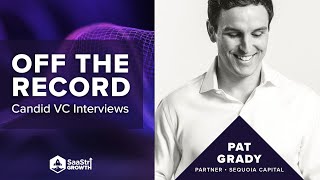
Pat Grady from Sequoia Capital on what makes founders succeed. He looks for slope, not starting point, and believes culture shows up in crisis moments. Markets matter, but the founder is what tips the scale.
Chapters
CEO's of early and growth stage companies better access to advice. And one area we understand that people want more exposure to is direct access to top venture capitalists and growth investors. And we're very, very honored to have Pat Grady, who's a partner at Sequoia, which likely needs no introduction, as our very first guest. He has great track record, worked with companies like Zoom, Okta, Servicenow, Snowflake Drift, and Too many other to count. And what we're going to do here is start with a handful of questions we've prepared. But more importantly and consistent with the goal of off the Record is we would like you to add your questions to the Q and A tab. So again, in the Q and A.
Tab.
Suggest some questions and we will be taking account of those and do our best to get Pat to answer them. While the title of this is off the Record, which is a bit cute, this is being recorded, as you can see it's being broadcast. So keep that in mind a little bit with the questions you ask. But again, it is on the record.
It's called off the record. It is in fact on the record.
Yeah, this is not like hidden, you know, it was probably private link that will never be seen again. But Pat is a smart, open guy and he'll do his best to answer whatever you ask. So with that, Pat, welcome to the show.
Thanks for having me. It's an honor to be here. Thanks. Thanks.
Do you want to give the audience just like a 60 second thumbnail of who you are, what you've been up to?
I'll keep it brief. I'm at Sequoia where I'm involved in our growth stage investment business. This is what I've been doing for the last 15 years or so, which puts me within a couple years of school. So I joined Sequoia at the age of 24 and apprenticed for many years, started leading investments and am even more excited for the next 15 years and the last 15 years.
Great. And based on the outcomes you guys have had, I would get the sense that you've worked with some really, really high quality CEOs and founders. Are there any habits of theirs that you would like to highlight that you particularly appreciate and would encourage the audience to try and practice in their business in the coming weeks.
It's interesting because there's no one size fits all founder. I was actually just having a conversation with a few of my partners where my partner, Michelle Baille mentioned this idea five nines uptime. And when she said five nines uptime, what she Means is when we get an email from a founder, we want to respond right away. And I mention that because some of the founders that I've worked with are that sort of person. They respond to every email immediately, and you don't know how they do it because you know they're busy. Some of the other founders that I've worked with are not that kind of person. They'll completely miss emails. They'll go a couple of weeks without responding. They just work in different ways. And so the point is just, I think the habits vary from one founder to the next, but inevitably they tend to be right for their business and their culture and their customers and the way that they're behaving. But I can give you a few examples. So when I think about Frank Slootman, who's the CEO of Snowflake and before that was the CEO of ServiceNow, so we've been lucky enough to work with him twice. He's a respond to every email immediately sort of guy. But I would say one of his defining characteristics is this concept of living in reality. And so he talks about how when you're a founder, by definition, you have to create this reality distortion field because there is nothing at time zero and you have to get people to believe. But as the company starts to scale, you have to transition to living in reality, which means just really directly head on addressing the cracks that are starting to appear in the business and the bad news. And so I would say the habit, that's one of his defining characteristics is being super, super transparent and super super direct and living in reality, as he would say. Or another example would be Todd McKinnon at Okta, who we've been in business with since 2012. Todd is an amazing listener. And I know that is kind of one of those generic things where everybody thinks they're a good listener. Todd is actually an excellent listener. He doesn't speak much in board meetings, he doesn't speak much in other meetings. But he listens to everything and he processes everything and he's really paying attention. And as a result, when he makes a decision, nine times out of 10, it's the right decision. And so I think like his, his ability to consume the information in a nuanced way, mash it all together in his brain, and then make really good decisions. I think he's really exceptional at that. And so I'd say listening is kind of one of his superpowers. And I can go on, but I'll. I'll pause there.
Maybe give us one or two more okay. They're all, like, hearing about Todd and Frank Sleepman.
So, Eric, Eric, you wanted Zoom, who I've known since 2014. We've been in business with him since 2016. Eric's one of the habits that you'll notice about Eric. First, he's a wonderful human being. Like, just a genuine, appreciative, humble. Hasn't changed a bit. You know, Zoom has become a household name. Just a wonderful person. But the defining characteristic that probably stands out is his focus on culture and the repetition. Meaning. He talks about customer happiness. He talks about employee happiness so frequently, it's impossible to miss it. And I think because of that, people pick up on it, and they know that the answer to any question is, well, what will make the customer happy? You know, what will make the employees happy? It's become such a clear true north because he beats that drum constantly. And I'd say that's a standout habit for his. Or Brian Halligan at HubSpot, who we've been in business with since 2011. The thing I love about Brian, he has a mental model or a diagram or an analogy for everything. And so it's actually really fun to talk with him about stuff because he'll immediately jump up to the whiteboard and draw a picture, or he'll make an analogy to a sports team, or he'll have some framework for thinking about things. And I think the result of that is each of these frameworks, these analogies or mental models or whatever they are, become little building blocks of knowledge that sort of percolate throughout the organization. And I think if you look at HubSpot, the reason that it's become an important company is not because they had the best product or the best strategy or anything else. They're very good at all those things. But I think it's because they've just. The culture itself is one where they continue to innovate and they continue to execute. And that's not the default. Like the default would be that innovation stalls out and execution gets sloppy. And so I think their culture is the reason they've become such an important company. And I think part of that is these little building blocks of knowledge that kind of comes from Brian and. And obviously, Dharmesh is. When I say Brian, you should hear Brian and Dharmesh, because the two are inseparable. And I can keep going, but hopefully that's enough for now.
Those are good. You've covered some real luminaries. People have some good takeaways there. And it transitions well to a next question. I know values and culture are important to you, and they're also important to your investing style and investing criteria. What are some signs that a culture will scale, and what advice do you have to any of the growth stage founders here on building a culture that scales?
Really good question. Maybe first to level set, what is culture? So I don't know what the dictionary says culture is, but we sort of think of it as it's a system of beliefs that manifest themselves in behaviors. And so your culture is not just the words that you say. Your culture is the things that you do. And the defining moments for culture come when those things are hard. Right? So the defining moments for culture come when nobody's looking, or they come when doing the right thing is actually much harder than doing the wrong thing. Right? And so those are the moments that company cultures are tested. For example, there is one company we're in business with where a pretty decent chunk of their sales organization was caught doing something they shouldn't have been doing. And at that point, you have a crucible moment. Do you let it pass and hit your quarter, or do you come down hard on them and have to rebuild your sales organization and probably miss your quarter and probably a couple more after that. In the case of this company, they decided to do the hard thing, which was they couldn't let it pass and they had to rebuild. And long term, it was great. Near term, it was pretty painful. So those are the crucible moments that sort of test the culture as far as the signs or the way that we try to suss it out. There are a whole bunch of questions that we ask when we're getting into business with a company. And what we're looking for in the responses to those questions is really consistency, meaning if different people have different ideas of what the culture is, then it's a bit chaotic. Because the value of culture. Maybe I should talk about the value of culture. The value of culture is we live in a world that is very fluid. We live in a world of accelerating change. You can't possibly prescribe every action that your employees need to take. All you can do is make sure that they have the right principles and the right values so that when a decision comes up, you don't have to prescribe the answer. They know how to make the right decision, and culture is the mechanism that allows that to happen. When people have a very consistent view of the culture of an organization, they'll make decisions that generally point in the same direction. When people are all pointed in the same direction. Elon Musk has this concept that the output of an organization is the vector sum of its individuals. Vectors are pointed in different directions. You end up back in the middle. If vectors are pointed in the same direction, you end up going pretty far. And so culture is the thing that aligns those vectors and gets people going in the same direction.
That's great.
And are there any like hallmarks with like an early stage company that they have a culture that's going to sustain and do really well over time?
I think the earlier the company is, the culture is always a reflection of the founder. At time zero, the culture is the founder. When a company is huge, the founder still has outsized influence, but now you've got thousands of people that are defining the culture. So at time zero, the question of culture is really a question of the founder. And so what we look for in founders as it relates to culture, a big thing is slope. So we talk about slope, not intercept. You know, Y equals mx plus B. We're looking at the M, not the B. We, we look at slope, not intercept because we're trying to figure out what somebody has a chance to become. And one of our partners talks about, you know, somebody who thinks they hit a home run, but they were born on third base. Right? Like we'd rather find a person who had to run all the way to third base before they made it made it around to home. And so trying to figure out the slope of the founder is really important for us. One example would be there's a, a guy named Alex Rodriguez. Not the baseball player. So that could be confusing with the baseball analogy. Not the baseball player. This guy named Alex Rodriguez, who's 26 years old. Just last week he became the youngest CEO of any public company not ever. But currently his company is called Embarked Trucks. It's a self driving truck company. When we got into business with Alex, he was barely old enough to drink, but you could see that his slope was exceptional. He fell in love with robotics when he was 12 or 13 years old. He won robotics world championships when he was still in high school. He kind of dedicated his life to this craft. But even more interestingly, he's got an exceptional business mind. And so he doesn't try to win by out roboticizing other people. He tries to win by building the best overall business across multiple dimensions. And you say okay, well how does he do that? Because he doesn't have any formal training, he doesn't have any other experience. He didn't even go to school. He dropped out after his first year at the University of Waterloo. The way he does it is he has this insatiable appetite for knowledge acquisition and he just doesn't stop until he feels like he understands something. So he'll spend his Saturday drafting an essay about how to improve upon the C Corp as a governance structure for public companies, because it's something that just piqued his interest and he wanted to go learn more about it. And so that's the sort of thing that you see in an early days that the founder defines the culture. And the founders who have the incredible steep slope are probably going to have cultures that are pretty constructive and they're probably going to go pretty far.
Great. And a related question, because it sounds like Alex is the type of guy who will scale well from everything you've just described there. Like, what are signs that a founder is going to scale really well over the course of growing the company?
So part of it is the slope, not intercept concept I just mentioned. Another big part is their motivation. So, you know, why. Why did they set out to do this? And not everybody has to have the same reason. So I don't think there's a right answer, so to speak. I remember talking with the founder one time who said, well, honestly, when we started this company, I just made a list of companies that I thought I could start because I thought it'd be cool to be a founder. But then I got into it and realized that a lot of customers relying on me and a lot of employees relying on me and realized how much the work that we do changes the lives of our customers. And so he said, I didn't get into it with a sense of purpose, but now I really feel one. That was one of the most authentic answers I've heard to the question of why did you start this company? Because a lot of times people try to make up a story that they think we want to hear, and that was the real story. And it resulted in this sense of purpose. And that's the thing that becomes your motivation, and that's the thing that's going to keep you going 5, 10, 15 years from now, through all the ups and downs that will inevitably occur. We have a soft spot for founders who start companies simply because they think the problem needs to be solved. So I mentioned Eric at Zoom earlier. Eric was one of those. Like, he didn't want to start Zoom as a company. He actually wanted to. He wanted to build a. He saw video becoming a new platform. He realized that WebEx wasn't well suited for video as a platform. WebEx grew up in the screen Sharing era, right? And so he wanted to completely rearchitect WebEx inside of Cisco, and Cisco didn't want him to do it. And so he said, well, do you mind if I leave and start a company? Because I think this problem needs to be solved. I said, yeah, okay, go ahead. And that became Zoom, I think. Similarly, Fred Luddy, who started ServiceNow, Fred thought he was retired, but was kind of embarrassed by the software he'd built in his previous lives once he saw Facebook and Amazon and some of these early consumer Internet companies and thought, man, I just feel like I could have built that software a lot better. On a flight from. I forget if it was San Diego. Rally lived in San Diego, but on a flight from San Diego to London, he had time to kill. So we just started coding and came up with an MVP of ServiceNow on that flight and then decided to see if anybody wanted to use it. And long story short, that became ServiceNow with 100 plus billion market cap. And so we sort of have a soft spot for these founders who. Whose motivation comes from a desire to solve a problem that they care about versus a desire to get rich or be famous or whatever else that makes sense.
And I know we've got a lot of Q and A piling up, a lot of audience interest, and I encourage people to continue to submit them though, and hopefully we'll get to them. And from here I think it might be best to just transfer it over to Lloyd, who's been moderating the Q and A for us to pull some of those out.
Wonderful.
Some great, fantastic learnings here. There's a lot of Q and A. There's several questions here, priming up. So let's kick it off with the first one. What was your best experience in terms of traction with early stage startups or I guess what. What they're trying to say, Arun, is trying to say here is, when you invest, what sort of traction do you want to see?
So when we got into business with Patrick and John Collison, not only had they not processed a payment, they had not written a line of code. So what sort of traction do we need to see? When we met with them back in 2010, Patrick was probably 21, John was probably 19, somewhere in that neighborhood. And their knowledge of the payments industry was phenomenal. Not because they came from the payments industry, but because when they decided to start this company, they did what made sense to them, which was to educate themselves as aggressively as humanly possible about the industry to make sure that the thing they wanted to do was a good idea. And so in our first conversation, and when I say our, I'm referring really to my partner Michael Moritz, who has been on the board of stripe for 11 years now. And I'm betting man he'll be there for at least another 11. When Michael first talked with Patrick and John, any question he asked was answered with a level of nuance and depth that was shocking given their backgrounds. And so I realize it's a non answer, but the real answer is it doesn't have to do with the metrics, it has to do with the people. And it has to do with their clarity of thought, it has to do with their depth of thinking, it has to do with their motivation, it has to do with their authentic story.
Definitely. And when you're looking at companies early on. Right. Are you looking at the founder first or the market first? Because there's a lot of theories around the market always wins. And when great markets meet great founders, magic happens. How do you think about that?
Well, I think, is it Warren Buffett who said, when management with a good reputation encounters a market with a bad reputation, it is the reputation of the market that remains intact? I think that was a Warren Buffet thing. So founders and markets are definitely the two most important ingredients. And we view everything else as the collision of founders and markets. The market in some ways determines how big a company can get. The founders determine how big the company will get. And what we've seen time and again is the best founders find new market. They are not constrained by the market they're in. They find new market. And so the founder is definitely the most important variable for us. And that's actually true as true at a seed stage, when we get into business with a Patrick and John Collison or a Brian Chesky. And it's true all the way through growth stage and even pre IPO and even after the ipo. So the founder is definitely the most important variable.
Definitely. I like that quote. The market dictates if it's going to be a big business and the founders control if it will be a big business.
Well, the HubSpot example from earlier is a good one. Right. Like HubSpot was one of literally thousands of marketing software companies and it was Brian and Dharmesh. Like it was the culture they created, the team that they built. Like they're the reason it's the one that stood out from the rest of the pack.
Definitely. What about like non obvious companies, at least to others.
Right.
Like Stripe, it was obvious that they're solving a big pain Point. But how about Notion? You know, when you look at some companies like that, how do you know it's going to be a billion dollar business?
Well, first, the level set, when we talk about a billion dollar business, we're talking about a billion dollars of revenue, not a billion dollars of valuation. And second, we never know. We have a thesis and we tend to make fairly high conviction investments. So we're fairly convinced at least that the risk is worth taking. But we never know. The critical components in that thesis is the founder and the market, as I mentioned earlier, for the market, we want to believe that we're on the right side of history and we want to believe that the founder is the best positioned one within that market. And so if I look at notion as an example, if you go back to 70s and 80s, I think 1979 maybe is when VisiCalc came out and was the very first killer app that sort of took the Apple II from being a hobbyist platform to being an actual business professional platform. So that was how PCs crossed the chasm. It was productivity apps. In that case it was a spreadsheet. But the word processing quickly followed and then slides. And therein we have the three pillars of the productivity suite, which is still the single largest category of application Software today. That Gen1, the killer feature was that you could actually reuse your work. Before that you had to retype the entire thing. All of a sudden you have a word process, you don't have to retype everything. So Gen 1 killer feature was reusable work. Gen 2, which started with Google Docs, it's kind of a lift and shift of Gen1. There wasn't a lot of real innovation in the product. You just all of a sudden have things like real time collaboration and cross device sync and messaging and commenting and that sort of thing. The killer feature there was collaboration. So all of a sudden productivity is not single player mode. Productivity is something that you can do as a team sport. And Gen 3 is defined by companies like Notion and Airtable and Coda and some others. And the killer feature of Gen 3 is composability, meaning these are not static applications where you are beholden to the set of features and functions they have provided. These are Lego blocks that you can mix and match in an infinite variety of what are effectively bespoke applications. And so the way to think about that is there are 5 billion ish people on this planet who consume software. There are only 30 million ish who produce software. If you want to close the gap between those two, instead of Writing code, you need to give people composable application platforms. And that's exactly what Notion is. And so when we look at Notion, we think it's the heir apparent to the Microsoft productivity suite, which again is the largest category of application software. We also think that it's something completely new in the sense that it will be the way the 4.9 billion software, using people who don't write code, build their own bespoke applications. And you see that in the emergent behavior on the platform. Definitely.
That's some good advice. And I like the thought on the Killer feature. I guess every era or iteration has a killer feature. Can you dive into that? Like, how should founders think about finding that killer feature?
Or. Well, I'll keep going on the on the notion example, so. And by the way, I just talked a lot about Notion without talking about Ivan. The two are inseparable. Ivan and his right hand man, Akshay are exceptional and they, I think you could put them on any business and they'd figure out how to make it a wild success. But to the point on Killer feature, when Ivan set out to build Notion, the original idea was the same, but the manifestation of that idea was different. So the idea of a composable application platform that somebody who can't write code can use to build bespoke applications, that was there. But he hadn't figured out the wedge. Right. And so after he retrenched in 2016 and got going again, he realized that the wedge was the simplest possible way to capture knowledge. Because any useful software is going to start with some sort of data, some sort of content in the simplest possible way to capture knowledge was note taking. And so being the best way to take notes was the thing that allowed that gave Notion the chance to deliver on that killer feature, which is composability. And so I guess the point is there's a difference between the killer feature that makes you a category champion and the killer feature that is your wedge. Sometimes it's one and the same, but a lot of times the wedge and the thing that gives you long term durability are actually a little bit different. And in the case of Notion, it's the elegant wedge that's very accessible to anybody and then the killer feature that just has infinite power for people to really invest in it.
Definitely great advice. There a lot of questions around fundraising process. You know, the market is absolutely bonkers right now. How should founders think about fundraising and valuations in this environment? And that's a loaded question. So let's unpack that Right. Everyone seems to be raising every, I don't know, few weeks, few months, like versus what it used to be, 18 months. People are raising every three months, six months. When is the right time to raise?
We are believers in treating fundraising as a strategic thing. And just like hiring is strategic and go to market is strategic, if you treat fundraising as a strategic thing, you should have a strategy with clearly defined outcomes. You should not just react to whatever term sheet happens to show up in your inbox. Your strategy should be a long term strategy, meaning where do we want to be in five or 10 years? And the reason I say that is for better or worse, people are going to look at your valuation and all that information is effectively public now. And they're going to draw a line through those dots. They're going to say, okay, if you went from 10 million to 100 million to a billion, you know, here's the slope of that line. And the reason you want to think five or ten years out is if that line is super steep at the beginning and then it takes a long time to catch back up to it in that phase afterwards, the next couple of years, it's going to be awfully hard to hire because people are going to look at that last valuation and say, well, geez, I don't know if there's enough upside from here. And so you should look five or ten years out, figure out where you want to be, plot that line backwards, and sort of have an idea for how you want things to track along the way. Stripe has actually been masterful about this. They basically raise money once a year. They raise a small amount of money because they're very capital efficient, they don't really need it. And they kind of do it to reset the price on the stock so that people can kind of see that line going in the right direction. And so I would sort of advise founders to do that. Which is another way of saying if somebody shows up with an offer that is too good to be true, it's not crazy to take it if you need the money, but you should think hard about whether or not it actually gets you to where you want to go. And you should think hard about whether or not what you are looking for is better, faster, cheaper capital, or somebody who can actually be useful. And those are different things. And obviously, if you want somebody who could be useful, you should do a ton of references and make sure that they're going to deliver on whatever promises they're making. And if you want faster, cheaper money, you're going to make a decision based on the term sheet. Either of those is okay, but you should be honest with yourself about what.
You want when you advise your companies, like towards next rounds of funding and whatnot. Where do your companies mostly lean? Faster, cheaper capital or someone who's more helpful or a combination?
It really depends on the company. And so I'll give you a recent example. There's a company called Kribble, which is an observability pipeline. So they created this category and we've been happy to see that other companies are now replicating our messaging, which is a nice point of validation. So Cripple is the original and the leading observability pipeline company, which basically means they take machine data and get it to the tools that you want to use it with far more efficiently than if you just did it with Splunk or Datadog or someone like that. Anyway, we did a Series C earlier this year and we had a bunch of different options. So unfortunate position. They had a bunch of options. Clint Sharp, the CEO, is fantastic. And we did not go with the highest price. We went with. We sort of sat down in advance and said, okay, who would our dream board member be? And we decided it would be David Wadhwani, who at the time was a partner at Greylock and is now at Adobe. But it was David Wadhwani because He'd been the CEO of AppDynamics, which is in the same domain, because he's an excellent operator who we thought could add a lot to the board dynamic because the board up to that point was Max Gazer at CRV and me. And Max is great, I'm fine. But neither one of us has been a CEO in the domain. And so we thought the best move would be to go for the. The helpful money, so to speak, versus the cheapest money. And we got a perfectly fair price, but we didn't top ticket. We actually chose who we thought was the best partner.
Definitely. I like that advice. And also it lines up with. It's neither the destination nor the journey, but the people, the companions matter. People matter a lot. If you keep optimizing for the nth valuation, then if you treat people like a transaction on the way in, they probably treat you like a transaction on the way out.
Right? 100%. So I love that you said that because we have a similar expression, which is if you treat us like a term sheet, we'll treat you like a deal. Meaning if people want to be transactional, things are going to be transactional. And that's just not a fun way to Live like, we want to have relationships with human beings that last a very long time. And if founders are interested in that, terrific. If founders want to view us as a term sheet, we're probably not the best people for them to work with. Yeah.
And it's a long relationship. Five, ten years, sometimes longer. Right. And so you want the best partners to optimize for questions around key drivers of valuations in this market. Seems like all over the place. Seems like 40, 60 x multiples are common. Seems like every other day there's a unicorn. How should founders think about it? Be overexcited, Be conservative? How should we think about valuations?
Well, there are a lot of things happening. First, there are some business models that have become very well understood by the market. And I'm cognizant of the fact that this is the Saster podcasts. SaaS is a business model that has become very well understood by the market and that causes valuations to go up because the risk associated with the business model has gone down. And that means that you can pay more. Instead of paying a year in advance, you can pay two or three years in advance, so to speak. And so I think there's a natural secular theme toward increasing valuations as a result of better understanding of the business model. That's one factor. There's a second factor which is where we are in the market cycle. And we're 15 years into a bull market for tech stocks, not for the economy as a whole, but for tech stocks. We've had unprecedented both level and duration of low interest rates. And we're just at a place in the market cycle where global capital flows are heading towards tech equities. And that causes valuations to go up for cyclical reasons. And so we're living through these fairly unprecedented times. I guess there are two things that we would say for founders. One is take advantage of it. So have your fundraising strategy in mind, but now is a good time to raise the money that you'll need for the next couple of years, because we do. We do see expectations of rates going up. We do see cracks appearing in public markets. Now is a pretty good time to raise the money you need for the next couple of years. That's point one. Point number two is try not to put the social capital of your business on valuation. Try not to hire people with the we're all going to get rich quick sort of mindset. Try not to let stock price be a barometer of employee emotions. And I'll give you a good example for this. So, Spencer Skates who's the founder and CEO of Amplitude, who's phenomenal, by the way. Spencer went public via direct listing about a month ago, maybe a couple months ago. And he knew that any new public company is going to have a very volatile stock price. It's just the nature of the beast. There's limited float. Stocks tend to jump up and down erratically in the first year or so. As a public company, he knew that was going to happen. So for six or seven months before Amplitude went public, he played this game at the employee all hands, where he would show a hypothetical stock chart. Hey, pretend we're public. Here's our stock chart. And then he would say, and here's what just happened in the business. And it was all good news. And then he'd say, okay, now what do you think happened to the stock? Did it go up or down? And of course everybody says, oh, it went up, it went up. There's good news. And then he shows the stock and of course it went down. Boo. Everybody's upset because the stock went down. And he's like, well, why did it go down? Well, it went down because people think rates are coming back up, so money's falling out of tax. So we performed well, but the stock went down. So he played this game over and over and over again and basically got people to decouple their perception of how well the company was doing from the stock price. Because how well the company is doing is only one factor that goes into the stock price. And a lot of times in the near term it's not the most important factor. In the long term it is. But in the near term market cycles and investor sentiment and all this stuff that's out of your control is what drives the stock price. And that's true for public companies or private companies. Lloyd, you're on mute.
Makes a lot of sense. Sorry, a bunch of questions. I think a lot the highest number of questions around. How do you recommend building relationships with investors and finding the right ones before you even need to raise? How do you get in touch with the top investors? And there's a lot of theories around this like cold email, warm intro. So let's take your, I guess take on it. Like how do people get in touch with you, the best founders? How did you find the Patrick's and the notion and the Ivans of the world?
A lot of times we are hunting, so a lot of times we are going after founders, but a lot of times founders come to us. So I'll just. Couple of practical, honest comments. Number one, I used to respond to every single email I got from a founder. I don't now. I get far too many to respond to. I try to respond to every email I get from a founder that was clearly targeted at me specifically for a reason. So if it looks like a blast email, I delete it. If it starts with something that makes it clear you did a little bit of homework and have a reason that you wanted to talk to me specifically, I will try to at least respond. Right. And so that the point of the piece of advice there would be, I think cold emails are plenty effective if you put real thought into it and have a small number of people that you're putting real thought into versus blasting a whole bunch of people with the same generic message. So I think cold emails are pretty, at least for us. We respond for the most part, if it's a good cold email. My second point would be as it relates to building relationships, you have to be practical, right? So I'll take my partner, Rule off, as an example. So Ruloff has been at sequoia for about 20 years. He's on amazing boards like Square and Mongo and Unity and Eventbrite and 23andMe and a bunch of others. We have open calendars at Sequoia. So I can see rule off calendar. It is a disaster. He's got a lot of stuff going on. And so if you want to build a relationship with Rule off, it's probably going to be pretty tricky because from a practical standpoint, the calendar is pretty full already. And that's true for a lot of people at Sequoia. That's not true for some of the younger folks at Sequoia. And so my recommendation to founders is there is this popular piece of recommendation of advice, ignore the associates. That's horrible advice. When people tell you that it's horrible advice. Do not ignore the associates. They are your best friend. You should actually try to build a relationship with the young folks, not with these senior partners. If you build a relationship with them, they will go to bat for you. And any venture firm with its salt listens to the young people. And so my second piece of advice, number one is a good cold email can go a long way. Number two is associates are your best friend. Do not ignore them. I would actually focus on them as a strategy, definitely.
And I think within the first one, the sub advice is if you're not good at cold emails, probably talk to an SDR on your team, the best SDR on your team on how to craft that email or get Advice from other people who are good at cold emails.
That's a great call. That's a great idea.
Yeah. Because they're trying to get into accounts day in, day out and it's everything is selling. But the second advice is really good. I hear that all the time. Like don't go to partners. Go go to. Or rather don't go to the associates or analysts, go to the partners directly. And what you shared is yes, firms, the top firms listen to the we.
Love our young people. Our young people are amazing. We like they are so in touch with what's happening in the market. We listen to them really carefully. If somebody has a good relationship with a young person at Sequoia, like that is very likely to become an investment.
Definitely. And I guess I don't mean to beat on the SDRA relationship, but since I was on it as a SaaS crowd, I mean the best AES have the strongest relationships with the SDRs because they bring them the best deals.
Right.
And so it's along those lines. Now in terms of timing, is there such a thing as best and worst time of the year to raise money? Like something to do with holidays? After the holidays, how should founders think about it?
I would encourage you to resist the sneak attack. It's become popular in recent years to lob internships on December 24th and those sort of times. I would encourage you to resist the sneak attack. Spend that time with your family, raise money when the holidays are over. Is there a best or a worst time? Not really. You know, I would, I would do it on a cadence that works for your business versus doing it on a cadence that matches the venture capital market. So you know, whenever your quarters start and end, whatever your annual planning exercise starts and ends, like figure out a time where you have the bandwidth to do it and make it a priority versus trying to time it to kind of external market factors.
Definitely. Follow up question to that is what is the right balance in a pitch meeting of convincing VCs of assumptions and trends versus finding VCs that see the world relatively similarly to the founders.
That's a good question. My partner, James Buckhouse, likes to talk about selling the problem, not the solution. And I think that maps pretty well to what you're saying. I think if you're selling the problem and the investor really just doesn't understand the problem, then you're fighting a heck of an uphill battle. If you're selling the problem and the investor clearly understands the problem, then you're in a pretty good place. And so I Don't know if I would. It seems like there are. I know that there are founders that I meet with where within a couple of minutes I feel like I kind of understand what they're doing. And there are founders I meet with where I feel like an hour later I still don't. And I'm guessing the founders have the same experience where there are investors they meet with who seem to immediately get it, and there are investors they meet with who seem to just not. And I guess I would probably focus on the ones who seem to immediately get it versus trying to convince the ones who don't.
Definitely. Definitely. Now, in terms of dealing with rejection, right, there's a lot of nos, and Reid Hoffman's Masters of Scale talks about the different types of nos. But getting a rejection is part of the game here. How do you advise founders that they prepare themselves to cope with this rejection? Is there an ideal number of VCs you reach out to and sort of like a funnel? X will say no, Y will say maybe, and maybe you'll end up with one or two term sheets at the end.
Keep in mind, I spend most of my time in growth stage investing, which is kind of series B and beyond. A bunch of my partners spend all their time on seeds nas. So we're very much in the seed NA business. But personally I spend a lot of time with growth stage companies at the growth stage. I'm a fan of concentrated processes, meaning go out to half a dozen investors that you have something of a relationship with who you think are fairly likely to convert and put a lot of effort into those five or six conversations, versus doing kind of a big funnel where you go out to a whole bunch of people and then see what's eventually left over. So it's sort of a fewer better things mentality.
Definitely. And I had, I had that question on, you know, how do the best founders approach the fundraising process, which you've answered. I think at the growth stages it is more concentrated. Find the best funds and then spend all your time there. What about process and timing? Like, you know, there's a lot of lot to be said on the whole. Fundraising process has gone from a two, three month process to a condensed three, four week process. And a lot of advice out there says, hey, talk to, you know, 6, 10, 12 investors. Week one week to share your data room if they're interested. Week three, address any sort of reference calls and week four, align for a term sheet. How do you feel if somebody like came at you with that sort of a process or is that fair game.
If we love something, we're going to break the process and, you know, make a decision, offer a term sheet much faster than the process dictates. I think it's a good idea to try to run an efficient process and to try to do things on your timeline. As a founder, I think that you should expect to hold people off if things are going well and that if you're not holding people off, I would take that as a sign that things are not going as well as they could.
How do you mean holding people off?
So I mentioned Kribble earlier. So Clint got a lot of inbound from a bunch of different investors. He chose the handful that he wanted to build relationships with. He told all of them that. And this is true. So it wasn't just a tactic. This was true. He told all of them that he was focused on a handful of other things and also that he didn't want to screw up his 409A price. And so he wouldn't accept term sheets until a particular date. When that date came, all of the investors gave him a term sheet. It was an easy way to control the process because he really didn't want term sheets because he didn't want to Mess up the 409A price. And by telling people, this is the date on which I will accept term sheets. He didn't say that's the date that you need to have them in. He just said, please don't send them before that date. That caused everybody to kind of show up on the same day. So that was a pretty well run process.
Definitely. And how long was that process? Few weeks, a few months.
It was one of these. We have this expression at Sequoia that the no raising raise, when you meet with a founder and they say they're not raising, but you know that they actually are raising. So it was a little bit of a no raising raise. Except he really wasn't. He really wasn't intending to raise. So he was intending to wait and then start a process. But in the kind of build relationship with investors phase, the investors went and did their own homework and talked to customers and all that stuff. And so he actually intended to kick off the fundraising on a Monday, and instead he got a whole bunch of term sheets on a Monday. And so the relationship building was spread out over many weeks because it was just a casual meeting here and there. It wasn't meant to be a process. But then the day that he was intending to kick off the process was the day that it was effectively concluded.
And there's a lot of contrarian views on this.
Right.
I guess it's the piss pit bull line. Ask for money, get advice, ask for advice, get money twice. And some VCs say, if you want a raise, just tell me you want money. If you want to build relationships, just tell me you want to build relationships. How do you view that? I mean, because the no raising raises is going off. The no raising raise, right?
Yeah. Yeah, so. So I think what Clint did was a very authentic version of the no raising raise. Like he actually wasn't trying to sneakily raise money, he actually was just trying to build relationships. I think if you're actually trying to build relationships, that's great. And I would highly recommend that founders do that because, you know, you mentioned this earlier. You're going to be, you're going to be in business with that person for five or ten years. So you better make sure you, you have shared, shared values, shared vision for the business. You don't have to agree on everything, but like, values and vision are pretty fundamental. Right. So I think if you are actually in relationship building mode, terrific. If you are actually in fundraising mode, terrific. If you're actually in fundraising mode, but you're pretending to be in relationship building mode, then you're kind of masquerading as something you're not. And I think people can feel that. And I actually think it does you a disservice, definitely.
There's a few questions here around what are good signs and bad signs from a founder perspective? To read that first few meetings.
Meaning if you're a founder, how can you tell whether it's going well or not?
Yep.
I don't know if any of this is going to come as a surprise or unique insight, but are people engaged in the meeting? How quickly do people follow up? Are they asking the same questions multiple times? Have they been transparent about the timeline and what the next step is and when they can expect. When you can expect to hear from them? It's all the kind of basic signals that you would see in any sales process.
And you hit the nail on the head. They're fundraising. So much of fundraising is actually selling. And one of the fundamental things that I find is that time kills all deals. So if you're incessantly following up and you're not hearing back, that means it's probably game over there.
There's a question. Can I take a question out of the chat here?
Yeah, yeah, yeah, definitely.
I like this last question because people always forget how hard things were on the way up when they See companies that have become quite notable. So the question is, can you please share an example of a company that you believe is good but has a lot of challenges to raise money? Late ABC rounds, not teeth stage. And can you share what you think it is? So one of the best examples is DoorDash. DoorDash is now a public company with. I don't know, I haven't booked recently. But a lot of market cap and DoorDash struggled to raise its Series C. We gave them a term sheet for an inside round. The rest of the market thought that our term sheet was a fake term sheet and that we were trying to get somebody else to fund the company. It was a real term sheet. The reason it happened was Uber Eats had come out guns a blazing with seemingly infinite access to capital and a willingness to burn that capital. That scared the entire investor universe away from DoorDash. That Series C, the period around that was a very hard period for DoorDash because they had decided very deliberately to focus on their unit economics and to focus on sequential improvement in the operations of the business. And they believed very firmly that building a high quality business would allow them to scale in a better way than somebody who is just going after growth for growth sake. And that was a hard decision because they saw Uber Eats rocketing past them. But today DoorDash has number one market share by a pretty decent margin. It is a dramatically better business than anybody else in that market. And that strategy paid off. But at the time it was very hard because most of the investor universe just saw Uber Eats growing so quickly, didn't appreciate the strategy to focus on the quality of the business, not just the growth. And that was a hard round. We ended up leading that round, which we had hoped to do anyway, but we ended up leading that round because a lot of other investors, quite frankly, didn't want to participate.
What were the key traits of the founder to cope through that journey? Because it is so hard, so hard to hear these no's and it's a misery.
So Tony and my partner Alfred led our investment in DoorDash and has been on the board since the Series A. So Alfred knows Tony intimately? Well, I know him a little bit, but from what I know of Tony and from what Alfred says, he is the ultimate operator in the sense that he's very focused on the inputs and not on the outputs, meaning growth and free cash flow and market cap and that sort of thing. Those are all outputs. Those outputs come from a set of inputs which are much harder to observe, but ultimately much more important. And so the thing that Tony saw was their relationships with restaurants were a little bit better than the competition and they were pulling away. What Tony saw was that their relationships with the drivers were a little bit better than the competition and they were starting to pull away. What Tony saw was that their value prop for consumers was a little bit better for the competition and they were starting to pull away. And so he saw the inputs and he knew that they were building a better business. And it was maddening that the investor universe didn't see what he saw. But he had deep conviction in his own two eyes and in what he was seeing in the business and it allowed him to push through. So he sort of knew what was important to him and he stuck to it even if other people didn't see it.
Definitely that conviction is a key. Jeff Lawson has a famous quote that says, have conviction about the customer you're serving and the problem you're solving for them. And let that be your primary guide.
It's the Bezos line. My partner Alfred says this probably twice a week. Jeff Bezos likes to talk about customer obsessed Competitor aware. Anytime somebody starts talking about competitors, Alfred chimes in with whoa, whoa, whoa. Customer obsessed competitor aware. Let's pay attention to our founders and that will take us in the right direction.
I love that. Customer obsessed competitor aware. That's a line on its own. A few questions around handling investor communications here. So when you're running this process, how do the best founders handle investor communications in between meetings? Because you talked about Clinton and the no raise raise, but how did he keep in touch? Or how do some of the best founders keep in touch where it doesn't seem like contrived or transactional?
I think if you're actually in relationship building mode, you do it the same way you build any other relationship. You know, you might meet people for dinner every now and then, grab a coffee, go for a walk. Like try to find some, try to find some unstructured time so it's not just sitting in a conference room across the table from each other providing an update on the business. Like, that's, that's nice. But you can send an email with an update if you want to update them on the business. If you want to build a relationship, like go for a walk.
Definitely. We're getting close to the top of the hour. I want to take a couple questions in rapid fire. You talked about not caring about metrics perhaps in the early days, but what are some key metrics at post product Market fit, maybe at the A, B, C round that make it very exciting for you to take a deeper dive.
I'm going to give you a non answer because the metrics are a function of the story. The example that I like to use back in the day was VIVA and Workday. If you look at VIVA and Workday today they're both 50 billion ish of market cap. But if you look at their S1s and when they had 25 million of revenue, Viva had like a high teens operating margin, Workday had a negative 200% operating margin, Viva had a 60% gross margin, Workday had a, I forget 20% ish gross margin. So dramatically different margin structures but the margin structure they had was right for their business. And so there is no magic metric. The thing that's important is are your metrics consistent with the story that you are telling?
Definitely. What are the key metrics then? Key, I guess business fundamentals, let me call it that founder should monitor. Is it ARR? Is it growth rate? Is it nrr? Is it gross margin? Is it a combination?
What's important to your business? So Snowflake as an example, we led two rounds in a row at Snowflake and between the first one and the second the gross margins went down when we thought they were going to go up. So when we dug in, why did they go down? Well it turned out it wasn't any sort of competition. Pricing had actually gone up, but cogs had gone up because we were getting pulled internationally faster than we expected, which meant we were opening up availability zones all over the world. We were also getting pulled into the enterprise for full scale teradata replacements faster than we expected, which meant we were forward investing in professional services to help big enterprises go on this major migration journey. So the margins have gotten worse, but the reasons were actually super positive. And so there is no one magic metric. It is what are the metrics that are right for your business?
Definitely. Awesome. And my final question is what do you recommend founders read or what are you reading? How do you become a better founder to enable you to build a better company and then of course raise lots of money? Huge valuations.
What should founders read? A good question. I don't know. There are a lot of really good, there are a lot of good writers out there. I'm a big fan of podcasts at the moment and so I listen to. I actually think 20 DC is terrific. What Harry Steadings has done, like getting so many founder stories out there, like Guy Raz with how he built this is terrific. I like hearing the stories about the people and kind of how they built what they built.
Awesome. Thank you so much. Some wonderful insights here, Pat. Wishing you great success. Hope you find another 10 decocorns in short order. And over to Matt to close it out.
Thanks for having me.
Yeah, for sure.
Pat.
This has been amazing. Like just a ton of deep insights and I've been getting emails and chat responses that this has been phenomenal. So thank you. Like, this has been great. Really appreciate the time and, and opening up your knowledge base to the whole community here. So thank you.
Thanks again. See you everyone.










