Scaling a Product-Led Growth Model with 1Password, Apollo.io, Sentry, and Lightspeed
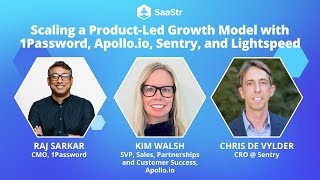
Raj from 1Password, Kim Walsh from Apollo, and Chris Wilder from Sentry discuss scaling product-led growth into enterprise revenue. They cover identifying high-value segments, building unified data platforms, adding outbound sales without losing PLG principles, and hiring curious people who learn fast.
Chapters
Nice to meet everyone and thank you so much for joining us today. My name is Anushka Vaswani and I'm one of the partners at Lightspeed where I focus on our investments in enterprise software and infrastructure. I've been doing B2B investing for the past five years and I'm lucky to work with many of our PLG founders here. So to kick it off, you know, we're here today to talk about how you operate a PLG business at scale. How, how do you build a best in class go to market motion to get from single digits in error to well over a billion in error. And I'm lucky to be joined with a number of incredible operators that have lived that journey at some of the most iconic PLG companies globally. So with that I'll take it over to Raj to introduce himself.
Thank you Anoushka. First of all, thank you for inviting me to be part of this esteemed panel with Crescent Keem. I'm excited to be here. I'm a big fan of PLG and I call myself an ardent student of PLG. So I work right now at 1Password. I've been a CMO for one and a half years. I was an advisor for a year before I took the job pre 1 password. I was at Atlassian for 6 years and then Google for 3 years. Have worked predominantly in PLG products starting with Google app engine, Google Hangouts, Confluence, Trello and Jira the service management product. Excited to be here to be part of this panel.
Great, thank you. Hi everyone, my name is Kim Walsh. I run all go to market sales partnerships, onboarding, customer success at Apollo. Prior to that I spent 11 years at HubSpot and yeah excited to be here to talk about the PLG motion and scaling your go to market.
Cool, thank you. My name is Chris Wilder, I'm a CRO at Sentry Sentry for those of you who don't know is a tool that's used by developers to fix issues in code faster. And so we are a typical PLG company. We work with, you know, single person dev shops all the way up to the Microsoft's the figmas of this world where we have hundreds or thousands of developers using our tool to improve customer experience, the user experience. Before that I was at Atlassian, so kind of like rise. I got my master's degree in PLG there. We were working on layering in the enterprise and mid market sales motions on top of the PLG engine and obviously learned a lot in the process because they clearly figured that out. And I'm excited to be here.
Cool.
And maybe we can click a slide ahead, but just to kick it off. So everyone on this panel has taken a company from, you know, single digits in error all the way up to over 100 million in error. So maybe just to kick it off, what have been some of the biggest lessons you've learned in scaling a PLG company? Maybe, Chris, to start with you, you led the sales efforts at Atlassian when the company grew from 450 million in error to 2.5 billion. And now you lead all of go to market for Sentry.
Yeah, yeah. So I think the patterns are kind of very similar. So if you think about plg, when a PLG motion works well, at some point you start to get drawn into enterprise type of engagement. So the customers that are in your user base, some of them are bigger, they want a different type of sales engagement, so they start to draw you in. And so what we did at Atlassian and similarly now at Sentry, is kind of capitalize on that motion. So what we wanted to do is identify the playbooks that would yield higher revenues for the company, and then we build the segmentation and the sales motions around that. So in essence, we looked at that entire install base, did a data analytics exercise to kind of bubble up the golden nuggets. So the companies that were firmographically interesting that also had playbooks that we could apply to them, and then rewrapped the sales motions around that.
And maybe, I mean, Kim, you scaled HubSpot when it was at 15 million in ARR all the way to 1 billion. And I think you took it from 80 employees to 6,000 employees and now are kind of running that playbook. Back at Apollo, what have been some of your biggest lessons and learnings?
Yeah, it's interesting, I think. Well, obviously I. Hopefully I'm not going to do a good enough job explaining the HubSpot story if you were here earlier with Brian and Dharmesh. But I'll add to it in the sense of, like, some of the lesson learned around HubSpot was that we always had a proactive motion about going and getting the market and being aggressive about tackling the market in any way that we possibly could. And then I would say at Apollo, there's two things happening. One is it's really special when you can figure out a PLG model that allows you to scale your revenue to a certain point with what I would call like a reactive motion. And then when you think about, okay, we're getting to this certain revenue With a reactive motion. Some people would call it inbound, some people would call it order taking. But then if you actually think about it and say, okay, what do we want to actually do to be proactive? How can we start to align the entire company, not just sales, around going out to get the market? And I would say that's what we're doing at Apollo is taking all the things that have gotten us to this point and essentially being reactive in our go to market motion and then saying, okay, how can we be proactive in sales? I mean, what Chris talked about, about propensity scoring and understanding our free and paid users and really inserting a sales assist motion or a sales led motion at a time that is like frictionless for the customer. And we like to say at Apollo, like, if the customer wants to buy, let's just let them buy in the channel that they want to buy it. Whether it's via chat, whether it's via a phone call, whether it's via talking to a sales rep. That's how we kind of think about it really from a customer centric point of view versus an outbound sales point of view. Or really like we don't. We try not to let our org chart show and just try and serve the customer.
And Raj, you've scaled marketing at, you know, two major PLG companies, now Atlassian and now 1Password. What have been some of your biggest takeaways?
Yeah, it's interesting because you guys are both touching on some of the key points with plgmotion. If you think about it, I think it starts with data, right? You need a robust data platform in order to do plg. If you talk to majority of the companies, which I have seen in Atlassian and for Password as well, data is in. Many of the companies are siloed, right? The sales data basically is in Salesforce or Outreach or Gong. The marketing data is in Google Analytics. You have an ad server or a marketer. The product have their data. They're probably dumping all the events data in redshift. Now these three data, you know, lakes need to talk to each other. So I think first and foremost thing, if you're trying to build a PLG company, you need to think about, you need to build a robust and unified data platform. The second thing, which I think a lot of companies struggle with is they bifurcate the funnel, right? So if you think about it, the marketing team is primarily focused on converting people who are coming into the websites into signups. Then probably the design team is thinking about, okay, how do I make sure that we have an optimal signup flow so they become users of the product. And then product is basically thinking about activation and retention metrics. If you structure the organization like that, what you are doing is you're basically optimizing one end of the funnel at the cost of the other. For example, you might be converting all the people who are coming into the website into signups, but not necessarily, they might be converting into a paid customer. In the long run, I think having a growth team which has components of product marketing and design is incredibly important as part of the PLG motion. And the third thing is a lot of the focus especially on PLG is around demand, demand only. You see a lot of the marketing organizations are predominantly focused on creating demand, which is a corollary of the second point which I touched on. You need to think about conversions as well.
So two big questions that come up with every founding team we work with is when do you start outbound in a PLG model and how do you do it? And so maybe starting with Kim and then Chris talking about some of your advice on this question.
Well, I would caveat and say that I think you start it pretty early on because I think no one wants to do it. And what I mean by that is talking about going out and getting your market. Like so many people think that HubSpot was just an inbound company. Well, guess what, we had a team called Spider Monkey. They were an SDR team and they were going after the business and going after the market, but we were bringing in inbound leads. I think it's evolved now to I'll talk about like Apollo and plg, which is like everything we got to a certain point about being reactive. And there are so many like I would say maybe there's like one company out of a million that can get to like 450 million in a total reactive order taking motion. So let's think about that as like when do you want to turn it on? Do you want to turn it on at 10 million? Do you want to turn it on at 20 million, 30 million? Like you'll know when your self serve or your users or you're free and like your single paying customer like you, you'll know when that starts to flatline. I would argue and I would say that is way too late. But again I'm in go to market. So I think about things like really proactive little bit of rosy glasses. I love marketing, I love sales, I love the unified customer journey. And if you have product market fit, I think you do them at the exact same time. But I think that's maybe a little bit hard to hear for a lot of founders and CEOs that like, doing the outbound motion is really freaking hard. It's hard with the target account list, it's hard with like outbounding into your free users, and it's hard with outbounding into your paid. But if you think about not resting on your laurels, you got to do the hard thing. So I'd like to say from day.
One, I know, Chris, you have a different view, so I'd love to hear.
Not necessarily. I think actually it's pretty aligned. But I would say that in a PLG motion, I mean, my definition, we discussed the definition of PLG and in my book, it's like you have to be able to get to 10 million in ARR without having an actual salesperson in the business. Like, then, you know, you have product market fit, the thing is working and it's humming. And then obviously you're going to get drawn into these enterprise sales conversations because some customers are going to want it. But I would, I would argue that if you look at Atlassian and some of the other companies that have been very successful at plg, they were extremely patient with their motions and they, they kind of focused hard on getting that whole motion right and honing it in all the way from how the product operated to the front end and the content marketing and the community building around it so that you get that engine established that literally keeps feeding the business for Atlassian now 20 years on, right. What I would say, and this is where I'm completely aligned with with Kim, is start kind of experimenting with sales either as a founder or as a product owner very early on because you have to make some changes as you make that transition, right? So PLG is entirely focused on end user marketing in product. How do I kind of sell the value of what I'm doing here in the product immediately? Once you get to enterprise, obviously you got to convince an economic buyer that they need to buy your solution. So you, your narrative is going to have to change. And as a founder, I think you should start experimenting with that, honestly, like day three, right? So that by the time you get there, you have these stories honed in, you know who the Personas are, you're going to talk to, you know what resonates with them and you know how to convince them. I think those are some of the things that I would start very early on. And then other than that, like, so assuming you have A perfect PLG motion. It's going to settle at some kind of an organic growth rate. I would say. At Atlassian, that was in the order of like 30%, probably a year. Then it comes down to like, are your investors happy with that? If not, you'll have to juice it up and you have to start adding sales energy to, to kind of compound, you know, the interest in, in that way. Or you may be in a market where there is a benefit, like, yeah, what I would call a Monopoly game market. There is a benefit in capturing the streets so you can collect the rents later. So those are some of the trade offs that you'll have to, to kind of consider as you decide to invest in sales.
Will you say it's in. It's easier to go from PLG to outbound versus outbound to plg?
For sure.
Yeah, Raj, maybe outbound. On the marketing side, what changes does that require?
I think, I think it requires a completely different muscle when it comes to outbound marketing. Events, for example, becomes more and more important. Content syndication becomes more important. Obviously account based marketing, I've seen that done very effectively at a bunch of companies. Again, when you're talking about account based marketing, you need a robust data platform. If you don't have a robust data platform, you can't do account based marketing. And then lastly, I think what I have noticed is a lot of inbound SDR teams, like have a hard time transitioning to outbound sdr. So you need a really talented outbound.
SDR team and maybe following up on outbound. I've heard you use this term, outbound fury a lot. What do you mean when you talk about that?
I know this is my favorite topic to talk about. So the literal definition of Outbound fury is being furious in your outbound motion. I know it sounds funny. Think about in any way you can get customer attention via having a constant presence in the media. So it can be tactics like viral tweets, funny videos, controversial blog posts. I got introduced to Outbound Fury when I joined the Google enterprise marketing team. This was 2010. Larry just became the CEO and all his attention was on the consumer side of the business. So we, the enterprise marketing team won't get any brand dollars to spend. And we were like, okay, how do we get attention? How do we create awareness around Google Apps? So we came up with this metric of every single article which talks about Microsoft Office should talk about Google Apps as well. So we put this team together, we'll meet on a weekly basis to talk about what are we going to do that week. So a very specific example, and it's a funny example, we came to know that Microsoft was going to launch their cloud version of Microsoft office called Office365. So what we did, and this was the idea from a product manager, just the day before launch. The day before launch. So they can't change their launch date. We wrote a blog post called 365 Reasons to Consider Google Apps. And it was a comparison between Microsoft Office and Google Apps. And, and the blog post went viral. Obviously, the media loves, like giant wars. Guess what happened the next day when everyone covered the launch of Microsoft Office, they linked it to the blog post. So we kind of hijacked their Office365 launch. So basically, in some nutshell, it's basically bringing an entrepreneurial mindset to marketing. That's what it is.
That's cool.
And you know, Chris, you live this journey at Atlassian. You're going through it now at Century, when you start outbound. How do you think about the balance between outbound and inbound?
Yeah, I mean, obviously, you know, blatant statement of the obvious, you want as much inbound as possible. It's a lot better. It's, it converts a lot higher, it's a lot, a lot easier to do. But it comes down to, again, that, that same thing we talked about with respect to segmentation, right? So the way we look at it is that we identify those customers that we want to go after proactively and then we define those very specific playbooks, and those are the ones that we implement and enable the sales teams on. And at Atlassian, that was initially super simple, right? It was all about like migrating people from behind the firewall products to our cloud equivalent products. So we actually joked about the fact that nobody could articulate the value proposition of jira because you didn't have to. So it was all about figuring out these very specific things that we could do that we could enable salespeople on. Because also, as you go through this transition, a number of things need to change. Like I talked about end user to kind of buyer marketing. Your sales team is typically inbound, doesn't have the experience of prospecting proactively into accounts, et cetera. So all these transformations need to take place. And so the easier you can kind of layer in all these things by, by making it very structural in terms of targets, playbooks, enablement, et cetera, the easier you're going to actually be able to make that conversion. And so what we did, Atlassian, was just gradually build up the sophistication of that. Right. Like the different playbooks that we layered in the type of salespeople that we ended up hiring. So went from pure inbound to more proactive outbound, but still inside sales to now there is actually a fairly large contingent of traditional enterprise sales teams that are kind of roaming the holes of all the big companies. Right.
And maybe, you know, switching gears a little. So Kim, you also oversee customer success at Apollo. Could you talk about how PLG companies need to think about customer success differently, if at all?
Yeah. Well, so I've been at Apollo for four months and I would say within my first 45 days, the number one thing that I needed to do cross functionally in a PLG motion specifically is understand the customer journey. So I met with the entire organization. We developed and launched a customer journey map. On the top was customer sentiment. In the middle was sort of like all the functions that need to serve the customer from pre sales to post sales. And it was interesting and we wanted to just educate everyone in the entire company. Apollo's a fully remote company. You know, over 200 employees representing 106 countries. So we have to think about how do we educate the people on our customer journey, where are their friction points in our customer journey? And show the entire company that across product engineering, design growth, pre sales, support, post sales, like there's so many functions that serve the customer along the way that matter and not everyone's happy. So I wore a red dress on stage. We've got a couple angry faces along the customer journey. I told everyone I'd wear a green dress when we turn it all around. But what that means is customer success is no longer a post sales function. Customer success starts at the beginning of the journey of when someone interacts with your brand. So we think about customer success in a PLG motion. We kind of, right now we have like support, we have product advocates, we have onboarding, and then we have customer specialists. And everyone talks about how do we serve the customer. And from the customer journey, we're evolving into the voice of the customer program. Again, super cross functional. We'll start every meeting, every weekly meeting with the customer voice of the customer. We'll work cross functionally all around the voice of the customer. I've also seen flying customers into company meetings like really try and actually walk the talk on are we serving our customers? We don't have a large customer success team today. And that's by design because everyone across the entire company at Apollo is serving our customers along the way. And that's something that we have really adapted and I think is really important in a PLG model.
And you know, this is an interesting time and market where I think sales and marketing teams are under tremendous pressure to cut budget. Maybe Chris, just speaking to how you navigate that process in a time of more economic uncertainty.
Yeah, I mean, I think the, the beauty of PLG is that it's a very highly leveraged model, obviously. Right. So you think about, I don't know if you saw Cameron diet speak at last in CRO, but their cost of sales and marketing is 15% of revenue, which is way lower than any other company on the planet. And so we've mimicked that to a large extent at Sentry. So our actual sales and marketing expenses are relatively small relative to the revenues. And we want to keep it that way. We want to keep leveraging the power of PLG as much as possible to minimize actual expenses for sales. And so we have not made as many adjustments, I would say, to our investment plans. I think the only difference is that we look at it experiments potentially a lot more, I would say diligently. And we really want to make sure that they work before we scale them up. So we had some investment plans where we said, okay, if this works out, we will double down. So those things are slowed down, have slowed down a little bit. But other than that, we just keep investing as we see the opportunity.
And maybe now switching gears a little, you both have been involved in growing teams within kind of the PLG model. And so as you guys think about building sales and marketing teams, what are the first functions and competencies you're really trying to hire out and build for? And maybe Kim, since it's your first four months at Apollo, would love your perspective.
Sure. And so just so I understand the question specifically around who do we look for first in the function or the type of people people we want to hire?
The function and then the types of people you're trying to hire.
So I'm pretty biased to the type of people we hire. I love learn it alls and people who are super curious and ambitious. I will bet all day long on a hire that hasn't seen something before because they show up and they're curious and they want to be a learn it all. I think I brought that with me from HubSpot. I mean the so many leaders at HubSpot took a bet on people who hadn't done everything before. And I just will continue that along my journey as long as I'm a hiring manager. Because I think it's so important. Like, so many people who haven't done something before have a new first principle way of thinking about it, and that's what we try and do at Apollo as well. Like, I even told our CEO, you know, obviously he wanted me to ramp really quickly, and I was like, if you want me to ramp within 30 days, this entire thing's gonna look like HubSpot. I'm like, I need time. I need time to shed my 10 years of being at that company. That's a long time for many of you. Not a lot of people stay at a company for that long. But I need time to shed it, and then I need time to come at things with first principles. I need to learn the team. We need to all collaborate together. And we're just like, I love the team because everyone's ambitious, everyone's super curious. We study what great companies look like, we study what great leaders look like, and then we try and come at it of, like, first principles for Apollo. And I think that's really cool, and I hope that's helpful to some of you, but I will bet on non experience all day long. But I'll caveat that by saying there are some roles in the companies based on certain stages where you just need to hire people who have seen the movie before and then a nice, healthy balance. Think is a really amazing team.
And, you know, Raj, I mean, you've had a unique perspective here as well, where you've effectively built the marketing teams at Atlassian and now at 1Password from scratch. And so when you think about the first functions you're trying to put in place, how would you think about that?
I think for plg, the key is the P, right? It starts with the product. So the first function, obviously what I advise the founders is start with product marketing, right? Because you need product marketing to do the messaging, positioning, understand the customer and buyer Persona, and then basically start building out the website after that. After product marketing, I think the next most important function is what I call growth marketing, which I talked about, like having someone focus on the funnel and understand where the leaks are on the funnel and the leaks getting fixed at the same time. You can start building hiring for what I call the unpaid channels, where SEO and community is gonna play a huge role. So you need to hire someone who understands SEO. You need to hire someone who understands how to build a community. And then after that, once you have build out the unpaid channels, you basically start investing in the paid channel from a type perspective. I very much agree with Kim, because I Remember when I interviewed for Google for the first time, they didn't care what my experience was. And Google had this philosophy of like called it, especially in the PMM organization, they called it hiring athletes. And the idea was technology is changing at such a rapid pace. Case like you should be able to adopt and go work in a new product like every two years. And I kind of adopted that same philosophy @ Atlassian and 1Password as well.
And you know, one of the unique elements of a PLG model is just the level of interaction between sales, marketing, growth, success and you know, Chris, what have been some practices you've implemented to get people, people in different functional areas to collaborate at Sentry?
Don't talk about our fights by the way.
We'll just bring up some dirty business here between Raj and I. Yeah, I mean it's hard, right? And it's harder. Like I kind of focused very hard on that at Atlassian in my last two years there. And at that point it was a company with 3,500 people, well established product functions, right? Like 20, 20 products in the portfolio, a marketing analytics team that was close to 150 people. I mean actually ridiculous numbers, right? And so at that point you say like, well how do we optimize this thing? And it becomes super complicated. So the way that we ended up doing it was essentially first off kind of again, aligning on where do we think the opportunity is? And let's narrow it down to like two or three things that we can get everybody aligned against. And so my first thing was I worked with the analytics team to figure out where is the upside opportunity. Let's figure out the three opportunities and then let's go back to every single stakeholder in this process and say, are you buying into this? Do you believe that we can do this? And then here's what it's going to take and do I have your buy in on that? Right? That was kind of the first thing. And then the next thing is build the mvp and it really is an mvp. It's miserable. It's like aligning certainly at that scale it becomes aligning hundreds of people. And so it's like you gotta be almost tyrannical at that point and say, we agreed to these things, now we're gonna align these different systems and the infrastructure to it because otherwise you can't get it done very different. Obviously if you're in a company with 20 people. But at that scale it was just alignment around KPI's goals. And then, and then the kind of the infrastructure really and maybe on the.
KPI front, you know, Kim, how have you thought about who to hold accountable for what KPIs at Apollo?
Sure. So I guess just a real quick build off of what Chris said. I also am a big fan of like investing in what I call surround sound. So like enablement ops and then documentation on either a wiki or so Wiki and Atlassian or notion like that is so key to how are you thinking about giving away your Legos or how are you thinking about scaling yourself? And how are we documenting so we can bring everyone with us over time? Sorry, I just wanted to add on that. But what was the question specifically?
It was on as you think about accountability for key KPI.
Yeah. So I think everything is about the why. Right. So the mission, the vision and the three to five key strategies. I'm cool. If the three to five key strategies are per quarter in a startup, I think that's a really healthy cadence. But aligning to like let's say you have three key KPIs at a company level, every single function, it's hard to do, but I think you can't if you can do it where every single function has a company level KPI that they're working towards.
Wow.
And if it's customer centric, that's like the unification in the behaviors of the operating system and the KPI that we try and look for. So at Apollo, we have four key strategic priorities for the quarter and each function has at least one of their KPIs tying into one of the four key pillars of our strategy. And then we try and always talk about the why of the mission and vision because I think that enrolls a bunch of people and what we're trying.
To do, I think, you know, we're about to wrap. But maybe if each of you have one key thought you want to leave our audience with as they think about building plg. Chris, starting with you and going down.
I mean, so I think we kind of talked about it, but I would say start experimenting with sales early. Certainly if you're a founder and start to kind of get into the stories, the narratives, etc. But keep focusing on the PLG motions and don't really compromise on some of the core tenets of that. Like some of the things that at Atlassian that stick with me and that I will take with me forever. I don't know if I will ever be able to implement them again. But it's like transparent pricing. You can find pricing from one person company to 20,000 people company on the website. It's incredibly powerful. No contract negotiations. All of these things were extremely powerful, very hard to replicate. But like keep that in the back of your mind as like that's my Nordstrom are and evolve your sales team around that and then you'll kind of come up with something that's more unique.
I would say figure out the way your customers want to buy and meet them where they want to buy and then I always like to say the best kept secret to a really healthy PLG engine is a really talented proactive sales team that doesn't have a lot of friction for your customers on the other end.
Yeah I already talked about it. Invest in a unified customer data platform. Hire a CDO if you can actually and unify the entire data function under the cdo. And number two which I already talked about invest in having an end to end funnel growth team. Don't bifurcate the funnel between the different functions.
Great thanks so much.










