Scaling a SaaS Startup to $1B+ ARR: Insights from UiPath's CEO and Founder Daniel Dines
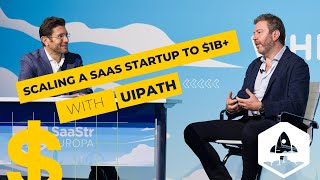
Daniel Dines, founder and CEO of UiPath, talks about building the RPA company to $1B+ ARR. He covers the customer pivots that shaped the product, hiring for culture fit over pure expertise, and how the company balanced aggressive growth targets with cash burn and eventual profitability.
Questions this video answers
2005
144%
July 2015
Accel (series A in 2017, per Philippe Boteri)
From roughly $1M → $5M → $45M → $175M (ARR figures referenced during the discussion)
Chapters
We are on the verge of a new revolution. RPA and automation is a new layer of software. People realize that they need to automate routine tasks. Get a robot for every person. Leave no manual workflow behind. We need to be bold. The fastest company will always win. We scale simultaneously across the globe. Net retention, it's 144%. Crazy stuff. Our robots get the data already curated from the user interface itself, emulating how people work. This is extremely powerful. We want to accelerate human achievement. Be humble. When you have the courage to be bold, people will take you seriously. Our mission is to run all the manual workflows ever and solve a big issue for humanity.
So I'm super happy to have Daniel here today. I'm Philippe Boteri, I'm a partner with Excel and we had the privilege to lay the series A in the company back in 2017. So some time ago, but UiPath was founded way before that. You founded the company in 2005. That's been a long time, a lot of key learnings and today we'll dive into some of the key things that you have learned along the way. But maybe just to start with Daniel, so when you know, can you tell us why? Like kind of the founding story of UiPath and kind of how did you zoom in on RPA?
I think I was always an entrepreneur at heart. Because of some unfortunate circumstances, I had to make a living for myself since I was 19. So I did a lot of gigs in post communist Romania, including like currency arbitrage. I have started my first company, which was kind of a recruitment company when I was 21, barely turning 21. And then I discovered software and I thought, well, this is an easier way to make a living. So I've become a software engineer. Then I got employed by Microsoft. So I spent five years in Seattle, which was a good experience for my engineering expertise, but it was kind of terrible for my life. I left a very colorful like Eastern Europe Bucharest to go into the cold Seattle. So I knew that I had to go back. But after I got my. I understood really how a company like Microsoft is working and which is interesting about Microsoft was that they offer some kind of tribe like experience so you, in a way you feel safe there. But at least in my times it was. And I met some of the smartest people in the world because between 2000, 2005 they were really at the top of the of the game. So going back to Romania offered me no chance that but to start my own company. And look, I did. You know what I know best to, to survive. So I did a lot of software consulting, outsourcing, but always the dream was to build a product. And the genesis of UiPath was a very little consumer tool that offers some kind of one click dictionary for desktop. So you can click on every word on Windows desktop and then we can extract the word and then show a pop up like search or you know, find the definition. It was an early form of computer vision because understanding every word in a computer application where it's positioned, it's a much harder job than you can imagine right now. You cannot just copy paste every. So it was an engineering gig. We went very deeply hooking the internal systems of Windows. It was an interesting stuff, but obviously it was a flop from a marketing perspective. But we kept going and eventually from this little thing we evolved into building really our entire computer vision stack. And then we understood that you will need the local no code system in order to facilitate using the power of this computer vision thing that interactive screens. And then we discover the market. We started in the business process, outsourcing market and then we got into really large enterprises and then we spread across the world and then we did the IPO and now we are here. But I can trace back to the first line of code which is really that one for this little application.
And along the way, how much did you learn from your customers? Like when you were, when you started as an outsourcing business and trying to find your way into a product, how important was it for you to kind of listen to your customers and try to infer should be versus you having your own vision of what the product should should be?
I think that was kind of my biggest transformation in, in how I think about building products. So I started as a software engineer working for a really large corporation. I was completely shielded from customers. I never met a customer in my life in Microsoft. So I came with kind of the same approach in building this business and I persisted in that approach. I am right and they are wrong. If I bring these new features, they will finally be enlightened. But it's a transformation and I can give you some pointers. So first we, from this little consumer program, we got to a small ISV from us and they, they were doing some kind of banking software. And what they did was to read the screens of a teller machine. You know, you used to go to the bank and cash, you know, get some money or cash a check. And these screens, these machines were not connected to the banking system. So they were reading the screens and then populate the banking software. So it was a very early form of rpa and they came to us and tell us, guys, you have this little thing that works very well with the screen and it was the best in the world. Really. Yeah, we just need this one, not the entire application that you built and you are so proud of. And it was funny because I asked. So he asked for a license and I thought, how much can I ask this guy? So I thought I had, you know, just out of Nowhere I said, $10,000, so you have an unlimited. Next day they wired the money. Honestly, the entire revenue from that other application was maybe $100 at the time. And that convinced me, we have to pivot into this. So let's build, maybe this is easier for us. Let's build like software components for other software developers. It's easier to understand this market. And then we started to build this library and then next we were having some few interesting customers that were telling us, guys, it's very difficult for us to use code, to use like C or JavaScript or whatever to build process automation. We need something simpler. And this is how we turn into low code, no code. So we build the low code, no code platform. And then we got another. It was a lucky strike, honestly, out of nowhere, we got a really big customer in BPO industry. When I had no idea what even BPO is, really zero idea. And they, they wanted to use our software in this nascent RPA industry. And before us, they were using one of our competitor, but they were really kind of stiff in their mind. They were not flexible to the customer demand and they were searching really via the Internet, like a software that it's easy to use and create some process automation. And they call us in Romania and we went to India for like two, three months to do a prototype. And it was the aha moment when we really understood, wow, this is the market we hope for. We were just kids so far. We were in a playground. But this is a serious thing and we understood that what does it need to scale a business? As a software engineer, maybe this is also interesting. I never understood the idea of scale. In an enterprise, at least you can make easy prototypes or even little products that can help a small group of people or individuals. But scaling across an enterprise, it's a freaking different thing. So this is what we started to learn with these guys. So we've built our orchestration software that can deliver hundreds and thousands of automation at scale and you can monitor them, you can do all sorts of things. But that was instrumental. I didn't envision this and then everything. You are in a very lucky position if you don't have to invent and reinvent yourself every year. And you just listen to the customers and your job is just to prioritize, understand what are your best customers, what are the best segments prioritize to their needs. And this is what we did. It was simple.
And you still do it today. Like what percent of your time today do you spend with customers?
I still spend a significant percentage during all these years I built amazing relationship with some of our biggest customers. I call them friends, we go to dinners, we had amazing experiences and it's a trusted relationship between us and they are not afraid to call me bullshit. So for instance I last week I had a call with one of our first customer a huge advertising agency and this guy and we are really good friends, we play tennis together. So told me Daniel, I'm disappointed. And what you guys are doing, you lost touch with us. You just go only for revenue. You go to different business units. You don't help me consolidate what we have. You try to overcome, go to sea level. And look to me was an, was a really, it was a powerful moment when you realize you are on the wrong track. So you are always customers always help you go back to your core roots and building something that matters.
Yeah, that, that, that makes a lot of sense. I think that that is one of the most important learning probably of, of the journey. Well, one other fascinating aspect about the story of UiPath, it's the speed at which the RPA category was created. I mean if you look back like six years ago, no one knew about rpa. I mean I still remember when we did the diligence on the series A, I spoke to the cop dev person of the very large software company and I was starting to talk about robotic process automation. And the person said, told me, well we don't, we don't invest in robots in robotics. Like what is this about? So that's what is the state of RPA six years ago today? It's top of mind for all the Fortune 500 CIOs. So, so could you tell us more like how this category came together and kind of what were the ingredients that made it happen and what are the learnings that you would and the advice you would give founders in this room who are aspiring to create their own category as well?
Well, let me start with the last question because I don't think that the desire to make a category it's the right approach to build software. I think it's a Sign of arrogance. I want to build a new category. It's. I think it's gonna clutter your mind. If you feel, you feel, it's. You feel too much, you put too much pressure on you. If you play tennis and you are a young guy, say I have to win winblet. You are not going to win. Win the room. You just have to go and play for the moment, for the joy of doing things. So even the mere idea of I want to build a category is going to prevent you from building a category. You build categories because it's the right timing, there is the right moment in life and you are somehow chosen to be in that place. That's the way people build categories. And we can look to numerous examples. What happened in rpa. It was a moment when the business process outsourcing industry matured enough so they were at the point where they couldn't reap more benefits for their clients. One of their core proposition is that every year they will deliver savings for their clients like 5 to 7%. So they were in a position where it was very hard to do all sorts of process engineering thing, human process engineering to optimize and deliver. So they were desperate to get into automation. So they were willing to take bets on very small companies. So this is. That was one of the, that was why the market was ripe at that point. But it was also a technology condition that, that was very interesting that happened at that time. It was the, the big advent of AI that happened. One of the big moment was 2011, 2012, when I think the image recognition, you know, take a giant leap because of the cloud and mobile phones and all these new pictures that were uploaded. People built software to recognize images. We took this type of piece of software and we applied it to desktop and we were capable of recognizing all the objects on the desktop. And that was instrumental for BPO industry because they were using kind Citrix to access their client system. So in order to automate something over C Trix or any remote desktop on a virtual environment, you have to do only computer vision, basically like a human user. So we had this really good technology at that point and the market was right. So that, that was it always. I think there should be like a Goldilock condition. There should be more conditions in order to build a category. And it was a few companies that was there. So it was good, it was good timing. It was really, for us it was only about good timing.
And did you feel like you had to evangelize your vision to the analysts at Gartner And Forrester, et cetera. Or do you feel that actually they came to you? What was kind of this push pull process in the naming the quadrants, et cetera.
I think the name of category was Great Robotic Process Automation. It attracted the attention of people. I think it helped in a way. We had a lot of detractors. People say this is not real automation. You just go via user interface, you should go only via APIs. It's all this and it's interesting because customers don't care about purity. This is also another lesson guys. If you aim to purity, it's the wrong way to do. You need to aim for kind of something that is the meaning is like life. Purity in a way bores everything around it. And you don't see you cannot do real use cases. You need to try to do a right balance. Even today I hear this shit, it's only have to be only API driven. And then generative AI came that fucking emulates people. It's not API driven, It's different and it's so powerful when you think about it. So I think it's really important to go over your biases and create a tool that works for the job at hand.
Yeah, that makes sense. So let's shift gear a bit and talk about hiring and culture. So as you mentioned, your experience was as an engineer, but at some point point you needed to hire people outside of your field of knowledge, you know, in sales, marketing, et cetera. And this is something that usually technical founder wrestle with like how do you, how do you hire that first VP sales or VP marketing. So I'm curious to understand like how, how do you think about it and what did you learn along the way?
So I'll start with the biggest learning and then I'll try to explain why with some examples to me. And I strongly advise you guys on this. My biggest learning in hiring. You should go for chemistry versus expertise. I was always under impression that if you can assemble a team of a players highly experts in their domain, this is gonna work. It is far away from working. This is a recipe for disaster. Honestly, you have. This is why sometimes I'm curious if this is go. They take three founders that barely met each other, but they are experts and they expect this company is gonna work. No, they will gonna argue to death and it's a recipe for disaster Chemistry. A team with people that trust each other and that have chemistry and they like to work each other. It's the best you can hope for in life, in software, in product, in everything. This is so Initially our culture helped us. So I know we'll get to culture. So I serve it for later. But then I started to. So I hired initially really nice crazy people. Sometimes their first job were people that were in their own words, like corporate fugitives. So they want a different experience. And it worked. It was magical. We had moments. So for us at 10pm it was full. You can see, you know, hundreds of people working, drinking wine and being immersed into that. It was one of the most beautiful experience and it's possible only by chemistry. But then at that point I didn't understand that this is the recipe. It came to me just by luck. And then I started to hire the experts and it's not working. They might lay a good foundation, but always the way they. People cannot change in life. This is also another big lesson. People's personality will never change. So you see two people that don't get along, they will never get along. This is always happening. So you hire someone with the personality that's a little bit different is not crazy different. I'm not talking about psychopaths, I'm talking people, different personalities. But they change, they create. It's like you bring a different ingredient to a recipe, it can change it. Some dice were good, but most of the time you destroy it. So I, and we've been through lots of lots, maybe too much. We shoot ourselves in the foot. With so many changes in the go to market, I now I consider more stability and building going for the chemistry. It's a better, longer, you know, way to success. And so I don't know if I have to go to examples because many people you know, are known. But it's, It's literally the, the way to go. So don't, don't guys, don't ever compromise on this. And this is very hard because sometimes I had to be like go to market leader. Having the regional sales leaders under me directly. It's a freaking hard job to do this because you have to go in all the sales forecast and calls and it's a lot. You have to put pressure on them. So I wanted to get out of this, but if you get out of this and you don't have the right person, you lose touch with customers, you lose touch with the teams, you create a lot of unhappiness. A lot of people come to you and they complain. And it's the culture, it's. You basically created dissonance into your, into your company.
And so how you mentioned the culture. So it's based on four tenets today. So you have humble, bold, immersed and fast. So how did you come up and when did you come up with these four tenets as they evolved over time. And how important is that focus on culture for the success of the company? Company.
So when we have started to see scale in the company, we were looking. So I and my early co founders, we are big fans of like Netflix culture and their Netflix lights. So we understood the power of culture in the company and we tried to define our own culture. People come with many words, you know, like candor, honesty, we are open, flexible, whatever. So we are having long debates and we can come up with long list of things that we define. But again, I had an inspiration at some point and I said to myself, let's reset this exercise and let's start just with one thing. What's the most. If there is one word that describes us and our culture, what shall that word be? And I realized that we are there because some of our competitors were arrogant. It was one of the biggest reasons they let a small company out of nowhere to steal their lunch, because they were arrogant. So I said the opposite of arrogance. It's probably what works the best. And then I said, let's be humble. This is humble should define. We should always stay humble. It's such a powerful concept. It doesn't mean that we are humble because nobody is truly humble. But to me, culture is more like framework of operating. You aspire to be something, you are not something, but you filter all your decisions, all your interactions by your values. So humble is very powerful because first of all makes you listen to others, which again, if you are not really that of a genius and you don't suck all the air in the room, you have to listen to the others. Collective intelligence, it's most of the time better than your own. So this is always my style. I very rarely make decisions that I enforce on people. Most of the time they change my mind. So the power. Being humble gives you the power to change your mind. I make decisions against the group of people that I trust very rarely, only when I am 100% convicted. This is the right way. When I have the gut feeling, when I tell them, guys, this is against my heart, I will die, I will reap my heart if you don't do this and they will do this. And so humble, it's extremely powerful. And also you need to be bold in life because if you aspire for little things, you'll achieve little things. So you have to be bold and you have to go, you have to be fast because you know the fastest company will always create the biggest impact. And the way to operate always is to be immersed. This is what I liked in life. I don't like balance, work, life, balance. This is a stupid thing for everyone. You have to be immersed and you stay immersed in your life or in your work as much as it's working. But at some point you are exhausted and you go back to the other thing and you immersed in the other thing. But this is how I see in general. I see a good way to conduct your life.
And so one point that you mentioned was, I think very particularly important and striking to me was when you say bold and the, you know, the need to kind of set this very bold, very audacious targets. And I remember when we invested, you know, in the company, I mean, this is one of the fastest growing software company of its generation. I mean, you went from, you know, 1 million, 5 million, 45 million to 175 million in revenue, which is kind of an amazing ride. And you always had like these very ambitious goals, which, I mean, I would say like initially when you say, well, we're going to grow from 5 to 50 million, I would say like, we've never seen that. Like, you know what if you do 20 or 25, that's already great, but say no, like we're going to do 50. And you ended up, you know, being very close to that goal. So how, how do you set these goals for yourself in a way that is a stretch, but not. But still achievable. Right? And what advice would you give founder in this room in terms of thinking about the goal and knowing what is an ambitious goal that's going to motivate the team. And even if you fell short, a bit short, it's still okay, versus something that is totally out of reach and therefore is going to discourage everyone because you're going to miss it by a wide margin. Like, this is a very fine balance. And just curious to see how you think about.
I think this is clearly the, the black magic of running a company that grows fast because it's, it's easy to be crazy. You know, when I heard Masayoshi Son saying, you are not crazy enough. That's bullshit. Guys, I am fucking crazy. And I can be crazy enough. But I am going to burn billions of dollars. I will overrun the market with traps and then they will step each other's toes and they will be unhappy. We will burn hundreds of millions of dollars, the culture will sink and we will go busted. Right? So craziness doesn't work. We're super craziness. You said it very well. The fine balance works. But I wish it's a thing that can work. I can give you an example how I have chosen. Like in 2017, we were number. We were number three in the market. We have two bigger companies ahead of us. So we were like finishing the year 17 with like $45 million. The other guys were maybe 70, 50, something like this. And I knew they are growing maybe 50%. So they get to 100. And then I said to myself, this is shaping as a big category. I felt it. It's huge. So it can absorb. We can take a much bigger risk. At that point, we were almost cash flow neutral. We've been cash flow neutral through a lot of our existence until that moment when I said, this is it. That's the market is ready. The biggest company will get the lion's share of the market. It's worth, you know, pressing the pedal. And then I came to the board, maybe you remember, and you guys said again, if you do, if you deliver $70 million, that would be a great achievement. Starting from 45, we talk about ARR to 70. And I said, no, guys, 70 will still be the third in the market. We will deliver 200. And then everybody thought I am crazy. But I went to the sales leaders at that point, I was still running all the sales, the Jew leaders myself. And I gave them this huge number. And to my delight, they were not shocked. They thought I'm crazy, but they were not shocked. And they said, give. Give me a little bit of time and I'll come with the number. And then they committed. So we had this concept neck on the line in terms of commitments. And they collectively committed to $150 million. And then I knew, this is it. We can capacitate to $200 million the entire sales team, because we will achieve 150. Well, we. We have achieved 175. And we burned $80 million that year. But it was nothing really. Get to number one position. Getting Gardner in everywhere. We won the market and the competition never caught us after. The gap only increased. It was a very well timed investment. But next year when I tried to do the same, it was a freaking disaster. So this is why we need to be very cautious. I wanted from 175 to go to 600. Look, and we capacity. And I said to myself, we can get the minimum to 450. Okay, we can borrow $150 million. That's nothing. We had half a billion in the bank at that point. We raised a big series D but the problem was that we didn't have the right controls in place in that year. And we grew significantly to like 375 or something like which was amazing growth. But we burned $400 million and that was not fun because you all and we over hired. So that was really the moment when we've been into diminishing returns and could have been very costly for us because in 2019 we were one of the rare companies that has done a round of layoffs and it's such a big blow to the culture especially when you are alone in the market, like Nobody was there. UiPath was firing 10% of their people. It was a six month terrible blow. And then Covid hit but again we were lucky because we've done this restructuring so we are well better preparing. Covid, our main competitor at that time were trying to catch us especially with softbank money. So they were pouring a lot of money into the, into everything. Sales, marketing, build a bloated company. And Covid hit and they were fucked. And we are in a much better position. We were nimble already. I learned my lessons. And then 2020 was an amazing year and where we still grew like 80%. We kept the cost under control. We turned guys from 400 million born to cash flow neutral in just one year. It's almost unheard of while growing 80%.
Well, UiPath has broken many rules, etc. So now I don't have any benchmarks anymore of what's possible. Just trust your, your founders. So I mean as you think about this journey between, you know, kind of being break even burning a lot of money then being, you know, cash flow positive again and rule of 40 company like how do you, how would you advise founders to kind of manage and think about the cash burn? And is the rule of 40 something that only applies for large public companies? It's something that is relevant when you're a young company. Like how, how, how do you think about it?
I think it depends on the stage for me as so I bootstrap the company for almost 10 years. 10 years actually. We raised our first round of investment in July 2015. I started a company in 2005, Bootstrap. When you bootstrap a company you need to understand cash flow because otherwise you die. So I was very much cash flow attentive and it's part of my DNA. I always, I feel a little, it's a little bit, a little bit against my nature to just go on board huge amounts of money. But you need to understand again the right moment when you have to board. There is this, you know a guy that I admire is Frank Slootman, CEO of Snowflake and he has a great book called amp it up or something. I think it's almost like a recipe for building a startup because this guy, he's an operator. I'm not an operator. It's a different beast we are talking. But as an operator, he describes very well when you have to push the pedal, when you have to increase the reps, how to think about it. He's an awesome guy and even in person. Let me tell you an interesting story with him to see how you know, truly operator thing. So I and Brendan, which was at that time my chief of staff, really good friends, we are very close. We went to meet him. It was before his Snowflake gig. It was between ServiceNow and Snowflake. And Brendan introduced himself and he said I'm Brendan dear, you know, Daniel's chief of staff. And this guy said, Frank said I would fire you next day. That was fun. Yes. What's this draw? It's a fluffy job. What Chief of staff, it doesn't exist. He thinks also customer success. It's a fluffy job and it doesn't exist. And to certain extent I agree with this, but it's a very hardcore thinking. It's kind of interesting to see. It's not me, but it's an interesting to watch and learn what you can apply to your own thing. Where we were. I got lost in my mind.
Well, good news is Brandon is still with the company.
Brandon is still with the company. Okay, well, great.
Well, thank you. That was amazing, Daniel. So I was just trying, if I try to summarize the key takeaway, this should appear here. So along this journey, I think as you mentioned, listen and learn from your customers, super important role. Really be thoughtful about when and how to use your cash. So I think this rule of 40 is good to have in mind. But you need to know when is the right time to really involve, you know, evolve your, your resources and really commit to, to the growth. Evolve your leadership style. As we just discussed, focus on culture and be bold but not too crazy. I think that's, that's the learning. Thank you. I don't think we have time for questions unfortunately, but thank you very much. Thank you. Daniel. This was an amazing discussion.
It was great. Thank you guys.










