Scaling Revenue Today: What’s the Same and What's Different? | Confluent President Erica Schultz
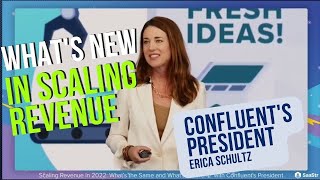
Erica Schultz (President of Field Operations at Confluent) delivers a conference talk on practical strategies to scale revenue in 2022. She presents five actionable areas: 1) continually re-evaluate customers and personas; 2) design a modern, connected customer experience (digital + human) tailored to different persona journeys; 3) combine product-led growth (PLG) with enterprise sales as complementary motions; 4) adopt consumption-based pricing as a cultural and cross-functional shift (not merely pricing); and 5) maximize growth while improving efficiency through focus, repeatable playbooks, and speeding key processes. She closes with guidance on leading transformation (explain the why, enable the how, define the what) and bringing teams along.
Chapters
Great to see you all. Great to be back at saastr. I'm Erica Schultz, I'm the President of Field Operations at Confluent and look forward to spending a little bit of time with you. Today we're going to talk about scaling revenue in 2022. What's the same and what's different and I look forward to diving into it. So a little bit more about me and it is great to be back at Saastr and just great to be back at in person event. I don't know about you but I find it really energizing and so it's great to be here. A little bit About Me I've proudly spent 27 years in this amazing enterprise technology industry. I spent the first almost 17 years of my career at Oracle Corporation where I started as an SDR and I've spent the last 10 years in growth tech companies. I'm currently at Confluent. As I mentioned, coming up on three years with Confluent and prior I spent a little more than five years with New Relic. I like to think I've seen a few movies. I've learned a few lessons. Many of the lessons learned the hard way and some of the things we'll talk about today are things that on the one hand we've learned in some of these organizations that are a little more at scale than a lot of the companies that are represented here today at Saster. But at the same time I think that many of the strategies I'm going to talk about I'd put in the category of I wish we focused on them sooner. And so I think they're really applicable to companies of lots of sizes and scale. So let's dive in. We are going to talk about five strategies for scaling revenue in 2022 and number one, I always like to start with the customer. I'm a big believer in everything that we do. We should start customer back and really orient ourselves around who is our customer, what are we solving for, what problems are they solving? And I'm a big believer that you can make it a habit to rethink your customer and Persona understanding and almost constantly challenge yourself and challenge your C suite. Do you truly have a deep understanding of who your customer is, what that ideal customer profile might look like? Who are the Personas within your customer that you serve and where do each of those Personas show up during the engagement cycle? So I'm a big believer in making it a hack habit to rethink your understanding of your customer and your Personas And I think that there's an incredible unlock that can happen when your C suite and the functions in the company are truly aligned around a common understanding of who your customer is and who their Personas are. If you think about it, when you can truly align your product development efforts with your marketing demand gen and messaging efforts, and with your selling motions, when you can truly align around a common understanding of that target customer and specific Personas, there's an unlock that's possible, particularly in moments like this where companies of all stages and scales are looking to get more efficient. And we'll talk more about that, but I think it's really powerful. And so how can you get a deeper understanding of your customers and your Personas? Well, we have, we all have a wealth of data and insight at our fingertips. It's about how we're taking in that signal. And we have all kinds of market information about what other technologies our customers are using, how they engage with our various marketing platforms, how they engage in a sales cycle. We have digital and we have human signal. We have customer. Sorry, we have product instrumentation to understand how our customers are engaging with our products. We have support interactions, we have partner ecosystem interactions. We have so much data and insights available. And it's about how do we take it in? How do we build the practices to really take it in and deepen our understanding of our customers and our Persona? So that's really number one. Start with your customer, work customer back. And with that deep understanding, there's an unlock that can really help you scale revenue. Now, related to that, let's talk about the actual customer experience. I'm a huge believer in designing a modern and connected customer experience because, let's face it, that's what our customers expect. Now, even if we're in enterprise technology and enterprise cloud services, our customers have been trained by all of the great consumer technologies out there. So their expectation when they engage with our enterprise solutions is that we're offering a very modern and connected customer experience. And this is really about if in the last slide we talked about how do we make sure we have a deep understanding of our customers and specific Personas? Designing the experience is really about how do we apply that into a great experience for our customers, both digital and human? For example, starting with, do you have a clear point of view on what your customer journey is at what moment? And how do your customers discover you? What problem are they trying to solve? Who is that person who's coming to first interact with your product or with your company? And what problem are they trying to solve. And if you have a clear understanding of that customer journey, are there multiple versions of it? Can customers go on slightly different permutations of that journey? Maybe they're coming at it from different points. For example, I'll share with you a little bit how we think about this at Confluent. In Confluent, for those that aren't familiar with us, we are a real time data streaming platform. And the founders of Confluent were the original authorities of what is now the open source Apache Kafka. And so when we think about our customer journey, there's kind of two flavors. Even in just this discovery and experimentation phase, we might encounter a customer for the first time or a prospect who actually is really far along in their data streaming journey because they've built mission critical production applications on open source Apache Kafka. So when that's the case, we need to know that because the way that we're going to engage with them, what they're coming to Confluent to discover and experiment with and learn, is very different if they're already familiar with what's possible with a real time data streaming architecture. In contrast, we also might have developers or architects come to us in that discovery and experimentation stage who are not familiar with data streaming. Maybe they're building an application for the first time and they're not familiar with a real time data architecture, so they're learning about that for the first time. So it's on us to think about how can we offer an experience to both of those first time confluent visitors that's in tune with what they're looking for and that needs to follow on to the onboarding and activation stage. How might we onboard or activate again, someone who's just for the first time learning about real time data streaming and the power of it versus how do we onboard and activate a very sophisticated individual who might be running, as I say, production mission critical apps on a data streaming platform using open source. That individual is going to want to know different things about how can you migrate my production applications and how do I need to think about roles, responsibilities on my team if we move to a fully managed cloud service versus running this ourselves on open source source. So some really different experiences that we need to offer as I think about the customer experience through different stages of the sales cycle and we'll talk a little bit about product LED growth and enterprise sales in a few minutes, but I think about that balance between the usage model and the subscription model. And one question to ask at that stage is do we know what's the right amount of usage in a product led model before we start pitching the customer on a subscription? That's an important question to ask as we think about creating new value and driving expansion with that customer. Do we know how that customer derives value from what they're already using from us? Do we understand how they're measuring value in their current use case and therefore how we should think about positioning the next one for expansion and then finally connecting that whole experience to the ultimate outcome that we want, which is, as we like to say, customer love and advocacy. How do we create advocates from our customers and when is the appropriate moment in the journey to ask for that for ask for them to give back to the company in that way and really speak on your behalf as a public reference or in the community. But I think thinking about this entire customer experience is needing to be very modern and kind of the combination of digital and human touch points and very connected and contextual so that we're taking different types of customers and of course Personas on slightly different journeys. That's a real unlock is we're thinking about how to scale revenue because we can actually accelerate the customer adoption and expansion phases which of course will drive the top line. The third point that I want to make is around the power of the multiplier effect of combining product led growth with enterprise sales. I think this is such a benefit that is potential for so many different companies. And I find that a lot of companies, and maybe you can relate to this, ask the question of is it either or are we product led or are we enterprise sales? And I'm a big believer that many companies, if not more, most offerings can be suited to both. And the trick is to think about, okay, who are the Personas that we're serving and might one model or the other be a better fit for that specific Persona? Again, if I think about, in our world, developers are a key Persona architects as well as economic buyers who might be business leaders, business unit leaders who own different functions within, within a business. Well, the developers and the architects love a product led model. They prefer certainly in initial stages to have a great product experience that they can discover and adopt and get usage and value from on their own. In many cases they prefer not to have to interact with humans. Just give me a great product experience with great in product documentation, maybe engagement if I need it. And that's really well suited for that, for that Persona. On the flip side, if you think about the economic buyer and what, what he or she is solving for. Maybe they're thinking about how your solution is a fit across the enterprise and so they're going to want to understand better your security posture, how easy it is to operate in an enterprise environment, maybe you know, you know, cross charging and billing and that sort of thing. And they're gonna wanna look at all those enterprise capabilities which aren't always best demonstrated in a product led engagement. So that's maybe where your enterprise sales team comes in and you can bring in other resources to prove out the security and the operability and the scalability and bring customer references to the table, et cetera. So when you think about product led and enterprise led, I'm a huge believer it's not either or. I would encourage you to think about can our team, can our customers benefit from both? Are there different Personas who might be served better by one or the other? I would also say you can start with either one and grow into the other. At New Relic, my prior company, for example, the company started with a very product led model serving developers. And as the company got more into the mid market and the enterprise and saw bigger expansion opportunities with customers, they saw an opportunity to complement the product product led engagement with enterprise sales. Conversely, at Confluent we started very much on the enterprise sales side because we were partnering with companies as I mentioned before, who had already built production mission critical apps on open source Kafka. So we immediately needed to engage with those architects and economic buyers to prove out why move to a fully managed cloud service. And then we introduced several years into our existence as a company, we introduced product led growth, we introduced a self serve model and a pay as you go offering for our customers. So you can start from either direction and come at an add to your portfolio. But I really would think about can you serve different Personas more optimally with both models. Last couple things I'll say about the benefits of both product led, I think that the promise of product led growth is ultimately, ultimately it leads to more effective and efficient lands and customer acquisition that can really help your overall cost of go to market down the line. Again we talked about how preferred it is by many profiles, many different Personas. So that's something to think about. And then conversely, I think one of the things we learned at New Relic, for example when we introduced enterprise sales was we went from customers being a little bit anonymous in the product led world to all of a sudden being we're in relationship with these customers and we got really rich feedback from those enterprise customers. Again through a lot of Human interactions that complemented the digital interactions. So we learned a lot and that was extremely beneficial. So think about the payoffs of both and can you serve different Personas in your base with both models? All right, there's a lot of buzz in the industry right now about consumption based models. There's, you know, we think of it as maybe the third era of software pricing and licensing and billing models. If the first was kind of the on premise software license and support perpetual licenses. The second, with the advent of SaaS, with subscription models now in the last few years, and really pioneered by the cloud service providers, consumption models have been gaining a lot of traction. So let's talk about them and I will come to this in a minute, but my point here is really around creating the consumption based culture in your company that it's more than just a pricing strategy. But first, let's talk a little bit about what it is. Well, a consumption based model, it really allows you to recognize customer revenue based on actual usage versus the subscription commit versus a committed contract and kind of the promise of usage. And so a lot of people are big fans of the consumption model because it brings your revenue recognition much closer to actual customer usage. And let's assume that your customer's usage indicates value realized. So that's great. You want to bring your revenue recognition even closer to actual customer usage. I know someone who likes to say it's a more intellectually honest model and I agree with that. So I think there's a lot of advantages. It can be tricky because it represents a big change. And again, I think many organizations think of this as kind of a pricing model change or a billing model change. But we have learned, and I have learned over the years, it's actually so much more than that. It really takes a cultural change and kind of a mindset change to embrace a consumption model within your company. Let me talk a little bit more about that. Well, first off, there are implications for almost every function in the company and you can see them listed out here on the slide. If product goes from designing products that are sold and somebody implements them, now they have to think about how can a customer self serve and adopt and usability. Your marketing focus might go from marketing demand gen to PLG and customer marketing. Your sales focus. I know certainly over the years I've built a lot of muscle memory around the bookings forecast and those subscription contracts. Those are the big wins. And then you have to retrain your brain to really focus on. No, the big win is actual customer usage. That's a big Shift and then we could go on and on about the areas of focus. But not only does every function in the company have to think differently in these two models, but actually they all have to come together in a really powerful way. As we've been introducing even more of a consumption model at Confluent as part of the cloud managed service offering that we have, we've learned a lot along the way and the commentary from the team members who've been involved from all of the functions listed out here and more they've said, wow, we've really had to gain kind of empathy and appreciation for what the next function next me does because if I'm building the product then now I really need to think about, I need to understand billing and revreck because I've got to build billing capabilities directly into my product and there's a lot of things I didn't know before or maybe if I'm focused on the usability and self serve ability of the product. Previously I was kind of thinking that someone in solution engineering or customer success might help our customers through that. Now I need to make sure that our customers can kind of consume on their own. Or for example, maybe all of the post sales, post the subscription commit, maybe your account executives assumed that someone in customer success would help your customer get onboarded and successful and now that's a little more the sales rep's job with their solution engineer to get customers onboarded and be thinking about again, the ultimate win is customer usage, not just winning the contract. So I think that for each of these functions and as a unit, the culture changes and the mindset changes as you adopt a consumption model. And again, in terms of how does this help you scale revenue? I'm a huge believer that the more resources in the company, the more functions in the company that are focused on maximizing actual customer usage. How can that be a bad thing? That's a great thing because all of a sudden you're that much more aligned with actual customer outcomes. And last point I'll make on this one is in our case we've actually we have a hybrid model, we maintain a subscription model and we have consumption elements. So it's not either or kind of like the PLG and enterprise sales, it doesn't have to be one or the other. But something to consider is are enough functions in your company really rallied around driving actual customer consumption? It can be a big unlock. All right. And the fifth strategy that I'll mention because it's, it's very of the moment is how do we maximize growth while we also keep an eye on increasing efficiency. And we all know that the landscape has changed, particularly in the last six or so months, in terms of the value placed on efficiency. If you're an early stage company and even if you're very early in the journey, of course you're focused on maximizing top line. But I'm willing to bet that your investors are asking you to show how you're keeping an eye on efficiency along the way. In our case, we went public last year and we're not yet a profitable company. But it's really important that we show the market what is our path to profitability. And so how do we both maintain the top line while also increasing efficiency, knowing that both are important to investors and to the market these days? So I have a few thoughts on this. The first is focus matters. And, well, let me take a step back, actually, before we even get to that. One of the best ways to drive efficiency actually is to maximize the top line. I mean, the steeper the growth curve and the top line, the more that you can, you know, the more room you have to invest and you can actually, you know, great growth kind of gives you a lot more room. When your growth wanes, then of course getting even more efficient is harder because you just have less to go invest with. So I want to be super clear that I'm a huge fan of staying laser focused on how you maximize the top line, number one. And then number two, what are ways we can get more efficient? So one way is to stay super focused. And we spoke earlier about the importance of having a deep understanding of who your customer is, who the key Personas are and who you're building product for, who you're building messaging for. And I think this comes into play here too. When I think about focus for driving both growth and efficiency. And we think about kind of who those customers are. I also think about, you know, if you're an expanding company, if you're at this stage, okay, what segments are you in? Are you serving the enterprise? Are you serving mid market? Are you serving startups? And depending on your scale, you might want to make some focused bets and say, you know what, we're going to stay focused on startups for now and we're not going to get into some of these other segments yet until we have enough growth here that we can then use the payoff from that to go invest in other segments. Or maybe you're being pulled into a lot of international markets, markets, which is super exciting, but actually it can also Spread you really thin to go service those markets effectively. So maybe you constrain yourself and you say, you know what, we are only going to focus proactively on English speaking markets and that way we don't have to go translate our docs or our websites and things like that, or hire in lots of different countries. That's another way to apply focus. Similarly, you could think about industries, but the power of declaring that focus. And of course, what does focus mean? It means you say no to some other things and that is always the hardest thing. But the power of focus is then you can align your bets across all the functions in the company. Your product and eng team, your marketing team, your go to market investments, your sales headcount, you can put them behind the same bets and that is super powerful. So focus inherently applies saying no to some other things and doing some things that you know where there's big opportunity. And it takes a ton of discipline to say we're not going to do it. But focus can really pay off. The second thing I'd say is invest in a repeatable playbook. And I can't highlight this enough. It is, it's so valuable to have that clear playbook as you're onboarding. Definitely new sellers and account team members, but honestly, anyone in the company, how are you enabling them with what you've already learned from your teams who've been out there in the early days? And how can you enable and equip them with a clear playbook again for who your target customer is, who the Personas are, how you position and how you lead your customers through that journey? What does the engagement model look like? Sometimes people will ask, well, does that mean I should hire an enablement leader or team right away? Maybe. But sometimes enablement and building the playbook early on just means getting some of your early team members in a room with a whiteboard for a half day or a couple days and crank something out that's really useful for the next 10 or 20 or 100 people that you hire. So codify, capture and codify kind of harvest from your team members who are out there and capture it in a living, breathing playbook that you can use to onboard your next team members and then solve for speed. So again, on this efficiency topic, a lot of times our temptation is to go find the things that maybe we want to cut from the model. Maybe we can not have as many resources around the ae. And sometimes that is the right answer by the way. But I also think that one way to increase efficiency is to think about solving for speed in every process that you have, whether it's hiring a new employee to your company or onboarding a customer or landing a new logo or getting to, you know, getting a customer onboarded and expanding. Instrument that process and understand how long it takes you and then figure out, how can I cut this in half? How can I hire someone in half the time? How can I get an AE ramped in half the time? How can I get a customer onboarded into the next use case in half the time? Solving for speed can be a big unlock, and there's so many opportunities in every function in the company. And so it's a great place to go when you're looking for efficiency. And just a few of my favorite metrics sprinkled along the bottom of the slide there. But a lot of those are outputs from growth plus efficiency. Okay, so maybe this all makes logical sense, and maybe some of these things represent a change from how you're operating today. And they might represent transformation that you need to drive on your team. So how do I drive that on my team? I mean, everyone's already really busy. People are really stressed out, they're working really hard. How can I drive transformation on my team? So a few thoughts on this, and it really comes down to the why, the what, and the how. And let me start with the why. I do think that all of our teams want to be. They want us to respect their intelligence and they want to understand why and take them on the journey that led us to the decision of why we're making some change. Maybe we're saying, you know what, we're introducing a new Persona or we're not going into this market, or we're evolving to a consumption model for misunderstanding, subscription model. Whatever the change is, take your team on the journey, help them understand your logical reasoning for the why. And then, of course, every individual is immediately going to think, well, can I be successful in this new environment and with these new expectations of me? So how can we help our team members feel confident that they can be successful? Well, that comes down to thinking through what is your enablement plan? What tooling do your teams need to be successful against what might be some new metrics, some new things that you're monitoring? So make sure that you are equipped to roll out the how and give every individual confidence that they can achieve success in this new model. And then finally, the what have you been super clear on what are the new behaviors you're looking for? What are the metrics that you'll measure and are your leaders equipped to teach and coach and then of course inspect those new behaviors and metrics. How does your operating cadence change in my world? How does our forecast call change? Are we looking at some new metrics? If we've been measuring a consumption business based on bookings, if we are saying sorry, if we've been measuring a subscription business based on bookings and we're moving to more of a consumption model, then you know what, we need to start forecasting consumption and how are we going to do that on those high stakes forecast calls every week? So a few thoughts on leading through transformation and I also think it's the what, the why and the how. But it's also it's the heart and the head and you want to capture hearts and minds as you're leading your team through transformation and bringing them on the journey with you. So those are my five thoughts and a little bit on leading through change. So in summary, a few tactics to think about in terms of being successful scaling revenue in 2022 and of course in this current macro environment which both values growth and efficiency, not just growth at all costs. Rethink your understanding of the customer. Leverage that to design a modern and connected customer experience. Benefit from the multiplier effect of product LED and enterprise sales in your business. It's an and not an ordinary create a consumption based culture if consumption is right for your business, not just a pricing strategy. And then of course, keep an eye on efficiency while you're maximizing growth. Building that discipline around efficiency is a habit, it's a muscle, and it's never too early to start. And then finally bring your team along for the journey. Win hearts and minds that'll always help them follow you and embrace anything new that you introduce. So that's it. Thanks very much. Great to be here. Great to see you all.










