“Scaling up: 5 Tips for Successful Upmarket Expansion” with Thoropass’s CRO and VP Demand Gen
Thoropass's Bryan Caplan and Jenna Keegan share five tips for moving upmarket from SMB to mid-market and enterprise. They cover readiness checks like TAM and board support, longer sales cycles, specialized customer success teams, and why you shouldn't abandon your existing business while scaling up.
Chapters
Morning, everyone. Thank you so much for joining us. I'm Bryan Caplan, Chief Revenue Officer at Thoroughpass. We are just at the booth right over there. Stop on by, we'll tell you how we fixed audits, especially the often painful SOC2 audit process. I'm joined here by Jenna Keegan, our head of DemandGen and we're here to give you a few tips on how to move up market. Jenna.
Hi everyone. Thank you, Brian, for that wonderful introduction. Before we give you your tips for how to move up market, we're going to ask the most important question. When should you move up market? Is it really time? Right, it sounds great. We can sell more users, we can sell bigger deals, but are you ready? So the first thing you want to know is if there is an opportunity for you to move up market, do you have customers that are successful using your product? Now, what does that TAM look like? What do you think you can achieve? Make sure you have cross functions, functional alignment. Don't make this just another squirrel you're chasing. I know it's easy to do. You will need support from every single department and function to even lift off a pilot to go upmarket and make sure your product is ready. You're going to be plugging it into more complicated environments. You're going to have more people using it. So talk to your product team. Is it ready for upmarket prime time?
Now, if you've moved up market before, you know this is not an overnight success. This will take time. Make sure you have the funding, the Runway to do that, right? This will be a 612 multi year process. You want to make sure you have the cash to properly invest in an upmarket strategy. Look at your team, right? Do you have a core portion of your team, sales, marketing, sdr, et cetera, that actually is equipped to sell up market. You don't need that full team on day one. We'll talk about that in just a second. But you want a core that can get you started. And then finally look at your board. Hopefully your board has, you have somebody on your board that has sold into this new icp, whether that's an industry vertical, a larger customer base, someone that can give you the advice that you're going to need to be successful up market. And more importantly is going to be an advocate for you in the boardroom in that inevitable set of challenges you're going to face early on. All right, so now that you've done the evaluation on if it's time to actually do it, here's some tips on how to Be successful.
Yeah. Okay. You're ready to move up market. One of the first things you want to think about is building or rebuilding your demand strategy. And it's going to look different. You're selling to small companies, the deals are moving fast. You're talking to one, tops two different people at the account. Maybe you're being more reactive, right? You're planning in quarter, you're moving really quickly and executing really quickly. You start to move up market. You need to think a couple of quarters out so that you can really build this strategy. These opportunities are going to take longer to create and they're going to take longer to close. So how can you engage these new users across the funnel? How do you figure that out? You have to talk to your customers and prospects, right? If you're going down this journey, you should have some customers at these upmarket deals. You should have people you can talk to, prospects figure out what they care about. How are they using your product? How are they saying that they're successful when they use their product? It might look very different than the smaller companies you've been selling to day after day and start to figure out that messaging and where to put it. Where do these groups hang out? What events do they come to? Do they come to Sast or do they come to something else? Are they a part of other associations? And you also have to remember that the bigger a company is, the more specialized everyone you're talking to is. This is less 101 jack of all trades hires, you know, 10 people in a room. We have people who are subject matter experts themselves and have a lot of knowledge. So the questions they're going to ask you, the things they want to learn, can look a lot different. So you're going to want to adjust your content, figure out what you can repurpose, what different series and channels may work with a different flavor, and what you have to build up from scratch and surround those accounts. Right? You're going to do this. You may do it with a small team to start. It may be a full company function. Make sure your demand gen team is sitting down with sales and deciding on which accounts to go after. I'm not going to tell you to do ABM right now because we've all heard that a thousand times. But make sure that you are aligned with your sales team on what you want to accomplish as you start to go upmarket and build these demand gen strategies.
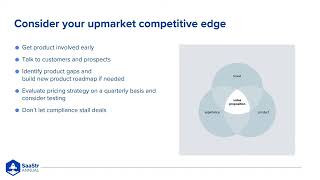
All right? Speaking of your sales team, right, you're going to want to focus your sales team so you've probably have your sales team today. You've built it to run after this core icp. Most of those folks, or at least a good portion of them may not be a great fit for moving up market, but hopefully some of them are right. This is a different buyer. The sales cycle is going to be longer. They're going to require more product expertise. You're probably going to need to be able to multithread, right? Selling to multiple contacts within the organization. It's going to be a longer sales cycle, right? So the patience that's required, that seller that wants that win that every three weeks, it's not going to work up market, right? So find those sellers inside your sales organization who can at least, you know, get you started here. You think that could be good fits for the profile that you're going to need moving forward. You're going to look at your sales process as well. Maybe you have a three or four stage sales process right now that works with your SMB customer. That might be a 6, 7, 8 stage. That three week sales cycle becomes a three month or six month sales cycle. Everything that got you where you are today is probably going to look pretty different up market, including pricing. We'll talk about in just a second. So find those individuals inside your sales organization. It's not just AES, those are your SDRs as well, of course. And on the customer success side, right, It's a different profile that's going to serve this upmarket customer. So find that core, that tiger team and test out this new process. An old friend of mine used to say, start slow to go fast, but then don't forget to go fast, right? So start slow, figure out what's working. Once you've nailed it, then you invest, then you go big and really go hard. After this market, grow the sales team to serve that upmarket customer. You have to look at your competitive advantage up market. Again, you've built a product, you've built a sales methodology for this down market customer. It's going to look different upmarket in terms of what your customers are looking for and who the competitor set is. Your product is going to have to evolve. So get your product organization involved really early. Can the roadmap support what these upmarket customers are looking for? Talking to prospects, talking to. If you have some upmarket customers today, early to get their feedback, get product involved in those calls, get product marketing involved in those calls really early on. Because you're going to need to evolve that product pretty quickly to serve that upmarket customer. And this takes a While right to my point earlier about ensuring you have the funding and the board support, you need to make sure that you can make that investment from a product perspective to serve that upmarket customer. Pricing is a big one, right? You've got your pricing strategy both in terms of how you price the Bundle, the packaging, etc. That works for your down market customer. It's going to look different, come up with a pricing strategy, it's going to be wrong. But test, right? Go out to the market, test if it works, evolve it, test again and then you'll figure out on what's working Here at Thorough Pass, as we've gone up market, we're reviewing pricing on a monthly basis. Now you might not need to do that. We have a very rapidly changing market. Quarterly is probably okay, but the important thing is to test that new pricing strategy, evaluate what's working, listen to those gongs, get that feedback from the customers and evolve from there. And then finally, compliance is going to be a really important thing. As you go up market, one of the first things, things a customer is going to ask you is hey, do you have the SoC2? Let me see that report. Don't let compliance stall deals, right? Jason Lemkin, the reason why we're here today, he said quite recently on LinkedIn, just do the SoC2. It's going to be super important if you're trying to do business with upmarket customers. Tip 4 Look at your partnerships, right? Not a day goes by right now on LinkedIn where I don't hear about how partnerships are becoming a bigger source of pipeline, especially as outbound is getting harder and harder. Hopefully you've built a partnerships ecosystem already for your SMB customer. It's probably a completely new partnership strategy that you need to go upmarket for a couple of reasons, right? Your buyers upmarket, they're more sophisticated, right? They're going to be looking for more expertise from you. They're going to be talking to a different set of of peers to get information about you, right? They just, they gather in different places to get information. They're more concerned probably about product integrations versus price. So you're going to need to find a new set of partners that can serve this customer. You want partners that have a very similar ICP that again, that partner that serves the SMB customer that you were serving today is very different from the partner that serves mid market or enterprise customers. So you're going to need to establish new partnerships that actually target the same ICP that takes time. Second, technical partnerships, I think often Overlooked. Right. You've built your product today and maybe it integrates with Salesforce or HubSpot CRM. Right. For a downmarket customer, you go up market, they're going to want to make sure you can integrate with probably some legacy technologies like Ms. Dynamics, maybe instead of us, they're on Azure and you want to be able to integrate with that platform. So the technical integrations, technical partnerships, almost just as important as the commercial partnerships. And you want to ensure again that your product and engineering team can support that. So your partnership strategy is super important. And finally, service upmarket customers are going to require a different level of service. Try to find partners that can help you there because that's expensive. Partners that can take on some of the service components for the upmarket needs will really take the burden off of your team's plate. So adapting your partnership strategy often overlooked. Really important.
All right, you've decided to go up market. You created the demand, you built the product, you built the sales team. You did everything we've just said. Now you have upmarket customers. So evaluate what kind of service needs they are going to need and anticipate those changes. You're selling to smaller organizations. I bet every all the responsibilities on that table are handled by one person for their accounts. You're going to want to start to think about specializing your customer success organization, having account managers who manage the relationship, the renewal and the revenue. Customer success managers who can handle more day to day product and troubleshooting. As you go into these larger organizations with more complex environments, more onboarding, more users and more internal change management that you have to help them navigate, you're going to want onboarding specialists who that is their bread and butter. They get up every day wanting to make new clients succeed and get on your product. And then if you're really going after these big whales, you may want to hire stream strategic account managers. I have worked at organizations where we had one strategic account manager for one big account. Managing that relationship and managing the land and expand. Right. There are a lot of different business units. There was a lot to navigate there and they just continued to grow that one account. You'd be surprised when you're selling up market how early you may need to bring on someone with that skill set to your customer success organization. Also consider how much you can do self service versus what white glove and what that looks like. Sometimes it might surprise you. Some of these users have more technical acumen when they're in the more specialized roles, but they may have white glove support that they need as well, whereas your smaller customers, they may need help just to get started with some of the things that your upmarket customers can handle on their own. This is also a point where, if you haven't already, start to think about bringing on a dedicated customer marketer to stand up some programs like customer advisory boards and customer advocacy programs so that you are continuing to learn from these organizations, continuing to engage them and keep them loyal to your brand and your product so that you keep these big whales once you've done all that work to get them on your platform.
All right, finally, bonus tip. Don't abandon your core. Corporate executive board did a big study about 20 years ago now called Stall Points. They looked at the top reasons why companies stop growing isolated. About four to five things that they saw time and time again. And one of them is companies abandoned their core, right? They got away from what got them to what made them successful. They got too distracted by the shiny new toy and often that is going up market. So yes, while it will require dedicated resources, dedicated investment and focus to run after this market, you've built a brand, you've built a really successful strategy in whatever market you're serving today. Don't forget about it. It's still going to be important. You're not doing one in spite of the other or at the consequence of the other band in your core at your peril.
All right, thank you for spending some time with us. Here's what we want you to take away. Get cross functional, buy in early, make sure everyone is on the same page. Do yourself this favor if you want to move up market, develop that demand strategy and be patient. So some things may take longer to work, but they'll still work. So figure out what the early indicators of success are and then give some of these things time to cook and bring in some of these bigger deals. Talk to your customers and products, fill in the product gaps, find out their pain points, learn how they're using your product. Some of it may surprise you. And keep those communication lines open. Level up your partnerships both for service, support for the integrations you need and then to have trust trusted partners who are already working with some of these big accounts that you want to close. They're going to be able to open that door for you and of course take care of your base. Right? Don't forget who's keeping the lights on the successful business you've already built while you add on this upmarket. It is an add on, right? It is not a replace. So take care of that core, Brian and I will be right at our booth over there. Over there for a little while if you have any questions. Questions. We have a lot of experience from the front lines of bringing companies up market. We'd be happy to share those with you. And thank you so much for spending time with us today.
Thank you very much.










