Secrets to Aligning Marketing and Revenue Strategies with Marqeta's CMO Vidya Peters
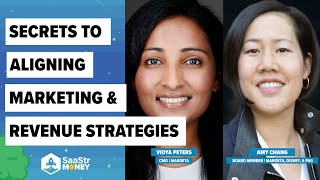
Vidya Peters, CMO of Marqeta, on aligning marketing with revenue. She led revenue temporarily and learned that marketing should own outcomes all the way to closed deals. She covers continuous strategy reviews, intent data, ABM, and how going public changed marketing priorities: quarterly rigor, employer brand, and investor relations.
Questions this video answers
August 22, 2021.
Four years.
61%.
Chapters
Hi, everyone.
Thanks so much for joining. We are closing out an incredible day here at Saster Money with a session with Marketa and we're really thrilled to have Vidya Peters, the Chief Marketing Officer at Marketa, and she's going to be in conversation with Amy Chang, board member. So we're really thrilled to have Vidya and Amy with us here for the next 50 minutes or so. Just a few housekeeping points for everyone that's joining that are joining the session. We're so thrilled to have you. We will have plenty of time for Q and A and Amy and Video would love to hear from you. So please make sure to drop your questions throughout the session at the bottom of your screen in the Q and A section. We have 50 minutes overall, so make sure we take advantage of our time with them. And then just a reminder that these sessions are being recorded. They will all be live on the SAASTR YouTube page immediately after the event.
So.
So you can definitely tune in if you have to jump off for a little while or if you want to share with anyone else after the event, we would love for you to do so. So without further ado, Amy and Vidya would love for you both to take it away.
Hello, everyone. We're so excited to be here with you today. I'm Amy Chang and I serve on the board of Marketa, and I am so excited to get this time with you all and Vidya Peters, our chief marketing officer at Marketa. So I'm just going to do a little bit of bragging about her and embarrass her for a second so that you know who she is. So she has already done all kinds of stuff on the marketing side. But what you probably didn't know about her is she recently was running revenue for Marketa as well during one of our highest growth periods and she helped take us public. Now, before that even the involvement at Marketa, she was CMO at Mulesoft for four years and she helped take them public as well.
So.
So she's our good luck charm. So I cannot tell you how excited we were that she was recently rated the number one most influential female leader in fintech as well. So I'm sure I've embarrassed her enough and we will get started. But that's just a little bit about Vidya. Now, Vidya, given you have been CMO for Marketa, but you were also recently leading on the revenue side, what were some of your biggest surprises there? Can you kind of share those insights with us?
Thanks, Amy. It's great to be here with you, especially because you are such a role model for so many women. I will do a little bit of bragging on Amy too. Jim Cramer recently called Amy one of the smartest people he knows in the Valley, which was just absolutely incredible. And it takes a lot to impress Jim Cramer. So I'm so honored to be talking to Amy today. Amy, regarding your question about leading revenue, I think the part that surprised me the most is how incredibly emotionally strong and how enduring your energy has to be in the revenue organization. The highs tend to be incredibly high. You're so close to the front lines when you close that deal that you've been working on for months through all the twists and turns. There's something very euphoric about it, and that's something many of us imagine absolutely to be the case when the deal closes. Closes. But there are so many things that happen behind the scenes that lead to incredible emotional lows. Think about a feature that is delayed that your customer has been waiting for for months. Think about a deal that you lose to say no decision. Or maybe they're just not ready to make that decision. After endless workshops and meetings and discussions, sometimes it can feel that a lot of your work is futile because it just led to a dead end. And especially because so much of your compensation in the revenue organization tends to be variable. So you tend to go with those highs and lows. And I've always been impressed with members of the revenue organization who lead with a sense of very strong emotional endurance and are really able to balance the short and long and really focus on the big picture because you can't let yourself go up and down as often as the business does with you that close to the front lines. So a lot of respect for the emotional endurance and the EQ and the intelligence on the emotional side that the revenue team has to have every day to be able to do that job.
I love that insight and it must have given you just so much more empathy for how marketing and sales should ideally be working together and how that partnership should look for a very healthy overall company. What were some of your learnings there and what have you taken back to the marketing team to make certain that you change in order for these two groups to cross functionally work best together?
This opportunity to lead revenue was such a gift because I think it helps me be a better marketing leader, a better marketer, and I wanted to share some of those big surprises and learnings which frankly were such an eye opener for me because having been in enterprise marketing for, for as many Years as I have, you kind of feel like you've seen all sides of the story, but you haven't until you've walked in those shoes. So I have a couple of slides here I'll just use to walk through. My first learning was this. And I think the statistic that I have here is very symptomatic of the issue that marketers face. 61% of marketers say that generating traffic and leads is their top challenge. You can see that this is top of mind for every marketer when they're running the business is watching those leads come in, seeing how that's tracking relative to their target, and sort of wanting that to be green and saying, okay, my job is done. Unfortunately, that is just the start of the work. Leads today mean almost nothing. And so the question is, how many of those actually get qualified into opportunities? How many of those opportunities actually progress? And so there's this whole mindset shift that needs to happen in marketing where it's not a baton passing of the lead anymore. It's really a game of soccer where the ball is being passed back and forth. And you really need a very close partnership to say, hey, the lead is now an opportunity. That's great. How are those conversations going? How can we help influence the pipeline? How can we help progress those opportunities? Can we invite them to a special virtual event? Can we invite them to. To a webinar that we're hosting where we deep dive into our platform? Can we include them as part of our customer advisory board so that they have a chance to meet with some of our customers who've been with us for years? And there are a series of tactics that we need to be bringing out from our back pocket, because it's not just about lead generation. And the job of marketing is not done till that pipeline leads to a closed deal and the ink is dry. But again, and I'll share a little bit more on that, but that's the first learning is the job is no longer about leads. The second is strategy. Yeah, Amy, go ahead.
Every single CMO CRO pair in the Valley could end. Worldwide could benefit from remembering that. Right? That one piece of information.
That's exactly right. And marketing's metric is no longer about marketing qualified leads. It's really about closed revenue for the business. And what role are you playing in helping revenue close that revenue? The second insight I had is that strategy is not an annual process. Many years ago, when I started my career in enterprise B2B marketing, the whole role was we'd sit down with revenue at the beginning of the year. And we'd say, what are the target accounts we want to go after? What are the tactics, what are the segments? And then we'd say, great, off to the racist, let's go get them. And we'll circle back in a year. Of course we'll watch the numbers together and make sure that we're tracking against it. But the strategy setting happened early and was rarely revisited. And the idea back then was if you revisit the strategy, you're creating whiplash in the organization. And don't do that. Really just stay laser focused on what you said you do at the beginning of the year and then focus on just delivering against that. The market is a lot more dynamic now, changes are happening a lot faster. And so it's not an annual process anymore. You set it at the beginning of the year. But we meet with a revenue organization on a bi weekly basis. We sit down and we look at our target list of accounts and we keep it as a living document. We say, what's working in the marketing tactics that we are seeing in the market, what's performing well, what's not. How are some of the conversations progressing? Are those still the right Personas for us to be going after? We actually believe these accounts no longer are ready for our product and our solution at this time. Let's bring these out, let's bring some of these additional accounts in. But it's a life and living conversation that needs to ensure that your go to market is aligned with the realities and the learnings that the revenue team is seeing on the ground. And that I think has been a huge learning is the conversation is continuous. It's not just a one and done. The third one is intent is the new lead. It used to be many years ago that we would just sit and wait for those forms to be filled out and we say, hey, we have a lead, we have a company that's interested here. We have so many great marketing technologies available on the market now where you can see companies searching for keywords that are relevant to your product and platform, where they're already exhibiting the need for your product. They're just not typing in your company name and not finding you and filling out the form. Bombora is a great technology that we are a huge proponent of. But again, the key here is the cross close collaboration between the revenue organization and marketing which is to say, hey, we are seeing these five companies surge in intent for the exact need that our platform serves. Let's partner in figuring out how we can reach out to these target accounts. Do we have someone on the executive team who knows the CEO there? Do we have a great board member who can help make an introduction? Maybe we should be trying SDR outbound leads. Maybe we should be inviting them to an upcoming webinar so that they can learn more about our platform and really corralling around in tech because there's nothing more powerful than knowing that there is a need. They just don't know what the answer is yet. And that's where you can come in. The other learning is closing the deal is not the finish line. Right? So we talked about how lead is just the start of the work between marketing and revenue and that's great. You go from lead to closing the deal and that's still not the end of work for marketing, which is, you know that you are not going to be successfully growing revenue until your customers are successful on your platform. So once the ink is dry on the contract, the job of marketing then is to get in there and help the customer succeed in partnership with the revenue organization. So for us, a lot of that has to do with, for example, our customers build cards on our platform, but they may not know how to drive consumption and usage of those cards. So marketing can play a role in advising customers on how they can drive consumption and usage and adoption by customers. It's also about raising awareness of other products or solutions that we have come out with. It's getting them to speak on our behalf because we know nothing is more powerful in marketing than hearing from a customer or a developer on your behalf rather than you speaking about your own benefits of the platform. And so the work needs to continue in order to create that flywheel effect so that those customers can not only be successful but also bring other great customers to our platform in turn. So those are a few of the learnings that I had from this role, particularly in the last six months of leading both revenue and marketing.
I so wish that more companies either had the luxury or had the discipline to actually cross pollinate in this way because I think having been on the technology and the product side for a long time, we massively benefit when we have to go out and interact with customers and sell actually, because it does give you that other, that other point of view. So I love that you're doing that. And just a reminder for everybody who's listening and please feel free to put in any questions that you have because as Vidya is going through all of these insights, if you have follow up pieces that you want to hear about or any kind of pragmatic advice of oh, okay, so you said this, but how did it translate for my teams? Like how am I going to translate this insight? Feel free to put them in anytime. And then Vidya, what was the biggest misconception then about revenue? Right. As from a marketing leader's point of view, as you were traversing both of these worlds.
I would say the understanding of revenue was a little bit simplistic from my point of view. I've always thought members of the revenue organization are excellent at marketing and selling, right? And that's parkours, which is you would expect them to very naturally have those skills. But my thinking has evolved in that I now believe revenue team members are almost all round athletes and you have to be in order to do that job well because not only do you have to market and sell, but you have to have a deep understanding of the platform and product, not just some high level bullets. On here are the features and benefits, but truly understanding the customer use case and thinking creatively about how your platform could help address those needs. So you have to understand the breadth of use cases and functionality that the platform can serve across industries. So you have to be great at marketing and sales naturally. You have to be great at product and platform, you have to be great at finance. Think about when you are in the pricing negotiations. I often see revenue team members actually modeling out the total cost of ownership over a year, three years and five years so that they have a deeper understanding of the financial implications of investing in the platform. They have to be very good at not just closing the deal but actually helping them get started on the platform, advising them on how they can set that program up for success once they're on our platform. I've also seen them advise them on critical hires. Hey, if you want to make this program successful, here are the types of skills that you need on your team. In fact, I know people in my network who could, who you could hire in order to make this program successful. But they also become trusted advisors over time because the revenue team members have seen the breadth of use cases and have exposure to a variety of industries, a variety of geographies and so they're able to be advisors to customers, especially our customers. Amy they don't always tend to be payments experts. This may be the first payments product that they're building. And so the revenue team members become their trusted advisors to say, hey, this is where the big risks are for programs. This is how you navigate the relationships with banks and networks. This is how I think you should design the program to be successful in Canada or in Australia or in Europe, here are all the payment rules and how they vary. And so I was just blown away by all the different hats that revenue team members had to be very adept at wearing in order to be successful at the core job, which was to sell the platform. It's an incredibly layered and complex job. And coming back into marketing, I realized that in order to effectively help and support a revenue organization, you need to be thinking more end to end. So for example, if they're trying to fill skills gaps on the customer teams, should we be thinking about training and certification? If they are thinking about finding the right tech talent, should we be leaning into our developer community and making that a resource for them? If they are thinking about total cost of ownership, when we work on pricing strategy, can we partner with them to make that as simple as possible so that if it's easy for them to understand, it'll be easy for the customers to grok. And so there's a new layer of empathy that we have, a deeper understanding of their role in order to make them successful that extends far beyond having sales, enablement, materials or great messaging or content for them to leverage.
Okay, I'm going to switch text for a second. And Vidya, whenever it's possible to get rid of the slides so they can.
See you full screen.
I think we should.
Great idea.
I want to see you full screen. So Marketo went public right About a month ago and it was an exciting and crazy ride. But how did it change the marketing goals? Now that we are a public company, what does that change and how are you thinking about this next 12 to 18 month period? Can you talk a bit about that?
This is a very timely question as we just had our quarterly marketing off site for the last two days of this week. And one of the messages I shared with the team is, let's picture ourselves like this is the first day in our jobs. Like we've all been fired and we no longer work at Marketa and we've been hired back as the first employees of the marketing team. How would we do things differently? And I think it's so important to do that because when you think about your job every day you think about an increments. What's the next 10%, what's the next 20% you can do? Very few times in the lifetime of a company do you get a milestone event like going public. It changes the nature of your existence as a platform and so it requires a very new mindset which is how should you be going to market as a public company, what's the new level of awareness that you want to generate? The reason is you get an incredible tailwind when you go public. If you look at just the traffic alone to our website, it goes up by three digits. There's just an exponential growth in traffic. You have such growing awareness, much broader than your industry, among investors, among talent across the country that now is aware of your company. You are now on the map of anyone that is thinking about a solution in the payment space. And so your job as a marketer is to not lose that momentum. How are you going to stay top of mind? And how do you bring that new level of rigor to all of the marketing that you do? And so there are several questions we asked ourselves, which is we are now not just in a free form of hey, this is a year long, right? 2021 is just a calendar year. No, now we have to think in terms of quarters and earnings calls and how do you navigate quiet periods and ensuring that your messages are integrated across channels? You're not just now the marketing department. You work very closely with the finance and investor relations departments to have one concerted message, one concerted face for the company. You also have to think about raising your brand awareness because it's not just about the platform you're selling, it's about the company brand you're selling to all of the prospects that could join you to help be part of the growth journey. As you know, Amy, we have almost 200 RECs that are open across product, engineering and various teams. And so employer brand marketing becomes a huge part of the marketing that we do. And then of course, it's also about the demand gen because this becomes a great accelerant now. We are actually much more trustworthy, much more credible to some of the largest accounts, the largest financial institutions. So how can you use this as a time to crack open those doors and those conversations to further accelerate your demand generation efforts? So we had a great off site and these are exactly some of the questions we talked about, which is now that we are a new marketing team of a newly formed public company, how can we turbocharge our marketing to meet these new challenges?
I love it. Okay, so we do have a few questions coming in from the live stream audience. And one of the questions is, what advice would you give to a leader who is taking on a new team and who's taking on a team for which they don't necessarily have extreme functional expertise? How do you make sure that you're effectively leading that team and still taking care of your current team because it's an additional.
You know, a lot of books that advise you about starting new roles, taking new roles. Talk about the first 90 days, listening and learning. And I wish I could say you have 90 days, the truth is you don't. In a high growth company that's doubling year on year, 90 days is too long to come back with your plan. I don't even know who wrote that 90 day plan book, but they must have had the luxury of a lot of time. I would say the first most important thing that you can do is ensure that your plan. You have no open critical hires. You will never be successful unless you have your critical hires on both teams that you're leading filled in because you need to be leaning on them now more than ever. So before you go on a listening tour, before you set the strategy for anything, make sure that you have your foundational leadership team in place. So if you have key vice president or director roles open, you need to fill them asap. The second, I would say, is set expectations very early on how you will be dividing your time. So I let the marketing team know that I would only be spending 40% of my time with them and 60% of my time with the revenue organization. And what did that mean? And that means a new level of trust and autonomy for the team that you used to lead. So now that you have your critical roles hired, now you can actually lean in on them and give them the autonomy to make certain decisions without your day in and day out oversight. And that's an important distinction because without that leverage, you'll never be able to dedicate the 60% of your time. Or more realistically, it was actually 70% that I ended up spending with revenue. You wouldn't be able to do that until you can lean on your team. Third, I would say is give yourself a month, not 90 days, give yourself a month to listen, learn, meet absolutely everyone on the new team as you possibly can and be just a sponge for information. And I think this is particularly important when you haven't let that function before like I did. I've never led the revenue organization. I have no functional expertise there. And so the key there is to learn, listen, ask questions and actually start to develop some patterns. Because that's the wonderful thing of not being immersed in the business is you can more easily see the forest for the trees. So as you're hearing the narrative from each person, you can start to form a point of view on here where all the strengths are in the business. And the organization. Here are the gaps and the opportunities. And start to develop early hypotheses on what you can address in your short time in the role. The tricky part is you'll never know how long you have to leave the role for. Amy, you and I talked about this, but, you know, the role was open. We were looking for great talent and we weren't sure if that was going to take us 90 days to fill or 6 months to fill or it could have been even longer. C level searches can be particularly, you know, lengthy in time especially, yes, sometimes it can take up to a year. And so I started to define what I was going to tackle in the first 90 days in terms of change and impact, and then the following 90 days. So a total of 180 days. And then you develop a different point of view and say, if I'm in the role longer than six months, then here are the next set of rocks that I'm going to tackle and share that with your CEO or your manager and get input early on. Because success is only defined when you have a very clear vision on what you are and are not going to deliver. And that clarity of communication is so important up front. And so there were some difficult conversations with Jason, Amy, and you and I talked about this, where Jason wanted to see everything done as he has a very strong urgency for results. And we had to draw that line in the sand to say what was realistic to be done in the first three months versus six months and what could happen further. So that would be my advice, is first ensure your critical roles are filled in, be very clear on how you're going to be spending your time. And third, listen, learn, and then declare what you will address and spend your time on. You're not going to be able to solve everything. So declare what you will solve, what you will address, and get alignment on that early so that then you have a clear map for how you're going to spend time in that new role.
I think there's so many insights from what you just laid out as somebody who is leading a global team from Europe when it is headquartered here in the Valley. Because the thing that was so striking to me when we first met was the level of discipline and transparency and communication that you had to bring and the amount that you had to trust and kind of find very strong leadership to delegate to for the things where you just can't do it all as one person. But you are a really phenomenal exemplar for that because you're actually leading this team both Teams for a period of time from Europe, which is time zone wise challenging. So it was so striking and I've seen a lot of this put into practice with your teams. Were there any other pieces that you would advise people given we're all working globally, we're all working, you know, still somewhat in Covid conditions around the communication or around kind of making certain you hire certain types of leaders. What else would you share with with these folks?
I think being nine hours ahead of the Bay Area time zone presents its own challenges. It creates a small degree of overlap in terms of working hours and meetings. And it was an incredible school or crash course in prioritization. And I will say this, which is hiring is your most important job. And if you do hiring well, then it makes it infinitely easier to do the rest of your work. And most people shortchange that. And I think that's the biggest mistake that people make. If you're not getting the leverage that you need, start back on hiring. And I'm not sure if I've changed my hiring philosophy given the geographic changes, because some of the talent and some of the attributes I still look for are self driven, high trajectory, high accountability, works autonomously. These are important no matter where I would be based. But they became a very critical testing factor, especially when I moved to Amsterdam last year to be closer to family. And one of the things I realized is it taught me really well to just say no to a lot of things. And your success in your role is not dependent on what you say yes to, it's what you say no to. And you have to say no to a lot of things because a lot of crap gets thrown across your desk all the time and not out of ill will because there's so much happening in a high growth company and you have to be able to sift the rocks from the pebbles and the gravel and really ensure that you're focused on the most important issues at all times. So my advice would be this, which is lead with trust. There's a reason you hire a high performing team. Be very clear on goals and outcomes with that team. That will allow you to then get out of their way on the day to day, but be available to them when they need obstacles removed or when they need clarification or help. And that allows for them to then step up into a much higher level role than you would be if you're working side by side with them, which I've always found to be a waste. Right. Why hire great people and then do their job with them? And so Autonomy with very clear goals and accountability is always a wonderful recipe to then free you up to be able to do more. Second, to say no as much as possible. But that only starts when you have a clear vision of what you're trying to achieve. So it comes back to what we talked about earlier. Set the vision for what success looks like because then you'll know what you need to say no to. If it's not moving the needle on these five or six issues, then it's not going to be your priority. And third is check in. Make sure that those goals that you set are having the impact that you expected right when you're starting a new role. I may have hypotheses, I may be wrong by 90 degrees. And so let's course correct maybe I had a hypothesis that this initiative was going to move the needle for the business in a certain way and it's just not panning out because there was, you know, a product market fit as an issue. And so then you can course correct. But the only way you'll do that is if you hold yourself accountable to metrics and gauging whether you're making the impact at the level that you thought you would and then come back and say, you know what? I thought these would be my six priorities, but I actually want to change course because of the learnings I have at market.
Love it.
Okay.
Love it, love it. And we have a lot of questions coming in here, so I'm going to start rapid firing some of them at you. When does brand marketing start to work? How do you know it's starting to work? And how do you know how much of your budget to put there?
I love questions about brand because, you know, prior to Mulesoft, I was at Intuit where we had a massive budget for brand and we ran brand surveys to measure the awareness of the brand, how much we were moving the needle every year. We had a big budget on ads spend. When you come to a smaller, higher growth company such as Mulesoft or Marketa, you don't have the dollars. You have to make every dollar go really far. And so you're not going to run a brand survey for $100,000 to see how your brand is doing. You don't have millions of dollars to run a brand campaign. And I would also say in enterprise B2B marketing, nor should you. You are not targeting everybody in enterprise. My mom should never know about Marketa and I really shouldn't be spending a single dollar trying to reach her or any of the consumers. So know your audience and ask who the brand should resonate with, who should know about your brand and then find the scrappiest, the most creative way to get there. And so what we use for brand, we have a very clear vision of the customers we go after, which are large, disruptive, high growth enterprises. And we absolutely focus on growing brand awareness with them through account based marketing, through social channels, through LinkedIn, through Twitter, and through very targeted campaigns, through demand based. And then it's important that we measure, we measure it through some of the social listening tools that we have. We look at the number of mentions that our company gets, we measure the sentiment of those mentions, whether they're positive and neutral versus whether they're negative. And we measure those over time. You can also measure direct and organic traffic to your site. Not all traffic, but direct and organic tends to be a better measure of how your brand is performing and whether that's growing year on year. And for a high growth company, a minimum growth that you should be seeing is 100% year on year growth in direct and organic. And if it's not growing at that rate, either you don't have the right content on your site to draw the right traffic, or you're not doing enough in social channels or in online channels with your target audience to draw that relevant traffic in. So those would be some of my suggestions. In terms of brand, be very cautious of spending a ton of money in ad campaigns that are just brand focused on radio or TV, especially if you're focused on enterprise B2B.
And we have a bunch of developer related questions as well. So what's the role of customer marketing and post sales marketing in developer sales? Right. And if you want to give 60 seconds of context in terms of how market interacts with developers, that might help them too.
Every company is different, but at Mulesoft and Marketa, I never sell to developers. Developers don't like to be sold to. And the moment developers hear marketing or sales, they run in the other direction. So I've always focused on winning the hearts of developers, not the minds. The minds we focus on the C level suite or the buyers could be the cfo, the head of payments, could be the CEO. For developers, I focused on how to make them successful, helping them learn new technologies, helping them connect with other developers, helping them solve their problems through great documentation, access to great tools so that they can be more skilled, more efficient with what they're doing every day. They do not care about your sales motion. They do not care about your marketing motion. They do care how great Your technology is, and that's what we always focused on. So I would say if you have a developer marketing program, scratch that. If you have a developer sales program, scratch it. Because the moment you do that, you'll actually repel them. The question I would ask is, do you have a developer relations program? Do you have a community program? Do you have a developer experience program? Those I think will really move the needle for the business. So then if you can create a bottoms up motion where you are creating love and affinity for your brand with developers by focusing on the tools to help make them successful, you then earn the right to have a sales conversation with someone else at that company. Because I guarantee you that when you reach out to that person to have a sales conversation, they will turn to the developer and say, hey, have you heard of Marketa? Have you heard of this technology? What are your thoughts? Developers are the secret shoppers at every company and so you will be remiss to not cater to their experience to their success.
I love it. And then how do you pay sales reps, right, for API type deals or developer focused kind of enablement deals that scale over time but start tiny large.
Portion of their compensation is variable and tied to outcomes. So the outcome that we care about is the success of our customers. It goes back to the point I mentioned earlier, which is the work is not done when the ink is dry on the deal. That's often the start of the work, which is building the program, scaling the program with them, making it successful. So our sales rep compensation is tied to the ultimate gross profit on the deal and ensuring that not only is the program scaled, but priced at price that value. Right, because you can also scale a program by really cutting down the price and giving it away for as cheap as possible. But this ensures that if you're tying it to the gross profit of the customer over time, that you're tying it to the right incentives that balance the customer success, which is shown by the volume of the program, but also a healthy enough margin so that it's sustainable for us to continue to serve those customers.
Okay, and then there's an adjunct question of are annual contracts a friction point for developer centric sales and marketing is pay as you go best. I know this is a tough one.
I love this question. Important one, it depends if you have open source routes. So if you have open source routes, then pay as you go is a great way to start because you're really affecting a bottoms up motion where you want developers to get on your platform to love it, to be able to use those tools to be able to deploy the programs. And then once they hit a paywall of a certain amount of consumption, that's when the payment kicks in. And I've seen the model and we have lots of open source models that have been successful on this, which is then once they hit critical paid volume, then the enterprise contract kicks in and then you try to bring them to an annual contract. At Marketa, it's a little bit different because of a lot of the regulatory requirements. You can't just have anyone build on the platform and deploy on a pay as you go model. There's a lot of KYC KYB requirements, which is know your customer because of the orchestration of cardholder information between banks and networks that we have to orchestrate. So for us, we believe we tie our contracts to the volume that customer runs on our platform. And so we succeed when our customer succeeds. So we don't have say an annual fee and it's an all you can eat. It's more around as you build and you see success on our platform, we build based on that. But of course these pricing models vary a lot based on business. But that's the way we have found success here at Marketa.
And then when do you bring sales into a developer centric environment? When is it useful? When will it not repel, for example, but attract the other the buyer that you're actually trying to pull in?
At Marketa and Mulesoft, we never sold to developers, so we ensured that they loved the technology and the platform, that they enjoyed it, that they brought other developer friends to it, that they had great word of mouth, that they create a community where they could all be successful on it. The sales conversations were had with the CIO or here with the head of payments or the CEO. There are other models I'm currently on the board of Influx Data and they have a wonderful model where once developers are successful on the platform, they watch the data and as they watch volume of consumption among developers, they actually reach out to them and say, hey, we're seeing a lot of you from this company use this. Would you like to formalize and enter a much larger contract? That way we can actually evangelize the usage of this on a much broader scale and give you cost economics to make this more reasonable for you across the company. And so I've seen both of those models work. It really depends on your product and platform and your go to market strategy and whether the developer is the buyer or the consumer of your product. Perfect.
So we've got A question around even more best practices to make marketing and sales work better together. I think a lot of people are interested in hearing kind of even a deeper level of insight than has already been discussed on what can make the two teams work even better together.
A couple of new areas that we have kicked off is competitive strategy, which is a wonderful way of very closely partnering marketing and revenue even more tightly together. So for example, typically you may see competitive intelligence sit in marketing and it's very much a one way street where, you know, marketing does the analysis and sort of shares it out with the revenue organization on a monthly basis. You know, here are the features and functionality, here's a battle card, here's the news, here's the messaging. But what we're actually finding is that in such a dynamic market, we actually want revenue to feedback intelligence, which is what are they seeing on the front lines of the deals? How do they win in a particular deal or scenario? Can we actually productize that intelligence into something that other members of the revenue organization can use that can make our marketing better? Because it's, I mean, you're right there in a sales deal and you used a certain approach that helped blow all the competition out of the water. We should bring that into marketing. That actually is something we should be leading with. So competitive strategy is a great area of close partnership again between pricing and between revenue and the marketing organization developer community. So we are in the process of launching our first developer community and it's a great way to have the sales organization recommend the developers of customers of prospects that they want to see in the community. Now we protect the community so we don't have sales members selling in there, but we want to ensure that we're keeping it as open of a funnel as possible and having sales teams recommend the developers that should be part of that community or could benefit to be a part of it, and then ensuring that if those developers go on to become ambassadors and huge advocates of our platform, that perhaps they could even be customer advocates for our sales organization. Because as you know, developers really don't like listening to marketing or sales. They love listening to other developers. So if you have won the hearts of developers in your community, can you get them to speak on your behalf at an event, at a webinar, to confidentially to a customer account and speak about their experience on the platform. It is so much more powerful than any case study I can write or any marketing page that I can put up on my website.
Okay, let's turn to account based marketing for just a second what have you learned about ABM from both sides of the org, both for marketing and sales.
ABM used to be this really cool thing that people just dropped in conversations. Are you doing abm? Yeah, I'm doing abm. ABM is great. And what I'm finding is that it's going from a nice to have like this really cool approach to now just table stakes. And there are three layers that I think about in terms of marketing. There's one which is just protecting your turf. That is SEM, ensuring that you're owning all the keywords in your domain. Something as basic, no one else should be bidding on the market keyword except me. If I let that go, my competitors would be all over it. So first, own your domain on search engine marketing. Second, master your SEO, which is ensure that you are the absolute thought leader and expert on everything in your domain so that you're getting all the most relevant traffic. But those are almost plug and play. Now they're just table stakes, part of the marketing, allowing you to then say 20% of my marketing goes there. 80% should be focused on ABM, which is don't be just fishing in the ocean. Oh, I got a lead. It's some lead. Oh wait, it's shoe. I didn't even want that lead. But really the shooting in a barrel, which is identifying with sales. What is a great target account look like? What is that universe? What's the Persona we want to go after? And let's use all the greatest marketing technologies that are out there. Engage your demand based Bombora and Terminus and go after those accounts with a laser focus and hold yourself accountable to it. And know that especially when you're talking about account based marketing, one lead is not enough. If you're going after, say an account like Amazon, you need multiple doors to be opened within that account at multiple levels in order to start a movement, in order to start a conversation there that actually would lead to a successful opportunity. And so ABM is where I would spend the majority of my marketing demand generation resources in order to be most effective. Okay. One last advice, Amy, I would give on that is technology is so quickly evolving in the marketing tech space that what worked for ABM three years ago doesn't work anymore. So ensure that you're taking at least one new ventricle every couple of months to keep yourself abreast of what's new and what's cutting edge. Because it's incredible what you can do with more tech today.
I love that. Okay. And then many marketers are resistant to Quote lead commitments as a dated metric, but are they really wrong? Don't they hold marketers feet to the fire?
Yes. And lead commitment you have to do that's just table stakes. It's a little bit like showing up to work, but the quality of the leads and whether those leads turn into opportunities, whether those opportunities actually close, is where the rubber hits the road and it comes back to that original point is, you know, a lead is a lead is a lead. It just doesn't matter. Was it the right title? Was it at the right altitude? Was the topic relevant? Were you able to connect them to an sdr, to an AE for a fruitful conversation? Were you able to then bring them through a set of marketing initiatives, content events, to progress that opportunity until it closed? So, yes. And the demands of marketing are only going to increase as we get into more complex sales processes, as we get into longer cycle times for deals, as the deals get bigger. And, and which is a great opportunity for marketing, which is our job will continue to stay interesting.
I love that. Can we go back to the team for a second? There are a few questions on how do you build trust with the team again, that you don't have as much functional expertise with and you have to do it almost instantaneously. Were there pragmatic things that you did just coming into the role that really helped kind of foster that trust really immediately?
It's asking about where you can be in service to the team. And this is really important. Many leaders come in and think the idea of leadership is to go in and to say, I'm savior. I'm going to do this job better than anyone else. That's not the job. The job is to be in service to the team and to help make their jobs easier so that they can do what they do best, which is go close a lot of deals. And so not only listen and learn, because that's a taking job, but in every one of those conversations, ask what can I do to make your job easier? And you'll be surprised at the ways in which you can help. Because the list will be, hey, I actually have a really hard time hiring for this role. And then you can say, you know what, I'm going to like, ping my network. I'm going to see if I can help you hire for this role and fill this role really quickly. It could be, hey, I'm having something stuck with legal and finance in this way. I'm not sure what's going on. And because maybe there's not been a leader in that role For a little while, that's what they needed. They needed an executive who could go have those conversations and be able to remove boulders out of their way. It could be a question to say, hey, I have the CEO of this account and the account is just not progressing. And you can actually say, you know what, I'm going to ask our board member to join this call. I'm going to ask Jason, our CEO to join. We'll be there. We'll bring all of the forces so that you have the support of this deal to unlock it. And so always ask what you can do to help and it'll become very clear to you how you can add value without having the functional expertise. And I think just having your mindset change from you're the savior with the cape on to really being you're there to serve them so that they can be successful will open up so many ways for you to be a productive leader of a function that you have no functional expertise in.
Vidya, I'd love all of the leaders on this call too to know what you were doing to support your leaders, like your most high potential folks on your teams right now, what you regularly do to care and feed and win hearts and minds for all of them.
I think the first important thing that you have to do, and this is table stakes and a lot of people forget this part and then they go straight into career development. But the first important part is ensure that you have defined the role for them in a way that, that is not only meaty and challenging, but in a way for them where success is clearly defined. Right. That is the most gratifying part of someone's job is when you have a clear line of sight to what the goals are and know that when you achieve them that you have done well in that role. So clearly defining it, there's nothing more frustrating than feeling like you are a hamster on a wheel working incredibly hard and going nowhere. And so invest the time to clearly define someone's goals and measures of success so that they feel that when they achieve that, that they have excelled in that role. That's 80% of what you need to do first as a manager. Then I think comes the next level, which is to ask them about what more would they get energy from, what more are the areas that they could learn and grow from. We have something on the marketing team called a 10% effort, which is 10% of your time can be dedicated to a passion project. Maybe you are in product marketing and you want to learn about demand gen and you take on a project to help you develop those skills so that you can be a more well rounded marketer. Maybe you want to spend 10% of your time working in a completely different function. Maybe it's in the revenue organization or maybe the product organization. How do you create time and space for someone to be able to learn and stretch and grow in ways that they may not traditionally get from their current role? We have someone on our team who loves to spend time on culture and some of the coalitions that we have here at the company to make Marketa a great place to work. So it's really about their passion project and really nurturing those. And last but not least, ensuring that they get visibility. You'll be amazed. I think a lot of managers feel like they have to represent the work of their team and I think it's such a missed opportunity. Have them be in front of the company, let them shine, let them show their work, whether it's to the board, to the all hands at a quarterly business review, because then not only are they doing this great work, they have a chance to talk about it, to shine with that work. And I think those three have been some of the cornerstones of what I have found to be most helpful leading a team.
I love that. Can I add one to that too, that I've over the years matching them with external folks who can mentor them too, from your network, because you have a network that they don't have access to normally. Opening that up and making certain that they have external people so that they can get those other perspectives, I find has been something which people really value and over the years really come back to as something that we can be doing for them.
That is such a wonderful idea. And especially your network, Amy, your network's got the who's who of Silicon Valley. Anyone would be lucky to be plugged in there.
Yours is pretty phenomenal. Well, I'm going to ask one last question from the audience and then I think we're out of time. So thank you everybody for tuning in. So there is someone who is asking, she's very curious about how you learn the leadership skills you talked about.
It's by making a lot of mistakes. It's by watching leaders I admire and emulating and copying behavior and saying, that's something I've loved about that leader. I'm going to try and do that more. It's about trying some things and missing it completely and then remembering how awful that felt for you, for the person that you were trying to do right by. It's about Acknowledging that with that person and rebuilding it from there. I think that there are many books on leadership, but the only way to do it is to go out there and take as many swings at the bat as you can, because only then do you get a feel of how to get it right. And so I would. My advice to you would be is don't shy away from leadership challenges or opportunities go their swing because you're going to miss every one of those swings, especially when you don't take it and surround yourself with great leaders that you admire. It's the number one thing that matters to me when I choose a job is do I really admire this leadership team? Could I learn from them? Could I feel like I want to be them? I want to emulate them. Because when you surround yourself with these people, you grow. You grow and learn so much and then, you know, get right back up when you fail. Because everyone fails.
I love that. Well, thank you everyone for coming today. We're so excited that we got to share this time with you and Vidya, thank you for sharing all the insights and thank you for being really open and transparent and having pragmatic advice peppered in with, you know, kind of all of the more theoretical pieces you've learned too, over the last, you know, years. Thank you.
This is a blast. Thank you, Amy. Appreciate it.










