Shipping Enterprise AI Agents with the CPOs of Rubrik, Glean, and Harvey
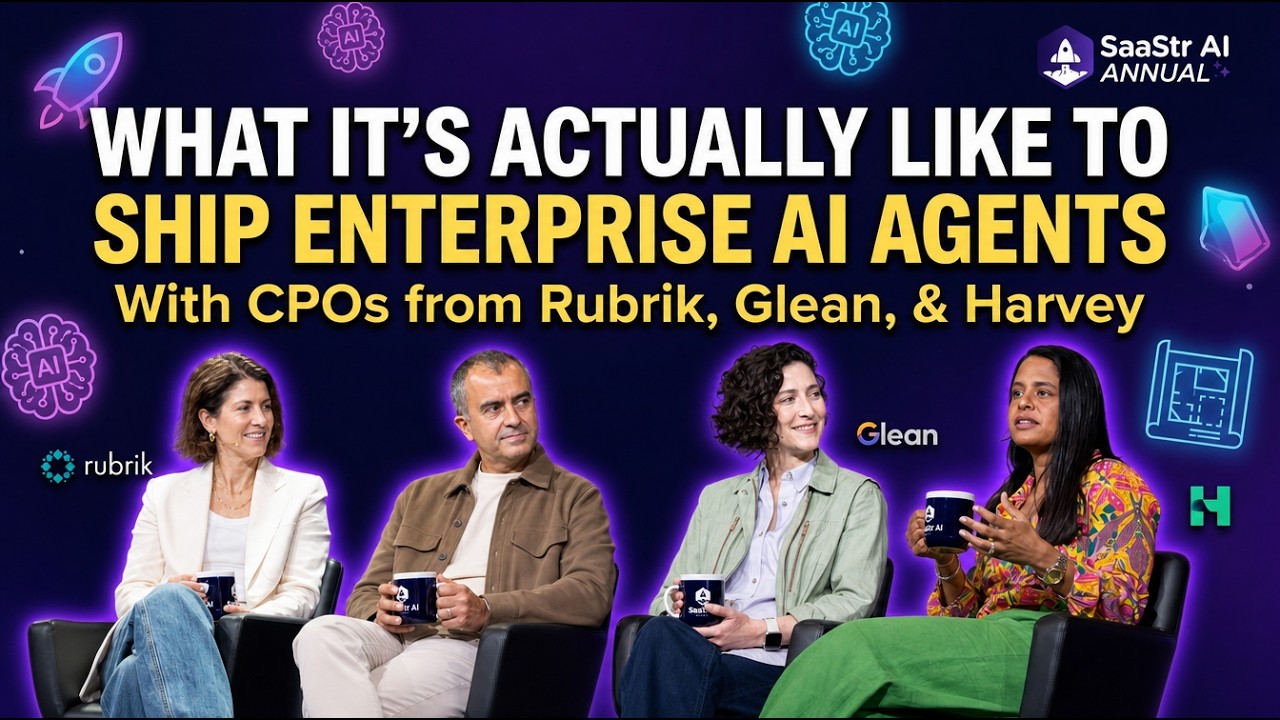
Rubrik, Glean, and Harvey's chief product officers discuss shipping AI agents to enterprises. Rubrik moved from a help bot to a fully agentic platform for cyber-recovery and capacity planning. Glean built an agent that pulls data from systems like Gong and writes insights into Salesforce. Harvey pairs software engineers with lawyers to build and verify agents for legal work like document drafting and discovery.
Chapters
So you're moving to an interface where I can chat and talk to everything in Rubik, which I love. I, I just, I, I can't learn another UX.
Yeah.
I'm just done. I can't do it. So I, I love that you're pulling all the data so that it, so that I, I don't have to have an analyst to figure this out. I can get access to any data. You're just beginning making that actionable through an agent. I could ask a lot of questions, but one is, As you spin up these agents to take core actions, right? Will the customer do it all? Will you have forward-deployed engineers help them? Because they want that agent that's gotta work, right?
So yes, there has to be some human in the loop to— ideally where we want it to be is that the human in the loop is approving the plan. I mean, at the end of the day, we're still responsible. Even when, when a customer makes a mistake and something isn't working, they blame us and rightfully so. They should. It's our responsibility to make it obvious what the right choices are. And today people do make mistakes because there's so much complexity in setting up our product.
Yes.
And people are gonna make mistakes more than agents if we build our agents with the right guardrails around it.
This is an exciting, exciting session. We ban panels at SaaStr for a year because they're boring and people talk in a line that's nothing. But if folks are friends, it's pretty interesting if they know each other. So that's the only exception we make. So I think we have, we have a special panel, I think, of friends, and we have what I think is the single most stressful job today in B2B is being a chief product officer. For, I think for 10 years it was a great job. You'd bring your mug to the office and you'd tell your team, what are we gonna ship this year?
Mm-hmm.
And you'd kind of, you'd do some Kanban and you'd spread what you're gonna build. Oh, we'll, we'll push this one to next quarter. We'll, Jason wants this. Let's just tell him it's coming, but it's never coming. That, that was like the job through 2024. Okay. Honestly, you think I'm kidding, but now, uh, we have, this I think is the hardest job because Everyone here knows we're under the gun to ship agentic features and ship AI, and it can't just be for fun. And we have leaders here. We have Rubrik, one of the most successful IPOs in security last 12 to 18 months. We have Glean, which is one of the early breakout leaders in AI for managing data inside your company. And we've got Harvey, which, you know, comes out of nowhere, what was a small, sleepy market and disrupting it. And so it's great, but it's so stressful because If, if you're, if you're even slightly older, you need to get an agent where you'll own the market and not be disrupted. Even if you come outta nowhere like Harvey, Anthropic's got new features. The, the amount of innovation in legal is 50 times what it was 3 years ago, I would say. So this went from a great cush job with a big team. I think I'm being facetious. Would you agree that maybe the most stressful job because Everyone's like, what are we shipping now? I need, I need, and I don't just need AI, I need something I can monetize. I can monetize. And if you look at the public stocks, there's a group that have, that have gotten a big boost in the market. Atlassian just launched. They finally were able to really monetize their AI agent and it's crushed. Their stock's up 30%. Others are still figuring that out on the journey. So that's my rambling preamble to, from the cushiest to the most stressful job. I mean, a little facetious, but I genuinely believe it. So, We're going to do something because we've got a great group. We're going to, we're going to first talk about what everybody's building today as an agent. We're going to talk a little bit more about what agents really mean. If you were here when I was with Amjad, the CEO of Replit, he said it's about the loosest defined term there is. We're going to talk about that. Then we're going to do some quick demos and then we'll go through a few other things. And if we have time, we'll take questions for folks. But, uh, but let's talk. I think it may be a few of us, but what, what do you, what's the latest? And the demo will— I'm going to skip ahead, but the demo for Rubrik is super interesting because in security, not like I can hack anything I want at SASTer. We can spin up a parking pass agent like we did for this event 3 days ago, and it's not that much sensitive data. It's okay. You know, Rubrik, it's not okay. It's not okay for your agent to accidentally leak some sensitive data or to create a little bit of a hole in your application. So what's the agent you're allowed to build and that you're building?
You're listening to the official SaaStr AI podcast, brought to you by— Hey everybody, starting a business can get expensive fast. Website here, email somewhere else, business phone with another provider. Northwest Registered Agent gives you a complete business identity in one place with free tools, resources, and built-in privacy from day one. Get more at northwestregisteredagent.com/saastrfree. That's northwestregisteredagent.com/saastrfree. Saastr Free. Saastr Free. Hey everyone, if you're listening to The Agents, then you need to be at Saastr AI Annual. We'll be back next May in 2027, the world's largest B2B and AI event, May 11th and 12th in the San Francisco Bay Area. Look, most conferences and content these days are about what's possible. As you know from The Agents, we're all about what's happening now, the latest and greatest, and that's what we do even more so at Saastr AI Annual. See the actual work where we bring together 10,000 founders, revenue leaders, and VCs, plus 200 of the very best speakers showing you the playbooks of what's already running in production behind the scenes, deep dive demos, and so much more. Plus over 5,000 scheduled one-on-one meetings so you can actually meet the people doing all of this, not just hear from them. If you're a founder or revenue leader, or you're the one who has to make this all work with agents, this is where you want to be. You already know this from listening to the agents. FastSaster AI Annual. 2027. Go to sastraannual.com and use our code THEAGENTS for a special discount on your tickets. See you there.
When we look at our product, so Rubrik is in the space of cybersecurity, but we really focus around cyber recovery. So, how do we help organizations recover their data, applications, identity after they've already been hacked? And we, we occupy this place where our customers are relying on us to provide this core service. So, nothing we can do can take the core service down. And when we think about delivering agentic outcomes, we're focused on, well, how do we take the amount of time that someone is spending managing our services and our product down to close to zero, where they just say, let me define my intent, we'll deliver the outcome. But the challenge with it is how do we do it in a way that is super, super high accuracy and where we're preserving that trust with the customer? Because if we give them the wrong recommendation or we take an action on their behalf, that impacts their, their production applications, then they're no longer going to want to be a customer of Rubrik. So that's been the focus. It's been actually a much more challenging problem to build agents within our product than I think I thought it was going to be a year ago to really deliver those outcomes.
Yeah, got it. Okay. So, so Glean is interesting, right? When we look back on the old days before Quad 4 or 5. Remember back then? It was a while back. I mean, Glean was one of these ones that broke out when AI started to break out, right? I mean, I'm not a total expert, but it solved a big problem. How do I access internal information and others?
Yeah. Right?
Whether maybe today we call it a prompt. I think even when Glean took off, we weren't even calling it prompts. It was just search, right? And how do I— I have this trove of data, I can never find it. But man, I can only imagine what customers expect of you in 2026 is an order of magnitude more. Than even like Q4 last year, right? So is that right? And what does that mean for your very latest agents?
Yeah, love it. So Glean started about 7 years ago. So when retrieving information, retrieving context was the key jobs to be done, like it was the most visceral to become a better knowledge worker. That's what you needed.
Yes.
So like fast forward to today, retrieving information, retrieving knowledge is part of the job, but The whole world is moving from like getting informed to actually performing, like getting AI to perform for you, et cetera. So what is not— a lot is changing there, but what is not changing is the superior context that you have, all the tacit knowledge, idiosyncrasies, specific unwritten, like, ununderstood information that you have in the company.
Yeah.
The better you establish that context, then you can get the perform piece done by AI rather than you as a full jerk. So, and it's not really solved as much on the context, you know, I talk to, like I use a variety of AI front doors including Glean Cloud, et cetera. But most folks I talk to, if they're spending, let's say 5 hours per day in front of an AI assistant, they're spending half of that time in quote unquote building context. Hey, I am feeding documents, I am feeding my decisions, my patterns, et cetera. So the thinking here is for AI to operate at its max, then you need— like, you shouldn't be actually spending as much time building context, building skills, updating your memories, et cetera. So that's where Glean comes in. On one part, you can use Glean as the AI assistant, as the front door, but also Glean actually serves the system of intelligence as a single MCP server if you want to use your own favorite AI assistant like Cloud Code, Cursor, Codex. where instead of tapping into individual MCPs, like these harnesses would tap into Glean to get the full and superior context to get the job done there. So Glean is now operating on these 2 angles. You can use Glean in the UI or you can use Glean as a system of intelligence.
What percent of folks are using Glean in the cloud today instead of using the app?
It's, I mean, if I bundle all of the cloud Cursor Codex bundle, it is one of the Fastest growing parts.
Yeah.
And definitely faster growing than the UI of Glean, which is still by a large margin a very high daily engagement driver. But the interesting thing is the more that usage happens in Clouds of the world, it actually has spillover effect back into Glean. And then we'll get into some examples of it, like how do you build agents that are not just for yourself, but for your entire team, for your entire department? Et cetera. So it is kind of an unexpected spillover effect that brings users back into other Glean UIs or assets or agents to use them in different parts of their work life.
So in a way, also, if using Glean in Claude and others is blown up, it's almost like a super memory too, isn't it? I mean, there's only so much data you can access inside of the LLM, right? It's not just MCPing into it.
Exactly.
It's taking, it's, it's taking the LLM and giving me memory across everything across my organization that's relevant to me, right?
And the, the key thing is MCP, as much independence as it brings, it's a very runtime fetch of information. You are bound by either latency or you are bound by the search APIs under the hood provided by the teams.
Yeah.
So it's a very different paradigm than you rely on high compute, offline processed information of connecting the dots between different employees, teams, projects, subsidiaries, organizations, companies you might have acquired. or the last decades, et cetera, and processing them offline to actually develop a superior context and understanding of the real-time pulse of the organization. They are very different paradigms, and then they can be actually very much supportive of each other. How do you use real-time information in runtime with superior offline processed knowledge or intelligence?
All right, and so, Anik, are you— so are lawyers asking for agents?
Yes.
Lawyer, your average lawyer that's not at the bleeding edge, that's not here today.
Average lawyer. Look, I think the legal practice— so where does Harvey serve? In like the mid-market enterprise, we're in 60-plus percent of AmLaw 100, we're in Fortune 500. You're basically talking about like elite athletes or like the lawyers at these law firms.
Yes.
And, you know, the internal teams working at these large corporations. Like, it's been a really fun, like, customer to have because they are super intelligent, incredibly curious. There's a real competitive spirit to what they do just inherently, right? Because they're, you know, selected for their judgment, their strategy, how rigorous they are, how right they are.
Yeah.
And so I think because of that, you just have a very curious base. And I would also say that it's fast. So, when I joined, I, I probably talked to, I did a listening tour with 60 customers and they're like—
Before you started?
No, my first 6 weeks. I was like pretty militant.
I was gonna give you the best diligence process.
I know.
For taking a role ever. We were gonna make you leave your poster job.
We were gonna prove out that we're hard workers.
But at least you did it right after you started, right?
Yeah, yeah, yeah.
That's my number one thing for a head of product. If you're not out talking to customers, show them the door, right?
Yeah.
Yeah. But one of the things that was really interesting is it was like, you know, when we first started partnering with Harvey, it was because I wanted to have, you know, the lawyers on my team using AI safely, using the right knowledge sources, using LexisNexis, you know, being able to have rich citations, all of these things. And now fast forward a year and yes, I'm talking to litigators that want to talk to me about our agentic capabilities. And how should they be leveraging it? How should they be using with their team of associates, et cetera? And I'm not saying that 100% of our customers and end users are there, but do I think that there is a real curiosity and demand for agentic work to support them? Yes. I would also say there's a real demand for how do I leverage agentic work really safely? So what is the verification process? Can I actually verify someone else's Agentic plan?
Right.
So if I have a more junior lawyer supporting me, can I verify their work?
Well, let's walk through that, 'cause that's interesting, right? You've got a, a partner reviewing an associate's work, or what's the workflow there?
Yeah, that, that's an e— that's a simple workflow.
Yeah.
Right. Right now, Harvey is partnering with schools of education, right? For, with law schools. My cousin is in law school at USC. It is incredibly top of mind on how do you grow as a lawyer, how do you become dominant in the field and learn the practice while also leveraging AI.
Yeah.
If I am an equity partner at a firm, how do I coach up-and-coming associates on how to leverage AI, how to leverage it safely, how to verify? But specifically with the workflow we're talking about, it's Okay, so I'm getting the work output from my associate. Do I have the opportunity to not only look at what the prompt was from the associate, but can I also look at the plan? And so it's, it's a really interesting problem.
A plan for a legal brief or for a document? Because there's a lot of different legal matters, right?
When I say a plan, I mean an agent plan, right? An agent is just the way that they are in coding models, right? They're receiving a legal prompt, they're writing a plan. That plan is, you know, being approved or customized. And do I agree with that process that ultimately created the output? And how, from a product perspective, can we make that loop very efficient? How can we make it collaborative? And like, I wouldn't say we're doing all of it perfectly today, but is that the direction we're going in terms of agentic work? Yes. So going back to your question, do I think lawyers are asking to leverage agents? Do I think there's a real appetite for this? Absolutely. I actually would say the conversations are one step further, which is let's assume we're using it. What does it mean to collaborate with it? What does it mean to coach with it, performance manage with it? What does it mean to verify? And it's— yeah.
Just 2 things I don't want to do. I want to move on to the next topic. But you've got senior partners at law firms, one of the last 2 bastions of the ThinkPad and the red nub, orange, whatever color it is, this and accountants. They're very smart and very intellectually curious, but not necessarily at the bleeding edge of technology. They are today creating prompts for their— having their associates draft prompts that they then review and then edit and commit to, to an agentic workflow. I, I, I'm, I'm just cur— that is such— it, it, it may partially explain the massive disruption in the legal industry, but that is such a, a different change.
I, I think it is.
The dictating tone, right?
Firm to firm, practice to practice.
Yeah.
These are unbelievably prestigious firms, right? And the legal practice is so respected, so important. And so I would say that everyone is finding their own path as to what this looks like. But is there appetite for this capability?
Yeah.
So when something comes up around diligence or discovery and AI is actually really good at finding, you know, those needles in the haystack, reviewing a wide volume of documents in a very consistent manner, flagging that for then human-in-the-loop review.
Yeah.
Do I think there's appetite for that in an acknowledgement that the tools to be really continue to be excellent at your job have evolved? The speed at which you can now deliver those outcomes has probably become much faster because of AI. Yes, I do.
Yeah. Yeah.
All right.
Well, let's, I wanna do our demos and then let's talk about some other issues, especially around guardrails and how to manage these agents. I just think, I, I think the legal challenge is even, I think what Harvey's done is even more impressive than others because forget about that it's legal. Security's harder, even harder to sell into legal, I would argue. But partnerships pay outta their own pocket. Let's not, when you sell to partnerships or private equity or venture capital for a, they're, they're reaching out. It's one thing if I'm at Rippling and I gotta get a few bucks from Parker. I mean, maybe he's, he's cheap. Okay.
But like, have you tried to do that with Parker? I've known him a little bit over the years.
I'm, I'm being, I might I know you have to, you have to argue for it, right? But ultimately you're not taking money out of his personal pocket when you go to a law firm. And what, I don't know what the biggest Harvey deal is. Let's imagine it's $20 million, $30 million a year. Okay. That's gotta come either from another substitute tool, like I'm taking that on my other budget, right? Or the partners have gotta say, this is why it's so impressive. There's so much ROI here that I'm gonna pay $50 grand, $100 grand outta my own pocket when I, I kind of wanna use it on the house and the Cape. I, I was kind of looking at that Roma Ferrari and I know I'm not supposed to drive it to the office, but maybe in the Hamptons I could. I mean, I'm being facetious, but this is traditionally one of the many reasons technology's been slow to law firms is there's so many things in theory you could buy. But I gotta, you know, you wanna pay for yourself. So I just think that, that, that it's more impressive the rate that it's scaled than a budgeted technology budget where it's, it's just a line item for the, for the CIO or the CFO.
I also think realistically there's also customer demand.
Right.
If I, you know, let's take for example, I, I wanted someone to review an employment contract for me, I would probably expect them to partially leverage AI at this point. And so I think it's also, there's just this massive shift in society that no one is, is protected from, right? Because us as consumers are now expecting.
Yep.
And when I say consumers, it could be a company or it could be like I, as an individual user.
Okay.
All right, good. All right, let's see this. Can we try to roll the rubric demo? It is interesting because it's gotta work, right? It's gotta be safe and secure. Let's see.
Okay. Yeah, great. So we're gonna pull up this, what we call Ruby, which is our AI agent for operating our platform. So when we think about the future of Ruby and where, where it's been is like we started this system as essentially like a simple RAG application where we fed in all of our documents on how to set up the product, how to troubleshoot. And people could ask questions and get, I would say, you know, okay answers based on whatever we had in our documentation. What we have con— like what we have worked on over the past year to fundamentally change is truly to make it agentic. And what that's meant is, you know, I'm not gonna go into all the details of this specific prompt here, but for, for example, for in this case, we're saying, okay, our customers, they are growing their data with with Rubrik and how much data we're protecting for them, and they need to do forward-looking capacity planning. This is a task that would typically take them at least a day, if not longer, to piece together all the information to actually do this capacity plan. And what we've built is agentic workflows that take all of the insights that we have from their systems, marry that with our understanding and domain expertise of this space and be able to provide them high-quality answers and eventually take actions on their behalf. So there are more examples here that we're— that are being kind of going through quickly of custom reporting, other, other things that people need to get done through, through the application. And our vision here is that eventually you can operate all of Rubrik through this interface, that you do not need the UI and dashboards at all. Mm-hmm. That it will be a fully agentic experience. And the way that we're going about this is we had to build a platform that allowed us to scale to multiple use cases. We didn't want to say, okay, we're going to custom build all of these different workflows and anticipate the workflows that our customers are going to have. We are going to build a platform such that it's generative and it can work in any kind of workflow their customer wants, from onboarding to troubleshooting to planning, etc. Hmm. And what we're, what we're envisioning here is a truly an experience that is similar to Claude Cowork, right? Where you can essentially say, hey, this is my intent. We come back with a plan and you can edit that plan and then you execute, and then we'll execute that on your behalf. And trying to bring together both determinism, which is important because in a recovery scenario, you don't wanna be guessing and you don't wanna be using like a probabilistic mechanism for, for Recovery. So instead, what we're using is we're using like all the, the LLMs to help come up with the plans, but the plans themselves of how you're gonna do a recovery in a cyber scenario are deterministic.
Mm-hmm.
And then are explainable to the, the customer. So that is how we're building our agents today. And it's been a very interesting journey of figuring out what is the right architecture To make this possible? How are we building the evals around this, especially because we have— we want to basically everything that's possible that's done through the UI to be done in an agentic way. So how do we do that? How do we democratize this so that we don't have a central team that is building all of the use cases and optimizing all the use cases, but every PM and every engineering team within our company is thinking from an agent-first mindset and an agentic workflow? flows. So it's a, it's a work in progress, but it's been a really exciting time because in— for security teams, security teams are very worried right now, right? We've seen the rise of MITRE and just a lot of concern around how many vulnerabilities are now being like brought to light, and can people truly patch and patch their vulnerabilities fast enough, which the answer is no. So they're on high alert, they're very interested in basically any solutions that can run at machine speed because the attackers are running at machine speed now. And so it's a huge challenge and they're very worried about, hey, we have only a certain amount of budget, we have a certain amount of people, we can't do everything with people anymore. We have to figure out how to leverage agents. So we're seeing a lot of pull towards agentic solutions, but also caution because they are not willing to kind of cede control completely to agents. for their, their core infrastructure and core security systems.
So let me ask you this one question on, so you're moving to an interface where I can chat and talk to everything in Rubrik, which I love, but I, I just, I, I can't learn another UX.
Yeah.
I'm just done. I can't do it. So I, I love that you're pulling all the data so that it, so that I, I don't have to have an analyst to figure this out. I can get access to any data. You're just beginning making that actionable through an agent, I could ask a lot of questions, but one is, as you spin up these agents to take core actions, right, to address load balancing or load planning or other pieces, will the customer do it all? Will you have forward-deployed engineers help them? Will partners help them? Because they want that agent that's gotta work, right? And so what is the human-agent interface or plan to roll these out?
So yes, there has to be some human in the loop to, ideally where we want it to be is that the human in the loop is approving the plan.
Yeah.
So they're approving, saying, hey, this is what— like we say, hey, this is what we're going to do. Do you agree that this is the right thing to do to achieve your outcome? We're also working with partners. We work with a lot of like GSIs and other kinds of partners who are delivering a larger program, especially to, you know, Fortune 2000 companies. And in that case too, we're saying, well, the partners also want to be able to automate things. So can we deliver this experience to the partners.
Yeah.
And they're actually operating this on behalf of the, the customer, but they don't have to take, they don't have to do a lot of the guesswork. They don't have to call in.
Okay. And then we could spend the whole session on this relationship. So, so the GSIs could, could help plan the agents. Other, who's responsible for the agent when it's just a human make, taking the action in Rubrik? The human's respon— I mean, if Rubrik has a bug, that's on you, right?
Yeah.
But if the human makes a mistake, it's on the human. When you have these agents out there, this is not SaaStr pulling up a parking pass application. Who's, who's, is it the GSI?
Well, I mean, at the end of the day, we're still responsible. Even when, when a customer makes a mistake and something isn't working, they blame us. And rightfully so, they should. It's our responsibility to make it obvious what the right choices are. And today people do make mistakes because there's so much complexity in setting up our product. And even though we have constantly sold on a message of simplicity and we have beautiful design experience, all this stuff. It's still, people can make mistakes.
Yes.
And people are gonna make mistakes more than agents if we build our agents with the right guardrails around it. And so our belief is that actually we'll make fewer mistakes in an agentic world. We'll tell people what the right solution is. We'll keep, take more of the guesswork out of the equation, which there's a lot of guesswork, a lot of different ways you could configure things, give them best practices. And that will actually yield better outcomes for them.
I got it. I just think the, your job's gonna get more fun because I think the complexity's gonna go up an order of magnitude.
Yes.
When these agents are out, I mean, we literally had the CEO of Replit with me yesterday. Even him and his team, we build things on, we're in the top 0.1%. We build things they didn't quite know were buildable on Replit, and it's exciting. But that means also folks are gonna do things with Rubrik's agents you didn't even know they were planning to do. And you didn't, in, in some case you might not even know were totally possible. And you're responsible not just when the core button doesn't work, but when millions of agents are. I mean, it's, it's, we just gotta get over the hump of having those agents effective. But the level of responsibility, I think, is something we haven't, and at a product level is gonna be stressful.
Yeah.
Right. It's gonna, you're gonna be responsible for everything and you're not gonna predict what your customers are gonna do with it.
You're not gonna know.
Especially when you have both headless experiences as well as—
You don't know what they're gonna do headless, right?
Yeah. You don't know, but you have to offer that because it's super powerful.
Okay, let's see what Glean demo we've got. Okay, let's see what we're seeing.
So I'll narrate a bit. So what we are looking at here is not the user, the consumer experience. We are actually looking at the builder view here. So as an agent builder on Glean, to the top left, the title would say, hey, there are 2 SaaS systems, like systems of record. One is Gong, where for Glean sales team, In any given day, there might be somewhere between 300 to 800 Gong calls being recorded with AEs doing like net new sales, renewal conversations, et cetera, right? Then there is amazing insight, net new information coming in. So then the notion is, hey, how do we get all this key information into another system of record like Salesforce with the right details and then write, like maybe get the agent to write Into Salesforce, fill in or update the necessary fields, etc. So now what we started doing here is a agent instruction is in the middle column. We might get back into it, but on the right is the builder. Now I am actually testing the agent with what? Just one call. I dropped in a Gong call recording. Mind you, when I deploy this agent, I might not actually use it. As a human to come and say, hey, here is one call, do it. I might actually run it as a departmental agent, put it on autopilot to say every time there is a gone call, run this agent and then let the AE know that agent is recommending to update it. I might even go bolder to say take humans completely out of the loop and then run it on full autonomy that every time there is a gone call, then do the analysis with this full context And then update Salesforce autonomously, right? So going back to these notions of agent identity, what is the cost of doing something wrong, etc., we'll get to it. But right now we are looking at one trial run with one call. Agent is applying its instruction set, its policies against it. And now agent is saying, hey user, I have what we need. Here is what I recommend to update into another system of record. Mind you, These updates could also trigger a wide variety of downstream workflows that are living in Salesforce, right? You might say build some agent force agents there, some workflows, et cetera. But now when I got this result, everything looked good, maybe except the technology stake notes. Like as the AE, I thought, hey, the conversation mentioned more items than the 4 that were extracted, right? So I am asking agent to double-check. There are 2 parts to it. One, the agent might change its answer. But second, there is also some persistence with this memory. Now the agent knows, hey, I did something, but it didn't land very well with the user. So how do I persist this so that the next run or the next 100 runs, I will actually adjust the agent behavior? So then you actually get it to a level where Hey, this is not an individual productivity agent for me as the AE.
Yeah.
This is actually a revenue operations agent that runs on behalf of the entire team. But then if an agent is writing into Salesforce, then who is that agent identity? How do we keep a very rich trace at like scale so that when you need to investigate like what, what can be improved for this agent, who goes and evaluates that trace? Whether Glean AI can recommend like self-healing improvements, et cetera. So these are very exciting, like product management challenges or opportunities that we are looking. Yeah, not at the individual productivity level. This is well beyond it, but how do you step change the entire operating rhythm of a department?
So what do you, so from this example, so you've got 800 calls a day happening at Glean.
Yeah.
Gong can push data into Salesforce natively, right? So what is the agent abstracting from that for the organization that you wouldn't get out of just querying Gong or just looking at a Salesforce record? Like, what are we getting out of it?
If we thought about that instruction set, the middle column, which was relatively, let's say, light. It is very much about, hey, given a call, there are gazillion ways to assess that call. The worst thing that you can do Is to get a skill from the internet to say, hey, give me a call analysis skill and then apply it to all these things. So basically, if you think of a spectrum where on one end you get a vanilla generic skill to assess a call, on the other hand, imagine that the CRO is looking at every call and evaluating it by herself or himself, giving it all the mastery, expertise, context. So Then the argument here is what is the, like, what is the higher level of performance or expertise you can apply by bringing in more and more context, more and more expertise to assess that goal as if your company's CRO or founder would do it if she had the time, right? So this is the—
And Glean is extracting those learnings for you?
Yeah, so when you are say, use our sales framework, you don't need to teach Glean what the sales framework is, what that context is. I got it. You don't also need to say, hey, here is that document. Glean would say, hey, I know the source of truth on what the sales framework is, but I also know like all these conversations happening around the sales framework, where it fails, where it needs to be updated. So I'm going to apply all these esoteric knowledge around how that Salesforce, how that sales framework Comes into the picture for edge extreme error cases, depending on the segment, depending on the geography of the customer, et cetera.
I got it. A company called Owner that I'm on the board of, he's got a couple hundred sales reps. They use Momentum, which is kind of like a next generation version of Gong. Salesforce bought them. It's probably not a coincidence. They go there, they go through, their CTO built this cool agent I should have had him present here, where they go through every single call. These are, this is SMB, so they're doing 40 or 50 calls a day. And every single day they get a real-time update on win-loss analysis and why. Competitive loss, exactly why. They can scroll it back through the month, through the day. But every single day, if you've got 200 folks doing 20 calls, 40 calls a day, it can synthesize all and say, here's the trends. We're starting to lose deals based on this. And it's, it's pretty cool, right? I mean, it's too much data for a human to process, right? So, Anik, I know you don't have a, you don't have a a QuickTime you wanna show us, right? Do you wanna paint a picture for us, or what do you wanna do with your virtual agent demos?
I mean, I think the hard part is that Harvey is not a single— it's not like an agent feature that we have. The entire platform is agentic. And so the places that— so our chat interface is agentic, right? So when people prompt questions, you will get multiple documents spun out, you will get a PowerPoint deck built with your template based upon your analysis. So I think there's the end user portion of our Agentic platform. And then the second component is really the agent builder, which is kind of 2 types. You have a natural language agent builder that is, you know, based upon skills and datasets that you are selecting. And then you also have a capability that is much more deterministic in the sense of When this scenario comes up, please follow these exact 10 steps in this manner. And I really think of this as this agent builder as serving kind of 2 roles in the platform. I think at the law firm in-house kind of legal operations level, it is how does— how do the agents reflect my best practices as an organization? How do I ensure that the agentic work being done Is based upon my bar as a firm, as a GC. And then the other way that an agent builder really serves the lawyer is when I have repetitive tasks that I'm consistently doing, how do I create agents that just know me and know exactly how I like to do things and I'm able to repeat it ongoing? Yeah.
Across a firm, is it guardrails? Is it taste? What are you doing to have that That pers— that firm-wide perspective in these agentic actions, how is it reflecting what you just described? Is it group-wide? How do you actually make that happen?
So I don't think it is a one-size-fits-all. Most major law firms have what they call knowledge teams or the office, the innovation office that really is focused on best practices and the AI transformation. And so that is a team of lawyers that are specialized.
Do they train Harvey and Yeah, that's right.
So they're like building agents that their whole law firm can use.
Yes.
Based upon Harvey, we have, you know, I think 180 legal engineers who are working with these law firms and in-house teams on building bespoke agents based upon the firm's best practice, the playbooks, their precedent. And these legal engineers have themselves been lawyers for 8 to 10 years.
Both of them have been lawyers.
Yes.
Your first 3 deployed engineers were lawyers, right?
They're all lawyers. And so I think it is both like, how do you build self-serve customization capabilities?
Yeah.
And then also, as AI is the shift of our lifetime, how do you have subject matter experts that can work with these organizations on their— to your point, it's not about an individual's evolution, it's, it's about an organization's evolution.
All right, last question. I know everyone has their own terms and chronology. Your forward-deployed engineers, so to speak, most of them are lawyers with deep legal expertise that get some help deploying the workflows for the law firms?
We have both forward-deploy engineers that are, you know, you have an agent PM, you probably have 1 or 2 actual lawyers within that FDE unit, and then you have software engineers and they're working Bespoke with specific—
so you got a, you basically got a pod.
You have a full pod, right?
And then we also have legal engineers which work ongoing with customers leveraging the agent building resources that we have out of the box, but they're doing the next level of customization, really unlocking the power of what the platform can do.
I think it's just a good insight for everybody if you can pull this off. When I go to buy Harvey, and it's not cheap, right? This is Bitbark Enterprise and App. I not only get a, an FDE helping me configure these workflows, these agentic workflows and others, but I get a lawyer as part of that pod. I get, I get the best of both worlds, right? Yeah. And the lawyers, you bring in their decade of expertise for how this should work. I mean, the FDEs are gonna get pretty good after 6 or 9 months, but you get both when I, when I buy, right?
FDEs are only with specific customers that need truly a—
Oh, not everybody needs an FDE.
Not everyone needs an FDE, but legal engineers are part of our deployment. Always, because it is so valuable, right, in having a subject matter expert help you understand how to fully leverage the Harvey platform.
I just think it's less common out there in general. It's not the most common agentic process where everyone gets a subject matter expert more often than they get an— I mean, we all need FTEs too. Many of us need FTEs. So it's a great learning. All right, let's thank the panel. This was great. We're out of time, unfortunately, but thank you very much.
Guys, thank you. All right, thanks, you guys.
You're listening to the official SaaStr AI podcast, brought to you by— Costs can add up quickly when you start a business, so stop paying for 5 different services. Northwest Registered Agent gives you a complete business identity in one place with free tools and resources to actually launch your business for real. Get more at northwestregisteredagent.com/saastrfree. That's northwestregisteredagent.com/saastrfree.










