Snowflake's CEO on the AI Data Cloud, Partner Strategy, and What’s Next
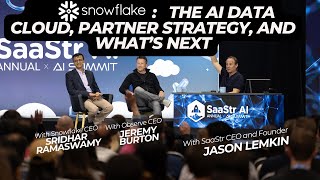
Snowflake's CEO discusses the company's push to make enterprise data accessible to AI, its partner strategy with vendors like Observe, and how AI is reshaping data roles. The company uses separate teams for new customer acquisition versus account growth, and is building connectors and semantic metadata to let AI agents work directly with data.
Questions this video answers
Late 2018.
Several hundred; Sridhar estimates ~750 ("750, maybe more").
Observe executes ~190 million Snowflake queries per day and ingests about a petabyte of data per day.
About 5 billion queries per day (referred to as "5 billion ish queries a day").
Around 60% (for tens of millions in revenue).
Chapters
The teams that close the customers are off the deal when it closes.
They keep it for a year, year and a half. We will continue to evolve that. But the set of people that get new accounts are completely distinct from the set of people that are growing existing accounts. Honestly, it's a different skill. The person that is managing an account that's spending $50 million a year, that person's a manager. Have 20 people. This is a big, complicated beast where you have to learn. Often these folks, our folks, know the architecture of their customer, often better than the customer because they talk to everybody within the company.
I see. And the folks in the first group, they're still sales, right?
They're both sales.
Are they? They need to have a more technical background to be real and expert in everything across the enterprise.
I, I have a lot of these conversations with sales folks. I tell them you have to be able to have a credible conversation with either a business executive.
Yeah.
Or somebody that is technical and be able to distill out what's the problem that really matters to them.
Yeah.
And how Snowflake, you need to know that much pattern matching, you don't need to know what's like the technology underneath. So, for example, with Snowflake, you can upload a bunch of PDFs or images and do things like image recognition. You know, you want to do receipt totals. Not a problem. You can just upload stuff. You do that as a salesperson. You don't need to know. That's a tilt model. That's 7 billion parameters that Snowflake developed. That's all blah, blah, blah. But you need to know, hey, if you want to extract, like numbers from a bunch of PDF contracts, they can do that. So it's like you need to know that the application of technology to business, those are our best account exams.
Hey, everybody. This episode is brought to you by Addio, the AI native CRM. Just connect your email and Adeo instantly builds a powerful CRM with every company contact and interaction you've ever had. Get 15% off your first year. That's 15% off your first year@attio.com Saster that's adeo.com Saster. But we've got a treat. We asked folks last year what they most wanted to see this year, and they said a board meeting. They said they most wanted to see a board meeting. That was what they had. They'd seen everything else. A lot of scaling revenue. So. So we've got this. So obviously everyone knows Snowflake, although many folks may not know as Much about Snowflake as they think I did. We'll sell some stories, but it's pretty interesting. Not only Jeremy, you've been on the board, Right. Since before Sweetheart was acquired, Right? Since the beginning.
That's right. Since pre revenue, actually.
Since pre revenue. Okay.
So, you know, longer than anyone should be on a board, but on board.
And we'll get into it. Jeremy is one of the most esteemed GDM executives. And I mean, you were EVP at Oracle, president at Symantec, ran half of the mc Did. I mean, pretty much everywhere you've run some part of it that's a big enterprise leader, is that right?
No, that's right, yeah.
Okay. And then we're going to talk about it. But Cerro is pretty interesting. We'll talk about Snowflake, but his little old startup was acquired by Snowflake for a billion dollars. Right. Which seemed like a lot of money back then. Do I have that right? If I remember?
Yeah. Sadly wasn't a billion dollars.
Oh, wasn't. I thought it was. Well, everyone's unicorn today.
It wasn't a billion dollars.
And then you became the CEO. So it's really interesting. Founder CEO, but not founder CEO is a very interesting perspective. And we've got the board, so it's a unique dynamic. So I want to use this to talk about. We've talked about nothing but AI, but the few. Snowflake's thinking a lot about this. Right. I mean, few have been more successful in the explosion of the cloud than Snowflake. We'll talk about it. But few are thinking more about the disruption. Right.
From.
From AI today. Right. And for folks that know a little bit less about Observe. Interesting too. And also the other dynamic is if this is a partner relationship.
That's right.
But this, I forgot the third dimension. So Jeremy was on the board of Snowflake before it started. Right. Observe now is a key Snowflake partner. Snowflake is a significant investor in Observe. And Observe in part is an observability platform on top of Snowflake.
Right? That's right.
I get the inside scoop on how good we are as a partner.
You do. Right. So I want to talk. I want to, at least on our time that we have, I want to touch a little bit on observability over the years since we started Saster, we've had, and I'm not a total expert, but we had Lucerny in the beginning. Really new relic in its day was. Was incredible. Right. We had Olivier came from Datadog when it hit 100 million. That seems like forever ago, right? Jordy Gonsel's been here twice with Appdynamics and then it seemed like things were quiet.
Right?
And then it's re exploded. Right? It's re exploded. I don't know why. So maybe we'll get into that too.
Yeah, I can help with that.
But maybe just to set the stage, there's a bunch of stuff I want to ask, but I'll tell a story and by the way, I hope it's a lot of hands. How many folks here have used Snowflake or their team uses Snowflake in some capacity? Okay, that's good.
Thank you.
That's good. I think it's badass. I will just tell you a story and maybe we can use this to learn about the future. One of the. Did anyone see Marshalle from Mango Man? She was the VP of sales of the salon software company yesterday.
She's really good, right?
So her CEO's here, here. They're a 20 million ARR. They do software for salons and spas. But he is a data engineer by background and he had this funny thing. He was wondering if his best sales reps were really his best sales reps. And he goes into Salesforce like we do the dashboard and he sorts and, and, and Jason and Jeremy at the top and Srira is down sort of at the bottom. And he thinks he knows the answer and. But he's a data engineer. He exports the data, puts it in Snowflake, figures out how to run a report, takes a few minutes, which we'll get into, but finds out maybe an obvious but profound learning from putting the data into Snowflake, which is at his top reps for some of his worst reps. Why? Because bear in mind is SMB. They had the highest churn. They had the highest churn because they were pushing deals through. They were so good at sales. So his top reps were not his top reps. So one meta topic for Snowflake is talking to your AI, right? Which you used to need. Maybe you still need a data scientist and a data engineer and the whole team. But tell us like versions of that story and where's Snowflake going in 2026 in this age of AI, where's it going?
Yeah, I mean, first of all, Snowflake is the AI data cloud, meaning we basically want to be a cloud computing platform centered on data. Whatever you want to do with it. Obviously there's simple stuff like analysis. You bring some data in. We want to make it easier for people to bring that data in, we're going to release a pile of new connectors. But then analytics is what we were always known for. Infinitely scalable analytics, difficult balance, everything from AML to predicting next best action, or as you pointed out, churn detection. But for us, AI is a big unlock as far as getting value from data goes. If we can make any business user be able to ask questions off of data quickly, that's a big plus. You just showed me your chatbot on your website. It's pretty amazing. If you folks haven't tried it, you should. But now imagine being able to do that on every data set that your company has. That's sort of, that's sort of free and the pieces to do that are already there and the next steps then are going to be okay. How do you stitch these data flows together? If you're a salesperson and you want to make a new stitch for a use case to your customer, you want to know perhaps like what are open use cases that other customers like this have deployed that this person should. You also want to make sure you know the latest about what's going on. How do you bring that into a single experience? That's kind of where Snowflake is headed, which is all of your enterprise data. But now the intelligence of something like ChatGPT deep research with access to every single data set that you have. We have a bunch of internal examples of agents. It's pretty magical in terms of what you can do just by bringing it all together. Just like I was totally blown away when I first started using ChatGPT research because the ability to get a high quality research report on a pretty arcane topic was amazing.
Yeah.
But I think that is going to happen over and over again. And that's where we are headed as a company.
And let me. And whatever the number is, I know it's stunning. I should know what I've written up. But how many million plus customers does Snowflake have? I know you have to do it every quarter.
It's several hundred hundreds, right? Several hundred. 750, maybe more. Yeah.
What are they? And I'm sure it's a spectrum. That's why I asked the question. When you talk to them, they. What are they asking for you in the age of AI? What do they want you to do more of in the future? What are they, what are they pushing you for on.
I mean, it falls into several buckets. The most important one tends to be how do I get more value from the data that I already have in Snowflake I was talking to the CMO of one of the the biggest mobile carriers today and he's like, I have all of this information on Snowflake. I want to build a better detection engine. If ARPU is going to fall off in some area, how do I automate this process and make it much, much easier to do? While others basically go, I was talking to this other company that came together by agglomeration. 60 different companies is now one company and that poor person's like has 60 instances of SAP.
Yeah.
If you were to ask me how much money am I making with this one particular customer, honestly I can't tell you. What can you do to help me bring it all into a single PANA class? Those are the two extremes of what do people want from Snowflake?
Yeah, well the 60 I'm not. It's been a while. When I was briefly a VP at Adobe, I had to install SAP locally in my Windows. That was one of my worst software. But I couldn't imagine you could even rationalize 40 instances. Right. So that's a winner for Snowflake right there.
Right. It's probably impossible to move to one.
Right.
It's really hard to do things like that. And part of the value we bring to the table is we can help these folks do it incrementally. I tell people never sign up for five year projects. I don't. If any of my engineering or like any team comes to me and says I have a great idea, it's going to take five years to implement, I go like, this is the age of AI. I just don't want to hear you. Yeah, talk to me about what you can deliver next month and next quarter.
But are there areas where you meet with them now that 12 months ago they weren't pushing you in hard? In the age of air, there areas where the customers are pushing hard, they're more aware, they're or even just at their expectation. I think it's raising all of our expectations. Right. In terms of what they want.
I mean agent AI is a thing.
Yeah.
Because people can interact with the chatbot. People can run that report on chat GPT and go like, but wait, I want that done on my data. Yes, there's definitely a push and we honestly try to temper expectations in terms of making sure we distinguish between what is doable today versus what will be doable sometime from now. You know, if you take a complex process like a loan underwriting process that takes like a set of analysts, if you're trying to ensure $100 million building or trying to decide whether to make a loan like that, that's like half a dozen people working for a week. That's a big deal to decide a decision like that. In cases like that, we can probably simplify many pieces of it, but not automate the whole thing. And so managing expectations is a big part of what we have to do. But it all starts with the data.
Yeah.
If you have the data, if it's easily accessible, if you have clean semantic information about the data, you're already well on your way to how do I get value from it? And there is this now hunger to do. Okay, what else can I do with this?
Yeah, and so. And I want to come back to a bunch of that. But, but Jeremy, so when was Observe founded? Before Snowflake or Snow, or before you joined the board?
No, it was. Yeah, I joined late 2018.
Late 2018. Okay. And then because partnerships, they're always interesting and they're always sort of what they look like on the outside, but the real story is usually more interesting. Right. Whereas. And how much of the business today is Snowflake oriented? I should know how much of observe is 100. Oh, it's 100. There's no other platforms. You're. You're tied, committed, good, bad and ugly. You are, you are, you're on. Right. And so. Okay. And so you, Jo. So walk through how that, how you manage that, this round trip relationships.
Yeah. So when we were founded back in 2020, end of 2017, actually, we had a couple of early Snowflake engineers on the founding team. I, Philip Underbrunner, who worked on the query engine, Vidhi Mantanov, who did the instructure data support. And so we were quite predisposed to building something on Snowflake. It was actually controversial in the founding team and in fact, we lost a number of members of the founding team because of that decision.
That came from Snowflake or other?
No, that didn't come. But yeah. So there was a bunch of folks who had a theory that every query had to return in 100 milliseconds, which I would like that as well. But that's just not, that's just not required in an enterprise SaaS application. And so they wanted to build their own database. Oh, I see. The folks who came from Snowflake were like, no, why don't we build it on Snowflake? And for me, I was on board fairly quickly because at the end of the day, customers are not paying us really for the database, they're paying Us for the analytics, they want to answer questions. And so my thesis here was quite simple in that if we've got our engineering team adding value above the database and we let the Snowflake team build the database.
Yeah.
Then we should be able to add more value and therefore charge more money. If we've got half the engineering team building a database, then we could be in trouble because that's a long road and many in our space, I mean, a couple of the folks that you mentioned earlier have built their own database. And our sort of strategic decision, if you like, was when we are not going to build a database, we're going to use Snowflake. And I think the most important thing when you make that call is you have to commit to it. Because in the short term, your gross margins are going to be worse than comparative companies because obviously you've got to pay the Snowflake bill. But if you're committed, you'll figure out a way how to exploit the unique features of the platform. You'll figure out a way how to be the most efficient application on that platform. And look, as we sit today, I mean, our gross margins were, you know, with tens of millions of revenue and the gross margins are already up around 60%. And so can we reach normal SaaS margins, 70s and 80s at scale? Why not? But that's only come through being committed and making sure we are the best goddamn application on Snowflake, bar none.
Yeah.
So there's a big commitment there. And then on the partnership side, it's sort of like a sibling relationship. It's like brothers. You know, we, there's like a love hate relationships. You know, many days we love Snowflake. Sometimes we love to hate Snowflake. But again, if you make that decision early on that you're going to build on a platform, you've got to realize you are picking up a dependency. You have to build relationships. Certainly technically we were quite fortunate in that regard. We could sort of get bootleg bug fixes because we had relationships, engineer to engineer.
It is right. It is right.
It's super important. But then as the company grows, what you realize, look, Sridhar has got this amazing distribution channel and so you need relationships not just in engineering, but across the board because we want to be able to leverage the sales team and the access that they have. They're a very credible enterprise player. Where not can we leverage that? Well, you're not going to do that unless you've got the relationships with the sales team and they understand your value proposition and so on.
And you guys are. Do you guys actively cross sell? Is that, Is that the motion starting to starting?
Yeah, we're sort of big enough now to be relevant. And really, although our sales motion is a little bit different, we go to sort of DevOps and SRE people. And I think the Snowflake guys predominantly go to data ops folks. Snowflake have excellent relationships with the top people in the organization. And so if you've got like a warm, credible introduction into an enterprise account for a startup that's, you know, 30, 40 million ARR, that's precious.
Does Snowflake benefit from observed deals when they're trying to close up sales or big deals or is it downstream or what does it happen in the. In the timing? When do folks realize they need the platform or want the platform? The Observe platform.
Yeah, I mean buy Snowflake without. I mean you, of course buy Observe without really buying Snowflake and vice versa. But they also go to a set of customers together.
Yeah, I think there's. I mean, our motion. We go sell off serve and think of Snowflake is sort of the man behind the curtain. It's embedded. So our users, they don't buy Snowflake. They don't log into Snowflake. They don't even know.
They don't. I should know this. They don't buy Snowflake.
No, no, no. They. They pay for Observe and everything is included. I say embedded. But where it does play out in the larger accounts, obviously through, let's say the Snowflake marketplace. An enterprise customer may have a big commit with Snowflake. Well, they can actually burn down that commit by buying Observe. So it's a. It's a huge benefit. And this relationship works great with like Amazon and GCP on their marketplaces as well.
Right? It helps. How does the rep make money out of it? I don't mean to be nerdy, but I'm curious.
They now get paid on that by you?
Our reps are based on consumption, for sure. Snowflake.
Oh, even if there's pre commits, they're still incented on consumption.
I will make sense. Snowflake recognizes revenue only when customers actually consume. Even if there is a. The free comment merely ensures supply of credits at a certain rate, but they actually have to consume it for us to recognize the revenues.
I'm embarrassed to say I didn't know that. I studied Snowflake and I get the model, but I didn't realize from a gap perspective.
So when we talk about skill.
Yeah, you can't recognize it until it's used and so you don't want to pay the sales reps until the consumption is. Even if it's a 500k a deal a year for 5 years, if they backload it and use it all year three, four and five, you can't recognize that ratably over the contract.
We know we don't get to ratably recognize the contract. It is recognized when it's consumed. There are limits on, you know, how much you can roll over and stuff like that. But the consumption model is fabulous because we get paid on usage. Our reps are now focused on making sure that you get value from whatever it that you sign for. That's a super aligned incentive.
I'm thinking a lot of startups might get this accounting wrong until they go public. But let's keep. I think they might just think if I, I at least can somehow recognize most of it ratively. But it's interesting, it creates incentives. I guess it's a good incentive.
Right.
You want as much data, as much workloads, as much going. So what does that. I mean it relates to observance is interesting. So what does that mean for your average AE? What are they doing with the customer 3, 6, 9, 12 months out? Because they're super incentive to grow that account, right? Yeah.
So they. Absolutely. They sell deals to the customer. Our typical first deals are like 50k, 100k. They tend to start small.
Yeah.
And then we go in, implement a project, either Snowflake or the customer or an SI system integrator partner. Yeah. And that drives a certain amount of consumption, a certain amount of value and then they turn around and sign a bigger contract. Some of our biggest customers have gone from like zero to one to two to five or space of two, two and a half years. But all of it is driven by what are use cases you can create. And every week Snowflake lives and dies by. How many new use cases did you create? How many did you win, how many went live? That's the motion that we are living. Yeah.
And how do you. If I've got a great account, how do you get the reps to like do new accounts when all the money is in getting their existing ones to grow?
Great question. We have completely separate reps for acquisition. There's a. So yeah, there's a hundred percent closes.
It is off the deal. Sorry, the, the teams that close the customers are off the deal when it closes.
They keep it for a year, year and a half. We will continue to evolve that. But the set of people that get new Accounts are completely distinct from the set of people that are growing existing accounts. Honestly, it's a different skill. The person that is managing an account that's spending $50 million a year. Yeah, that person's a manager. You have 20 people. This is a big, complicated beast where you have to learn. Often these folks, our folks, know the architecture of their customer, often better than the customer because they talk to everybody within the company. They know what the pain points are. They make business proposals for, hey, we can do this project over here, we can make your regulatory reporting a whole lot simpler, or we can do this other thing. And so they are on that cadence of how do you create value with the customer? Then we have a different team that's focused on, you know, us winning 5, 600 new logos every I see.
And the folks in the first group, they're still sales, right?
They're both sales.
Are they? They need to have a more technical background to be real and expert in everything across the enterprise.
So we do have solution engineers. So we have both account executives as well as solution engineers. But honestly, you have to be pretty technical today to succeed, because your customer is going to ask you about Agent T.K.I.
Yeah.
You can't white code your way through answering what Agent TKI can do for the customer. It's hard.
So we're on the spectrum of being technical for sales. How technical do you think you have to be 1 to 10 to succeed at Snowflake?
I have a lot of these conversations with sales folks. I tell them you have to be able to have a credible conversation with either a business executive or somebody that is technical and be able to distill out what's the problem that really matters to them.
Yeah.
And how Snowflake applies. You need to know that much pattern matching. You don't need to know what's like the technology underneath. So, for example, with Snowflake, you can upload a bunch of PDFs or images and do things like image recognition. You know, you want to do receipt totals. Not a problem. You can just upload stuff. You do that as a salesperson, you don't need to know. That's a tilt model. That's 7 billion parameters that Snowflake developed. That's all blah, blah, blah. But you need to know, hey, if you want to extract, like, numbers from a bunch of PDF contracts, I can do that. So it's like, you need to know the application of technology to business. Those are our best account execs.
Yeah. I have a founder I work with and they closed a seven figure deal with OpenAI and they had what they thought was a relatively technical CRO, but when they went to close the seven figure deal, they just left him in the lobby. I mean, it says it all, doesn't it? It's like because the questions were just so good that they really felt I have no value. Now they're not at snowflake scale, but they do have a brand. It's an extreme case, but I think about this, I just. There's just no value having that guy in the room because the questions from the Open AI team are just too good. There's just no point. You can't have any. You know, talking about golf or who won the NBA finals is just not helpful to this VP of Engineering Dubai.
I mean, I really encourage all our folks to use the products or use tools that are built on our products. If you use Observe, you'll know a lot about like, hey, what's going on underneath. Similarly, if you use Sigma as a dashboard and it runs on top of Snowflake, you have a good feel for data, what it's going to do. I think applications is something that they should be able to do. And then pattern matching, like business problems to get our things we can solve and separating out. Yeah, this customer wants this. Zero chance we can do this in the next 10 years. Yeah, that's also important so you don't make the wrong promise.
Yeah, I get it now. So we hit it and maybe we hit it enough. Jeremy, but. So your team is hyper focused on enabling them to burn down these commits, right?
Yeah, the nice unlock. Right, the nice thing. It took us a while to get there, but the snowflake rep is paid whether we burn down credits that they've sold into the account or whether it runs on our multi tenant SaaS environment. Yeah. So the nice thing there is the rep doesn't matter where Observe is deployed. We can deploy against the customer snowflake tenant or we can deploy on a multi tenant. But yeah, the big incentive for the, for the rep is we're a very compute intensive workload. We do 190 million snowflake queries a day and we ingest.
You got to slow me.
190 million queries a day and a lot of queries and a petabyte of data a day we ingest. So we're a very compute intensive workload. Cash is great to burn down credits.
Out of like 5 billion ish queries a day. So it's.
That was the question. I was 190 million out of 5 billion.
5 billion.
Ish.
So that's a strategic partner. That's a strategic partner. Yeah. I know you're together. I know, I'm just learning. Well, you also, you also punch above your weight class, right? Because you're at eight figures in revenue.
Right.
But and snowflakes, it's coming up on four billion, four and a half. Yeah, but you're enabling. You're punch. Sometimes you punch above, below your weight class. Right. Sometimes you have ever in the world uses you and you have no revenue, but you're enabling even more than your ARR. Right.
Yeah, I, I, I think so.
They're super aligned as partners and part of my own discovery over the last two years has been in figuring out what do different partners need. Yeah, Jeremy, for example, honestly brings us deals. He doesn't need a salesperson. He's not shy about telling me that what he really needs is deep technical help. Because he's like, if I can make my 200 million queries go 25% faster, he's like, dude, that's a lot of money for me.
Yeah.
And so figuring out what different partners need is part of the challenge. We've gotten much, much better at sort of aligning both who is inside Snowflake, helping them with what they need at.
A broad level, I assume one way or another through partners, sis, big guys. The majority of Snowflake's revenue is touched by partners of some form.
Right.
It's got to, it's not. The majority can't be direct.
A lot of it. Yeah, a lot of it. So we have some companies that had their own engineering crew and will implement their stuff. Yeah, we have a great professional services team that will go implement some projects but the vast majority, they're done by system integrators.
So just, and just because it is an interesting topic, I appreciate you being here. Your schedule is pretty busy running, running a company of stuff like how much of your mental bandwidth goes into like partners in the ecosystem versus all the rest. How much time do you have of your scarce time to that part?
I actually spend a fair amount of time on partners, especially the gsis. In this world that is changing so rapidly with things like agenti, a number of them have pretty amazing solutions that they've built. Several of them, Infosys, for example, are cognizant, have very large engineering teams, have built substantial software engineering projects. So working with the Accentures, the Deloittes, the Capgeminis, that's pretty important. So I do spend some time on that scale of motion. The bulk of my Time though goes first of all with customers. I'm on the road half the time. A lot of the time goes with the product team and I spend like the remaining time with partners in the go to market team.
Let's move on to a different topic. But I just think it's so what is sometimes as outsiders, as founders, which you've been all of it. Right. We're so jealous of folks that have these inside relationships. Right. I want to be one of these. I want to be one of the observes. And we don't realize what it's like on the other side. You need trusted partners. Right. And everybody ends up with an inner circle. Like the game isn't rigged against you. Like this is software. Build whatever you want. But sometimes you're like, how can I get this relationship? How can I get one of these special relationships? Sometimes in some ecosystems are a little Machiavelli and I don't think they are. It's Snowflake. But how do I, how do I get into the inner circle?
First of all, this problem of how we make partners successful is something we take seriously. And I think there is a lot of similarity between how we take new products that my team builds, whether we have a great data, clean room solution, limited applicability, some set of customers had, customers wanted, not everyone. And so we have now a very rational model for how do we invest in these things. I tell my own engineers, you know, if it's a 10 person team and they think they have a great idea, I go, that's wonderful. We have one person.
Yeah.
To take that product to market. Go make me 5 million bucks, I'll give you the next person. And similarly with partners, there's a limited number of partners that we can support because the sales team is busy selling Snowflake. And then it's just a limited, limited coverage.
Yeah.
And so what I tell folks is there needs to be alignment. For example, Snowflake. Investing money in a partner in a startup without having a serious intent to work on a partnership to drive more giant revenue together. It's kind of pointless because we are not VCs. We don't offer you advice for here is how you grow your company. It is aligned investment. Similarly, when it comes to partnerships, we are increasingly headed to a place where we have like limited number of them, not dozens, but we invest significantly.
Yeah.
And the thing that I always tell any partner is unless there's someone in Snowflake whose career and future depends on you succeeding, you don't have a partnership. And by the way, that's true for every company.
Yeah.
You never believe a company that says, like, hey, welcome, you're a partner. Come spend money on me. They just want your money.
Yeah. So again, in the inner circle, if you commit that commitment shows through, you will build relationships by virtue of the fact that, you know, you are 100 committed to the partnership. I'd also tell you that, you know, how do you get into an inner circle? I mean, one of the things I wish I'd done more as I was been out in Silicon Valley probably 35 years now. I wish I'd kept in touch with more people. It's never been as easy.
I'm not too good at it either. Yeah.
I use social media. One of my old bosses, Joe Tucci at emc, knew everyone. And I'd ask him, I'm like, joe, how do you know everyone? Yeah. He's like, well, I. I take time. I'm like, what do you mean, I take time? Oh, he takes time. He takes time out every week to keep in touch with people. And there are very few benefits to getting old, but one of them is the older you are, you know, more people if you've kept in touch with them. And the temptation is only to go to somebody when you need them, which is actually the worst time to go to them. So the other advice to give, I mean, I know a lot of people that do with snowflakes. Like, I used to play soccer with Terry at Oracle.
Yeah.
Mike Spicer used to work for me back at Veritas. He was the product manager for backup. Now I'm asking him for money. So these relationships are precious. So keep in touch with more people, you know.
Yeah. I don't. I don't know what. How it works with the world narrowing and getting broader or something, but it. Maybe it goes like this at some point. Right.
It.
It starts broad, then it seems to narrow at a certain point in your career.
Right.
And then things get bigger, and then you end up at a certain level where.
I think that's a really good life lesson. Regardless of what age you are.
Yeah.
Matter. Your relationships matter. Yeah. And it's not about technology. Can help fix some issues, but it has to come from your heart. All of you can tell the difference between someone who goes, hey, how's it going? And walks right by, and someone that stops and looks at your eyes and goes, yeah, what's going on? How are you?
Something I just want to dig into before we run out of time. Your key power users in both spaces. Okay. The data analyst, the data Engineer at Snowflake or describe your key user and the DevOps engineer at observe 12 months from now or pick wherever you want. In the age of AI, in 2026, how is your job going to change? Because maybe it didn't change that much from 2021 to 2025. Maybe the job was I got better and better at my Snowflake queries and my workflows and is it going to change in the next 12 to 18 months?
I think a data engineer currently spends a lot of time setting up pipelines, manually figuring out what the right column names are going to be, or extracting data and validating it, writing tests for it, or doing painful migrations from one kind of database over to move that data into Snowflake. I think there's going to be a lot more cursor style coding of these data engineering workflows. I think things like being able to extract metadata so that the data set that you extract is almost self describing so that AI can get to work on it. I think that is going to be significantly different for data engineers in a year, two years, than what it is today. You'll be more like an orchestrator than the person that's actually writing the code. Similarly, I've spent sadly thousands of hours doing data analysis, literally thousands of hours writing SQL queries, making mistakes, figuring it out. And I tell people, Listen, I've written 2000 line long SQL queries. It's just a lot of detail.
Yeah.
On the other hand, I think what that data analyst, instead of writing millions of variations of basically similar queries, is now going to be describing data sets. He's going to be running these queries, but he's going to give semantic, they're going to give semantic context to what does this query mean? What does this dataset mean? So that again that data becomes more AI ready, more self describing, so that now tools like the, the ChatGPT research I'm talking about can do so much more with, with these data sets. So I think the job goes from I needed to individually write every line of code to I do the meta work that lets my business users get value from their data straight out of the box.
Does that mean that they'll be doing geometrically more queries next year? They'll be doing more on their data.
Well, we absolutely want more business users to be going against the data for data to be easier to access, for people to be able to stitch things together.
Yeah.
And that's part of the reason why we are optimistic about our future as a company. Because all of the data that makes AI interesting is in Snowflake.
Yeah. I mean, I'm not a total expert, but I would imagine even with as wildly powerful and successful as Snowflake, is that a lot of enterprises, there's a backlog, there's an insatiable demand for I want to get it information out of my data. I want reports, I want queries, I want to figure out things on my data. And I think if you get, if you become cursor esque, you might have to answer 10 times as many questions for your organization, which is a good thing. But it might be very different than it is today, right?
That's correct.
And this also is going to increase the pressure for where do you create value? Remember, at the end of the day, the CFO that looks at the Snowflake bill goes like, wait, this is the second largest bill after aws.
You got to earn it even more next year.
Right? You got to earn value from the data.
When I hear the narrative, and it's been a while since I lived it, but boy, I'm staring at the dashboard, staring at the spikes, I can't. I mean, I used to have more hair before all this. It's been a little while as a founder, but whether it's 12 months or 24 months, but in this region, can I go so far as to not only identify its own dashboard, but can it wake me up and propose the solution? I'm speaking as a founder, not smart enough technically, but that would be nyirvana. Hi, it's 11 12. I've noticed the spike in issues in it. I'm 90% sure this is the answer. Jeremy, would you like me to execute that? And your super smart engineer just decides with all of that collected, this is the action, right?
Yeah. My search ads team at Google had auto experiment scaling, which is an experiment would go out to one process, one machine, then two machines, then a whole data center, then globally. And we would look at metrics every time and faster than humans could, it would revert the thing if it saw some significant deviation. Every change that goes out at Snowflake is guarded by what we call parameters that get turned on in order to enable a feature. 100% parameter auto reverting. That's the thing that's going to happen very soon.
Yeah, yeah, I 100% agree. There's a little bit of bootstrapping required because once you've got AI looking at the investigation and you've got the AI doing the root cause analysis, you then have better investigation history. So when. Then. When something comes in.
Yeah.
The troubleshooting is going to be on rails. The biggest problem we have right now is you see a problem, you think it's something you've never seen before. Actually, you have. You just never root caused it. You never documented it properly. And by the way, when you need to search it, you can't find it.
Yeah, I mean, I tell you, you know, I. If there were no DevOps issues. If there were no. I probably wouldn't have sold my last company. The stress I've seen. I mean, it just. As a battery kills you, it just. I mean, it's part of. It's. It's interesting. It's like golf. I don't golf. I think you golf. You can't. You can never be perfect at golf, but I guess you can never be perfect at resource contention and memory leaks. But, man, I just. This stuff just. I would love it if AI solves all of this for us magically. We never have to think about these things. Yeah.
We want to build features, not fix problems. I mean, that's.
I know. I hope.
All right.
I know. We're over time. Did we get everything we both wanted? Do we get everything out of this? All right, thanks, everybody.










