State of the Cloud: The Cloud AI Era with Bessemer Venture Partners
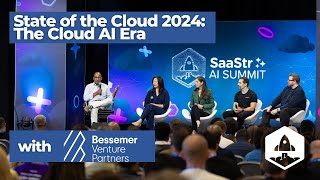
Founders from Anthropic, Abridge, Jasper, and EvenUp discuss why AI adoption differs from past cloud waves. They cover foundation models, multimodal capabilities for healthcare and marketing, defensibility through workflows and data, and why change management matters as much as the technology itself.
Questions this video answers
About 39 different models.
Kaiser Permanente and Sutter.
20 million per year.
Chapters
If you think that customers are adopting AI in the same manner that they adopted SaaS over the last 10 years, you're wrong. It's just completely different. And one of the big differences is with most SaaS software, most of the outcomes and the value were very deterministic. I know that if I do abc, if I fill out these forms, if I give it this data, if I do these actions, I'm going to consistently get this unit of value from the software. But I think, as we all know, working with models and working with AI applications, the outcomes are very probabilistic. And so there are a lot of things that you need to do as a trusted partner, not just as a trusted model or a trusted piece of software to help companies go through that transformation, to identify what are the KPIs, what are the business processes, what are the workflows that they can transform, and then how to help their employees begin to adopt this.
All right, everybody settled in? Good afternoon, everyone. Great to see you all. I feel like we gotta start off with a little bit of gratitude. Gratitude disaster. Thanks for y' all for hosting this. I've been coming to these events for, we were just talking about a decade now when I was the CEO of this little company named Sendgrid that would learn, I would be in the audience and hear great stories and pick up a few tidbits. And when we got public, I got to come back and speak a couple times and now I get to come back and in a second career as an investor and, and now have all of our portfolio companies share their lessons learned. And it's awesome. Super grateful to Saster for bringing us together. Grateful that all of you came and spent time with us. Really grateful to my four panelists up here. These guys are all really busy and they carved out time to, to come here and talk with us. And I would say I hope everybody in the audience is realizing that we all collectively should be really grateful. How lucky are we that we get to live in this era of this transformative time, where AI is undoubtedly going to change the way that we all work and live. And you can feel it, you can see it. There's no question you've got the Amara's law of overestimating what's going to happen in the short term and underestimating its long term impact. I have seen this happen in the Internet era in the mid-90s. I saw this again with mobile, we saw it again with cloud, and we're living through it again. But it is so exciting to see what's happening for Bessemer. We're all in on AI. We've dedicated a billion dollars of our 4 billion in dry powder to go invest in AI companies. And couldn't be more excited about what these folks are doing here today. Why don't we dive right in? We'll start off with some introductions and then we'll go from there.
Hi, everybody. I'm Julia Chapin, chief operating officer at Abridge, where we're on a mission to power deeper understanding of healthcare conversations all through purpose built AI. Today we take doctor patient conversations and we transform them into clinical notes for clinicians to review and quickly get more information into the medical record. We're working with systems across the nation, including Kaiser Permanente, Sutter and beyond. And in my role, I work to ensure that we are continuing to responsibly deploy this technology to the healthcare space, space and really driving impact and culture. Prior to Abridge, where I've been for the last five and a half years, starting my career at Google, bringing Google products to emerging markets.
Thanks, Julia.
Thanks so much for having us. I'm Kate. I lead our sales and partnerships teams at Anthropic. Anthropic is an LLM company that's part research lab, part commercial entity. I hope most of you in the audience at this point have tried Claude, if you haven't, please do. Uh, we work with companies of all sizes from startups, like many of the folks on stage here with me today, all the way up to really large companies like Intuit and Salesforce. Really excited to chat about all things AI today.
Awesome. Thank you, Kate. Rami.
Hey everybody, My name is rami. I'm the CEO here at EvenUp. We're on a mission to be the source of truth of what injury cases are worth the way we, we help injury victims. The. The 20 million of them that get injured every year in the US is by essentially doing a part of the job of the attorneys that represent them. Very excited to be here. Chat with all of you about generative AI.
All right, My name is Timothy Young. Super excited to be here. I'm the CEO of Jasper. Some of you may have remembered Jasper from 2019. We launched as one of the first companies to really prove that you could build a business model on top of an LLM with our writing assistant. Today we've expanded the business quite a bit into an enterprise AI platform for marketing teams and very excited to be here.
Awesome, Timothy. Thank you. Thank you. So let me give you all a roadmap for the conversation that we're going to have Bessemer every year for many years now in the cloud era would create this thing called the state of the cloud and we've put this out every year and we would come to Saster every year and talk to the audience about where we are in this journey of moving from on prem software into the cloud, into SaaS and so on. Obviously in this stage SaaS is a very mature category, a very mature industry and it's impossible to talk about cloud and SaaS here at Saster and not be talking about AI. So this report we put out is all about the cloud AI era. The five trends that we have been seeing. There are five key themes that we pulled out today. We're just going to talk about 1, 3 and 4 up on the screen. We'll talk about some foundation models, we're going to talk about multimodal capabilities, we're going to talk about vertical AI. We're also going to throw in one more topic that is so critical which is around defensibility and moats in a generative AI large language model world. And so let's go ahead and dive in. Let's take that first one about foundation models. There are so many models where open source models, there are closed source models, there are frontier models, folks that are using their own models that are fine tuned with their own industry data or content. I really would love to hear first Kate, from the Anthropic view, some of the great things that you all have seen about Anthropic's model relative to all the competition. Why do enterprises choose anthropic? Why should all the folks out in the audience be absolutely including, at a minimum including Anthropic if not choosing it outright as the only one and then maybe from the application builders that are up here a little bit on what you all have been doing in your organization. Kate, I'll start with you.
I don't think I need to tell anyone here that there are a lot of options available and often what we're talking to, when we're talking to our customers about is about when do you choose Claude versus another model? And sometimes that's all within one use case. Sometimes you're choosing a model based on a very particular use case. To answer the question about why, Claude, there are so many reasons, it's why I work there. But one of the biggest ones is our model performance continues to get better and better. We're iterating really at the frontier. So you just look at performance and we continue to be told by our customers that they're really pleasantly surprised by how well Claude can understand, very detailed, very nuanced context, how well Claude can write. And many of you are probably thinking about building customer facing applications where your models are actually going to be writing things that your customers will be engaging with directly. And that tone is so important. On more of the enterprise side, you often hear a lot about security, reliability and availability in the cloud. And so a big part of that for us is we have relationships with Google and with Amazon. So if you're a GCP customer or an AWS customer, you can use Vertex or Bedrock and the cloud models are available there. But I know many of you, we talked about this yesterday, are actually using a whole bunch of different models for a lot of different use cases.
Yeah, I think in the case of a bridge, the industry and the landscape is changing so rapidly with new models coming out all the time, new capabilities coming out all the time. And so how we think about things in terms of what to use off the shelf models for versus what we fine tune internally and create our own models for, it's largely a function of what delivers the best quality product for our users. And so we're constantly trying everything that's coming, coming, available, evaluating against the latest and greatest. And also I think something that's unique about our evaluation process is that we actually do head to head comparisons against every single model with humans in the loop to also ensure that what we are shipping makes the most sense for our particular users. Now, in the medical space, there are many cases where off the shelf kind of solutions will not actually work to the specification that we need for the healthcare industry. And for those use cases, we have our own proprietary data sets that we've trained models on ourselves to be able to deliver the types of experiences that our users need.
Awesome.
Rami or Timothy, you guys want to pile in?
For sure. Just for folks that don't know us, we draft a specific type of legal letter called a demand letter on behalf of these lawyers that we serve. We do about a thousand of these letters or 10,000 pages of legal text that we write every week. And similarly for us, there isn't a one size fits model that can serve all of our needs. It's a mix of discriminative and generative models, a mix of human in the loop and fine tuned models for us to get to where we need to be from an accuracy basis for industries like ours, precision and recall really does matter. 90% of the way there in a legal letter is not enough quality, which is why fine tuning and having a human in the loop really does help get the product to where it needs to be.
For Jasper, it's really been a big journey for us. In 2019, we started with one model and today we run about 39 different models in production across the entire customer base. And so we're really LLM agnostic. We are huge fans of anthropic, of course, and use that very aggressively throughout the customer base. But we really try to work from what the customer's desired output is and then work backwards through the model. So we're constantly 10 models, we're evaluating them for drift over time and we run a mix of foundational models, open source models, our own, especially on image. And then we have customers who are also bringing their own model. And in a lot of cases what we're finding is that customers are beginning to, when they're rolling these systems out at scale, they want structured outputs and they want repeatability, they want trust, they want high confidence. And so we're constantly monitoring that in certain models for certain different pieces of content and marketing, but balance that repeatability with the proper amount of creativity. And so that is something that we're constantly looking at and helping customers find the right model for their use case.
Super helpful. And just as the guy that's lived through these waves before, I think many in the audience will agree with me that it's very different than the last revolution that we saw. Like we're all here at Zaster and Cloud. When we got started In Cloud in 2007, 8, 9, most businesses that were starting with Cloud picked one Cloud and then they built and it was usually AWS for the first five years. And then GCP came along and. But they had to convince people to build on their cloud. Multi Cloud really didn't arrive for many years in a real high penetration rate of what enterprises were building their applications. People are just building on one infrastructure by and large. And I think what we're seeing in this wave is very different actually. It's, we're seeing a lot of folks that are quickly leveraging the capabilities of a number of, of models and large language capabilities for particular use cases and particular tasks. And an interesting distinction. Okay, next question. Kate, I don't know what anthropic legal is going to allow you to say, so we can pass on this, but I'm going to ask it anyways. Everybody in the audience is wondering this. I know I am. We've seen the leaps from GPT 2 to 3 to, from Claude to 3.5. Like they have been big leaps right from each generation. And we're all wondering, the next one that drops is Claude 4. Is it asymptotic? Is it incrementally better but still amazing? Or is this. Or is it step function? And I don't. We don't know. But you all have a better insight into that than anybody here.
It's funny because if you ask anyone on the research, what is the next model going to be able to do? The answer is, usually we'll find out. But no. In more serious terms, there are three things that drive a model performance. One is hardware. The next is algorithmic improvements, the software that we're running to train the models. And then the third is the data that we're using to train the models. And you can think of every lab right now as making big improvements, all three. And that's really where and why you start to see these step function changes when you have much better hardware with much better algorithms and an ability to leverage even more interesting data. Multimodal is a big thing that I know we'll talk about in a few minutes. The model performance just continues to jump as things come out. The other area of innovation, where a lot of folks are maturing is just developing better products around these really basic APIs that interact with the LLMs.
Awesome. Fantastic. And it's funny, the answer of we'll see. We don't know what the models are going to do. I was on. I hosted a panel. It was actually a Jasper AI panel in San Francisco two and a half years. Two years ago, maybe a little more than that. And Dario said on that panel that they discovered that the models could code like. It wasn't a design requirement. It wasn't an intentional. The model, it had the capability. It figured out how to do it. And so it's interesting that these models can in fact, just. We'll see what they can do once they're there.
It's absolutely right. We call it coming out of the oven and seeing what it's capable of. Of course, you fine tune it on the back end and make it better at certain things. But so much of what we're doing is making bets on what we think will work.
Yeah.
And then we call it putting it in the oven and taking it out of the oven and seeing what we made.
And I do love, obviously we're biased, we're investors. And all the companies up here, we love Anthropic because it also has a great deal of focus around constitutional AI. The safety and trust to ensure that the proper guardrails are there and in place in a way that not all language models and providers have that same level of emphasis. We love what you all are doing, so fantastic. All right, we're going to switch gears now. We're going to go into the next topic which is around moats of defensibility for these AI businesses. And I'll just tee this up, particularly for those of you in the audience that are the application builders. What's wonderful, it is a magical new capability that's been unleashed by the language models and so you can apply those capabilities to long old problems in novel new and interesting ways, which is amazing. The underbelly to that is these models are readily available to everyone in the world. All your competitors too. So how do you think about defensibility in that context? I wanted to start with Timothy, because you all are honestly the first of those great businesses that got to double digit million ARR rocketship growth and went through a transformation, as you were describing in your introduction, from what some described as the thin wrapper to where we are now as a full application platform.
So I knew you were going to say API wrapper. Yeah, I knew it.
Go ahead and tell them about that journey and then. And how you all over the last two years have built those defensible moats that didn't exist two years ago.
Yeah, yeah, absolutely. I think it's an incredible journey and it's, it's very, I think, top of mind or should be top of mind for everyone here. A couple years ago everyone was talking about, oh, it's just a API wrapper. And then in 2019 when the company launched, I think that was a little bit true. We were the first true application built on top of an LLM. We launched before Chat GPT and there was that magic moment for the market where people said, wow, here's a hard problem that I have. I don't want to write this long form piece of content and here's an application with just a little bit of instruction. I can get a great blog post or a white paper or an article and that really changed and opened up people's opinions and introduced them to LLMs. Over the last couple years since that time, we've obviously seen a broad adoption and just capturing everyone's imagination with generative AI, whether it be from ChatGPT or the great products from Anthropic. And we've learned a lot from customers as well about what they want. For us as kind of an applied AI application company, the way to think about defensibility is really workflows and integration. So I'll walk you through a couple of quick workflows that I think are not really discussed out in the market from a couple of our larger customers. One is iheartradio. So a lot of they run a lot of radio stations locally throughout the U.S. a great customer, a great partner of ours. And historically the business model is to sell ads. And the people who are running the ads are local businesses. They're small SMBs. So what Jasper basically did was figure out how to work with them to accelerate that. So if you are a BDR right inside of our iHeartradio, Jasper connects to Salesforce. It analyzes all the leads. And historically, what a BDR would do is they would reach out via email or a cold call, let's say a local plumbing business, and say, hey, would you like to advertise on the radio? A lot of these local businesses would love to. It makes a lot of sense for them. The problem is they didn't. They don't have the marketing budget or the team or even the wherewithal to know how to build that ad. Well, with Jasper, it totally flips the equation for iHeartRadio and their customers. Now when that BDR reaches out, there's already a script for that business, for their ad in the pitch. And that business just needs to say, hey, this sounds great. Let's run that ad.
Love it. Awesome. Julia, maybe a sentence or two, Julia, on integrations, EPIC and systems that are in your ecosystem and how important those can be for defensibility.
Yeah, absolutely. I think there's this list of modes of defensibility for AI businesses is huge. But let's not forget that I think there are traditional modes of defensibility, among which are distribution and partnerships and the ability to establish a trustworthy brand at the end of the day. And what we've done from the very beginning is think deeply. As Timothy pointed out, like workflows and integrations are incredibly important and in our space. When we're working with the top hospital systems around the country, we need to be able to integrate our solutions into their existing infrastructure and technology. And what we've been able to do is partner with epic, one of the largest EMR providers in the US to be able to natively integrate our technologies into existing clinician workflows. And that really helps with adoption and engagement and distribution overall.
Just to double down on what you said about the importance of trust in partnerships and distribution, we heard from Intuit the other day, Intuit is using anthropic to help explain what taxes you actually paid and why that's so important. It's a.
It's kind of.
It's a lot of money for many people. And it's also just something that you.
Have to get right.
And it's something where you have to have that trust. And it's the trust that they had with us, the trust that they had with their cloud provider to make sure that the security was there for all their customers data, it's the trust that they had with the model to make sure the model wasn't hallucinating all the time. There's just so many different things when you hear trust, what that actually means. And I think that's really at the essence of a lot of what we're all trying to build.
Rami?
Yeah. So just to give you folks a little bit more context, we draft a letter called a demand letter. And if you're not familiar with these letters, there's a very thorough summary of the case that's in this letter, in addition to a valuation of what that case is worth. In our industry and personal injury, the vast majority of these cases are settled privately, where it's very hard to build intuition around what should an injury be worth. So the moat that we have that builds up over time is the more of these letters that we write, the better we are at drafting the letter. But more importantly, the better we are at saying for this injury in this jurisdiction, it should be worth this number. So it's generative. AI is the component to ultimately get this really valuable data, to build a data moat that matters for our customers.
The data becomes the moat. All right, business model for those of you in the audience, SaaS World, we use very standard. We just charge per seat. It's very simple, easy for enterprises to understand, et cetera. In a world of AI and large language models, a lot of these things become a lot more. Allow our customers to become more efficient. So that might mean there are fewer seats. That kind of goes against the grain of how we want to charge. How's that going to work? So I think where innovation's required. I'd love to hear, Rami, maybe a little bit on the innovation on the business model that you all introduced at Evenup.
Yeah, I'll try to make this quick. But the way when folks think about us, we don't sell software, we sell work. And so if you think about how we're priced, it's based on the legal letters that we write to our customers. Very different paradigm shift from pricing per seat. It's More in line with how we deliver value. If you have 10 of these cases where you need these letters drafted, we would charge you for 10 letters. Awesome.
So think if you're in the audience, think very hard about the value exchange with your AI powered solution and your customers and what's the right pricing lever to use and rethink if you're. If it's currently seat based, think again on it. It could be the right answer, but it may not be. All right, power of multimodal, obviously large language models right there in the name language. It started off very much text driven and now we're seeing all these amazing innovations of with audio, with visual, video, et cetera, maybe and allowing you to change fundamentally the solution that you can offer to your customers. So I'd love to hear from a couple of you on how multimodal capabilities have been important to your business. A bridge, it's pretty core, right? You can't actually do it without voice and text. Maybe a little bit on that.
Sure. I think the fundamental artifact is the conversation that happens between a doctor and a patient. And so what we do is we ingest that audio, we transcribe it with our in house speech recognition models and then we run additional models on top of that in order to generate the clinical nodes. So it's core to what we do. Without a doubt.
And Jasper, Timothy, you all made an acquisition in the space because you wanted to solve more of the marketers problems. Not just the output of the text but also images. Can you talk a little bit about that?
Yeah, we made a sizable acquisition earlier this year in a company called Clipdrop which does a lot of image manipulation, editing generation and that was really driven by our customers. So as we continue to move into larger and larger enterprises, they wanted that multimodal capability. For example, we work with a big shoe manufacturer. Probably 20, 30% of people in here are wearing their products today. And they wanted to bring personalization to their product pages in not only the product description but also in the product images. Let's say they're recently they released a new trail running shoe. When you come to the site they want the photo of that athlete running the trail to be a trail that is close to your house. And we were able to do that by building a catalog of trails all across the US and then being able to generate a series of models running on those trails and provide that. So that's that personalization and scale where in the past that was a dream of theirs, but it was impossible. But now with AI and Jasper they can do both.
They can create the blog post content and get the images they need for it as one tactical example. That's awesome. Another topic that came up as the panelists were discussing yesterday and getting ready was something that's very different from this last paradigm shift. We were talking about similarities and differences, let's say from the cloud era to this AI era. When we move from on premise software to SaaS, there is no change, by and large for the end user.
Right.
The end user of the application didn't care very much whether the compute network and storage powering that application was in a data center that was owned by their enterprise or was out in a public cloud. That is wildly different than the solutions that the AI powered solutions that we are enabling in this AI era where the user experience is wildly different. In fact, what they are working on may be wildly different. And so change management becomes way more important in this era than it was in the cloud era. By the way, if you go all the way back when we were building software, the first in the mid-90s, early-90s, change management was really important back then. For those of you in the audience who were working then, you'll remember that Accenture made $3 for every dollar that SAP sold in software because there was so much to do around change management. And that's. That I think is going to be a really important part of what we're seeing in the AI world. I'd love to hear in terms how you all are thinking about change management and services and how you bring your customers along in this journey that is both a little scary for them. It's going to have lots of change for them. I'd love to hear how you all are thinking about it. So I'll start with Julia with a bridge. Dr. Adoption. Has it been surprising? Has it been great? Have they been terrified? Any. How do other people around them maybe get involved?
Yeah, great question. I think change management is traditionally something that's very difficult in healthcare. And I think one of the great benefits that we have with what we, the product that we have today is that I think at its core what we are selling is not just a documentation tool. We're, we're giving people the joy of medicine. We're actually helping people get home earlier and actually spend time on other pursuits. Spending time like being able to have dinner with their kids again instead of charting after hours. And so I think from a fundamental, just emotional response, people want this, they're desperate for it, they actively want some help. And so that's definitely going in our favor. Of course, there are skeptics as well and people who say there's no way, like I've already got a system that works for me. And doctors are so busy that it can be challenging for them to actually take the time to learn something new, even if it's really simple to do. And so what we've done as a business is we've invested in a couple different programs. So one is that we have a very comprehensive set of materials that we equip our partners with to better understand how to onboard users, how to really approach and train them on how to use AI and how to look for, how to trust it fundamentally. Beyond that, we also work really closely on what we call a clinical champions program. And so at every system that we deploy at, we actively work to identify who are the set of early adopters within that system who are excited about new technology, who are willing to try new features and understand how it works in their individual context to then bring those best practices to additional clinicians as well.
Awesome. Timothy, you were the one who raised this great insight yesterday and we're talking about the importance of partners. Can you share a little bit about Jasper's experience here?
Yeah, I would say if I was building a AI application company, I would. My first piece of advice is build a services strategy immediately. Do not wait. If you think that customers are adopting AI in the same manner that they adopted SaaS over the last 10 years, you're wrong. It's just completely different. And one of the big differences is with most SaaS software, most of the outcomes and the value were very deterministic. I know that if I do abc, if I fill out these forms, if I give it this data, if I do these actions, I'm going to consistently get this unit of value from the software. But I think as we all know, working with models and working with AI applications, the outcomes are very probabilistic. And so there are a lot of things that you need to do as a trusted partner, not just as a trusted model or a trusted piece of software to help companies go through that transformation, to identify what are the KPIs, what are the business processes, what are the workflows that they can transform and then how to help their employees begin to adopt this. When you actually go out to large enterprises and you watch them use AI applications, the average employee will look at you and say, it's a blank box. I don't know what to put in there. Or you know what, I had this great prompt like a month ago and I got this great report. My boss asked me to do this report again or this piece of content again. I can't remember what that was. And so then you see users managing notepads of prompts and cutting and pasting and you really need to go in as a trusted partner. It's a huge benefit and differentiator for you against competition to go help the customer understand how to apply it to their business and how to transform their employee experience.
With this, we've got one minute to wrap. Hopefully there are things that you all heard from these great practitioners in this transformative time that you can apply to your own work and business. These takeaways I hope are clear from what we talked about. Focus on these high impact, high ROI solutions that where there's a very clear why now. And the why now is I'm now leveraging these new capabilities from AI that couldn't have solved this problem before. What each of these companies provide to their customers today was not possible five years ago fundamentally. And so if your business isn't like that, think about how you can make it like that. Defensibility and moats so critical if it, if you don't have it, it will be a bloodbath. You will be in a race to commoditization and pricing going to zero. It will be ugly. So I strongly encourage you to think about in your businesses how you will put those in place. Leaky buckets and SaaS are pretty painful. They are really painful in AI too. There's no difference that leaky bucket problem. Focus on user delight. Do they love what you're doing? We see a lot of consumer apps on the AI side that have a lot of challenge with Churn. Same is true for B2B. And so you just want to make sure that your B2B retention dynamics, just like in SaaS are as strong as ever. And user centricity, at the end of the day you got to help the world learn how to adopt this breakthrough game changing technology. We are all so lucky that we get to be doing what we're doing at this time. Have a gratitude for that. Go out there and change the world. Thanks to our panelists. Much appreciate it.
Thanks for having us.
Thanks.










