Taking Care Of Your Team and Your Customers with Slack CEO Stewart Butterfield
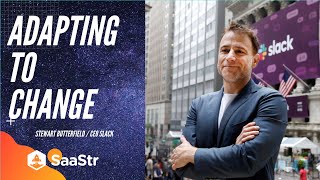
A transcript of a 2020 conversation between Jason M. Lemkin (moderator) and Slack CEO Stewart Butterfield about how Slack has responded to the COVID-19 pandemic. Butterfield reflects on past products (Flickr), describes Slack's move from an "innovation" to a "must-have" tool, notes customer heterogeneity (110,000 customers), and explains customer-success and onboarding strategies ("successful teams" metric). He discusses short-term relief for struggling customers (temporary free months, outreach), procurement/discount pressures, operational scaling (peak ~1.6M transactions/sec, large server footprint and refactors), and leadership advice for managing stress, uncertainty, and distributed work.
Chapters
And many of those people are going to go on to join new companies or start new companies or join new teams, found new teams, and they will make the decision.
All right, everyone, I know it won't really work on the zoom, but please give a warm round of applause for Stuart Butterfield for coming back to sastr. Stuart, thank you so much for joining us and taking out the time. It's super appreciated.
No problem. My pleasure. Thanks for having me so much.
I'd love to chat about, and I want to talk about everything and bridging the gap, but just looking at that video and thinking back to 2015, with 50,000 users in the Bay Area.
The.
IPO, how do you feel? Slack's been such a part of our lives. Like, how do you. How do you. How do you take it all in? How do you think back on those five years?
I don't know if the frog in boiling water is the right metaphor or not, but it's just, you know, it's. I've been in it all day, so it's actually kind of an interesting throwback to see that punctuated gap of 2015. 2020. Yeah, I. There are moments when I really appreciate it. Listing day was definitely one of those days. My mom ringing the bell to open trading of the stock. And kind of times like that. But the rest of the time, it's just work. There's just lots of stuff going on. There's always one more thing. One more hire, one more customer, one more feature, one more investor meeting and just keep going. Yeah.
Now, I really want to take careful use of your time, but I want to be nostalgic because we're work from home and it's the end of the day looking back, like, we've been doing this for a while. Flickr was so crazy. It was bought for what, $30 million by Yahoo. And that was like, crazy at the time, wasn't it? Like, oh, my God, this Web 2.0 thing, is it all just so much bigger and crazier than you ever thought it was? Is it hard to take in at all?
Yeah. I mean, it's a different world now, too, though. It's like Flickr was already acquired maybe like eight months or something like that before YouTube was even founded. 2000 and, God, it's 2005. We were acquired so 15 years ago. @ that moment, the coolest phone that you could get was a Motorola Razr. And if people had them, they would, like, you know, conspicuously put them on the table during lunch. So that's just one indication, I bet probably fewer than 40% of American households had broadband access at home. We were still pretty early in the general transition to digital. I guess that's four years after Salesforce started with the software, with the, you know, the line through it and cloud was born. But you know, this is, it is a completely different universe. Trying to think back to that time.
Yeah, it's just. And let's move on to Slack. Just Flickr. We didn't even think of Flickr as a cloud product, but it was actually one of the most disruptive cloud products. Right. No one thought how could you even afford to store your photos on the Internet? And it was just at the bleeding edge and we're kind of doing it again. We'll have limited time, but folks, put your Q and A and we'll try to at least hit some of the questions at the end. So from consumer and Flickr, I want to fast forward and I just want to briefly share the slide with folks. You know this slide, Stuart, if you can see it, which is Slack's percent of revenue from the enterprise. But a lot of folks who are OGs slack may be surprised, right? They may think that Slack is mostly a tool for startups or others they may not realize. But coming up, or maybe even past a majority of your revenues from six figure and up deals. So Slack has become at least I would say fairly enterprise. And I think you use the enterprise language, right? You have a very interesting mix of small, medium and large now getting bigger, which I want to dig into. But first tell us what you're hearing today from CTOs and CIOs. What are you hearing? This slide is the last deal you did before you went to sheltered homes. So what can you tell other founders? What are you seeing at the top?
I think it's going to be so specific to the company, the category, the product, but also I think the situation of the customer. I had a meeting with both the CEO and the CTO of an unnamed customer in retail. I don't know, I could say two, three months ago. And they were describing how they had just rolled out WebEx to the company last year. But they talked about it like they were in the Vietnam War. And it was just awful. Like you couldn't believe how challenging the change management was. Like this is just an impossible transition for us. And then near the end of the call, the CTO asked me if I thought he should switch to Office365 from on Prem Exchange. I was like, why are you asking me? If you put all the Customers on a spectrum and at this end is, you know, progressive digital first kind of thinking really strategically about their technology investments. I forget how many there are kind of at this end of the spectrum who are significantly behind. And you know, I think there's almost certainly some bias towards who I end up talking to first of all because salespeople will put me with the, you know, the more important strategic customers are ones where it feels like it's going to make more of a difference. But generally if there's an exec at the company who wants to talk to me, it's a good indicator that they're thinking pretty seriously about this stuff. Every once in a while I get a lucky break. But I think that there investments that seem necessary now are definitely getting made. The good news is if people can bridge the gap, if people can make it through to the other side, I do think for some customers we're pushing them three or six months down the road. For others it's like three or five years down the road of digital transformation. You know, we talked about this actually in my staff meeting earlier today. Think about in the last 25 years how many companies had consultants come in or like internal strategy teams do like a prepare report about telecommuting in the future and working from home and what it would take. And like just preparing the report took nine months and the plans were all like, you know, three to five year. And if you asked anyone if they could do it in a week, they would have said it's impossible. And then when it turned out to be necessary, turns out it was possible. So I think that will force reevaluation of a whole bunch of stuff down the line. I mean there's some stuff that's obvious, like Zoom. We used to sit in the conference room talking to each other. We still need to talk to each other. Therefore we need some kind of video conferencing, voice and video calling service. Some things are much less obvious. And I do think that once we're out the other side, when I have no idea how long that is, but once we're out the other side, I do expect kind of further uptick in investment in software technology, digital transformation, cloud. So kind of good news for everyone in the audience.
And what do you, you probably, I mean Slack's obviously seen incredible growth since Shelter at Home, but to me, and I'm just more a student and a fan and a user, but it seems like you might have an interesting insight because it almost seems like before Shelter at Home, Slack was a poster child for the Innovation budget. I want to bring innovation into my enterprise and Slack is a tool where I will be a her in my company. I don't hear much innovation budget happening in April and May, but a ton of budget from must have for mandatory and Slack I feel like went from an innovation tool to need it to function in my business. So is there a trade off there? Are you secretly struggling in some weird corners of Slack at the same time as you're seeing this avalanche of growth and usage?
Yeah, I guess we're seeing everything. Right. So you mentioned at the beginning the breakdown of enterprise customers and we use that $100,000 ARR mark. It's a little bit arbitrary because there's people who are way beyond that and there's people who spend 50 or 80,000. But we have 110,000 customers, as you know at last quarterly announcement. There's only 500 companies in the Fortune 500 so just kind of necessarily at least 109,500 of them aren't in the Fortune 500. So they're going to be a lot of small businesses. There's state, local, municipal government, there's like academic research labs, there's nonprofits, startups. So we're really seeing everything. And I think you're right, it's a good point. And I think an ongoing challenge for us, maybe not right this quarter, but kind of historically and when things resume normalcy that there is no line item that we're replacing in people's budgets typically there is no other. You know, like what I said in the 2015 is still true. This is a new category. We still have to invent it.
Budgeted even in 2020.
Yeah. And so you know, that presents some additional challenge. It also gives you a little bit of latitude. I mean I think net it's a disadvantage but it does give you a little latitude to sell in a different way. And I think innovation budget is one of those. And obviously after thousands and thousands of hours of practice, you started to refine ways to communicate to both to the executives and kind of the more procurement administrative. It kind of like people who actually have to deal with the stuff, how to pitch it.
Yeah. And how have you evolved your onboarding process and making customers more successful, especially with folks that are maybe the one you described that had spent five years evaluating WebEx. How do you get them up to speed on Slack in an hour or a day instead of maybe what change management used to be?
Yeah, well, we have a. I haven't experienced a lot of other people, so I don't know if this is really true, but I feel like we have the best customer success team in the business and there are now many tens, maybe even hundreds of thousands of hours of experience. And we used to think like Oracle had through acquisitions, maybe 1,000 or 2,000 people using Slack. And in 15 months we took it to 100,000 people wall to wall. And that was like the record that was so fast. That just seemed like, you know, mind bogglingly fast. And not to the same extent, I don't think, but there was 72 hours to get to 100,000 like a month ago. But I think the success comes when people are willing to invest and forget Slack for a second. You join pretty much any company, it's unlikely that there's any part of onboarding. There's all this, here's our security practices, here's get your laptop, here's provision your software, meet your team. Probably nothing on culture of communication, discipline around communication expectations. But if you're a manager, you spend more or less 100% of your time on communication. And for many roles inside of enterprises, certainly salespeople, it's going to be close to 100% as well. Even the people who spend the least amount of time in communication are probably 30 or 40% of their time. Even like you imagine the archetypal back end systems engineer kind of person, they still have to write bug reports and code commits and checkouts and they still have to communicate with their team and their manager. But if you average it out, this is not data, this is just made up. It's around 50% of people's time I think is on really basic communication and coordination. So not the interesting strategic, creative stuff, but just it's the daily standups, it's the status reports, it's the quarterly business review and it's the roadmapping sessions and everything that a project manager does. And I don't mean to say that that stuff's unimportant. I think the reason we invest such an extraordinary amount of time is because it's really important. So now you imagine I got 10,000 employees, payroll is a billion dollars a year. Half of that is going towards just people trying to stay coordinated, you know, just keep each other up to date on what's going on, just answering each other's questions so that they can do whatever the actual work is. So it's kind of nuts that there's zero or close to zero investment on how we should communicate, how we should run meetings, how we should write memos or anything. There are exceptions but generally people don't. So we kind of view the roundabout way to answer the question that the Slack success services are kind of the missing training from onboarding at your company that you maybe should have had. But that's also an effective pitch to customers and it's, hey, look, you're going to make this change. This is going to affect how people spend a couple of hours a day. Use this as an opportunity to piggyback some other change that you want to to some change in the culture, some change in process, a reorg. And you know, interestingly, in the current environment, kind of looking at the same thing at a global level. The backdrop of global pandemic change is so enormous that you can kind of sneak in anything you want. And I see that Talking to other CEOs today, not my customers. Just like there's a, essentially a Group Therapy SaaS CEO Roundtable and it's like, oh, that reorg that we've been sitting on for six months because we know people are going to be upset. Now's the time to pull it off because no one really cares. Everyone's like, has a much higher tolerance for change than they would otherwise have.
Got it. So you're seeing, I mean, I want to talk about SMEs next, but this is a great time to push the organizational change. As challenging as it is that we have no choice. Right. So take it all, take it all together. This one from your tweet. Good things on the mouse and daos and yaos and all the owls. But 110,000 customers. Many would go out of business. I remember when you came to SAS trainer in 2015. I was a Slack user, but I wasn't really aware of the fair billing policy back then that you auto deprovision. My jaw kind of dropped. My jaw also dropped when you said you'd never have a salesperson. You could chat about that later. It was a fun time. But I really felt that the fair billing policy was antithetical to how you scale recurring revenue as well. What are you seeing today with your customers that are struggling? Right. I mean it must be material. It's double digits that are struggling. It's not just the ones that are growing. What are you thinking? What are you learning? And how has Slack evolved to help your SMBs?
Yeah, so there's a bunch of things that we're doing. Some is more outreach for new customers. The teams have been running one on one consultations that just anyone can sign up for if they have a question, need help getting started, why they should do it. I'm actually doing my first one tomorrow. But the team has done hundreds and hundreds of these. We're also obviously doing more webinars, more training sessions. We have every vertical, every geography. So we obviously, we have customers in travel and hospitality, like probably most of the big companies you can think of in travel and hospitality, and they're obviously hurting pretty hard. There's a lot of people who are talking to CEO of another company, and he's like, yeah, my procurement guys are asking for discounts, as they should be, from everyone, for everything. I think there's a little bit of that. Like, you know, even if your business isn't especially affected, you might as well be asking for discounts. But it's pretty obvious the ones that are hurting. We also did something where when you cancel, like actually cancel a paid plan, which historically has been very, very low. So we have excellent retention. We do ask you why. And when we see COVID pandemic lockdown any of those things in the response, we just write them back and say, okay, have a couple months for free at least. It might help you wind things down if you need to wind it down. And worst case, we're not out anything, really. In best case, we have a fan for life. So there's a little bit of that. We're trying to be proactive with some of our customers who we know are hurting, but most of that is just driven by fair value. So we saw enormous spikes and we started to see churn, and we kind of have to tease it apart to see what's happening inside of individual companies. And I heard someone said something like 80% of startups have had some layoffs. So I have no idea if that's true or not. I also don't know how who measures that and how you would know. But there's definitely a contraction at the same time as there's expansion, I think net positive for us at this point. But over the course of the year, who knows how that goes?
Yes. So the sort of. But the take the free months from us, if Covid's impacting you on the exit seems to have helped, right? As one actionable tip.
Yeah, yeah. And I was talking to again, some of my peers, colleagues. A lot of them are just giving kind of a budget because it's usually not money that you have to spend, but kind of like an amount of money revenue they're comfortable giving up and just letting people in the field make those calls about how much they're willing to go down. And I think everyone feels like that's worth it because it's not like this is any kind of new insight at all. But acquiring a new customer is expensive if you can maintain one that's really, really good.
I want to just one I view. And again, I'm not on the other side. I view Slack. But it's, it does tie into another question. I think it's cheap. I think your ACVs are not that high. I think your per user price is compared to a pure set of applications. Do you see a lot of that procurement pressure or folks that are paying? I mean if I'm an enterprise and I'm paying $200,000 a year for Slack, it feels cheap compared to my stack. Are you feeling folks that want 10% off just to get it?
Yeah, I mean it's everything. And sometimes I don't even know how much we pay for most software. Honestly, I just trust, trust my team and I as a general rule think if we're buying software it's a good deal because it frees up people to do the stuff that people are better to do. And the things that are amenable to automation tend to be more repetitive and kind of mind numbing menial tasks. So hopefully I'm not doing anything dumb, but I'm always struck by how irrational people are. And I'll talk to sometimes the CEO of a company like much bigger than us, who wants $100,000 discount. I'm like what the fuck? What? How are you spending your time like.
This is spending their time? That's the mystery to me.
Right? Yeah, like how could that possibly be a priority for you? But you know, we get, you're crazy expensive because people will compare IT to Office365 which they have to license for the whole company. You know, even if there's only 10% of the company is using it. I look at what we spend on other software and we spend as a multiple of what we would sell slack to ourselves. Obviously we get slack for free, but we spend about 2x that on a workday. And I'm thinking of things that are basically company wide. We also spend about 2x that on Zoom because we have a huge number. Like every conference room is a zoom room. And is it too expensive? I don't know because the slack will come out to $0.80 per user per day or something like that. And if you're spending 50% of your time on internal communication and this has a real impact on that, who cares? Like set the thermostat half a degree warmer or cooler depending where you live and there's your 80 cents a day.
Well that's interesting. Zoom. You find folks pay twice as much as a total.
I don't know about other people, I just. Because yeah, the per user licensing for Zoom is lower but Zoom rooms are pretty expensive and we just. We have a third thousand of them or something.
Yes, this one I was super curious about. I find Slack free fascinating. I think Slack is cheap in the enterprise and I also think it's too free. I think Slack free is like the best. Well, Zoom free is pretty good deal too. 40 something minutes for nothing. I get even confused which Zoom I'm on. Our paid or our free one. But you said more are upgrading to paid plans. What's going on here in these crazy times and what can folks learn from it?
So we have an internal metric that we call successful teams because here's what our funnel is like. I went to the website because I was interested in it. I actually created a team which is basically means I filled out a form and got to the end of the process. I actually launched the app, I sent some invites, some invites were accepted. People actually used it to send some messages. People started to sustain their usage. So successful teams is like kind of the earliest benchmark where we and say these people are really giving Slack a try. It's like over the course of a week, multiple people are signing in on multiple days. So everywhere from the very top of the funnel to more people showing up on the website, to more teams being created, to more successful teams to more of those paying, all of those were up. And like I said earlier, the success team is more effective and efficient now because customers are really paying attention. I think it's the same thing. I try to make sure we always keep this in mind as designers and product people. People who don't work at Slack really do not care. Like Slack is not important in their lives compared to like their kids messing up at school or they got in a fight with their spouse or like you know, trying to remember the email and they wanted to watch Netflix tonight or maybe they should go to the gym or like what all the stuff is going on in their head. If this is the threshold that it requires for you to take time out of your day to visit our website. Every customer is just, just at that threshold. No one's coming in with an excess of intent. Like, like I might when I need a certain cable and I go to Amazon or something like that. I want to find that cable. I need the cable. I know exactly what I'm doing, whereas most people are like, I'm curious about Slack. So people are coming with a different attitude, a different intent. Like we need something. Um, I've heard this is good. So they're paying much more attention, they're putting more effort and energy into it. And you know, if, I don't know if there's a tip based on today's environment for, for people, but here's like a. I finally figured out how to explain something that's, that's bothered me forever. And that's. Let's focus on people's comprehension, let's focus on whether they want, want to do this thing or not and less on the friction removing because you can make it trivially easy and remove every bit of friction from some process. Adding an app to a channel in Slack, let's say. But if no one knows what, what that means or why they would want to do it, then it's completely useless to them. On the other hand, if they knew what the value was and they really wanted to do it, they'd overcome all kinds of obstacles to get there. And that's the, the not where we focus. We tend to focus. Everyone has this kind of growth hacker mindset kind of largely based on retail, like single interactions. I did the thing or I didn't do the thing. And where that doesn't work is it's not a big commitment for me to buy a T shirt or something like that on an E commerce site. I make the decision on my own. It's not a hugely consequential decision. I don't need to go away and think about it. But for Slack and for many other tools, I got to risk some of my personal capital inside the company to invite people and say, I think this is worth your time and I have to put all this energy and then the whole group has to decide at once and then we have to decide if we pay. Usually at larger customers, there's legal, finance, security, procurement, all these people you got to get involved and kind of enrolled in making this purchase with you. So it's not at all like the friction in the moment, like how hard it is to find the button or how big the text is is actually relatively unimportant compared to making sure that we're building up a good enough model of what people want. And I think we have made some improvements lately and that can maybe account for a tiny bit of this. But this is almost all people are coming in with a much higher degree of intent, like you know, five times more desire to actually get something out of their visit to this website. Got it.
If we had more time, I'd love to explore that. Making applications frictionless is not enough because we love this idea. We all love this idea of taking. We can just think about it as builders. Let's relentlessly take friction out. But it's not enough. I suspect when you talk to CIOs and CTOs, that's not number one or number two on their list versus the competition is friction. Isn't it something else? What are their number one or number twos? Out of curiosity today, why are CEOs and CTOs picking up slack?
Well, this is an argument that may not make sense here, but I'm happy to have it in the broad sense. I mean only Slack's the only product that you can choose if you want to do the thing that Slack does at any kind of scale. We have an enterprise grid product allows you to federate multiple workspaces together for our largest customers that means thousands or even tens of thousands of work workspaces, millions of channels and teams, which is the real alternative in some sense. Although I think it's much more of a competitor to Zoom or other voice and video calling services than it is a Slack. It's limited to 5,000 people per instance and critically only 200 channels. And if you want to add a 201st channel, you have to hard delete one of them without the whole history. So it's not that I don't think Teams is a useful product. It's their replacement for Skype. For business they're migrating people over and people need to do voice and video calling. I think it's also by reputation anyway the world's best SharePoint browser because it makes it now that you have a kind of a locus for interaction around stored files. It's much easier than using SharePoint directly. But people choose Slack because they want something in this category and Slack's kind of their only choice with a certain set of security requirements or a certain scale. If you want it, you choose Slack.
Got it. And it just I would love to have that learning for an hour, but the meta learning to me is Frictionless isn't on that list. Is it there? That is not on. That is not.
And for given customer we had launched international data residency in the fall and for German customers and a lot of other European customers are like we're not having this conversation until we can have our data stored in Europe encryption key management came six months or so before that and there's a lot of customers who were Just like until we can manage our own encryption keys, we can, we can't use this product. So there's that, you know, there's. Can we be HIPAA compliant? Is it FINRA compliant? Does it have this. There's that stuff and then there's. Does this. Can you convince me that this really fills a need that we have? Because often what they're hearing is kind of an undifferentiated desire among the end users to continue to use Slack or to expand the usage. And all they know is the people like it, but they don't know exactly why. And often end users can't necessarily articulate exactly why they like it either, to be honest.
Yeah, let's talk about this one because it's fascinating to me. Maybe just give us one or two learnings for everyone else. How do you even keep Slack up? I mean, what are the grow? I mean, you know, I remember I saw Drew Houston say something maybe 60 days ago saying they had about a 20% elasticity budget at 20 Dropbox, like they're scale for files at least 20%. And that was my experience. You're seeing an order of magnitude more. How is this even possible and what should we learn from it?
What are a couple. Well, you know, I think if this had happened six or nine months ago, we would have been much more challenged to keep up with it. But I think the investments we've been making over the last year have been, you know, they've really, they've paid off. And I think people don't appreciate the scale of Slack. You know, people rarely do this now, but people say, oh, it's a messaging app. I can make one in a weekend or something like that. At peak, it's like 1.6 million transactions a second or something like that. I could look in the background while we're talking here. It's huge. There's tens of thousands of servers. It's a really complex topology. But we've been focused mostly on automating, scaling. And prior to that there was an enormous effort to kind of untangle parts of the internal technology and the services because we grew so fast and we're trying to do so much. The engineers who had been at Slack for a long time and had kind of Jedi level knowledge of how everything fit together, could deploy new code and not worry about things breaking that often. But for new people, it was just like, oh my God, every time I try to deploy something, something unexpected breaks in this other part of the system. So the kind of refactors that they've been doing, which are always really complicated when you have lots of users and lots of data, because you can't just make the change, make the change and then backfill data for sometimes six months or a year. A lot of that has really paid off. And if there wasn't something like aws, I think we would have been much more challenged to accomplish this as well. Because a lot of it, literally the systems are automated in the sense that we do have people monitoring and we have people on call all the time and they do have to intervene. But generally, like theoretically, you could just sit there and watch it on the ops team for a day as suddenly it scales up. Now, that's not to say it's not hard work, because it was enormous work to get to that point.
Yeah. I sort of quietly, as a student watch on Twitter which services are actually going down that are under load and slack and Zoom have held up well, There are plenty out there. I won't name names that I can just see just go down. I can just see the login page not work in contention. But maybe the meta learning for me is you had to refactor and it was six months ago, you had to refactor again to have this sort of infinite horizontal scalability really make it work. So this one I want a little bit skip because we did it. Let's just help us a little bit because I know we'll run out of time and let me know if you need to leave this second. But tell us about this tweet. Tell us about stress. How are you guiding the team? What can you share with the rest of us cathartically in terms of helping folks that are. I don't know what we're in 38 days to this. We are 40 days in this crazy world we didn't plan for.
Yeah, it seems like a long time regular life just seems so long ago. Now, this is not necessarily useful advice if you don't have the means. And I do know people who have thought they had 18 or 24 months of cash on hand and suddenly when revenue drops 90%, they actually only have 45 days of cash on hand and they have to make pretty dramatic choices. So some of these options aren't. Aren't available to everyone. But I think going out of your way to be good to people today will pay off in the long run. And we were out there really early with a message if you need to take some time off, you need some flexibility. Because the reality is we had people working from home before they had a home office set up. They had childcare. At 11 o' clock in the morning they could walk over to their favorite cafe and sit on the sidewalk and enjoy a coffee and then go back to their home office and continue working. This is not like that, like you can't get a haircut even like, never mind anything else. And you're. Everyone's waiting to get their home Internet connection upgraded and everyone's arguing with their spouse about who gets which part of the kitchen for the next video call. And everyone's trying to figure out what you do with a six year old who's going bananas being locked up in the house. Um, so it's a, it's a very hard time. I think we have to remember that. I also just, I personally find it exhausting. Like the. By like 5 o', clock, I'm toasted. Um, and the number of hours I'm working is not greater, but maybe I hope I'm getting more done, um, because it just seems so much more challenging than it did normal life. And we had a big surge of adrenaline, which I think helped and kind of pushed us through some of the early weeks. But at some point that kind of wears off. And there are a lot of people who are unhappy, who want to be able to go outside, who want to be able to go to a movie, who want to be able to go to the office and they want to be able to see people and have dinner out and stuff like that. And I don't have any prediction, but my personal guess is that it could take us till the end of next summer before we're out of like, we're kind of back to work. I cannot see companies like, because we don't have to be in the office, so why would we go first? No one gives a prize for being first. I can't see us being back in the office before September. And I think that would be. That's the absolute earliest. And I don't expect that to happen.
So remember this year or next year.
Of this year again, I think that's the absolute earliest. I don't think that's likely, but I can't imagine it happening any sooner than that. And if that's the reality, then we're still, we're maybe 5%, 10%, 15% of the way into this. We've got to pace ourselves.
Yeah, I'm just trying to learn and we'll hit our last point. But I just feel like especially Bay Area tech companies were the first to go home. They're going to be the last to Go home back. I mean, as a co, would you want to send anyone into an unsafe environment? You never would unless you had to. You're gonna be the last person out there. I mean, to say go back to the office if you're not 100% confident and safe.
Yeah. And you know, we have offices in 15 countries, so it'll be interesting to see like we shut down Japan a month before San Francisco, but we actually opened it up back up. Not everyone is expected to go to the office, but you can go to the office if you'd like. Tokyo was not designed for the whole family, including the kids, to stay in the apartment all day. That's just not how the society works. So I think they especially needed it. Now they're closed down again. Australia might open up earlier, so, you know, we'll keep an eye on those things. But no, I definitely wouldn't want to encourage anyone. And at some point, I think when it seems like it's safer, giving people the option to go in to have a different space to get some work done, I think is something that we would consider. But yeah, I do think this is going to be a long, long time. Long time.
Yeah. The last one I wanted to hit and then if there's anything else you want to hit with your scarce time, let me know because it's always interesting to me. I meant this one as a joke, but maybe I'll answer it more. More your cast iron pans as your but shelter hacks. Either tell me a home one, we can have fun or give me a work one. Like from a leadership perspective, like, what have you learned? What's your hack? Could be on slack, it could be anymore. But what's your top learning that's improved things at home or at work?
Yeah. So on the home front, it's really interesting. You know, I've never. I'm not in the top half. I'm probably in like the bottom quartile for like handy, handymanness or something like that. And I never learned how to sharpen knives. I love cooking, so finally learned how to sharpen knives. There's a lot more dishes, there's a lot more cooking and cleaning and I actually kind of like that because unlike, you know, stupid to do list here, it's finite and it's kind of tangible and I can see measurable progress and I can get it done. So I almost find it therapeutic to cook a big meal and clean up. And so if you don't have cast iron pans, I recommend just get some the cheap large ones that cost 20 bucks or something, and you can scrub them with metal scrapers if you want. And this look good. On the leadership side, I don't think I've been living up to this to the extent that I should, but it. I was talking to Scott and Mike from Atlassian, and in the early days, they were uploading a short video, like a 90 second video to the whole company every single day. Just to say, people, here's what we're hearing right now. Here's what's going on in the business. We just want to let you know that and fill in the blank with whatever, because this global situation is an excellent illustration of kind of one final thought, and that's that human beings hate uncertainty. Like, we're just. It's built into every culture. You know, it can't. Things can't be random and unexplained. It can't just be roll of the dice that it didn't rain here this year. It must be that we didn't sacrifice enough goats or something like that. There has to be a reason for everything and it has to be knowable. And I think this is really testing all of our ability to even continue to function cognitively in an environment where we don't. Where we don't have that kind of certainty. So on the leadership side, but this could be CEO, this could be line manager, this could be individual contributor on a team who wants to provide some leadership for everyone else. Leaders remind people what's important. And while we can't know what's going to happen with the economy, we can't know what's going to happen with the health and the other impacts of the pandemic. There are a lot of things we can know and there are a lot of reasons why we do things that people could stand to be reminded of. I mean, this is a great opportunity for people to double down on purpose and the impact that they have on customers and kind of what they want to accomplish either out of the business or out of their lives. And you can't bring that up often enough. Yeah.
Something we're all thinking a lot about these days. All right, Stuart, I would love to chat forever. Anything else you think that founders and others that will watch this would like to know today or. That could be helpful.
Yeah, I'm sorry we didn't get to the questions. I tend to answer pretty verbosely. You know, we're just going back to the very beginning. I hopefully as many of you as possible can hang in there while the world sorts its stuff. Out because I do think the other side of this is going to be great for software in general. A lot of people who thought something was impossible are going to now think maybe it's possible. A lot of people who had resisted certain kinds of change now having been thrust into this great change, are more open minded about what they'd attempt. So there's that. There's going to be even more opportunity, let's say three years from now than there was last year or three years.
When we get through it. Right. And maybe to just summarize and we will break my view. I don't run Slack, but I think the boost that Slack's getting as an example, I think it will be permanent. I don't think anyone that's all of a sudden come to Slack once we get together at home is to say, I don't need slack anymore. I think you may be in industries that don't benefit today, that are hurt, but when we come out of this, I think we're going to get an even bigger push than we anticipated before.
Yeah, I can see that too.
Yes. All right, Stuart, thanks for making this time. I know you have a lot going on. I'm sure everybody appreciated it and you're a good friend to Saster and to everyone in the cloud. We'll talk to you soon. Thank you.
I'm glad you were able to pull this off. I know it must have been a little heartbreaking to cancel the real thing. And hopefully you're back soon.
We'll be back. All right. Thank you so much. This was great.










