The 3 Stages of Denial When Graduating Beyond Founder Led Sales with Mixmax
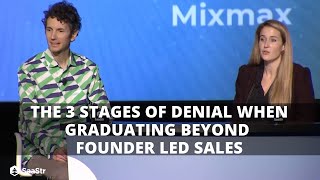
Transcript of a Mixmax talk (Olaf Matei, CEO, with AE Katie Helton) about the three stages of denial founders experience when moving from doing sales themselves to building a sales organization. They describe (1) CEO-as-rep pitfalls, (2) hiring first reps and common hiring mistakes, and (3) delaying senior sales leadership — then discuss practical interview questions and hiring exercises for ICs and heads of sales. The tone is candid, reflective, and tactical.
Chapters
Please welcome mix max CEO olaf mate and mixmax account executive katie helton.
Good afternoon everyone. I hope you all have been having an amazing time. There's already been so much rich conversations occurring and I'm sure only more to come over the next day or so. So I'm Katie Helton, an account executive at Mix Max, and with me today is Olaf Matei, so CEO of Mixmax. We're here to share a few personal stories of the three stages of denial you go through as a founder, doing sales like Olaf, and ultimately to building out a sales team and hiring people like myself on this journey from 0 to 10 million in ARR.
And so the hope for this talk is that it'll be like very hands on, potentially a little bit self deprecating, and that you'll all hopefully either recognize yourself in some of the stages of denial that I we went through as a company and you might even be in other stages of denial. So you might even be able to elaborate on this preliminary list of the three.
Yeah, and from a rep's perspective and being at previous earlier stage startups, I've seen CEOs grapple with this transition from founder to first salesperson, because after all, they likely know the product best and are able to use customer feedback to measure product market fit in real time. However, at some point you do need to hire a sales team as a founder or else I'd be out of the job. So Olaf, tell us about the three stages of denial you went through as founder and CEO of Mixmax.
Yeah, I'd love to. We can actually bring them up on a slide here as well. So these just reflecting on our own journey at Mixmax in terms of the evolution we had as a company. Here are a couple of the stages of denial that I think I went through as founder CEO, from doing sales completely on my own, to building out a sales team and finding actual leaders for the go to market team. And so the very first stage of denial that I went through, and I'm sure some of you in the audience have gone through, is this notion that as CEO, I can be a great sales rep for my company. And so a lot of people tell you, you know, as CEO, you're an amazing rep, you have to be an amazing rep. And as we'll go into, there are a couple of reasons why that actually might not be the case. And the impact of this stage of denial is you're too late in terms of bringing on the first couple of reps to your team. And so that kind of leads into the second stage of denial, which is when you bring on your first reps. That's typically really hard because you're building out a function from scratch. And so you don't have the detailed domain expertise in sales. Right. And so you find a set of candidates and you feel they're just like, kind of. Right. And so you tell yourself these people will grow into the role. And of course, in a lot of cases, it's just too hard and they might not. And so that's kind of the second stage of denial. And then the third stage here is once you have a first couple of ICs, you tell yourself, for a variety of reasons, we'll go into that. I, as CEO, can double down or double up and actually be head of sales. And we don't need a functional leader here. And so you're too late to actually build out senior leadership in sales. And so, as you notice on these, these are various stages that you go through. So it's a little bit of a funnel. Once you hit the first stage of denial, you're fresh onto the second one. You don't realize it yet, and you kind of graduate through these stages. And right now there's probably a fourth stage of denial that I'm in. That will be a great topic for Saster 2020.
Yes. When we briefly spoke about doing this discussion a week or so back and you floated these three stages to me, they definitely even resonated on a rep level. As a teammate, I've seen CEO do sales. And that, of course, has some benefits, but a few drawbacks as well. It's always exciting to see new ICs brought onto the team that have a lot of projected growth. Of course, the risk then becomes too much growth and them actually filling into that role. And then finally CEOs actually letting go and handing over the reins to seasoned sales professionals. So why do you think founders struggle with these three stages of denial?
Yeah, so in kind of, what I've extracted from just my own introspection on this is there's just a huge difference in the skillset. You have to have to be a successful entrepreneur pre product market fit versus post product market fit. And so what really distinguishes a lot of entrepreneurs is we're typically like pretty multifunctional. We have this can do attitude pre product market fit. We might be juggling 10 or more functions on our own, and we're so used to diving into the nitty gritty and details of all functions that we often forget that there are people who are literally 10 times better at all of these functions than we are. And so the kind of interesting transition once you feel you have product market fit in the kind of post product market fit world is it's no longer about your own can do attitude. It's about finding seasoned professionals who can execute on particular functions and who are great operators. And I'd even go so far as to say, as I think founders are perhaps overall, in the kind of discourse and world of startups, founders are probably a little bit overrated and operators might be a little bit underrated as kind of the unsung heroes of the startup world. So I just think that difference between pre and post and how you have to completely shift your mindset as an entrepreneur is a big contributing factor to going through these three stages.
Sure. And just going ahead and tackling this first stage, head on, this idea that you as CEO will be the best rep actually seems to make a lot of sense. Most founders, CEOs, they build the product themselves or at least are heavily involved. I know you especially are a big product guy, have a lot of background in that, and have had a heavy hand in how Mixmax has grown, grown. And you know it better than anybody else. Did you secretly at first think that you would never need to hire a sales team and would be able to do it all on your own?
Yeah, great, great question and good, good point to clarify because I think the short answer to that is no. Everyone knows they need a sales team. And what's interesting about these stages of denial as well, like everyone knows they'll need ahead of sales. So the question is just when do you, and what you tell yourself as a founder typically on these, is, you know, we, we don't need to do this thing quite yet. I can still be doing closing most of the deals myself or I can be head of sales for yet another couple of months. And that's kind of not how it shakes itself out. And so a couple of reasons why I think that's the case. And it's probably particularly the case for businesses that start out as self serve businesses or have a really strong self serve component. So Mixmax, of course, being a self serve business, what did we tell ourselves? Well, hey, sales for business seems to be booming, so there are all these companies we admire like a Stripe or a Slack or a Dropbox or an Atlassian and they seem to have built these unicorn companies seemingly barely without sales. And so you tell yourself, well that seems really awesome, more people, more problems. If I can avoid or postpone building out this other function that's going to cost a ton of money. The longer the better. Right? So that's kind of one reason. The other reason I think is if you have a self serve business initially, the type of sales inquiries that you get are just so artificial and kind of weird. And so if you have a self serve business, what types of inquiries do you get from people? Well, typically you have people writing in, they're already like pretty bought into the product. And so the types of sales inquiries you get are people asking like, hey, can you explain more about team functionality? Or can we get a discount for 10 or more people? Or can you provide a slightly longer trial because we want to see how it integrates with this other product or tell us more about your security certifications. And so what you notice about all these questions, these are not really the typical kind of sales questions you get in a real sales environment. They're much closer to product customer discovery questions. And so what you end up doing as founder CEO, who grew up in a product area, be it design, engineering or product, is you end up approaching these what defactor our sales conversations more as like customer discovery or user feedback. And so you end up with like a 75% close rate, which is completely crazy and like indicative of like part of the problem in a way.
Yeah, sure, I would love a 75% close rate, but and on that note, were you running like, what did a typical sales cycle look like for you? I mean, were you doing discovery calls and really trying to understand like the value that you like mixed max could potentially bring to this organization?
Yeah, I mean, frankly to me, I think it was much more of like what even is a discovery call. Right. And so that's something I think you discover as a product centric CEO when you at first bring on sales.
Sure.
And so kind of by virtue of the type of questions you get, and also just because you don't have a clue of what a great sales cycle looks like, you end up treating these conversations again, much more as like customer or product discovery sessions than an actual sales call. And so one of the drawbacks of this is sales quickly gets really boring for you as a founder because you end up treating it more as like, hey, I'm going to show you all the great features of what this product does rather than doing great discovery, which is what amazing reps do. And so it just means that you get very quickly diminishing returns on these calls. You do like 10, 15 of them. You stop to get new learnings from it. And part of the reason is you just didn't do good enough discovery initially. So you haven't understood kind of what the unique pain points are or what's unique about the particular organization you're talking to.
Yeah, it's definitely interesting hearing how you approach sales definitely differently than how my peers and myself would approach it. Thinking about really doing an intense, drawn out discovery call with thinking about all the different sales methodologies, whether that's Challenger or using Vance or Medic, to really kind of hone in on what's the potential value we can bring to the entire organization and not just maybe a subset of that group because of course, we would never want to leave any money on the table.
Sure, sure thing. Yeah. It's funny actually, just what you mentioned about discovery ad discovery calls. I think the first time I said it on the discovery call, I was like, wait, you spent 30 minutes and you didn't show off the product once? Like how, like what are you doing kind of thing? So that was definitely. That's a process, definitely eye opening. I mean, I can think of a couple of other reasons where I think kind of founders who kind of grew up in kind of a broader product or grab a product background are a little bit disadvantaged when it comes to sales. So a couple of great lismuth tests just to ask yourself, for how long should you as founder, CEO be doing sales? And so one thing you can ask yourself is, what do you really enjoy doing? Do you enjoy building relationships with people or do you enjoy building product? And if you're on the product side of the house, it's clearly the latter and not necessarily building relationships. Another great litmus test for this can be something like, if you have an hour left, suddenly you have an hour to spare. Where does your mind wander and what do you spend time working on? And so for me, that was immediately like, I dive into aspects of the product or test out new flows or whatever it is, or think about the roadmap or write specs at the et cetera. Whereas I think folks like you are actual reps, you're like excited to do research on your accounts and understand that so very. Yeah, we're a little bit disadvantaged in that regard.
Yeah. And actually I remember early when I joined Mixmax, you were talking about the differences between like two different types of people. The dichotomy of like this, you know, a monk versus a potential stockbroker and how that plays into sales versus product focused people. Care to elaborate more on that analogy you love?
Oh, yeah. Well, it was actually a growth hacker, a growth marketer who showed this to me and it resonated with me. So this person was basically like in terms of illustrating the dichotomy between the maker and the closer parts of any organization. So it was kind of like very stereotypical but a little bit useful. So kind of broadly in terms of extroversion, willingness to take crazy risk and. And perhaps how forward or aggressive someone might be. On the one end of the spectrum you have stockbrokers. Right. They're used to just like haggling, being super forward. And on the other end of the spectrum you have monks. And so monks obviously, like, very introverted about internal peace. And so product people tend to be perhaps a little bit closer to monks and kind of salespeople and growth people tend to be a little bit closer to the stockbrokers. And incidentally, you actually started your career as a stockbroker.
Yes, indeed. Adds up.
Fits kind of well the. I think the interesting thing too with this analogy is monks being more like introverted stocks or like internally focused, where stockbroker is dealing more with kind of externalities and external constraints. There's a big difference when you're a kind of the types of constraints you're used to working with if you're a product focused CEO that are very different from the types of constraints you face in sales. So on the product side, typically the type of constraints you have are purely internal. So you want to execute on some particular part of the roadmap. And the constraints you have are typically internal. It's like, how many people do we have on the team? How many hours will this thing take to build? Do we have the right infrastructure set up? Do we have the right knowledge on the team to execute on this roadmap? All very internal focused. As soon as you deal with sales, suddenly you're dealing with a ton of external constraints. Right. Many of which you try to make under your control, but are fundamentally just so different in nature. So some of those being like, what does the customer org look like? Who are the stakeholders? Is this an important initiative internally for them or not?
Yeah. And timeline, I know something is you struggled with early on having reps on the team, potentially pushing things to the next month.
Yeah, I mean, that was super frustrating for me because when I would do, I would do sales calls in part because I felt they were a little bit repetitive. I was all about closing as free fast as possible and just moving on to the next thing. And so it was funny. I think there was some point in our early interactions, I was like, hey, how is this deal going to close? This month. And you were just like, oh no, it's just going to, they're not ready yet. It's going to be a couple more days. And I was like, what?
Yeah, it's definitely interesting. And I think while you certainly have a point that timing does kill deals or time does kill deals over time. You know, you also want to be cognizant about making sure an opportunity has the appropriate amount of time to grow into its full potential. So that was definitely a little bit of back and forth we had on that one. I do remember. So given this background, Olaf, do you think CEO should be doing sales at all?
Yeah, well, for sure I think it's useful in terms of getting a first sense for just how customers react. And I think the point here is again, one of timeline is graduating that very quickly to a professional. There are a couple of. Yeah, I think there might be a couple of like structural reasons to why CEOs ultimately aren't like great reps. So one thing about something that characterizes a great rep goes back to discovery, right? Understanding customer needs, asking really great open ended questions, being a great listener. And it's just interesting reflecting on the first part of my own CEO journey, which was so much about evangelizing. And you end up doing more talking. Right. And it's just interesting. Like some of the people I consider the very best reps are like coaches. And coaches are fascinating because they spend 2% of the time talking and you as a customer do 98% of the time talking and they charge you a ton of money. And still after a coaching session you're like, wow, you're worth like way more than this. So just like a very different kind of mentality what you get trained into.
Curious as CEO, I would imagine. I know for me it's always nice having a little bit of a lifeline. But how was that like having no lifeline when you were running your own sales cycle?
Yeah. So stressful as a CEO salesperson. So very often in sales cycles, right, you have the customer, they go like, okay, well we'll buy if we get this for whatever it is, $4.99 per user per month or something like that. Can you do this deal? And then a CEO on the call, you're like, who do you call? Like, it's not like who wants to be a millionaire? And you just have a lifeline. You can't go like, yeah, let me check this price with my board. Like, you're kind of like, you're forced to give an answer then and there. So you just don't. Whereas you can escalate.
Yes, and I do. And it's definitely very helpful to have a part of, and it's typically a part of a lot of sales conversations. But whether it's you or my head of sales, it's always, you know, someone does have to have that final say. So it's nice to have that lifeline, unlike you having it.
Yeah.
So it's a nice segue into the second stage of denial. The idea that, okay, maybe you're not the best suited person to be the first rep and that you're going to hire an IC and that you're going to hire one that has a lot of room to grow into the role because after all, you naturally grew into the role or at least for a good bit of time coming from that founder, CEO role. Tell us about some of the first sales hires you made at mixmax.
Yes. So, yeah, great, great point. So we're kind of at the second stage of denial, right? We've realized, oh, as founder CEO, I need to find someone who's like 10 times better at sales than I am. And so it's just an interesting kind of general question because we all face this in our companies. We're building out a function for the first time. And so we're having a first hire in a particular function, which of course is really, really hard because we know very little about this function on face value. And so what do we typically do as founders? Well, as founders or entrepreneurs, we're impressed by the prenicorns or unicorns who are ahead of us. And so we go, hey, those companies are really successful, so we should bring someone on from those companies. Right. And so it kind of makes sense of face value. And so what you miss there is the person who joined as employee 700 at unicorn company Alpha wasn't employee number 17. And so the types of support systems and training that they got was just like so wildly different. They might have been incredibly successful as employee 350 or 500 and just the constraints they'll be under at your company are just so different at like a series a stage company. So what we ended up doing was we found someone who was super excited about it, really excelled. A real sales pro from, you know, a Silicon Valley unicorn company brought them on. Mixmax being like very much an SMB mid market focused company, this person was an enterprise rep and we were like, you know what, it's going to be fine. This person will grow into the, the role because it won't be that different.
And what happened next?
Well, of course it didn't turn out that way because it turns out that growth trajectory is just like too crazy. So it was kind of like we thought that the seasoned sales pro from the unicorn company would be great for us, and that wasn't really.
So what was your thought process, thinking about? All right, well, now I've made this, which is a big leap, this first sales hire, and they haven't necessarily worked out. What did you do on the second hire?
Yeah, so it's funny, I think very often in these hiring situations you end up swinging almost between two extremes. So we've gotten. This first hire was like super seasoned, amazing rep, just like not the right fit, given the type of org we were. And so we were like, okay, what are the learnings? The learnings are we need someone who's like way more startupy and way more scrappy. And so you go to the entire opposite end of the spectrum and you hire someone who's like this startup generalist who totally knows how startups work, who can take on any type of function. And you tell yourself, well, you want this person to build a sales team over time. And you tell yourself this person will grow into the role over time, even though they might not even have any type of formal sales training. And so that becomes really rough too. And that's where we ended up. That person ended up adding a ton of value to the company, but ultimately wasn't able to actually build out a sales team just because they didn't have that expertise or experience.
Sure. And that definitely is a story of two extremes. And obviously, unfortunately, those not working out as the first two, two hires. If you could talk us through what you would do differently, if you could go back and make that first sales hire again and what type of personality that might be.
Yeah, great question. I'm not sure I have anything prescriptive to say. I'll just share kind of an observation from a couple of other companies that have had kind of, I'd say probably just a more mature approach to placing their first sales hire. And then I'll share how kind of what we did that ultimately worked out. So what I've seen some other companies do, which is really interesting, and this just goes back to this notion of how hard it is to build out a function from scratch. So what I've seen other companies do successfully is they hire someone who in sales has excelled as a rep in a similar type company. And what's different about this person is while they have multiple years of sales experience, they're not necessarily. They don't want to be VP sales next year. They in fact, fact might think, you know, hey, perhaps, perhaps they want to go into another function over time. They want to go into biz ops, they want to become a gm, perhaps they want to do product or, you know, own a success org or something like that. So they're intrinsically just have in their mind that they might not be in sales two, three years from now, which just makes them way more, you know, adept at kind of adapting to different, taking on different functions in the company. And of course, like eventually having a head of sales versus what's otherwise kind of common. You hire a first sales rep who wants to be VP sales within a year, and that can kind of create all kinds of tension. So I've seen that work out well.
Nice. Yeah.
And then perhaps since you asked too about kind of how we ended up solving this. So for us, what we did, and we've done this in a couple of functions and it's worked pretty well for us, is you actually bring on someone who has been ahead of sales or VP sales on a consultant basis. So they come in like a couple of hours per week or something like that, and they help you build out the team. And so a great advantage of that is you have someone seasoned who can help you hire in a function that you don't have a ton of expertise in. And it'll kind of bleed in a little bit to the third stage of denial here as soon. It'll also help you as entrepreneur iron out any rough edges you have around what it's like working with the head of sales.
Can you elaborate a bit more on what it was like handing over the reins when you brought on, whether it was a consultant at the time or when we eventually did make a more senior sales hire, what it was like before that, trying to be actually head of sales and CEO at the same time.
Yeah, yeah. I think this goes to the third stage of denial. Right. Which is SEO. You think you can be head of sales for way longer than you should be. And so let's dive into why. I think that's a really common stage of denial. And by the way, I think this goes. I've seen this in so many founder friends as well. And I think it goes for kind of almost any executive level hiring. And there are almost multiple stages of denial just within this last step. And so a couple of things you tell yourself is like, hey, we don't need this hire right now. We have one or two reps. So, hey, with one or two reps, the management burden isn't that great. It's not like it's a 10 person team and suddenly you have so much else you have to deal with. Right. So you're happy to postpone it. You're also really nervous about bringing in a senior hire because, hey, senior hires cost a ton of money. You know that the failure rate intrinsically, from what you've read, is just higher than in other functions. You're nervous that you haven't figured it out. You're nervous that, hey, we don't exactly know what our funnel looks like. Perhaps we're going to change our commercial model a year from now. There's so many uncertainties and kind of, hey, the thing you have to realize is the reason you're bringing on a senior hire is that they answer those questions. You don't have to have all those answers for yourself. And that goes back to the little bit like this can do attitude. That becomes kind of your worst Achilles heel. You're now bringing on people to kind of solve those problems for yourself in a way.
Yeah, sure. And can you elaborate more on this idea of sales just being a funnel and kind of the mindset you are had where it can't be that hard. It's just a numbers game. Clearly with my 75% close rate, I'm crushing it. And so surely I can help a few reps like pick themselves up and do a great job.
Yeah, yeah. It probably goes back to this kind of CEOs who haven't necessarily kind of like come of age in sales, become available in a product function. Right. Because you're typically kind of analytical and numerical yourself. So you have a couple of reps, they seem to be doing great. So you're like, there aren't enough of them that they need a ton of management. I don't need a formal career ladder or anything like that yet. So it's about funnels and numbers. Awesome. I can do this. And so what ends up happening with this is you end up being six months too late in terms of building out a sales org. And this is actually what happened in our case. At one point, my two co founders sat me down and they were like, hey, weren't we supposed to actually have a sales team by now? And I felt really defensive about it. And then later on that evening, I was like, damn, they're totally right. And in theory, as CEO you can do all these things, but what takes you three days to do takes ahead of sales, like three minutes or 30 minutes to do. And so you're just like wasting company time.
I'm curious, outside of the co founder sitting you down and thinking like, hey Olaf, where's the sales team? Are there any events that stick out to you of like, wow, maybe I'm in over my head trying to manage being like two jobs at one time.
I think it was probably this, just this realization that whenever I would spend time on something sales related, it would just take like exponentially more time than I felt it should be for someone who's really senior. And so bringing on that consultant was a big like watershed moment for us and helped us a lot.
Yeah, well, wow, what a journey. Definitely through these three stages, it's clear that you come to the realization in some capacity that you do need to hire a seasoned sales professional and at each level as well. So switching gears a bit, let's dive into a more tactical session. So interviewing candidates after going through these three stages of denial. So how does prior experience of being a rep yourself, mishiring the first few couple of reps and then trying to be CEO and head of sales at the same time impact how you went about hiring the sales team as it's saying stands today?
Well, I think overall it was just like a very humbling experience overall and one that I think just gave a little bit more humility in the overall interview process. So definitely a long learning journey.
What are some of the questions that you started to ask that you felt like were leading to some of these successful hires?
Well, actually, I wonder perhaps just to flip it around to you too. It's interesting to hear kind of view as, as an AE and candidate perspective on what you feel some of the best questions are that you've been asked in your career when you've interviewed at companies.
Definitely. Yeah. I think it's a very rich topic and one that's important because at the end of the day you're also interviewing this company as well. And so what they ask you is really important. For me, three things stick out and the first is some type of exercise because at the end of the day I want to make sure they know how I'm going to do my job. Talking about my past experience a bit and then whether I'm a good culture fit and ultimately a small startup. That culture aspect becomes super important because you never want to join the wrong team when there's so few of you.
Got it, Got it. So it's interesting that for you as a candidate, the kind of three big kind of areas you mentioned are kind of what I feel is like entrepreneur, CEO are really important too. So having some kind of skill based exercise and sale, understanding past experiences and then culture. So on the notion of a skill based exercise, it's interesting that you bring that up because I would imagine as a candidate you'd be like, it's great if I don't have to do a skill based exercise. Like, why is that important to you?
Yeah, I think, I mean, in theory everything would be easier, but things that are easy are not as satisfying. So it's almost more of a red flag if someone's not asking me to do some type of exercise because how are they going to have an accurate idea of how I'm going to perform on the job? And, and I think it's perfectly fine to have some type of mock or role play of a discovery or demo call. And that way the head of sales or CEO, whoever's interviewing you really gets to kind of take a sneak peek into how you would be selling their product. And I tend to believe that you should just demo the product that you're currently selling because you should be an expert. And it'll be very clear when the other side of the table starts to ask questions that you probably have never heard before because likely they're not familiar with the product and you either do or don't know how to address them really clearly. So I do think that exercise component is important in the interview process.
Got it. Got it. And so. Got it. So to me there's like this age old question of when you have a rep do some kind of demo or discovery in an interview, what do you ask them to demo? And so you're saying, ask the rep to demo the candidate the current product they're selling, not your product, not like some other super well known SaaS product like a Dropbox or something like that, but the product they should know.
Yeah, I mean, I think it's preference of course, but why not put someone on the spot with something they should be an expert at? Because then it'll become really clear if they're not currently an expert at the current product they're demoing.
Got it, got it. And so what about past experiences? What, what are some of the richest like questions and like most motivating questions you've gotten all year long?
Yeah, so I love the question like, tell me about your worst month or what did you learn from your worst month? Of course, as a sales rep, I never want to have a worst month and I never have Olaf, don't worry. But sales is generally just so many no's sprinkled in with yeses. And I think understanding how a rep responds to no's and potential, potentially a bad month or a down quarter is really relevant in terms of who you're bringing onto your team and how will they respond when it becomes tough and deals always can go south. And so I think numbers will tell a certain story. And those are really great to see and understand about a rep's past performance. But understanding the nuances of how they respond to adversity is really important for me when being interviewed by a head of sales or CEO.
Got it. So the question of tell me about your worst month or potentially tell me about a deal you were certain was going to go through that you then completely lost.
Exactly.
Interesting. So a lot of these, they tie into lots of the kind of topic of adversity or learning, which are just so important for early sales hires.
Yeah. And I think especially even at startups. And so I think through these questions of understanding how a rep responds to adversity and nos really kind of bleeds into a culture fit and whether this rep is someone who will go above and beyond. And I think if a CEO or a sales leader is not asking and kind of alluding to how will I go above and beyond as a rep myself? That's a little alarming because I want to be inspired by you every day and know that you're going above and beyond. And so I think that's just kind of indicates how like, you know, a day would be on the sales floor if you're not even caring about how I'll pull myself up by my bootstraps when things get a little rocky. But and on that note, because culture is so important, especially at early stage startups, I'm curious how you approach assessing and interviewing candidates and feeling out whether they really would be a good culture fit.
Yeah, great question. So I think one is on the topic of adversity, one is like getting a sense for their learning mentality. And actually also I'd like to ask a couple of questions on ethics just to kind of gauge a little bit what level of emotional maturity they have on learning. I think it's really interesting. Do they actively take part in their own learning trajectory? So a question I might ask there is tell me about the most inspiring sales rep on your team today and what's unique about this person and what have you learned from that person? Just to gauge a little bit their competitive nature and also like, do they learn from other people and are they looking at how other people are successful as well, yeah.
And on that ethics topic, Curious. Can you elaborate a bit more on what you mean by that?
Yes, it might be a question. Tell me about, you know, the least ethical thing you saw someone on the sales team do. And so hopefully they share an example where it's not like someone did something like blatantly bad or like purely criminal, but it's a little bit more like, might be a little bit more subtle. In a gray zone, perhaps they got into an argument about a lead or a shared commission or some nuances about whether a customer had gotten oversold or not. And their ability to talk through that in great detail and richness I think tells a lot about both learning and integrity.
Sure. And kind of thinking about the questions that I find are super important. You know, culture, past experience, some type of exercise. Are these the same type of questions you asked when we eventually brought on our current head of sales?
Yeah, very, very similar. I think there might be just like a couple of differences and nuances to it. So even for someone in like a leadership capacity, I think it's super helpful to ask them to do some kind of skill based assessment in part because they'll be, you know, lead by example and role model to your teams. So it's awesome if they can do great discovery as well. And of course the skill based assessment might be a little bit different because for a head of sales, you might ask them to do a full on sales model and how you think about building out the org, which you might not ask of an IC when it comes to leaders otherwise and sales leaders, perhaps a couple of things that come to mind on the culture aspect. So one being a really wonderful thing you can do is since there are a lot of products now throughout record sales calls, you can share a sales call with them that wasn't great and then you can ask them like, hey, give me feedback as if I were the rep and tell me how to approve this call. And that's something they'll be doing daily. Right. So you get a sense for a. How much, what do they actually know of Sandler and Challenger sales or whatever it be. So you do know sales methodologies, long journey, but you get a sense for how they give give feedback. Right. And related to the topic of feedback, I think overall as leaders, it's really easy to be leaders who recognize who the low performers on the team and manage them out are. It's much harder to find leaders who are also able to turn low performers around. And so it's interesting just to ask the question, like tell us about a low performer on the team who, you know, you actually managed to turn around and made very successful. And there you're looking for like real depth on their, what the performance issue was and what specifically they did to turn it around. So.
Interesting. And one before we kind of wrap things up, one question I have is, I know you've mentioned before that like a question you love to ask during interviews is potentially what would make someone stay at a company, which I think is super interesting because it kind of puts them on the spot and forces them to think about that a little bit differently. So can you walk us through what that, what do you ask people on the spot?
Oh, well, it won't be so much an on the spot question. I just think it's a helpful thing for us for, I guess anyone to think through in general in their career and the current job they have. Right. So if I'm talking to a candidate, I'd love to understand what would make them call off their job search and stay at their current job. Or if their CEO called them like right now and they could ask whatever they wanted of their current CEO, what would they ask and how would that change their current job search? And what that tells you is do they actively think about shaping their careers and shaping the environment around them and do they take ownership for their own situation or not? And of course, taking ownership for your own situation is what characterizes great sales hires and early stage companies.
Sure. And that also ensures you're bringing on someone who would be an amazing culture fit. Anyways. Well, I think that about wraps up the time for us. Thank you, Olaf, so much for sharing.
Thank you, Katie.
These are three stages of denial that you've gone through building out the Mixmax sales team. And thank you all for joining us.
Thank you. Cheers.










