The 4 Secrets to Better Prospecting with Vidyard VP of Marketing
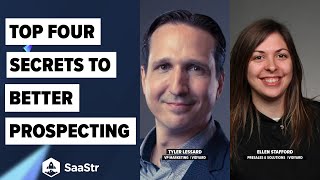
Tyler Lessard and Ellen Stafford from Vidyard share four prospecting principles: stop pushing for immediate meetings and use smaller asks instead, stay persistent with value-first touches, personalize by connecting to specific pain points rather than merge tags, and use short personalized videos to humanize outreach at scale.
Chapters
All right, well, thank you so much, Brian, and welcome everyone to this session here. Why are we talking about just four secrets to better prospecting? Well, we only have about 20 minutes and so we're going to try to plow through what we think are four of the most important concepts in successful sales prospecting today. For all of you out There in the SaaS world, my name is Tyler Lessard. I am the VP of Marketing here at Vidyard. And joining me today is the incredible, the amazing Ellen Stafford. How you doing, Ellen? Good.
I appreciate that, that introduction. Super happy to be here, including sound effects.
Well, that was just the audience clapping for you. They are excited to see you here, folks. We are going to talk about our experiences in what's working in today's sales prospecting, both from what we're seeing out there in the community, which we stay close to, as well as what Ellen's own team here at Vidyard is seeing now. Make them successful. Now, as mentioned, drop questions in as we go. Since we have so little time to get through this, we are going to hop right into it. Are you ready, Ellen?
I am ready. Let's do it.
Fantastic. So as discussed here, we are going to go through four specific secrets that by the end of this aren't going to be secrets to you anymore. And you're going to be able to start implementing right away. Now, we're going to start with secret number one. What could it be, folks? Well, the first secret to successful prospecting in today's world of sales is is to stop trying to book meetings. I know it sounds counterintuitive, but as somebody who gets prospected all the time, I hate the sales rep who is constantly trying to book a meeting instead. Well, Ellen, what do you suggest doing?
Create conversations like leverage interest based CTAs and not specifically asking for time.
That's all it is, folks. It's a simple idea, but so few sellers that I find in today's world. Take this mentality of your goal is to create a conversation with your prospect. The problem is, I think for a lot of SDR and BDR teams that they are specifically geared towards and actually measured on the number of meetings booked. So what do they always ask for?
Yeah, they're asking for time.
That's right. Now you mentioned something there, Ellen. A couple of ideas, interest based CTAs, which I love. And this is a quick source from our good friend, I believe over at Gong, I think it is, who had a really interesting report recently that talked about the performance of sales prospecting messages and they found that those with interest based CTAs had a higher conversion rate than those specifically asking for a meeting. Do you have any perspective, Ellen, like when we say these things like an interest based cta, what are we talking about? What are some examples of that using.
The end of your email to start a conversation versus asking for a specific time. So potentially asking them, is this topic of interest for you? Of you, Sorry, is this a topic of interest for you or is this something top of mind for you to again start that conversation? If we go directly to asking for the meeting, you're asking for a really large commitment from that prospect who potentially isn't interested yet about that topic or understands how it will provide value to them. So by starting a conversation it's a lot of an easier lift for your prospect to lean into. And in that conversation you can lead towards a meeting potentially.
Yeah, I love that. And it sort of ties into the third point on here, which is trying to create an asynchronous dialogue to get started, which I know for a lot of salespeople is hard, right? Because you're like, look, I've got one goal here. I just got to get that meeting booked because then all the magic's going to happen. But I find time and time again that if folks, they're not going to be necessarily ready to just say, yeah, great, I'm glad you showed up. In my inbox, I was waiting for your message. All this time, I can't wait to have a meeting with you. The reality is it's, you need to have a couple of quick back and forth. Ask them if you can share like for permission to share additional information to maybe send them a video about something to have a further dialogue. And as soon as you get that nod that first yes, right. I think that's such a big piece to. It is these micro asks, getting these small yeses gets them into a positive response mode which then when you start to move along and then you say, hey, we'd love to have a chat further about this, they're more likely to say, well yeah, yes, yeah.
And it's, it changes the tone of your, your prospecting email as well. And it, if you're reading that from the other end, it's a little bit more clear that they care about your interest and what value they can add versus just booking that specific meeting. So the whole tone has changed. The body of the email could be the exact same, but by changing that CTA in the end it almost gives the ownership back to the prospect. And you're on their terms now and not specifically on your terms, trying to book that meeting. So for us, we do that quite a lot at Vidyard. We are often talking to individuals that are already leveraging our free solution or leveraging video in some way. So we'll talk to them about how they incorporated video or where that came in. And when it gets to the point when we're asking for that meeting, we have a lot more understanding of what they're specifically interested in. And then it's clear that we're gonna be able to provide value on that meeting.
Love it, love it, love it. And you know what, there's a question here about CTAs for enterprise outreach. And I assume that's compared to like reaching out to a smaller company. And one of the things that I've seen a lot of sellers do successfully when they're reaching out to more enterprise type clients is knowing that they're going to have larger, more complex organizations is intentionally asking for guidance on who would be the best person to have a conversation with about this or who might be interested in such and such a topic. And that's going back to that like interest based or open ended question. Instead of saying, hey Alan, da da, da da da. Can we book 15 minutes to talk? It's hey Alan, I'm seeing a lot of interesting things in this area. There's a few ways in which people are solving this problem. Who would be the best person in your team to have to have a conversation with about this? And the easy thing, the nice thing there is it makes it easy on the person that you're reaching out to to respond to that in a way like it doesn't feel like you're putting the burden on them. Yep, I love it. Any other ideas there or are you going to thumbs up that one?
I would thumbs up that. That's absolutely something we do internally as well.
Yeah, brilliant, Brilliant. All right, folks, I love this topic here. I could actually talk about open ended questions and interest based CTAs all day long. But we have to move on to secret number two in our conversation. So let's see what we've got here. Secret number two. Ooh, I can't wait for this one. So secret number two is play the long game. I know, I know it's tough, but patience is a virtue and there is so much merit in today's world to being persistent and consistent in your outreach and not thinking that, oh, I've got a 15 day cadence. I go through that and that's it, right? Ellen, when you think about this being persistent and consistent, what does it mean to you?
That idea of playing the long game is so important on my team, with the SDRs and BDRs that are on my team, you know, you can't just think about your quota today. You have to think about going into each month with a meeting. And even if you're booking those meetings today, if you haven't created enough interest, they're probably not going to convert into pipeline. So you want to make sure that you're consistently reaching out to individuals in a way that's memorable. So when they potentially feel that pain that you can align to and provide value around, they remember that outreach. Maybe they saved your email or they accepted your connection request and they're seeing you provide value consistently over time. It's again, not just thinking about the short game. How do I get my meetings this week? How do I do that as well as set myself up well for meetings in the future? By consistently providing value to my network and my contacts and different things like that.
Brilliant. And it really calls out the difference in mindset we need to have when handling inbound leads versus doing outbound prospecting. Because when you're handling inbound leads, the assumption there is somebody has come in showing interest or intent and and are raising their hand to get into a conversation. But when you're doing outbound, of course, we all know it's a disruptive motion, right? It's often somebody who hasn't necessarily raised their hand, who may not have shown a great deal of intent yet. And so expecting that they're ready to have a conversation and they have budget ready to make a purchase, of course we can't do that. And so I know for me, a lot of the purchases that I've made in our own marketing team have come from organizations that, of course, when we first heard about them, we didn't have that pain point. But six months later, sometimes two years later, when we started to look for a solution in a certain space, you always remember those two or three people who reached out to you in a great way that provided value that you're going to go back to to have that conversation. I know it's hard, but patience, patience, patience can pay off. One of the points to this as well, in addition to being memorable by having a consistent cadence, is also that point of trust, which you touched on, Ellen, of making sure that you're seen as somebody who is helping and serving as opposed to just trying to sell. And that also ties Back to that first point of if you're always just asking for the meeting, you're not going to come across as somebody who's trustworthy and somebody they're going to want to reach back down to at a later time. Do you have some suggestions on that? There's a point here on like the no ask touches being really helpful. What do you see out there in that?
It's just critically looking at your messaging and thinking, is this adding value to the person that's receiving it? So in the no ask touch, maybe we're giving tips on how they could use video. In our case, we would be doing social selling, like connecting to individuals on our in our network. But when I say social selling, I don't mean pitching on LinkedIn. I say providing value to your network through engaging content that will get them to click, get them to read, and then potentially save some of the things that you're sharing. Or are you commenting on some of the things they're posting with valuable insights that you could provide? So using multiple channels and multiple different types of messaging over a long term, that's been really successful for us. And it's again, all about that idea of providing value, not just asking to convert Right now, provide value.
And remember to paraphrase what Ellen said, social selling is not selling on social. So it's as simple as that.
That's a whole other topic.
Yeah. Now if you or folks on your team are more junior sales reps who may not have the confidence or the skills yet to necessarily be communicating with people in a way where you feel like you're adding a ton of value, there are always opportunities there to collaborate as a team and make sure that everyone on your sales team has those great resources that they can share with their market. Some templated messaging for things that again, they can be sharing as value add gives instead of always feeling like all they can do to help the business is book that meeting. So. All right, excellent. So we are not asking for meetings all the time. We are playing the long game. And now our third secret, Ellen, our third secret. It's so secret we may not even know this one yet. I don't even know what it is, so we're going to have to find out here. The third secret is personalization doesn't work. Wait, what? Okay, Ellen, finish this sentence.
If all you're doing is search and replace, if your personalization could be done by a merge tag, probably not personalization.
That one gets the air horn. I love that because I think a lot of us think about Personalization as basically a series of swaps or merge tags. I got an email yesterday that even was at the point where it still said company name in brackets and I had that little giggle and they went on my never email me again list. And I think for again, a lot of people it is that that's customization, that's not personalization. So what does personalization. And maybe I'll pass it back over to you, Ellen. When you think about how to really actually personalize a message to a prospect, what do you think about or what sorts of things would you recommend to do that?
Yeah, you have to tie it back to providing value again. Right. So you've got a couple points here around company reports. Where could we align to their potential pain points in their role or within their industry or within their specific company and leverage that type of mess messaging? I've seen personalization be things like, hey, I like yoga and you like yoga, let's have a call. Like that isn't what we're meeting either. It has to tie back to something that's going to provide value to continue the conversation forward with that prospect. So there's a couple things we do internally. If it's a really high value prospect for us, we'll do what we call like hyper personalization where we'll go to their LinkedIn and find a couple of key things that we could align to. Efficiency is always super, super important to us. So with our new members of our BDR team who do outbound research, we'll do some exercises of can you find two things in two minutes to sort of like build that muscle and if it isn't maybe a very valuable prospect for us, maybe it could be a good prospect for us. We're not sure. We'll use Persona based personalization where we're not just putting the title, but we're putting what we understand could be a potential pain point in their role that we could add value to. And that way we can do it a little bit more efficiently based on what we know about that specific Persona. So I would suggest sort of splitting out your prospects that way and look for opportunities to add these elements in to ultimately increase your conversion rate.
Amazing. And one of the other things to be thoughtful about that is in addition to customizing the message for them by simply dropping in hints as to things you've learned about them or their business during your research. And that not only personalizes the message, but to the last point here, it inherently proves that you've done your homework and increases the expectation of Value from that person reading that message. There's an example up here on the screen by an amazing person, Sarah Brazier from Gong. If you don't follow her, follow her. This was one that I just saw recently where she shared an example of a message that she personalized based on looking at someone's recommendations on their LinkedIn profile. And she started off her message saying in his linked, the subject is actually, you know, person's words, not mine. She said in his LinkedIn recommendation, this person says you have the rare ability to be both visionary and tactical. Da, da, da, da, da da, connecting the dots here. And then she goes on to talk about it. And it's one of those moments where you feel like, oh, wow, this person's done their homework. Interesting way to connect things here. And it just puts you in a different perspective as you read through this message.
So definitely.
All right, so we have only a few minutes left here. So let's move on to number four. Secret number four. The best kept secret of all is that you sell to actual human beings, to real people, and you can use tools like video to actually humanize your message, to connect with people in a personal way, and to show rather than just tell your message. Ellen, this is what you and your team do all day long. Can you talk a bit about using video as part of prospecting?
Yeah, absolutely. I mean, all those secrets that we've shared already. Start conversations, be memorable, be personal. Video is the next best thing to being there in person. So if you could communicate and build trust with your prospects by them seeing your face, hearing your voice, seeing your body language, you have that ability to create those connections and be memorable and be able to engage with your audience in a different way. And you can be really, really creative about it. I mentioned in the last section there that I like yoga. You like yoga. If you can actually tie that back to something that adds value and deliver it in an engaging way, it could be really effective. If I think about one member of our team that the prospect had on their LinkedIn about me that they like a specific rap song. So our BDRs wrote them a rap song talking about how video could help them in their role. That might not work for every audience or market that you're working with, but that was something that really stood out for us. And they were just amazed that we went to that level of effort and delivered it in that engaging way that they took that next step. So lots of opportunities to leverage video, to engage with your audience.
Brilliant. And I think most people just, they don't realize or appreciate what can be done here, how simple it can be. The great thing is these days there are tools like the ones at Vidyard that make it easy for you to record out a video to your email, send it off, just, just as easy as typing out an email. It allows you to get personal, allows you to engage and allows you to stand out in different ways and actually build rapport before they've ever even talked to you. And that can go such a long way. So we're going to, I'm going to bring Brian back on here to see. We just got a couple minutes left. Is there any questions from the audience we want to tackle? And while we go over that, just a, we'll mention this as well, but Ellen and I and some other folks from Vidyard are going to be hanging out over in our lounge in our booth area right after this. So if you want to talk more about these prospecting tips, talk more about using video in prospecting. That's our area of expertise. So we'll be over there to talk about that. And if you aren't yet using a tool like a Vidyard to prospect with video, just give it a shot. You can sign up for free@vidyard.com start recording and sending videos. There's lots of resources on our website to help you learn how to do it. Brian, over to you.
Thank you, Tyler. Thank you, thank you. This has already been an insightful session here. I'm definitely ready for questions. I'll get us kicked off here because this is obviously something that I'm extremely passionate about, which is a prospecting end of life. So let me just get us kicked off. I'm curious, right. For enterprise level prospecting and reaching out and using video via channels like be it social or be it email, wherever you're going to use it, even mobile these days. Right. Like I think one of the big hangups is how to scale it. Scaling seems to be an issue like, oh, I'm second guessing myself, I want to stop. What tips tactically can you add here for this audience in order to really take their enterprise level messaging to the next level?
Yeah, I can jump in there. Tyler, what we do for a lot of our enterprise prospects is we'll create account based videos where potentially in our case we'll walk through what we see on their website of different areas where video can add additional value, convert more people into their funnel and then we'll send that out to different individuals. And if it's maybe our key contacts, we'll create that personal video to introduce the account based video, but it'll give us that opportunity to send it wider. And that message is relevant to quite a lot of people within the organization. And then by using a tool like Vidyard, we can see who's leaning in, who's watching that and then those are probably the people we would follow up with with more personal approaches after that. So that's one thing that we've done internally that has really helped us scale to reach a wider audience within an organization and pinpoint who might be those key people that are leaning into our message.
Awesome. I'm going to follow that up with just another one right off the bat there. Account based is very buzzy these days. I think it means a lot to a lot of different people and when it comes to prospecting, it's something that really matters, especially when you're going after real targeted accounts. So question for you is how do you make sure that you're doing these best in class actions of personalization working hand in hand with those different parties? Maybe what are those different parties internally to help enhance that abm?
Yeah, I can jump on this one. I think if to take account based marketing and selling seriously, it does need to be an aligned effort across both teams and collaborating on what is that outreach strategy across the two teams and how are you working together with similar messaging, with similar calls to action to again go after an account in different ways and ensuring that you're helping each other, not hurting each other. Sometimes you'll have sales reps delivering some messages and then at the same time they're getting automated emails from marketing and they're getting ads with different messaging. So just taking that aligned approach to how it is you're, you're going after these key accounts and then I think there's lots of opportunity to collaborate again between marketing and sales to think about how can we get a little bit more creative with these key accounts with things like direct mail campaigns, customized videos, personalized video messages and sort of break outside of the box of just the things that scale really easily like emails and ads and thinking about those really impactful things that maybe don't scale but are the things that show that account that you're truly invested in working with them.
Amazing. This has been such an insightful session, such high energy and really appreciate in that regard. If you.
Hey, thank you guys.
If you have more questions for Tyler, for Ellen, by all means you should go and check them out in their Vidyard lounge, which is absolutely within their sponsor booth. On Saster Enterprise website. Tyler Ellen, thank you so much for today. If you are interested and you would like to go and see any of our other sessions that have happened today, by all means you can see them live on our YouTube channel. We've all had them there all day. You can go and watch any single one we we'd ask you to go do so. That being said, thank you for joining and I hope you all have a great rest of your day.










