The Inside Story of Krux and its $700m Acquisition
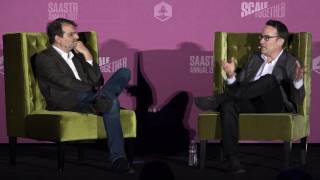
Transcript of a panel discussion (moderated by Mark Bodnik) featuring Tom (Crux founder/CEO) describing Crux’s origin, product, market, scale, competition, and decision to be acquired by Salesforce. Crux was founded in late 2010 in San Francisco, built a global data-management platform (often called a DMP) focused on consumer web data and trust, reached large scale across EU/APAC, and chose acquisition by Salesforce after weighing category size, team readiness, values alignment, and go-to-market scale.
Chapters
Good morning, everyone. My name is David Apple. I'm the general manager of the software and SaaS vertical at intact. We're sponsoring the tactical stage here. It's our third session of the day. We've already had a great start. This one is called the Story of Crux. And for each of you, I know some of you in the crowd, Tom's got a great story. He's going to be led by Mark Bodnik, who Tom and Mark have known each other for a long time, since grad school. Mark, as the moderator, was co. I hope I get this right. Co starter of Elevation Partners, a very successful private equity firm, before going on to run the business team at Quora. And then Tom has a fascinating journey to tell. For all of you joining, there's a story we hope you learn so you can apply this to your own stories, which is as you're really trying to build a business and a culture and an understanding about what the market wants and you're going through the highs and lows, how to just muscle through them and find your way to a great success. For those of you don't know, Crux just had a fantastic acquisition by salesforce.com roughly three months ago. Tom, plus or minus. And so with that, I'm going to introduce Tom and Mark.
Thank you, sir.
Do it here. Okay, here we are.
So let's see when we booked this. We're trying to figure out if we agreed to do this after the sale or before the sale. So you sold Crux three months ago, is that right?
It closed November 1st. Okay.
So why don't you start by giving everybody an overview of the company, what Crux does, and then we'll. We'll talk a little bit. I'll jump back and talk about the sale.
Sure. So the quick thumbnail on Crux, it's a company we started here in San Francisco, last part of 2010. So it's about a five, six year ride, and every company needs to start with a simple idea. So our idea was that over time, and especially in the last 10 years, say, who's looking at the screen becomes an awful lot more important than what's on the screen. And from our vantage point, there was a lot of technology out there that was pretty good at counting web pages and shipping ads, but there wasn't adequate sort of infrastructure and applications to help companies harness all of the data that they're gathering via sales and web experiences that they're creating for their customers. So taking all of that data, putting it to work in the service of generating cooler, smarter experiences for consumers on the other side of the screen. That was the premise and that's what we ended up building. So about six years, as I mentioned, we got to a global footprint pretty quickly. So offices in the EU, about 35% of our revenue comes from the EU, a presence in APAC. And I mention that because one of the things that was really important for us was to achieve meaningful scale quickly. If you're building one of these data driven businesses, it's all fueled by data showing up and relying on the kindness of strangers for data was, was not something that we wanted to do. So. So we built the company in that way and ended up joining Salesforce about three months ago as I mentioned.
Can you give us some sense of scale like let's say now or six months ago? I know you're obviously a private company or constrained, but. But before we kind of get into how you thought about the future of your business, it'd be good to know sort of how big it was.
Yeah. So I'm not able to talk about revenues now that we're part of Salesforce, but in terms of data scale, our platform is reaching about 3.75 billion unique devices and browsers per month. So we think it's the largest sort of non public data people driven data asset out there. About 200 billion instructions that are flown into our system per month. 200 billion signals sent to mobile devices, tablets, laptops, refrigerators, cars. So it's pretty interesting scale and that was really the foundation of the company. We felt that if we're going to do this, we needed to achieve an unassailable supply of data with trust. And that's also one of the innovations that we think we achieved is just figuring out how to get into market in a way that builds trust with brands like Live Nation and Warner Brothers and New York Times and Turner. Both marketers and publishers on our platform, giving them confidence that we could capture all of that data, serve as effective stewards of it, but then at the end of the day, basically help them be more like Amazon.
Right, Got it. Who's your competition? Or because I want to kind of get into thinking about like, you know, the decision to keep going forward versus selling.
Yeah. So look, we, we started the company and we talked about what we did as data fabric for the consumer web. And this is before the moniker dmp, which is what people think of CRUX as data management platform that I think took root in 2012 or thereabouts. So before we had a category or a name we were just doing this thing that we thought was pretty cool. And around that time it became clear that larger marketing cloud players like Adobe and Oracle were starting to kind of figure this out. And so it was unconquered. But people are frameworking their way through these problems at the time and so. So really in a remarkably short period of time, I think at the end of the whole ride we were showing up, I remember we would get RFPs and there'd be 14 DMP providers and I didn't even know half the names of the other folks who were showing up and competing for these deals. There were a lot of other companies in ad tech who were sort of trying to dmp, DMP Data management platform. A lot of ad tech players, programmatic media guys who were trying to repot re vector and present themselves as dmp. But at the end of it all, it just came down to us, Oracle, Adobe and pretty much every Bake Off. And so there was this drumbeat in the market for a long time where Salesforce, who was actively building its marketing cloud business, our customers would come to us and say it's a head scratcher. I don't. Salesforce crux. And therein began the dance.
But pure play competition. Blue Kai gets acquired by Oracle. That's or anybody left.
Bluekai got acquired by Oracle. There were other players out there, but I think what we'd achieved and the reason ultimately that this made a lot of sense for Salesforce as opposed to some of those data driven players I mentioned, particularly in media. The problem with media is that you have a lot of folks with their hands in the cookie jar, so they're sort of skimming, borrowing other people's data and they're doing things with that data not in the plain light of day. And so our thing was to show up and say, look, we're not going to play both ends against the middle. We're just a pedestrian technology company. We're gonna give you technology to help you harness value from the data. But it's your data. That was one of our slogans. We had it on all of our stickers. And so that really allowed us to create the trust that allowed us to fuel to create that large data position I mentioned. And so as it turns out, doing this at super scale with trust kind of creates an intelligence layer on top that becomes sort of impossible for others to quickly replicate.
Got it. Okay, so Salesforce approaches you at the beginning of the year. Well, I'm not looking for precision, just.
Trying to like it was a dance. Okay.
And so if you had stayed independent, the broad opportunity around data management is to basically be this single large player in the market that has quite, quite a few of the customers. And then what?
Yeah, no. And that's something that our board and I were discussing actively, right? I used to tell people, now, I love dmp. I'm all about dmp. But in the beginning, you always talk about dmp. I'm down with dmp, you know, me. And so I didn't like DMP because it was so hopelessly nondescript, right? What in the world does not involve managing data, right? Especially it's 2017, come on. So it bugged me because it didn't seem to be precise enough, but people were globbing onto it. And so in our business, we had this moment where I sort of shed all of my prior scruples about dmp. And I said, okay, guys, let's play along. It's dmp. The question is, is that a category? Right? Because if you're going to stand alone and you're going to build a big company, you can't have a sliver. You've got to have a meaningful, sustainable patch. And so the question our board and I were batting around at this time was like, okay, do we have the makings of a category? Laying aside the terrible nomenclature of dmp, what is it? And can we persuade ourselves that it can become huge enough to sustain a standalone company on the scale of a salesforce or a true pure play player? Now, I don't know how to answer that question. It's kind of metaphysical because we're on this other branch of the tree. But at least we were framing the right question. Can it be big enough such that in an exploding market, can you build your portfolio of products to define and own a patch? We talked about naming and claiming. In fact, we talked about the intelligent marketing cloud. What does that mean? How do we define it? What other kinds of adjacencies do we move into as a company to build it? How much capital do we need to raise to go and take the beach and expand from there? So these were the questions we were wrestling with as we got, you know, as we noodled with how next to kick things up a notch for the company? So, you know, there's the market question. Is it big enough? How do you. How do you hit that market? How quickly can you expand your portfolio of products to. To defend that patch and to create a moat around what you're doing? I think there were, obviously there's people, you know, these people Questions are really fundamental. So what's the psychology of the team? Are they ready for battle and good to go over the long haul? I had another company before Crux called Wrapt, and that was a company that we ended up selling to Microsoft in late 2007. Look, that had been a long build out and I think it's safe to say our team, if we were going to press on, I would need to really make some difficult adjustments on the team and bring in a lot of new people. And the question there was, could the social architecture of the company really support all of that repotting that we'd have to do? But yeah, you have people and are they still ready to go or are they out of gas? You have employees and investors and you have to nourish people and they have families. And so you got to. So all of these considerations start to weigh in.
So how did you make the decision? I mean, really, like, you know, no bs, Like, I'm sure you consulted with many people, but really like, you're the entrepreneur and the CEO, fundamentally, investors. It's very hard to go against the decision the CEO wants to make. How did you go about, how did you going about making the decision and then describe kind of the cultural buy in you needed to get?
Yeah, look, you trigger something there. Interesting, because sometimes you talk to folks and I guess there are different schools of thought. And sometimes people feel like the investors are making this call or the poor old CEO is shackled down, taken to a room and told, you're going to sell. The best investors, I find don't do that. But there is that dance that you're doing with investors and you're trying to be attentive to their interests as you absolutely should. You know, for us, the decision was really hard because as we were saying backstage, you know, these companies, when you build them, they become your baby. Right. It's very personal when you're building one of these companies. I would have done crux for the next 25 years. You know, we were, we were full of vim and vigor and ready to keep on building. So the psychology and the team and the people dimension that was, that was flowing. We were fortunate to be in a market that was growing in a category that was expanding quickly with a defensible. You know, it was hard going toe to toe with these biggies in all of these accounts, but we were winning. So, you know, check on market and product fit. The category was congealing. It was still a little messy and murky and not as sharp as we wanted. It to be. But we felt that those were questions that we could, with more capital and more scale, we could crack those. So the way that we made the decision ultimately was to assess, okay, how much time and pain to reach that end market is it going to require and what are the relative benefits of joining a company that has huge scale and a platform that you could ideally plug into. Now I was really skittish about that because I think I was sold on that idea once before and it didn't. It did come to pass. And so you can have the dream and it can make a lot of sense and it can just gets right there. You should do it. But that doesn't necessarily mean the acquiring company is going to make it so or create or pay off that m and a premise that you can plug in and we can blow this out. Which brings us then to values. And I know it sounds a little goopy to say it, but we didn't have to sell. We weren't running around with a book pedaling our wares. It came down to could we establish concurrence with Salesforce about the values that matter to us and how we wanted to build the company, keep building what we were doing. This idea of trust, for example, is really fundamental. Right. Salesforce. I just came off a three day kickoff with Benioff and other managers. Salesforce. You see it on the website and I'll just say it. I saw it on the website. Yep. That's cute. Everybody has happy talk like that on their websites. But no, it's deeply ingrained in the company that you are stewards of your customers data and we have to work always to maintain and build that trust. Well, that was when I was talking to Benioff early on during the summer. And I'm droning on about trust and how important that is to what we do as a company. I didn't know anything about Salesforce. Right. So I didn't know that they were already. That that's exactly how they roll. And then we met more of the people. We just, we like the people. And then at that point with our investors, it just became clear that, all right, we can, we can actually do this. We can plug what we have into this much, you know. And Salesforce is a machine. Right. The scale and scope at which Salesforce operates is, is remarkable. And so yeah, man, I mean we're a quarter in and the early returns are pretty promising. Like we didn't want to, you know, we wanted to sort of monitor it in a rigorous way to see if those M and A ideas we were kicking around could really come to pass. And again, early returns are promising.
Changing direction, to what degree is Crux does it depend on kind of ongoing, healthy heterogeneity in the media market? In other words, let's take some extreme that all traditional media companies go to zero? Yep, sure, that's not going to happen. But what happens if, you know, there keeps being degradation among traditional publishers with more and more consumer attention going to essentially automated Silicon Valley based folks? Google, Facebook, Pinterest.
Yep. So I'm going to skim that cat in two ways. First, sort of the sources of data that power a company like Crux. And to your point, as I like to say, data needed a day job and advertising turned out to be the best one in the early innings. So we absolutely take a lot of media and advertising data, fly it into our platform and do interesting things on behalf of our customers with it. But one of the tricks for us was to explain to ourselves, our employees, our investors. I remember when we were doing our series A, Arthur Patterson at Excel, who was about to make the investment. I remember the day before he says, I'm trying to just get my head around this ad tech component of crux. And I told Arthur, listen, if you think that you're investing in an ad tech company, please do not wire the money. We're not an ad tech company. I used to put Ghostbuster signs around the company with a slash ad tech and a slash through ad tech because we wanted to explain to people that yes, this is a critical source of data, but the endpoints and the sources of data that we're going to be leveraging are so much larger and so fast forwarding to today. It's subscription data, it's registration data, it's CRM data, point of sale data, transaction data. There's a huge swath of other data sources now that we unify.
I guess what I'm getting at is the traditional publishers are not so great at technology, I've heard, whereas the native technology centered media companies like Facebook are good at technology. And so my question is, and that's true not just about advertising, but about all the areas you describe, including how they manage their data and their logins and subscription and whatnot. And so is it a risk that the world of these older, dumber guys degrades?
Right. And so that's the second part of the general challenge. And I think what you're pointing to is this valid concern that we all have about the, quote, walled gardens. Right? So you have Facebook it is sealed off hermetically from the rest of the world. Data can enter so that you can find audiences, but it never leaves. It's a sinkhole. Google, I would say, is doing some more interesting and innovative things, recognizing that their marketer customers need to have a sharper understanding of if I'm buying all of this media from you, does it actually work? So that's an insertion point and a place where we add a lot of value, in part because we show up as a trusted mutual source, but also because the technology that we bring to bear on those questions is, you know, these are questions that l' Oreal wants to get to the bottom of now. So I don't. To get to, you know, I don't see it as an extinction level event. Right. I think that there's going to be a lot of flux as walled gardens reexamine some of their prior assumptions. We're working with some of the larger players that I can't talk about just today and doing safe data transport across these different clouds, across these different sources. And I think there will be maybe one principal holdout for a long while. Over time, the table will tilt. And I think we're going to see a market that promotes safe, intelligent data transport across all of these touch points.
Does amp matter for your world?
Not really, no.
It doesn't matter.
Got it.
Okay, so talk to us about some of the, like, really tough moments proceed from, from 2010, 2016. Give us a couple examples of times where you thought, geez, we might not make it if you had any like.
No, yeah. I mean, listen, we've. We've wrapped up the company and when you are at the place we're at, you spend a lot of time telling these campfire stories. I mean, they're fun, right? I always loved the mess of company building. I mean, you lurch up out of bed at night terrified because there are 65 million ways to die. Choose one. But no, I remember one of our early customers who will remain nameless. But it's a very prominent media company. I was in New York and we had just gone live. We'd gone live about two weeks before. Our code is deployed very broadly across this media empire. For our thing to work, we have to have almost ubiquitous deployment of this JavaScript. And so I remember getting a call from our lead engineer letting me know that we had actually crashed this site on about.
You crashed the customer's.
We crashed because of our code. It wasn't rendering on about 45% of the browsers out there. Well, that's terrible. And not surprisingly, we can giggle about it a little bit now. They fired us. And it's a perfect exemplar of, like the white knuckle moments. And that was our first. It was really our second customer. So your second customer fires you. Houston, you know, we've got. This is. This is bad, right? Lots of moments like that. And so look, you got the gutter balls with customers who fire you, investors who reject you. You have, you know, cash crunches that take you right to the brink. Always that delicate dance around how much capital are you going to bring in from different investors. The problem with investors is exactly all the times when you don't need the capital is when they're most excited to give it to you. And that's when you actually need it. They're less enthusiastic. So you're doing this dance, keeping all these plates up in the air. I think those were the scariest moments for us is when. Oh, another good one is NBC, who became a customer the Friday before the kickoff of the Olympics. On Sunday, they called us and said, you know, we forgot to mention, but we're going to be running you for the Olympics. In other words, our infrastructure is going to Suddenly, you know, 20x, no more than that, 40x the amount of data that we have to capture. Sorry, we forgot to mention that, but it's happening in two days streaming. Yeah, Every scrap. And remember, our code is deployed everywhere, so we've got to capture all of this. Holy guacamole, it's happening in two days. And this was actually one of the turning points when we realized, because this is also the time when you're getting the Twitter fail whale and Pinterest and all of these other sites are going down much in the face of much more modest spikes. So we were using aws and this was the first sort of crucible moment with AWS where it didn't fall down. We captured everything. Everything was smooth. And that was the turning point where we realized, ah, we're onto something and we actually have a technology advantage that's worth building out further.
That's great. Thanks, Tom.
Thanks, Mark. This was.










