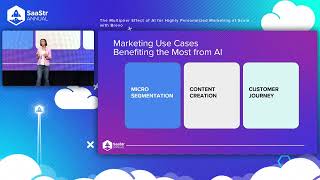
Isabel Giese (CEO North America & Global CMO, Brevo) gives a live talk on how AI multiplies marketers' ability to personalize at scale. She frames AI as longstanding but recently turbocharged by generative models, cites rapid tool adoption (e.g., ChatGPT) and industry surveys showing rising marketing AI use, and outlines three core marketer use cases: micro-segmentation (expanding from ~dozens to tens/hundreds of micro-segments), AI-generated content (to solve the scale problem of creating tailored content), and AI-driven delivery (predicting the right message/time/channel for each customer). She advises marketers to triage data (build in-house AI for proprietary, differentiating data; buy off-the-shelf models for commoditized tasks), develop AI-proficient staff, and be strategic about where to apply AI because of cost.
Questions this video answers
500,000 customers.
Reached 100 million ARR (speaker first said MRR, corrected to ARR).
About 8,000 applications in 2020.
ChatGPT reached 100 million users two months after launch.
An increase to 27% usage of AI versus 18 months prior (comparison baseline referenced).
Chapters
Isabel giese, CEO north america and global cmo at brevo. Hi everyone. I hope you're having a great semester so far. I'm Isabelle Gies and I'm thrilled to be with you today. I work at Brevo. Brevo is a CRM company. We just reached 100 million mrr. Sorry Andrew. ARR. We make us a center in January and we have 500,000 customers and I am the CEO North America and CMO. But I am thrilled to be here because I'm passionate about Both marketing and AI. A little bit about me, more than 20 years ago I was an AI engineer. Was not called AI then, but I was working on speech recognition and speaker verification and it's amazing to see the technological progress that has been made. And I've been an executive practitioner for marketing for the last decade and I teach marketing at Santa Clara University as well. So both topics I'm very passionate about and I'm thrilled to share that with you. There is a lot of buzz about AI in case you haven't noticed, but AI is not new. How many marketers he here? How many of you? Okay, so you all probably have been using AI for a while already. The marketing tech stack keeps getting bigger. We are at, in 2020 we were at 8000 application at your disposal. A lot of them already have AI if you use it. Chatbots, if you're using any analysis of data around e commerce marketing mix, you've been using AI. Actually the American Marketing association, they did a survey in August 2019 and they saw an increase of 27% of usage in AI compared to 18 months before. So this is increasing, it's increasing in the stack. Deloitte did a survey in 2020 and they asked the early adopters of AI, what is your use case? Out of the top five use case, three of them were marketing. So obviously we're going to be the first one to use that. So why is the buzz, why is everybody excited? Obviously because of generative AI and you know, the excitement is shared. So I got a few stats. It's been extremely fast, the adoption of ChatGPT. They launched and two months after they launched they had more than 100 million users. This is, you know, for Instagram who launched in 2012, it took them two years and a half to reach hundred million users. So the faster, the more we advance in time, the faster the technology adoption is. Why that? Well, why are we so excited about generative AI today? Because we finally have enough data, enough processing power to make it happen. But also because we've been using AI in a very passive content data analysis way and for once now we can be proactive data generating and that opens the door to a realm of possibilities especially for marketers. So I want to talk about the use cases where I believe I'm going to benefit the most from AI. You all know here with your customer and especially if you're a marketer, customers are more inclined to share information online, to purchase online, including B2B customers. They're taking their habits from their old consumers as well and they put it in the workplace. And we're entering an age to really be good at engaging with them. We're going to do more micro segmentation and hyper personalization and that can really benefit from AI. So what do I call micro segmentation? We all look at market segments, right? Most of the time we have kind of a dozen of them. Either we use that by industry, by Persona, by geo, by use cases. But it tends to be in the tense if we apply AI. AI is capable of not only use a thermal graphics I mentioned but but also to look at social media, who type of people they talk to, what are the different search they're looking and getting a really refined profile. If we start using AI for segmenting the market, we can start thinking about 20, 30, 50 hundred market segment to serve with a very refined understanding on who those customers are. So that's one use. But then there is cash 22. Who has an army of marketers to create content for 100 market segments? None of us. And that's where the excitement about generative AI is because now we have tools that can actually create content. There are a lot of vendors, some of them are saster who actually help you create content. Thanks to AI. They tend to be specialized. It can be email like Bravo or it can be also blogs, it can be ebooks, different type of content. And now you can really have the right content for the right audience. Obviously the last stage is how do you give this content to the right people at the right time and then the customer journey. For all the marketer out there, you know this is the most difficult thing to reach out to the customer about what they want to know at the right time. It's a nice slide, but it's not reality. Some customers are going to spend a lot of time doing consideration and doing research but then they're going to purchase and acquire the solution very fast online with a credit card because they know exactly what they want. Others will want to spend more time on the acquisition, talk to someone Negotiate have a custom solution for them. So not only, you know, those phases are different per customer, the number of touchpoints are different and what the slide doesn't show is the channel is different. Some customer will want to talk to someone in person to learn about a product. Some will want to go to a webinar, some will want to talk to a salesperson. So you have a multi dimensional problem as a marketer now that you have your segment and your content is when do I talk about what, with whom, over which channel. And again, AI can help because AI can look at all the patterns and can really predict what would be the next step for each segment about what content. An example our platform, Bravo does Part of what we do is email marketing. We can tell what is the best time at the individual level to send an email because we know when they tend to open them. Who can do this humanly without using AI? Not a lot of us. Right. So these are the three use cases. Now you know, do you have a lot of solution? I got the question a lot. How much AI do I adopt? What should I do? Let me give you a couple of examples. There is not one solution for everyone, but it really depends on how much data you have. What the quality of the data, but also how much of this data is unique to the way you're running your business. Let me give you one example with we all shop on Amazon. Amazon has tons of data. They can look at you, you make one purchase, they predict the next one. They can even look at your purchase and say, oh my God, you just bought a new house. How about buying this? This is what all the people who buy a new house have. They can do an individual pricing. So obviously tons of data. Data is core to their business. What do we do? Well, usually we tend to have our own built in AI because this is critical and it gave for instance, Amazon a very difficult, they're going to be very difficult to catch up with because they have so much advance and they have so much data and they have such proprietary AI. Now let me take another example. Let's say Orange Theory or the Bar Method or name it. Like any gym you have what is a competitive differentiator? The class they offer the trainers, they have, the schedules they have, the location they're in. When you think about that, how could they use AI? The data that's really proprietary to them is where do their users go, what class? AI can say, oh, they like this class. And we know that people who like this class tend to like this one. Maybe you should Promote and cross promote those class to each other or they like to come on Fridays. Maybe we need more class on Friday. All of this is really specific to them. But for sending email about a promotion or telling them this trainer has a new class, you can use an off the shelf AI. This is not your competitive differentiator to share information. You can use a solution that will send the email at the best time, that will have the right promo code in it. But your differentiator and when you want to have your in house AI is how you analyze the usage of your class, of your facilities with your customers. So we're not all Amazon, we're not all a gym membership, but in between, my advice to you is to really look at your data and triage. Which one are specific to your differentiated core business and which one is the one that you can use and off the shelf, you know, AI tool so you don't have to built in in house. I want to leave you with a few thoughts as you embark on your AI journey as marketers. First, you know I strongly encourage you to have AI proficient staff and I don't mean to go and hire a PhD in AI or developers. I just mean having people in your staff who are tax tech savvy, who enjoy that. Just have them go try some tools, start using them and really do this today. Because you've seen the adoption of ChatGPT, it goes so fast. If you don't start learning today, six months from now, it's going to be really hard to catch up. Also, you don't want to be the only one working when everybody's going to be running. So you just want to jog and train and be sure you know you can go for the sprint if you have to sit, think about your data triage, triage, what's relevant to your business, what's proprietary to use with your built in AI versus to use of the shelf AI and the last one, be really strategic about how you use your AI because I foresee that all those tools are going to be pretty expensive, pretty fast processing power, storage costs money, more data costs money and all the prompts you're going to need, it's going to cost more money. So if you use it for everything at one point, you won't be sustainable. Choose really where you get the best return on investment and focus on that. With that, you know, I'm going to be available for question at the booth on the Bravo booth on this aisle. I wish all of you a fantastic semester, a great AI journey and thank you for coming today.