The Proven Customer Acquisition Strategies Behind Toast's Record Breaking Growth with Toast's CRO
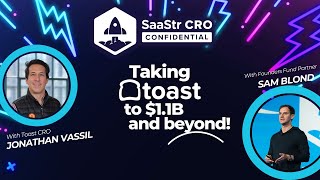
Jonathan Vassall, CRO of Toast, explains how the restaurant software company grew from $20M to over $1B in ARR. Toast uses territory design based on restaurant density and unit economics, relies on field sales for 75-80% of deals, and gets about 20% of business from referrals and channels. The company promotes roughly 25% of its sales team internally each year.
Chapters
Sam.
I'm Sam Blonde, the host of today's CRO Confidential episode. And we have just a legendary guest. Jonathan Vassall is CRO at Toast where he has been since 2017. I want to talk a little bit about this run that you've had, Jonathan, before I welcome you to the pod. So Jonathan joined 2017. Toast was a series B company with 20 million in ARR. You joined as SVP of Sales. You went through the IPO in 2021, currently CRO of the business. So not only has the business just crushed it over the six years that you've been there, you've also personally crushed it with really exciting career progression. Now in the CRO CRO seat that you are in today, welcome to the pod. Thank you for doing this and excited to have you here.
Hey Sam, thanks, thanks for having me. Excited to catch up today. First rule of sales though is to set expectations and use the word legendary. So just like lower expectations here a bit. We've had a great run, we've got great folks working for us. That's been really like a very kind of primary fundamental of my career. And so all of this, all the things you see at Toast and elsewhere are a product of our team really more than me. So just want to set it level, set a bit before we get into it.
Amazing. Well, I like the setting low expectations and over delivering and it's a part of all the success stories is there's not one person that is entirely responsible for the success of the business. The success of the go to market organization. So much of the people that we surround ourselves with are why businesses ultimately do well. Before we jump in, uh, let's get some context on your business. I think most people are familiar with Toast but for, for anyone that's not. And just to get a bit of a deeper understanding, let's start there. What is Toast?
Yeah, so we're a vertical software and embedded embedded payments solution that today focuses on or serves the restaurant community here in the U.S. and and, and abroad across the U.S. i'm sorry, Canada and England and Ireland, UK and in other markets as well. And so we've been at it. Toast has been added 15, 16 years. Venture backed startup, one of the fastest growing software businesses of all time. And we've got, I think we said Today we've got 80, 85,000 customers across the US and Canada and the UK and I and we're still in our early days. Right. And so we're one of those unique businesses. A lot of reasons why chose is unique but The TAM that we're, that we're servicing is one of the largest vertical TAMS in the world with still, you know, 85% of the market left to conquer or to tackle. And those opportunities are really, really unique. That's what also what makes our job in our role at TOAST really challenging and, and rewarding. Right. Because we think we're in pretty rare air and are excited for. Not only excited about what we've accomplished, certainly in the run we've been on, but also the Runway ahead.
Awesome. Well, so many things in there that we're going to sort of distill into the first topic. Couple things that stood out that you mentioned. One, you joined the business at 20 million in ARR, you just passed a billion. So sort of unprecedented growth. On the revenue side, you also mentioned this large from a market share perspective, still just getting going as sort of you described it. Let's start with customer acquisition strategy. I suspect that TOAST is going to be unique in the way that you acquire customers given the sort of TAM that you're going after. And what I would think of is like the non desk worker nature of restaurants. Let's start here. How is your go to market structure? Are you selling in the. Do you have an inside model?
Yeah, sort of all of the above. I'll start with. You know, one of the greatest strengths of our go to market motion I'll start with is the partnership between our sales organization and our marketing organization. We are in lockstep and work very well with one another to drive growth across the business and that it starts there. Right. So my counterpart, Kevin Hamilton, our CMO and I work very, our teams work very closely to drive the business. Separate of that. I think what we've done really well and I'll get into the structure here in a second is we understand our tam, okay. At the deepest level and we've spent a lot of time understanding our market, who, the composition of the restaurant vertical, how they make decisions, what's important, all of these things that you learn. Ironically, my boss, Aman Rang is one of our co founders and our coo. He was the first salesperson. He spent the early years selling into restaurants locally. And that experience is invaluable. It really is. And what we learned, right. And my background is really an SMB. I've been in high growth software, software enabled businesses pretty much my entire career leading teams that sell things and services into small businesses. And what makes the restaurant vertical distinct and therefore our go to market motion distinct is really the density that you see with Restaurants. So there is no other vertical that has that many rooftops in the US or across the globe, right? So if you think about any city block, right, in San Francisco or Miami or wherever it might be, you may have a pet store, you may have a drugstore, right. You may have a salon, then you'll have four restaurants. So it's really the only vertical where the density is really compact. And we've leveraged that to our advantage. And because of that density, what really matters to a lot of restaurants when they consider new technology purchases, or any purchase for that matter, is social proof. And that's been consistent with every business that I've been a part of that is sold into and served SMBs. Right? Social proof is incredibly important and it's even more important the restaurant vertical because of the density. So we have with our sales organization, I'd call it, you know, 80, 75 to 80% are field based sales reps. Where they are in the market, they own a geography and they are the trusted advisor to the restaurant space in their patch, as we like to call it. The balance of our, of our new business team, right, are inside reps and they, they act in the same role, right? Their role's not any different. Their TAMs are different, their territories are different because they may not have, you know, the, the density that the field reps enjoy. Right. Or they may have different areas where it's been difficult for us to hire so that the insight team has grown as a percentage of our, of our business and it's, and it's become a key part. But if we can find a rep on the street in a geography, that's our preference right now. And you can think about how meeting face to face versus remotely might create an advantage. And we've certainly seen that super interesting.
Point of clarification and then reinforce a point that you had around meeting in person and the advantages there. You described segmentation and when I think about segmentation traditionally from a software standpoint, it's more about like revenue opportunity. We have field sales folks that are going after the largest revenue opportunity companies and we've got inside folks that are going after maybe smaller companies, smaller revenue opportunities. What I heard is that you all actually do sort of like restaurant density. So if you're in New York City, you have a territory rep. If you are in the suburbs of Kansas City, Missouri, where I grew up, there might not be a territory rep there. And so the inside folks take care of the sort of like less densely populated areas. Is that the right understanding?
Yeah. Yeah, the way to think about that is that doesn't mean the suburbs of Kansas City are any less important to us. It just means there are fewer restaurants. Right. And so what? An inside rep might have part of Topeka. Right. In fact, when we first started thinking about how are we going to serve tertiary markets where it's difficult to hire, can we serve them with an inside team? The first city we went after was Topeka, by the way, ironically. But you might have Topeka, you might have parts of Lawrence or other parts where the density just doesn't justify a field rep. We'll cobble those together with an inside team. The quotas are no different. By the way, that inside rep is still going to produce the requisite amount of ARR as a field rep. They're just going to do it across the different geographies. And so what enables us to have this model? Because many of our competitors don't have a field based model, they have an inside based model. There are benefits to that. It's a little easier to scale, hiring is centralized. Although today with the after effects of COVID and with more and more folks being remote and hybrid, the talent funnel has opened up considerably. But what I would say is we try and have, in the instances where we have enough density, we'll put a field rep. What I will tell you is what enables all of this for us. And I think this is a differentiator r really our unit economics. And so there are other businesses that or other verticals that don't have the density and that also don't have the unit economics to get the payback that you need on a distributed workforce. We do because of the software plus embedded payments model. And so if you only have half of that, if you only have the software piece and you don't have, you know, you don't have the ARR coming in or the LTV to justify the expense your paybacks are going to. It will be out of whack. And so what's enabled this, I would say is both the density that we see in the TAM along with the unit economics of our business, which are remarkable. Those together have kind of pushed us towards this strategy.
Super interesting. One takeaway that I'll reinforce, you said something like the advantages of selling in person versus selling remote. One thing that we did in the early days of Brex was we measured conversion rates based off of whether a potential client received an on site visit or not. And those that a sales rep went on site and met the customer, they closed it like a 3x rate, you know, so let's say our conversion rates were something like 15% from opportunity to close if it was a non in person, you know, opportunity and it went up to like 45% if we did an on site. And I think when the lockdowns happened and everyone sort of went remote and in person interactions were happening far less, there's this like lagging effect that it seems like these in person interactions are happening fewer and fewer and I think it's a missed opportunity for many where you know, getting back to meeting folks in person, whether it's a potential customer, an existing customer, I just think the benefits of doing so are massive.
Yeah, we see something similar, right where our conversion rates when we're in person are higher. Certainly there's no doubt that doesn't mean that our conversion rates when we're not are materially different. They're not. But you know, there's a reason why we're 80, 20 in terms of field versus inside. But I'll also say again going back to the density, there's so much value if you think about, we've studied quite a bit is and I encourage companies that I work with to think about this. We, we've spent a lot of time thinking through how restaurateurs and owners make decisions. How do they select which software systems they're going to use, how do they select which suppliers they're going to partner with. And so much of that comes down to this local, we'll call this local ecosystem that restaurants live within. Right. And what we're finding is when you can penetrate that local ecosystem and be part of some cases the fantasy football league or whatever, when you get into that decision making ecosystem it's very, very powerful, right. And within that ecosystem you have the food purveyors, you've got the knife sharpener, you've got, you know, the equipment manufacturers, you've got all these, all these folks that serve restaurants that, that all work together and it's easier to penetrate that ecosystem when you're in person. There's just no doubt, right. And so what we say, not only do you, do we see the impact on our conversion rates and win rates and those sorts of things, we also see a top of funnel, right where we're able to find decisions or find opportunities that exist that others may not know about because we're kind of that again that we're that trusted advisor within the community which, in the communities in.
Which we serve and earlier you referenced that you all on this, that sales and marketing are sort of in lockstep with one another. And you've talked about these different geos where you have field sales folks in territory and then maybe less densely populated areas where you don't. When you joined Toast and it was 20 million in AR and certainly lower market share than you have today, was were you deliberate about segmenting restaurants by either like the type of cuisine that they had? Was there some segmentation that existed that you would target specific types of restaurants and then a follow on to that would be. Were you methodical about this sort of like nationwide rollout where you were like, we're now going to attack the city of Houston and we're gonna do like a bunch of marketing campaigns and we're gonna put a bunch of boots on the street and we're gonna go after like that GEO specifically and continue, you know, to the next one in line from there. I guess what comes to mind.
Yeah, there's a lot in this one. We spent a lot of time thinking through this. I would say the folks on our sales and marketing teams that help us think through everything from, you know, resourcing territory planning, incentive structures, like I think the role that those teams that handle that are world class and all of those elements are, you know, the confluence of those elements. Go to answer your question. So while we didn't early on, like when we were launching, let's just say we're launching Seattle for the first time, you know, what we, what we know is the territory size you give the rep will dictate your growth rate. Right. And so while we could have given our first rep the entire city of Seattle, we knew that'd be counterproductive going back to the density. Right. And so the key is to the sales reps out there. They won't want to hear this. Right. But it's actually better for them to have a smaller tier. Right. So that they can work the territory deeper and be a mile deep versus a mile wide. And so. So that's number one. Right. And as we thought about the incremental Reps, we added 200 reps to whatever we have today, which is many multiples of that. You know, we were very thought we are and we're still very thoughtful in terms of where we put them. Right. Because we know you'll hear us talk about on our earnings calls, the flywheel concept, where we know definitively and we've got a ton of data to prove this. When we reach a certain density level within a market, our win rates on our top of the funnel actually begin to increase and Our reps become more productive. And that goes back again to the density of the markets and the aspect of social proof. So if you believe that, then where you put the next incremental rep really matters. And we did this almost by accident early on where, you know, we didn't actually have a rep in California for many years after we started. Right. Because it was just better for us to put another rep in Boston or you know, we had a really strong channel partnership with a food purveyor and they were strong in certain markets. Right. We saw that, hey, when we paired one of our reps to one of their reps in a market like we were able to accelerate productivity. And so instead of adding our 51st rep in San Francisco or LA. Right. Well, let's just go to put it where they have reps, which might be Chicago or South Florida. And that allowed us to build the rep coverage that you need to build a city like in Miami where you are right now, we have dozens of reps, dozens of reps and the amount of TAM per AE in that city is relatively low. They're all very, very productive. And I think because those tams are small, that's why they're productive. Right. Which then enables this flywheel concept to come to life. So that's number one, like how you design territories where you put people, incredibly important. And it's an aspect that I've seen over the years that doesn't receive enough attention to be honest with you. Number two, like the product, your product. So for us, you know, our, we've got a great, like just a world class product. Our customers would tell you that. And the product kind of dictates the segments in which you pursue. Right. In a lot of ways. And we came out with Tosco, which is now a legendary kind of handheld device that allows servers to take and place orders and take payments, allows them to increase turn times, which thereby drives more revenue and throughput for restaurants. And so that product, which is just one of our amazing products, but it's a really amazing product, naturally gravitated reps towards full serve restaurants, right. Because it has less of an application for qsr. So in a lot of ways our product dictated where our reps went in this vast tam. We have a massive tam, others don't. And so almost unintentionally they gravitated towards segments based on the product. And then the last influence is really the incentive structure. Right? And the incentive structure as you know, is like the biggest lever any head of sales or CRO has. It is Infinitely complex. Right. And it has, you know, we seem to are in this iterative process where we are learning every year what our teams need and how the, how the incentives need to be structured to satisfy what our teams need. Right. And what the business needs. And so it's, it's a very complex process, but that is one where it's a huge lever that you can use to really drive behavior across the business. So hopefully that answers your question.
It does, and lots of interesting takeaways there. One analogy that comes to mind, thinking back in the early days of Brex, a couple things that we did that really led to our early success was we, we were not everywhere for everyone. In fact we were very specifically the first corporate card for startups. And so that's like not everyone, that's a specific, you know, vertical or sub vertical even and is like broad category of B2B. And we also primarily focused on San Francisco when we first launched. So we blanketed the city with first corporate card for startup billboards. And one thing that folks may not know, Brex was not the first company that came up with the underwriting model that we were sort of famous for. No personal guarantee and customers could use their bank balance to get access to credit. There are other companies that did that, or at least another company, but they weren't targeted in who they were going after. And so by branding ourselves as we are a corporate card for startups and by really targeting a specific geo where you talked about this flywheel of customers that can start to engage with other customers, the likelihood that we were going to close a deal when we created an opportunity in San Francisco compared to even New York, which is a bit of a startup hub, it was just significantly greater. And so this isn't maybe a strategy for everyone, but this concept of like being deliberate about who you're going after and where you are going after oftentimes can provide sort of like conversion rate tailwinds that you don't get if you are everywhere for everyone.
Totally. I just think it's, you know, which is really understanding your TAM and matching your TAM with your go to market strategy. Right. And like our strategy will not work for others because they don't have the characteristics that we, that we benefit from or that we have that we have to overcome with our tam. And you know, early on, you know, when we first joined, we thought about data and how we use data to make decisions and it's, I'd call, you know, data analysis a strength of ours and then really an advantage. Right. Everything from Looking at how our team is performing and what insights we might discover that can help us further optimize the business to, hey, if I'm, you know, the curse of our team is that it's so big, right? And so if you're a rep and you're, and you cover south beach, right, say, well, where do I start? Who should I do? I just blindly pull on every open door or is there a more strategic way for me to approach my patch? And we've always felt like we could use data to answer that question and really push our team towards the latter, which is. No, no, there's a way, scientifically we can figure this out. We can tell you what the best opportunities are within your patch. You can combine that with your own intuition, your local knowledge. We don't want to take that away. But the two of those pieces when combined are really powerful. So we're getting to the point where, where how we score our tam, right? And how we take a city block and evaluate and value the TAM within that city block is something we can do. Which once you can do that and you can score, let's just say the 3,000 restaurants in Miami, well, think about what you can do then. Well, it will change how you resource and how you build territories and how you compensate folks and it'll accelerate productivity. So underlying all of this at Toast has been data and it's certainly been an advantage for us. And we've resourced the business appropriately to ensure that we're optimizing and taking advantage of that opportunity.
And you talked about this sales rep in south beach not knowing which restaurant to sort of target to potentially acquire as a customer. When I think about most software applications, and I referenced this earlier in the show, but they're, they're selling to desk workers. Most folks that are buying software are sitting at a computer screen all day. And so the way that you market to those folks are things like online ads, emails, and I imagine the strategy is different for you all. So I'm curious, from sort of a demand gen perspective, how does selling into restaurants, selling into non desk workers, how does that impact your demand gen strategy?
Strategy? You know, I, we've got a remarkable marketing team and, and believe it or not, majority of our funnel is driven by our marketing team, you know, despite having folks on the ground. And I actually think they're more similar than you might think. One out of five deals, and we've said this publicly, one out of five deals is referral. Right? And so going back to social proof like that, it's just while marketing is a huge part of our funnel, we talk to reps all the time and ask them what's easier, what's easier? Pulling a door, walking into a restaurant cold, or asking someone to walk you in with them. And so that's a literal example. But there are just more efficient ways to get in front of the folks that you want to get in front of. And we happen to take advantage of it because we got folks on the ground and it's who do you know? Do you know someone at this restaurant? Or hey, do you, you're the U.S. foods rep and we've got a partnership with them. And hey, do you know so and so at X, Y and Z, can you help me get in the door there? That's super valuable. Right? That's not any different. You know, if I'm selling software to, you know, a marketing vp, there are ways to do the same behavior, the same act a little differently. But again, leaning on social proof to me is something that is critical. We do certainly do kind of offline market level, field based tactics from a marketing perspective that you may not find with decision makers that are in an office. But we certainly, again, because of how we've thought about going to market and how we prioritize markets and zip codes, there's a bit of a halo effect right. From our brand and our product as we get, as we reach certain density levels within a zip code.
Let's go a layer deeper on this concept of referrals. It's an area that I think most companies under invest in, which is leveraging existing customers to acquire new ones. And is it, is it for you all as simple as the folks in the field that have developed the relationship with the restaurant owners or whoever's purchasing toast just sort of like asking, do you know anybody in your network that you can refer me to? Do you have a more formal program? What are you, what are you using to drive additional referrals?
You know, believe it or not, asking still works, right? But, but most people don't, don't do the bare minimum. I know, I know. It's like all you got to do is ask. So. And we're still teaching our team these things, but I would say there's, it goes a level deeper. We talked about how we think or how we've studied our folks who purchase restaurant software, how they make decisions and what influences their decision. Right. And we have a very, very robust partnership program in the ecosystem where we've got software applications that we integrate with that integrate the toast that Solve certain features that we may not have. Right. That, that a third party can solve for. We have marketing partners. I referenced US Foods as a large marketing partner of Toast. And so we have a large, like kind of channel partnership aspect of our business that is as important as walking into a restaurant and asking, do you know someone else that might be interested? Like, there's certainly that element. And if I'm in, what we try and teach our reps and our team is, would you rather again, walk into a restaurant cold or would you rather walk into an existing customer, ensure that they're happy, right. And ask them if they know of someone that might be in the market? Eight times out of 10, they do. Bottom line, eight times out of 10 they do. And so that's something we really, we talk to our team about becoming the mayor of your town. That's literally the words we use. Those are the words where we want them to be the mayor of their patch, where everyone in that restaurant ecosystem is aware of who they are and we're helping them. Right. And an example of this is we sell. Our TAM is unique because there are a lot of net new openings every year, similar maybe to Brex early on, where you've got, you know, new origination of new businesses create being created because you're targeting the startup kind of startup world for us. Like there are new restaurants that open that call Toast and say, hey, I'm opening a restaurant three months, I'd like to buy Toast. Well, that is valuable to our partners, right, because that's a deal that US Foods or DoorDash or any of our partners may not know about. So we can bring a lot of value to them. And so we spend a lot of time we resources with teams to help push this referral motion with our team, not just with our customers, but with channel partners as well. And it's become a super, super valuable part of our business. It's scaled certainly as we've scaled. And right now for us it's, hey, you've got, let's say you've got 800 restaurants left in your patch. It's like, let's figure out how to prioritize those 800 based on what we know about them, based on the last time they bought a point of sale system, based on who they're currently using, based on the size of the restaurant, based on all these different factors, and you can begin to score them and point the reps in the right direction. And once they have that list, then it's okay, I can either walk in cold which sometimes you have to. Right? Or who do I know that can help me get in the door here? And that skill is what our best reps do. And that's been a very consistent motion throughout my entire career. Whether it's a toast or order up or Golf now or Groupon, whatever it.
Might be, I love it. Let's try and distill this down to some simple takeaways for the folks that are listening when it comes to leveraging customers in this concept of referrals. So as we mentioned, at a bare minimum, most people don't even ask like most people. Most folks don't ask their happy customers or customers that they're just signing up if they know anyone else that's like them that might realize some value or benefit from using the product. The second thing that comes to mind is referral programs. I have seen them work. I've seen them work in, like, very different flavors. And it's one of those things that it's not a one size fits all where the thing that worked for Zenefits, it would be different from the thing that worked for Brexit would be different for the thing that worked for is working for Toast. And so it's different to have sort of this like one size fits all. This is the referral program you use because it's going to be dependent on what you're selling, who your buyer is and more. But one thing that I think is easy to do is when somebody does make a referral, you should reinforce that behavior positively with a thank you. So at a minimum, a sort of after the fact can be a handwritten note can be some sort of a gift. But you want to, like, promote and reward that positive behavior. And oftentimes, certainly more oftentimes than not, that will drive more of the same. And gosh, like, I don't remember the last time I got a handwritten note or a random, like, gift as a thank you for going out of my way for helping someone. And, you know, this is. I think this is true for both referrals. You could even apply it to things like really positive social media posts. If someone like, raves about you on Twitter, LinkedIn, whatever it is, like, thank them that that's almost as good as a referral and certainly better than, like, you know, paid advertising on one of those platforms that costs money. So for sure, those are some things that come to mind. Any other thoughts before we wrap up on this?
Yeah. Yeah. What I would say is in a big part of this is thinking, thinking through really two Pieces. One is like, how can I help the other person? How can I help? So if I'm partner, we're partnered with US Foods, how can I help the US Foods rep in my territory? Are there deals that I'm in that he's not, he or she is not aware of? How can I help them? And that's such a big part of it because it is too. It's a two way street. And thinking through how I might help the other person that's referring business to me is super important. By the way, this happens all the time, the financial services business. Right. So if you call your financial advisor and you need estate plan, an estate planner, they refer you. Right. It's just, it's just this whole kind of network that goes back and forth. And then number two, which I think we do really well, Justin, there's a lot we need to work on across the business, but this is one area like we test constantly. So it wasn't like one day we sat in a conference and said, ah, we need referrals, we should do that. Let's roll. It's like we, we have really bright people who are obsessed with these types of challenges, number one. And number two, we give them the freedom to test and iterate constantly. Right. And you know, I don't know if I see that often enough across the businesses that I see, but it's one where you need to have the flexibility to test and fail, test and fail. Because you'll need to do that to find, you know, eventually find the winning, kind of the winning motions.
Awesome. And when we're talking about referrals, couple of things that we've cited here. One is like customer referrals. So folks that are using toast at their restaurant, maybe there's a network of restaurant owners or chefs that they can refer other folks that are in their network, you know, as an existing customer of the product. And then another type of referral is the partners that you've described like US Foods and the sales reps from those partnerships. So lots of different sort of referral angles that, that a business can leverage. In the early days. It's probably going to be more on the customer side because it's going to be more difficult, I think, to get those sort of like third party sales organizations to send you a bunch of business until you're a bit more mature.
That's right.
We, we could go on for a lot longer. In the interest of time, we're actually going to skip over some topics and we're going to go straight to Talking about you a little bit, which might be slightly uncomfortable because you're a humble guy, but I just want to reinforce something that I said at the beginning of the conversation. You have really unique experience at TOAST in that you've progressed your career from a very senior level inside of a company that has also realized incredible growth during your tenure. So you started as SVP of sales. You expanded the sort of like how strategic a role was to SVP of sales and GM of a, a core business unit. Now you're CRO of the company. And while it's common for folks that are starting in more junior roles, whether it be a sales manager or sales directors, to realize really exciting career growth inside of a hypergrowth company like toast, I rarely see it happen at the most senior levels. In fact, you know, I mostly see CROs being topped as companies enter into new stages of growth. Rather than being promoted from non, non C level positions, you were able to realize. So what do you attribute your success and ability to accomplish this to?
Gosh, there's so much in this one. Number one, you have to be in the right opportunity, right? And so, you know, I, I've been, you know, my time at TOAST has been remarkable, not only because of what we've accomplished as a team, but because of the opportunities that the business has given me and our teams to grow. The environment you're in has to be one that supports what we call durability or the ability to grow within the company. Right? Not all businesses are like that. Right. And that's a key component we talk about all the time. We feel like the most lethal folks in business are what we call business people that can sell. And that combination is, we think, incredibly powerful. And, and really as a, as a, in your, in your career, if you think about your career, right, and your, your potential as a, as a leader or a, whatever it might be, you know, potential is really the, the product of your own ability, right? And the skills that you have and your work ethic and all of those different things that are innate to an individual. Plus the times, the opportunity that you're within. So the size of the opportunity and the folks you work for in the environment is, is really a big part of it. And so for the folks out there, like, you got to think thoughtfully about that. Okay? That's number one. Number two, I've, you know, I've never thought about my next job or the next role within a company. I've never. And I tell people that people think I'm crazy. I'm like, this Advice may not be for you, but my focus has been two things. Just always exceeding expectations, always delivering over, delivering every time, always. And doing that the right way and really being thoughtful about how the inputs impact the outcome. Because ultimately you scale the inputs, not the outputs, right? And so the folks who get top, the folks who don't grow, are the folks who are solely focused on outcomes and not how those outcomes are produced, which is really where the value is created. Okay. And I think along with that, you have to have a curiosity, right? Or a mentality of continuous improvement in order to grow and learn. I learn every day. I learned from our team. I learned from our executive team. I learned from our customers. I learned from. I'm constantly learning, and I'm open to learning. I want to be. I want to be taught. I want to learn, I want to develop. And so, you know, I'll talk to folks who are growing in their careers at Toast, and, you know, I kind of stop them sometimes. Like, just, I want you to focus on being the absolute best. Have the absolute, absolute best discovery, right? Have the absolute best closing process. Help your teammates. If you're a manager, coach your team, be a coach. Don't be a deal chaser. We talk about it all the time, right? So it's really like a very simple focus on what you produce and how you perform against expectations. But not just in how did I perform the quota? It's, how did I actually deliver the numbers? Because that's what you scale. And generally, if you do that, if you perform well, exceptionally well, you're curious, you're learning, you're growing, you're improving, and you're in the right environment, your career will grow. It certainly will grow. At toast. I think we had a stat recently here where like 25% of our sales organization, which is large, right? It's a big number had been promoted in the last 12 months. And I talked about the environment. At Toast, we promote from within for a couple reasons. One, it's the right thing to do, right? Two, when we're trying to hire reps or managers and we're competing against other companies, this is earlier on when people didn't know who TOAST was or what we did or that sort of thing. We needed a value proposition that allowed us to convince folks to join our company. And part of the value proposition, which is still core to our proposition today, is you're going to grow your career at TOAST faster than anywhere else. Because we're not afraid to give people opportunity that don't have necessarily the background or the experience for it. Some of our best sales reps were school teachers or have come out of the military or have come out of the restaurant industry. Not folks who have had many years selling, you know, for other businesses. And they join us because they want to, they want to learn, they want to grow, they also want to grow their careers. We value promoting from within and that's, that is really attractive to a lot of people. And so again, going back, kind of the environment you're in, you have, you know, if you want to grow your career, A, I'd go to a growth business and B, be one where they, they really value promoting from within.
Yeah, there, there's so many great insights contained within those comments. A couple that stood out. One was around maybe just like advice for folks that are ambitious and looking to grow their career quickly. One thing to solve for. It's a lot of the way that you've described the environment at toast. Find a growing environment with the philosophy of promoting from within. And if you can associate yourself and be successful in a company with those dynamics, you will progress your career. And then the second thing that stands out, you know, we'll want to be totally honest here. Throughout my career, I have thought about sort of like what's, what's next and you know, slight, slight nuance between the two of us there. That said, you mentioned something around like over, like just constant paranoia and focus around over delivering and exceeding expectations is just like the way that you sort of approached the role or roles that you've been in. And one thing that's slight nuance to that is the way that I have thought about my career and advice that I provide is to just never be satisfied. And a couple different manifestations of that. You know, when I was in AE and I got to 100% of my monthly quota, I think what I saw a lot of my peers doing was sort of like laying off the gas at that point and you know, maybe sandbagging even until the following, you know, measurement period, whether it was a month or a quarter. And for me, like, I just stepped on the gas. Like, give me 200%, give me 300%. Yeah, like never satisfied with the amount of, you know, revenue I was bringing in or like meeting the expectation of quota as a sales rep. And then the other thing that I see happen somewhat regularly is oftentimes when people realize a promotion, whether it's SDR to ae, it's this thing that like they've been working on for 12 months and like, finally, like all that hard work has Paid off in the form of becoming an ae. It can be an ae becoming a sales manager, like years of work, wanting to get into leadership finally. I'm like a sales manager. And I see folks that are sort of satisfied with that new position within the company because they've worked so hard for it. And I think like, you know, the advice that I provide and certainly the way that I approached it was this is just the beginning. Like the second you become satisfied with your position, you're going to stagnate. And so just like constantly wanting for more and not being satisfied.
Yeah, that's exactly right. You know, it's, it's really, it's really a pride and competitiveness characteristic I think of like you gotta prove yourself every day. You gotta reap, approve. Like every day is an opportunity to reprove what you, what you've accomplished and what you can do. Like you can never settle ever, right? And, and I remember early on I started my career as a bdr, right, and then sold and then became a manager. And, and I've always approached it as, aside from hitting my number, did I make the business better somehow? Was there one thing that I made the business better or my team better, or someone beyond just myself? What did I do to improve the broader enterprise or institution? And that's always, always in the back of my mind, what am I doing right now? When I look back at last quarter or last month, what did I deliver that made a difference? Right? And the only way to have, I think that kind of mindset is if you take a lot of pride in what you do and you're fiercely competitive. Not competitive in the way where, damn, I want to beat you in terms of performance. We're going to compete, but like I want to be the best, right? At everything that I do. And I'll work tirelessly to do that. And I may not be today, but give me enough time, I will figure it out and I will work and work and work and work until I feel like there's nobody better than me. And that's just mentality that you gotta have, right? Which drives the continuous improvement, the continuous learning. It drives skill development. And someone once told me, I forget who it was. They did a study on leaders and they were trying to reduce leadership into characteristics and to be able to predict who might be a great leader or whatever successful person down the road. Obviously a growth mindset is part of it, but it was this combination of incredible competitiveness paired with humility or low self need. The combination of those two is lethal. And so you'll never hear me say me or I just don't believe in it and I don't. It's not about me. But we want to win, man. We want to be better than anybody else. And if I go to a conference or I'm partnering with other CROs or other executives on a hear that they're doing something better than us, it irritates me and we'll go figure it out. And so there's this driving competitiveness that you got to have, I think, which will become the engine, the motivation that you need to continue learning, to continue kind of honing your craft.
I love it and can't think of a more positive or better note to wrap things up on. So Jonathan, really appreciate the time. So much interesting insight in how Toast is run as a business and the way you acquire customers all the way to the way you've run your career and advice that you have for other folks that are trying to emulate that. So thank you for your time. Really enjoyed it. Thanks to all the listeners. Hope to see everyone in short time.
Bye bye.










