The Risky Business of Raising a Series B Round
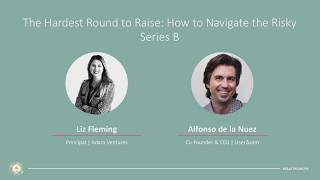
Video discussion (Jason M. Lemkin interviewing Alfonso of UserZoom) about why raising a Series B is difficult—especially in Europe—and how UserZoom moved from bootstrapping to a VC-backed growth strategy. Key data cited: <10% of European deals over the past decade were rounds >$10M (≈382 of ~3,000 deals); only 13% of seeded companies later raise a Series B. UserZoom was bootstrapped to roughly $12M ARR and raised a $34M VC round in 2015. The conversation covers differences between Series A and Series B, the balance of momentum (metrics) and vision (story), pros/cons of bootstrapping, relocating to Silicon Valley, choosing investors, and the CEO transition from founder to scaling manager.
Questions this video answers
Less than 10% (about 382 deals out of ~3,000).
13%.
Approximately $12 million ARR.
$34 million.
Chapters
So we're going to talk about the hardest round to raise the risky business of a Series B. So what are we talking about? No, that's not the first slide. Oh, do you need another minute? So I'm just going to pull up a little bit of data.
No.
Oh, hang on. Yes, yes. Excellent.
Thank you.
Thank you. Excellent. So this is actually how difficult it is to raise a Series B. This is data particularly looking at Europe. So less than 10% of deals done in Europe over the last 10 years are rounds of over 10 million. And so it's certainly not an easy feat. And that's about 382deals out of almost 3,000 deals done last year. That's including Israel as well. So they obviously are contributing to that, but it's pretty, pretty challenging endeavor. Here is some data room data that is looking deal room data that is looking at these cohorts since 2011 of how companies are raising funds. And here we'll see that only 13% of companies that are seeded are actually going on to raise a Series B. And so it's definitely not an easy task. And we started looking at our portfolio. We're Series A investors. So once we actually go in on the initial round and, you know, prove out the proof points that were necessary for the Series A, we are thinking about how do we help our portfolio get to Series B, that we would be heavily involved in that process. A lot of our founders would not have done that before and it's certainly a challenging issue. So why is that? Essentially from the 12 years experience we have investing in different companies, about 40% of our portfolio have already raised series B, 400 million plus between them. The reason we see Series B is so challenging is because it's essentially, it's an in between round. So. So Series A is a little bit more obvious. An awful lot of the fundraising is built on your vision and on the team and the capability and the execution. We have a product idea, we have some early reference customers, we think this can go big and we are looking for capital to prove it out. That is Series A and there's really an awful lot of due diligence going into the teams and the market potential there. But Series B, it's not like you have everything sorted on the later rounds. Maybe it's a Series C or a Series D, they're really looking at the financial models. You have significant metrics that, that are showing how this is a money making machine and you put more fuel to the fire, you're getting more return, but usually you're not quite there yet at Series B. Right. So you've built this level of momentum to actually get this far. You have a lot of data behind the company already in terms of interesting reference customers, interesting acquisition models. The team is quite strong. You've actually built out the team, obviously wider than the founding team and brought on maybe some interesting executives. But there's still some talent missing. There's still different models that haven't been tested, maybe new geographies and verticals that you are planning to go into that are unproven at the point of Series B. So how do you get to the other side? How do you actually bridge that gap and bring on that round? And we believe that it really is a combination of the momentum that you've already built in the company and your vision as the founding executive team of how are you going to realize the full potential value that company? And it's really about these two things. The momentum, which is entirely driven by data. And that's your metrics and that's your traction and that's your model. But not exclusively. The data typically won't show the full potential of the company at this point. You actually need to sell them your story as well. So the vision you have for the company of where the market is going, of how you can continue to be a significant player in that market, you're really talking about taking the company from 10 million ARR to 100 million ARR. The vision changes significantly from Series A to Series B. And what we've seen in the most successful fundraisers within our portfolio are teams that can combine these two elements in a really cohesive manner. So you can't be selling a vision that's not really matching the historic data that you already have. But likewise, the historic data in isolation is not enough to actually get you across that gap to the other side of Series B. And so they're just kind of broad observations that we've seen from our investments. And now what I'd love to do is get to the far more exciting part, which is understanding the story of UserZoom and how they've actually managed to finance their growth strategies. So in case you haven't heard of UserZoom, this is an incredible company whose story should be much more widely told and thrilled that they're able to tell it here@saster. UserZoom is a SaaS company which is a category leader in the area of user experience research. So it's a platform where large companies and enterprises can monitor, test and react on the user experiences of their websites and online digital assets. They're already working with a significant number of Fortune 500 companies. Originally out of Barcelona, now based in the Valley, bootstrapped to almost 12 million annual recurring revenue, I believe, and then finally decided to make a leap and raise a significant VC round of 34 million just back in 2015. So an incredible story, Alfonso, and delighted to hear more about it from the horse's mouth. So can you just take us back a little bit to the beginning and tell us a little bit about how and why you set up this company and its trajectory to date?
Sure thing. So thank you very much. First of all, I have to apologize because I ran out of a voice this week, so hopefully you can, you can hear me. I asked for the biggest microphone they had. Thank you so much for that introduction. Super exciting to be here. We started the business because there was a gap in the market. You know, websites and apps were being built without any regard to the end user. And I hated that. So we got together and we initially started a consulting business to help enterprises, like you said, do the research and the testing to optimize user experience. And after a while, we realized that consulting or services was not a scalable business. And we started looking at how we, how we could productize the research and that service. So UserZoom was born out of that need and that domain expertise that we gained through the consulting years. We bootstrapped it out of Barcelona. I'm from Madrid, but I don't have much of a rivalry with Barcelona. It's okay. I like them too. I like to beat them at the Champions League. But anyway, quickly after we launched, we realized that the biggest market for user experience testing was Silicon Valley. And so we basically took money from friends, family, and a whole bunch of fools and we went to the US to the Valley. I moved there with my family to initially test waters and see if there was a market or if we could scale this business. It turns out that we were able to go from pretty much 0 to 12 million in ARR in about six years. And you know, at that point we raised money and we kind of, we kind of were born again, so to speak. And so that's kind of like what we were talking about here.
Excellent. Cool. So, so now I suppose, in reflection, what are the pros and cons that you've seen through that bootstrapping period? I mean, relocating to the Valley, a very expensive cost base. I can imagine acquiring, you know, really high end customers there certainly wasn't an easy feat. And what do you see now where kind of the pros and cons or the advantages and disadvantages around bootstrapping?
Well, the pros obviously are, you know, the dilution that Jason was talking about. Right. So we had the three co founders, we had the majority of the company. We had total control, and we basically, you know, were able to make our own decisions and all that. I think that if you raise too early and to Alex's presentation earlier, too much for early growth, you know, it may sound fantastic, may sound sexy, but the fact is it's all about momentum and it's all about the market opportunity. So for us, we didn't know. And actually, we never thought this market would get big. That's why we didn't raise. We had some great brands and great customers and, you know, fairly good growth. But when I was in the Valley, I basically rejected anybody that was telling me that I should go talk to VCs, because I was like, I'm not a fundable business for you. You want to get a hundred, a thousand, you know, million or a billion dollars in return. It wasn't big enough a market. It changed later. So the cons is. Well, I got scars all over the place. You can't see them, but, man, is it tough. You know, I mean, we like. Especially if you go to the Valley like I did, you know, I had a low salary for a long time. I had my life before I went to the Valley. I had my great life in Madrid. And I know how, you know how great life is in Madrid because you live there and basically gave it all up. You know, personally, you don't have your family anymore because they're nine hours distance and all that stuff. And from a professional, from a business perspective, you actually may lose opportunities because you don't have the capital. So, you know, so that's the pros and cons. Looking back, I would have probably raced a little earlier, would have taken a little bit of more chance because it was really, really hard. And also because once we raced, one of the first things we did is we started professionalizing the business and that we should have done a little earlier.
Okay, sure. So certainly a hard slog. A lot of resilience involved there, I imagine, and making it happen. But super interesting case and kind of unique growth trajectory. So you came up exactly against the dilemma that Alex was talking about in terms of we've busted our asses, we've put 700 years into this company. It's starting to show the fruits of that. We're building a solid business. You probably could have taken that decision to make a lifestyle choice and maybe exit that company or just let it continue to grow and live maybe more comfortable life, or go to the big leagues. So suddenly, I mean, back, I don't know. When you started fundraising, you did the round in 2015. Why at that point did you decide, okay, it's big leagues, we're going to fundraise, we're going to go for a much more aggressive growth trajectory?
I guess so the key is market opportunity, honestly, I mean, and momentum like you had on the slide. See, I think this is why entrepreneurship and growing a business, scaling a business is an art and science. If we all knew that there's a huge market opportunity out there to go after, everybody should raise, right? We didn't know this would get big. We didn't know that we actually had a lifestyle business. We thought it was a lifestyle business. Now, past 12 million, or at the time we got to 12 million, we were also profitable. By the way, I will tell you honestly, VCs pitched to us. We didn't pitch to VCs. I feel very, very proud about this, and I don't want to sound cocky, But I raised 34 million without a single pitch. All we had to do is tell the story and show the numbers and look at the. And really analyze the market opportunity. Now, the good news is that when you're in the Valley, you know, companies somehow know about you. They know they heard it somewhere or they have this incredible intelligence. So they knew about us and oh yeah, I followed your trajectory in the last few years. Oh, my goodness, I can't believe this. So they were pitching to us, you know, because at that point there was a clear opportunity that we could turn this into a major business and scaled to 50 or 100 million. And that's what we ultimately decided to fully Americanize the business. By the way, by that time, we were a Barcelona company and I was in the US trying to make it. But, you know, with the money, we Americanized the company. We set the headquarters in California, in Silicon Valley. I got my green card. And at that point, you know, my co founders who were still in Barcelona, understood that they had to give up control for the better of the company. It was the best news. And so that's what we did. We ended up going for a large round that, you know, was just a fantastic dream come true.
That's amazing. It's actually almost the reverse to what you usually see, because very often what we're seeing is founders pitching a massive market opportunity and seduced by this opportunity that they see and then the challenges around, can they execute on that opportunity? Can they get the right positioning? Can they build a market? But you were almost dragged into that scenario where the market was pulling you, which is quite curious. And so you kind of already proven, I suppose, product, market fit and your ability to execute. So then it was far more obvious, I guess. So I can understand why it was so attractive for the VCs to come in at that point.
Well, if I may say, the thing is we're in Paris and we're in Europe. You know, one of the things we have to do in Europe is think bigger. We have to think bigger. We were not thinking that big. And yes, the VC and kind of the market back then was clearly telling us, think bigger. Everybody is a software company. Every company is a software company. Everybody should be worried about the user experience of their product. You know, today it doesn't matter if you're a software business or a hardware business, and it doesn't really matter what industry the consumer is going to interact with you through some sort of ui, mobile or desktop or iPad or whatever. And so, yeah, we were not thinking that big. And the VC convinced us, the market convinced us. And I think that, I really believe that if we had thought a little like, if we were, if we had thought bigger, we would have raised maybe a little earlier and today we would be more like a $50 million business rather than a 25 million dollar business.
Yeah, so, and just to be controversial about it, do you think any of that would have happened if you had stayed in Barcelona? I mean, around this change in the chip of thinking big?
Absolutely not. Things are changing today. Barcelona is becoming a fantastic hub and there's a lot of great companies in Spain as well as, you know, but back then, no way. I mean, the Valley is this, this is what I like about the Valley. It's about the people, it's about the network, it's about the spirit of entrepreneurship. That's not something, it's, it's cultural. So it's not something you can bring in just because you have an office in Barcelona and you call it the Silicon Valley of Europe, whatever. It's all about people and the mentality. So I think that we, we changed. In fact, I'll tell you honestly, if my co founders heard me say this, you know, maybe they would be upset with me. But I got the virus, I got the Silicon Valley thinking big virus because I moved there. But my board in Barcelona were like, oh, come on, Alfonso, don't, don't don't you know, what are you thinking about? You know, you're going to be another billion dollar company. Yeah. I think we got to change our mind in Europe and think bigger.
Yeah. It's certainly awesome. Woo. Excellent. Round of applause for that. Love it. It's a huge issue. I think there's a whole separate session to be done on that and we focus on bringing European technology to the US and it's a lot more challenging than you would think, particularly from a cultural perspective, even that within the team. So it's curious to hear about that kind of friction. I guess that that happens and is inevitable. So how's life since your life surely changed dramatically. What, you know, what's the difference between before the round, after the round, how things have, how have things changed and how are you dealing, even on a personal level, with that transition?
Yeah. So this is the first company I scale and so I'm super humble. I'm learning every single day. That's why I come to this conference. I've been following Jason and Sastor for many, many years. I love it. I absolutely love it. What I've learned before we race, I think I felt like I was learning to be an entrepreneur and it's extremely hard, as you all know now after a year or so, after we raised, we had to find talent and we had to change a lot of processes and the companies changed so much. So I feel like I've learned to be a CEO. You know, it's kind of a, I guess a funny way of saying it, but it's, you know, when you're launching a company and you're maybe up to 10 million, maybe 20 million, you're learning to be an entrepreneur and that's already hard enough, but boy, it doesn't get easier. So I'm learning to be a CEO and to me, a CEO of a bigger company, you know, you completely change, the role completely changes. Obviously, as many of the other panelists and speakers have said, you have to be a people person for sure because people are number one asset for sure. You know, HR is huge. Process is huge. Every single functional area in this company, in our company, user zoom, has changed dramatically in the last two years. I mean, product marketing, of course, sales. I actually have hired really expensive and experienced VPs. We were talking about the VPs earlier and I've let them go too. And boy, it got really, really hard. I've promoted people inside the organization that initially were not ready, but now they are. And I've also let go of people that were ready to or were actually really, really good at getting us to 10 million. And they absolutely sucked after that because they wanted to keep control of everything and they wouldn't let go. I have two major employees that I actually loved and that happened, you know, it just wasn't a fit. So anyway, I guess there's a long answer to, you know, you're an entrepreneur, then you do series B, you got to change your game and learn to be a CEO.
Yeah. Excellent. And in terms of alluding to this growth pressure that Alex talked about earlier, I mean, are you feeling that you have, you have a lot more responsibility now in terms of the outcome? There is. You're, but you're now building this company for, you know, more than the immediate team and yourselves? I guess so.
One of the things that, when I was listening to Alex came to mind is you have to pick the right investor. He was right. I mean, there are investors out there who want, you know, to really, really large exits. But I will tell you that there's also investors even in the Silicon Valley area that are okay with an exit of 2, 300, 400, 500 million. Yeah, I guess it sounds, that sounds like an amazing outcome, but for Silicon Valley standards, 200, 300 Silicon Valley, pretty good one, but not that great. So what you have to do as an entrepreneur is you have to pick the right fit with your investor. It's worse than a marriage, okay? With a marriage, you can get divorced. With an investor, no, you can't. It is there forever, okay, until you sell the company or whatever. So make no mistake, you want to find the right fit culturally. So in terms of pressure, you were asking about the growth pressure. Our investor is a very special investor. And to be honest, I like him a lot. Even after two years, because it was all about expectations. They said we want growth, but they weren't looking for 100% growth. They were looking for long term sustainability and a business that can grow in the next five to seven years, you know, and if we exit at, you know, 200, 300 and 400, we're all gonna make good money. So I feel the pressure for sure. But it's a pressure that, to be honest, I put into myself because I think now we have a great opportunity and if somebody has trusted us, you know, in my company that I started with zip, with 34 million dollar, with a 34 million dollar check, I kind of feel the responsibility to pay them back, you know, so I don't know, I don't have that much pressure, to be honest.
Excellent.
Cool.
I mean, it sounds like it's been pretty conservative approach and a lot of momentum already there in the business. So interesting trajectory ahead of you. So just to wrap up, we're running out of time there. But finally, how are you, you know, what is now driving you? What are you now most excited about? Most passionate about? What's next for user Zoom? You know, how has your vision changed in terms of doing this round? What, you know, what are you super excited? What are the challenges that you're excited about right now at this stage of the company?
Lots of things come to mind. We still have a lot of the early employees, so the first thing that comes to mind honestly is I would love a great exit for my employees. I think, you know, I think of my employees sometimes as my kids and I also appreciate so much that they've join me in the journey. They've taken a whole lot of risks and it's not easy. Right? I mean, there's just like this. So I really want to do this for, for the employees. Second, I want to do this for the, for the investor. Again. I'm just so appreciative that somebody would write a 34 million dollar check at a point in the company when things were not certain, you know, so, so I would like to pay them back big time. And then last but not least, a journey for me, I'll be honest, you know, part of that round was used for secondary. So, you know, I was able to get some nice money to sanitize my financials. But, you know, money and having money that kind of goes quickly. The next day you want to go back at it, you know, and you want to, you're thinking 50 million and then next 100 million. Because it's a journey. And so what drives me is that journey of going, you know, in different stages, meeting different people, having different challenges. That's the third thing that drives me.
Yeah. So enjoying the journey even more than in the outcome now. Amazing. Excellent, folks. That's all we have time for. Please join us in this big round of applause for Alfonso. Alfonso, thank you so much for sharing your story.
Thank you. Thank you very much.










