The Secrets to Scaling Zapier to 500 Employees from Employees Themselves with Zapier CEO Wade Foster
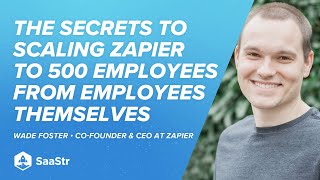
Wade Foster (Zapier CEO) presents a keynote compiling lessons from ~20 early Zapier employees about scaling the company to 500+ employees while remaining distributed and largely bootstrapped. The talk enumerates practical, repeatable takeaways—build scrappy MVPs, hire and onboard deliberately, prioritize people and values, embrace constant change, measure outcomes not effort, and protect innovation—culminating in a brief 5-point synthesis: people first, values matter, change is constant, be scrappy, and focus on fundamentals.
Chapters
It's good to see so many familiar faces and folks that getting to meet for the first time here in person. After 18 months of stuck on Zoom, I'm here today to share a few of the secrets that we've had scaling zapier to over 500 employees. Now, I'm told Zapier is unique for a few reasons. One, we've been distributed for the decade of our existence. That was quite unique when we first started doing that. Now it seems like the norm for a lot of us. We've also largely built the company Bootstrap. We raised about a million in a seed round, but beyond that, we've scaled the company with cash flows and our balance sheet. Also, we've largely done this without a sales organization, which also makes us somewhat unique. So today I'm going to share some of the lessons we learned scaling. But contrasting from the lessons that I've had, I'm going to share from some folks you normally don't hear from. Today we're going to hear from a lot of founders, CEOs like myself. We'll hear from a tier executives, we'll hear from some great VCs, but there's a group of folks that we don't necessarily always hear the lessons learned from them. These are the folks that form the backbones of our companies, the early employees. So I talked to 20 of our earliest employees. I found some of their best lessons learned that they've had along the way. And hopefully some of these might help you too in building your companies. So this is the group of folks we're going to hear from. So we'll go through them one by one. First we hear from Zay. So Zei shares create scrappy solutions that are going to get you 80% there. They're going to last longer than you think. When I was talking to Zay, he shared a little bit about the first MVP he built for for maintaining our zap template CMS system. He built this system over four years ago and today it works with 20,000 different zap templates. And it's largely that same MVP he built four years ago. Is it perfect? No, it's not perfect, but it got the job done and allowed us to focus on other things that were more critical in scaling and building the company. My takeaway here is the great news. We with a lot of no code solutions, things like Airtable, webflow, even Zapier itself, allow you to build things not just quickly, but also with quality. And so it's easier than ever to build these MVPs. And actually have them go the distance for you. Next we hear from Jordan Jordan Shares don't brace for change. Instead, learn to love reinvention. When I was talking with Jordan, he shared a particularly busy period of time that he and his teams were going through. They were tasked with building out our original teams product. Soon after they launched the mvp. Of that they were focused on building revenue expansion. Then they had to focus on building a billing system to support our new revenues coming in. Then they moved over to supporting our company's product. After that they came back to revenues expansion all within a 12 to 18 month period of time. During this period their teams were doubling and then splitting into smaller teams and doubling again and splitting into smaller teams yet again and adding so many new folks, new leaders to this team or while also folks moving on from the company at the same time. It'd be easy for all that change to be daunting with folks, but if you build an organization that loves to reinvent itself, you'll find yourself more successful over time. My key takeaway here is that you want to have a learning culture, a learning mindset. Building companies is hard enough and so you want everyone that you're bringing into your org to adapt that mindset. Next we hear from Vicky. Vicki shares when you're in the high growth stage, solutions to org problems are going to have around a six month shelf life. Don't be tempted to overthink that first version and also don't be tricked into thinking that it's going to be one and done. Instead, build mechanisms that allow you to constantly evaluate where you're at and evolve over time. That way you don't have to rethink everything from the ground up again. Again, my takeaway here is you're going to build for the problems you have today, not necessarily for the problems you might have a year or two from now. While it's smart and even good to think about the problems that you might have a year from now, two years from now, it can also become tempting to over index on those things. And often if you over index on a year or two from now, you'll find that the solutions to your problems and don't actually solve the problems you have today. And so by all means, think about what's coming next. But make sure to really understand the problems you're facing today and build your solutions with those in mind. Because like Vicky says, they're going to have about a six month shelf life. Next we hear from Adam. So Adam shares invest in a strong hiring and onboarding process from day one. Adam mentioned one of the things that's kept him around Zapier so long is the caliber of the people and he attributes that largely to a great hiring and onboarding process. And the way you do this is one you make sure you have members of the team that are trained on interviewing and onboarding, making sure they know how to evaluate people that are going to be a great fit for those roles. 2. When they onboard into the company, make sure to teach them values, the way you work, what matters to your culture. 3. Institute a great pairing culture. Pairing culture means that new folks have someone that they can go to for for difficult questions to ask and make sure that they have someone to ask those kind of nervous things and coach them along the way. And then four, you can repeat the cycle again at the end. So those folks who are new as they become veterans, teach them how to be the next generation of interviewers and onboarders into your company such that you have a strong hiring and onboarding process and great people in your organization over time. My key takeaway here is that you want to make sure that the job you have to offer is a great one. One of the best things your company offers is a good job and so don't skimp on your hiring and onboarding process. Next we hear from Paolo. Paolo shares People are going to be more passionate about the work. They have a good understanding of products and customers. One of the things Paolo mentioned to me was how we invested a lot in all hand support for a long time. We asked every single one of our employees, no matter what function you worked in, to do some support. What this meant is that all of our folks really understood the product that we were building and what was special about it and they also understood who our customers were and what made them tick. My takeaway here is for as long as you can. I know folks are not going to love it. Not everyone's going to love it. Find some way somehow to get your employees in front of customers and get them using the product however you can. Whatever mechanism that looks like, make sure they spend time doing this. It will pay off dividends over time. Next we hear from Stephanie. Stephanie shares startups are hard enough so be someone you want to work with. Stephanie's been in a lot of different companies and some of those companies have been great and she wants to stick around over time. Some of them haven't been so awesome, but the ones that she does want to work with are places where folks who show up eager, challenge each other, work hard, push each other and are largely other people that she wants to work with over time and as a result it's going to keep folks around. My key takeaway here is that it's really important for all of us to look in the mirror and say, hey, am I the type of person that others are going to want to work with? It doesn't matter how smart you are, how talented you are if you're a jerk at the end of the day and so looking in that mirror and making sure that you are going to be someone who wants to show up and work day after day, week after week, month after month, year after year to build something special with is really going to change the type of company you can build over the long haul. Ben has something very simple to share. People come first. I love this one. When I talk to Ben, he comments on four different aspects where we work hard to take care of our people. One is the employees that we have in the company. We work hard to have great rewards and recognitions, programs, a great culture that folks want to show up to day in and day out. He talks about our customers and the work we do to build a great product. He about talks and to build great services to support them over time. Mentioned that all hand support mechanism we used before. He talks about our partner ecosystems and what we do to build an open platform to allow anyone to integrate with our product. He talks a lot about our power users and how we try and support them by sharing their stories, retweeting their good news and really showcasing the special things that they do. In all things we try and do, people come first. My takeaway here is that orgs exist to serve people. Don't forget that it's really important to understand who your key stakeholders are and what matters to them and work hard to serve them over time. Next we hear from Steve. Steve shares Keep the values but change the mechanics. Companies change constantly. Whether it's your code base, your org chart, your systems and processes, your go to market motion, all these things are going to change and evolve over time. So your organization, an organization needs something to ground itself. That could be a shared mission, a shared purpose or shared values. In the case of Steve, these things help people feel a sense of continuity over time. Next we have from Linz Lyns reminds us have fun. It builds camaraderie. It makes people want to stick around. Now it's all great to have shared values, shared purpose, shared mission. But as your org gets bigger and bigger and bigger it can start to feel a little more lonely. So one of the things that Lynz's team done is they've branded the support organization. They have this term called Keep Support Weird. It's kind of silly. Yes, but as the org gets bigger, it helps it feel smaller, helps you feel connected to the core mission of the small team that you're working with. My takeaway here is startups are hard enough. We work hard at this work. And so remember, like Lynn said, have some fun. Next we hear from Joe. Joe shares don't hire for the sake of hiring. Ensure you've got a six month plan for all new hires. I was talking to Joe. One of the things he mentioned is his most successful folks that he's hired. He's worked hard to set expectations for what three months looks like, what six months looks like. He knows what those expectations are going to be so that when a person joins the company, they're much more aligned with what success is going to look like. When we haven't done that, when Joe hasn't done that, the results aren't as strong. My takeaway here, like Joe said, is make sure to define those expectations up front. It can be tempting to want to throw more bodies at problems and say, oh, if we just had one more person, if we just had 10 more people, we might be able to solve this. But if you don't have a clear perspective of how they're going to help, you're going to end up overspending and put too many cooks in the kitchen and it's going to be hard to get things done. Can we go back one? Oh, there we go. I think we're good. Andrew shares Core values will stick with you as you grow. Take the time to be mindful about those values, hire for those values and live those values. When I was talking to Andrew, he mentioned how uncanny it's been. Some of those things that we thought through at 20 people have scaled with us to 300 to 500 and have ripple effects over where we've gone. Those sets of core values have really helped us be intentional about where we're taking the company. If you contrast to the places where we maybe weren't as mindful, those have also had ripple effects too. My takeaway here is one of the most common things I heard talking to folks, and Andrew is no different, is how important those core values are in establishing those early. We bake them into our hiring process and so it's part of our hiring rubrics. We evaluate people against those, we bake them into our performance review process and so it becomes a part of who we are. And it encourages everyone to make decisions with those core values in mind. Next, we hear from Rob. Rob shares even when you have positive intentions, going to make mistakes. Rob reminded me of a time where we used to have a profit sharing program at dapr. We still do, but it broke at one point in time. That could be a story for an entire talk itself. But suffice to say, we had to rethink how we did profit sharing at Zapier. And it would have been easy to say, you know what, we're not going to exactly pay how we thought we would, but for a period of time, you said, you know what, it's going to cost us a lot more to do it the way that we should do that. We had said to do it, and we're going to go ahead and do it that way because it's better for our people. My takeaway here is it's not the mistake that kills you, it's how you respond that matters. If you own up to the mistake, if you course correct, people will understand. They will give you a long leash. But if you try to ignore the problem or hide the problem, that's where you're going to get in trouble over time. Next we hear from Statwonk, our local data scientist. Statwonk shares Measure outcomes, not effort One of the key things here is that effort doesn't necessarily correlate to outcomes over time. So you want to be clear about what it is that you're driving for. When I talked to him, he was sharing a particular problem around code reviews. Code reviews at Zapier are really helpful. They help us avoid shipping bugs into production. But there's a challenge if there's code reviews for everything. It also delays getting valuable features out to customers. So one of the things we've done over time is said, you know what? We're going to put in infrastructure to make sure code review is happy against some of the riskiest changes, and then we find another path to production for other types of changes. If we were measuring for effort, we would say, hey, do code reviews everywhere. But that definitely wouldn't have allowed us to get great features in front of customers as fast as we possibly can. My takeaway here is like stat Wong said, make sure you're focused on the outcomes here. But even better is if you can find a way to connect efforts to outcomes, then you've won the jackpot, because now you can drive that effort and make sure that it's leading to the outcomes that you want for your customers. And for your business over time. Next, we hear from Justin. Here. Justin shares beware of teams sharing code without clear ownership. One of the things we tried to do in the early days to go faster was to share code. You know, when you have an engineering team of 2, 4, 6, 8, it's tempting to say, hey, let's share these methods. And as a result, we might be able to go faster. What we quickly found over time is some of those initial designs worked, some of them didn't work so great. And as more and more teams start to rely on those core design principles, you realize, oh, maybe some of those things aren't going to be as scalable. And what started as a thing that helped us go fast quickly, as the engineering org grows from 8 to 16 to 32 to 64, now becomes the very thing that slows you down over time. My takeaway here, it's hard to re engineer things at scale. Whether it's code, your go to market motion, your org charts, all of these things are difficult to change. Them become more difficult over time. And so to the best of the ability, if you can understand the strong foundations and then scale, you're going to be better off over time. Next, we hear from Jesse. Jesse shares it's easy to get ahead of yourself, focus on solving current problems before thinking about solutions for future challenges. When I was talking to Jesse, one of the things they shared with me was a particular problem they were trying to solve. In the early days, they had an MVP that they were working through. And as they started to work through, they were trying to anticipate all the things that could go wrong. So you might need a feature for this, we might need a feature for that. They'd started to work on building it all out by the time they got ready to launch this sort of MVP for some internal stakeholders, folks were kind of confused by it. They were like, this doesn't really solve the problem that we have. So Jesse went back to the drawing board, tightened things up, got rid of a bunch of the features and focused on the one core problem set that we have. We shipped that out. The reaction was much better. People really liked what they had. My takeaway again here is that you want to focus on the problems you have today rather than the problems you might have down the future. Let the future problems show themselves as you get into the future and worry about solving the things that you have right now. Next we hear from Danny. Danny shares there's no such thing as a small role. Help employees understand their impact regardless if they're a manager or an individual contributor. Some of your earliest employers are going to get lots of opportunities that come their way to take leadership roles, to take management roles, and at first it might seem like the best thing for their career path. In fact, some folks will thrive in those roles and do great. But as your organization grows, and if it grows faster and faster, your org growth might outpace an individual's ability to grow. And that's okay. So it's important to make sure each of your early folks really understand that there is a path for them inside your company. My takeaway here is that it takes a village to build companies and you really want to invest in all your people. Make sure they understand that no role is unimportant. Every role serves a purpose and has value over time. Next, we hear from Cooksey Cooksy shares Equip employees to prepare for a constant state of change. It's inevitable that org structures will shift, processes will break down. Cooksey and I were reminiscing about a particularly fast growing year in engineering that we had, and he posited the question, I wonder how many people had multiple engineering managers this year? And we looked back at it, there's quite a few. But what maybe caught us a little off guard, there was multiple folks that had over four engineering managers in one given year. Now, obviously, four managers in a year is not the ideal state of things. That can be a pretty tricky thing to navigate. However, when you're growing fast, sometimes that kind of change is inevitable. And so again, it's really important to build an organization that has a learning mindset that's willing to embrace change and to really focus on what are the needs of the customer and how can we best solve for those things over time. Next, we hear from James. James shares as you grow, it becomes important to move away from a mindset of I can do it all and instead become accustomed to delegating. James shared One of the allures about joining a small company is the speed at which you can operate. You can build things fast. You can build something in an afternoon, ship it out to the site, and that can be such a fun, exciting time for companies. But as you grow, one of the things you quickly realize is you can't build everything your customers want a lot, and it can be difficult to keep up with all the demands and challenges that your customers are going to have of you. If you try and do it all, you're going to burn yourself out. So when you find yourself in that moment, it's important to step back, take a deep breath Understand what you're best capable of delivering, then prioritize that work and find and build a great team that you can delegate and assign things out to. My takeaway here is again, it's really important to invest in your early employees. Your early employees are going to be stretched in all sorts of new and different ways and the skills that they had in the early days, like building great things, may not be the skills that are going to help them into the future. So you want to help them grow and evolve over time. Next, we hear from Micah. Micah shares don't play business until you have to, especially when you're quite young. When you're less than 20 people, it's really hard to have to do everything that bigger organizations can do. You're going to hear a lot from a lot of great folks today. We'll share tons of best practices. Many of those things won't be possible if you're a quite small company. Micah's advice I find to be particularly good. You may not be able to build reports for everything. You might not be able to adapt the applications these larger organizations are doing. But what you can do is focus on three things. One, are you building a great product for your customers? Two, are you helping sell more of your stuff? And three, are you serving those customers really, really well? If you do those things, you can let other stuff you can save that for later down the line. Next, from my co founder Mike Mike shares, don't forget to invest in innovation. You risk getting left behind. All new companies innovate in some particular way and once you find product market fit, you can start to grow and grow and grow and that feels great. But if your founding team is the only ones that are thinking about innovation and they're now focused on scale, what you can find is that innovation starts to stagnate. So it's really important in your organization's to bring in other folks that are thinking about the future and are helping advance the vision and the mission and pushing on new things. Not just operational effectiveness, but what is going to take you to the next chapter for your organization. My other co founder Brian Brian shares hire senior people sooner. People that have been there and done that, but are still scrappy. This is something we didn't do early enough. I think we were fearful that folks would come and join the company and not really want to roll their sleeves up, get their hands dirty. But if you look around, even at an event like this, there's so many of us now that have so much more experience in SaaS and are still willing to roll our sleeves up now? Yes, of course there's folks who are tired and want to sit back and advise and point that. But for all those folks, you can definitely find senior leaders who are more than willing to come in and join a small company and carve out a path for the future. And last, I'll share my tip here. We've heard from a lot of great tips from early zapians, but my advice would be Break the rules. Best practices are going to get you the same outcomes as everyone else. The best companies are outliers and they're outliers in one or two key dimensions. So you're going to have to find a place in your organization that you want to stand out, whatever that dimension might be. Don't be afraid to take risks. Do something that looks a little weird. People might go, I'm not really sure that makes sense. But those are the areas. If you don't take those chances, you find that you won't stand out over time. So with that, let's wrap things up here with a quick summary. There's a few things that I think stand out from what I heard from our earliest employees. 1. Put people first. Like I mentioned, organizations exist to serve people. So understand what your people care about and work to serve them. Whether your customers, your employees, your investors, you name it, put them first. 2. Values matter. These are things that are going to have ripple effects as your company grows. So the extent that you can define your culture, the values that you serve is going to allow you to hire people and onboard people with those things in mind and grow in a way that is going to be much more smooth over time. 3. Change is constant. High growth organizations change all the time, so make sure you build a learning mindset that will help your organization adapt to the change over time. 4. Be scrappy because things are changing all the time. It's really important to find solutions to problems that you have today rather than ones that you might have over a long period of time. And last, focus on the fundamentals. It can be tempting to want to do everything, but your organization is going to win by being great at one or two things in particular. So make sure you get those things right. Thanks for having me here today. I hope you all learned something and enjoy the rest of the afternoon. Sam.










