Top 10 Mistakes Founders Make with Series A with Black Mangroves, Square Peg, Vertex, and GGV
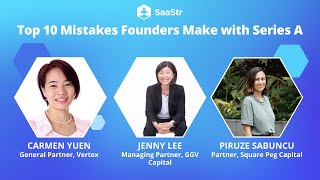
VCs from GGV, Vertex, and Square Peg outline Series A pitfalls: pick investors who understand your sector and will follow on; validate customer personas by talking to users; separate product revenue from service revenue and be honest about repeatability; tailor pricing to regional behavior, from US subscriptions to China's budget buys; plan funding around milestones and confirm investors have reserves; close term sheets fast.
Chapters
So good afternoon everyone. Thanks for joining us for the last session in this room. There will be another one after with Jason. So today we're going to talk for the next 45 minutes and you are going to contribute. We're likely to take some question at the end. So think about what is a burning topic you want our panelists to cover. And the goal today is to cover a lot of mistakes that have been done on the series a round. But we would like to know a little bit in the audience if you can raise your hand on if you're a founder. So who is the founder of a startup in the audience? Okay. Who have raised at least one round, only one round of funding with VCs in a round. We're not counting angel rounds. Who have raised one. Okay. Who have raised two rounds with VCs?
Well done.
Okay. Who have raised three rounds with VCs. Okay. We have only one who survived to that point. Okay, got it. Now I think we wanted to know who is in the audience to get a sense and it seems like a lot of you have raised one or two rounds. So it seems that the topic is quite accurate for today. So I will start with you, Jenny. I think a lot of people may know about PMF product market fit, but you mentioned also the another aspect, the founder product investor fit. So what do you mean about that and why you think founders sometimes have challenge on this?
Yeah.
Hi everyone. It's good to be here. And while this is the last session, the panelists have committed to making this more interactive and more fun. It shouldn't just be us discussing this. So, you know, I think we should all loosen up and be entrepreneurial. So I think that, I always feel that as you has founders, as you're building your team, you talk a lot about having the right complementary skill sets, right from the first day, subsequently going into a team that you can scale. So organization planning within the startup is very important. But I do feel that sometimes founders only look at capital as capital and that whoever gives you the check, I know sometimes you don't have a choice, you do need the check, you take the check. But when you do have to check ability to choose the checks, then I feel that, and I was quite specific, founder, product and investor fit becomes very important. Right. Even from day one, having investors who knows the team, who knows the sector or the needs or problem set they are trying to resolve and getting that concurrence on day one becomes very important. And that actually goes into many different things. For example, does this investor know what you're trying to do, can the investor help you? Have they done it before? And if they have done it for the last 20 years, they are most likely able to help you navigate. Today's environment is not, you know, it's very, you know, dissimilar to the last or very different from the last two years where everything was up to the right and it was growth at all costs. And today the environment is extremely, extremely complex. From geopolitics to inflation, you know, to, to like, you know, really different. Like you know, two years ago we were talking about, you know, high expense hiring, right? And then now we are talking about the great hit count reduction, right? Things just change. And so having the right investor who knows what it takes to build and have done similar things becomes very important. So doing that due diligence becomes very important. And you should feel very empowered to ask those questions even from day one of your engagement and meeting. If you don't get the check, at least get some advice.
So since we have three investors on the fund level on the stage, maybe we can help those founders and each of you can maybe share on what are you very knowledgeable and what are your check size and stage you're doing?
Profit question.
So maybe we can follow up with Eugenie. So what is your check size stage? And like SaaS, do you do dev tools or like what kind of vertical do you like?
So ggv, we are global venture capital firm. For those of you who have attended similar events in the US we have partners who cover software services quite a bit. So as a global VC firm we are multi stage. We have discovery funds which allows us to come in at the seat series A, B level. We can also follow up with 30, 50 million check sizes. Companies are set up to scale, we have different products. So multistage venture capital. We are global which means that our key markets are us, China and now increasingly emerging markets like Southeast Asia, Latin America, India is growing and becoming our third bucket or leg so to speak. And within the partners we have a partnership. We have six partners if you know us. Each of our partners are extremely different and we are known for a specific sector area. For myself, I prior to becoming a VC 23 years ago, I used to upgrade fighter jets. So I'm an electronic warfare system engineer. I used to work on jets, I used to work on cutting edge technology, I used to design drones and so I do build large scale simulation programs. So if you're doing gaming, Metaverse, if you are looking at smart devices, autonomous driving, flying planes, drones, I'm probably the right person because I can tell you exactly what's needed, but I have partners. So within ggb we are, we are technology investors. We have different verticals. So similarly we look at SaaS where I have partners who have spent 25 years tracking and investing in infrastructure, infrastructure software, increasingly the open source movement and then you know, in terms of the different development tools as well as enterprise software. So really across the board we have our enterprise practice, we have a smart tech practice and of course social Internet, which is a lot more in this region about fintech, you know, Metaverse, education tech and the like.
So Carmen, tell us more about Vertex and where is a good fit for a founder.
Sure. So hi everyone. I hope all of you are still okay. Keeping strong. Yeah. So Vertex Ventures is one of the constellation of funds. So the team that is in Southeast Asia and India as a group, we are one of six funds. We do primarily series A investments and tech enabled, at least for the fund in Southeast Asia. So for those who are coming across from China, from Israel, from us, you probably see similar logos, but that's because it's run by separate gps. So within our fund in Southeast Asia, India, there's about 22 of us. We have got really young people and we have got those who are less young.
Right.
So amongst us, you've got people who have seen the industry run through a couple of times where we have come through Dotcom, Asia financial crisis and what have you, the works. So whatever that had happened in 2000, although it's fresh in our mind, it wasn't very new to in 2020. It wasn't very new because we had seen it in 2000. Right. And after that, the SARS, which is what we are seeing, the reaction and so on in terms of discipline, we are tech enabled. We have got six areas that we look at of which is business and SARS will be one of them. We have people who are tracking this area and we believe that SARS is not just confined to any one specific vertical, but it can be quite horizontal. So yeah. And beyond us we've got a growth fund that can invest behind us.
Tell us more about Squarepay.
Okay, so can you guys hear me? Hello? Okay, perfect. So Squareping is an international fund as well, started in Australia and we have teams in Australia, Israel and Singapore covering Southeast Asia. It's been 10 years since we started. We are six partners covering these regions. We do a lot of, I'm generalist, but we do a lot of SaaS and I think we have the advantage of Coming from Australia and having seen the game played in Australia and Israel and now I think like similarly getting played in this region we have a few, you know, things or how shall I say it, the things that people have gone through as they try to either set up teams locally but try to sell to the US or start from a small market but they have to go immediately international. So it's really, really nice to see how it is played here and having seen that game before, be able to be part of this journey. We can come in and see it. We are Series A, Series B we can follow. We also have an opportunities fund. It's been fun in the last few years especially like to double down on SaaS in Southeast Asia, especially in global from day one companies doing dev tools or many other SaaS plays out of here.
Great. So on Pirouzee and Carmen, you also mentioned that a lot of startup at the Syriza stage they may don't know enough their customers. So what are your recommendations around that? What founders should know or they should articulate their view on their customers.
Yeah. So as I mentioned earlier on, we believe that SARS is not just confined to any one area so you can have successful SaaS companies. I mean the Fortune 100 shows you enough that can come from different verticals. However, what is most important is whether or not we know as the founder go out and develop what they think is the value proposition. Is it really a value proposition or is it just an imagination? So this is where sometimes founders need to walk the streets, talk to their Personas and define who exactly is the Persona that you are looking to anchor in on. And this Persona can shift. Right? Because you shouldn't be so quick to nail down that. No, this is it. You have to have that width or that breath to experiment with the Persona that you are looking at and from there the product that you are talking about, which part of their workflow is it fitting? Is it a nice to have little feature or is it a must have replacement? So I think sometimes these are just basic hygiene that founders occasionally will get a little bit carried away and their imagination get the better of them and they have yet to validate. So this will come up subsequently in churn in revenue, in inability to raise funds.
I'm just going to add to what you say. Completely agreed. I think a lot of the news on the street is okay, I'm going to hit 1 million ARR and go raise my series A. And there is always like what is that number that I have to hit to raise my Series A. But if you think of what series A means, of course it's just a number these days, it depends. But you need to be at a point where, okay, I think I have a view on what product market fit is right now. And I think that I know what I can do with that money that I'm going to raise. Especially like I will double down on X or I'm going to go to this other country, et cetera. So in that sense you really need, need to be able to answer not only the revenue but also what are the drivers of your business? What does that mean that you have 500k or a million or do you have number of users and are they growing and what does the user mean, are they engaged? Churn is a good number to have, but Sometimes you sell one year SaaS products and subscription and you don't have enough information on whether they're going to churn or not. But what are the things that you're going to look at every week or every day to see if something is working or not? And people usually don't want to talk about those things. It's like I'm going to hit this number, I'm going to go out. But I think good SaaS investors are more interested in the other types of business driver metrics as well as the revenue.
So would you expect founders to mention two or three Persona of their customer and their deck to show that they understand who they are?
Yeah, so case studies examples is actually one that speaks to us. Right? So just to give you an example, some of you may already have heard of this company called Storehub. I figured it's easier to use examples. So during COVID everybody was dying, so would they. So their lifeline is if their restaurants, their small F and Bs survive. So these guys will pay them the SaaS fees to sustain the use of their point of sales. But if this guy dies off and close business, they are the next to go. So what happens is for them they will have to very quickly come out with a Persona. During COVID These are the FMBs that need help. They actually have got good food. So of course everybody must have good product. Similarly, F and B must have good food. They have good food, but they do not know how to reach their customers. They are clueless. Everybody who comes in becomes just a dollar sign how much they check in and out. That's all. So now how do I help my F and B guys to learn how to take photos of the food, the glorious food that they have so they have to go down to say, this is the kind of food am I going to do the char kway teow, which is like maybe 3 bucks or should I go for the 30 bucks? And because it's Covid, you're talking about delivery, how is your packaging? So they actually have to go down that journey of walking their customers and in the end they realize who are the ones that will likely be motivated to do something about it. Those will be the Personas that they will focus on during that Covid period. And of course now when we are forwarding it to 2023, things are a little bit different. People are a lot more savvy. So yes, they will have to give examples so they know know what they should be looking at.
Do you expect even if sometimes the CTO to be able to articulate that Persona well or you expect that from the CEO? From both.
Currently the CTOs are not. Well, at least those CTOs that we work with are not quite able to articulate yet. Is it because they are busy doing all the codings and making sure that things work or is it because you have got enough people facing the clients? Right. But in the larger scheme of things for other companies for the company to know the pain points of their users. Actually the leadership team should occasionally helm the call centers.
I think it really depends. We work with a company called Supabase. You might have heard of them. They are a devtool company. Their CTO is the cmo. So absolutely. But also it's very important if you're a small company, everyone should be talking to the customers, I think and understanding what drives the business. Maybe they might not be as articulate, but they should know.
I'd like to jump in and maybe add a point. So I think this conference is a misnomer. Last two years, last three years, definitely SaaS was on a hot streak. And then over time people develop playbook and they call it standard playbook. You need to look at net dollar retention, you need to look at logo retention, you know, chat, GBT can be a good investor because as long as you fulfill a lot of this criteria and matrix, you made it. Yeah, like a super A plus company. I cannot resist but to chime in because I think that in entrepreneurship you as founders are looking to resolve a key burning issue or problem set. Right. And that problem set could be in enterprise, in workflow, it could be in many different industries. Has come and mentioned. And when you put that lens, that is the most important lens, are you solving the right problem set? Is it A good to have, is it a need to have and are there people willing to pay for it? And I want to caution that because as a global investor, we look at so called SaaS companies in the US, in China and in Southeast Asia. I can tell you that in China when you look at so called SaaS companies, they are, you know, same thing, trying to address similar issues. But the way the market is set up is that many of the customers are budget based. They are not SaaS based. They're not going to pay you per month, per week, per year. They said this year I have this budget, right? And if you resolve this issue, give you the annual budget, you can space it out into 12 months and make your numbers work. But the reality still comes down to can you solve that issue. And number two, if they are budget based, you price based on budget base. The best company, one of our investment wps, which is like the King Soft equivalent or the Microsoft Office equivalent of the Western world, is the number one player in China. They are budget based, right? Of course, you know, one could say they are SaaS. Yeah, they are trading at 20 billion market cap, 25% net margin, right? Yeah. And so, so and then in Southeast Asia, put in this context, right? So if as entrepreneurs you're trying to focus, fit your business model to what you think is a template, you're going to be wrong. So I still want to come back to fundamentals, right. If you are, if you are resolving the right issue and if it's a need to have, then how much are people willing to pay for it? And has early and sometimes you're so early in the industry people don't know how to price it. But if it's great, you experiment, if they're going to give you part of their budget, you take it and then you figure it out. So I still want to caution us, especially in this current climate, there is no right template. If you are 1 million today, it's PS of 5, that's your valuation. Are you going to accept that two years ago, maybe 50, you know, you get 50 million for series 8 today, it's not going to happen. So again, I think that it's very tough time to be in entrepreneurship, to be doing your startup, but right now it's really so searching. Are you really addressing the right issue and then understanding the business, understanding the clients and then saying in this region who's going to pay? I mean for us we caught the customer, I called them up and said, is this what you're going to pay? Is this a One off. Is this a sandbox? Is this recurring, how much budget this 10% of your IT budget. 1%. Okay. You know, so, so again, I think sometimes a lot of the perceived template may no longer be relevant in this current world. So I think, you know, I'm tempted to join this. As a cautionary note, I will add.
On, I mean, your questions. Thanks a lot for preparing a lot of questions, but I think there's enough content here, so likewise. So people are getting a bit worried, right? So now people are saying that, okay, why don't you give me for free. The idea is so that I can, as a SaaS company, I can sustain. But honestly, this is the way to go into a design disaster mode. So again, like what Jenny had said, if they only have a certain budget, take it and just run with it. And you met, you manage your expenses on that side. And if you are currently giving for free, the way to validate whether you are nice to have a need to have a definite must have is to start charging, right? And as you start charging, you will realize that these people who are paying, they want to get an extra mile for the buck that they pay. Maybe that could help you to build your next product, the next feature. And therefore you can now circle back to them and say, hey now, instead of $1 is 120 or whatever, right? So I feel that as SaaS entrepreneurs we must be courageous enough to know how to price our products so that we know we are really worth it.
This is really a very good topic and I think it touches on what Jenny said. There is no one size fits, fits all. I also have the opposite example of okay, I'm a SaaS company, I have a wonderful product, I've already figured out who my Persona is going to be and I'm going to charge them 10k and it's perfect. Here is the calculation. It's going to lead me to a plus series and all that. And all of a sudden life has changed. A lot of the SaaS companies, companies are selling into tech companies now. One of the budgets are cut, A lot of the people who are buying these products are let go and a lot of the priorities have changed in the last 12 to 24 months. So maybe if your plan was that, but your cost is much smaller and you believe that you have a great product and your team is ready to build on and you've built a great team team, give the product out, maybe you reduce the price and you get it in front of people and they start using it and you evolve from that instead of just sticking to your plans and guns and that price point that you set and waiting for the market to change.
Jeannie, you mentioned also the funding needs over key milestones. So what do you mean, what does it mean for founders and what they need to be careful of?
Yeah, so again, I always feel that if you are in your startup because it's cool, it's not so cool today. But if again you have a burning need to resolve and you really want to change the world in certain ways and you have the persistent to do it, then do a full pickup plan, right? So do not, do not just orientate your business by series A, series B, series C. My advice is that you should think through for me to get to my end point. My endpoint is to fire a rocket into space, for example, then go into it. How much does it take first Stage one to get to building the rocket, stage two, testing the rocket, stage three, how do I commercialize, right? What is this rocket going to bring? What kind of satellite, blah, blah, blah. And then you have the whole full pickup plan. And you said for me to really reach my vision, it's going to take me 100 million. And then look back and said, who's going to give you 100 million? Which are the investors? Who's going to be there, A, B, C, D and B there as you test through those milestones and be able to get there. Right. If you are only funding, so understanding the perspective is correct, breaking down into milestones become very important. And as you talk to the investors, articulating this plan becomes important. I think sometimes we do see founders asking me, can I come to you when I hit 1 million? Or is it 500k of users? We don't go that way. We are looking for the endpoint. How big of an outcome are you trying to create? How much effort, resource is it going to take and the team setup is going to to take to get you there, right? And then we look at you and say, can you do it? Can you raise 100 million? If you are a founder who can only do 10, this business is not for you. So I would also say, you know, before you go out and fight the battle plan, strategize if it's going to take 20 years to get, fire the rocket. Okay, let's see if there's something else to do. So, so, so that's why I mean I think plan first and then after that look for the right investor and when you talk to them, be able to show them that this is what this Funding plan is going to get you to, but don't expect that in stage one I'm going to go to space, right? And so I think when investors understand this, good investors, investors that have very sustainable long term funds, we do what we call reserve planning. Today it's very, very important. I mean GPS like ourselves, we actually reserve a lot for our portfolio. In our early stage fund we do one to one, right? So let's say our fund is 500 million. We may, we will only plan to invest 250 half and, and reserve the other half, you know, for subsequent support of the portfolio company. Because we believe that if this is a great entrepreneur, great direction, I need to plan to see them to the end, right? We spread it out, use up 80% and when the company comes back to us, there's no more cash and then you cannot get to the end point. So good investors will plan for it. But if they are not ready, then this is not the right fit either.
Which is also for the founders to know your investors and get a sense about what kind of final outcome they're expecting from your company. Are they fine if you have 100 million exit, are they expecting you to be a 1 or 5 billion exits but also at the same time how much capital they they, are they looking to allocate per companies? There's a few funds, not that many will only do first check and never follow on. But you're better to be aware of that and going through that.
I tell them I would say this is a brand new category. I'm not prepared to put a lot of money by like you, you know, maybe we'll do a seat check, 1 million or 500k but there's no guarantee there's a second check and we will be upfront and because I want to see then where this is going to go and if, and this is for brand new areas, right? So in that situation, if you then go down and execute on it, then obviously it goes into what we call a mainstream deal and that's where the reserve would be there as well.
So it's important for the founders to know if it's a 1 million out of a pocket of 250 million and they are not maybe doing 250 deals. You know, you have been getting a check that is way lower than the usual check. So they may be paying to learn. So you are not in the same category that a core deal or deal that have been going to put way more than usual. So it's back to do your own due diligence. On VCs and you may still take.
The 1 million because this investor can bring you a different kind of insights that other investors cannot. But you then have to have it in your expectation that the bulk of the check may have to come from other investors. But if you do prove yourself, obviously the investors deep pocket to do this.
So on the customers, I think, Carmen, you were mentioning terms like Paymaster or North Stars. What do you mean by those terms? And why are they so important for founders to know them?
Yeah, so one of the things is that as companies have got these grand plans, they must know in the clients who exactly are they talking to? Are you always talking to the CEO? Is this really something that the CEO is bothered about or is it somebody else within the department or somebody else in the corporation who has the budget? So case in point, right? So another company that we have, petsnap, most of you probably will also know they started as SARS before SARS became sexy. I think at that time they were like just trying to sell into universities. Idea behind it is it's actually in a very narrow space called patent. But who knows, Intellectual property will become something that becomes today called innovation.
Right.
So at that time when they were going around, they were selling to the universities because universities has a way to grade themselves to say, oh, which university is better ranked by the number of patents that they filed. It doesn't matter whether they are better or not.
Right.
So that's why they were trying to sell into the universities. But you know how university budget works. So it's not exciting, Right? That number is not exciting. But soon enough he realized that, hey, actually for universities, they also work with corporates. Corporates are also trying to work with universities. Corporates also have a certain budget in the IP department, intellectual property department. And you have got IP lawyers who are evaluating deals. Okay, fine, let's go there. And now they have gone beyond ip. They are now moving into the R and D. Guess what? They are identifying who actually is the paymaster. And it does change. How is it possible that they change? Because as as they went work with the universities, they realized universities has other needs. Okay, we go into the IP department. IP department has certain needs. So they started to build out their product repertoire. But this is only because they have got a base of recurring revenue, small as it may be. Budget control, as it may be, is still sustaining, keeping the lights on. So they are able to set aside some money for experimentation and they went back to their users to say, is this something you can like? Oh no, not really. And along the way they became so good they were identified by big players to say, hey, I want to work with you. So that opens up yet another avenue, another door for them. But for each of this they realized that the paymaster is different. Now they have got 50% of their revenue coming from China. And to Jenny's point, China's playbook, totally different from everything outside China. China has budget. China's use case is different. Everything that we spoke about just now about university does not apply to China, at least in the initial days. So they are able to identify who are the pay masters as they go along. And so now their pay masters is not just confined to only one type, one Persona, but multiple types. So I think this is where it is important. You need to know who you are speaking to and whether that party has got budget and how much budget is that. If it is a budget for a one year project, go get it. If it's a budget where it's possible to expand because it helped them to achieve their goals, that's a different story. Then you're more valuable.
So we have the customers in China that works more into budget in the US that are comfortable paying subscription. But here we have a lot of people from India or from Southeast Asia. So how about those type of customers for SaaS companies?
So our India companies, they are SaaS, they are generally US focused. So they will work on the UN US model of subscription base. And all Southeast Asia we have got SaaS companies. The Southeast Asia clients are very sensitive, hypersensitive to how much you're charging them. So therefore you will have to be creative on how else can you get additional recurring revenue in other means. So maybe your SaaS per se has to be modest, but what else can you build? What other hooks can you, you build into the process of the company's workflow so that you can now it's too painful to extract you out, but yet at the same time they know they need whatever that you're providing. So it could be more of like I'll give you 10 features for free, but the others are more valuable so you will have to pay. So this is where creativity comes in. But that's only because you know what hurts the clients if they do not have it.
But we need to be careful about creativity I think because in this region we all know that there are a lot of service based things that we do that are not necessarily categorized as SaaS. It's not SaaS and there might be commitments, there might be, especially at series A where the Founder is still maybe they're great and people want to work with them. So they're like okay come do this and come build this both in your story and then realistically when you look at what is my product and what is repeatable and what is my margin and how will it grow without me having my pre sales post sales all solutions engineering, is it first conversation you need to have with yourself? Because it can be a good business as well. But is it a SaaS business really is the question. And if you try to build your narrative and come to a SaaS VC, I think at least in your second meeting you're going to go deep into the what is repeatable, what is service? Who are you selling to? Is this really SaaS?
So interestingly India is a bigger market than Southeast Asia, likely to be way less fragmented. But you still believe SaaS companies can succeed by selling in Southeast Asia or should they go to the US or should they do something else? How do you look at that? Because so far we have seen a few exit here like the wave sales et cetera, but haven't been a three big exit. We don't have yet like very large SaaS, Southeast Asian based companies that are quite active here in the region. So how do you look at that? Is it like a no go if they too focus on Southeast Asia or do you look at that market?
I think Southeast Asia is, is not sexy yet. But that's also because we have got a group of companies like I said early on that are less willing to pay. But there is indeed need for our Southeast Asia companies to have certain levels of productivity via the SaaS companies. Right. The tools that is available. I feel strongly that they need to be leaders in the domain that they are in and it could well be an M and A game. So the exist that we have seen previously where Zoping was exited to Zendesk, I think it caused certain excitement for a while but not enough right then for the founders. Let's say when the companies are exited, where do they go next? Are they coming back into the SaaS game knowing that it's so hard and painful? So are they coming back or are they going to say I'm checking out, I will be an angel investor? I think that's, that's something that founders ought to also help to lift the ecosystem up. I believe that once we have got a very strong, Strong exit by IPO or M& A and if people have indeed managed to sell the company at a way higher price tag, we will start seeing excitement in this vertical.
So we need a Zoho of Freshworks.
We do, we do Freshworks. Yeah.
I think you can absolutely start a SaaS business out of Southeast Asia. But and you can sell to great companies here. They can be your first users. It's great like founder to founder sales, but close to series. Again depends. You need to keep your eyes out in a more developed market if you want a more proper like we see type of tech company growth. But there are certain pockets that are getting quite interesting I think in countries like Indonesia. But they are very like HR tax focused where like regulation changed and like everyone needs to move to a certain place and much faster and there is no way around it. So there needs to be some kind of a catalyst. Otherwise it is people are still not willing to pay big amounts for SaaS software.
What you're also saying is that since the market is not that large, you are better to tackle something like HR that every company needs like a zero or something that everyone can use. And don't go maybe too niche because otherwise you're already a fraction of a small market. So it's very unlikely you can correct.
And I think there needs to be an advantage of being local like whether you know the tax codes or what's going to happen to the regulations and then you can keep on building on that moat.
So I'd like to give another example. So I think when we talk about sars we are talking about the ultimate perfect model in the US market. It's great. You can sell tools, APIs and call it SaaS. Right? Because it's recurring. But it's condition on a few criteria. I think one, the ability of the enterprise or the users to pay. So GDP per capita does matter whether it's at the company level or at the individual level. Then number two, you are also assuming that enterprise when they use your tools as a group of developers who knows how to use it for whatever that they are using that tool for, right. So if you're using it for data observability, they probably have data scientists, they use your tools and then they can do it. But it's very important when we look at markets like China, Southeast Asia, India, while from a pure number perspective we have more developer rest of the world versus the US the quality of developers in our Asian market, many of you hires, right? You know that quality of developer, that innovation. Maybe you find some coders, people who can code Vietnam is probably better than Indonesia. But the ability to take an off the shelf tool and then make it useful within company is Solely lacking. So again, if you can get to the ultimate model, perfect, right? Light model, just do tools, standardize and everybody pays you on a daily basis. But the example I want to give is this. I think education is one sector that everybody knows is huge, particularly in Asia where parents are all tiger, dad and mom. The system is about competing on education. The kind of companies we see, see and startups we see in the US they tend to be SaaS. You know, we have startups that provide SaaS tools for schools to better manage their grading, for schools to better kindergarten, chains to better manage payment. And the kind of companies we see there tend to be very simple app downloads or tools. In China, in Southeast Asia, market is huge. But if you sell the tools to the schools, they don't know how to use it. You sell the tools to teachers and you say let me help you to manage your students, they don't know how to use it. What do they want? They actually want you to use your tool and your technology and operate as service. And if you operate and service, you actually end up taking the bout of that value chain versus just trying. So enablement doesn't work globally because the stage of development of the development community is very different. So it doesn't matter like, like do you, do you, if you are truly trying to change the world, in this case bring education to everybody. It's not about just giving them tools, it's about saying I want the endpoint which is to educate. And therefore you may have to do the dirty work, the tough work the operations were, but as part of that you are going to probably get 80% of the value. And then three years down the road, five years down the road, enough people, enough teachers, enough students use your platform, they may be enabled to then leverage the platform. And in that case, can you now take the technology that was your back end that you don't sell because it's your core advantage, maybe you open it up and then enable the long tail and then you can start to have a SaaS. So it's really customizing your value proposition to the market, not just waiting for a market to be SaaS ready. Because who says SaaS is holy grail right now? SaaS is not sexy. So again, but what is sexy is ultimate value creation to the end user and it could be services. I think the world is going back to hard work. There is no low hanging fruit. If it means you have to operate, if it means you have to find teachers, if it means you have to deliver and do some customization, you may have to do that. And in developed emerging markets, that may be the right way to get yourself in first and then you do a conversion to the ultimate model over time.
Yeah.
So that's why just now when Peruze was saying about beware that we may be considering a services company is true. So Most of our SaaS companies have certain elements of services revenue. We do not want to see that to be too big. But we also realize that this is one where number one, it helps to put money on the table because service you pay by installments or pay by milestones, it puts money on the table. And number two, you are able to now know the problem of the company more intricately. We do not deny that. But eventually we would like to see that they were this customer doesn't churn because I do all the hard work for you right up front.
I didn't want to be too negative, like maybe you become a payments company so like it's just to find other ways of creating value and capturing that value.
So Peruze, you also discussed about sales efficiency matrix and you were saying that that may come too early sometime on startup using it. What do you mean by that? And when is the right time to use it?
Depends if you found the product market fit. And if you know that, okay, I put the first, like I did my own sales, like, I don't know, founder, let's say, let's say you're doing SaaS. It worked. I put two other people. It seems to be working. Of course you won't get the predictability yet, but you can, you can sustain a few other people, then you can start looking at, okay, like, how would the future look? Like it might not be happening right now, but what would be the sales efficiency of this product? But sometimes we see some companies that are way earlier in their journey that are just like slapping a sales efficiency metric where like, you know, like depending on a great salesperson or a relationship, etc. Like that number might look great or really bad, but it might not mean much because it's just like you don't have the right metrics to show that this product works for this user or that market.
So I think what we're hearing quite a lot today is about there's a lot of framework, there's a lot of things to follow, but you need to deeply understand them to know when you should and when you shouldn't and when you should twist it and what makes sense. So the challenge is you deeply need to understand before you can go around it. So that is not Easy for the founders. Before maybe we take some questions from the audience. We're going to wrap up on the challenge. You may see on the closing process and negotiation and terms on the founders on the round. So maybe we can start with Ginny. What are your thoughts on that?
Yeah, you know, this is one topic people don't talk a lot, right? You get your term sheet, you're happy, you think it's done and then the lawyers come come in and then the terms comes in and you start a series A, right. So you're like what's liquidation preference? What's redemption? Or in China we have redemption Asia as well. And then you start to go down this whole legal jargon and then you freaked out. So. And then it takes six months to close. You seriously trying to raise 3 million. It shouldn't take you six months. It's six months of loss opportunity in the market.
Six months from, from the term sheet to the money in the bank.
Yes. So I think this is one I would like to caution because if you are a series A, you're trying to find product market fit, you're trying to build your management team, you try to explore monetization. And I can tell you from an investor point of view, a term sheet sign is not a deal. Done. We continue to do our due diligence up to the last day. And the entire negotiation process with a founder on the terms is like the most revealing of all due diligence because it shows us what is this CEO anal about, you see going down the long tail, trying to nitty gritty, negotiate reps and warranties. I can tell you if the company does not do well, there's no more cash. Why worry about liquidation? Zero right now. Why does the investor need it? Because we are funds, official funds, institutional funds. We have a fiduciary duty to our investors, limited partners, some are public pension funds. So we need to have check and balance. We need to have a worst case situation. That's why legal comes in. Legal is about protecting. The worst was downside. But in early venture the downside is zero. Right. And so I think as founders you have to take take this into perspective. I'm not saying don't negotiate your terms, I'm saying understand your terms, focus on the big picture. There may be 20 terms you're anal about, but say which are the two showstopper. Maybe it's valuation, maybe it's ESOP, maybe it's exit liquidation, maybe it's board seats, maybe it's voting rights. But focus on the big picture. Get those points and then get your money in. Because when the money is in, you can start to do what you do need to do. And we have been known to step away from a deal because through that negotiation process the only the lawyers are making money because the clock keeps going, the curtains keep going and I'm like 3 million deal. They are going to spend half a million on legal. This is not a CEO who knows how to use his resource. He's trying to guess and give me all kinds of scenario of a worst case investors trying to invest in a competing company. You are not big enough to worry about competitors. You should only be worried about your own getting to market and having your customers. Right. And so worry less about is this investor going to invest in someone else? Because if you are not good enough, they will invest in someone else even if there's a legal restriction. Right. So. So I know it may sound weird. I'm just trying to put it to perspective. Is that understand the terms and if they are really showstopper from day one, it's in the term sheet, you should discussed it and not have a prolonged process. Right. But it really allows me to tell is this CEO or the founder strategic or is he so much in the weeds that comes tough time, that company is going to die.
So we mentioned a few times today that customers in the region are not willing to pay too much on sas. But also the feeling founders are not willing to pay too much on good lawyers. Is it something also you see at.
The series A lawyers?
There's no good lawyers, only great.
Only AI can replace lawyers. So sorry, I love my lawyers, but I think that in the world of startups there's only fixed set of terms that you have to worry about. And so there is no difference between great, great lawyers. The lawyer who's going to get you that last hundred points and you pay half a million isn't going to be there when you shut down the company. You cannot afford to pay. Right. So. So I think the best lawyers are the ones that will tell you the commercial terms and said this clause, it may sound onerous. The chance of happening is 1%. It will happen 1%. Are you going to fight? Right. I think that's, that's the key. Pay, pay reasonable rates. A lot of investors like ourselves, we have lawyer law firms that we work with and so we actually have about discount which we can offer to our entrepreneurs and say just use the template, right? Yeah, you can work with a lawyer but use the main template and you can get a deal. Series a less than 50k is the norm. If you're paying more than that, something's wrong. Maybe 20k is what we see if there's no restructuring. So again, these are the range. Talk to your fellow founders, figure out what's the right range, get their review and then you get your kind of service that you demand. But you don't have to overpay.
Okay, so let's take one at least question from the audience, please. Keep it super short on your question. No comment. Question. Anyone with a question, you can go to the mic. Do you have any question? No question. One question.
Thanks guys. That was a very interesting set of perspectives. So I think, question to Jenny. I think you shared that a lot of times, you know, you talked about the fact that there's a way the business runs, right. And then based on that, you know, you'll have to look at product versus service. You look at what really is the way of extracting value. Right. And that is what really matters. And I think that's great conversation of the partner level. Right. But when founders, and I'm going to speak as a founder, as founders, when we talk to the analysts, it's a very different world. Right, because you're going to get into an analysis paralysis mode and there's a lot of arm wrestling in terms of is this metric high or low or does it meet the benchmarks? Right. And I think a lot of, we've seen that with a lot of analysts. What happens is that he, you know what, these are your, this is your data room, these are your metrics. Right. But our template says that this is how a great company should look like. Right. It doesn't match it. And then the conversation on value for the customer is not there at all. Right, so what is your advice to founders to get around this?
I actually had a point on that.
Right.
I actually had a point mistakes, which is the approach, you don't approach the analyst first.
Sure.
Right. I think if you find the right investor, you should try and get a meeting with the partner experienced person in the room so that it's not about cooking cutter, cookie cutter, trying to fit the mole, but it's about having that long range discussion about what you're trying to do. So in today's market, deals are not done after one meeting, maybe last two years. Today's market, it will be more iteration even at the early stage. And therefore requesting for that meeting becomes very important. You have have to do your due diligence. Not all VCs have money, not all of them are deploying so don't buck up the wrong tree either. Do your homework and then as you talk to the partners, you say, okay, today it's not going to be crazy valuation right. Now, if you do have to dilute your business a bit more than usual, make sure that it's done with the right person in mind. So I don't know how you can convince the analyst. I would say figure out how you find, find a decision maker.
Don't mind. I have one more counter question there because I believe that I fully agree with what you're saying. Right. But I also have seen that a lot of partners do rely very heavily on the analyst team to give, you know, their feedback.
Right.
So I, I don't know if we can say, hey, you know, I don't want to talk to analysts, I only want to talk.
You may have to talk to the analyst first, but make sure that you share your vision, your long term path. Actually, I don't want to discount analysts. Right. Many of the investment team, they're very smart. They have met, if they have met 3,000 founders, they have a way of sussing out, is this the right guy? Right. Don't get stuck into the numbers on day one. Know your numbers, but be able to impress with what you're trying to do and then you request for the meeting.
Right.
So there's no way around it. Right. You've got to trust that the person who you talk to is qualified enough to discuss with you. But don't get down into like argument on this number and that number. Like try and come up on the strategic and be able to spark. Sometimes it takes more than one meeting. We do track our founders over time. Like I remember my founders like from five years ago. I've tracked companies for five years and the entire team knows me from A to E. I only came in at series E, but it was easy because they know I know exactly what they have done. Their management team changes. But the early days they were not ready and they know it. Right. So sometimes you may not get them in series A, but come series B they would have seen how you have progressed. And that earlier conversation, if it's done right, would have built the foundation for those subsequent conversations.
Thank you.
One thing to add is I think Jenny is right. But you guys probably know that like many other companies, VCs also have their own CRMs. So if you meet an analyst or another partner and if the answer is no, and if you go to another partner and don't give that context, the other partner, the chances are that other partner. Knowing that you also met and seeing the nos is very, very high in this business, trust comes first. So please, please be transparent. And it happens, it happens a lot. Sometimes you say no and make a big mistake too. It doesn't have to be an analyst. I think it's very critical.
I'll just wrap up. I think time is way up. I'll wrap up. So at the same time your business is not a one off. So while the main metrics doesn't work right now, that doesn't mean that six months down the road you are still below benchmark, whatever benchmark may be. I think end of the day we are looking at companies that can have a sustained, better yet higher growth.
Right.
So if you're able to demonstrate that without burning too much in today's context, I think you get to live another day and play another day. And then we are always looking out for that, that company that can give us the home run. Right. So, so and we will continue to look and we'll come back to companies like what Jenny said. Maybe not five years, maybe half a year out, we'll touch base, right.
I've been in business for 23 years so the duration can be a little longer than most.
But be carefully which partner you talk to because if it's the wrong one, sometimes there's not much communication in some funds so images die there. So look across the page, look at which deals, which one have been involved. Do you see the one giving quotes in the press for which deal and get a sense about the one is more likely to understand your industry and do the deal on your company.
Some of the folks that we are talking to, they know they are pre a they are seed stage. They know we don't do a seed stage and they are saying can we start letting you know what we are doing? We will never say no.
Right.
Because we are also tracking the founder. We want to see how the founder react responds during times that are hard.
Right.
So we are tracking and it's always open for conversations.
Thanks guys.
Awesome. Thanks very much everyone. Please join me to thanks our great panelists.










