Top 5 Ways to Build a Successful GTM Team | Owl Labs CRO + Global Workplace Analytics President
Kate from Global Workplace Analytics and Josh Allen, CRO of Owl Labs, discuss building go-to-market teams after the pandemic shift to remote work. They cover five priorities: hiring people who can work remotely, leading with trust, building a coaching culture, equipping teams with the right tools, and keeping external stakeholders in mind. The conversation includes audience questions on workplace preferences and remote sales touchpoints.
Chapters
Foreign. Everybody, good afternoon from wherever you're calling in from. Now, we all know that the pandemic has forever changed the where of work. But it's also had a profound effect on the who, what, when, where and how as well. It's the how of work that Josh and I want to focus on today, because that's where we're seeing organizations struggling the most. Changing the how of work is absolutely critical to the if organizations are going to maximize the potential of not just hybrid work, but of human potential. Now, imagine if when cell phones came out, we only used them for, we only used them at home. Or when smartphones came out, we only used them to make phone calls. In so many ways, that's what organizations are doing with remote work. They're using old practices and processes and old tools to work in new ways. And the result is much like what you see in this image here. Inefficiency, ineffectiveness, and a failure to achieve what's really possible. Much of the frustration that people are feeling right now, the 12 hour days, the constant stream of zoom meetings, thousands of unread messages in your inbox, it's because of this failure to evolve the how of work. A lot of what we need to do is actually quite simple. We need new team norms to help people understand it's okay not to answer the boss's email at 3 in the morning. It's okay to take a break after a big project. It's okay to work at 9 o' clock at night if you're working around your family schedule. We need to embrace asynchronous communications too. Over synchronous. So not every conversation has to be a zoom call, not every meeting has to last an hour, and not every meeting has to be a meeting at all. So as you think about the how of work in a post pandemic world, I really urge you to do it with fresh eyes and an open mind. Do we really need to replicate the water cooler? My husband has a line that I like. We try harder and harder to get better and better at things we shouldn't be doing at all. So ask yourself, were your meetings effective before the pandemic? Did the places and spaces where you worked actually support the work that you were doing in them? Did your people have the right tools and technologies to do their best work? Organizations are ready for change like I have never seen before. So let's not miss this opportunity to hit the reset button on practices and processes that were broken to begin with. Now, I don't mean to pick on meetings well, actually I do because they're the low hanging fruit on the tree of what needs to change in how we work. They occupy a huge part of our workday. And as I said, they were broken long before the pandemic. There were too many of them. They were not very effective or efficient and in fact many of them were just a complete waste of time. And we probably all know what it's like to be the only one who's not in the room. If we're going to keep remote workers from feeling like or being second class citizens, we need to get better at hybrid meetings. Story I want to tell about a client of mine. I was just wrapping up like a six month engagement on return to work and hybrid strategy late last year and beginning of this year and I was making a presentation to the board. They were all in a room. I was virtual. At the end of the meeting I said, okay, let's rate this meeting. And I said, I'm going to go first. I'd call it a three. You didn't have your laptops open so I couldn't see you. There were ceiling mics that didn't really work very effectively. I couldn't tell who was talking. You couldn't see me because you only had one screen in the front of the room and it was showing my presentation. At one point I had somebody in the room asked a question and I had an answer to it, but I couldn't break through to say anything. I wound up texting the chairman and then he broke me into the meeting. And at one point you all took a break and you turned off the sound. I missed what's often the best part of the meeting. They all laughed at themselves. But then one director said, hey, didn't we just have a consultant in here for like six months to help us do things like adopt new meeting practices? Hybrid meetings are just one example of the how of work and how it needs to change if we want to be better at if we want to make work better than it was before the pandemic. And I think that's truly possible. So I want to turn things over to Josh Allen, now CRO of OWL Labs to talk about how they changed the how of their go to market strategy in the wake of the pandemic.
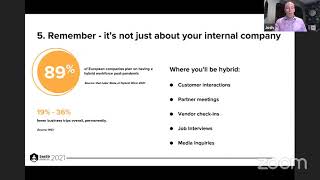
Josh, awesome. Thank you very much, Kate. And good morning to everyone who has joined us early on the west coast and wherever you are, thanks for popping in. So my name is Josh Allen. I am the Chief Revenue Officer here at OWL Labs. And the reason I want to talk to you all about building an effective go to market team. Specifically now in these days, while we're still in the midst of the effects of the pandemic, is because I happen to work for a company in Owl Labs that is headquartered in Boston, but has been focused on building collaborative technology, specifically hardware for hybrid teams. During the pandemic, we've actually more than tripled the size of the company overall. We've quadrupled our sales team and we've learned a bunch of things along the way that I think, as Kate mentioned earlier, relate to the how of how to do this. So why don't we jump into to the top five reasons we're talking about here? I think one we're going to get into seeking out the right people, which was always important, is hiring when you're building a high growth company. But in particular it has changed in the landscape of the pandemic. Leading with a principle of trust within your organization, creating a culture of coaching, getting the right tools to support the new environment and how we communicate with each other and those who are outside of our company, and then remembering at the end that it's not just about your business, it's not just about your company, it's about all of those you interact with. So let's dive here into step one, which is seeking out the right talent. Now, the most important takeaway from this particular step is that you have to think that the 25 mile radius, the imaginary radius we had around our headquarters and our satellite offices before that has all been knocked down and we are now competing with companies that are all over the place. It's not just Seattle and San Francisco and Boston and New York and Austin. It's companies in Copenhagen and London and Dublin that now have access to the same talent pool and are trying to hire in the same people. So if we look at these steps, I want to highlight a few of them and not go through all of them, but specifically the ones that I think have changed the most as a result of the pandemic. So step one, when you're thinking about hiring strong communicators, that can be a different type of person in the sales world. You think about your quintessential salesperson who is the office extrovert, the one who is walking around saying hi to people, they're hopping on planes, jet setting, shaking hands and giving presentations. That has changed. All field sales teams became inside sales teams overnight in March of 2020. And so when you're thinking about hiring people into your go to market teams, you want to get samples of their writing. You want to see how they communicate and understand how they communicate asynchronously in addition to how they are in meetings with customers. The other step, step two here is you need to be able to identify people who can truly work on their own and independently. So it's getting into the intrinsic motivators of individuals and what causes them to do great work. Why are they motivated to do things on their own? How have they acted autonomously? That is more important than ever because we need to be able to trust the people that we bring into the business to operate without a whole lot of direction. Last one I'm going to touch on here is step five that you see at the bottom there, which I think is extremely important. Now it's leaving egos at the door. What we've seen is that if you're hiring confident and humble people, they tend to be better communicators across the entire organization. If you have people with strong egos and too much arrogance, it builds walls between teams. It builds walls between people and arrogance can be a. We can't afford that at this point. All right, let's move on to step two, which is leading with a principle of trust. This is about creating a loyal workforce, one that you retain and continue to develop and grow as your company grows. One thing I want to leave you with on this one is remember that we live in an era of glassdoor and where people's feedback, how you made them feel as an employee, is accessible to the general public. It's accessible to the world. So if you are, if you are operating in a company that is directive, where decisions are coming down from the top and just being pushed down as opposed to taking feedback from the team and allowing the team to help drive decisions. If you're not creating an organization that is based around trust, those people are going to go to companies that have established that baseline. And it's very easy to see if you just do a quick Google search on a company's reputation. The next one is getting into creating a culture of coaching. So in a go to market world, this is of particular importance because you think of sales teams, marketing teams, customer success teams, support teams, anybody who's actually touching the customer, we want to be able to teach and coach. And when you create an environment of coaching where the expectation is that you are keeping a pulse of feedback that is ongoing, it doesn't just have to be at the mid year review or the end of year review, but it is the little stuff every day along the way and that has changed significantly in the hybrid world because again, we don't have the natural over the shoulder coaching that is happening. You either have to carve out time as a manager or a team lead to give that feedback and listen to those and review that presentation, or you're building it into your natural cadence of one on ones in the work that's happening throughout the course of the week. But that ability to coach in a hybrid environment where you're not necessarily going to be next to somebody physically is a learned skill that we've had to develop here. Next one is getting the right tools and it kind of relates to the ability to coach. So it's like, what are you actually using? You think about it in a sales world, are you using something like a chorus or a gong or call recording where you can do asynchronous review, give feedback to somebody and then open up a dialogue so that people are learning the right skills? Think about general cross company communication tools like Slack have been used almost ubiquitously throughout the world, especially in tech and information companies, because it allows you to communicate both synchronously and asynchronously. We have employees who are on the east coast communicating with those who are on the west coast. You can drop a Slack message just to say, hey, when you're online, I have this question, blah, blah, blah, and you can review it, but you're trying to get feedback from people to make sure you have the right tools. And it's not just about software, it's also thinking about your physical space. Kate gave the example before she rated that meeting a 3. Think about what all of your company's meetings are like now. If you're moving to more of a hybrid model or you're engaging with companies who are in a hybrid model, you need to have the right hardware, the right technology to create an experience that is good for both the people who are in the physical location, but as importantly, the people who are attending remotely and joining. You want them to be on as close to equal footing as possible so that their experience is good and they feel like they could participate as if they were in the room. All right, the last one that I want to hit on here is I think this is a very important one. We get so pulled into our own companies and who we are and what we do and drinking our own Kool Aid until the sugar high is so high that it's the only thing we're focused on. Remember, it's not just about you. It's about everyone that your company engages with and all of Those engagements, whether it's a sales call, marketing review, a customer success implementation, a support interaction, all of those things represent how your brand reputation is in the market. And so it's not just about you and how you organize yourself from a go to market standpoint in terms of the interactions you're providing for the world. So think about how you're engaging with your customers when you're doing a product review with them, when you're interacting with a partner about their go to market and needs that they have, when you're talking to a vendor of yours because you bought a solution and they're helping you troubleshoot something that's going on, all of those interactions and the way they happen, and the platform and forum that you provide for them to interact with your business, all of that matters. And all of that is a reflection on your company. So even if you've made the decision that you're only going to be remote only, or you're only going to be in office only, or you're on that wide spectrum of hybrid operations, remember that the decisions you're making are not just about you. It's about everyone that you interface with. All right, so just to recap quickly, we talked about seeking out the right people. Hiring is always the most important aspect. But think about how the landscape has changed in this era that we're in now where we're competing literally globally for the same type of talent, leading with a principle of trust and understanding that if you don't develop that, that your reputation will be in the market as a company and people are going to want to work for companies where trust is king. Creating a culture of coaching so you're constantly getting feedback and reviewing and up leveling the skill sets of yourself and the people on your team, getting the right tools so you can do all of this communication and all of your work as easily as possible. And then remembering that whatever you set up for that communication for that work, for everything that is happening for everyone who interfaces with your company, it's not just about you, it's about everyone. All first, second and third degrees of interaction that happen there. Thank you very much. I think we do have some time here. We've got about five minutes for Q and A that will tee up.
Yes. Okay. The first question, step two, mentioned surveying employees. When you survey your teams for their workplace preferences, how much should you put into action? Can you find fundamental ground and how? And Kate, why don't we start with you? Sure.
Very good question. It's one that a lot of organizations are struggling with right now. In general, what we're seeing is that employees want a little bit more flexibility than managers are willing to grant. I think it does have to be a compromise. We're in a market where there's a lot of options and a lot of other organizations are offering full flexibility. So, you know, you've got to understand, you know, what's, what's my talent pipeline like, how badly do I need these people? You know, what is it that I really want them to come to the office for? I mean, it really shouldn't be. I call it fences, not walls. Don't. Don't make things so rigid that everybody feels like they're, they're, you know, it's controlled flexibility that just doesn't work. So I would really suggest being fluid as you can going forward.
Okay, second question. This one is for Josh. The pandemic has forced sales to take a slightly different approach. What are your recommendations for creating those face to face, like touch points without actual face to face time?
Great question. I think a lot of it comes down to the preference of the customer. I think even before the pandemic, much of selling had moved to a place where there's so much information available for buyers now that many of them were entering the sales process much further down the funnel than if you went back 10 years ago, 15 years ago. There's just so much access to information. So if you think about it from the customer's perspective, it's really about their preference for how they want to engage and understanding that if we're, if we're engaging in a sales process, if we're working together, let's come up with a plan. Working back from whatever the goal is, whether it's. All right, the first thing we want to do is we're going to run a demo, we're going to run an evaluation of your product. It's like, great, let's work back from that and understand what our cadence is going to be. Whether it's meetings on zoom, email exchanges pulling you into a slack room, which I've seen companies do, if they have larger, longer enterprise sales cycles, whatever it is, it's really understanding the preferences of who you're selling to and how they want to communicate, but making sure that at least the two of you are on the same page for what that cadence is going to look like.
Okay, this question is for both of you. What upcoming trends are you seeing emerge as companies enter a post pandemic world? And Kate, why don't we start with you and then go to Josh?
Oh, boy, that's a, that's a big question. Certainly more flexibility, more trust in terms of the physical office space. A lot of organizations are moving to unassigned seating. They're looking at kind of flipping that mix of what used to be maybe 30% social and community space and 70% individual space, and really flipping that because they understand that people will likely come to the office for that social connection to have meetings and they'll do their focus work at home. That's what all of the studies we've seen over the last year and a half say people want to do. So expect some differences in the office that you go back to.
Yeah, I think I would answer that question. We're seeing there's a need for equal access when it comes to employees. Meaning if you're going to be working remotely or you're going to be coming into the office twice a week, or you're going to be in the office every day. The expectation is that employees have equal access to their decision making rights to whatever they need for resources to get their job done, and that they are viewed and have the ability to, to earn promotions, to earn compensation increases, to earn all of the things, no matter what category they fall into, whether it's remote hybrid or in the office. And so the only way to accomplish that is to make sure that as companies, we're giving them the type of technology they need, the tools they need to make that come alive and into existence. So I think employees have really kind of made the comment that they expect their companies to do that on their behalf. And that's pretty different from the world 18 months ago.
It really is. And Josh, just to add to that, they're learning that they really need to be intentional to make that work. They're looking at how do these meetings happen. The example that I gave earlier, how do we get people to feel included. Some of the recommendations I have is have a buddy system. If somebody is not on the, not on the call physically, then have somebody in the room that's their buddy and can interject if they want to, or make somebody that is not in the room actually manage the meeting, run the meeting as another option.
Great point.
Perfect. Well, thank you so much, Kate and Josh for that great session.
Really appreciate it.
And we have a lot more great content today. See you all in the next session. Bye.
Thank you, everyone.
Bye.










