VC Office Hours With Craft Ventures GP David Sacks, Managing Dir Brian Murray, Associate Ethan Ruby
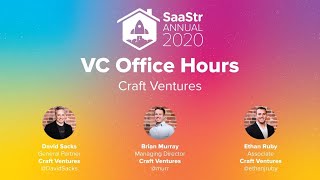
David Sacks and the Craft Ventures team walk through SaaS go-to-market strategy, from defining your category to Series A and B fundraising benchmarks. Founders ask about timing raises, scaling sales, and working with channel partners.
Chapters
Top down sales approach. David was developing a bottom up strategy for Yammer and that bottom up strategy has really become the default for early stage SaaS companies today. It is also our focus as investors now. So just quick overview. These are just a few of the many great SaaS companies that we've invested in. They vary by industry and stage, but all of them, what they all have in common is that they have extremely strong product and go to market acumen. So real quickly, Sendoso is a sending platform for sales and marketing teams, added parts of portfolio management software for financial institutions. Returnly is a return center for e commerce companies, Data assembly does pricing data for CPG companies, Pipe is a financing tool for SAS contracts. ClickUp who's presenting a sastr is a universal productivity tool, Source Graft is an enterprise code search product, CLU is a competitive intelligence product and northspire does project management for commercial real estate. So drawing on our operating experience, we also do a lot of writing about sas. David is particularly prolific on his blog, which you can find on medium. Some of the major themes that we talk about are the consumerization of enterprise, category definition building, a strong sales organization and founder mentality. So that's just a very quick overview on us and we're, you know, happy. We're happy to open up the rest of this session to you guys to take any questions you have about craft, the fundraising process or company building. And we'll be taking craft. You can either raise your hand or we'll be taking questions from chat as well.
Hi, why don't I go first? My name is Becky. I'm the founder and CEO of Dragonboat. It is a portfolio collaboration tool for product companies. I have a question around category definition. Would I love to hear a little bit more about this? Is the term coming a lot lately that in terms of a category definition, what other trends do you see and how many categories there will be when the first company, second company started define category. That's something kind of more interesting. But when you start to have lots of categories, things can start getting pretty noisy. What's your real thoughts on this particular topic and how successful companies differentiate from the others?
Sure, okay, great question. Let me jump in on that. So actually I have a blog that you may want to look at. It's on this page here. The one who defines the category wins the category. I see category creation as sort of like a fundamental marketing tactic that you want to engage in. There are you always want to portray yourself as a category leader and there's a bunch of reasons for that investors want to invest in the category leader, employees want to work at the category leader, and then customers. There's this old saying that nobody ever got fired for buying IBM. The modern version of that saying is no one ever got fired for buying the category leader. Customers want to go with the category leader too. So what happens is you can think of like category leadership becomes the self fulfilling prophecy where if you can establish category leadership, you actually, or if you can establish the perception of category leadership, you actually will win because all the key stakeholders want to go with the category leader. So how do you create that perception? Well, I think the first thing to do is you want to define the category. If you come up with a definition for a category, people will assume that you must be the leader of it. Right. Stands to reason that the leader would be the definer. So then the question is, well, how do you define the category? And I think you have to come up with a definition. Well, you either have to come with a definition or you have to come with a redefinition. And. That can be more art than science. You have to come up with a definition that I think is intuitive, that other people will buy into some of its branding. But it's how you do it. There's a lot of subtlety to it, but you need to come up with a name that is descriptive enough to describe what you and the other companies in the space are doing. But at the same time it's also a little bit aspirational. And so finding the balance there is usually the trick. So for more details on that I point you to the blog. But yeah, great question.
Thank you. I did read the book, but I would like to hear some insider information. But you're totally right, I think the first mover advantage is definitely there and having the connection of something people can connect to, but it's a little bit aspiring. It's definitely something that I. Thank you.
Yeah, so I mean, I enjoy a.
Blog by the way.
Yeah, thanks. Yeah, I mean so. So what we did, what we did at Yammer I think is interesting, which is Yammer was there was already an established space called social software in the workplace. Gardner had a magic quadrant that they put out for years and years called social software in the workplace that both that Jive and IBM won every year. Jive has fallen by the wayside a little bit. But they were a public company several years ago and unfortunately for them, they had a legacy on prem architecture. They were not a true SaaS multi tenant cloud company and as a result they fell by the wayside. But when Yammer first launched in 2008, 2009, we had this problem that we were initially excluded from Gartner's Magic quadrant because we didn't have all the features. We then realized that was a blessing because if we were put in that magic Quadrant, we would have been perceived as in the bottom left corner, kind of the loser category. They would call it niche challenger or something. We didn't want to be a niche challenger. We want to be the category leader. So we out of necessity had to try and redefine that category, because if we KN that if we played on other people's terms, we would lose. And so we came up with the definition of enterprise social networking. Social networks were really taking off. Facebook was going exponential. And we just said, no, look, what you're seeing in the consumer world with social networking is only half the world. There's also this sort of enterprise social networking world. And that definition was more intuitive to most people because what does social software in the workplace mean? Creating an internal enterprise social network made more sense and our definition took off. And because of that, we were able to redefine an existing category. So you either need to redefine it or define it. But one of those two things is really important.
Would you say working with the Gartners in the crowd will be definitely part of the playbook?
I think if you're going after enterprise customers as opposed to SMB, it can be very helpful to have an analyst relations person on your team. We actually had somebody whose job was just ar, so a lot of companies will have a PR person. I would also suggest an AR person on your team if you're going to go after enterprises and their job is to go out and Gartner and so on. They're influencers for that target segment. And so you want to influence the influencers. And so, yeah, I think that's a good investment to make if you're going after enterprise customers.
Cool.
Thank you.
I don't want to take too much space. So anyone else have questions, feel free to jump in.
Yeah, I see we have some raised hands here. So, Sanjay, I'm going to take you off mute if you want to go ahead and ask a question.
Thank you. Thank you, Emilia. Thank you, David. So I'm Sanjay Gould, CEO, founder of Nacho Nacho. We're a San Francisco based marketplace for B2B SaaS. Our buyers are SMBs who use Nacho Nacho to buy and manage and control all the subscriptions using virtual credit cards. And our sellers are SaaS vendors, we use nacho nacho as a new user acquisition channel. So I see there's a lot of marketplaces in your portfolio. So clearly you guys understand marketplaces and focus on them. My question is that what is the point at which marketplace becomes interesting to an investor?
Yeah, so, yeah, there are certain benchmarks that we kind of look at. The sort of rule of thumb for. I mean, so it varies widely by stage. So you kind of have to define what stage of investor you're looking at for whatever reason. The magic kind of rule of thumb or threshold for series A investors is usually for SaaS companies is 1 million of ARR. I think for marketplaces, you don't really have an ARR concept. It's more of a there's like a GMV times take rate equals net revenue concept. And so probably around a million dollars of net revenue. And then divide by 12. If we're talking about monthly numbers, that's kind of like the rule of thumb for series A. And then the rule of thumb for series B would be like roughly 5 million. And then at the seed stage, there might be sort of pre seed seed, late seed, and that would just be about kind of like whether you've crossed the penny gap at all into real paying customers or not. None of these numbers are set in stone. There's a lot of other things that matter. Growth rate matters a lot. I think for a marketplace, a lot of investors would just look at, is there liquidity? What does the quality of liquidity look like? And if investors like what they see, they'll frequently do around it earlier, they'll preempt the next round. Does that make sense? Is that what you're looking for?
It definitely does. The reason is because we're building a flywheel and it takes time to build the flywheel because you build one side first and you build the other side, and then comes a point where everything starts clicking and then you see the hockey stick. So we're just at that point where we're about to see the hockey stick. All the pieces are in motion now. So is that a good time to raise funds or we should wait until we can actually demonstrate the full liquidity and the full GMB you already have, but also to be able to show the take rate and the net revenue and all of that.
Well, I think you should raise money when you need it. And so if you need the money, then you have to go out and raise. And the terms that you get will be based on kind of your metrics at that time. And so the tension will be if you don't want a raise at that valuation. Right. So if you can wait until you're in some sort of hockey stick, then obviously you're going to get a much better valuation. It'll be easier to raise if you're sort of in that very early stage of showing some liquidity. But it's not like it's not particularly growing, like week on week or month on month, you're going to be more in a seed state stage. So I tend to think you go out and raise money when you need it and then you kind of let the chips fall where they may in terms of valuation. But, yeah, makes sense.
Thank you.
And then Robert has a related question to something that Sanjay was just saying.
Yeah. Robert McLaus at Burnrate IO, I was curious on. You mentioned the preemptive rounds. We've been seeing a lot of preemptive A's lately. What's your take on that? Yeah, I mean, so I think the reason why preemption is a sign that the venture business is very competitive and there's a lot more funds and investors who can lead an A round. And so if you're a VC and you know that all the other VCs are going to wait for a million dollars of AR to invest, then why wouldn't you invest? When there are 900,000 of ARR, then that logic cascades. And so then the million dollar threshold drops to 900,000, then it keeps dropping. And so when times are frothy, the threshold for a Series A keeps going down. And so now it's not uncommon to see Series A deals get done with a few hundred thousand dollars or half a million of arrangements. I think those are all good things for founders because it means presumably you can raise that bigger A round earlier, I guess, if you want to. And it really like, in my view, it's just come down to how soon do you need the money. If you don't need the money immediately, then why not keep stacking ARR? You'll get a higher valuation down the road. Unless somebody is just throwing terms at you that are so good that it's what you would have gotten anyway, then you should take it.
Gotcha.
Appreciate that. Thank you.
Great question. We have one from Carolyn here that I think folks are going to want to know. David and team, what's the process for getting an investment from Kraft? Do you prefer warm intros over cold emails?
Yeah, we do. It's so much easier when we get a referral from someone in our network who we know can vouch for a team of founders. People do ask, well, do you recall emails? So the answer to that is yeah, I mean we sort of. But the cold email has to be written exactly the right way, which is if I get this like long cold email that's multiple, like multiple many paragraphs long and I can tell it's like being generated by some like you know, form sender where it's being sent out to a hundred people. I'm just, it's, I'm no, I'm not going to like read that. It's too long. If you want to get my attention with a cold email, like it should be like a few sentences long and it should just give me like it should tell me what your ARR is and what your month over month growth is. Because you know if I see an email that says we're at whatever 500,000 of ARR growing 20% month over month and with a link to your site, I will definitely forward that to the investment team to look at. Now if you send me this long paragraph again dissertation that has no numbers in it that's about what you're going to be doing without any reference. That's just, I'm not going to take the time to go through that quite frankly. But if you write the cold email the right way and you have real numbers you to share, we will definitely take a look at that and someone on the investment team is going to follow up.
Yeah, Jason from our team has had very similar advice on winning the cold emails and I know there are some samples on sasser.com and I'm sure David, you guys have blogged about it too. Next question. Susheel Rana, I'm sorry if I'm butchering your name. You've had your hand raised if you want to go ahead and ask your question.
Hi David, my name is Sushil Rana. I am the CEO and founder of Build Booster. We are platform for construction industry. We are vertically integrating the entire construction industry from material manufacturer all the way to the builder. So my question is I want to get some tips on increasing our scaling our sales so we have grown organically. My background is I was a home builder and I had a good network. I'm out of Minnesota and we have had good network in Minnesota and nearby states. So we grew organically and we have found some good customers. Now we want to grow to the next level scale our sales. So I need some tips on that. We are looking at in our, we are looking at the network strategy where we get, let's say a manufacturer involved and the manufacturer has a bunch of customers. So we go after their customers. We have a builder, they have a bunch of vendors, we go after their vendors. So we are trying to go cross stakeholder strategy to expand our sales. And the other thing we are trying to do is we are looking at some channel partnerships with other products that we can integrate with. So my other question would be if I were to. So far we have not done any channel partnerships for cross selling. So if we were to do that, what kind of deals should we cut with them in terms of revenue sharing or some kind of commission structure?
Okay, great. Okay. So there's two parts to the question. One is how do we grow faster than the other is like what kind of deal to cut with the channel partners. What I would say about growth is that the rate limiting factor on growth for most SaaS companies is lead gen. It's top of funnel. So there's basically two parts to sales or to growth. There's top of funnel, the leads coming in the top, and then there's actually converting lead to close. Once in the very early days of a SaaS company, it's all about, I think, lead to close. You're just focusing on trying to figure out like, okay, you'll have a handful of leads that were passed on by your friends, your networks, your incubator, classmates, whoever, and you're just trying to figure out what is the value prop that's going to appeal to these people. And you're going to then get these initial objections, you're going to realize you're missing certain features, you're going to fix that. And so you're really in more of like a lead to close where you're trying to dial in the product market fit. And so once you get to a basic level of product market fit and sales competence, you're going to get to a very predictable lead to close win rate. It's going to be X percent and you can improve that over time at the margins, but it's going to converge on X percent per pretty quickly, whatever that number is. And then you're gonna move into a new phase which is, okay, like how do I get more leads? And so I think for like a company that's got reasonable product market fit and sort of reasonable sales execution, it's all about lead gen. And so then the question is, well, how do I increase my lead velocity? And I think Jason Lemkin's done some great blogs about, you know, he's kind of got like the Same view that I do that what makes a SaaS company magical is when you've got like organic lead gen. There's a good blog he wrote about how I think it was his number was like 50% of your lead gen should be sort of unpaid or organic and then 20 to 30% should be expansion and then the rest should be paid or something like that. He's got some ratio you want to look at. But that really is the magic is figuring out like the lead gen and there's going to be paid and unpaid versions of that and not all that will be done by salespeople. You've got to figure out, okay, well, are the salespeople really in the best position to do the lead gen? Because what salespeople do is if you tell them they're responsible for generating their own leads, they're doing cold prospecting generally, which is a very unproductive activity. I've never really understood how, you know, how salespeople make that work. So the question is, can you add a marketing team to the sales team to start generating some leads for them and the ability to nurture them and so on. So it requires you to become. Solving lead gen is more of like a multifaceted problem than just having a great sales team. With respect to the channel partners, I would say yeah, that's. Channel partners are one way to, they're like another way to generate leads. I think the tricky thing about channel partners is that partners generally don't do a good job selling your product for you. They don't know how to handle the objections they're likely to get. And so really what you want to use them for, ideally, again is as a lead gen channel, not as like a replacement front end for your product and your team. And so then the question is, well, what can you afford to pay them for the lead gen? And I think what you'll want to do is kind of look at.
The.
Cost of lead gen in other contexts and then figure out what kind of rev share you can give them or what kind of upfront payment you can make to them for lead gen. But I think probably like channel partners should just be seen as another lead gen channel within my framework.
Great, thank you, David.
We've got a great question in the chat here from David Frolick. I think I said that right, hopefully. How do you know when the time is right for a Series A round? They have 25 of the Fortune 500 as clients, but many of them are only at proof of concept. How do you know if it's the right time for them to raise.
Well, are they paying proof of concepts?
David, can you turn on your chime in here?
Where's the question coming from?
Yeah, I'm sorry. Yes, they are paid proof of concepts.
So what, what's the typical like payment they're making?
So maybe $20,000 or something like that to buy a small number of licenses from us. We are a subscription based model, of course, while we're here. So they buy. Maybe this is a corporate training software company, so they may buy 30 or 40 subscriptions to run a proof of concept, which would run around between three and maybe six months in duration. And we have some. And Amelia asked a question. Thank you very much, Amel. One of the other parts of it was we have three or four that are past the proof of concept stage and we're starting to expand with them. So we do have proof that once the concept is done that no one has done the proof of concept and quit on us. So we have good numbers there, but we've only got a few that are sort of past that stage and into the next stage where they're growing their number of licenses that they're buying from us maybe in a thousand seat increments, but there's not many at that stage. So how do you think about that from a series a round perspective?
I think you're pretty close because if you do 20 deals at 25 deals, proof of concepts at say 20,000, you're at half a million of annual revenue. Now, I guess there's a question of whether that's recurring yet or not. But so the obvious thing is gonna be like, what's the conversion rate from proof of concept to permanent customer? I don't know if I've got like having a handful of like referenceable customers is like key for sure.
Yeah, we're probably at about a million dollar rate. When you look at the ARR. When you look at those that have gone past the proof of concept, so they're expanding with us past that, you know, kind of, you know, the average revenue per client that's past the proof of concept stage is pretty impressive. But there's not many of them yet. So I don't know.
But I think if you've got like a handful of them and then there's others who are late in the proof of concept stage, who could be that an investor could reference and just find out if they're likely to convert. I think probably around. You're there. Yeah. I mean, obviously depending on the investor, obviously if all those proof of concepts convert, you're definitely there. So the question says how many you need? And I mean, I think you need some. Yeah, I mean, the number's not zero, but I don't know, it's probably not 100% either. So it sounds like you're, you're, you know, kind of in getting close.
Yeah.
Okay, thank you.
And then I know we're reaching the end of time here. David, do you have time for one more question?
Sure, yeah. Happy to keep.
Okay. Dima, I know you've had your hand raised for a while. If you want to take yourself off. Beautiful.
Thank you.
Thank you.
Well, first of all, amazing, amazing insights, guys. So my name is Dima. I'm a CEO of stealthmail. It's a zero trust email privacy and security solution. And as opposed to competition, we don't host our clients email data, we don't host the encryption keys, we don't risk their data. And so the competition does host. So I'm trying to understand, how do we communicate a new category for email privacy vendors? How do we communicate this to analysts? How do we communicate to the market? How do we decay them? So they say, hey, listen, how about those solutions that gives the clients full control, the encryption keys in an email database that makes the new category? How do we do that?
Maybe just.
I know there's no perfect answer, but just maybe some ideas.
Yeah, well, I think it's, I don't know that like category definition is something you need to convince early customers of. I think the most important thing with respect to early customers is just getting them to buy into the value prop and get early adopters. I think category creation is something you want to build towards over time, especially with respect to enterprise categories. I think it's like a much less important tactic for SMB selling because like I said, I don't think SMBs, they don't have this no one got fired for buying IBM mentality. They just want to find something that alleviates an immediate pain point. SMBs do, I think, enterprises, in order to get bigger enterprise deals, you need to get budget allocated. And so what will happen is those enterprises will run more as the budgets get bigger and bigger. They're going to run more of an RFP process. They're going to talk to competitors and you're going to want to position yourself as a category leader. So I would just make sure that you're doing it for the right reasons. Again, number one, you're going after enterprises, not SMB. And then second, the market is sort of maturing. It's becoming more competitive and you're trying to get bigger deals. I think that what's most important in the early stages is just having a very crisp value prop that just again, solves an immediate pain point. I call it kind of the wedge into the market. Find just that wedge use case that again, it's like immediate pain solves some immediate issue. That's the most important thing to do out of the gate. And then this category creation idea is something that you use to sort of like consolidate your leadership position to extend it, especially as more and more copycats come into the market. Right. Beautiful.
Thank you, David. Amazing.
All right, thanks, David. Do you want to do one more? Do you want to give? Yeah. Okay, cool. So last question. Maximilian, I know you've had your hand raised for a long time too, if you want to take the last question.
Cool.
Yeah.
Thanks a lot. So, hi, I'm Maximin Nonner. I'm the CEO of HumanU. We are Germany's leading digital health rewards platform. And actually, so far, we've built a major SaaS company, or major in terms of that. We raised. We raised Series A. We're on well on our way for Series B. We meet the conditions that you discussed for Series B. So kind of 5 million as an arrow growing fast, and we're also quite profitable already. We didn't have burn for the last three months, but now I'm starting to get ready for the Series B deck. And my question is, so far we've built the company on a SaaS model, but we now have the opportunity to actually go for marketplace play on top of it. And I'm wondering, since we don't have proof of concept or we don't have a. We don't have revenues yet from the marketplace side of it, to what extent should it be a big part of the deck, or to what extent should I base the Series B deck solely on what's been proven so far?
I generally think it's very hard to raise money on a pivot. And so I think you want to raise money based on, here's what we've done so far and here's how successful it's been. And then you say, well, and we've also got this really amazing product roadmap where we're going to be able to layer on X, Y and Z. That's like a better message than saying, yeah, like everything we've just done is kind of irrelevant because we're about to pivot into some new model.
It would not be a pivot in that way. It would be really a third revenue stream to add on top. So the one is still going to grow. The SaaS model is still very well growing so far. But the marketplace play would be getting some money from stakeholders or clients we're not taking money from yet and adding that to the same product.
Right, I understand. And I'm saying that if positioned in the right way, the marketplace will be additive to your pitch. But I think the crux of your pitch is going to have to be around the SaaS business because again, you'd be raising a Series B. Right. And the marketplace idea, if you think about the stage that it's at, it sounds like it's at like a seed stage or maybe even pre seed stage kind of.
Yeah.
You can't raise a Series B based on a pre seed or seed stage idea. You have to raise it based on the business that's actually at a series B stage, which is the SaaS business. But that deck, that pitch will be more attractive based on the fact you've got this really robust product roadmap and you've got these extensions that you can add. I'm not saying don't pitch it. I'm just saying, like, you know, I think the most of your time is going to be spent talking about on.
The growth of the SaaS. Yeah. Okay, gotcha. Thank you so much.
All right, guys. Well, sadly, we're out of time. I know there are more questions for David. He's always uber popular every time he speaks Aster. David, we're grateful for you and the craft team for doing this today. How can they? I mean, they're going to go straight and read your blog. How else can they get in touch with you on the craft team?
Yeah, you can just email me@davidraftventures.com and.
The pictures are going to come.
I know they will. So again, I'm going to give you a format. So just like one paragraph and put your ARR and your monthly growth rate in the first paragraph and put a link to your site and just tell me in one sentence what you do or what your category is. And if you do that, like someone on the investment team is going to follow up or we're going to look at it and then follow up and that sort of thing. But don't send me a dissertation. Numbers are good. Short is good.
Yeah, great advice. All right, thanks for doing this, David. Always a pleasure to have you. And thanks for joining us at Southern. Guys, have a good rest of your day. Enjoy your next session.
All right, thanks everyone.
Bye.










