Fireside Chat with Sam Blond: Former CRO at Brex
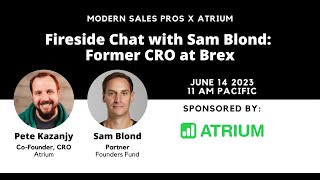
Transcript of a Modern Sales Pros fireside chat with Sam Blond (former CRO at Brex) focused on practical, stage-aware outbound sales strategies and career development for sales leaders. The speakers cover: effective outbound/pipe generation (AE outbound, concentric-circle targeting, leveraging customers and brand, and data-driven account/contact scoring), and guidance on accelerating a sales career (performance, effort, attitude, picking the right manager/company).
Chapters
Today. Awesome. Sam, what's up?
How are you? Thank you so much for having me. Pete and Elliot, great to see you guys.
Super excited. Of course. We're here today for the fireside chat with Sam Blonde. Before we start, always, always like to kick things off with a quick icebreaker. Today's question of the day is what's your favorite way to unwind and relax after a long day? Pete, you want to start things off? Is it going to be Legos? Is it going to be Legos?
It's not going to be Legos. Right. So I have a five year old, Mikey. So Elliot, good guess, but not going to be Legos. But I think at this point like what I do is I kind of like split my like half. I try to do, you know, customer meetings and like because at this point Atrium has so many customers. Like I, you know, prioritize that and I'm based in San Francisco. Same way that like I go out to like New York or wherever to meet customers. So it's like half that and then it's half. Usually I'll get in a quick game of Pokemon with Mike. Quick card game. Sam, what about you? Any Pokemon in the cards, so to speak?
I don't know if I can top that one. I would say my guilt and pleasure and certainly what my girlfriend would reference is I like to watch sports. So most of the time, and that would be an exception with the NBA finals being over, but on weeknights you can find me watching some form of sporting event and probably having a little wager on it to make it more entertaining.
Nice. I love it. I think probably our sales leadership audience, but probably, probably could identify with that, you know, a bunch of adrenaline junkies and, and degenerate gamblers. Did you get a chance to go to a Heat game while during the, during the finals or. No. I know you're based in Miami.
Normally I went to a couple playoff games. I wasn't able to go to either of the finals games. I was in London last week when they were in town, so that was a bit of a bummer. I did go to an exciting Kings warriors game while I was in San Francisco for the playoffs as well though, so was able to make a couple.
That's awesome. Elliot, what about you? Man?
I keep it simple. I love to just like keep moving. So as soon as I get home after work I'll just like get ready and just, just hit the gym. Push those, those moderately lightweights is what I, what I do.
Love it.
So I do see that we have A few more folks in attendance here, so going to kick things off, of course. Today's event is brought to you by the team here at Modern Sales Pros. If you're not familiar with the community, it is the world's largest and highest quality community for those in Sales Management, Sales leadership, Sales and revenue operations, and Sales enablement, AKA our Modern Sales Bros. Our mission is to create an environment for members to answer questions they'd struggle to solve on their own and help them see around corners that they may not know about. We do that through live sessions like this, an online forum, and our quarterly summits. If you're not already a part of msp, you're going to be invited to join after this event. And before we dive into this event, going to go over some quick housekeeping notes. First of all, this event is being recorded. You can be able to access the recording and key takeaways on the previous events page of the MSP website. Second, if there's any questions for our panelists, please use the Q and A function and they're going to do their best to get to them during the event. Okay, going to kick things over to you, Pete, to do some intros. See you at the end.
Fabulous. Thanks for the help there, Elliot. Yeah. For folks who are not familiar, today's event sponsored by Atrium, my software company. So Atrium makes what we call data driven sales management software. It's software that helps sales organizations, sales leaders, sales managers, use data to improve team performance. So we're super pumped to be talking to a data driven sales leader here today. If folks are interested, I'm actually rocking one of these right now. We're going go ahead and drop a link in the chat here if you'd like to get a one of your very own sales nerd hoodies. It's a cooler version of a Salesforce Trailblazer hoodie. Just go ahead and sign up for that in the, in the chat there. We'll get that right out to you. But without any further ado, I'm really pumped to have have Sam here. We were lucky enough to have him at the MSP Virtual Summit either last quarter or quarter prior. Can't remember, but his session was so popular that we thought we'd bring him back again for another Focus Fireside chat here. So for folks who don't, we'll do a little interest here. For folks who don't know me, my name is Pete Kazanji. I'm one of the founders of Atrium. As I just noted, prior to Atrium, I started a recruiting software Company called Talent Bin that was acquired by monster worldwide in 2014. And then subsequent to that, that's really where I went from being a business generalist founder to a first seller sales manager, sales leader and kind of became familiar with the concepts of modern sales. Ended up writing a book on startup sales called Founding Sales and then started Modern Sales Pro. So that's a little bit on me. Sam's been around the block a couple times. You might be familiar with him as the CRO of Braxton, but now he's a partner at Founders Fund. So Sam, maybe you can tell us a little bit about what you're spending your time doing at Founders Fund. Talk about Brexit and maybe talk about Zenefits a little bit. For folks who may not be familiar with the. With, with the meteoric rise of, of San Blon.
Yeah, I'm happy to first, great to see you Pete, and thank you for having me. Big fan of the modern sales pros community and happy to be back for the second time in just a matter of a few months. So thank you again. Let's see. So I'm originally from Kansas City, went to college at University of Missouri. Was lucky that my brother was in the Bay Area when I graduated and I moved out here and took an SDR job at EchoSign. I was at Echo Sign for a little over five years. Started as an SDR and became an AE and then got into sales leadership and then was introduced to Parker who is the CEO at Zenefits. This is back in 2013. I joined as VP of Sales. Was there for almost three years. Really exciting, sort of rocket ship like growth. And then also plenty of lessons on sort of the way down as well as in if it's ultimately was acquired by Trinet and sort of like a not exciting acquisition. This is just a couple of years ago. And then most Recently I was CRO at Brex. I joined in 2018. I was there for a little over four years. Joined at a pretty early stage of the business. We were maybe 15 or 18 employees and when I left we had about 400 million in annualized revenue. The business was most recently valued at a little over 12 billion. That was a sort of 2021 valuation. But the business continues to just crush it. And um, I joined Founders Fund as an investing partner. This is now almost nine months ago and I'm focused. Yeah, it's, it's been about nine months. Um, and I'm focused on investing in early stage B2B software companies. So sort of maps to my experience At Echo Sign, Zenefits and Brex where I joined as you know, two sales reps or thereabouts, 10 to 15 employees at each and then hopefully I can help de risk the sort of go to market and revenue engine side of the business as an investor.
That's awesome. And you're normally based in, based in Miami, but today you're in San Francisco, right?
Based in Miami. I was in San Francisco for about 14 years before moving to Miami and so, so much to my network is here. I'm actually in town for a Rippling board meeting. So I'm sitting in Rippling's offices. Parker, who's the CEO at Rippling, was my CEO at Zenefits. So close friend and incredible entrepreneur.
That's awesome. Well, I think one of the first topics we have a bunch. So one thing I'll just caveat to everybody is if you don't follow Sam on Twitter or on LinkedIn work, Facebook.
You really should go fix that because Sam has really uncorked a bunch of really fantastic content and just like sharing really fantastic learnings from his experience at Brex and Zenefits and Echo Sign and what have you. We're going to talk about a number of the, like literally when I was putting together the things I wanted to talk about, it was just like you know, just shopping through his, his social feeds there. So if you're not, if you're not following Sam, I really would recommend that because you can just get like modern sales, you know, brainwaves on, on tap there. One, one thing that Sam's been talking about recently that I think will be really top of mind for a lot of folks is essentially pipe gen.
And specifically outbound because I think in the current SaaS recession environment, kind of like economic wobbly times, not a lot of inbound, maybe marketing budgets are less frothy than they once were and certainly there are less customers who are like window shopping on their own. And so all of that means that instead of being able to sail, we gotta have steam power, we gotta row, we gotta put our into it. And so one thing I thought we could kind of just start out talking about is just like, you know, some ideas around really effective outbound. I know that one of the things that you've talked about is ineffective versus effective outbound, especially at kind of different stages. Maybe you could kind of start us off and share kind of some of your thoughts on that with the people who are joining us for sure.
So let's see, you're not going to find a bigger proponent of outbound than me. And if I think back to Brex, about 80% of our revenue was sourced from sales outbound. And the breakdown on that was 50% from A IS and 30% from SDRs. And then the remaining 20% of revenue was sourced through other channels like inbound, but any, any marketing channel. And so I think there's maybe two takeaways from that. Like one, you know, it sort of ties into the. You won't find a bigger proponent of outbound than me, sort of like evidenced through such a large percentage of revenue being contributed through, through that motion. And then the second thing is like, AES should outbound. And I have very strong opinions around that. And a conversation that I have pretty regularly with folks is something like, you know, what is the constraint? It's always, almost always demand. And then it's like, okay, how many demos are AES taking each day, each week, whatever it is, and you sort of like pull up people's calendars and it's like AES may spend two to three hours a day in front of customers. And then it's like, all right, well that, that leaves five or six hours in the day. What else is happening with those hours? And I would argue there's no higher ROI activity than sourcing additional revenue outside of the sort of direct customer interactions and closing revenue. And so, you know, unless you're in this incredibly fortunate environment where you are inundated with demand and leads and don't have time to outbound, then I'm a huge proponent of AES outbounding. And candidly, I think they are more effective if.
Sort of like trying to source revenue. They know what good customers look like, they know what good demos look like better than SDRs who are sort of like the most junior population of employees within, in the company. So that was the first thing that came to mind. Pete, you asked a very different question, which was like, what are, what are?
I think that the first and foremost is like, hey, get religion, you gotta do it. And so now we're talking about, okay, cool, if I have that religion, like, how do I do it well versus and maybe like, how do I do it shitty? So we can avoid that for sure.
So now, now I'll answer the question directly. I think to your point, it is an evolution. And when I joined.
Brex as an example, we were outbounding, but we were outbounding. Think about it, sort of like concentric circles and is as close to sort of in network outbound as you can do in the early days is where you want to start. And so for Brex, that was our YC batch, Brex was a YC company. And then once we had sort of exhausted acquiring all of the customers from our batch, we went to prior batches. And so again this concept of like concentric circles and if you're in a prior batch of yc, you don't know Brex, you don't know Pedro Enrique. There are hundreds of companies in each batch. But like your probability of replying to a new YC company is just significantly higher than a non YC early stage startup. And so we, we leveraged these networks. I leveraged my personal network as well, asking for introductions, leveraging advisors outbounding into companies that, that had some commonality with us. And like if the company hadn't done yc, the story would have been different but the sort of framework would have been the same which is leveraging personal networks as much as we possibly can. I'll pause there, but I'll sort of like continue along the path of what we did as the business needed to evolve beyond just acquiring YC companies.
Yeah, totally. I mean I think and I think actually you know your, your close colleague and mentor Jason Lemkin talks about like building like mini brand and I think that concentric circle kind of like speaks to that which is like you want to start with the white hot center and this is like very stage specific. Right. If you're starting out and like I don't know, let's say you have like five customers or 10 customers. You don't need to like go out to the world. You want to go to exactly the next Cohence centric. I like this metaphor of coincentric circles. The coincentric circle around those folks who look exactly like them and then moreover like are going to, they look just like them because they're and as a result they'll probably like get value like those customers. Right. And then moreover the social proof of those customers that you have in hand is going to be extremely powerful in getting that next coentric circle versus like you know, going super, super far afield. I back on the AE prospecting thing. This is something that we' in our Atrium's customer base pretty substantially is whereas previously one of the biggest use cases that organizations would use Atrium for when it came to like measuring and managing account executives, it was more around like opportunity conversion rates seeing like where the people were getting stuck in the, in the pipeline and also kind of symptoms of like plenty if you will, like pipe hygiene issues, way too many untouched ops, way Too many stuck ops, all those sort of things because like essentially symptoms of just like a ton of inbound and what have you. And then about like a year ago that kind of transitioned where a lot of organizations ended up, you know, downsizing the size of their SDR teams or maybe not, you know, they kind of reduced their marketing spend. And so one of the things that we've seen across organizations is a refocusing on AE prospecting so organizations will goal like it's funny, when we first started selling atrium back in the day we like our customer success team would go to organization be like yeah, you know, you should generally go at the minimum time period that makes sense. Right. So like you know, maybe for account executives you should go on customer facing meeting volume on a weekly basis. Like you could probably go, you know, on, on emails on a, on a weekly basis and people will be like oh man, I don't know, that sounds like micromanagement. And like, you know, this was like three years ago or what have you. And so now people are like, yeah, we want to set goals and make sure that the account executives are sending at least like you know, 100 non opportunity facing emails a week to 30 net new net new contacts that they've never touched before. And we want to see five opportunities being popped per month. And like that's like you know, table stakes at this point. So I think it's very much reflects what you're describing there. Sam. One thing I know that you have a lot of religion around is like doing it well and like not being like spammy and what have you. And I think like one mechanism by which you can do that is like you give yourself the benefit of like being able to write a message or like a talk track or what have you that is going to be like pretty resonant if you are focusing narrowly there. Maybe you can speak to some other kind of like ways of cutting through the noise versus just like you know, being the spam cannon that a lot of organizations oftentimes are when they do outbound. Yeah.
To reinforce that just a little bit, I talk to early stage startups, founders, sales leaders on a daily basis just in the position that I'm in. And almost all of them I would sort of suggest are just doing this wrong.
And.
I don't know if it's, I was about to say laziness. I don't think it's laziness. I just think people don't, people don't know.
Awareness.
Yeah, I think you nailed it. I think it's Awareness and the most common conversation is like, we're doing outbound. It's not really working. What we've done is we've, you know, we've purchased zoom info and we've purchased outreach, like you know, email sequencing tool. And then we're, we're like trying to be creative with writing these email sequences and they're like five or six emails each and we just like send each. You know, to your point earlier, we have a quota of, you know, 500 people are in sequence per rep at any given point in time. And it's like, guys, you're a 12 person early stage startup. I just googled your startup and it's like your website is not impressive. There's no public information on you as a company at all. On LinkedIn it says you've got 12 employees. The probability of you sending this cold email to a person who's never heard of you, never heard of your company, the first thing that they do is they Google you and they're like, this is like some no name startup, I think. And you know, I referenced this earlier, it's like a bit of an evolution. Brex can do that today. Brex does do that. And it's because when the recipient receives the email, the probability that they've heard of Brex is high.
And then also now.
Yeah, yeah, yeah, now. And also if not, you sort of Google and there's like a lot of publicly available information that's like social proof on the quality of the business. And so, you know, starting at this like only warm outbounding to.
Companies that you have some commonality with. And then you. Pete referenced the thing that I knew next, which is leverage. Leverage the customers, especially the happy ones, and you should know who they are and you should absolutely be asking for referrals. And so then as your customer base gets larger, you have more customers to like effectively prospect into to get these referrals. One thing that Brex did, that again, just like going along this path of starting with almost only warm outbound, I'll call it to where Brex is today, which is like they can blast the universe. One thing that we did was when we launched, we put billboards. I'm looking out your window right now. You're in downtown San Francisco. We put billboards everywhere and we did this on launch day. And at the same time we had the fundraise announcement that got some PR and we were sponsoring some podcasts, but we put these billboards everywhere and we ran reports on companies that were headquartered in downtown San Francisco. And that is who we outbounded to. And so many of the companies would reply with I see your billboards everywhere. And what we weren't doing was sending these cold same cold email but we weren't sending them, I'm from Kansas City. We weren't sending them to you know, small tech companies in Kansas City like New York. We weren't going into other geos. And again it was just sort of like these concentric circles that was. Was more and more effective as the business continued to grow that it ultimately allowed us to do this like truly cold outbound to any company in the United States.
Yeah, I like that. And I think the way to kind of think it's like the, the, the like the coincentric circle can be a lot around any particular like like vector like facet of a successful like so in this case you were saying like hey let's go ahead and target other companies in San Francisco because of this great, you know, because of this great billboard campaign or whatever you. But similarly like all of your early YC customers, probably a lot of them were based in San Francisco as well. For sure. Right. And have a lot of intensity there. And so we've, we've observed this with our customer base where at this point like Atrium has hundreds and hundreds of customers. But like our account executives started observing just from a pre call planning standpoint you'd see these patterns of former sales leaders from organizations that had like fairly scaled sales orgs crossed with pretty modern sales sales culture. And so you know, examples of that like our account executives like the hair sticks up on the back of their neck when they see somebody who used to be a sales leader at like a Box or a Dropbox or LinkedIn or what have you. Because a lot of these organizations were very data driven with like very substantial data teams and now they're at like these, these leaders will be at organizations that are smaller and, and don't have you know a 10 person like analyst shop to, to kind of help out with. And so that's a good example of like another coentric circle is like we, we do recurrent outbound campaigns just on a quarterly basis across alumni networks of so we like you know we'll go and find all the like all the like all the former leaders like people who previously were a sales leader at Box and are now a sales leader somewhere else. And the same with like and so on and so forth. And then what we'll, what we'll do to your point about like know who your happy customers are know who, you know, we'll actually use the alumni. Right. Who are at our current customer base. Like use box as an example.
The.
The CRO of a company called staff base is gentleman named Dan Farkas. He used to run large parts of the the box emea sale like sales organization. Everybody bought like everybody is a former boxer, like knows who Dan Farkas is. Right. Or like Laurie Jimenez. And so what you can do is like a. You use that in the subject line, you can use that in the email, etc. Etc. And now they have to be happy customer. And like, you know, ideally you're like, hey, we're going to do these. Like we're going to do this campaign. We really appreciate it here. Like, you know, we'll send you a bottle of champagne and et cetera, et cetera. But what you're doing is a. It's that coincentric circle. You're using social proof. And then moreover, you're kind of cutting through the noise of, of like here's just like another random, random person. I think you guys used to do some pretty clever stuff at Zenefits where I think you guys did some stuff around like using Parker in outbound or like Parker in. In outbound. I think that like, maybe you could talk about that. I feel that those like strategies can be really effective as well.
Yeah. So we, we originally had Parker be the person that was sending the email and we were creative around things like.
Well, first we started with companies that were in the Bay Area. Like again, like started with companies that sort of like had the highest probability of being a good fit and hearing like knowing whose ineffits was before they received the email. Parker would send an email. We got sort of creative with things like Parker sending an email to a sales rep and the sales rep forwarding like quote unquote, forwarding that email. It's actually all email copy where it looked like Harper was saying, you know, check out this company. And then, you know, like psychologically, if somebody receives the email, they, they think that Parker was like researching their company. And then they find out like Parker's the CEO of this company that's super successful. And so then they respond and just like you're, you're of course trying to improve the probability of folks responding. One thing though, that, that like the world has changed a bit since 2013, 2014, when that was happening. And so it's.
Maybe these tactics get used up.
Yeah, yeah. I think like today I'm not sure that that's the most effective strategy, although, like throw stuff up against the wall and see what works and then double down on those things. But one thing that you mentioned that resonated a lot with me and I think will resonate with you as, as the leader of atrium.
Over time, you just start have to have so much more data and one and you can leverage the data to be more effective. And I'll just give an illustration of what I'm talking about here. The way that it worked at Brex and the way that it works at most organizations is you have an SDR or an AE. They are, you know, on LinkedIn, they're using some data points around, like, what are the industries that seem to work? Well, us for Brexit was like an Alexa ranking, which is how many visitors to the website. And then these SDRs and AES, they would add new accounts to the database and then they'd go into zoom info and they'd be like, okay, let's add these contacts and then they'd put them in sequence. And I think that's the way that many organizations start. And what happened over time was there was just huge variance in the effectiveness that each rep was able to have through their outbound. And it's because there's so much subjectivity in the process that I just described. And what one SDR would be doing with a little bit of loose guidance would be radically different from a different SDR who probably was more seasoned and knew how to do these things more effectively. And so we went from the environment that I just described, which is like very wild west, to a far more sort of like automated and prescriptive environment. And so the way that it worked was at maturity, SDRs and AES no longer decided which accounts were in their name. RevOps decided which accounts were in your name, and you had like 500 to a thousand accounts. And the way those accounts were determined was looking at the historical data and seeing which types of companies had the highest probability of converting to a customer and which types of companies had the highest ACVs. And so there was a bit of an equation around like, you know, revenue generation crossed with probability of converting. Okay, these are the accounts that people should be going after. And so you come in, you have your 500 accounts, and then within those 500 accounts, we would actually assign to the contacts what we call the hustle score. And not only did we know the best accounts to reach out to, but from data we knew the best contacts to reach out to. People like CFOs converted at a higher rate than controllers. And intuitively that makes sense. Because CFOs care more about something like the bottom line. And a controller wants to really understand things like how reconciliation is done at the end of the month. And so the cycle is longer and it's a deeper, more sophisticated accounting conversation than the one with the CFO who just wants a corporate card. And so we assigned which account you should reach or excuse me, which contact in your accounts you should reach out to. And we even told you which sequence to use. There's like a matrix that was like, okay, it's an E commerce company and it's a cfo. Use the E commerce CFO sequence. Like drop them into that one and through that process, man, just like conversion rates went through the roof, ACVs went through the roof. And it just sort of like removed the subjectivity from outbound. That again like allows you to do the more cold outbound when you have so much data, when you have a brand. But again like you can't do any of these things that we're talking about day one.
Yeah, well, I think we could go on and on, on this, but we should probably move on to a new topic. But like, as I noted folks, you definitely should follow Sam because he just like talks about this stuff on, on Twitter and LinkedIn constantly. Just shake gears a little bit. Because I think one thing that you were talking about recently that really struck a chord with me was for people who want to be like grow up and be a CRO someday.
And it's not just like be a CRO, but I think it's like advancing your career and what have you. Most of the people who are here joining us today are sales managers, sales leaders, sales operations and what have you. But I still think that they're advice you were providing was, was really, was really resonant specifically around like, you know, just like out, outworking everybody else and, and like you know, being problem or excuse me, solution oriented versus like you know, complaining. Maybe you can kind of like share some of the other things that you know, your kind of points of view on how to accelerate your, your career. Because I mean I think like, you know, you've, I'm sure there's a non zero amount of luck in like you know, what, like how you've, you know, advanced in your career. But like we also make our own luck and it's kind of like the harder I work, the luckier I get. So maybe you can kind of talk a little bit about like your recommendations.
There for sure and certainly not trying to promote my social media. But to your point, I Did a post on this yesterday and so what I'll try and do is.
Try and add like a little bit of different color than just what I wrote in the post describing some things that can, can lead to really positive career outcomes for folks that are in sales. I would think about at a very high level, I would.
Things that are within one's control in three categories and maybe let's separate this conversation into things that are within one's control and like things that you should be focused on doing. And then the second category might be something like how to think about joining the right company that can facilitate this career growth which is a bit outside of your control. But, but you, you certainly can be thoughtful about joining.
Yeah, it's picking well. Yeah.
So then on the like wholly within your control, the, the things that I've always focused on both myself and then also as I'm looking for future leaders. The first is performance. And you know, sales is very objective. You can see who the top performer is at each given interval. And to your point earlier, like those that are at the top of the leaderboard, consistently, they aren't there because of luck. There can be like a little bit of luck involved. That is fleeting and you know, maybe somebody isn't the number one rep every single month, but if somebody's there 60 or 70% of the time, they're not getting like law of averages, they're not lucky. Like teams, 20 people, so and so then performance just like define your success by being the best and being number one on the leaderboard. And the reality is when sales reps, individual contributors are promoted to sales managers. When sales managers are promoted to sales directors, like the place that you start looking is who's, who's the top rep, who's the top manager, who has earned from their performance the ability to become in a more strategic position and have a larger impact on the company. And so again sort of like defining your success as being number one on the leaderboard is how I would approach the performance side of things. You know, like you finish top 40% or something like that. On a 10 person team it means there's going to be three or four people that are ahead of you. And gosh, that's just like a long time horizon until you're promoted. If there are four people that are being promoted before you into these manager positions as they become available. And so again like sales is very objective. If you want to progress your career quickly, you got to be at the top of the leaderboard. The two other things that come to Mind that actually don't require skill. One is effort.
And I'll reinforce this with the next one. People that are on a team, they will emulate their manager's behavior. And so if a manager isn't working hard, then the rest of that, that sort of, like, manifests or transcends throughout that team. And so, you know, even if you're at 120% of your number each month as an individual contributor, if you want to be a manager, it doesn't mean that you can sort of, like, lay off the gas and not work that hard. Because me as a CRO, when I'm looking to promote a manager, I'm looking to promote people who. I want people on their team to emulate their work ethic. I want people on their team to emulate their attitude, which I'll talk about next. And not just the sort of performance side of things. And then the third one is, I sort of alluded to just a moment ago, is the attitude and just being a positive influence on everyone on the team, going out of your way to help other people. No negativity, man. Like, complaining just sort of spreads like a cancer throughout an organization. And so you just want to set the tone on both working hard and also on being, like, the positive influence. And if you can have all three of those things, if you can be the top performer, if you can have a great positive attitude, and if you can be a hard worker, like, the. The sky is the limit in terms of where you can take your career. So I'll pause there. That's sort of the things that comes to mind on the individual side versus the company side.
Yeah, I think one thing that kind of pops to mind there is. And I think that this is kind of chilling out recently because of the, you know, the reduction of, like, the kind of, like, churn and fervor of a zero interest rate and expansionary fiscal environment, but just, like, people sticking around. Right. And.
I think, like, one of the things, you know, people get kind of turned up about this. But, you know, you honestly, like, you don't really get good at what you're doing.
Or, sorry, you don't get, like, familiar with what you're doing for at least a year. Like, that's the reality. And then you don't really, like, get good at it for, like, a couple years. Right. And so I think the thing that oftentimes folks will do is they'll react to this, you know, this inbound email from a recruiter, or they'll react or like, you know, they'll be talking to a buddy or whatever and, you know, they'll hear the siren song of maybe like a 20% higher OTE or like a, you know, a little bit of a difference in, in compensation. And they'll kind of like, miss the forest for the trees because, like, you're resetting your clock. Like, you go to that new organization, you're gonna. You have to like, learn new sales motion, new product, new icp, et cetera. And also you're now, like, having to re. Bake your reputation versus, like, oh, man. Yeah, that's Sam. Everyone, like, you know, imagine at like, Echo Sign, right? And I can't remember how big Echo Sign was when, when it was acquired by Adobe, but, like, you know, in your third or fourth year at Echo Sign, like, you knew where the bodies were buried. You knew how to actually get things done in the very kind of like, we all know how companies are, right? It's like, oh, yeah, yeah. You have to like, pull on your ear and then go like this on your nose and then click this button in Salesforce in order to send the proposal. Like, we all have that, like, stupidity, right? Like, you know, no company's immune to that. And so that is a really huge part of, like, getting things done is like, sticking around longer and being available when opportunity strikes there. I don't know if this is something that you've observed at Brex over.
Its rise and like, where people stuck around a lot longer have, like, had more opportunity.
Well, it totally resonates. And I feel like it's one of those things that no matter how many times.
I can sort of preach this, and it sounds like you as well, you're just reinforcing a lot of what. What I'll shortly preach in just a moment as well. Like, people still make this mistake so frequently. You know, you talked about the, like, recruiter reaches out to somebody 20% higher OTE or something like that, and they leave. And look, I think, like, certainly what I'm not suggesting, and I'm confident you're not suggesting either, like, there are reasons to leave jobs.
There are the right reasons to leave jobs. And what comes to mind for me is if you're in an environment where you have a great relationship with your manager, if the company is doing well, and if you have, like, a path to success, which could mean, you know, hitting your number, being at the top of the leaderboard, getting promoted, like, if you see a future where you can be successful in your role and you can progress your career within the company, it there's there's almost like no role that makes sense to leave that environment for. And to my earlier point, like if those things don't exist then look, it may make sense to leave. But I have seen time and again, or maybe not time and again I've seen multiple times throughout my career at Brexit benefits at other places where somebody would be doing really well and they would have like, you know, I'd be on the precipice of a promotion or something like that and it's like this person's leaving like they put in their notice or something to lead to this company. I'm kind of like, what? Like that, that doesn't make any sense. And nine times out of 10 it's a worse company. It's a worse company and they have to pay higher on the ote. And it's just such a short sighted decision to leave an environment where things are going well and you're performing for a bit higher comp on the sort of like OTE side. And every time those decisions haven't worked out. And so those are the things that come to mind. Just sort of piggybacking off of your thoughts there, Pete.
Yeah, and especially because like the people in our audience are sales managers and sales leaders and sales operations folks and actually think Sam Jacobs, another Sam from Pavilion.
Does like a pretty thoughtful job of talking about this and this kind of is maybe a little unique to folks who work in high growth technology companies. But what will end up happening is actually okay. Like let's. Here's a good example. Salesloft is a longtime Atrium customer. I'm really good friends with a lot of the sales leadership there, Kyle, etc. Etc. You know, the people who ended up sticking around at Sales Loft and for went a lot of like, you know, whatever, you know, maybe six Sense was trying to recruit them or like fill in the blank or whatever. But like they stuck around and you know, rose up the ranks and continued to get invested in more equity and then Vista comes shopping and that was like that ended up being transformative as compared to that 20% higher ODE or what have you because again, as you become more valuable to the business, the business is like, oh man.
It'S going to be very problematic if one of these people who knows how to pull their ear and wiggle their nose and knows all the ins and outs of the organization, if they leave, I'm going to retain them and compensate them appropriately. And of course if the organization isn't doing that, then you should be having that conversation with your manager, Right? My co founder has this really great talk track that he uses in his one on ones. He kind of refreshes people on this every once in a while because it'll go in one ear and out the other where it's like, look, if you show up and tell me that you've taken another job or if you put in your notice and I'm surprised by that, I failed. I failed at my job. And instead what I want you to do, like anytime you're unhappy or you're like thinking about something else, whatever, don't hide it from me. I don't want you to hide it from me. Right. Because what I want to do is presuming that your performance is at a place where we want to retain you and like a, and then B, the organization has that need for that role. We're going to figure out how to make that happen. And then if for whatever reason that can't happen, like maybe the role isn't present. Like, hey, I don't want to be an AE anymore. I want to go on a revops. Oh man. A Rev Ops team is like fully staffed. Okay? I'm going to help you find a role external to the company and you're going to get a way better role because like I, the CRO or the, you know, the founder or whatever, I'm going to show up and be like, yeah, like, I wish I could keep this person. But like our Rev Ops team is like fully, you know, fully stocked. And so I think that can be a really effective mechanism by which to make sure that there's good open lines of communication and nobody's like surprising, surprising Anyone? Anyone? There any other kind of things you might add regarding kind of like career pathing for sales managers, leaders, etc. For our audience?
Yeah, I mentioned that we talked a lot about the individuals and sort of like performance, effort, attitude, those sort of things. Look, if I look back on my career, I have been incredibly fortunate and certainly some of that is luck. I can only do so much in terms of the ultimate outcome of a business as a sales leader. There's lots of other factors involved and people involved, but I've been fortunate to surround myself with people in businesses that have given me the opportunity to grow my career quickly. And so there is an angle of selecting the right company that sort of like facilitates the career growth that one might be aspiring towards. And so then the things that I would solve for to sort of like enable fast career growth, put myself in a position where if I execute, I Then can realize this career growth, fast career trajectory. You know, I've talked about it a couple times. One is the manager. I was at Echo Sign for five years. Brendan Cassidy was my VP of sales. And Brendan could have had a sort of like mindset or philosophical approach to sales leadership that was, I'm going to hire external sales leaders and not promote from within.
Regardless of like the performance that I was realizing. And had that been the case, I just would have had a very different career. And so Brendan, close friend, but also sort of like enabled me to progress my career very quickly. And without him making those decisions, like I was doing the performance. But Brendan was ultimately deciding without him making those decisions, like my career growth doesn't happen. And so, you know, sort of solving for who your manager is, Some philosophical alignment there, a lot of trust there, I think is really important. The other things are the business got to be doing well. Like, you can't be promoted into a manager role if there aren't manager roles to be promoted into. And so the faster the business is growing, the more leadership roles become available. And so try to align yourself with a business that you believe in and that is growing quickly. And then lastly, join somewhere where you believe you can be really successful. You know, I joined Brex in part because I think it mapped really well to my Zenefits experience where we were selling to, you know, companies that were like around under a thousand employees. And the monetization was interesting. We made money on interchange Zenevits made money on broker fees. And so it wasn't like this write us a check type environment.
You know, like, Snowflake is an incredible company and man, I would have been lucky to be Snowflake CRO or something. But like, I don't think that would have been the right fit. Like, I. I don't know, you know.
Developer sales, highly technical.
So just because the company is doing well, it doesn't mean it's the right place for you. And so I think, you know, as you're deciding where to land, potentially, it's like the manager, the success and growth of the business and the fit for your experience, does it map well? Do you have a high probability of success there?
Nice. Well, Sam, I think Elliot's here to kick us out. That was absolutely fantastic. I really appreciate you taking the time to share all your wisdom with us. I'm sure we'll do it again here soon. I know you got a run to a, a board meeting. You know, I. Oh, I just got to go to this board meeting for like Rippling you might have heard of it.
Before.
And then you can take the sales team out to Tequila Mockingbird afterwards. There you go. Elliot, anything else we need to. I know. No kidding, right? Anything else we need to cover before we wrap?
Just. Yeah, one last thing. Of course. Big thank you to everyone for attending. Thank you guys for speaking and providing all this great content, recordings and key takeaways from this event. Oh, yeah, don't forget to grab your sales nerd hoodie link is in the chat there. Recordings and key takeaways are going to be available on our page shortly. Don't forget to check out our upcoming events and we'll see you guys next time. Take care, everybody.
Awesome. Bye, Sam.
Thank you.
Thank you for having me.
More from Sam
CRO Confidential: 3 Secrets For Early-Stage Startups To Acquire Customers | CoSell.io Co-Founder
SaaStr CRO Confidential: Sam Blond + Omni Founder Colin Zima on the Power of Leveraging Your Network
Founders Fund's Partner, Brex's ex - CRO, Sam Blond | Investing in SaaS companies; Career in Sales
SaaStr CRO Confidential:Hiring a Great VP of Sales Today Sam Blond + Former Lattice CRO Dini Mehta
SaaStr CRO Confidential: Founders Fund Partner Sam Blond + Rippling VP Sales Matt Plank
SaaStr CRO Confidential: Founders Fund Partner Sam Blond + Divvy CRO Sterling Snow
CRO Confidential: Sales Comp, Quotas & Recruiting with Jason Lemkin and Sam Blond of Founders Fund
How to Set and Hit Revenue Targets with Sam Blond, CRO at Brex | SaaStr Software Community