SaaStr CRO Confidential: Founders Fund Partner Sam Blond + Rippling VP Sales Matt Plank
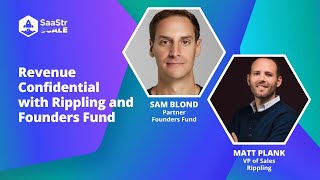
Sam Blond and Matt Plank discuss Rippling's early growth from a basement operation with a Google Sheet CRM to a multi-product platform. The company scaled through outbound cold email targeting IT pain points, channel partnerships with brokers and accountants, and a lower-cost sales team in Bangalore. Rippling raised prices aggressively while expanding from employee records into payroll, benefits, identity, and device management.
Chapters
Foreign.
I'm thrilled to be joined today by one of my best friends in the world. I was a groomsman in his wedding. Somebody that I've known for. It's probably been like 12 years at this point. Matt Plank, who was first an AE with me at Echo Sign, the first hire alongside Jameson, last week's podcast guest, the first of two hires that I was fortunate enough to have me join at Zenef. And now Plank is just continuing this unbelievable career as the revenue lead for Rippling. And so excited to have you here, Plank. Thanks for taking the time and excited to talk about Rippling with this incredible audience that Sasters put together.
Yeah, thanks for having me.
Of course. So let's jump right in. Today we're going to talk a lot about Rippling and the evolution of its early beginnings to a lot of unbelievable success. And if we sort of fast forward to today, Rippling is this incredible success story. It is a number of different things. It's a company that is now valued at something like over $11 billion. That was a valuation as of like May of this year. So this is like a fairly current valuation after a lot of the correction. Founders Fund is a very happy investor and gladly participated in that round as well. It is a sort of success story and real vindication of Parker Conrad from Zenefits, the revenue growth, hundreds of millions of dollars of ARR and so much more. But I know that it was a lot of really hard work to get to where we are today, and probably a lot of hard work left as well. But maybe as a starting point, it would be helpful to understand what is Rippling and tell us the environment that existed when you joined.
Yeah, so the kind of simple, shortest way to describe Rippling is we are, you know, we're kind of an employee system of record that starts at, you know, employee data at the core of that system of record. And then we do things like payroll and benefits and identity management, device management, I mean, you name it, kind of anything you would think of in like a traditional HCM suite, as well as a lot of different IT products in the world, like an Okta or a JAMF or anything like that. And so to your point, when we, when we started in this space, we had a lot of competitors. We had a lot of competitors that were doing parts of what Rippling did, but nobody that was doing all of what Rippling did. Essentially, if we were moving somebody off of their current system to Rippling, in pretty much any case, we were replacing an existing HR and payroll system. Whether that was A modern solution like your Gusto Zenif, it's namely those type of players or a legacy solution like an adp Paylocity, Paycom. So we were replacing HR systems but then also for a lot of folks we were helping them stand up kind of systems to manage like it for their employees kind of from the get go focused mostly on smaller companies when we first started.
Very cool. And so what you're describing is one of the first thing that comes to mind when I think of Rippling and it's. Rippling was sort of the next iteration of Zenefits but it was a very different market that it entered than when we joined Zenefits Benefits was creating this new category. Rippling entered like a relatively mature and hyper competitive space as a brand new business. There was Zenefits, there was Gusto, there was namely just Works probably several other folks. And you entered as this sort of like no, no name brand business. And tell me about a little bit the you joined what existed, how many employees were there, how many salespeople were there, what did the company look like?
Yeah, so when I joined Rippling we were, you know, I was looking at a few opportunities at the time and Rippling was currently being run out of the basement of Parker's. So it was Parker a handful of engineers who were building kind of the first version of the product and that was really it. I mean when we started Parker was giving all of the demos like he was the sales rep for the company. I remember the first day he handed over a Google sheet of all of his opportunities. Like that was a CRM that we were using. So it was literally just company names and a bunch of raw notes from Parker and that was it. And we had really nothing like we, we didn't, you know, we, we at that time we were really, we had. Parker had gone through YC for the second time around and so at that point we were really just selling to YC companies. Like we had come out of the recent winter batch and so that was really what our top of Funnel was selling to other YC companies in the batch. And we were really starting from zero. I mean we had no paying customers at the time for the most part. So it was, it was definitely, definitely early days.
So a lot of things that are unconventional here. You joined as the VP of sales, so you joined as sort of a senior sales leader and you were the first sales hire that Rippling made. So unconventional in that myself, Jason from Zastor and many others just like generic advice around this is when you're Ready to hire salespeople, hire two individual contributors. And so Parker and you took a different path there, I guess, to that end. And another thing, there are four engineers. I think your employee, like number five is. This is earlier than a typical sales person, certainly sales leader joins on the go to market side. Like, what did you do? You joined this company. Nobody knows who you are. Four engineers. How do you get started?
Yes. Yeah, really good point. I mean, I think when we started, I mean, I think first of all, part a little bit of it was there was kind of some mutual trust for like both me and Parker. Like, I wouldn't have joined any other company that was like running out of the basement of someone's house. And I don't think, you know, Parker, we had worked together at Zenefits for, you know, three and a half years. For a lot of that time, you know, you and I shared a desk sitting across from Parker. So I kind of got a lot of exposure to Parker. We had a relationship early on and so it kind of made sense. When we started, it was literally, you know, the first, the first week. It was literally listening to probably first couple days, as we know Parker. Parker doesn't have a ton of patience. It was like he did a few demos for me. It was like, okay, cool, like, I'm done doing demos. Like, here's the, you know, here's the talk track. And I kind of built out a script, started taking over the demos literally, like the week that I started and for the most part was regurgitating, you know, whatever Parker was saying. And then I had to buy a CRM, obviously had to get us out of Google Docs. We bought Outreach super early on. Parker actually convinced Riley, who had moved over from Zenefits to Outreach, to give us like a free seat in the early days, which was a great play because we became a big customer of theirs. But we spun up outreach. And so the really, the first primary things were like trying to build out a lead database, which was also an interesting experience. That was a. That's a very interesting industry for anyone who's ever like, tried to go about acquiring like leads from lead vendors and building a database. Like lots of things that, that you need to know that I didn't know. So we acquired leads, we built the database, we plugged in outreach, we started writing, you know, cold email and dropping people into sequences. And those were the early days. I remember the first few people that would respond, you know, you'd put 100 people in a sequence and somebody would respond to your cold Email and be like, this sounds interesting. I'm interested in the demo. And like, the excitement from that. There's nothing I remember more about the early days, more so than the excitement of like, someone responding to a cold email. Even more so than, like, the first contract someone signed was actually just like responding to an email and being like, yes, I'll take a demo.
So I love hearing you talk about this. It reminds me of early days at businesses. I've never joined a company as early as Employee 5. And I think, like, some takeaways here are you are the VP of sales and you came in and you're acquiring lead lists. You've probably never done that before. You're buying. I remember you telling me this story that you set up Salesforce for the company. Like, you implemented the CRM system. And so you're doing all of these, like, very scrappy, not natural things that you have any experience in, because that's what the business calls for. And I think that's symbolic of the type of hire that early stage businesses really require. You were talking about the first thing that you did. It sounds like, centered around outbound. You acquire lead lists, you acquire outreach, you put people in sequence, and then, like, you cheer for those folks that respond. What. What did you find was the most effective content in those outbound emails?
Yeah, you brought up a point earlier that was. That was interesting that, you know, we had joined a really competitive space. I mean, you know, almost every company we were emailing in the early days just kind of given like, the value prop we had, was a company that was likely already using like, Gusto or Zenefits or like some kind of modern, you know, all in one HR system. All of the companies at that time had kind of rebranded around this, like, all in one HR concept. And so if we would have emailed people with. With a pitch of like, you know, hey, we do, you know, all in one hr. We do, you know, employment agreements and, you know, hr, payroll benefits. Like, nobody would have responded to that email. And so the way that we kind of described what we did to people was we basically wrote an email that was something along the lines of, like, look, I'm sure that you have like, you know, an automated process for like, onboarding employees and managing HR and payroll benefits. We do that as well. But like, when you hire somebody, how do you get them set up with a computer for the first time? Like, how do you go about creating their accounts and all the different systems that they had used? If you think back to 10 years ago, when you hired a sales rep. It was like maybe two to three accounts you would set up for them. It was like, here's your email and here's your, you know, video conference tool. And today when you hire a sales rep, there are probably anywhere from like 20 to 30 different tools that they get set up with across their whole stack. And if you hire an engineer, it's probably something like 50. And so we kind of had this like real specific pain point that we knew that founders were doing themselves. Like the answer for everybody was like, I manually, you know, go to Apple and like buy a computer and ship it to their house. I manually log on to all these systems and I'm like ad user Sam Blonde. And then he gets an email from that account. And so we kind of focused on the Greenfield thing that we knew that people were doing manually. And really that came from the Zenefits playbook. Like at Zenefits, when we emailed people, we would write cold email where it was like, how do you do, how do you have employees sign agreements? Like, how do you add them to payroll? How do you add them to insurance carrier websites? And we knew that the answer for all of those was I do it manually. And so we were like looking for that thing at Rippling, which was not HR and payroll. It was really the IT stuff that we did. And so that got a huge. It was also that, like founders often were the people that were doing that. And so like the people that responded to the email, there was like this deep pain. Like some of the responses would just be, you know, people would literally, they wouldn't just be like, yes, I want to demo. They'd be like, oh my God, I hate doing this so much. Like, can we talk tomorrow? It was just like, you could tell that there was a real pain point there.
So you. Parker starts this business and the idea isn't like Zeniths with a slightly better ui. There has to be something that sort of like game changing, that you're providing to the market, that is unique to your offering that. And in your outbound, you sort of expose this problem, whether it be through questions or maybe even assumptions, because you already know the process that exists in the problem that you're solving. And you really hone in on the differentiation that your product or service provides to gain interest. You're going to solve these founders, as you described it, their problem. And in your emails you're going to tell them how you're going to solve their problem.
Yeah, yeah. I remember even one of the best emails that we wrote was actually an email from Parker that was, to your point about the assumptiveness of it. It was like, hey, like, I'm not sure if this is a problem for you, but for me, like one of the things I deeply resent most about being like CEO of the company is like all this busy work that I have to do and I onboard an employee. Things like getting agreement signed and setting up computers and provisioning accounts. But he wrote it from the perspective of like this is a huge pain point for me. It's like part of the reason why I started rippling and we're emailing at the time like CEOs and founders of tech companies. And it was just so obvious that they could resonate with that pain point.
That's awesome. Really interesting learnings. Now I imagine Outbound isn't the only thing that you're focused on in the early days. What are some other go to market initiatives or channels that you found effective early on?
The biggest one for us, I think to your point, getting started with Outbound is actually really easy. You get the leads, you put them in a sequence and you can really start pretty much anything from there. A big one for us that we knew we wanted to invest in early on was channel. And it's really because at Zenefits we were like anti channel. Like everybody's in, right? Insurance brokers are like a channel for pretty much any kind of HCM company. And for us, like Zenefits, our experience was obviously like the entire broker community hated us. We were direct competitors. And so not only did we not get referrals from brokers, but we actually also had all this like friction in the market, right? We were competing with like humans when we were winning business. We never had accountant partnerships when all of our competitors like Gusto, you know, an enormous amount of their revenue in the early days came from the accounting channel. And so we knew it rippling early on that we needed to have a channel. We didn't just want to like go at it alone and build this kind of direct business with competitors all around us. And so we, we focused early on both a broker channel, which is obviously a lot of irony for those that know the Zenefit story well, like you know, partnering with broker, like if anything in the early days, brokers took calls with us just to like, you know, see if Parker would join the call. Like just to kind of like, you know, talk a little bit about benefits. So brokers and accountants were two of the biggest channels that we invested in very deeply. And there's like tons of learnings across those experiences as well.
That, that totally resonates. As you're talking, I'm thinking back to the early days of Brex and I'm not going to go super deep here, but we did, we did a lot of outbound because to your point it's, it's easy to spin up and can realize pretty immediate results. We also invested heavily in partnerships, some that come to mind. YC was huge for Brex in the early days and having a presence like the different events and even hosting different events. YC is a large investor in Brex and so having them promote Brex to the different batches. First Republic of course like non investor in Brex. So not like just using investors as a channel isn't, isn't super scalable. One of the most successful partnerships that we put together very early on, Michael, our now CEO put this together was with First Republic bank and there are B2B banks that don't have a card offering. And so Brex really became First Republic's corporate card for their tech company customers. And so the quality of businesses that they referred in the volume of the businesses that they referred was really exciting. And so I think the takeaway there is even from a very, very early stage you can identify these potential partnerships where you offer some complimentary set of solutions and really drive behavior and demand and it pays long term dividends. I mean to this day YZ is still a huge source of customers for Rex.
Yeah, I think one of the things that I think people make, the mistake that people make or one, one mistake people make in channel is they expect like, they expect immediate results and they expect to be able to measure the impact of the channel like incredibly directly. And you have to have like conviction with the channel because it's not going to work right away. Like partners don't just show up and start sending you like massive volume on day one. But you have to invest a lot to get a channel partner to like get going. You have to like invest to get the referrals. Then you got to win the customer, then you have to have a happy customer. And so it took us a while to get channel to work, but when we look at our revenue today, channel's like a huge percentage of revenue. It's a big diversification for us across the board. And so and then I think the other thing besides like directly attributed revenue to channel, which is like a pretty significant portion of our revenue also there's just channel influence everywhere. Like now that we have 100 sales reps across the country, like direct reps are in deals all day long where a channel partner influences the deal at the finish line. Right. They didn't refer it. It's being handled by a direct rep. And all of a sudden after a two month sales cycle, somebody's like, hey, my insurance broker wants to talk to you guys and work. Back in the day, we used to be like, fingers crossed, like, hopefully they have something good to say. And now today, an overwhelming majority of those brokers have heard of Rippling. They have some experience with us and they're always thumbs up for us. And so it has a lot more influence than what you just measure through revenue attributed to the channel.
All right, so let's continue along this scaling. Go to market. At Rippling Journey, you join super early, you start generating some demand, you found product market fit through largely like it provisioning this service that competitors aren't offering. You spin up a bunch of partnerships to generate demand as well. Probably time to start scaling the team. Let's talk a little bit about how you thought about that. What did you do there?
Yeah, you know, I think for us, scaling was really, in the early days, scaling was really always about like getting more leads, getting more demos. At the end of the day, I think Parker was like, of course there was an ambitious revenue plan that in order to hit the revenue plan, you needed to hire reps who carried a quota, who would walk you up to the revenue plan. But we were committed early on that we were never gonna, like, we were never gonna like hire people to, you know, convince ourselves that hiring people would like, solve our problems. Like, we didn't desire to grow extremely quickly. In the early days at Rippling, like headcount growth wasn't something we ever really celebrated. In the early days we wanted to grow efficiently. We wanted to grow in ways that were scalable. And so for us, that was leads. We had to get more leads in the database. We had to get more leads in the database so we could send more emails or we had to get more effective with our emails. Like if we were getting a 1% conversion rate on a contact, if we could get a 2% conversion rate by writing a better email, then we could get twice as many demos and have twice as many reps. And so.
Like, I think in the early days you're kind of trying to like fill calendars. At least we were. I was always a big believer in. And really still to this day, like we put demos on reps calendars. We did not hire reps to be like, go out and you know, kind of build your own pipeline. Reps literally would do 3, 4, 5 demos a day in the early days. And we would figure out like, what's the right amount of demos a rep can do before they've ultimately like we start to get diminishing returns, you know, by, you know, they're too busy.
So we thought about getting more leads, we thought about getting more demos and then we hired, you know, I hired a couple people that were super critical to the success of rippling, like the first, you know, first sdr, first sales rep, first handful of sales reps who came kind of directly from my network. We were both lucky after Zenevids to have this like incredible network of people that you knew were the right culture builders, you knew were good, you knew could like retain information. And then so we built the database, hired people from the network and then I think we hired like the right profile for us, which I think is really important to get right early on, you know, for us. Like we had to hire people that had like live demo experience, which sometimes I think people maybe underestimate, like how important that is to be able to like give a live demo and talk and also like move or click around and like show people stuff. And then also high volume. Like our reps were doing, you know, in the early days, like literally 40 plus demos a month probably. And most people would just ground on that volume. And so we identified like, we need more leads. We know people in our network who we know are good. Now we need to go hire like a few people who are not from our network and like, what's the right profile for that? And really dialing that in. And then once you have those three things, it's not a lot harder than that. Like you get more leads and you hire more of the right profile and you, if you get the wrong profile, you tune it in from there. And. And the last thing, I think that was actually a huge part of our, A huge part of our thinking and mindshare was like, how do we evade Google spam filters? Like sitting around with Persona, our co founder and Parker and really thinking through how do we get our emails delivered to people that didn't used to be a problem five, six years ago. And today it's like every startup buys a lead list and blasts everybody with emails and Google immediately flags them for spam and you're like domain. So anyways, we spent a lot of time trying to figure out how do we get our emails delivered. We feel like when they get delivered, they're successful. But how do we make sure they get delivered?
Lots of really interesting takeaways there. So to start one, your first several hires were all in network. And I think that's something that's probably.
Founders should expect out of their sales leaders and probably all, all executives, some really critical in network hires. I know the first hires that you made were now, what has it been, five and a half years? Something like that?
Yeah, yeah, it'd be six years in May.
Six years in May, and they're still there. And so these are people that were sort of instrumental in the success of rippling six years after the fact, they're still there contributing revenue. So they've obviously been successful in their own right. So in network hires. And then I hear two things that really influenced sort of the trajectory of hiring. One is the revenue targets. You had increasing revenue targets. You couldn't be the first, the sales rep, because you, you know, conventional approach that you all took was you were the VP of sales and the sales rep. You couldn't be that forever. So you needed people to help take, take the additional demos and ultimately hit revenue targets. And then the second thing that was a factor that was sort of like mitigating on how many heads you brought on was demos. And so your role evolved a bit from sort of like effectively the first account executive, glorified account executive, to spending a bunch of your time on recruiting and making sure that there was pipeline and so like demand gen effectively for you to be able to scale. One of the things that. That comes to mind as you're telling these stories, and you've referenced Parker a lot of times, four months into Zenefits, we were in 2014, our target was 10 million in ARR. We started 2014 about 500,000 of ARR. Parker set this, you know.
Stratospheric revenue target of 10 million in ARR. So 500,000 to 10 million. And like the end of March comes along and we're doing well and we're excited about it. And Parker and I are in a conference room at like 10 o' clock at night one night. And Parker's like, hey, I want to talk through what it would take to get us to 20 million in ARR this year. And I was like, okay, that sounds like an interesting 10 o' clock Tuesday conversation. We're doing well. Let's have some fun with it. And we started putting on the whiteboard things that we would do differently this year. And there were a lot of sort of like unconventional ideas that came out of that brainstorming Session one of them was like, you know, we would have to hire a bunch of people. And in order to hire a bunch of people, we would need more than just the San Francisco market. And also we wouldn't want to scale really aggressively in San Francisco. So we'd probably open, like, a second site, which ultimately led to us opening up Phoenix and scaling really aggressively there. But, you know, at the time, like, we were. We were too immature. Like, no companies I just joined three months ago, we were 500,000 in AR just three months ago. No companies were really thinking about, like, a second site to scale, go to market. And there were a bunch of other, I'll call them, like, unconventional outcomes that came out of that conversation, you know. You know, the end of this story. We changed the revenue target to 20 million, like, two days later. Parker couldn't keep the secret. And we had. And so that was really exciting. I'm curious just knowing how businesses like Zenefits run by Parker operate. Did y' all have similar conversations and what were some unconventional scaling ideas that came out of them?
Yeah, for sure. Working for Parker means like, you know, signing up for ambitious or at least entertaining, like the most ambitious goals. Right? Just like being okay with. With dreaming about whatever comes out of Parker's head and seeing if you can build a realistic plan to get to that number. That's something I've learned over the years with Parker, and I think it's a really good exercise. We kind of demand that across the company from everyone. The things that we did, I think obviously we spoke about. For us, new Logo acquisition was important. Parker, from the very beginning of Rippling, we had one skew when we started Rippling, one product that we sold. But Parker always had the vision of building this compound startup and building all of our. These products on top of this, like, employee, you know, this kind of employee data model. Like, that's ultimately how he convinced me to come work at Rippling, because I didn't want to work at a Zeniths 2.0 either. And he convinced me, like, this is definitely not that. And so we always had that strategy, but we knew that, like, Logo acquisition upfront made sense. And so we invested a lot of Logo Acquisition. We did whatever it took to win logos. A big thing we did that I think is underrated is we. We increased our pricing, like, multiple times in the early days pretty dramatically. And we. And when we did it, we actually removed it from our website as well. We were competing in a space where pricing transparent like Zenefits and Gusto and all These guys had pricing, it was cheap and it was online, you could sign up automatically. And so we kind of increased our pricing but we were like look, if people go look at our websites they're going to like not sign up for a demo because we're more expensive. But we're going to take that away. We're going to be like request the demo. There is no more free sign up link. And so we increased pricing pretty dramatically and nothing changed. Like the win rates didn't go down at all. You know we just started making two, three times more per customer. It was like clear to us that, that we could charge more for the product. And we've done that throughout the six year journey. Anytime that we could. Until you get a little bit of friction, I think you have to do that. And once you find a little bit of friction it's like okay, that's good, you want some friction and pricing otherwise it's not high enough. We obviously launched a lot of new products so we had all these customers and as time went on and we launched more products we were able to sell those add on products into our customer base. And we have some off the charts net dollar retention from being able to do that. And then we hired probably the most non conventional thing is we built sales team out of Bangalore that were basically for the under kind of, you know, companies that are setting up payroll for the first time. They probably want that like direct click sign up that are, you know, you have to close a lot of them to make the economics work. We built the sales team that we have today based out of Bangalore that today I think is like 15, 16 people. A director, a couple managers and those folks are like incredibly efficient from how, you know compared to kind of how much revenue they close. Like it's, it's pretty extraordinary. So that's, I encourage people to like build, you know you went to Tempe to build the team more efficiently and like we did that in India which at the time folks were hiring like engineers, you know in places like India. But like not many people were building like a sales team, you know in India for like a kind of selling to US based company. So that was pretty interesting.
I, I love all of these ways to accelerate growth. I mean it zenefits in the way that we thought about accelerating growth. It was always what you mentioned is the first thing which is new logo acquisition, how can we get more customers. And we did a lot of our modeling around just acquiring new customers. We didn't have much pricing control there. But most people do for context, Zinovid's made money as a health insurance broker. The commission rates were fixed. And so we didn't really have this concept of pricing, but most software businesses and most businesses broadly do. And so what I'm hearing from you, Matt, is early on we were priced at sort of parity with other solutions. And what we found is like pricing was not a block from us acquiring customers. And so we started pressure testing our pricing a bit and we were able to raise prices to where it still remained sort of like frictionless to acquiring customers. And the math on this is simple. If you increase pricing by 30% and you close the same number of customers, you just increase sales by 30%. And the second thing that you mentioned that you did at an early, early stage is you introduced these additional SKUs and so your revenue per customer likely increased dramatically as you had these additional product offerings. And so you're still acquiring potentially the same number of customers, but those customers are so much more valuable to you in that accelerated revenue growth. And I love the last one where if the economics don't totally make sense, by hiring sales reps in San Francisco to serve a specific segment of the market, you went not just to sort of a lower cost US based location, but you actually went to India, which probably saved a lot of money. And the unit economics, I imagine, look really attractive there. And so this is exactly what I was talking about, which is the like unconventional thinking on how to scale revenue outside of the conventional wisdom, which is like, we just need to get more customers.
Yeah, yeah, absolutely it was. And those folks have scattered across different places in the company, whether it's sdr, account management, like they're in lots of different roles based out of that team.
You and I, I think could go for like six hours on this stuff. We probably got to where rippling was it like 10 million in RR and y' all are hundreds of millions of dollars in ARR today. Maybe we'll do a part two where we go from like 10 to 100 or something like that. But this was a blast and always awesome to see you. Thank you so much for being here and disaster scale. Look forward to an amazing conference. So thank you for having us and everybody have an awesome rest of the day.
Awesome. Thanks Sam. Thanks everyone.
More from Sam
CRO Confidential: 3 Secrets For Early-Stage Startups To Acquire Customers | CoSell.io Co-Founder
SaaStr CRO Confidential: Sam Blond + Omni Founder Colin Zima on the Power of Leveraging Your Network
Founders Fund's Partner, Brex's ex - CRO, Sam Blond | Investing in SaaS companies; Career in Sales
SaaStr CRO Confidential:Hiring a Great VP of Sales Today Sam Blond + Former Lattice CRO Dini Mehta
SaaStr CRO Confidential: Founders Fund Partner Sam Blond + Divvy CRO Sterling Snow
CRO Confidential: Sales Comp, Quotas & Recruiting with Jason Lemkin and Sam Blond of Founders Fund
How to Set and Hit Revenue Targets with Sam Blond, CRO at Brex | SaaStr Software Community