Stepping Out of the System: The Real Hero’s Journey with Mamoun Alamouri
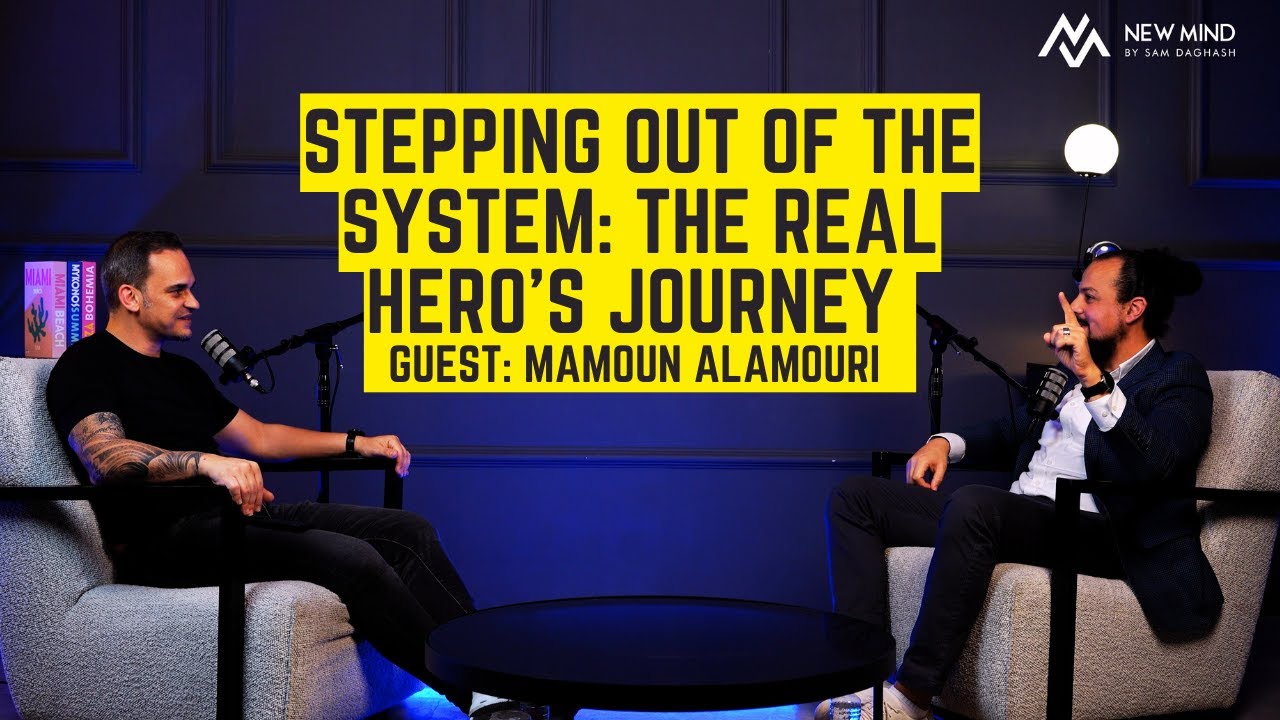
In this interview Sam Daghash sits down with AI‑powered sales and marketing leader Mamoun (Mahmoud) Alamouri to explore how Joseph Campbell’s Hero’s Journey maps onto modern career transformation. Mamoun recounts his 19‑year corporate trajectory, the internal unrest that drove him to quit a VP role and launch an AI agency, and the practical frameworks he uses to navigate the shift. Key ideas include the dual outer‑inner journeys of the hero, the importance of starting a side‑hustle to learn, the “known vs. unknown” paradigm, and the concept that “the enemy of greatness is good.” They discuss the traits of successful people—superior complexity, crippling insecurity, and focus—and how to channel these fuels into purposeful action. Mamoun introduces a “domino” method for aligning short‑term actions with long‑term vision, emphasizes the need for daily habits (meditation, fasting, brief yoga) and the physics concepts of inertia, momentum, and leverage to manage energy and avoid burnout. The conversation also touches on inner work, the role of ego versus spirit, the paradox of seeking approval, and philosophical analogies like Plato’s Cave, illustrating how inner transformation fuels external achievement. Additionally, Mamoun shares a transformative plant‑medicine experience that acted as a catalyst for insight, frames AI as an individual rather than a mere technology, and situates the current AI boom within larger historical cycles (5,000‑year, 1,000‑year, 100‑year cycles) referenced by Mayan and Ibn Khaldun thought. He highlights the scarcity‑mindset and cultural challenges faced by entrepreneurs in the MENA region, arguing that mindset must precede skill development. To bridge the gap between Western entrepreneurship discourse and regional realities, he is documenting his journey through a YouTube channel aimed at inspiring local youth, showing how AI can automate unwanted tasks in sales and empower creators. The interview weaves together personal anecdotes, philosophical reflections, and actionable frameworks for anyone seeking to embark on their own hero’s journey in the age of AI.
Chapters
The enemy of greatness is good.
The enemy of greatness is good.
Okay.
What was that moment for you when you realized that you needed to go all in?
My advice to people when they go, and I know maybe we have a different journey within this, but start a side hustle because you got to learn.
Yes.
In the hero journey is 2 journeys. There is a journey in the outside that people see, but there is a journey in the inside.
Within that journey, there will come a time where you would need to change that fuel purely because if you don't, it becomes empty, the process.
And that's what I'm seeing with my team. All the jobs they don't like to do, the AI is doing it. And I'm seeing it in my customers as well.
Grand rising and welcome to New Mind, where our intention is clear and it's to share information for transformation. Thank you for being here. Thank you for taking the time to watch this or listen to this wherever you are in the world. It really means a lot to me. And if you are new to the channel, please subscribe and pay attention to this particular episode because I guarantee you this conversation, you're going to walk away with something that's going to shift your mind. And perhaps actually potentially change your life. I have a very, very special guest with me today, someone I've had the pleasure of knowing both personally, a family friend, but someone I've known for almost 30 years back actually. And we'll talk about the story how we know each other, but someone that I've reconnected in, in, in Dubai and someone that honestly speaking I must say has been one of the most interesting people that I've come across in my journey. And I'm really proud because he's a friend and I even call him a brother. So I have with me today Maamoun El Amouri. And Maamoun is a leading voice in AI-powered sales and marketing in the MENA region. And after 19 years in enterprise tech and sales leadership across global companies such as Google, Cisco, Avaya, and Uniphore, And over a decade working on hands with AI, he founded SM Orchestra, an AI orchestration and automation company, helping businesses, entrepreneurs to build AI-driven sales and marketing machines. And about 6 months ago, and I've been a witness to his journey, guys, but about 6 months ago, Mahmoud walked away from it all, from the corporate world and leaving a VP role at a Silicon Valley AI company to go all in in his mission. He now documents the real journey of scaling his AI agency from 6-figure side hustle into a 7-figure company, sharing frameworks, tools, and honest lessons with entrepreneurs and SMEs across the region and around the world. Welcome, Mahmoud. It's so good to have you here, brother.
Pleasure, Sam.
I really, really appreciate it. And, and, you know, it's, it's interesting because— and I'm not really trying to compliment here, but honestly speaking, Um, every conversation I've ever had with you off camera has always been one that I find so much depth in, and it's always been a pleasure because I genuinely— I'm very, I'm very, I'm very lucky, you know, because in the work I do, I'm always learning and, and, and working with people from all around the world, right? And I get to see different mindsets because that's my line of work, right? And you have, you know, honestly, you have such a beautiful mind, brother. You have a very powerful. And that, that, that's a testament to you. Always been knowing you, you've always been a high achiever in, in from your high school all the way through to university, always being the first in your class, first in what you do. And I know you don't share this with, with public, but you are, you know, one of those that has an extremely high IQ. And, and it's always a pleasure, and I really appreciate you being with, with us today. And I want to start the conversation with something that you introduced me to over a period of time, and it's about this hero's journey, Mahmoud. And I remember you mentioned to me the story and the book of Joseph Campbell and how every single one of us today in life in general has what we call this hero's journey. So if you don't mind, just for our audience to start the conversation, if you can just zoom out and give them a bit of a context to how you explained to me what this hero journey is, what Joseph Campbell was all about, but how it somehow reflects on our own journey and in your journey in particular.
Absolutely, Sam. I think, see, Joseph Campbell's work is outstanding in so many ways that— and I know you talk a lot about awakening. Joseph Campbell introduced the concept that you can awaken through mythology. So that's one of the, like, for me was a shocking moment, correct? And I'll tell you why in a minute. Because when you think about all culture, whether Islam, whether in Quran, whether in Christianity, whether in whatever, Buddhism, and all the kind of culture, even non-religious culture, you will find always there is a hero that people look up to. And beside the hero, there is so many other heroes that people look up to. And Joseph Campbell was His main thesis—he has two strong thesis. One of them is everyone, and he studied you know his his awesome book Hero with a Thousand Faces. He studied many heroes, and he come up with an arc. He's seventeen stages. Let's I'll summarize them in a maybe zoom out and look at it from a bigger picture perspective just to make it more practical to the people. But he he kind of introduced that element. that when you study all these kind of hero, all of them follow the same arc, the same structure. And I think it resonated so many things with the people, because eventually it speak with our psyche.
Mm-hmm.
Because eventually, what is happening outside is actually, is an insight. So that hero that you hear, whomever hero that you're referring to, in reality, it's actually something within you, and you kind of live in that struggle within you. But one of the most beautiful things from the zoom out of that journey is that he looked at 2 words, one word called the known and one word called the unknown. And that is like the first thing that struck me when I looked at that journey. By the way, like the way I want to speak about it, because eventually it's really one of the things that made me quit my job.
Yeah.
And make me actually go into the journey of uncovering and make— help me make a lot of sense of what I'm going through.
Yes.
It actually was that book. So that's why, like, It's always in front of me and I bought it as a book and I always, it's a reminder for me all the time. So you follow the arc, you have an unknown, you are living in the known. The known in our world is what the system promised. System promised people, you go into school, you get good grades, you go to the university, you go to a good engineering, whatever kind of good specialty based on where you're at. You and I in our country was like either a doctor or an engineer.
Yes.
I went for engineering. I chose that, not a doctor, though my family wanted me to be a doctor. But I went to that, and then you go and you work. If you do very well, you climb the ladder. And then all of a sudden, I was doing that.
Mm-hmm.
And during the— but I never felt settled. All the time, there is an aching within me. Like, I didn't feel the sense of belonging in there. And there was, you know, and then I got into a program Part of it is the hero journey, but I did a lot of things. I started meditating, you know, maybe 10 years ago, and I started discovering what is, you know, what is that voice that is, you know, want me to step in outside what I'm doing. Though what I'm doing, look at the outside, like, you got it. Like, you have a high-paying job, you got the car you want, you got the house you want, you married to your love of your life. Like, it looks like— It's a good life. You get it all. So why things doesn't feel settling? And actually, Joseph Campbell talked about this very well. He talked about it when the hero refused the calling. And when I say a hero, I'm not talking about myself. I'm talking everybody is a hero in their own journey.
Yes.
Now, if you never step out from the known to the unknown, you'll almost never taste this. And it took me some 40, 2 years, like since I discovered, maybe 12 years, but it took me a lot of time to take that job, to take that step.
Yes.
And during that time, and that's what Joseph Campbell said as well, you will, when the hero reject the calling, and we see it in movies as well, you start suffering. You feel the suffering, you become a victim. You become somebody who need to be saving, or things start not working out for you. And there's so many examples of movies you can relate to. But eventually, when you accept the calling, you step into the unknown. Now you step, you go into a new world. There is a new world, like, that's the unknown.
Mm-hmm.
And that is usually the world less trouble. You go in there, you will face obstacles, and during these obstacles, you will need to start building skills. And then you reach to the abyss. And in the abyss, before you reach to the abyss, you feel, You reach to a point, they call it the point of no return, which is, that's it, you cannot go back to the old world. Like, that's it. Like, the way is only forward. And then you're going forward, then you face the dragon. And this is where in a lot of movies, when you see people actually, and that's, it's a death and rebirth, and it symbolize a lot in the movies. And if you look at even like our favorite, or at least my favorite movie is The Matrix.
Mm-hmm.
When Neo died, like, he literally died to, you know, to come and rise again to become the one eventually. So it is the death and rebirth, and you see it across all that. But then it comes to you as a calling, whether are you going to go to the new world?
Yes.
And you need to go back to the known now.
Yes.
Like, if you have to go— not you have to, but if you got to help people, you go back to the known world, and you need to help people within that. So, one of the core things when I was at corporate, I realized in corporate, that's the path that was drawn to us. That's the known.
Mm-hmm.
And if you're gonna go back to the— today in our world, entrepreneurship, at least in our region, entrepreneurship is unknown. It has a lot of uncertainty with it. And when you cross that, you started in reality. That is the, at least to me, that was the moment where I figured out I'm taking the hero journey now.
Yes.
So that is kind of like, maybe we'll talk maybe more about it, but that's the—
I love it. I love it. And I resonate with that, Mahmoud, because remember, I reflect while you're speaking, I'm reflecting on my own journey and I can't believe it. I was actually making a post the other day. It's almost been 8 years. Can you believe it? 8 years stepping out of the corporate world, depending on a salary, depending on security and what was the norm. And I, and I, that's why I feel our journey somehow there's a parallel, a parallel resonance, because, you know, I, I was the same. You know, I wanted to get my sports car. I always share the story, you know, I, I, my, my dream car was an Audi S3. I got it. And I know you've got the Maserati. That was one of the things that you had as a manifestation, right? So it's always been ticking all those boxes, reaching a senior level, making whatever considered as a successful title, and still there was something missing, right? And I think this is the initiation, Mahmoud, that a lot of people get to step into the unknown, but the conditioning, which I see a lot with my clients, is, and the fear of the unknown, is what holds people back most of the time because the mind is trying to protect them of what could go wrong Versus what could go right, right? So it's the choice. But but but like you said, the hero's journey only begins, at least for for my understanding. Correct me if I'm wrong. Is it only begins when you step into the unknown, right? When you when you take that first step. So for me, what I want to ask you, Mahmoud, and you know when I look at you, Mahmoud, you've got a lot of responsibility, right? So do I. But you have a family. You have you know you have. a lot of things going on for you in your life. And I feel the longer, at least in my understanding, the longer a person waits to step into entrepreneurship, I feel sometimes it becomes a little bit more complex, right? It can be more complex. So, so for me, my question to you is, what was that moment for you when you realized that you needed to go all in? What was that? What was that calling? What was that aha moment where You couldn't keep— you know what I mean? Like, you can't be in 2 worlds. What was that real urge, that fire that came up that was like, okay, I'm all in? Because I think that is very inspiring in my opinion. So for you, what was that moment? Where did that come from?
Yeah. Well, Sam, I really— you said so many things to unpack, but I'll tell you, it's never like— to me at least, there is a moment you come where you say, I'm going to burn the ships. That's it. And I did that. But it's not a moment. This has been a work for 12 years while I introduced, at least I met my ego and spirit, and I get into meditation and breathing and these kind of things, start into awakening. And it takes a lot of courage and a lot of— it takes a lot of courage. I think courage is the biggest word when it's come to interpret, to not maybe interpret, just taking the hero journey. Yeah. It takes a lot of courage to go into that. And the buildup towards this, and that's what when you said, see, I think I'm going, it looks like a tangent, but it's very important. It's fine, go for it. I think a lot of people, they think that entrepreneurship is a young guy game. And I think this is, absolutely wrong and it sends the wrong picture. And I'm not saying that this should not— you should not encourage young people to do entrepreneurship. Absolutely not. When you have a lesser risk, when you don't have a family, you don't have— you can actually go on and do it.
It's easier.
It's an easier thing because actually it's a skill. And the university and things, they don't teach you that skill. And that skill, there's a skill and there is a mindset with it. You need to learn as well. So when you are learning, you got to go, and the sooner you learn these things is the better.
Yeah.
Nonetheless, when I read a book which is Think and Grow Rich, and I read it earlier and I read it so many times, every year I read it actually. But there is one, the first time I read it, there's something stuck with me that when they studied the most successful people, the writer, the Hill said in the book that the best man work, it's happened between 40 and 60.
Yeah.
And I was young when I read that, and I was shocked, man. I was like, wow, between 40 and 60. And it makes a lot of sense in a way. And when I went back to the research, even during our time, I find out that the vast majority of successful entrepreneurship who built successful companies, they actually started at age 42.
Wow.
But we glorify the university dropout. We glorify started so early. For a guy in the corporate, you feel like I missed the boat. And I've seen that with so many friends within me. And you see that within you as well at start. But you're right in a way that the longer you wait, the more conditioning the energy will suck it in. So I'll tell you why it's never been a point for me. There's a point will come that you say there's no return. It will come. But since I introduced to that calling, I've been working in so many side hustles. I decided I'm not going to stay in corporate. I knew that, but I knew as well, I got family and so on and so forth. But at the same time, I was not ready. I don't have the skills. I don't have the mindset of entrepreneur. Interestingly, because I was top of my class in university, I started in corporate right away. I never worked in a small company.
Yeah.
I don't know what does it mean to be an entrepreneur in reality. Like, I had no— And what a lot of people maybe don't know, that I believe that corporate is actually the worst at teaching you entrepreneurship. I wouldn't say it's the opposite, but it's nearly the opposite of entrepreneurship.
Yeah.
Because you're part of a bigger machine. Your definition of driving value actually changes. When you are a bigger machine, you gotta just sell what is on the cart. You're gonna build what people say. So you never think, Sit down and think, what value am I driving? What is it like? Is these people have a better, you know? So reality, you lose the element, the definition of value. It's redefined because your value is you are a part of a small thing. The value is driven by a bigger element, which is the machine that is work as a corporate. So you lose that. And the far away from the, you away from the value, the end value.
Yeah.
you start losing that. And this is where other thinking come, is that the enemy of greatness in his book, Good to Great, Jim Campbell, I forgot his name, but he wrote, the enemy of greatness is good.
The enemy of greatness is good.
Greatness is good.
Okay.
It's not, when you are suffering, the only way is up. But when you are You got everything you want.
Yeah.
You are in comfort.
Yeah.
Why you wanna step out? That's why the enemy of like to take that step, to take that journey, is to say, I'm gonna leave that behind. I'm gonna leave good so that I'm gonna pursue great. But when you do that, you have to take a step back.
Yeah.
To take then a step forward.
Yeah.
So it's a kind of very hard choice to do it.
Yeah.
My advice to people when they go, and I know maybe we have a different journey within this, but start a side hustle. At least this is my thing, because you got to learn.
Yes.
Especially when you are, you know, in corporate, at least to the people I'm speaking to, the people similar to my journey.
Yeah.
Step out, because working on the business is different than working inside the business.
Correct.
Being a great salesperson, being a great marketeer, being a great— it doesn't— like, there's a huge difference between being successful here and then Go work on the business.
Yeah.
So it's completely 2 different things. So stepping out, and I feel for this, it's kind of like you are inside the room, and instead of, you know, knock off everything and go, you start like, I see a door.
Yeah.
Okay, every day I'm gonna step out.
Yeah.
Inside that door, and I'm gonna go to the— I venture to the jungle.
Yeah.
And I'll come back. It's kind of like, or I go to the ocean and I swim to the ocean.
Yeah.
And you kind of like testing yourself. You're building that skill. At one point, you will know that this is not enough, and you cannot actually learn the biggest skill, and you have to— but at least, you know, this element to see, like, to go into the ocean and start knowing, oh my God, that you— this is not similar. The swimming pool— swimming at the swimming pool and swimming in the ocean is completely 2 different things.
Yeah.
You got to try this. So my— that's kind of like, you know, my journey. So I started that side hustle For many, for a couple of years, right? For a couple of years. Yeah, yeah, yeah. And I hired people and I had good team and we grew. We had more than 14 people.
Yeah.
But it was eventually a side hustle.
Yes.
Like it was—
You were one step here and one step there, right? That's correct. Yeah. And I think what you're saying, Mahmoud, just not to interrupt you, but I think it's such great advice because also there is an idea of what entrepreneurship is and running your own thing in your head versus the reality of it. So starting a side hustle is probably one of the greatest things you can do just to get a feel for it. Because sometimes you might think you want to be an entrepreneur, but actually it's not for you, right? It can be for you, but it might be like, no, actually I'm not the type of person to run the business. I like to be a part of the business, right? It's different running a business, a whole entire company, Versus being having a role within the organization, right? And I think that's why you say that shifting from corporate to entrepreneurship and starting your own is always good to start to have the side hustle. One thing you said that was golden, Mamoon, was around value, and I want to touch on that a little bit if you don't mind, because I feel this is what I see on a day in and day out with the senior people that I work with. They look for purpose; they look for value that they feel that they're not. getting through their work, through their career. And with AI coming into perspective into the modern world today, what we're noticing is that a lot of people, they're going to lose, no longer have their job, and they tied their value or they tied their purpose to their company, to what they're doing in the organization. And in reality, that's the missing link, I feel. when someone is seeking something else, usually it's because they feel that they're not adding value to what they're doing in the world, in the corporate world or whatever they're doing, their job. So do you feel that value and purpose is important to step into the world of entrepreneurship and to start that hero's journey in that perspective? Do you think that there's an important aspect to that?
I think that is something that everybody should think about every day. what value they drive and being useful. And I don't think that is the answer is black and white. Like I should go leave corporate or leave my job and just go all in.
Yeah.
I don't think that. I think eventually, but you need to name the name of the game you're playing. So eventually when you wanted to step into anything in life, you gotta build certain skills, correct? And there is skills at corporate that is transferable.
Yeah.
And there is mindset that is maybe, you know, that is, I would say it is destructive to being an entrepreneur.
Yeah.
So you got to know what is the game you're playing and what you're, you know, so when you define the name of the game, so I'm here to build this XY skills, you see, and I'm doing the side hustle to build XY skills and this kind of mindset. So naming the name of the game, It's extremely important. So to drive things like, I hate my job and I don't like this, it's really not a good life, correct?
Yeah.
Nobody wants to live that life. But yeah, so— And I call this, there's a beautiful thing that, you know, I think that is one of the biggest lessons I'm learning now is to line up the dominoes.
Yeah.
So don't think, like, line up the dominoes. Start what you— and when you line up the dominoes, and this is something I struggle with so much, You got to start small. So start like, okay, I'm here now.
Yeah.
What is the thing I can learn in this place that will, you know, help me on knocking the next domino and then knocking the next domino? But at least you need to see inside a vision, like there is a big domino.
Yeah.
That one day, one day, and that's actually what you should define it. You say, one day I will crack that domino, whatever that is. So that excites you. Then you drive from that bigger domino. You say, in three years, what domino I need to knock off so that I can knock off the bigger domino? Yeah. Then you you state that. Yeah. And then you coming back and you say, what is in the one year? That one is the one thing that if I do this year, I knock off this domino. That will help me knock off the three years domino. Help me knock off the five years domino. And then you come back. Then you come. To a monthly exercise, and you come to a weekly exercise. Yeah. And if you are obsessed like me, you will do it as a daily exercise. You come in and say, "What is the one thing that if I achieve today, it will be enough of the one week doing? It will be enough of the one month doing? It will be enough of the one year doing?" You see. So what happens now? What you do today is become useful. Yes. It's become adding value, and you're not losing sight of. of your vision. But if you keep like, I don't like this, I just have this vision, I want to build a $1 billion company. But today you are— so that's what will happen with you. It will drive your energy extremely down. You'll have a— so I think this lining up the domino, it's one of the best frameworks that I've done. And I think everybody should— not everybody, but when I advise somebody, I say, do that.
Yes. Yeah.
And regardless, like, if you don't have a vision for a very long term, it's all right. Like, what do you see? What far away you can see? Maybe you can't see far away. I just want to be a consultant. Just, you know, whatever you can see.
Yes.
Line it up and then work backwards.
Yeah. The gap, the gap, the gap between that vision and where you are today. Work it backwards of the milestones you're referring to, brother.
Correct. That's the milestones.
Like the milestones of making sure that you're also— I think, I think what you're sharing is so valuable because in a way it takes away from the sense of overwhelm and pressure.
Exactly. That's correct.
So, and it also aligns your focus. I mean, you say things to me sometimes off camera, Sam, make sure you're not doing too much of so many things because you leak your energy, right? You always say otherwise you move slowly nowhere. So the best way is to just align your focus towards the vision, But what is the low-hanging fruit? What's the next thing that you can achieve that will take you to the next step, which is aligning the dominoes or knocking the dominoes, as you're saying, right? So, so, so, so—
See, in this, Sam, people wanted to have purpose, correct?
Yeah, yeah.
So if I keep thinking about purpose as something far away from me, and what I'm doing now, it's like I just— something I just want to get rid of.
Yes.
It's not a good mindset. It's not a good something to live with.
Yeah.
But if you reverse that, you say, okay, I see my vision.
Yes.
But now I need to bring it down all the way now to today. Yeah. What today I can do? Yeah. Then I know while I'm doing this. Yes. I'm actually stacking into that 5 years goal. Yeah. It doesn't have to be 100% that you're doing. Can be 20%, can be 10%. It doesn't matter. Yeah. But don't make it zero. Yes. Because anything multiplied by zero is a zero.
Yeah, you're right.
Simple equation. Yeah. If you— if it's 10% at one day, it's compound and it will start, you know, growing and growing. And there's a very beautiful book on this called Atomic Habits. It's one of the few books like I read maybe 5 times. It's super awesome with this because you don't rise to the level of your goals.
Yes.
You fall to the level of your systems.
Yes.
So how can I, like, I want to have a big goal, but then I need to bring it down here today, here and now.
Yes.
Of where I am, that I can do something. And regardless what's your job, regardless what, how much bad your job is, doesn't matter because eventually you have worked 40 hours in that job.
Yes.
You work 50 hours, whatever amount. You still have 10 hours you can put into that vision that you've got, correct?
Yes.
And as long as you are doing this, eventually you will feel that sense of like, I have a purposeful life. I am walking the path towards that goal. And reflecting back to the hero journey, eventually, in the hero journey, the thing that I didn't mention is 2 journeys. There is a journey in the outside that people see, But there is a journey in the inside.
The inner world.
The inner world. And the inner world, eventually you will find as you start going that the journey outside is just a manipulation for you to uncover the person within you. It's not about achieving the goal. It's about the person you become who achieved that goal.
The person you become to achieve that goal. That's so true.
Exactly. There is people, they put up a sport goal and there's people who put up a financial goal. There is people put up whatever goal you put up. That's the game that will help you to overcome yourself and discover new things and realize yourself. So the outside goal become not the goal, but it's just to keep you focused, is to give you a laser focus, to give you purpose, to attract people towards you. Because people want— when you want to attract the team, you want to give them, you know, it's not— you want to give them a goal. So, I think that was super, like this framework and this thinking is super valuable in a thinking that you think eventually, because the person you become, it's always going to stay with you and it's always going to grow with you. So there is no, the goal becomes secondary in a way, so important, but it's become secondary.
I agree to what you're saying, Mahmoud. And I mean, for me, What I would like to pose a question is, is do you think that the inner world is a priority prior to everything else? Meaning, meaning, I mean, for what I see, at least in my model of the world, I feel that it is super important to have honest reflection of the inner world that we have inside of us, right? The inner self-perception, the self-belief, the self-trust that we're able to pursue and take those steps in that direction. And if there's misalignment inside, I feel that it will reflect outside of you, the misalignment, right? And I think the biggest teacher in our journey as a— everyone, like I said, everyone has a hero's journey, but the biggest teacher is what's being reflected outside of us, right?
Yeah.
What are the challenges, the patterns, the things that we see that I feel that sometimes it's always a calling to go inward and go, what do I need to overcome within me to be able to shift that Um, and, and start to see change outside of me. So do you feel that that is also true to, to your, to your experience? Do you feel that there is a lot of inner work that needs to take place, um, in order for us to pursue what we're meant to be pursuing in life? Um, because I find, again, Mahmoud, again, I just speak from my experience, my own journey, um, which I had to overcome a lot within my own experience internally, but also with the people I work with, you know, the, the the clients and students I work with is that there's always these layers that you have to break through. Like, and a lot of it is driven by fear, a lot of it is driven by conditioning, a lot of it is driven by a world that actually always feeds us information that there's not enough, it's too hard, stay in your lane, um, and you're unable to— you know, who do you think you are to succeed? You know what I mean?
Yes.
And, and I, I sometimes feel I, I mean, for me at least, is like I try and make sure that I'm differentiating between— and I want you to touch on this— between the ego and the truth of who we are, you know? Like, as in, as in, A, first of all, my first question— sorry, it's a loaded question— but A, is it true to you that the inner world is as important as what's happening outside of you and the inner work that you do? Because I know you've done a lot of inner work. In fact, you've been inspiring me myself, and we'll touch on something shortly in terms of— we had a We both had a very powerful, extremely powerful inner world experience with plant medicine, which we're going to share shortly. But before we get into that, Mahmoud, what's your thoughts on that dynamic?
Well, Sam, I'll tell you a contrarian view on this. And see, when I was growing up, and you and I, we are kids.
Yes.
We knew each other. We came from a very hard place.
Yes.
maybe they're listening from Jordan. We came from Zarqa, from a place called Wadi al-Hajar. And it's a very tough place. We love the people, we love doing— and we respect. And I kind of like, at one point I was so angry from that history, and then I made peace with it, then I fall in love with it. And I have a strong root, I would say. But it was a very long journey to get there. But it was a very tough place. And I'm so proud of you as well.
Thank you.
You're here, from where you and I, that we know where we've been.
Yeah.
Now, when I was growing up and when I getting into the inner work journey, Sam, I was so angry. I was a very angry person and I didn't know what to do with that anger. I was clueless why I'm angry. I just was angry.
Wow.
I was angry from the world. I was angry from everybody. I was like, People who work with me at the beginning, they see this guy's so smart, but so angry. I was really angry.
You had that energy, that anger, resentful energy?
I have whatever you want to call it. I was resentful. I hated the world. I was really black. I was dark.
Okay.
You and I, at that time, we went our separate path.
Yeah.
But then when I start working on doing the inner work, so during that time, I didn't know where to put that level of energy in. Entrepreneurship in my mind was not part of the game at all. I don't know why. It was like it's other people.
Yeah.
The ultimate goal was you do well in university, you go work in a corporate, then you start traveling the world, you got a high base salary and so on and so forth. That was the dream. And when I start working in the inner work, at one point, Maybe, you know, I think maybe 5 years back, I was looking at the research. Was shocking to me. The research, Sam, they studied the most successful people. And when they want to study the most successful people, they actually didn't come with any hypothesis. They just want to see, you know, what makes these— what trait makes the successful people. They find you 3 traits. You will be shocked from the trait now. Trait number 1. Superior complexity.
Superior complexity. Wow.
The people, the very successful people, they think they are better than others. Now, a lot of people now, they will hear this, say, oh my God, like this is— but let me continue why this is so important now. Superior complexity was number one. Number 2, crippling insecurity. They had within them a crippling insecurity. I'm not worthy. I am what— they wanted to fill a gap. The third thing was focus. Now remove any of these features. If you have superior complexity and you have crippling insecurity without focus, you will be crazy. If you have superior complexity and you have focus but you do not, you know, do not have insecurity, you might be, you might be good, you know. So if you have any of the two and you just bundle them, you will get a different person than people who go astray doing something. Why, Sam? This was like— and I was like, oh my God. I was always fighting that dragon within me. I wanted to tune that dragon. And I find out, and this is where the punchline I'm going to say, because you talked about it, whatever fuel you have today, whatever that is, anger from whatever fuel you've got, just put it on what you want to achieve. Have a proper goal.
Yeah.
and have a focus toward that goal and make it a good goal. Don't make it an evil goal.
Yeah, of course.
Make it a good goal and pour that fuel in. Now, when you start the journey, you realize you cannot keep surviving on this fuel. You see, that's the challenge. This fuel is temporary, is good temporary, but it will actually burn you aside. It will kill you if you keep relying on that fuel. But see the initiation point, this initial point that you need to get to, to create momentum, to reverse inertia, inertia.
Yes.
These points, use whatever fuel you've got. It's anger, it's resentment, is whatever that is. At least in my case, it was anger. And I wish— and I've seen a guy who I respect so much and I like so much, I, I follow so much, and it's part of, um, a lot of things he did do is Alex Hormozi. And maybe a lot of people, they know, in, in, in the sales and marketing domain. And Alex, actually, when he was speaking about his journey and he talked about his anger He had a bath of entrepreneurship. And Sam, for a certain reason, like I believe if I have that as a possibility in my life at that time, and I pour my anger into that element, it would've been a different game. But I didn't know what to do with it. So I start pouring it inside the corporate. Now inside the corporate, I become a disturbance. I don't like the way we do this. We have to change the way we do that. No, you got to—
It wasn't good enough.
It wasn't good enough. But no, I was disturbing the people, 'cause people want me to do my job.
Yes.
And I wanted to do something bigger. Stay in your lane. And I wanted to do, and it's not something on their fault. Like, I'm signed up for this, correct? That's the game I'm playing. So you gotta respect that game in a way.
Yeah, yeah.
When you are inside that game. So about the superior complexity, because a lot of people think like, oh my God, like superior complexity. See, and I had it all my life. See, superior complexity is not about being arrogant on people. And unfortunately, if you have the superior complexity, ego is very smart. We play the game that you see, you not be a humble person. But any proper leader got to humble themselves, correct?
Yeah.
But what is the game? The game is if you are sitting inside a very big room— white make a lot of sense to me— and there's so many people, there is a challenge, and everybody say, oh, we cannot do it. If you think you're better than everyone, you will actually go do it. That's the definition of the hero, correct? That hero think, I can do it.
Yes.
You know, and sometimes you need to feel, I am better than these. Now, when you say I'm better, I'm not talking about at the spirit level.
Yes.
We are equal at the spirit level.
Yes.
But at the ego level, you get to— there is people better than others.
Yeah.
We are different levels. There is people who play at a complete different level.
100%.
As an entrepreneur, you and I will play at certain levels now. And, you know, Elon Musk play at a different level than other people. So you get to realize there is This element of individuality, that's what makes it interesting. And that integration between the spirit and the ego is what is, at least to me, what I start making as a very important goal in what we do, or at least of what I do, to realize that. So inner work, extremely important.
Yes.
But wherever you are, don't wait. in that element. And when I say don't wait, I'm saying just be useful. Be useful. Have a goal. Reverse it. Line up the domino. Come here and say today, whatever that is, I'm going to do something. That is, I'll start cracking myself into becoming that person I wanted to become who can achieve that goal. So yeah, I think, I hope that that was the first part of the question. I don't know if that was—
Yeah, no, you addressed both actually. For me, what's interesting what you're saying Mahmoud, is basically just to summarize, is that even if you have someone that has— if you're someone that has some form of insecurity, the ability is to channel that insecurity in a positive way towards creating momentum in your life, right?
Absolutely.
The second thing what I would like to share with you, Mahmoud, and maybe this is something because obviously I've been in this, in this, my model of the world working with high achievers, I have picked up a very interesting, and I'm going to share this with you, but mostly I would say, and without exaggeration, probably 90% of the high achievers I've worked with, okay, and I'm talking really high achievers, being it multimillionaires in trading or in other leadership roles or even entrepreneurs, the thing that I pick up, which is indirectly why they come to me, is that what got them to where they are and what got them to the level of achievement that they were is because they had an insecurity, which is, I'm not good enough, or that is not good enough. Okay? So I'm not good enough, or that's not good enough. Now, when they come to me, it becomes a little bit tiring after some time, Mahmoud, right? Especially if you're at a specific advanced level. Why? It's because it robs you from the satisfaction of where you are in the journey.
That's right.
Right? So what I found out is what I've been doing a lot with high achievers is I've been going, And there's a fear of letting go of that insecurity. Let me explain. The fear of letting go of that insecurity is because it served them so much in their life that they don't want to let go of.
True.
And what I do is I say, it doesn't mean if you let go of this complexity of, it's not enough, it's not good enough, I can do better, I can do better, I can do better, to change it to completely a different fuel, which is, I actually love myself and I want more for myself and for my family, and I want to achieve. But taking it from a perspective of being satisfied with yourself not means that satisfaction means that I am complete, I'm just gonna be blasé and just not do anything. No, it's that you actually become even more hungry because you want to succeed for you, not to succeed for the ego or for the— for showing off or comparing yourself to that, to the rest of the world. And, and like I said, I agree with what you're saying, Mahmoud. Whatever fuel it is in the beginning, go for it. However, my only comment to what you were saying is that within that journey, there will come a time where you would need to change that fuel, purely because if you don't, it becomes empty, the process. It becomes none. No matter where you are in that beautiful journey, because we're supposed to enjoy the journey, you want some form of satisfaction. You want to be able to stop, pause, look back, and look how far you have come, right, Mahmoud?
Absolutely.
And I think that, that for me is, is super, super important for a healthy journey. And yes, you can hack the system by what you said, but I think adding to that and being conscious about being gentle on yourself along the way to not burn out. And I had a very interesting guest who I think you both would be amazing to have a conversation with, who's also in the AI, because I want to touch on AI with you for a moment. But he was saying to me that most entrepreneurs fail is because they are so burnt out prior to actually doing the launch or doing things. So they burn themselves out so much that when they get to the stage, which is most important for success, they're worn out. And usually it's because of the elements we spoke about. So how important is it for you as an entrepreneur today? And I know you've been doing it for some time, but now like fully, fully, fully, how important is it for you to find that balance in your life to make sure that you don't get burned out, Mahmoud? And what are the, what are the practical things you do on a day-to-day basis that almost keeps you in check, where you're not, you know, you're not burning your fuel to a degree where you just can't, can't move forward? Because I know you have such great energy in you, brother, but also I'm sure there's a way where you need to recharge and fill it up. So what do you do in that perspective?
See, I'll— I have a contrarian view on these things, and I know I'm doing a lot of of contrarianism.
No, it's fine.
I think because the— I think that is the— I call it that way. I call it, you know, God is in the paradox. And like, you go in, if you want to realize, you know, the bigger meaning of things, you got to go to a paradox. Why is that? Because the definition of the paradox is that the mind cannot understand the paradox. So when you cannot understand a paradox— a paradox, for example, I say if you want people to like you, you need to stop you know, caring about people to like you. And like, but if I stop caring, it's a paradox.
Yes.
You cannot realize it at the mind level, so you need a different intelligence to understand.
Yes.
So that's what I say, God is the paradox, because you need a different intelligence to realize that. I am not a person— I believe balance is absolutely necessary, but do not optimize for balance.
Okay.
Why I'm saying this? Because everybody's— they need— everybody, they have their own balance. It's not something you gotta learn from You can learn from outside. I'm not saying— at least let me speak about my journey because it's very hard. Like, I'm very careful. I know telling people what they should do, it's not my place. Like, I really— I can only speak about my journey.
Yeah, you speak about you.
So I'll tell you about my journey. I believe that you go in bursts. That's the— achieve balance. You optimize at a longer, not in a daily basis. You expand the time horizon, and then you start saying, okay, I'm doing a balance in whatever you can sustain, whatever good for you. Because that is about— the game is momentum, inertia. Like, when you understand these, these, uh, concepts— and I say there is 4 concepts in physics that when you apply in life is so important.
Mm-hmm.
And it's the, the number 1 is inertia, number 2 is momentum, uh, uh, number 3 is leverage, And number 4 is— I forgot number 4. But when you understand these, it will help you to optimize things in a complete different level. So the way I do it, I expand my time horizon. So for example, I'll tell you that in maybe a simple thing.
Yeah.
Even at the food level, I like to go feast and fast. So there is— I fast for past 5 years. I daily fast 48 hours continuously— 40 hours, sorry, continuously every week. Every month I do 3 days, I do 68 hours. But I fast as well. I feast, sorry. Yeah, I feast as well. So, uh, this, you know, level—
Yes.
I felt it is actually— it's actually by research as well— stressor make you stronger. Stressor make you live longer. That the most activation of longevity genes is actually when you go in a short-term stress. So the short-term, you define the short-term. How much you can sustain? Is it a day and you have to go wine out in the evening? Is it a week? Is it a month? Is it— you got to know yourself.
Yeah.
Now, I think it's always good to have a daily routine, at least for me. I go nuts if I don't have it. But I think, as I said, Alex Hormozi doesn't cheat. And actually, he laugh about the people who don't do it. That doesn't make it right. But I'm saying, when you play, you got to understand yourself and understand that this might be a weakness when you say, I need that. But you're going to acknowledge this within you.
Yeah.
I meditate daily. There is no— every other— if I miss tomorrow, I have the rule of don't miss it twice. And thus I took it from the book Atomic Habits. And I think a lot of people miss that. This is a very beautiful rule because when you apply it in your life, a lot of people, you do the thing and you are on a diet, then you break and then, oh my God, then it's downhill from there.
Yes.
You don't reverse momentum. And that's where the momentum comes in.
Yes.
But when you say, I'm not going to miss it twice, so when you do it today, tomorrow your job is not to miss this. So you reverse momentum.
Yeah, 100%.
And so you keep reversing that momentum because you have it on the positive side. And yeah, the last rule I wanted to talk about was compounding, how to compound.
Yes.
Because compounding is a big element of life. So compounding, if I'm going to keep doing something for a while, then I keep rewinding, You need to realize that you're going to realize your goal is a bigger time horizon. How much you can put up an energy on something to break, to get this inertia and you build the momentum and you go against that, you go with that momentum.
Yes.
And you need to know when to stop, when to cool down. And that's, I think it's a completely personal thing. But yeah, in my journey, as I told you, being with family, I'm fully present. That's part to my purpose. But my family's very understanding. I spend a lot of time working. I work more than 50 hours a week. I'm not very good. I love to work. So it's kind of like if you ask me— You enjoy it. What makes you happy? I like to do it. I like to read. I like to work. I like to learn. But meditation, something I do 20 minutes daily. I do, believe it or not, I do at minimum 2-minute yoga.
Nice.
Just to keep it, to keep the habit. And that's the other rule I like from Atomic Habits is the— and there is the beauty about not making it zero.
Yes.
Don't optimize. As long as it is there. And I'm telling you, man, my back, my body shape, my— it's better than when I was even in my 20s. And I regard that a big part of that, of doing 2-minute yoga at least.
Yeah.
I optimize it, but I've been doing it for a very long time.
Yeah. So combine—
Some days I do it, you know, 20 minutes. I do it 1 hour. I do, correct. But for the daily thing, I finish meditation, I just go and I do the basic, you know, thing, 2 minutes, 3 minutes, and that's it. Breathing is a big portion as well to learn this. then the regular thing, you know.
Yeah, I mean, I've learned so much from you on, you know, over the years, you know, on in terms of the supplementation, because I know you have a— you've also studied, uh, nutrition background. You have— you were the one that introduced me to DNA testing as well. So there's so much— your wealth of knowledge, and I think we could go on and on, uh, in this show, and I realize we've already done, done an hour, but I, I wanna— I wanna just for the But just to— I might even make this part 1 and part 2, 'cause it's such a great conversation. But I just wanna touch, and going back to the hero's journey, okay? You know what happened to us as we got to, coincidentally, after 20-odd years of disembarking? For those of you who don't know a bit about my background, so I was born in Dubai, and then I moved to Jordan, and that's where we were in the same neighborhood. And that's how we got to know each other, literally in the same neighborhood. It was a very rough neighborhood. It was a tough, a tough period in my life, a couple of years at the high school level. And then I left. And then, you know, I left early at the age of 18, and Mahmoud carried on his journey. And then he left as well and then started his journey around the Gulf and around the world. One thing that was interesting is I believe in synchronicity, and I feel that synchronicity is also a very powerful form of abundance. You know, when you meet the right people at the right time in the right place. It's not a coincidence. I don't believe in coincidences. And 20 years later, I'm at a gym and you walk in, and I didn't even recognize you, Mahmoud, because when I left Jordan at the time, you were overweight, if you remember. And, you know, you came in, you were lean, and you were— felt— you felt like you were taller and you were more present. And you were like, you know, Sam, or Hussam even. You called me my full name, and no one calls me my full name because no one hardly knows my full name is Hussam, right? So you went like— and I looked down like, who's this person? You're like, man, it's Ma'mun. And I'm like, oh my gosh, like, how's that journey? And then obviously we became reconnected and family friendships, etc. And then throughout the experience of, of developing and reconnecting our friendship and our brotherhood, we had this opportunity that came to us, um, to a non-disclosed place abroad or to, uh, to do a plant medicine journey And we both had that calling at the same time. And what's interesting about that experience, Mahmoud, is when we had that experience, we both had what is known as the hero— the hero's dose, the hero's journey, which is just for you guys know, it's about above 6 grams of, of psilocybin. And, uh, you go into a meditative state for 9 hours. And it felt in that experience that a lot of things happened, of course, that we can't really unpack right now. But one of the things that I remember that I found fascinating, and I'll never forget this for the rest of my life, is that when we were in that experience, we had a full-on conversation, and that conversation happened telepathically. And, um, what was interesting is that after we came back from this, from the ceremony, and we had like a person that was holding space— it was done in a very professional manner and we were back on our journey back, back to, to Dubai, we started having the conversation like, Mahmoud, do you remember this moment when I asked this and you looked at me and you said that? I'm like, man, we had a full-on conversation in a telepathic manner, which for me was really, really powerful. But also it, it showed that there is some truth to the inner world and outer world experience, and also to what we don't see with our, with our senses. And I wanted to just ask you, because a lot happened in that experience, what was the most profound thing for you to take away from that experience, Ma'moun, that has potentially helped you in where you are today in your, in your, in your journey, um, especially now stepping into the unknown? And to be honest, the unknown is more known than we think, but it is unknown because we don't see it with our senses. But what is that moment in time experience? Because for me, it added more courage. Just to, just to add, for me, it added more courage. For me, it built more self-belief, and it also took away a lot of fear and doubt from, from my— from me, to be honest with you. Yeah. But it also, it's also taught me that, that there was no— there was, there was no such thing as a coincidence, and we were meant to be in that experience. From 2 young boys that didn't know anything much about the world, to being on the other side of the, of the world, to having such an experience. And I don't take that lightly. I really think there is more to it. So what's your take on that? How has that helped you integrate and become the man that you are today? Because it is a life-changing experience. Would you agree? It's a life-changing experience.
Well, first, Sam, before I go into this, I actually— to the synchronicity point. Yeah. Let's link it back to the hero journey. In the hero journey, when you step into the unknown, actually one of the first things you face is a helper, helpers, or a guide. That's at least what's mentioned. And I took my helpers and guides in a completely different way. But there is a saying like when the teacher is ready, the student is ready, the teacher appears. The master appears. Correct. The teacher. And I think you've been a teacher for me.
So have you, man. So have you, Bill, honestly.
And you've been a helper. And I think there's something beautiful about coming from the same root. Because see, eventually, for a very long time, time. One of the biggest anger was for me is to look to other successful people and saying, this guy dropped out and they've done this and I'm smarter, or whatever that is.
Yeah.
And then when you start knowing that eventually, when I started my journey from that truth, it's a completely different journey. My ego's different. What is in my side different than whomever you look up to, these guys are from a different place. So when you and I met and have this root, eventually, we have almost the same root.
Yes.
Coming from the same background.
Yes.
So many, we resonate with each other.
Of course.
So that level of energy, eventually, when you have people in your life who resonate with you at deep level, because we're coming from the same place, correct?
100%.
It's really profound and it's helped lift the energy for sure. So I think there is no coincidence down there and I think it makes a lot of sense to that. Back to the plant medicine experience, it was so beautiful experience. All right, so I'll tell you something very interesting about I'll tell you before I go into this, I love philosophy so much. I love Plato. And Plato has a framework that helps me a great deal in my life. And Plato has a writing about something called Plato's Cave.
Yes.
It's an awesome framework. The framework says, if you are sitting in a cave and we are chained and you are looking at the wall, like this wall, And you know there is puppeteers moving the puppets, and we're watching the wall. We're chained. We are looking that way. Then all of a sudden, Sam finds himself unchained, and then he looks outside like, "Oh my God! These are puppeteers, and this is not real. These shadows." And then Sam now has a choice. I I need to exit. I want to exit the the cave. So you gotta let go of that, and you start exiting that cave. When you exiting that cave, you through the journey, da da da. Then you go outside, and when you go outside, you will see a world. Okay. Now I want you to imagine Sam this with me. Yeah. Yeah. So you want outside the world. You've seen the trees. You've seen the the rivers, the water, and universe. You don't have a vocabulary to explain what does it mean. Yeah. Right. So now Sam has a decision to start there. Or to come back. And that's why Plato wrote it about Socrates, because Socrates, he saw the outside world and he wanted to bring it to the people to realize. Now, the challenge for Socrates, he didn't have the vocabulary. And nobody has, by the way, none. Because it's not in the language. That's where the paradox is.
Yeah.
There's no— and I want you to imagine this. Imagine, Sam, you went there, you come back, you come to these people, no vocabulary to explain what you saw.
Yeah.
And I want to challenge you, maybe a challenge for the audience, try to explain what a tree is to the people, what a green is to the people, what the water is to the people. They never saw it.
Yeah.
Or a river in a way.
Yeah.
So you have no vocabulary for it. So how you will make these people see what you saw?
Yeah.
What is the way? If you keep talking about it, you keep explaining it, you keep, you know, There's no way to explain it. And this is to the hero journey. One of the elements that Joseph Campbell talk about, that he talk about the truth is in mythology. Mythology carry a higher truth than I tell you the lesson. If I tell you this versus you see a mythology about The Matrix, for example, or about whatever mythology you— but that's for some modern example.
Mm-hmm.
It actually explains a higher truth than if I come tell you the truth as it is, correct? Or try to put it in that wording, which is there is no word to explain. Yeah. So, but the beauty of— I know it's a tangent, but it's a very awesome thing because if you think about it, you can think about this as an outside thing.
Yeah.
That a hero go in, but you can think it as an inside thing.
Exactly.
Because you have an idea that wanted to go explore this, but all the personas within you is bullying you. Sit down here. And the continuation of the Plato cave is that the guy decided to come back. And they came back and he told the people, guys, this is what you see is not the truth. And we got to get out. Let me show you. There's a different world down there. These are puppets. What happens that these people killed him.
They killed him, eh? They killed him.
That's why, because they killed Socrates and Socrates actually chose this because they told him exile or death and he chose that. So the beautiful thing about this is that resemble when you have a courageous idea, there's so many personas within you, this conditioning.
Yeah.
It's like to pull you like, no, you want to kill that idea. Similarly, look at it from a bigger perspective as an outside.
Yeah.
You know, you, and you can think about puppeteers like so many things, the KPIs, the, you know, at your work, the things you look at, how you define success. So the plant medicine experience is kind of like you took something and you are inside that cave, and all of a sudden, something pull you out of the cave.
Yes.
It pumped you up and you go there, you see the truth and—
You come back in.
You come back in.
How do you explain that?
And now you cannot explain it, but it was so much of a dose. So that's the best way, because you didn't walk a path. You just took something, the earth spoke with you, shows you something, whatever that you're calling it is. Yeah. But you— it was a snap for you. So I think it's so much you, like, regardless how much word— and by the way, this is why people attract to poetry and these kind of words, because yes, it's kind of like a way to explain that thinking. Yes. But there's no word to describe it, man. There is something like the only way. Yeah. It's gone like you gotta try it yourself.
You have to try it yourself. You're right.
Everybody will have their own different journey.
Yeah.
But it's just, you gotta realize if you tune into it.
Yes.
If you feel the eject.
Yes.
And some people, they take it, they're not ready for it.
Yes.
They go somewhere and like, oh, they're not gonna see.
Yes.
And there's some people experience bad journeys and so on and so forth. You're gonna respect the journey.
Yes.
You have the right element. But yeah, it's a trip to that—
I understand, to that special place. I just found it fascinating that when I look back at that experience is that it was meant to be both of us from— you know what I mean? Out of everyone in the world, all my experiences and every person I've ever knew, it was you to experience that together as our first plant medicine experience. And I walked away really feeling so much more at peace in a way of what is and trusted the process a bit more. But also, like you said, I think if you remember, it's like it literally came to us. It's like we were initiated by it. It wasn't something we were looking for.
Correct.
It literally came to us and you're like, you feel it? You feel it? Yes, I'm ready. I'm ready. Okay, let's just attempt and let's go for it. So everything aligned. And I think that's the message for you guys is that you have to be in tune and to be aware of all these initiations that comes in your path to step into your full hero's journey, to step into the calling. And I think it's important to sometimes do these practices like Mamoon says, like, you know, your meditation or quieting the brain so you can listen to those and be aware of it. Mamoon, like I said, we can go on for hours. I just want to take an opportunity to say thank you so much, brother, for sharing all your value, your knowledge, and I want to wish you such a, you know, all the very best with what you're creating with your organization. And if you don't mind, this is how I want to wrap up. I just want you to give a quick encompass of what you are doing at the current beautiful journey in terms of MS Orchestra and how you are supporting those in your greater mission so that people can find you. People that want to interest, because I'm going to put down the details as well, because I find it fascinating how you're bridging the gap of AI and entrepreneurship and sales and marketing. And I know you want to crack that code and you are on the path to cracking it. But if you don't mind just giving a quick summary of that, brother, so people understand the mission you are on today. And I know you've been on it for some time now, but what you're really trying to make an impact in this world in that puzzle positive way?
I've been working in AI for 10 years, not like the hype of the AI, since I, I think when they were educating AI to speak, which was natural language processing at that time. So it's been quite a journey for me to, to work with it. But the moment AI, you know, came into this, you know, boom at that time, that was the exact time where I started my, my, um, my company And I think the best way to think about AI, at least to me, is AI— to think about it as an individual. Because if you think about it as a technology, you will actually miss the point of so many things. And I know this is so much controversial, but at least will help you understand the world in a different way, or at least the world of AI in a different way. To not go so much on that tangent, but my journey was 18, 19 years of sales. A lot of people misunderstand what sales is. I believe sales is about helping people make a decision. I think about if you believe of that value, and I want— if I believe, like, if I want to help Sam to make a decision towards something, that this coffee is the best coffee.
Yeah.
I got to believe it's the best coffee. If I don't believe it's the best coffee for Sam, then I'm frauding you. I'm, you know, so, and I think that was so much understood. And, you know, I've been through a journey till I understand that. So that is the first element, that's the misunderstanding of this, how you multiply and make it a reach and change some mindset with it. But at the same time, what is the skillset and the elements you need to build towards that? Now, AI, as I said, I think that requires a different conversation to see how things are changing in the world and why it's so much important even to the consciousness level and so many things.
Yes.
Yes. And changing the way governments run and the cycle of history. You and I talk about it like the 5,000-year cycle. So it wasn't a small change for me. It was like I saw a cycle. We are at the top of a 5,000-year cycle, a 1,000-year cycle, a 100-year cycle. And the cycle, just for the audience, is the cycle— it looks like as we have a daily cycle, days and night, as we have a the season cycle, 4-season cycle, a yearly cycle. There is a bigger cycle. We're living in an awesome time where we have so much bigger cycles. We are living at the top of a 5,000-year cycle. The Mayans talk about it.
Mm-hmm.
They call it the new world, the death of an old world, a new world. We are living off a 1,000-year cycle being documented by others, and it's in a nice book called Individual Sovereignty or Sovereignty And there's a 100-year cycle. Ibn Khaldun talked about this, and recent historians talk about this as well. So we're living in a very interesting— so this is for me not only just as a smaller thing. It's kind of like part of so many things meeting at the same time. And I said, okay, that's, I think, that's what will drive— I want to drive a lot of value out of this. And I think sometimes it's hard to, because so many talk about it, and everybody now is an AI company in a way.
Yeah, yeah, yeah.
And rightfully so, in a way. But eventually, the mission we are in is to help, because I believe that is when you are in an entrepreneurship journey, you got to make the stuff and you got to sell it. But when we talk about sales, we talk about it from the right mindset. I want to help people make a decision towards what I'm creating, and I need to believe in the value that I'm creating. The moment these combine, You get to have multipliers to let people know about you and, you know, subscribe to that journey and buy from you eventually. That's what sales is. So I believe sales is a moral, excellent thing if you have the right belief about the value you are creating. And we're leveraging AI across all what we do, and we are in the automating and infusing AI across everything we do. And I believe that AI eventually will help us grow. And that's what I'm seeing with my team. All the jobs they don't like to do, AI is doing today. And I'm seeing it in my customers as well. The things that nobody likes to do is actually the AI start doing. So that is, I mean, in a way that we are leveraging AI to help people sell and let people hear about their solution. There are so many talks can go into it. But I want to keep it here. One of the things I did as well, I wanted to document the journey.
Yes.
So I started doing my YouTube and I'm still figuring things out. But the purpose is I'm learning about how to document the journey as well. I want to document that journey, like what that journey looked like for the kids from a tougher place coming along and, you know, see, like hopefully will inspire somebody or teach the skills for somebody to try this because there isn't There is good discourse for entrepreneurship, but it's coming from the US.
Yes.
And the US has a different mindset, has a different skill set, has a different starting point.
Yes.
And that's what we're missing here.
To the region, yeah.
The starting point is different for our region, for our people, for— it's different.
Yeah.
And the mindset we have, and I think it's not a skill set game anymore. Skills is important.
Yeah.
But the mindset will precede the skill sets.
Correct.
In a way, or they play together, but— There is more scarcity mindset that we have. There is more dealing with a stranger mindset. There is more lesser of— we have wrong mindsets that actually put us at disadvantage when you wanted to start the journey.
Yes.
You're going to learn it as there is a skill set and this mindset that you need to bridge. So I hope— I want to document that journey with the people. building, uh, um, what I'm building now. And hopefully somebody will be, will be able to learn something from that.
Well, I'm, I'm always learning when I watch your content. It's always inspiring. And I like the fact that you're also doing it in Arabic to, you know, support the, the region and to support the, the, the, that background in particular as well, which is, which is quite refreshing because again, your knowledge and expertise working with global corporate America companies and also transmuting that now into, into the region of bringing that wealth of experience and how you are creating your own empire, which is, which is very much inspiring to witness, Mahmoud. So, so thank you so much, brother, for what you're doing. We're gonna link up all your details as well as the website and, and all, and where people can find you. I want to take a moment, and like I said, I know we can go for hours, myself and you, which we tend to do that off-camera anyway. But I just want to say, take it, take a moment again one more time to say thank you so much, Mahmoud, for being here. I know you're a busy man. Thank you for making the time to share your knowledge, your value, and all the references you've put. It's, it's incredible. So, uh, thank you for being here, Mahmoud. Appreciate it.
I appreciate you as well, and I enjoy every single minute of the conversation.
Thank you so much. Thank you guys. Much love and positive energy.