
How One Book Tranformed My Entire UX Design Career
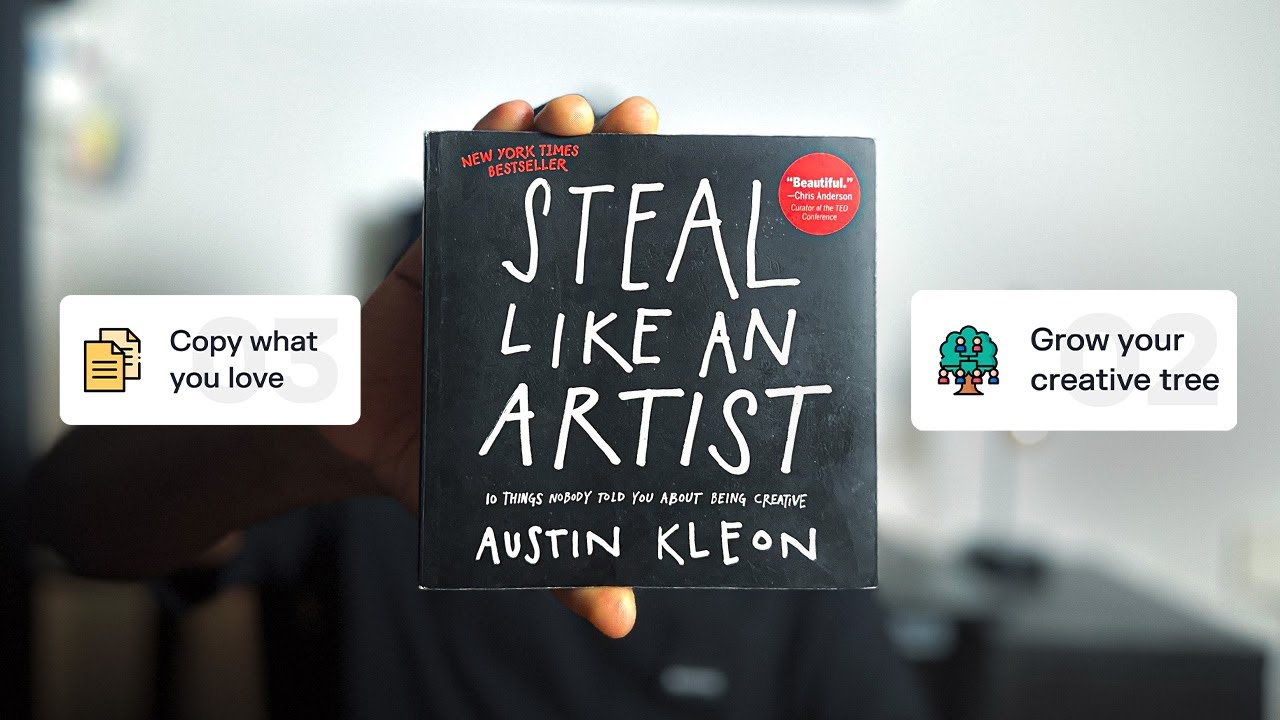
Samuel Fabayo credits Austin Kleon's Steal Like an Artist with transforming his design practice. He shares three lessons: originality is a myth, so study your creative heroes' lineage; copy what you love and adapt it to your style; and maintain an Inspo page in Figma to unblock yourself when stuck.
Chapters
One of the books that have had the most impact on my career as a designer is this little book called Steal Like an Artist by Austin Kleon. This book taught me to unlock my creative potential by embracing the idea that nothing is truly original and it is totally fine to allow the work of other people influence and inspire my own work. That is why in today's video, I'll be sharing 3 lessons from this book and how it has made me a better designer. Yes, just 3 lessons. Today's video is going to be short and sweet. So stick around to the end. Let's get into it. The first lesson that I got from this book is that no idea is original. According to one of the writers that was quoted in the book, his name is Jonathan Lethem, he said that whenever people say that an idea is original, 9 times out of 10, they just don't understand the inspiration behind that idea or the source that that idea was referenced from. So as a creative, you must understand that there is no entirely new idea. Every creation, invention, or innovation builds upon something that existed before. So the lesson from this is to free yourself from the burden of trying to create something entirely new every time and try to allow your environment inspire you. Try to find influences in your environment with things that you interact with every day. There's a lot of ways that you can be influenced if you're observant enough in your environment. You could get inspiration from the graffiti art in the next street. You could get inspiration from the posters in the train station. It could be from your favorite scene in one of the TV shows that you watch. Or even what the checkout experience of one of your favorite apps looks like, or the sound of nature when you go for a walk. The important thing here is to make sure that you acknowledge that there's inspiration everywhere around you and you're always observant of your environment so that you can be influenced by it. The second lesson from this book is to grow your creative family tree. We all understand the concept of the family tree that we are taught in primary or elementary school, which is basically how how you are connected to your parents and your grandparents and how all your nieces and your nephews and everybody is connected together. This is similar to growing a creative family tree. In growing a creative family tree, what you need to do is to find somebody that you admire their work, and then you're going to find the people that influence that person that you admire their work, and then you would also find the people that influenced the people that influenced that person that you admire their work. So you're basically creating a family tree of creativity and tapping into each of those people's work by understanding and studying their work and looking at how they approach their work. And that can help you to gain influences and inspiration from multiple generations of creativity. Now, let me give you an example of how I grew my own creative family tree. I didn't even know I was doing this at the time until I started reading this book. While I was working as a graphic designer at a real estate company, I met a very talented Nigerian graphic designer called Seyi Olusanya. So when I was working with Seyi, I started to admire Seyi's work a lot. He was into brand and visual identity design, and he was really, really good at it. So as I started to admire his work, I realized that Seyi was influenced by the work of Michael Bierut. Michael Bierut is one of the most respected graphic designers of our time. He's responsible for the design of iconic brands like Levi's, Slack, and MIT. Now, to get closer to Michael Bierut, I bought one of his books. Titled How To. And then I also realized that Maike Beirut is heavily influenced by 2 designers, Paul Rand and Massimo Vignelli. Paul Rand is like godfather of graphic design. Paul Rand was responsible for the design of NeXT and IBM. So you could imagine how that ladders up from Seyi that I met in Nigeria to Maike Beirut, who is a partner at an agency in the US to Paul Rand and Massimo Vignelli, who are the godfathers of graphic design. In building this creative family tree, I'm able to tap into 3, 4 generations of creativity, and I'm able to be influenced across all the generations. Growing your own creative family tree will actually help you to tap into influences across a lot of generations, and it will help you to have multiple sources of inspiration. The 3rd lesson from this book is to start copying what you love by stealing from many. One of the quotes that stuck out for me in the book is the quote that says, start copying what you love. Copy, copy, copy, copy. At the end of the copy, you'll find your true self. Think about it. When kids start learning how to write the alphabet, they copy the alphabet for several months, and then years later, everybody has different handwriting. Nobody writes letter A the same way. Nobody writes letter B the same way. This is the same thing with copying. You find out that no 2 people can ever truly make the exact same copy. One of the things to pay attention to when you're copying is to understand the thoughts behind the original that you're copying from. Understand the thought process that went behind it. A popular basketballer, Kobe Bryant, admitted that he would copy all the moves of all his heroes, but then he started to realize that he didn't have the same body type as his heroes, so he wasn't able to pull off the moves. Properly until he was able to adapt those moves to fit his own body style. Then that made him his own person and it made him unique as a basketballer. So one thing that you need to realize here is that there's no crime in copying. You just need to make sure that in stealing you are being inventive, in stealing you're being innovative, and then you're also stealing from lots of sources. So when you've been able to tap into your creative family tree and you have a generation of creative influences and you bring everything together, Then that way you can create something that is truly original. One of the ways that I actually apply this in my own work is the way I organize my Figma files. On my Figma files, whenever I want to start a new project, I always have a page on Figma called Inspo or Inspiration. On this page, I have all the screenshots or all the things that I find online that could help me with the product that I'm working on. It could be competitor products or it could be products that are not even related just because I like what the visual design looks like or what the brand design looks like or the typography that is used or how that particular product is able to solve a problem. So whenever I'm working on the project and I get stuck at any point in time, maybe I'm not able to proceed with something or I'm having problems solving a particular solution visually, I always go back to my inspo page and try to look at that and reflect and see, okay, how did these people do this? Or how did this come about? And that inspo page is on my Figma file, so it's as close to me as possible. So I always know that whenever I get stuck, I can always go and look for inspiration. So this is one of the ways I've been able to use copying and stealing from many to be able to solve the problems that I'm trying to solve in my own niche. So those are 3 lessons from Steal Like an Artist by Austin Kleon. There's actually a lot more lessons in there. These are just the ones that resonate with me the most, and I wanted to share them with you. It's an amazing little book with a lot of tips that can help you do creative work. If you enjoyed watching this video, you can also watch another video I made on how I became a product designer. Thanks for watching and subscribe to my channel for more videos that can help you Become a better designer. I'll see you in the next one. Bye.










