
How to get ahead of 99% of UX designers.
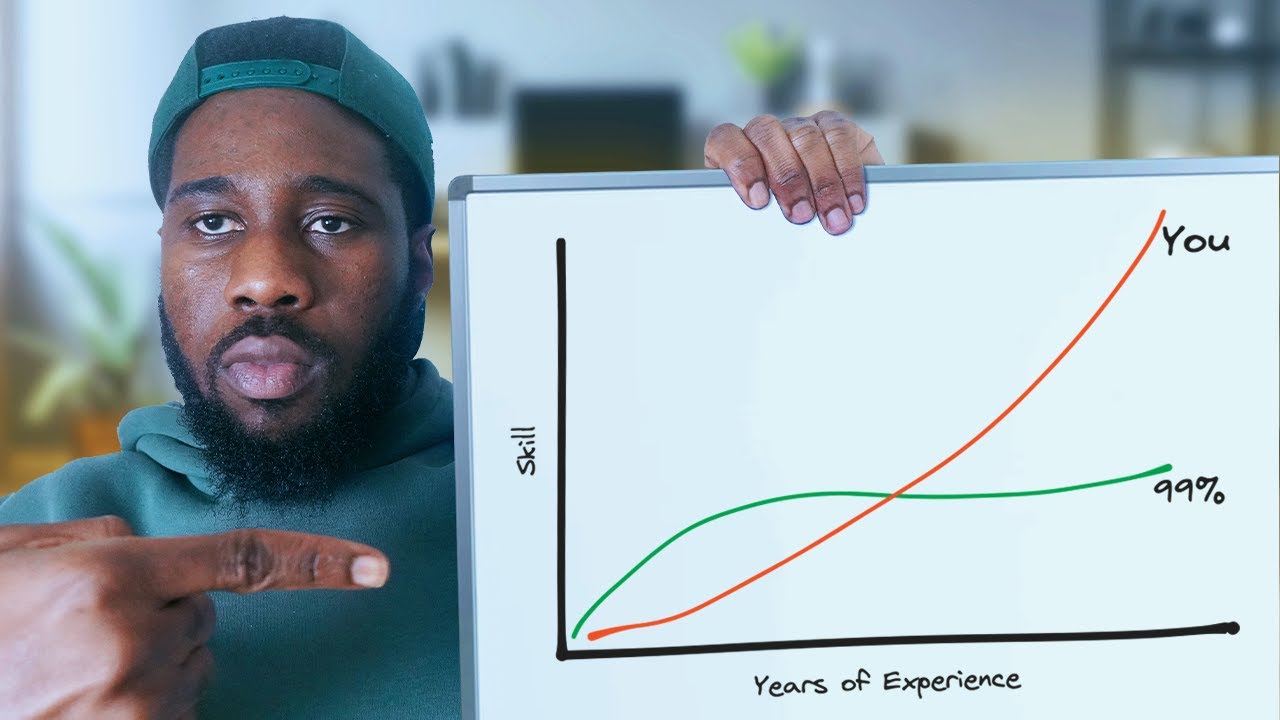
Eight habits separate top designers from the rest: embrace ambiguity, apply the Pareto principle to find high-impact work, voice opinions confidently, use data to define success, think in systems, build a personal brand, create side projects with no-code tools, and mentor others. Founders of Airbnb, Pinterest, and Linear belong to the top 0.1%.
Chapters
What does the founders of Airbnb, Pinterest, and Linear have in common? All 3 of them were designers who have gone ahead to create companies which is now worth hundreds of millions of dollars. So I'll classify them in the top 0.1% of designers globally. But aside from starting your own company, what are the other things that you can start doing to get ahead of 99% of designers? In this video, I'm going to be breaking down 8 things you need to do to be in the top 1% of designers globally starting today. To be in the top 1%, you need to start doing what 99% of designers are not doing. That brings us to the first thing, Which is to embrace ambiguity. 99% of designers are waiting around for clear requirements to be passed down to them from product managers or senior stakeholders before they can understand what to work on. And this just makes you a pixel pusher or some kind of Figma expert. What you need to start doing right now as a designer is to learn how to embrace ambiguity by throwing yourself into the deep of unclear problems so that you can identify the most impactful things. To work on. As a designer, you need to be the person that is shining the light on the work that needs to be done. You need to be like at least 3 steps ahead of your team in shining the light and painting the vision of what needs to be done and what needs to be achieved to be able to solve a problem that can bring the most impact to the users and the business of whatever product that you're working on. If you're not getting involved in the conversations of a new product whenever the conversations start, you need to find polite ways to insert yourself in the conversations, like making sure that you have frequent one-to-ones with your product manager so that you can always get updates on what needs to be done, and you can always be one or two steps ahead by painting what the vision might look like. Embracing ambiguity helps you to be 3 steps ahead of every other person in the team, and this helps you to shine the light on the most impactful initiatives. This brings us to the second thing, which is to always find the 20%. You're probably familiar with the Pareto principle, but if you're not, the Pareto principle is a phenomenon that states that 80% of results come from 20% of effort. And if I'm to relate it back to your scenario as a designer, let's say you have a new product and the product has 10 features. There's a high chance that 2 of the 10 features are going to drive the most impact for the users of the product and are going to drive the most impact for the business as well. So what you can do to chase impact or to always find the 20% here is to identify what those 2 products are and start to focus on them and start to prioritize them. Don't leave this to the product manager to do. You need to work hand in hand with the product manager or senior stakeholders to identify what that 20% is. And if you don't embrace ambiguity, there's no way that you can be able to identify that 20% without it getting passed down to you from senior stakeholders. The faster you're able to identify the 20%, the closer you are to being in the top 1% of designers. Now, when you're able to identify the 20%, the next thing that you need to do is to voice your opinion. When you've been able to understand the 20% that can drive impact, you need to let people understand what you've discovered by sharing your opinions. This was one of the mistakes that I made when I first joined a large tech company. When I joined Deliveroo, The first three months, I wasn't sharing my opinion as much as I should. I would realize that when I join meetings, sometimes my camera is off. I'm not exactly contributing as much as I should. I'm not asking questions as much as I should, and I had ideas in my mind. But I always felt like, come on, these guys are really talented people. What what more do I actually have to offer into the conversation that they have? So whatever they say is fine. But I was forgetting the fact that I was actually hired. There's a reason why I passed the interview. It was because there was something that I had to contribute to the team. That was why I passed the interview, and I had huge. Imposter syndrome. So I actually wasn't expressing my opinions. I wasn't asking questions. I wasn't sharing my opinions as much as I should. And after the first 6 months and the review season went by, I got 2 feedback that has shaped my career from that moment. And I'm going to read the feedback to you. The feedback says, Sam should feel empowered to proactively suggest new ideas on design improvements and new features, partnering with the PM, contributing ideas they had not even thought about, and even challenging them where needed. The second one was, I'd like Fabs to share his design ideas to the wider team. It's not often we see updates from him. I'm sure the whole team would benefit from seeing any upcoming designs or ideas so that folks can view out of curiosity and spark some interesting conversations. Immediately I got this feedback, I started contributing more and I started seeing a change in how people perceive me and how much I actually contributed to the team as well. So how do you sell your ideas to people when you've been able to identify the 20% and then you're voicing your opinion? This question brings us to the third thing, which is to be data-driven. To be in the top 1% of designers, you need to be able to identify trends and follow the data. This will not only help you advocate your ideas to stakeholders, it will also help you to observe user patterns and behaviors so that you can diagnose problems early and propose solutions. The thing is that 99% of designers are not data-driven, even in cases where they have a specified data analyst team or specified data analyst in their companies, they are not as close to the data analyst as they should. And your data analyst should be very, very close to you. You shouldn't just wait for data analysts to report data to you. You should work with your data analyst so that you can identify cases where you can self-serve data, you know, cases where you can go on to whatever data platform that you can use to observe user behaviors yourself so that you can diagnose things early before the data person then digs deeper to help you uncover more insights. But the data person in your team needs to be your friend, literally. The same way you're close to your product manager, your engineers, that's the same way that you should be close to like the data analyst or data engineer that you're working with as well. And for people that are working in companies where data is not priority to the company or the company is not really investing in data, this is where you have the chance to start advocating for data in the company. And you can start by something as simple as Google Analytics to be able to track user data, or something as simple as Looker to be able to track user data as well. Whenever you're picking up a new project, understand what the success metrics of that project is. That should be part of the plan from the very beginning. You shouldn't start working on a project if you don't understand how you will measure success. For example, you could measure success by engagement rate of a particular feature. You could measure success by reducing the churn rate, by reducing the amount of times that people are actually dropping off on a particular feature. You could measure success by click-through rates. There are so many ways that you could measure success, but you should be able to identify ways to measure success at the beginning of the project so that you can know if your design is working or if your design is not. I want to make a more in-depth video about how you can be data-driven as a designer. Let me know in the comments if this is something that you'd be interested in. The next thing that you need to do is to be a systems thinker. The top 1% of designers solve complex problems, and to solve complex problems, you need to practice more systems thinking and less linear thinking. And you might ask, what's the difference between linear thinking and systems thinking? Linear thinking is using similar solutions for similar problems because you're familiar with the problem already. So it's a less creative way of problem solving, while systems thinking is analyzing a problem in the context that that problem exists to ensure that you get to the root cause of the problem and avoid treating symptoms. For example, you walk into a room and you turn on the bulb and the light does not come on. The first thing that comes to your mind is, oh, this bulb is bad, so I need to change the bulb. So you go to Amazon, order a new bulb, and you fix it, and the light comes on. Fine, that's linear thinking because that is a familiar problem and you've been able to solve the problem just by fixing the bulb. Now the same scenario happens, you come into the room, you turn on the bulb, it doesn't come on, and then you order a bulb on Amazon and you change the bulb and it doesn't work. Then you realize that The bulb didn't come on because the bulb is bad and the lamp holder is also bad. So you need to fix the lamp holder and buy a new bulb. If you apply the same linear approach to solving that problem in the second scenario, you won't be able to solve it because you have only thought about the problem at the surface level. You haven't tried to identify the root cause of the problem. It is very, very important as a product designer, if you want to be in the top 1%, to apply systems thinking to complex problems, because most of the problems that you start to solve will be complex problems anyway. With. So you need to start applying system thinking to problems and making sure that you get to the root cause of the problem before you proffer a solution to it. And one of the ways that you can do this is to use the 5 Whys framework, which is a very, very easy framework to apply system thinking to a problem. In the 5 Whys framework, what you're basically doing is whenever you have a challenge— and I want you to try this with your next challenge that you have at work— whenever you have a challenge, you can always ask Why 5 times, and you can do this alone. So ask why the first time and talk about the reason why you're solving that problem or the reason why that is a problem. Then ask why and try to go a level deeper. Sometimes you might not even get up to 5 whys, but by the time you're done with 5 whys, there's a chance that you're going to get to the root cause of the problem and you can start treating that problem from the roots. The next thing that you need to do is to develop your personal brand. Either you like it or not, you have a personal brand, and with every interaction you have with people, you leave an impression of what your personal brand is. Now, the question is if you want to be a bit more intentional about the kind of impression that you leave. Now, with developing your personal brand, I'm not asking you to start to post on Instagram or Twitter or any social media app multiple times in a day if you're not that kind of person. You can find other ways to develop your personal brand and you can find ways that actually relate to you or ways that resonate to you. A big part of building your personal brand is being honest about who you are, what you stand for, what resonates with you, and sharing that in a way that suits you best. You can start by being more intentional about how you approach your work. You can be the designer that facilitates the best workshop at work, right? And then people know you to be that person and they always look forward to coming to your workshop. You can find one thing that you really enjoy doing and double down on that thing and make sure that that thing is associated with you. And you can always make sure that this is a huge part of your brand. For example, I've been told at work that I ask really insightful questions. So I make sure that whenever I'm in meetings, I am able to contribute by either asking a question or preferring a different direction of thinking. The key reason why you need to develop your personal brand is to establish yourself as someone that is a source of knowledge and expertise in your field. So you shouldn't bury yourself into the work that you do every day because that's what 99% of designers do. 99% of designers are buried in everyday tasks and they don't bother about expanding their horizon beyond the tasks that they do every day. And this brings us nicely to the next thing, which is to build something outside your 9-to-5. Remember the 0.1% of designers that I spoke about at the beginning of this video? The founders of Airbnb, Pinterest, and Linear. These people were building their businesses, or they were building something outside what they did in their 9-to-5, and that is how they were able to get to where they were. Now, I'm not saying that you need to become a founder or you need to start a business to be in the top 1% of designers. But you also need to find ways to build things because that's the best way that you can practice what you preach as a designer. Because in most cases, you would not be able to expand the full spectrum of your experience at work because you will not be able to try a lot of things that you feel like you should be doing as a designer. You're going to be limited by the company's budget. You're going to be limited by the view of some stakeholders that you might be working with. You're going to be limited by the resources that you have at your disposal. But when you build something outside your 9 to 5, it almost feels like you have your own clean slate to do whatever you want to do. And that helps you to put what you've learned or what you're learning at work into practice in something that you do personally. This is something that I have also learned by trying to build things outside my 9 to 5, right? Whenever I'm trying to build things outside my 9 to 5, I'm able to like learn more things, learn more no-code tools to to build these things and also learn more about how I can get feedback, about how I can do some user testing, about how I can observe the data and behavior of people that are using the things that I build so that I can be able to make it better. And then this in turn feeds back into my work because now it is part of my practice outside my work as well. And now it's so much better because you can move from idea to solution so much faster now because of no-code tools. Tools like Framer, Bubble, and the likes. So we are not as limited as we were 10 years ago when it was so difficult to move from idea to solution. So to be in the top 1%, you need to find ways to work on your own ideas and build your own ideas and find ways to solve a problem. That way you can always be in thinking mode and you can always also be in learning mode. And that brings us to the last thing which you need to do, that is to mentor others. Mentoring has been one of the most impactful things that I've ever done as a UX designer. I actually noticed some explosive growth in my career at the point when I mentored about 100 designers with zero experience. Because I was self-taught, I started to see things that were lacking in the design industry and how to sort of share that knowledge. And that also made me to learn more. It is a known fact that the best way to learn new things is to teach others, and everyone that wants to be in the 1% of designers should take the opportunity of putting other designers with lesser experience under their wings. I believe these are some of the most important things that you should be doing if you want to be in the top 1% of designers. I'm working with some of the best designers globally and they embody all these traits. I see them do all these things every day. Thanks for watching this video, and if you'd like to watch another video from me, you can watch the video where I break down what makes a great design portfolio. I'll see you in that video, and if not, I'll see you at the top.










