
I Asked 11 Elite UX Designers Which Skills Matter
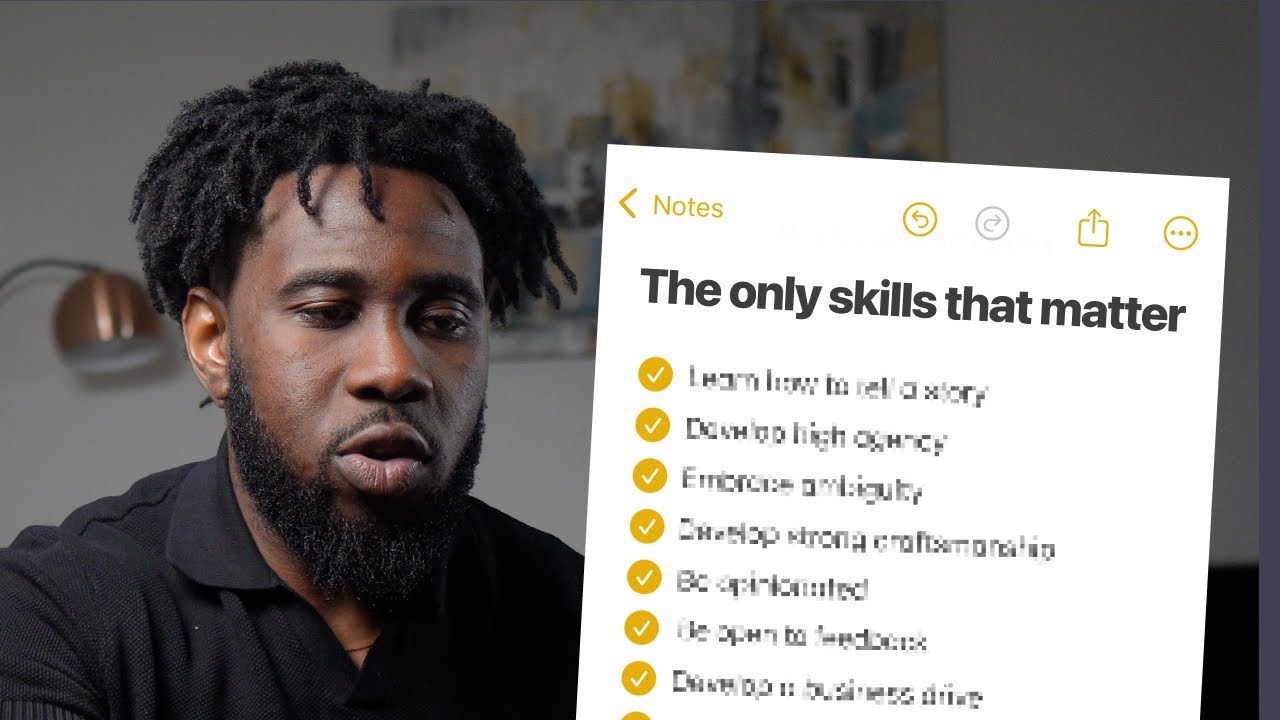
Samuel Fabayo asked 11 senior designers from Spotify, Meta, Deliveroo, and Coinbase to rank the skills that separate top designers from the rest. The top traits: storytelling, thriving in ambiguity, being opinionated yet flexible, thinking like a business, and understanding people.
Chapters
So I asked 11 of the best product designers I know who are working at companies like Spotify, Meta, Deliveroo, Coinbase, ASOS, and Monzo, where I also work, to rank the top 10 traits exhibited by the best product designers they've worked with. And in this video, I want to share the results of that ranking with you. Either you're an experienced designer or you're just starting out your UX design career, this video will help you understand what the top 1% of designers do differently to be well paid and what you can learn from them. A portion of this video is sponsored by Mobbin. Starting from number 10, the top 1% of product designers understand people deeply. And when I say this, I mean that they understand that design exists to influence human behavior and people are at the center of everything that we do as a designer. Once you understand this, you're going to also identify the fact that every great product that you design either helps people to form a new habit or break an old one. And you can't change the behavior of people if you don't deeply understand people that you're designing for. For example, I currently use YouTube Music. 2 years ago or last year, I was using Spotify because whenever I watch YouTube videos, there would be no ads. That was what convinced me to switch to YouTube Music. I had to change from my habit of using Spotify to start using YouTube Music. A lot of times when I was switching, I would still mistakenly go and click Spotify to find a song there before I realized that I no longer have a subscription for Spotify. So these are the things that actually shows that when you're designing products, you have to think about the new habits that is being formed in those products. And that's one of the things that the best designers know. They study people obsessively and develop an intuition for what drives human behavior. Let's look at another example of like Google versus ChatGPT. The very first time I used Google, I think it must have been like 20+ years ago when I went to a cyber cafe with my dad back home in Nigeria. And when I was in the cafe and I started using the Google search to find information, I was so amazed, like, wow, you could literally just type in anything and you get a bunch of links for you to get that information. 20 years down the line, that habit for searching online has been formed in nearly everybody with Google search. Now, 3 years ago, ChatGPT came into the game and they started creating a new habit of search, which is basically through AI, where you can ask a question and you get like more direct answers and you're not getting links. But they have to create new habits in people, and it takes designers and researchers that have a deep understanding of people To really do that. Now, one of the designers I spoke to said that it feels that great designers are the ones who truly care about the people around them and people they are designing for. Apart from just having hard skills and being good at their craft, they form great bonds with other people. So this is very, very important to have an understanding of people and let that show in your work. Number nine is to be data driven. I've spoken about being data driven in a couple of my videos. The reason why it is important is that you have to let. Data-guided decisions that you make. Data helps you identify the user behaviors and patterns that is difficult to understand just by observing how people use your product. So it is the easiest way to convince stakeholders to agree with your decision. If you make a decision and you feel like this is a design direction that you should follow, when you have data to back that up, it's much easier to convince stakeholders to follow that direction. And if you find yourself in a company that doesn't care about data, then you might be in the wrong company, and it might be time for you to start looking for another company. And the reason I'm saying this is that you're not going to grow in your career if you don't understand data, if you don't care about data, if data doesn't inform your work. You won't be able to land a design job at a company that is serious, that actually cares about data, because those are the things that they will require from you when you're maybe sharing your portfolio. So how can you be more data-driven? Become buddies with the data professionals in your team. Try to become friends with them, maybe like a data analyst or the data scientist in your team. Try to see how you can start getting closer to them so you understand how they design experiments, how they analyze data, and how they translate that data analysis into anything that goes into the product. And also, before starting any new project, always have a clear understanding of the metrics that your team wants to improve and ask questions. When you're starting any project and you have a problem that you want to solve in that project, try to find how you can ground that problem in real data because that will help you understand the success metrics that you want to solve that problem for. Now, you should also learn how to use simple tools in your company to understand some of the metrics without the help of a data analyst. If you don't understand like the proper metrics that your company cares about and you can't self-serve that and you always need a data analyst to get data for you, then it's going to be difficult for you to quickly get the data that you need. And this can affect you when you say you want to be data-driven. So number 8 is to be more open to feedback and being open to feedback just means sharing your work more often. Opening your work to feedback gives your team the chance to contribute to your work and shape the outcomes. And this is the fastest way to build trust with your team. Imagine that you've been working on projects and then it is close to the time when engineers want to start building the projects. And then you just bring the designs and say, this is the design, go ahead and build it. You haven't given them the opportunity to feed back into the work. You haven't given them the opportunity to contribute into the work. So it's going to be difficult for them to actually trust you because the eventual work that gets shipped at the end of the day is something that is the responsibility of the entire team. And for them to believe that the work is at the standard that it should be at, they should be able to contribute to it as well. So whenever you give other people the opportunity to contribute to your work, you make them feel empowered. And you can be open to feedback without implementing every feedback that you get. Your goal is to really get that feedback and then filter that feedback. And it's never too early to share your work. You could always share your work and make make sure that you're providing context on the kind of feedback that you want. Another designer that I spoke to for this video said that the good designers are not people with the best ideas necessarily, but they are also people who enable their team to share ideas and collect and filter through them to design the best product. So how can you be more open to feedback? You should work with the garage door open. And what this means is that just make sure that your team has access to your work. You know, they can always go in there and comment in your files and get and use that to get their feedback. And then you could also take the screenshot of your design and share that to start a conversation whenever you have quick feedback that you need from your team. One thing that I do is that I use short screen recordings because that way I can quickly provide context on the problem that I'm trying to solve and the kind of feedback that I'm looking for. And I use Slack for this because Slack is capped at 5 minutes. So any kind of context that I can't lay out in 5 minutes is probably not enough. It's probably too much context. So I always try to make sure that I cap it at 5 minutes. And I send it for feedback. Also, you need to be clear on the type of feedback that you're looking for. Don't, um, don't just share work for feedback without saying that this is the exact area that you're looking for feedback on, or else you're going to get the kind of feedback that you don't want. Number 7 is to develop strong craftsmanship. And what does this mean? Craft is your ability to do something exceptionally well where it feels like you've put so much thought, love, care, and attention To what you produce. Craft is basically very good visual design, very good interaction design. What makes your product or your work to actually feel like it's alive? When you have good craft, when your work has good craft and you're presenting it to the stakeholders, they can almost picture it in the hands of the users already. And the craftsman is somebody who is obsessed with producing work at an insane level of quality, and they hold themselves to a high standard. Holding yourself to a high standard is the mindset that you need to develop as you are trying to develop your craft. And also, craft is what is going to set you apart in this time and age where we have AI being able to generate designs easily. But when you see the output of AI, you can obviously tell that this is generated by AI. You can tell that everything looks the same. It looks like it's using similar libraries. Your craft is what makes that stand out. When you've developed your craft, you understand what good design looks like, and you can even collaborate with AI to make that good design happen. So how do you develop your craft? First of all, you need to expose yourself to high-quality work. Also, you need to find inspiration within and outside your industry. Don't just limit yourself to finding inspiration within your industry. For example, if you're designing a health tech app, you shouldn't just find inspiration in the health tech industry. You should go outside your industry to find inspiration. You could go to the fintech industry, you could go to the food industry. More importantly, you should even leave tech alone. You can even go outside screens and find inspiration just by, you know, taking walks or going to the museum or observing things around you and seeing how nature comes together. Nature is such a good source of inspiration, and that's how you bring in original work into your craft. Also, reverse engineer any work that you admire. If you see any kind of designs that you admire, that you really like, Think about how it came together, break it apart and start putting it together again. That's how you develop your craft muscles and then sweat the details. Find the small, tiny details that make your work look good and sweat those details. Personally, one tool that has helped me to improve my craft is Mobbin. And here's how I use Mobbin in my workflow. Once I get on the Mobbin website, let's say I want to— I'm designing a fintech app and I'm trying to design a kind of design pattern. I'm not going to go into the fintech section to look for that. I'm just going to be scrolling on Mobbin because I have the idea of the designs I want to work on. I'll just scroll through. And then while I'm scrolling through, I would wait till I find something that's interesting. For example, I could say, oh, this looks interesting. And then I would either download that or save it and create a collection and then name that collection. And I will save other inspiration around that project. In that space. And another way I use Mobbin is that I go to maybe, if maybe I want to like find UI elements, I could search like cards and then I go into cards and then I start to look for UI elements for cards. And that way I can find like a card design that I want to search. So I could say, okay, this looks interesting for a card. And then I save that to my collection as well. What makes Mobbin really interesting is that it is the largest library of iOS, web, and Android design inspiration in the world. And these are real-life apps that are already in production that people are already using. So they already exist and they are real. It is not something that is like a fake design that is not possible to achieve. So it is a good way to get inspiration because you're getting inspired by something that is already possible. So you could go ahead and try to get some inspiration from Mobbin. I'd like to see if you're using Mobbin already. I'd like to see how you use mobbing in your workflow as well. Number 6, developing high agency. Be an high agency designer. High agency simply means actively going after what you want without waiting for the circumstances to be perfect, without waiting for everything around it to be perfect. And beyond design, high agency is actually a life skill because this is what actually spurs you to go after things that you want. But I don't want to be philosophical, so let's come back to design. As a designer, having high agency means that you're taking ownership of tasks before they are assigned to you, and you can identify problems before they become obvious to other people. So if you go back to the other points that I've mentioned, if you have a deep understanding of people and you are data-driven, it's going to be easy for you to identify problems before they become obvious to other people. High agency means being able to act on those problems that you've identified by creating solutions Without waiting for permission. It just means that doing things that you believe is right first and then asking for permissions later. You could develop agency by starting small and fixing one thing without being asked. Also, you can keep a problem I noticed journal because not everything can get prioritized at once. You can't work on every problem that you've identified at the same time. So you can keep a journal where you're just maybe on Notion or Google Docs or some kind of spreadsheet where you're keeping the problems that you're noticing in your company or in the product that you're working on and As time goes on, you start to identify areas where you can start to solve those problems when the time is right. Also, you need to build relationships with your engineers and your PMs, and building these relationships helps you to reach out to them when you want to solve any problem that you might have kept in your journal already. Whenever you're presenting problems, always come up with solutions. The solutions don't have to be complete. Again, this is where you just go and share your work. Hey, I saw this problem, I noticed this, and here is how I'm thinking about solving it. Something as simple as that can start a really good conversation around solving an important problem. Number 5 is to understand product strategy. We hear product strategy a lot, but what does it really mean? In a nutshell, it basically just means going from vision to pixels that you actually see in a product. So the vision is what you want to achieve in the product in the next 3 years or 5 years. That vision is then broken down into goals, which is what goals that you need to set to achieve those visions. And then the goals are broken down into bets or initiatives, which is which bets would help you to achieve those goals. And then you can run experiments to validate if that is the right bet or if it is the wrong bet. And then you come up with pixels for what the experience actually looks like for the user. This is when you actually ship the final solution or the final bet or initiative to the user. But the problem is a lot of designers only get involved at this final stage. Most designers get involved— don't get involved until the pixel stage. And the problem with that is that you've lost so much context from the vision, goals, bets, and experiment phase that you're not able to provide the right solution to the problem. It feels like you've been handed over— you've been handed a product requirements to go solve the problem. But the best designers actually get involved at the vision stage. This is where they get involved because they help to set the vision. They help to explore what the future might look like. And the most important role of a designer is to paint a picture of what the future looks like, because that is— you're the only person that can do that as a designer. You're the only person that can paint the picture of what the future might look like. Everybody else is thinking about like the numbers. They're thinking about like the business. They're thinking about like the strategy, but your goal is to be there and listen to the conversations and understand it and soak it all up. And paint a picture of what the future might look like visually with a design, with an exploration. And then that is then broken down all the way till it gets back to the pixels that you actually ship to the users. This is how to show value as a designer. And when you understand product strategy, you will be able to go through all of these phases alongside your team. Point number 4 is to develop a business drive, which is basically to solve problems that drive business growth. The best designers understand the business impact of their design solutions, and they create solutions that solve user problems and drive business growth. And again, this is your role as a product designer. You need to be able to create solutions that solve user problems and drive business growth. I think the reason why the industry has been trying to move away from the title of a designer as a UX designer or UI designer to a product designer is because the title user experience sort of puts it in the mind of designers that they should only care about the experience of the user. But the title product shows that you have to create something that the user wants, and then you have to sell that into the user and get some value from it, which is revenue for the business. So that is where product comes in. And that's why the term product designer is getting a lot more popular. Than user experience designer. But this is not about the title. Whatever title you have, either as a UX designer, as a UX/UI designer, either as UI or product designer, you should be able to create solutions that solve user problems and drive business goals. There are times when it will be difficult for you to find this balance because sometimes you would solve some problems, they would provide so much value for the user, but they won't drive business value. Or you would have some ideas that would drive so much value for the business, but they won't have so much value to the user. So your role as a designer is to know when to make the right trade-offs when your design solutions don't do both. And this is the most interesting challenge that a designer has. So how do you develop your business drive? First, you need to understand the business models that helps your company to generate revenue. You need to understand how your company generates revenue. If somebody calls you and say, How does your company make money? You need to be able to explain it flawlessly. And also you need to understand all the business metrics that your company cares about. Like, you know, daily active users, ARPU, annual recurring revenue, monthly recurring revenue, and all of that. You need to understand this. What's the most important metric to your business and what's the most important metric to your team? This way you can know how the designs that you're working on can ladder up to these metrics. So that you can always revisit those designs and say, with this design, would I be able to move this particular metric? There are so many metrics that companies care about, and I've prepared a glossary of key metrics that businesses use. And you can get access to that glossary through the link in the description. Also pay attention at your company's all-hands and town hall meetings and ask questions about anything that you don't understand. Number 3 is to be opinionated. Have strong opinions, but hold them loosely. This is such a, such an important trait of a top 1% product designer. And a lot of people confuse being opinionated and being difficult. So what's the difference between being opinionated and being difficult? When you're opinionated, it means that you do not shy away from sharing your point of view and you back it up with evidence because you are data-driven, because you have the data and you understand everything that informs that point of view. You don't shy away from sharing your point of view. But being difficult means that you don't want to hear what other people are saying. You don't consider other people's point of view when they share their own point of view. You don't want to change your own point of view. That's what being difficult means. And you can be opinionated without being difficult. If you want to be the best designer that you can be, it's important to be opinionated, but you need to be able to change your opinions whenever new evidence comes to light. Never shy away from sharing your point of view, even if you think it sounds stupid. Number 2 is to embrace ambiguity. The best designers are able to thrive in ambiguous problem spaces. A lot of designers just sit around and wait for the clear requirements for the design to be passed down to them from their product managers or senior stakeholders. You need to be different. You need to embrace ambiguity by throwing yourself into the deep end of problem solving because that is how you're going to develop the best design solution. Because when you put yourself into the problem and you embrace ambiguity, you are there when the problem is not really clear and you are able to make the problem clear. You're going to understand the best way or the best solution to that problem. I think there's a saying that goes that a problem that is understood is half solved. Once you understand the problem, then you are halfway there with the solution. The more you throw yourself into ambiguous problem spaces, the better you become at identifying the right problems to solve. How do you thrive in ambiguous problem spaces? You should make sure that you're part of conversations of new initiatives from the very beginning. A lot of times designers are not going to be involved in this conversation if they are not seeing any signs of value. If you can't show them that you can paint the picture of what the future looks like from a vision stage, you're not going to be invited into those conversations at the beginning. So you need to start finding ways to insert yourself into those conversations by showing value, by offering to paint a picture of what the future looks like when things look ambiguous. I always think that ambiguity, embracing ambiguity is like going on a hike with your team. And as a designer, you've looked at the map the night before and you understand the places to avoid, the places where the hike or the terrain is sort of wobbly. And you already know that. And then when the team is going again on the second night, you are now the one that is leading them. That's how I think of embracing ambiguity, because you've painted the picture of what the future looks like. Embracing ambiguity helps you to be steps ahead of every other person in your team so that you can shine the light. In the right direction. Number 1, which is the number 1 trait that the top 1% designer has, is that they learn how to tell a story. And you need to understand how to tell a story. The most powerful person in the world is the storyteller. The storyteller sets the vision, the values, and agenda of a generation that is to come. This was said by Steve Jobs. And if I think about one of the best storytellers of our time, it's probably him because of how is being able to tell stories of a product that never existed, talk about how it is going to be, and then literally talked about that product into existence. And then that influenced a new generation of tech products, like everything that we see from Apple today. And even the way companies run their product demos today was influenced by Steve Jobs' way of doing the Apple keynote just because he's such a good storyteller. Without storytelling, it will be difficult for you to leverage every other skill that we've spoken about. You can have high agency, you can have such a high craft, you can be business-driven, you can be data-driven, but if you can't stand or sit in front of people and convince them about an idea that you have or show them a vision that you have and how it can solve a problem, If you can't convince them to see your point of view, to understand your point of view, then every other skill is not going to be as impactful. So your ability to tell a compelling story makes it easy to influence your team and sell your ideas. And every time you present your work is an opportunity to tell a story. So always have it in the back of your mind. If you have to present your work, always think about how you can weave a story into this presentation. Think about how you can keep the audience engaged. What can you do differently that other people do not do when they are doing their presentation? Always have that at the back of your mind. So how do you become better at storytelling? One, you need to understand your user needs and the business goals. 2, you need to use concrete examples and real user stories to show what those user needs are and those business goals. And then you need to use stories to connect your designs to your user needs. And the business outcomes. And you have to practice how to explain your work to non-designers. When you're presenting your work to designers, there's a chance that, you know, you're going to start talking about like, you know, the kind of drop shadow that you used or the kind of lights that you use or the kind of colors that you use or why you use this. But when you're speaking to business executives, you then have to start thinking about how you start framing your projects to what interests them, which is the numbers, the revenue. How does this affect the revenue? And then how do you make them feel the problem, that that problem is an important problem to be solved? Also, you have to keep the focus on the user's transformation, not your clever solutions. When keeping the focus on user transformation, what you're basically doing is that you need to make your audience feel the problem and then see how that user has transformed. So storytelling is simply having a character, having an obstacle that that character is facing, And talking about how that character was able to overcome that. And talking about— and talking about how that character was able to overcome that obstacle to eventually get a great outcome. And that is basically storytelling. You can use this framework for literally any of your presentations whenever you're presenting your work. The bonus point here is to always play to your strengths. Everything I've mentioned in this video, every skill and every trait I've mentioned are things that you probably are good at or you probably are not as good at already. There are some things here that you might notice that you already have skills in, you're already developing. You might already notice that you have high craft or you're curious about data or you understand people. So start to think about your strengths and how you can start focusing on that area. In fact, I'd love you to drop in the comment section now from all of the points that I've mentioned here and all of the traits that I've mentioned here. Which one do you think you're already strong at and which one do you think you need to improve on? Take the ones you're already strong at and double down on that and pick one that you feel like you need to improve on and start learning how you can improve on that as well. The slides I've presented in this video is going to be available in the link in the description. You can just go there, click that link and grab the slides I've spoken about. I'll see you in the next video.










