
Why you can’t find a UX design Job.
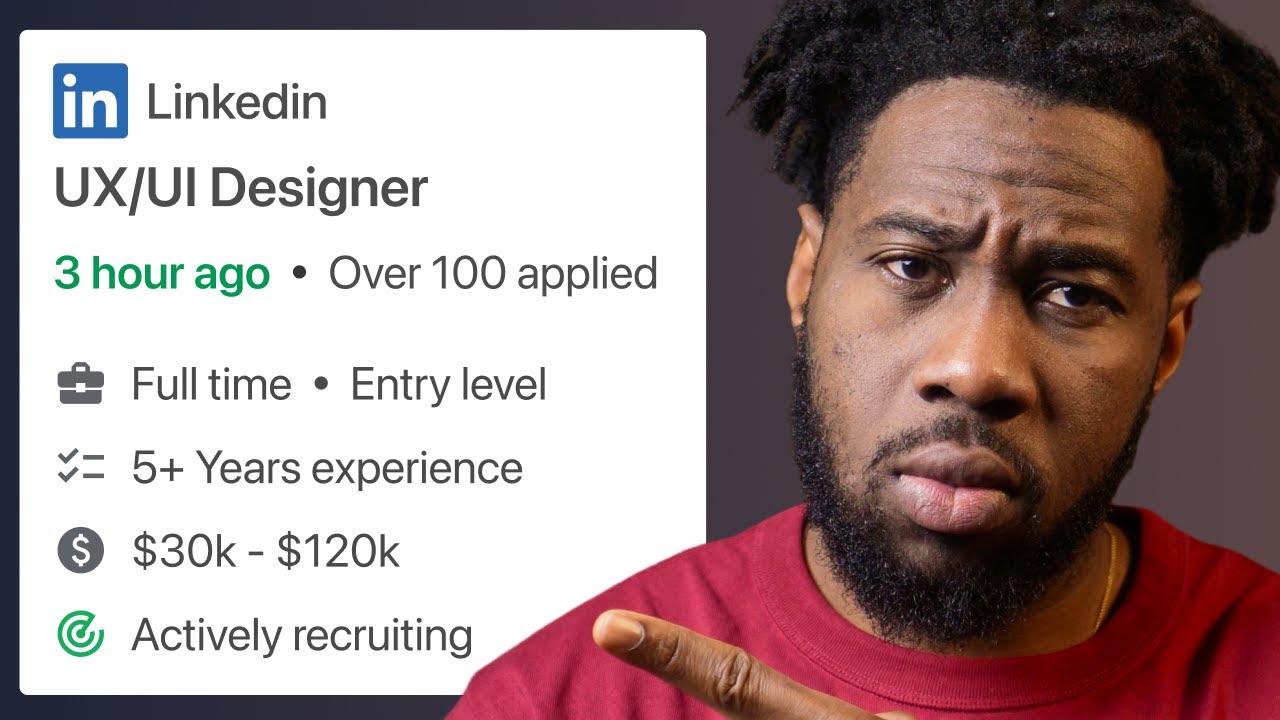
Samuel Fabayo breaks down why UX designers struggle to land jobs: too many applicants chasing too few real openings, weak portfolios, and mass applications that go nowhere. He walks through fixes for each problem, from building 6-12 strong projects to customizing applications instead of spray-and-praying.
Chapters
In this video, I'm going to share 5 reasons why most people are struggling to land a UX design job. As frequent viewers of this channel may know, I don't only identify problems. I like to provide solutions to those problems. So for each reason, I'll share what you can do to improve your chances of success and land your dream design job. I believe these reasons can affect 3 categories of designers. The first category is entry-level designers who are looking for their first design roles. The second category is designers who already have a job but are looking to get a better one. Better in this case could be higher pay, opportunity to work on more impactful projects, or whatever better means to you. The third category is designers who might have been laid off or took a gap year for personal reasons and are in the job market for a new role. If you fall within any of these categories, then pay close attention for the next 10 minutes because this video is for you. If you're new here, my name is Samuel Fabayo and I've been a UX designer for 8 years. In that time, I've worked with startups in Lagos, Nigeria, and a few design-led companies in the UK, including Deliveroo and Monzo Bank. The first reason why most people struggle to land a UX design job is the foundation of every other reason that I'll be mentioning in this video. This reason is outside your control, to be honest, but there are things within your control that you can do about it. The number one reason why it's so much harder to land a UX design role today than it was 4 years ago is that there's so much competition for almost every role in the tech industry right now, especially low technical roles like UX design. And by low technical, I mean a role that has little to zero coding requirements. But this competition is only a symptom. To really understand the problem, we need to go one step deeper. Between 2020 and 2022, there was so much venture capital funding in tech. In 2021 and 2022, tech companies raised $1.2 trillion, but in 2023 and this year 2024, which is done already because we're in December, only about half of that has been raised so far. This funding caused a lot of overhiring in tech in 2021 and 2022. Tech became this glorified industry where you can work on your terms and by that work remotely and get rich, so everybody wanted to get into tech and roles like UX design, product management, product marketing were jobs with low barrier to entry because you didn't need to know how to code before working in these roles. This was why UX design bootcamps became a pandemic on its own, and videos of people claiming to land UX design roles in 3 months were all over YouTube. To put it in simple terms, being a UX designer was overhyped and sold as a dream job for anyone that wants to join a tech company but doesn't want to code. In 2023, This funding dried up and layoffs began. The bootcamps had to keep making money, so they were still giving people opium and certificates. The rate at which people graduated from UX design bootcamps and online UX programs was so much faster than the number of available job openings for entry-level designers. Because tech companies are not getting the same heavy funding that they got during the pandemic, very few companies want to hire entry-level designers that they have to train simply because it's expensive. It's cheaper to hire someone that's experienced because because they can start delivering value immediately. But this competition is not only happening at the entry-level phase, even though it's more prominent at that phase. It's happening across all levels. Hiring managers and recruiters have numerous options when it comes to UX design candidates, so they are becoming a lot more selective. For every application you submit, they may receive about 1,000 other applications depending on the company's size and popularity. None of this is within your control. The only thing you can control is how you choose to stand out from the competition, either as an entry-level designer or as someone that's looking for a new role. So how do you stand out? From the moment you start applying for a role, you're already competing because this is when the filtering process begins. If you're an entry-level designer, you should know that the average candidate who has just completed a bootcamp typically has about 2 projects in their portfolio, and that's all the work they've done. Most times, none of these projects showcase any original work, which diminishes their chances of landing a role. To stand out as an entry-level designer, you need to triple the work output of the average candidate. This means you should aim to have worked on at least 6 projects. This allows you to select the best 3 or 4 to include in your portfolio. This means aiming to land a UX design role in 3 months without any experience is a pipe dream. There's a really slim chance you can do it in 6 months if it's the only thing you're focused on, but I would always recommend setting a 9 to 12 month goal and acting on it aggressively. If you fall in the second and third category that I mentioned at the beginning of this video, I have more tailored Advice on how you can stand out later in this video. The second reason, which is also outside your control, is the fact that there are so many ghost jobs posted on the internet every day. Ghost jobs are positions that do not exist but are posted online. According to this article, about one-third of the jobs posted online in 2024 are ghost jobs. That is three out of every ten jobs. This is another article from BBC that says the same thing, and this is another one from Guardian. This can be quite frustrating because you may think recruiters are not responding because something is wrong with your resume, when in fact they are not even hiring for a UX design position. There are a couple of reasons why a company may post ghost jobs, and one of them is to create an illusion that they are growing. Remember that they have to keep up with all of the hiring buzz during the pandemic, so it doesn't look like their business is doing badly. Another reason is they are just collecting people's details and resumes for future hiring needs. So if you see an email inviting you for an interview out of nowhere, it may be one of the ghost jobs you applied to months ago. To avoid ghost jobs, you need to research the companies you are applying to properly and look out for companies that seem to be hiring every time on LinkedIn. That's likely a ghost job. Personally, I don't use the LinkedIn Quick Apply feature to apply to jobs on LinkedIn. When I see a role on LinkedIn, I go to the company website to see if the role is still listed on their careers portal, then I apply from there. This can significantly reduce your chances of applying to a ghost job. Now let's talk about some other reasons which are within your control. Reason number 3 is because most people are following this spray and pray approach to applying for jobs. This spray and pray approach is basically applying for any UX design role you come across and praying for an interview. Some people apply for 20 to 40 jobs in a day and claim they have applied to 600 roles without success. The reason for the lack of success is obvious, and that is the fact that you're not showing that you meet the minimum requirements for the position you are applying for. How do you even meet requirements when you haven't read the job description? It sounds like obvious advice, right? But so many people are still making these mistakes. They apply for every role with just one resume, and that's a typical example of spraying and praying. Instead, you should be more strategic with your job applications. The maximum number of jobs you should apply for in a day should be about 5 because that gives you the time to read through the job requirements, research the company a bit, and tailor your resume to the application. Most companies usually have a text field where they ask you why you want to join them in the application form. This is your opportunity to stand out by telling a compelling story of what you can offer and how it meets their needs. Because you've done your research about the company, you can weave your story into how one of their recent blog posts or news about them is inspired you to apply. Make it obvious that you took your time to apply to the position. You might think nobody reads these things, but when it comes down to a decision of choosing the 10 people that they want to interview, these are the additional information that they use to assess a candidate beyond their resumes or even portfolios. That brings us to the next reason, and that is your portfolio sucks. Is there a polite way to say that? Probably yes, but I need to get your attention because this part of the video is really important. By the time I'm done with the topic of your portfolio, I want you to be honest with yourself by asking yourself this simple question: Does my portfolio suck? Or not. It's a yes or no answer. There's no in-between. And here's how you can tell if your portfolio sucks or not. There are 3 common qualities that great design portfolios possess. The first quality is strong visual design. The second is good storytelling. And the third one is great personality. Strong visual design is what makes your portfolio stand out from other portfolios at a glance. It basically says this person has a good understanding of how to combine typography, colors, and imagery. So I should probably take a deeper look into this portfolio. There might be something interesting in there. It is what attracts the viewer, the recruiter, or the design Manager into your portfolio. Good storytelling is how you take the recruiter on the journey of the work that you've done in your case studies. You need to be able to clearly state the problem you are solving, how you solved it, and the final outcome or impact without boring the recruiter. Great personality is all about you, the person behind the work. What makes you different from every other candidate? What's your background and how has that influenced you as a designer? You can show all of this by creating a compelling About Me page or using some unconventional, weird visual design pattern on your portfolio. Something that still looks good but you won't find on other portfolios. Good portfolios should at the very least have good visual design and either good storytelling or great personality. Great portfolios have all 3. If your portfolio has only one of these qualities or none, then it probably sucks and you need to get back to the drawing board. If you're not sure how you measure on these qualities, then you can share a link to your portfolio in the comments of this video and I'll review and tell you where you stand. I might even pick one or 2 portfolios for a deeper review, so don't be shy, Drop a link in the comments. Now, if you're an entry-level designer, you should aim to have a portfolio with good visual design and any of the other 2 qualities. If you're an experienced designer, your portfolio needs to check all 3 qualities. It's the only way you can stand out. And by the way, please make sure your portfolio is hosted on a proper website, not Figma links, Notion sites, Behance, or anything else that's not a website. A website is the best way to show that you can organize information on a digital interface, which is a basic skill that every UX designer should possess. If you want to see what great portfolios look like, then you can check out Folio, a portfolio inspiration website created by me. There are 60+ portfolios there and they all meet the 3 qualities I spoke about. If you believe you have a great portfolio but you are still struggling to get a job as a UX designer, then you might be doing a poor job at presenting your work. Before we get into presenting your work in a portfolio presentation interview, I want to tell you about my newsletter that I share with 1,600+ designers. Like you, you see on YouTube, I'm not able to go deep into these topics that I speak about because yeah, it just feels like you need to rush through everything that you want to speak about, or you need to talk about topics on the surface level. But my newsletter actually goes deeper into these topics and helps people that have already subscribed to it. So click the link in the description of this video to subscribe to that newsletter so you can get more tips on portfolio presentation, how to stand out as a designer, on how to stay ahead of the competition. Twice every month. Back to the video. You can have the best portfolio, but if you can't carry people on the journey of the work you did in a portfolio presentation interview, then you're going to have a problem of getting them to say yes. The popular mistake most designers make is to show up to a portfolio presentation stage of a design interview with their work and a Figma file. You should always show up to a portfolio presentation with slides that take the interviewers on a journey of your work, from your personal story to the background of the work that you did, the problem you solved, how you solved it, the solutions you explored, the final outcome, and the impact. Even if your portfolio is impressive, if you struggle to present your work effectively, it can hinder your chances of success. You must be able to articulate how your work has impacted the business, improved metrics, or solved problems. Simply showing visuals without a coherent narrative is not enough. You also have to prepare thoroughly for your presentation. Practice your presentation a dozen times before the actual interview, and you'll be extremely confident. I don't know why people don't do this enough. Competence, is confidence. Once you practice a lot, you're going to be confident in your interview. And once you're confident in your interview, other interviewers can also see that as well, and that makes them say yes to you. You may also find yourself at a disadvantage if you have not completed any real work. If you are fresh out of the bootcamp or lack substantial experience, your work may not compare favorably to others who have completed real projects. To improve your chances, look for opportunities to gain practical experience, even if it means volunteering or working on a project without pay. I have a whole video on the design presentation that got me hired at Deliveroo. You can watch that video to see exactly how to show your work in a UX design interview. Reason number 5, you're specializing too early. For years, some of the early voices in the UX design industry have pushed this idea that you should specialize early in your career, either as a UI designer focused solely on visuals or as a UX designer prioritizing strategy and user flow. Flows. And maybe during the hiring boom between 2020 and 2022, when companies were desperate to fill roles, that advice probably worked. But today, that mindset is what's holding you back. And here's why. Companies can no longer afford to hire designers who only do one thing. The budgets are tighter, the teams are leaner, and if your only value is creating beautiful visuals without understanding the why behind the design, guess what? You're just a pixel pusher. Companies need way more than that. They need someone who can design solutions that not only look good but also solve real problems. On the flip side, if you're purely focused on UX strategy, crafting user flows, personas, and wireframes, but can't bring those ideas to life visually, then all you have is theory. Without a practical, tangible outcome, it's just ideas floating in the air. So, what's the solution? At the early stage of your career, you need to embrace being a generalist. And this doesn't mean you should master everything, but you should at least cover these core bases. Number 1, think holistically about user experience every time. You should understand the problem, the users, and the business goals and apply that to your work. And even when you're telling the story of your work, make sure that these 3 themes— problem, the user, and business goals— always reflect. Also, learn to create visually appealing and functional designs, something that not only works well but should also excite the user. Then number 3, take it one step further. Get familiar with the front-end development frameworks like HTML, CSS and JavaScript and understand how it works. You can use AI tools like Claude and Cursor AI to bring some of your ideas to life, or you can start learning prototyping softwares like ProtoPie that can help you build advanced interactions. These are the things that 99% of designers are not doing right now, and that makes you an incredibly valuable designer. You need to be able to demonstrate that you have the right combination of skills at every journey of the hiring process, from submitting your resume to your final interview. Specializing early might seem appealing because it feels like you are positioning yourself as an expert, But at the start of your career, what hiring managers really want is someone who is versatile, a problem solver who can adapt to the needs of a project, whether that's crafting a strategy, refining visuals, or prototyping a solution. So forget everything you've been taught about sticking to one lane early on. Start building that hybrid skill set that lets you own the entire design process. It's not really about doing everything perfectly. It's about being able to contribute meaningfully across the board. That's what will set you apart in today's job market. And that'll be all for today's video. I'll see you in the next one.










