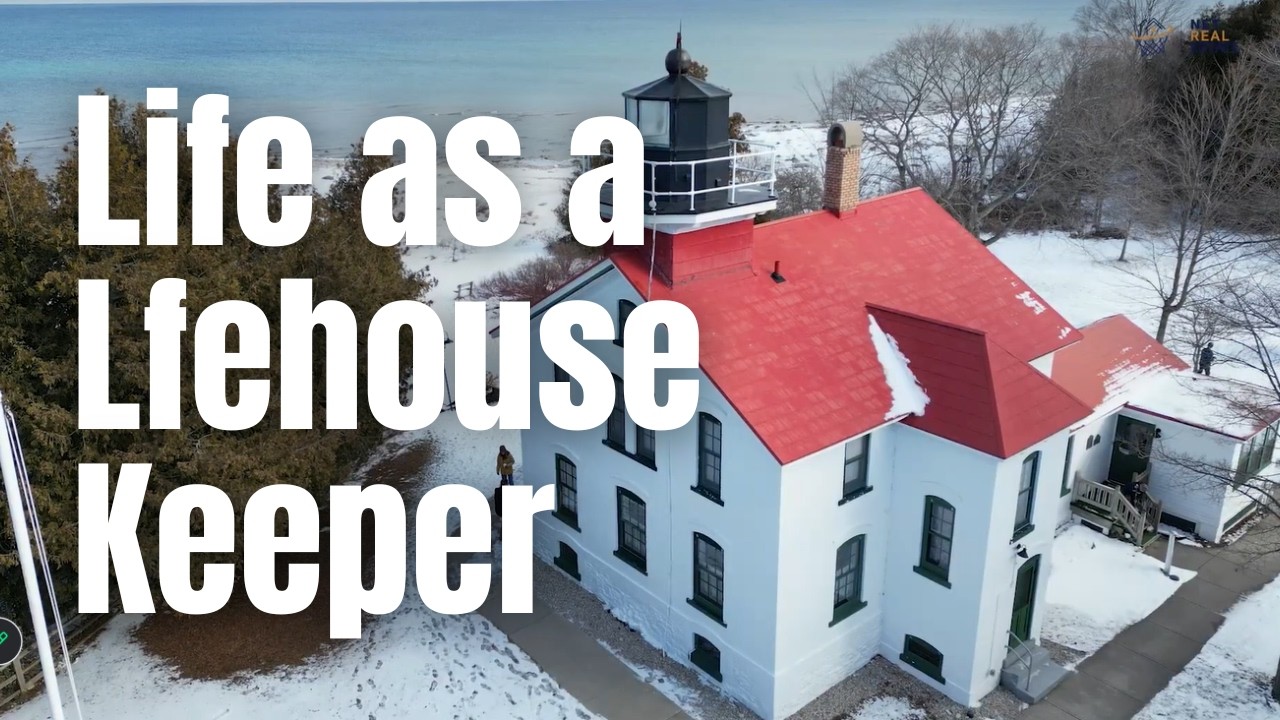
The video is an interview with Stephanie Staley, Executive Director of the Grand Traverse Lighthouse Museum, conducted by a host (Speaker B) and featuring volunteer keeper Jean. The conversation covers the museum’s relationship with Leelanau State Park, its 40‑year history of restoration and maintenance, and the fact that the nonprofit leases the historic portion of the state‑owned property and funds all operations through admissions, gift‑shop sales, fundraisers (Lobsterfest, Rock the Light 5K/10‑Miler), grants, and donations. Historical context is provided: the original 1852 lighthouse was replaced in 1858, the current tower is 47‑48 ft tall, and the site was raided twice by followers of King James Strang. The museum recreates the 1920s‑30s keeper’s residence, displays shipwreck artifacts, and operates a volunteer keeper program. Operational challenges include ongoing maintenance under Secretary of the Interior guidelines, COVID‑19 closures, and the need for continual fundraising. New initiatives include the restoration of a 1945 Coast Guard motor launch for historic boat tours and a sonar‑guided shipwreck search program using a small ROV, with high‑school students helping identify targets. Visitor logistics are explained (state park recreation passport, $8 adult/$3 child admission, indoor scavenger hunt). The interview also touches on local lore (haunted lighthouse stories), community ties (Gill family, local restaurants, Northport Museum board), and the personal experiences of volunteer keepers, including their duties, schedule, and the seasonal “haunted lighthouse” event. The overall narrative showcases the lighthouse’s historical significance, community role, and future plans for education and tourism.
Chapters
So my name is Stephanie Staley. I am the executive director here at the Grand Traverse Lighthouse Museum.
Can you talk a little bit about how Leelanau State Park, when you, when you come to the lighthouse, you first hit that kind of— it's not really gated, but it's, it's an entrance. And where does Leelanau State Park and Grand Traverse Lighthouse Museum— how do they work together? How are they together and separate?
So it's, it's all one property. It's all owned by the state of Michigan. It's all considered Leelanau State Park. The nonprofit group that I work for, the Grand Traverse Lighthouse Museum, leases this end of the property, the historic section. From the state of Michigan. So we have a long-term lease.
Okay.
And we, um, this is our 40th year, so our organization is 40 years old, and we have been restoring and maintaining the lighthouse for 40 years.
Yeah. Okay. And so, so essentially the fundraising that's done for, um, the museum keeps— it's a burden off the state.
Yes.
Um, yes. And so, so in that sense They're incentivized to keep leasing it.
They are. I hope so. I hope so.
Okay.
So, so we have to raise in and we reinvest all of the money that we make. We receive no funding from the state park or from the state of Michigan. And so we do that via fundraisers, admission to the lighthouse, the gift shop. Everything we do has to be raised on our own.
Okay.
Okay.
And so, um, you know, when I was a kid, we, uh, there was a Boy Scout cabin here.
Yes.
In the state park.
Yes.
And And so I spent a lot of time out here and we used to play kick the can right here. We'd use the circular, the oscillating, I don't know, searching for the right word. But at that time the light would spin. And then I came out here last night to try to get some film of that and it doesn't spin anymore.
No, it just blinks.
Yeah, okay.
It just blinks.
It just blinks, yeah. So that's a change. When did that, do you recall when that change took place?
I want to say 2000.
Okay.
And we have that light on exhibit in the fog signal building.
The light that's—
yeah, that would spin around. And it broke down. The Coast Guard came out and put up the arrow beacon, which just flashes every 6 seconds.
Yeah. Okay. And so, so the purpose of the lighthouse is basically to illuminate the Manitou Passage, is that correct? Or to provide What is the Manitou Passage? And I guess, what is the purpose of the lighthouse?
Where we're located here at the tip of the Leelanau Peninsula, we are at the entrance of the Manitou Passage, or the exit, whichever way you're going, and the entrance and the exit to Grand Traverse Bay. And so we are here to guide everybody around this rocky point that are headed towards Mackinac, or around us going into Grand Traverse Bay.
Okay, and so the Manitou Passage is exactly What?
So it's, it's, it runs south of here alongside Leland. It's a strip of water, if you will, that is a safe passage for vessels, and that the most, um, used passage rather than going all the way around south of North Manitou. You go in between the Manitous and the mainland.
Okay. Um, yeah, and actually off camera before we started this, I was sort of being self-critical about the fact that, you know, I grew up here. I spent, like I mentioned, with being a part of scouting, and we had the cabin down in the park, right, in Leona State Park. Spent a ton of time out here, but I don't— I honestly don't know that I've ever been inside.
Oh my gosh, that's wrong!
That is just so wrong! It is so wrong. I don't think I've ever been in the building until today. So, but I mentioned we, with that light that would that would spin, we would play, the Boy Scouts would come up and play kick the can. And you had to time it, if you were gonna run and kick the can, you had to time it in such a way.
That's fun.
With the spinning. And I actually ran into a classmate and shattered my hand. Oh geez. When I was about, I don't know, 11, 12 years old, broke it in several places playing kick the can with her. Oh my gosh, that's funny. And of course kept playing.
Of course, of course, of course.
Yeah, so, So the purpose of the lighthouse is to make sure that obviously ships don't run in. But I also, in preparation for this, I did some reading that this is, this was not the original building that was constructed.
No, it's not. So this is the second building built. The first one is actually down in the campground, and what is left is just the foundation. There's a fence around it today. That one was built in 1852. This one was built in 1858. The problem with that one, it was its location. There were several problems. Its location, you had to come almost into Grand Traverse Bay around this point just to see that light. And it was only 30 feet tall, so very short.
Okay.
And it was built on sand. And you build something on sand, it's not going to last.
Yeah.
So the keeper at the time petitioned Congress to build a larger dwelling further up on the tip in this location and higher.
Yeah.
And so we have a larger building that has had several additions to it over the years, and we're at 47, 48 feet tall here.
Okay.
Compared to 30 feet.
Compared to 30 and a better foundation.
And a much better foundation. It's all rock here.
Yeah, okay. And then I also read something about King James Raiding. So not the biblical King James Version Bible, but King James Strang, right?
Yes, yes. So legend has it, and I'm using the word legend, legend has it that twice he raided the lighthouse. He sent people to raid the lighthouse and take all the supplies and food and everything. We know this for sure. Reverend George Smith kept diaries in Northport, and in two different years of his diaries, he made a note that the lighthouse was raided.
Okay, and so we have it in the diary that it was raided. We're attributing that to James Strang.
Yes, King Strang, correct.
King Strang, yeah. So for those viewers who don't know, the James Strang anointed himself king of Beaver Island.
He did. He did.
And if you've ever visited, this is one of those, you mentioned off camera, the 50-mile rule. I visited Beaver Island twice. Once I took the ferry, and then once I flew from Woolsey Airport, hitched a ride with a friend of mine who was doing some well drilling on Beaver Island for a friend and went down a little bit of a rabbit hole in their museum about King James Strang. So he sort of named himself King of Beaver Island and then went on pirating expeditions, allegedly.
He did. And from what we know is it was from here all the way around to Gill's Pier. So it was personal homes as well. And then I believe in the Manistee newspapers, he was quoted as even being down that far too.
Wow.
So.
Wow, okay.
Yeah.
Yeah. Yeah, and I'll just mention, since you mentioned Gil's Pier, you know, that is named after my great-great-grandfather. My great-grandmother, Alice M. Gill.
Yes.
It was her dad who was a logger. And yeah, they just had a picture of the boat that he named after his daughter who married then my great-grandfather Hugh Scott, and that's how I'm connected with the Gills. And then what's another funny thing is that, uh, you know, I attend church at St. Wenceslaus, and there you have a historical sign out there that says, you know, all the, the families that really populated that first pier. Okay, the Corsons, the Kurtz, the Kvariks, the Kolariks, and on and on. Uh, Corsons in there. And so actually, you know, they would work for Gill during the day, and then they'd go home to their farms at night.
Right.
And so anyway, that was a unique— because I married a Corson.
So there you go.
And the bloodlines never crossed before this day. That's our story and we're sticking to it. There you go. Yeah, there you go. Yeah. So anyway, that building, the first constructed lighthouse, was basically torn down, correct?
No, actually, we understand that it was disassembled, put on a raft, hauled to Northport, hauled up a hill, reassembled, and a second story added. That is the yellow house on the corner just up from the gas station.
Oh yeah, uh, yeah, Doug Scripps, where Doug Scripps used to live. He used to live—
yes, yes, it's owned by, um, Gil Connell's daughter. Okay, okay, wow, okay, yeah, not Gil Connell, it was, um, I can see him too. Her name was Beverly. He is— yeah, you know who I'm talking about.
Yeah, yeah. Well, you've got— so you've got the gas station, and then you've got, uh, Joanne Saz's, uh, building, the Century 21, right?
And then the yellow house, and then the yellow house up the hill.
And there's a mulberry tree in there.
Kellogg.
Kellogg.
Phil Kellogg.
Okay.
Yes. So when he passed away, he left it to his daughter. We have been in the house, and we have the blueprints from our original house here. And they match exactly. All we know is that they've added a second floor. They've not changed anything on the interior whatsoever.
Wow.
So it's pretty cool.
Wow, awesome.
So do you want me to give you a little bit of history about here? Yeah. So we're sitting in the museum side of the house. The house is divided in two. There was the assistant keeper's apartment, which is where we're sitting. It's a museum today. And then the, the, this was the head keeper. That was the assistant keeper's side. That has been restored and more modernized, and that's where my volunteer keepers live that help us manage the lighthouse. And then this is now a museum today, set back to the '20s and '30s.
You've got some keepers living there right now?
I do, I do.
Okay.
So this is set back to the '20s and '30s when the McCormick family lived here. So when I came on board 26 years ago, there were 4 McCormick children still living. That were involved with the lighthouse group at that time. So they had firsthand accounts as to what was where, what furniture was here, where it was located. And so they took their memories and recreated their home.
Wow.
And so this main floor is as it was back during that time.
Yeah. And I noticed it would have been the keeper's son's Coast Guard uniform as we came in, right?
So, yes. So there were 12 kids. 2 died in infancy. 2 had already grown up and moved out. So when they moved into this building, there were 8 kids plus mom and dad. And that's a lot for this space, plus a couple bedrooms upstairs. And so all the boys that survived grew up and either joined the Coast Guard or the Navy or the lighthouse service. All the girls grew up and married guys that were in the Coast Guard, Navy, or lighthouse service. So it kind of stayed all in the family.
Definitely runs in the family.
Ran in the family. It did. It did.
Yes.
So what, what challenges do you have as an executive director and just in running and maintaining the lighthouse?
So we have spent a lot of years doing the restoration work. We're kind of now in the maintenance phase, and so we're replacing furnaces and, you know, general type of maintenance. So we're, we're actually in pretty good shape. A lot of the big projects are completed. But that doesn't mean that coming up we're not gonna have to replace the roof again at some point or whatever. But it's expensive, it really is, to maintain a historic building to how it should be. And because it's historic, we follow the Secretary of Interior's guidelines to maintain a historic building. So we do it right, and that costs money. And so the fundraising is always ongoing. You know, it's always, what are we gonna do next to bring in a few dollars to fund this or to fund that? So it's—
So what are some of the fundraising events or things that you do?
So right now our biggest fundraiser, which is our Lobsterfest in August, that brings in some funds for us. We do some smaller things. We do some Halloween and Christmas events that bring in some additional funds. The bulk of what we do are grants from individuals and granting agencies, and then admissions and the gift shop. That's really the bulk of it.
And what— Leonaw Township Foundation is also kind of—
they have been very generous, very generous over the years. Absolutely, yes.
And so are you also on that board? Are you— are You as an individual, are you a part of Leelanau Township Foundation?
I am not. No. No. No, I am on the board for the Northport Museum.
Northport, okay.
Yes, through the Northport Museum.
Okay. And that's in the old Beech Tree, the Northport Museum?
No, the old Masonic Lodge.
Masonic Lodge.
Across from the post office.
You were both in the Beech Tree?
We were in the Beech Tree a long time ago.
Yeah, yeah, okay.
In the depot and everywhere else.
Yeah, yeah.
And so we bought a building.
Yeah, yeah, okay. Right. Okay.
Right.
Tell me a little bit, isn't there a run, a 5K and a 10K run?
There is.
Okay.
There is.
When is that?
This year it's June 8th.
Okay.
It's called Rock the Light 5K and 10-Miler.
Okay.
And so it's an out and back. So the 5K will go out to Percus, turn on Percus for half a block and turn around and come back.
Okay.
The 10-Miler goes past Woolsey Airport for a little bit and then turns around and comes back.
Okay.
And all the money that we raise, we actually use for the state park. So we are also called the Friends of Leelanau State Park. And so if the state park needs something, and we've raised some funds, like we recently purchased some benches last year. They needed a couple bike racks.
Okay.
So we bought that kind of stuff.
Yeah.
So things like that, that they may or may not have in their budgets.
Okay. And so we'll be able to find links to the, the run. What's the name of the run again?
Rock the Light.
Rock the Light. Um, and a link to the Lobsterfest. Um, and, uh, those are the— and then of course people can make donations directly or through Leonar Township Foundation.
Either way, either way, we have, we have a fund there too.
So we do. Okay.
Now our new thing, I don't know if you've heard or not, but we have restored a Coast Guard boat.
Oh.
So in 2007, we were donated an old 1945 Coast Guard cabin motor launch by Northport Bay Boatyard.
Okay.
And we had it sitting out here for quite a while during the summer and then put it away for the winter. And just prior to COVID, we decided to restore it completely and put it in the water and use it for boat tours. COVID hit, we stopped. And now that COVID's kind of moved along a little bit, We picked up the restoration. It's now completely restored, has brand new engine in it, sitting back at Northport Bay Boatyard. They're connecting the mechanicals this coming month.
Wow.
We're splashing it in May, and Historic Maritime Boat Tours of Northport Bay will start in June.
Wow.
It is going to be awesome. It's going to be awesome.
That sounds absolutely awesome.
It's going to be great.
Yeah, yeah. Well, I'll make sure I'm on one of those.
Yes, for sure, for sure. We can take 6 people at a time.
Yeah. Okay.
It's a, it's It's only 26 feet. Yeah.
So it's, um, and where will, where will you— that'll be right out here, right on?
No, it'll be in the bay, in Northport Bay. So it'll run out of the marina and it'll be a 1-hour tour within the bay, and it's all going to be about our local maritime history and how Northport got started.
Wow.
It's going to be cool.
Awesome.
And there's a couple of shipwrecks out there, so we're going to go to the shipwrecks. You can look over the side and see them.
Yeah.
There's another one that's down about 40 feet. You won't be able to see that unless we take the ROV out.
Yeah.
And put it down and show people.
Yeah.
Where, whereabouts? So I mean, I, I'm familiar with Hoppy's Wreck, which is just south of the— which is really now just the remains of it really is just the big boiler.
Right.
Um, the other one— I tried that as a kid.
Oh, everybody did. Yep, everybody did. The other one is in front of Fred Steffen's house.
Okay.
Eagle. Yeah, that's Eagle.
Okay.
And then there's another one out by the buoy.
Okay.
And then when we did our shipwreck expeditions—
the one out by the buoys, the one in 40 feet?
Yeah.
When we did our shipwreck expeditions, we had the high school students come with us and they identified maybe a dozen or 15 targets that we've never gone back to. So that is also on our radar this year to take our new boat.
They identified them how?
With the sonar system that we had on a boat that we were renting.
So they may be below sand or something like that?
Or there's something there that we just didn't have time to go back and look at. So this summer we've got all these targets in the bay. I'm still looking for a Model T or a Model A that went through the ice between Northport and Northport Point headed to George Anderson's store. It's supposed to be there someplace according to Jim Bell. So we have some targets that we want to— we have the coordinates. We're going to go back, drop the ROV down, identify what it is, and then go from there.
Wow.
Yeah, so, and I'm missing a boat. There's supposed to be a turn-of-the-century sailboat called Gloria somewhere in that bay, and I haven't found it yet.
Okay, well, that's really cool. I know that, uh, you know, Greg McMaster, who— oh yeah, does real estate photography and stuff— I know he was big in different, um, you know, finding of wrecks. Yes. And he was even was a part of wanting to to, because he was a state representative for a while, and, um, and he, I think, at one point tried to actually sink a—
I heard that.
And then that ran into some, you know, obvious red tape and some issues around that. But, um, but I'll pass that along to him as well as, uh—
so there are 14 wrecks that we're aware of between Northport Bay, Lighthouse Point, and Cathead Point. Of those 14, 7 are known. They'll have a known location.
Yeah.
So there are still 7 out there that we're looking for. We have pretty much combed shallow areas, so I'm— we're thinking now we've got to go a little bit deeper.
Yeah. And so what would— when you say shallow, under 20 feet, or what's considered under 100 feet? Oh, under 100 feet is considered shallow.
Yeah, that we've looked, right, that we have looked.
Yeah. And you know what makes that challenging? I, I'm certified rescue diver, so that's like step 3. So I have, you know, I have enough scuba diving experience to be dangerous to myself. But, uh, but you know, you get down past— you get down to about 100 feet or more and the visibility is— and like, of course, the, um, the zebra mussels have helped with that.
They have, they have.
But, uh, but you know, about 100 feet you lose color, um, and the sunlight, you know, has a hard time getting that, you know. So, right, right, it is a different type of diving when you get to 100 feet for sure. But, um, but those— what's the name of the underwater drone?
ROV.
The ROV.
Yeah, which stands for remote operated vehicle.
Okay.
Yeah, so we have our own here. It's a small one.
Okay.
If we have a target in more than 100 feet, then I need to call NMC, and they have a bigger ROV and a bigger boat, which we will get to come out at that point.
Awesome. Yeah, I know when I was associate superintendent of Traverse City Area Public Schools, I know Central High School also had a unit, and I think that they were collaborating with NMC.
Yes.
Yes.
And stuff like this. Pretty cool.
Yeah.
Yeah. Yeah.
So it'll be an exciting year.
Yeah. It'll be a very exciting year. Yeah. Really looking forward to signing up for that Coast Guard boat tour. That's going to be—
It's going to be awesome. It's been a long time coming.
Yeah.
But—
Yeah.
And everyone I've talked to about it is very excited.
Yeah. Yeah. So— Yeah, cool. So is there anything on the web about that in particular?
Not yet. We're just getting that pulled together. Our website guys to put on for us.
Okay.
Um, reservation system probably won't open till in June.
Okay.
So we've got to test out the engine a little bit and run it.
Yeah, a few weeks, make sure it's all—
make sure it's all good and ready to roll. And, um, but we'll at least get the information up on there and history and things like that.
Yeah, awesome. So awesome, awesome. Well, um, what do you want me or anyone else viewing to know about the lighthouse that I haven't asked you?
Wow, it has an amazing history. It really does. It's a cool place. A lot of the comments that we get from people coming here is, you know, you, you look at it from the outside, and then if you do come in, you're, you're astonished at how well we have recreated somebody's house. Some of the lighthouses that you go to, you just get to climb a tower. Here you can go through a restored keeper's house, you can climb the tower. I've got exhibits, I've got stuff on shipwrecks. You know, we just have a lot of different components to our history. In all, there were 67 families that came through here from 1852 to 1972 when it closed.
67.
67.
Wow. And so, by the way, will we— as soon as the ADTV folks get here, will we be able to go up?
Oh yeah, you can go up now too. Oh, absolutely.
Great. Yep. Is the first— by the way, the thing we haven't mentioned is, is that you can't go any farther on the tip of the Leelanau Peninsula than really where we are right now.
Your hat will float if you start going any further.
Your hat will float.
Your hat will float.
Yeah, so it was funny that I think it was Al Ammons when he was in charge of Leelanau State Park, he mentioned a couple different funny events. One that we would run into where people would get lost, and he said there was a group that was— they were dressed in tuxedos headed to a wedding and they arrive and they say, you gotta lower the bridge, we're late for a wedding on Mackinac Island. And Al, Al said, kind of shook his head and says, guys, you're going to be late.
Yeah, yeah, yeah.
What, uh, what, what stories do you, do you have any?
That actually happens a lot. People think they're close to the bridge here, they really do, or that when you look out you can see the Upper Peninsula. You know, they're really disoriented as to where they're located.
Yeah.
So it's, you know, it happens. It does. The other big thing is people confuse us with Mission Point Lighthouse.
Out on Old Mission. Out on Old Mission.
And so they'll come up and they're thinking they're at the Old Mission Lighthouse. And we're like, no, wrong one.
Yeah. So, well, how far is that?
Oh, another hour and a half? By the time you go down and back up?
Yeah, yeah, wrong peninsula.
Wrong peninsula.
Wrong peninsula for sure.
That happens a lot. Between the two of us, we both have an identity crisis because people get over there and think they're Grand Traverse because they're in Grand Traverse Bay.
Right, and it's called Grand Traverse. I mean, when I was talking to Davey about coming out and helping support this video, you know, I said Grand Traverse Lighthouse, and right away it was like, well, is that in Grand Traverse County? And, you know, because, uh, right, Grand Traverse Bay, you know, it's interesting that I shot a video on Hall Bay, and of course that's a bay within Northport Bay, which is right then, right? And sometimes those nuances are lost, um, with people that, um, yeah, they get confused.
Yeah, it happens, it happens.
Yeah, so you have a lot of people thinking they're on the Uh, is around the way to the Mackinac Bridge.
That they're that close to the bridge. Wow.
Yeah. Uh, Old Mission. So, you know, my mother was a part of many different authors that contributed to the history book. History book for Leonaw Townshend.
Yes.
And I remember reading in there that, oh, the, the reverend who started on Old Mission and then came to Omina.
Doherty. Reverend Doherty.
Yes.
And actually a sawyer who's done the Bated Raymond Bolt, which contributes to the Northport Museum. He was researching it, and I guess he was going to call Omina New Mission until, if I'm remembering what Sawyer told me, is that when he was, when he left Old Mission and came to what is now Omina, that the Native Americans were, would say Omina a lot in in that Reverend Doherty was saying they were showing him around and he was saying, "Is that so? Is that so?" And I guess Nishnaabe language, "Is it so?" is "Omina." Is that— does that—
I don't know that. That I don't know. That I don't know.
But yeah, I'll have to verify that.
Okay. Okay.
Before this goes to print. But apparently, um, interesting. Yeah, Omina is, uh, the native language for "is that so?" because that was, huh, Reverend Doherty's polite way of answering.
Is that so?
So there you go. Yeah, there you go.
Yeah. So, um, as far as just practically, if people want to come to visit Grand Traverse Lighthouse Museum, you're going to have to get into the park. You have to get into Leonawee State Park, right? And so what does that entail?
So you come up to the gate, there is a recreation passport that you have to have. Most of us in Michigan can get that through our license plate. If you're from out of state, you just, you buy a pass on the spot. And then once you come in, there's an additional fee here because we are in a sense separate there because all the money that we raise— dust to lease— all the money that we raise goes right back into the building and maintaining it and preserving it.
Okay, and so what's the fee to get into the lighthouse over and above getting in the state park?
So it's $8 for adults. $3 for kids.
Okay.
And we do have an indoor scavenger hunt for kids and so that they're not just, you know, bored to tears walking through here like, wow, okay. And the scavenger hunt is great. It really just, it keeps them engaged.
Yeah, it does. And do you, off the cuff, do you have, I mean, so I came out last night to get some, thought I was going to get video of the spinning light and I caught a family out here that was skiing, and they, they mentioned they didn't know there was camping out here at the Leonel State Park. Do you have any off the top of your head— I know that's not your, uh, bailiwick, but I mean, do you have any idea about how, how many campers a year, those kinds of things?
Well, you know, during COVID and since COVID it's full all the time. Yeah, there are I think 49 campsites. It's a rustic campground, but it's it's booked. Yeah, it is just always booked.
Yeah, yeah.
So what their numbers are for the year, I don't know, but it's, it's always booked.
Yeah, well, the snipe hunt was always a thing when I was a kid, uh, for Boy Scouts, of course, snipe. But we would be fooled into going out and searching for the snipe. That was an initiation, uh, thing. But, uh, yeah, a lot of great memories out here.
Great.
In and around, um, the Grand Traverse Lighthouse Museum, Leelanau State Park. Leelanau State Park is not just out here either.
No, there's, there's two sections to it. This is the smaller section. The bigger section, which is like 1,700 acres, is down by the airport.
Down by— yeah, and all the trails that take—
and all the trails.
Magic, right near what was called Magic Carpet.
Magic Carpet.
Yeah, so that's something to check out as well. Yeah, I like taking DeeDee for runs at that part of the Illinois State Park.
There you go, there you go. So great.
Um, so one last thing, you mentioned COVID. What— how did COVID affect Grand Traverse Lighthouse Museum? What, what changed? And then is there any— what changed during COVID and then what has changed after COVID, if anything?
So because we were a lessee of the state park we had to follow everything that the state departments had to do. And so we were closed for quite a while. It took us a long time before we could even get reopened and have enough protocols in place that got approved. Once we opened, we had, you know, we required masks. We, we put in TV screens, and instead of, of handed out self-guided tour sheets that had to be cleaned all the time we had screens that people could just look at. So you just tried to get contactless? Contactless, yes. So we put all those things in place, worked very closely with the state. There was a different set of rules for the state departments compared to regular people. So ours were a lot more stringent. But we were able to work through all of that and get reopened to the public as best we could. And so since then, most all that's all lifted now. And people can come through. We've left things in place like the TV screens that now scroll, and so you can flip through it, and we can add a lot more information than we did on a piece of paper. Yeah, um, but it's, it's kind of back to normal again. Yeah, which is good.
Yeah.
Well, Jean, thanks a lot for joining us here. So you are a lighthouse keeper?
Yes, I am.
All right, and how many years have you been doing that?
I believe this will be our 20th year.
20 years?
20 years here at Grand Traverse.
And so how, how long do you stay?
A week at a time.
Okay.
Our favorite week is October, in October. Yeah, we used to have a haunted lighthouse here And so, um, I was always Pirate Jane for years. And now we're no longer doing the haunted lighthouse, but we'd love to come up in October for a couple reasons. One, I hate the heat, and October is usually cool, and the trees here are beautiful. Yeah, the changing colors. Yeah, so we— yeah, because this is a historic building, so there is no air conditioning. Yeah, yeah, you know, the fans now I like the fresh air.
Yeah, yeah. Now, you know, I didn't ask Steph this, but there was— you did an event of a haunted lighthouse. Yes. But there was some rumors about the lighthouse actually being haunted.
There are those rumors. One of the keepers that we used to work with, Rhonda, she would always say that there was a ghost, and his ghost, it was Harry. So, Henry, Henry. So anytime we'd hear strange noises, we'd all holler, "Knock it off! Knock it off, Henry!" You know, it's like, yeah, so we laughed about it. Now, I myself have never heard supposedly the people walking up and down the stair— or the hallway upstairs, because if you go through the museum, what's our exhibit halls now were actually children's bedrooms when the McCormicks lived here. They had 8 children. So what the story I've heard is that they hear, the paranormalists hear, the mother walking back and forth with the child in her arms that are sick. I've never heard that. Never heard that, you know. But we've had people that say, I've, you know.
Other lighthouse keepers?
Yes, yes. Or people that come in and say they've, they sense stuff by the, if you walk down the stairs, there's gardens there in the summer that I don't know, they can.
Yeah, yeah, right.
I'm not. Yeah, so, so, and I prefer not to have it haunted. Yeah, right, right, right, right.
Yeah, you prefer just to make it a part of a Halloween celebration rather than real.
Yeah, the real thing. But I will admit, when it was— when we had our haunted lighthouse, they'd decorate the basement and the kids from Northport would come and man the basement as people would come through. Now, we wouldn't let any kids under the age of 7 go down unless their parents said it was okay. But the kids from the high school absolutely loved to scare people in the basement, jumping out or grabbing an ankle here or there, stuff like that. And you could hear them screaming in the basement all the way up to the top of the tower.
Wow.
I mean, we had a lot of fun with it, but it was a lot of work. And it's funny because people don't seem to enjoy it as much anymore. I mean, we don't have the same people coming out.
So that's really why it stopped. Yeah. It sort of fizzled out in terms of interest.
Yeah. I mean, because if you go through the basement once, you don't go through the next. I mean, so it kind of, yeah. With time it changed.
Okay. So how, what qualifications do you need to be a lighthouse keeper?
One, what people need to realize when you come to be a keeper here, you work. You're a lighthouse keeper. So I mean, it entails, as you know, we've got the museum here. So someone is usually at our administration desk. So you're welcoming people, you're collecting fees from them. So you have to know how to work the cash register or credit card machine. Nowadays we have Apple Pay and Google Pay and all that. I mean, so you get trained on it. So someone is usually working here in the museum and then someone has to work down at the gift shop. So if you're working down at the gift shop, well, it's the same thing. You have to be able to, you know, work the cash register, the credit card machine. You definitely want to be able to talk to people, to be friendly, you know, to enjoy it, you know. But it's not— I mean, you need to understand, when the day's over, just like you open up in the morning, you want to put the flags out, you want to set the museum, turn on all the lights, go down, you know, the same thing down at the gift shop, get that all ready to open, put our signs out, and then you're with people all day. So I mean, if you're not good with people, you don't want to be a lighthouse keeper. And then at the end of the day, well, we have our closing procedures. You're going to shut the museum down, you're going to shut the gift shop down, but your day's not done yet. I mean, now if somebody, you know, threw papers on the grounds, I mean, you want to pick up any garbage. Depending on the time of year, you're going to cut the grass. You're going to rake the leaves, you're going to wash the windows. I mean, you're a lighthouse keeper.
That's quite a commitment.
I mean, so you, you know, but when that's all done, you're living here in the lighthouse. It's yours. It's beautiful.
Yeah.
I mean, walking around outside, getting up in the morning. I mean, I love, because I'm usually the one that opens the museum part when I work. We've got another couple we work with now, and we love I love climbing to the top, opening it up, looking out. It's beautiful.
Wow.
You know, and it doesn't matter if it's a— the sun is out and it's shining, it's beautiful. If it's raining out, if there's a storm, I mean, it is— it's just, it's so different. Um, it's beautiful out here.
So being a lighthouse keeper now obviously is much different than what it would have been 100 years ago because now it's a tourist attraction, right? It would have been pretty solitary for the lighthouse keepers.
It'd been of old very solitary. Yeah, I mean, it's, it's nice to come out here for a week, but to live out here, kind of like The Shining. Yeah, yeah, yeah, exactly, exactly.
And what did you do? I mean, I assume you're retired.
Yes, I'm retired.
And so maybe talk about like, um, what, what did you do before you retired and And then what led you to become a lighthouse keeper?
Okay, well, I was a human resource director before I retired. And how I started this was I live in Michigan, Rochester Hills, Michigan. And the lady that I work with who's down at the gift shop right now, Cindy Kellogg, she and I used to work together in Chicago. I was a labor relations advocate with her. She retired before I did, and I had already moved to Michigan for my job. And she was in Chicago. She called me up one day and said, because we had been good friends, she said, "Did you ever think of being a lighthouse keeper?" And I'm like, "No." She said, "Well, are you opposed?" I said, "Not necessarily." But there had been an advertisement. Stuff Staley was advertising. It was the first or second year that they were actually opening this lighthouse to the public. And so there was a process, you know, an application process like there is now. You fill out an application, there's an interview process, background check, all things that, you know, you want done. Because normally in this lighthouse there are 4 people. So there's 2, there's a bedroom downstairs with 2 beds and there's a bedroom upstairs with 2 beds.
And so there are 4 lighthouse keepers.
Correct.
At the same time.
At the same time. Right, correct. And in this case, well, we started out, we've been with other keepers. Sydney and I have been coming now for 20 years. And what's interesting, she drives up from Chicago, she drives up this part of the state. I'm coming from Rochester Hills. I go up directly. We meet up here. And, uh, so this is a friendship that you've had for quite some time. We've had quite some time. I mean, I know her, her kids, her grandkids. She knows my family. It's like, yeah, we've known it, we've been good friends for 20 or 4, no, more than, we've been lighthouse keepers for 20 years. We've been friends for a whole lot longer than that. Yeah. Yeah. Like, yeah, long time.
Yeah.
Um, but that's how I started. She saw it and, uh, we interviewed with Stuff that year and we started. And that was awesome. Yeah. And that she had, Stuff had asked us that year if we would mind dressing up for Halloween because it was the Halloween week, and we said no. And so Cindy was a witch and I was Pirate Jane, and we did that for as long as we did that Halloween.
Pirate Jane.
Pirate Jane.
I was talking to Steph earlier, we talked about Pirate James Strang. Yeah, King James.
Exactly.
Pirating.
Yeah.
But so after a full day, so let's just take you, take us through a day in the life of a house, of a lighthouse keeper. So you mentioned getting up in the morning and then just take us through a regular day and then what takes you into the evening as well.
Okay, well like I said, when we open we have certain things that we do before we're open to the public. Putting out the flags, opening all the buildings. What time in the morning is it?
When the sun rises?
You know, yeah, right. Yeah, yeah. Um, what's interesting is depending on when you come, our hours are different. So in the summer, Labor Day, Memorial Day to Labor Day, I believe it's, uh, 9 to 5 maybe. But when we come in October after Labor Day, it's usually 10 to 4. Now the end of the day, I mean, if we have a lot of people here, we don't close at 4. I mean, we'll stay open as long as, you know, we've got people coming. Especially when they, you know, they come up and it's so beautiful. They love to go to the top of the tower, look out and see the leaves. So depending on the time of the year you come, that tells you what time you get up in the morning. But I'd say normally you're up by 8 o'clock because you're going to open by, you know, 10 at the latest. And so you want to, you know, have your breakfast, open all of the buildings, set up in here, you'd set up the cash register. You would then go through, you turn on TV monitors, you turn on our new screens now, our touchscreens. We have some videos that run, you know, so you go all the way through the building. You'll get an idea if you take a, a tour, and you'll see how you go through from the kitchen, the dining room, living room, the keeper's bedroom. You climb the stairs, we have two exhibit halls. From there you'll see the spiral staircase that takes you to the tower landing. When you get to the landing, there's some shipwreck exhibits up there in another video, and then you'll see the ladder that takes you to the top of the tower. And, and part of what— who's ever working down here, you have to tell the person, up like a ladder, down like a ladder. And what I usually do, if you noticed, I'm short. Well, Jim McCormick, who was our last keeper here, was about my height. Oh really?
Yes.
And actually, that's his uniform right there. And so if I stand next to that, you'll see I'll fit in that uniform. But I would look at you and I'd say, see that? Yeah, you're gonna hit your head. Yeah, you know, I said going through. So that's— I always— it's a safety thing. So we always tell them up like a ladder, down like a ladder. And then I usually ask them when they come down, so who hit their heads, you know? And you'll be surprised how many will say I did or not. And of course, we— safety, as a keeper, you gotta you have to emphasize because you'll see when you go up.
Now here's something that I'm ashamed to admit that I've been up in the Old Mission Lighthouse. I've lived in Northport my entire life. I was telling Steph that we had a Boy Scout cabin out here and I used to as a kid play kick the can of all the scouts and the, the lighthouse light at that time would spin. And so that was a part of— so I've— and I've been out here so many times, I've never been up there.
Shame, shame on you.
Isn't that— but today I'm going to, so I'm excited about it. But yeah, it's one of those things that because it's always been here, you figure, well, I can always do it.
Yeah, well, but you've done Mission Point though.
I've done Mission Point, yeah.
All right, well, you're gonna like this one better. Yeah, I've also been a lighthouse keeper at Mission Point.
Oh really?
Yes, and we used to do a week at Mission Point and then come do a week here because way back when Steph was helping them get set up in Mission Point. And so she had actually asked us, they had keepers that were supposed to work there and they had some emergency, and so she asked if we'd, you know, help her out at Mission Point. We said sure, so we went from Mission Point for a week and then we came here. Well, we really liked it, so then we started doing it until they switched their starting days, because here it's Thursday to Thursday, and there it used to be— I forget, maybe it was Friday to Friday, I forget, because it worked out going from there to here. They changed it, and then it was like we couldn't—
no, it doesn't match.
Now we couldn't— didn't match up anymore. So then that's why we're no longer at Mission Point. But we've worked at a couple different lighthouses around.
Yeah.
But this one is our favorite. I mean, the museum is beautiful. One of the things when you did Mission Point, and you don't have small feet, so you can't push through. You had to go up sideways at Mission Point. Here, it's like a ladder. So you'll climb the ladder. Your feet— yeah, your feet will go through. You know, but you'll hit your head if you're not careful. And don't have a backpack on your, you know, and definitely don't put sunglasses on top of your head. It eats sunglasses. Yeah, so we usually try to tell people that. So now they've come through, they've come down. When they come down through the museum, then we instruct them to follow the sidewalk to the fog signal building. Our fog signal building is the last building down here. And we have some more exhibits in there.
What a fog signal building?
Well, back, way back when, when this was a working lighthouse, in addition to the light here, you also had a fog signal where on the foggy days they had to crank—
Additional signal.
Had to do the fog signal because, yeah, people might not see the light. It was foggy. So they'd hear the fog signal going off. So we still have the fog signal building. In the summer, they have someone that comes out. I forget exactly when it is, where they crank it up because now it takes about an hour to get the steam going so they can blow the fog signal. And kids love it to hear it. The other thing that we have in the fog signal besides exhibits, there's a beautiful exhibit in there of, from Howard Byrne, who used to be a resident of Traverse City, recently passed away. And he's got an exhibit out there that you need to go see. It's beautiful also. And then we also have the ROV tub where we have an intern that's there.
That's out in the fog signal?
That's in the fog signal building. And so the kids love to, you know—
Wow. And when do they fire up the fog signal?
It's, you know—
It's okay.
I mean, just, I want to say it's like a noon on a Saturday.
Okay.
It's not—
is it announced? I mean, is it like, you know, I think if I were on the web, I could probably find it on the website or something.
You know what, I don't know. Okay, because I'll ask that. Yeah, ask, ask Steph, because when it comes to the Fox, it'll— we're not doing it when I'm out here in, in, uh, sure, October. So I, you know what, I, I don't know exactly. I don't want to—
yeah, because that would be cool to get some audio.
Yeah, yeah, it's only done, you know, once a year. Yeah, it's not done often because it takes quite a while to get it— to get the steam going. Yeah, yeah, yeah.
Run by— the sound is generated by steam.
Yeah, yeah.
Um, so what, after, after a full day of duties as a lighthouse keeper, you've, you've entertained the public, They've taken off, you've gone around, cleaned, you know, picked up any litter, kind of police the area.
Right.
That's what my Boy Scout leader, Buster Dame, used to yell at us, police the area. He actually was a driver for General Patton.
Oh really?
Yeah, pictures. He's now passed, but he told a story that I love to tell, so I'm going to tell it. That he had— he wasn't the driver at the time when Patton got in that accident.
Accident, okay.
Yeah, I think led to his demise.
Yeah.
Um, Buster was not his driver at that time, but prior to that, he was actually in the field with Patton, and they had gone into— they had taken a certain territory, and he had said to, um, to Buster, um, to go get fish for the group. And Buster said, well, I, you know, there's a pond down. And I said, well, how? You know, he said, Penn was not a guy that you'd ask him how. You just had to figure it out. So he went down, uncorked a grenade and threw it into the pond, and then he had all the fish he could stand to feed everyone. It's the concussion of the grenade. And I thought that was a lesson in leadership.
Yeah, I guess so.
You gotta figure out a way to get it done.
That did it.
But, um, so anyway, you're finished with those, you've policed the area, and then what does the evening look like?
Well, as I told you, there's 4 people here. So, um, for the last couple of years, Cindy and I have been with another couple, uh, from— they're actually from Indiana. And Gina and Bruce. And we either decide, the four of us together, that we're going to cook here, because while the museum side is the original keeper's quarters, the assistant keeper— because this building, or this lighthouse, had an assistant keeper— it's a mirror, it's the other side, and that's where the volunteers live. That's why we're actually living in the lighthouse right now. So we, the 4 of us, usually decide if we want to eat together, what we're going to have. We usually talk before we come so we know who's bringing what, so we don't all bring spaghetti or whatever. So, you know, so once we're done and everyone's done with their duties depending on what they're doing, um, we usually make dinner together, dine together. Or, um, we also like to hit some of our local restaurants. You got some great restaurants in this area. I mean, it's like, yeah.
So, um, so what are some of the favorites that—
oh, Fisher's. Fisher's. Yeah, I live out near—
okay, happy hour. And my, uh, my father-in-law, um, eats all of his meals at the happy hour. So when they even will fix a breakfast there, even though they don't serve breakfast, but he'll go down, he'll, uh, he's a real staple. Ralph Corson is my father-in-law. He lives on Jelinek Road, just around the corner from the Happy Hour.
Okay.
I live on Christensen Road, which is around the other corner. Oh, okay. And, uh, yeah, my, my wife, um, her, her folks are now divorced, and they divorced when she was around, I want to say, 12, 13 years old. But up until then would go. And Stan Fisher, which he was the— he bought that and turned it into Fisher's Happy Hour, and then it went to Paul, his son, and now Paul's daughter Christy has it. But anyway, Stan— my wife has fond memories of Stan giving the kids little bottle cap candies.
Oh yeah, yeah. So yeah, Fishers, uh, that was our first place our very first year 20 years ago. Steph is the one that told us about, you know, we were like, we were new, what do you do, where do you eat, you know, um, and she said Fisher's. We went to Fisher's and we've been back every single— so they were very disappointed when they, you know, we heard, what do you mean they're closing?
It's like, yeah, yeah, yeah, and now, now they're back open Monday, Tuesday, Tuesday and Wednesday. Yeah, um, and so that's, uh, that was music to our ears as well.
Yeah, we were, we were upset, and it was funny because Cindy wanted to check the Facebook page to find out when they're open this, you know, because we were coming up in the winter where we normally don't, you know, and it was just like— and then she thought it was going to be on the weekend. I said no, it's during the week.
And Fisher's is for sale. Uh, is it really? Ramesh a real estate agent, if I didn't mention that. It's not my listing, but it is— it's for Christie. Yeah, I mean, that's what they, they, they put it up for sale. And then, um, I, you know, I—
it—
there have been a lot of different media articles around it. I don't need to, you know, rehash that necessarily, but I, uh, what was reported in media was just that COVID and a lot of different labor challenges that they were having. It, it's been up for sale. They, they— when it closed, it was still for sale. And now they've reopened those 3 days a week, and it remains, uh, up for sale. Um, but, uh, yeah, anyway, uh, Fisher's is a—
yeah.
Oh yeah, hopefully if it does sell, hopefully the, uh, the new— a new owner will continue to run it the Fishers have for 3 generations.
Oh, I mean, we were, we were so upset, you know. Yeah, I mean, we've also, you know, gone into, um, Omina and Sutton's Bay and, you know, hit a lot of the different restaurants there. I mean, what is it, um, Not Just a Bar. I mean, we had a, you know, we've gone there.
Dave Laskovich, my, uh, grew up, I grew up, uh, his mother, um, actually was my daycare when I was a kid. Dave owns that. Restaurant, not the building, but owns the restaurant and runs that. And, uh, yeah, Not Just a Bar is great.
Um, I mean, you know all the good restaurants around here. We've, you know, well, that's the other thing, that as keepers, um, Steph does give us a day off. And so usually on our day off, when you're telling me, oh, we, you know, every year we, you know, uh, gone. So when you're telling me where you live, where this is, just like, oh yeah, we've been those down those roads. You know, well, we've been through there. I mean, it's just like Peterson Park, you know, had it, Woolsey Airport. I mean, all the stuff around here, Sutton's Bay. I mean, I'm sorry, every time I come up, I have to hit the candy store at Sutton's Bay. It's just like, that's my favorite on the way home. And of course, Lelandoff Cheese. I mean, all those good— it's like, and yeah, and they won the awards this year. I saw that. So it's like, yeah, I mean, we, we always get their raclette, you know, the aged. I I mean, so, you know, we've been coming up here a long time, but because we also used to work at Mission Point, we're very familiar with Mission Point. And then when people would come to Mission Point at the lighthouse, we'd always tell them to go over to the general store on the other side. You know, I said it. I mean, so yeah, we're very familiar, seeing as how we're not from up here. Yeah, neither of us are.
A friend of mine had a house house right across from that general store that he bought and remodeled. It was, it was a repossessed home, and when he bought it, he has family history on Old Mission.
Okay.
And redid the entire house. I helped him string wire through it, even though I'm not an electrician, but I can pull wire.
Yeah.
But anyway, I just sold him another place, um, on, on Old Mission, um, right around the corner from his uncle. And it's been in the Mead family for years and years.
Oh, how about that?
Um, and he's able to get back, um, get back out there. So yeah, a lot of, a lot of good history, um, a lot of good— there's a lot of connections between Old Mission and Northport, Omi area.
Yeah, just because of the shipping and 45th parallel, you know, I mean, all of it.
Yeah, yeah, yeah.
So while we've, you know, done, uh, I mean, coming up here as often as we had and getting a day off, it's like, yeah, we've explored all over here.
Yeah.
Um, Cindy's father, um, uh, was from Charlevoix or lived in Charlevoix, and actually one of our off days, um, we We drove over to Charlevoix with one of the other lighthouse keepers. Some of what her dad, when he passed away, he had some last wishes that we wanted to fulfill.
Yeah.
So we kind of did, you know, so we got to go over there and do that. My favorite story here though was probably our very first year here. I admit I was a smoker back then, and so I go out at night to have a cigarette because you don't smoke in a historical building. And so we're outside and we've been waiting to see freighters go. You know, we hadn't seen any, hadn't seen any. Well, I'm out there, it's like, oh my goodness, there it is, the first freighter. So I come running in the house hollering, guys, there's a freighter, there's a freighter. So people were getting ready for bed, they were in their pajamas with slippers on. Everybody empties out the lighthouse. We're all outside looking at the freighter, right? And there was, we were all excited and stuff. Except it wasn't moving. We thought that was a little bit strange, but I don't know, maybe they stopped, they laid, we don't know. So the next morning Steph comes and we tell her we saw this freighter, we're so excited, and she tells us that was Charlevoix Cement Factory, which is why it wasn't moving.
So then, so it must have been a clear night.
Oh my God, yes it was. I mean, yeah, and you can see the cement factory. Well, now when you get up to the top of the the tower. What's nice is when you look out, although it might be frosted up, there are painted woodwork— there's woodwork signs that are painted, and it tells you directly what you're looking at. And when you get to this one over here, it does say Charlevoix Cement Factory. And so now those trees over there have grown up, but 20 years ago you could actually see the cement factory from the top of the tower. And you probably can see it now because the leaves are down. You know, if the windows are clean. But so that's been— they've never let me live that down. I saw the first freighter and it was the cement factory.
So this is an easy one. Is there anything else that I haven't asked you that you'd like people to know about being a lighthouse keeper?
It's a wonderful opportunity. Come out and do it. It's beautiful out here.
Are there spots available?
Yes, actually. She has a calendar, it's on the website, and you'll know which weeks are open yet.
Okay.
Yeah, so no, I believe she still has some open for this coming year, for 2024.
Okay, check it out. So, but remember, we'll put a link in the, uh, link to it.
Yeah, but remember, it's not a vacation. You work, you work, but it's fun. Yeah, it's fun. I know there's just something about if I have to wash the windows at my own house, yeah, you know, but you wash them at the lighthouse, it's different.
You actually enjoy it.
It's different, it's different, yeah, it's wonderful.
Yeah, thank you very much.
All right, well, thank you.
And I've actually got a little treat for both you and Steph, some maple syrup that I produce.
Oh, really?
It's a little bit of a hobby of mine, so I've got a little jar of maple. I don't know if you cook yourself breakfast.
Yes, we do. Yes, we do.
Pour a little bit on your dinner.
Oh nice.
Pancakes. So yeah, it came from my folks have a farm, um, right near the, um, the airport.
Okay.
Kiel and Otis Road, Black Sheep Crossing Farm Animal Sanctuary is where. So that's the majority of my sap I get from their big maple trees that they have. I get some from my own place out on Christensen, but the majority and my sap comes from, from that farm.
So, oh nice.
So yeah, it's, uh, it's what it all boils down to.
Boils down to.









