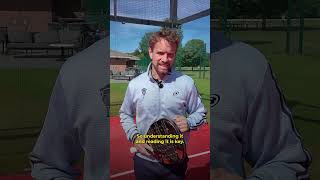
Sandy Farquharson shows how to read spin before the ball lands by watching the racket and contact point. Slice and topspin bounce at different heights, sidespin changes the angle entirely. Stand closer for slice, farther back for topspin, and watch for left-handed sidespin that hugs the glass.
Chapters
So now we understand how the spin is created, we know what to look for. Yeah, that's the next bit, is reading the spin. So I'm going to look at my opponent, I'm going to see the position that they have with their racket, and as they swing down to the ball, I'm looking at their racket and their contact with the ball to determine what type of spin this is going to have on it. Yeah, and as they meet the contact, I will be able to tell you on contact what type of spin that has. I'll go, right, okay, slice, and that means the ball will stay lower at my end. Or I'll look at the way they're coming across the ball and I'm going to say, okay, that's a sidespin, and therefore I'm expecting a side rotation. Or they've brushed up and they're hitting one of these heavy topspins, and I can tell by the time they contact the ball what type of spin it is going to have. And I'm almost saying it to myself under my breath, I'm going Okay, slice, and then I prepare and react. It's important that you are reading the type of shot your opponent's going to hit, particularly on the serve, because you have to deal with some quite difficult shots with the glass. So understanding it and reading it is key. Okay, now let's talk about what that reaction means when the ball contacts the glass, for example. So slice and topspin will not change the angle of the rebound. Okay, slice will mean that the ball contacts and it stays lower. It will follow the same angles and it will go like a flat ball in the same direction, but it will just mean that it bounces and it stays lower off the glass. Yeah, topspin will do the same, same angle, but this time it's going to kick up off the glass. So for example, as a returner, if it's a slice serve, it means that I need to go closer to the glass because the ball is going to hit and go down. So means that I need to be closer to that glass in order to play it. If it has topspin, I can step further away from the glass because I know it's going to kick up off the glass and therefore I have more space to play. Sidespin is the tricky one because this is the one where it will change the angle of the rebound. But I always say to players learning the serve, a sidespin serve works well at a beginner level 'cause it catches your opponents out. But as they get up to level and they read the rebound, it becomes easy.. But what happens with the sidespin is the ball comes in, and let's assume they are right-handed. If they are right-handed, the ball will come in and it will kick more towards the center, more towards your body. Yeah, if they're right-handed, it's going to come in here and it's going to bounce further away, which at the beginning catches you out. But once you understand that, it's actually great because it gives you more space to play this ball. Yeah, if they are left-handed and they are doing the same thing with sidespin from the left side court with a left-hander, it's going to bounce and it's going to stay closer to the glass. So it's difficult— it's more difficult for a player to return against a left-hander hitting sidespin on the left side because the ball will stay close to the glass. The right-hander, the sidespin will kick out, giving you lots of space, making it a lot easier.