Stop Hitting Bouncy Bandejas: 3 Fixes That Work
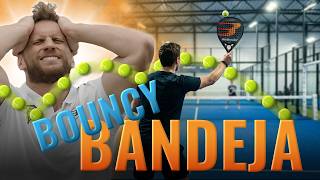
Sandy Farquharson breaks down why bandejas bounce high and gives three fixes: footwork timing with a split-step and quick steps to reach the ball early, racket position above the ball with a slightly open face, and starting your arm higher in the prep phase to avoid an upward swing.
Chapters
One of the most frustrating things about your Bandeja is when you hit it and it's always bouncy at the other end. It bounces down, it hits the glass, sometimes it kicks up, and your opponents attack that ball, and you've turned a position at the net into a defense because you are keeping your Bandeja bouncy. In this video, we're going to give you 3 reasons that this shot is bouncy for you and how you can fix it. Some of the most frustrating things about this is that you You know what you should be doing with this bandeja. You've seen the theory, you understand it, you know you should try and keep the ball low at the other end, you know you want to give yourself a difficult ball for your opponents that gives you time to get back to net. And actually, you might even find in practice you hit it really well. When your coach is feeding you or you're using a ball machine, you're under the ball very nicely and you can hit it where you want. But when it gets into a game, you feel like it gets out of control and you don't really know what you're doing wrong. So I'm going to go through this in order of importance, but also in order of what happens first. Now, number one, most important, is your movement to the ball. This is by far the most common error when I look at bandejas and I see it at the recreational level, is the opponent is hitting a lob. You can see they're going to hit a lob because they're Racket is underneath the ball, they're coming up like that, they hit the lob, the ball goes into the air, they watch the ball, we get into this position, and then we move back while the ball is already halfway to you, and you are therefore late into position. Like, that is the most common problem that we see, is either ball watching, or the lob is hit and we're just not moving soon enough to get into position, and often these first few steps are absolutely crucial because the problem is these small steps like this going backward do not cover ground the same as turning and either crossover step or even sidestepping back into position. Part of this is anticipation, part of this is watching what your opponents are doing and saying, "Oh, they're going to lob. I maybe should start moving back into position," but part of it also is this footwork, this idea around movement and footwork. The split step, pivoting with this right leg if you're right-handed, obviously it's the other way around if you're left-handed, and then moving quickly back into position with 3 fast, powerful steps instead of lots of little steps that don't really take you anywhere. So, anticipation, but combined with this footwork. Split step, turn, and then pushing off. And this is exactly why we recommend all our members go through our Faster Feet for Paddle course. This is part of it, is getting faster with the footwork. We do loads of shadow exercises with footwork patterns like this where we do bandeja, volley, things like that. But everything getting you light on your feet because the last thing you want to do is when your opponent is lobbing, think to yourself, oh, I've got to move my feet now. Like that disrupts the whole game and actually it never happens because players are so focused on the point, right? So what you need to do is make this automatic. So do these exercises off the court. You can do them in your garden, you can do them at home, in your garage, wherever you want. But the idea is you do those footwork patterns so that when you come onto court, it's done automatically. It's muscle memory. So you're splitting, turning, moving back into position for the bandeja without having to think about it. And so if you don't get back fast enough, or you're doing these little steps you end up contacting the ball behind you, and therefore the racket face is open, therefore the ball will go up and be bouncy at the other end. So that is the first reason why your bandeja could be bouncy. Reason number 2 is your body position in relation to the contact. Now, in an ideal world, you get into a position, the racket is above the height of the ball, and it comes down to meet the ball around forehead level, racket face slightly open, and you have quite a horizontal swing path and therefore a horizontal ball trajectory, and it stays lower at the other end. But if you get yourself underneath this ball, you don't have the space to swing, and what ends up happening is you adapt and you swing up to the ball. Your contact is too high, and therefore there is a steeper trajectory of the ball, meaning it is bouncy at the other end. Reason number 3 is your arm and racket position in your preparation phase. So we often see this, this is another very common error, particularly those from tennis, that when the lob goes up, they go into a like trophy position, which is a tennis setup for a smash. And people think of the Bandeja as a smash. I often describe it as a high forehand volley. And really, you want to make sure that your racket and arm is above the height of the contact. If the racket starts low then you go up to meet the ball, and therefore the swing path of your racket is going upwards to the contact. So it's normal that the ball will go upwards from the contact, right? So when we get in this position, we want to make sure that the racket and the arm is higher and therefore can come down to meet the ball. If your swing path is going high to low, or even horizontally through the ball, it means that the ball will follow that path. Yeah, so that's what we need to think. If our racket is low and it goes up to meet the ball, the ball is going to follow that path and therefore again be bouncy at the other end. A lot of what I do is help players and coaches develop their paddle, and I've done this for the last 15 years. I've worked with thousands of players, and many times on the Bandeja, we have a platform where players can send in their video, and the most sent in video is the Bandeja., and often the reason is because it's bouncy or because it's inaccurate. And the majority of the problems are off these 3 reasons. So if you can tick these off, that you're not doing any of those, I can almost guarantee that you will have a better Bandeja. So let's just do a quick recap there. You've seen your opponent is about to hit a lob, you're going to do a nice split step on your toes, pivot with your right leg, and move quickly back into position. Now if you're someone that wants to work on your footwork, I highly recommend doing those off-court sessions. It will make you faster. It's already made many of our members faster by doing that, and it helps all of your game. So when you're moving back, you move quickly back into position, you get a good distance from the ball, so you've got a nice space between you and the contact. You start with this racket above the height of the ball and you swing down to contact, racket face slightly open because you want to hit a little bit of slice. And you swing horizontally through the ball. If you can do all of that, it's more than likely you will have a nice low bandeja at the other end. Repetition for the bandeja is key in terms of practicing it. You need to practice the footwork to get into position, you need to practice the racket, the technique, all of that for the bandeja. Now there are certain ways to do it. You could use a ball machine, you can do it with a partner. It's very difficult to practice this in a match because you don't know where the lob is going to come. And actually recently in our roadmaps, we have released train at home exercises. So a lot of shadowing, a lot of getting into position, practicing certain ball feeds. Again, stuff you can do at home so you can actually improve without having the high court fee that usually you have to have when you want to go and practice. And that will all make you better off court so when you step on court, it's going to be much easier. I'm gonna put a link to thepaddleschool.com up in the corner there. You can access that straight away and start improving your bandeja.
More from Sandy





Want to finish more points? 🎾 #padel #padeltips #padeltennis #sports #coaching


Want more side spin on your Vibora? #padel #padeltips #padeltennis #sports #coaching



Your partner can’t read your mind #padel #padeltips #padeltennis #sports #coaching

Struggling with your bandeja? #padel #padeltips #padeltennis #sports #coaching