Ex-tennis pro Sandy Farquharson shows why tennis habits fail in padel. Baseline camping doesn't work here, lobs become attacking shots, and rallies demand constant mental switching between offense and defense. Tennis players need compact footwork and active partner communication, not singles aggression.
Chapters
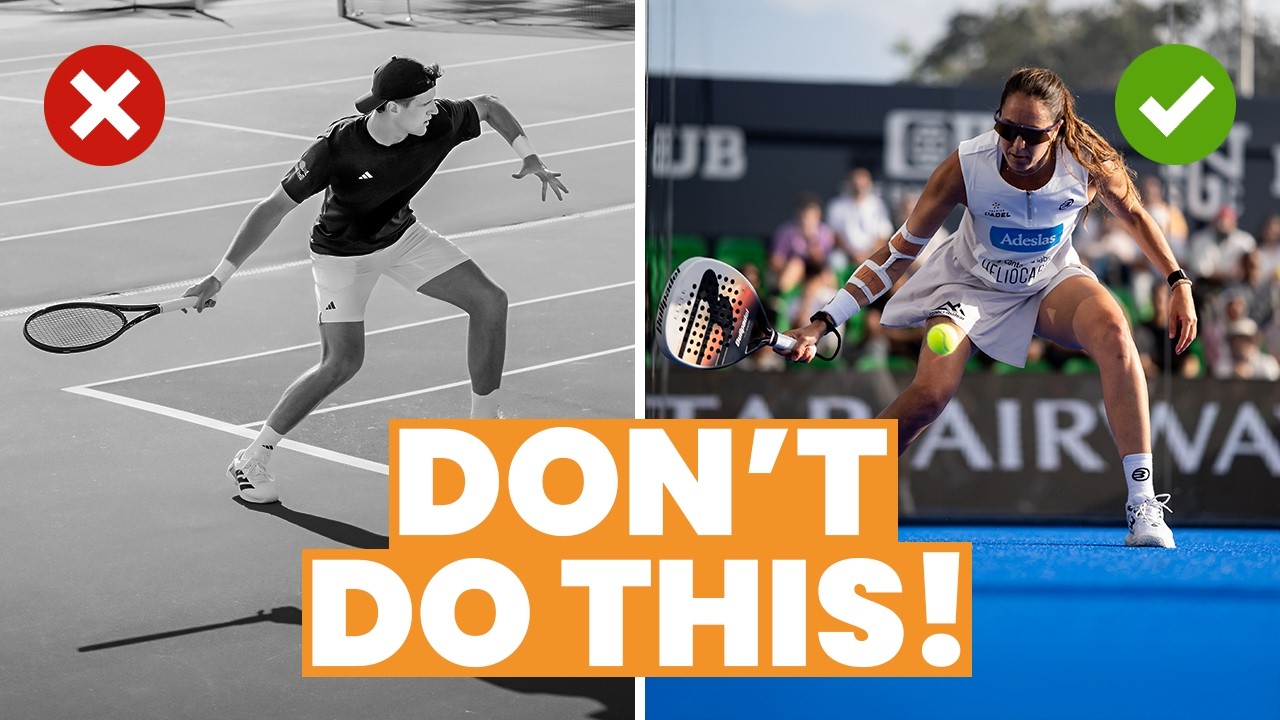
Look at this, a beautiful British summer day. Don't often get this. Players are sitting outside watching the tennis. Not normal for this part of the world. And we're going to take you inside to the Padel Club and show you some things that are normal in tennis but not normal in Padel. Camping at the baseline. Many recreational players from tennis don't like to volley in tennis, so they don't like to volley in Padel, so they camp out behind the service line, they're hitting their ground strokes from the back here, and when their partner goes to net, they don't go with them. And it's hugely frustrating for the partner because this player is just staying at the back of the court. Now, in padel, you can't really win the points from the back of the court, so as a pair, that's not going to work. Myself and other ex-pro tennis players almost have the reverse. We love to chip and charge. So when you see an ex-college player or an international player come to the padel court, often you see them chipping and they charge to net on any ball. And that's almost the reverse because they come in with high risk and therefore are not successful at higher levels, but often get away with it at the beginning. The other is the intention from the back. Often tennis players from the back of the court are trying to hit passing shots where they hit through their opponents like you might do in tennis, or they are lobbing in desperation. They get in a really difficult position and they try and lob as a defense mechanism. Both of these aspects work for tennis, it's how you play in tennis, but in padel there aren't passing shots because you have smaller gaps between your opponents and a bigger gap behind them. So actually in padel, the lob as an attack is a great way to put your opponents on the back foot, to push them to the back of the court, and allow you time to get forward. So that's at the back of the court. When players come forward, if you're from tennis, the temptation is to try and hit past your opponent. So you use power, you hit aggressive volleys and smashes, and if you've hit a smash on a padel court, it makes a really nice sound. It can feel very satisfying when you hit it, but the majority of points in padel are won through placement and control, trying to find the spaces and force your opponent into a difficult situation at the back of the court. One of the hardest things for me to change as an ex-tennis player coming to the padel court was the, the flow and the instinct within the point. In tennis, you try and set up the point from the back of the court. You hit aggressive shots, you wait for a short ball, you're aggressive, you come to net, and probably the point ends there with a volley or with a smash. Maybe a lob or passing shot, but either way, one or two shots. In padel, the points can last so much longer, and you come forward to net and they maybe lob you, you go back and forward again, back, and so you have to constantly get this idea of being in attack in a point and defense and not let the adrenaline of the point and you trying to finish affect your next shots. So you've just got to get used to and be comfortable with the flow that you might attack and the next second you could be defending again. Another major change from tennis to padel is that padel is always doubles, and if you are a singles mentality from tennis, you're used to being hyperfocused on yourself, on your game, and blocking out everything around you. But on a padel court, it's really important you build great chemistry with your partner. Communication is a key to that, both communicating in the point. So when they are being lobbed, communicating where the opponents are and talking to help them choose their shots, but also between the points as well, coming up with the tactics, where they should play, and what you want them to do in the points. So one of the first things that you can do if you are from tennis is to work on the footwork at the back and the front of the court. It's very different to tennis. Tennis, you're you're focused on transferring of body weight, driving with the legs up through the ball because power is important. You want to hit the ball a longer distance. Padel is much more focused on lighter, smaller steps with your footwork, compact with your body so that you can hit soft, you can lob and control the ball. And that's exactly why when players come to our platform, thepadelschool.com, one of the first courses we give them is a footwork follow-along course. It's something they can do off the court in their routine, part of their warm-up, or at the gym, and it will make them faster for when they step on the court. And it builds muscle memory so that when you're playing a match, you don't have to think about faster feet. You automatically have them because it's part of your training. So if you're from tennis, those are the tips to get you started in the padel world. I'm going to make the most of this beautiful day and go and watch some tennis.