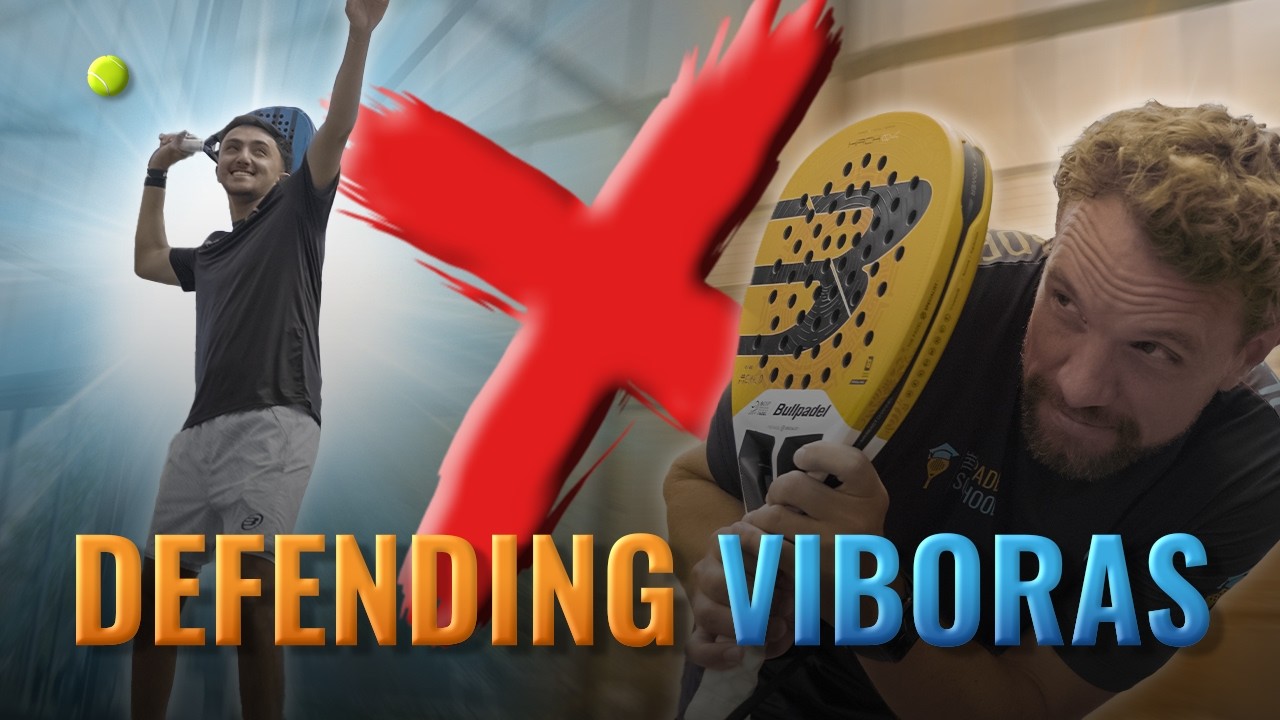
In this instructional video, two coaches explain why club‑level players struggle with the vibora—a slice smash with sidespin that often lands in the corner or double‑glass area. They identify the main mistake: treating the vibora like a flat, fast smash and rushing forward to the glass, which leaves players out of position. The coaches then outline how to read the opponent’s contact point and spin to anticipate the shot, and present two defensive approaches: (1) stay back and use the glass or corner, or (2) step in just before the white line and block the ball. They stress the importance of decisive commitment to one option rather than hesitating. To embed these concepts, they demonstrate a specific drill (2 balls down, 1 lob) that lets a player practice both defensive options in a controlled setting. The video concludes with a promotion for thepaddleschool.com, offering a 7‑day free trial for further vibora technique and drill resources.
Chapters
At the club level, when someone learns a vibora, it can be absolutely devastating for players to defend. But at the pro level, do you struggle with the vibora?
Not anymore, but I used to.
In this video, we're going to take you from being scared of it to comfortable. So first up, the technique for vibora is when the players hit a slice smash, it's an attacking slice smash, they brush around on the ball, typically it goes in the diagonal in towards that corner, doesn't it?
Absolutely. I mean, the vibora is normally hit from the center part of the court, from, from the middle. If you end up lobbing towards the end, you're hitting the rolo or the smash. So when you do lob through the middle, you're expecting the vibora to come back.
And usually when they hit the vibora, it's a ball that comes in here, a bit of slice, bit of sidespin, and often like it'll go in that corner, isn't it? Like double glass.
Absolutely. The spin varies a lot, and you've got to understand you can't rush this because I used to rush it a lot. Think I've got to hit it even harder. But now I think the more you relax and the more you understand where your lobs go in, you can then react to the vibora.
So I think a big problem at the club level is players are used to defending flat smashes and fast smashes, so they see their opponent hit a smash and they immediately run forward waiting for the glass. But because the vibora is slice and sidespin, they run forward, wait for it from the glass, and it just dies in behind them and really difficult to defend.
Absolutely. I think at club level they're expecting the same shot every time, but for the vibora, I think it's really important to watch the contact point of your opponent. If you see them contacting high and in front, you know it's going to come flat. But if you see them hitting it slightly to the side, expect that spin and don't run too forward.
There are two main ways to deal with this vibora. One is to stay back if you feel like it's got a lot of spin, or maybe the contact is a little bit higher you can use the glass, allow the ball to rebound in that glass. And if it's a little bit softer or nearer the corner, you might come a bit further back. If it goes further in towards the middle, you might need to shuffle forward and play it after the second glass. But the idea is one way of dealing with it is to stay in the back part of the court, defend with the glass.
Absolutely. And for me, the way I actually prefer, if I see the opponent hitting a vibora, which is a bit lower and with a bit more spin, I tend to take half a step in just before the white line here and be prepared to block. That for me gives me a bit of advantage because they're hitting the vibora. If I'm blocking before they've come back to the net, it takes time away from them as well.
Yeah, I think a big thing for the club player is if you do go there, you're going there to block. Like, don't go up to here and then, and then leave it, right? Because that's when players get in real trouble. So I think one of the best ways to improve your defense and also probably improve your vibora is to put it into an exercise, into a drill, right? That's almost the best way. I think club players expect to improve it in matches, but really, you know, you and I, we drill.
Absolutely, I think that's the only way to practice. A lot of people think, okay, this match I'm gonna practice, but you end up going into that mindset, I just wanna win this match. So should we demo some drills?
Let's do it. So a good little exercise that you could do, and it's quite an advanced exercise, is to have one player in net, one player at the back defending the vibras. You're going to play 2 balls down and 1 lob for the vibra, and when he hits the vibra, you can practice using the glass, using the corner, but also coming up and blocking. So I'll go 2 down. So 1, 2. So to get from a club level to a pro level, to a high level, so much of it is around key decision making, isn't it? If the log goes up, and you decide to go forward, go forward and block, commit to it. Or if you stay back, you leave for the glass, leave it, wait for the glass and respond.
Absolutely, it's about not getting stuck halfway, right? And I think the only way to master it is by practice and not try and go into a match and think, oh, I'm gonna practice this, 'cause you're gonna get competitive and try and win instead. So book yourself a court and I think just go and do that drill.
Yeah, and if you want inspiration for drills or you want to understand more around the technique, for the vibora, we have all of that on our platform, thepaddleschool.com. A 7-day free trial, sign up and start improving your vibora today.