Three Game-Changing Habits for Padel Players
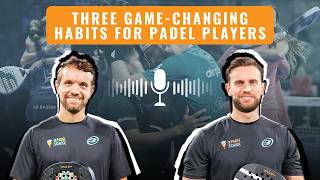
Sandy Farquharson breaks down three habits that stop padel players from plateauing: footwork drills that prevent injuries, grip and ball control exercises, and a pre-match journal system for mental focus. The platform offers three courses bundled as "Instant Advantage" for new members, plus 700-800 exclusive coaching videos.
Chapters
Tom, we've worked with thousands of players around the world, both in person and online, and we've identified 3 reasons why players are plateauing and not improving in their game. So by the end of this episode, we are wanting players to go away with real things that they can do within their game.
Yeah, this is a common complaint, isn't it, from players? We, we hear this a lot where players start playing padel, they love it, they get addicted to it, they're playing, and initially they start improving and everything's looking great because everything is new. They're starting to use the glass a bit more, so it starts to feel a bit more familiar. But after some months of playing, and this is only playing matches, is that they start to notice that, well, their level is plateauing, that they're not beating those better players, and, and frustration kicks in, and it's a really common complaint that we have. And that's where these, these 3 skills that we're going to talk about today fit in.
Yeah, and I think that you and I, we work with so many different types of players in terms of their background, their personality, their motivations, what they want to do, also where they are in the game. We've worked with players like right from the first day they step on a court to national team players. And so these 3 areas, I think, are something that you can work on with a player at every level. And if I think about when we train with the GB guys, we are looking at these areas, and we're also looking at beginners. It's like, right, get these foundations the right way. So let's start with the first one, which is footwork. I think that footwork is absolutely key, especially when you are learning the techniques. You are trying to get yourself in the right position for the ball. It's part of your preparation. More often than not, when players say, I really struggle with this particular shot— let's take the bandeja because that's often a common one, it's almost always because they haven't got their feet in the right position for the ball and therefore can't execute good technique.
Well, footwork underpins every single shot in padel, and it's overlooked, isn't it? It's one of those things that is almost assumed, assumed that you have it. Everyone talks about where the elbow should be, where the contact point should be, what the result of the shot should look like. But if the feet aren't working, then none of the shots in padel can work. And it's the cause of feeling slow on the court. It's the cause of reacting late. It's the cause a lot of the times actually making errors. If a lot of players that have a high unforced error count, a lot of the time it's to do with, well, they're not ready for the ball, they're not reading the ball correctly. And so much of that starts with the feet.
And it's also really difficult to think about the exact foot movement while you are playing a match. Do you know what I mean? Like, you can think about where your arm goes and things like that, but to think about your feet, you don't want to be in that position. You want to be thinking about tactics, strategy, where to play the ball. And so you want your feet to be automatic. But the only way to improve that is actually to do the exercises, to do the trainings. Like our Faster Feet for Paddle course, they are follow-along exercises. So we do 4-minute, 8-minute, 12-minute sessions where you just follow along and you're doing the footwork patterns we're showing you. I'm on that video showing you what footwork to do, but it It's something you can do at home, in your garden, in your garage, somewhere off court that can improve your footwork, improve your split step and being light on your toes. So when you step on court, it's like muscle memory, you don't have to think about it.
Like, that's the most important thing.
Yeah, it's quality reps. How often do you think the pros are thinking about their footwork in a match?
Yeah, no, it's like you say, it needs to be ingrained. And like you said, the beauty of this is that you don't have to hire a court, you don't have to hire a coach to go and do this. This is stuff that you can do at home, and especially with footwork, for me at least— and just see your thoughts on this— is that it's little and often. Little and often is so important. So many players on our platform are using the Faster Feet for Padel course actually as a warm-up. So they'll go on, they'll arrive 10 minutes early, they'll do the Faster Feet for Padel, and all of those reps will build up over time. If you think, if you— depending on how many matches you play in a year, if you, if you can put in 3-4 minutes of footwork before every match just think at the end of the year, how many minutes of quality reps you've got in with footwork. And it is only a few minutes, but yeah, little and often for me, footwork is key.
Yeah, it's interesting. I was chatting to one of our members this last weekend and we were talking about the footwork course and he said, oh, it's great because I turn up to the club and he's like, if I've got lots of time, I'll do the 8-minute one. And if I don't have as much time, I'll do the 4-minute one. And it's funny because it's almost like the players will get to the club, think of the time they've now got and then they will do what suits. You and I are probably the other way around in that we would say, right, we want to go there, we want a 5-minute warm-up, I want to do 5 minutes of exercises, and therefore I need to be there 20 minutes before. But if you are a bit more time-pressed or you're a bit busier, you can just turn up, go onto the app, and, and you follow one of those, those quick sessions.
It's not only about performance on court and also being sharp and ready for your match, but injury prevention. We've had some members come to us and say the Faster Feet for Paddle is great because I have lots of lower leg injuries and this is just something that allows me, again, it's a few minutes, it allows me to strengthen that part of my leg. And again, obviously if it comes to injuries, that's something you work with your physio, but at least it's, again, it's getting those quality reps in, strengthening that part of your body, and over time that just builds up.
Yeah, so that was the first one, really footwork. I think that's a core pillar. The second pillar for me is like ball control and like having a good grip. If you're learning and you've just come into the— to paddle and you're on your paddle journey but you're at the start, it's probably finding the right grip. It's like the continental grip, being in the right position. If you are a higher level, it's ball control and being able to hit softer balls, the Chiquita, the lob. These are all variations of ball control. And so for me, that is also a really, really important part of, of that journey and, and a really focus area if you want to improve.
And the grip is very much like the footwork, isn't it? You don't want to be thinking about on the court, am I in the right grip? And a common problem that players have is that if they haven't come from, say, a tennis background where continental grip is a bit more usual in the technique, is that they change this frying pan grip. They start the rally in continental and then during the point the grip shifts and they turn into like a frying pan grip without even realizing it. And then afterwards they go, 'Oh, I moved my grip again.' And this is, this is again the reason we created the Complete Ball Control course, is that these are all exercises you can do away from the court. They're a few minutes long, but they create those quality reps for players. And again, we want it to be automatic. You want to go on the court not worrying about, 'Have I got the right grip?' It's, 'I've done enough quality reps that I know that I've got the right grip.' Yeah, and sometimes the grip might stay, but the hand and the wrist moves, and you need to be able to control that.
And, you know, that course, we have exercises to practice at home to get your pronation for when you smash and how to control the ball. And yeah, the more you could do of that, the more ball control you will have when it comes to the court. And what a lot of our members do is they just chuck it in as part of their warm-up. So they do a few minutes of ball control as part of the, you know, the footwork and the warm-up, and it ends up being a little 12 to 15 minute kind of circuit that they do before they step on and they feel really good on court. And I think that that's it, it's just making it part of the routine.
And you mentioned a word earlier, foundations, and I know that's something that we've, we talk about so often is about creating those foundations. Those two courses are about creating the foundations, aren't they? And we, we talk a lot as well with our players around building a castle on sand. If you're looking to to hit the 3-meter smash and you want to practice all of the shots that you see on the highlight reels, at some point you're going to get stuck with that because if you don't have the right foundations in place, your game won't improve. Yes, it's nice to be able to play the flashy shots that look good, but footwork, grip, ball control, those are the things that over time will help you improve.
Yeah, and really the third pillar then is almost, and we've called it consistent confidence, but it's really making sure that you have clarity when you go on court. And this is a little bit more mental, a little bit more focus-based. And we have our journal, which we often recommend for our members to use, a way of keeping clear. But even if you don't use the journal, it's basically, I'm going on court today with this objective. I want to focus on this in my game. And if it's a training session, it might be something technical. If it's a match, it might be something tactical. But it's really like, how can we Narrow that focus and make sure that we are thinking about the right things when we step on court.
Yeah, for me, the Consistent Confidence course is the most powerful course in the series because it takes our years of working with players. So we, we put into that course all of the secrets of how to learn the fastest on the court, how to maximize every single minute. But it's also taken our years of performance, our years of competing We've both competed not only at a pro level in tennis, but a pro level in padel competing for our country. And we've put all of those insights into this course and we've applied it for recreational players. So we have all of the insights from a, from a coach perspective, but also from a performer perspective. And I know you're just going to grab the, the training and match journal there. We'll also put a note in the description for this, but this is something that we created that It's, it's a book, but it's way more than that. It's, it's really like a tool that players can use to action this whole process.
Yeah, so often we speak to players and they think of this part of padel learning as something like, oh yeah, I know my focus, but you and me know it's the most important and it's the one that needs the most focus.
And within this journal, we cover everything from pre-match, post-match, pre-training, post-training and online content. So the best ways to maximize the learning that you can from the online videos.
And that's big because on our platform, I think we have something like 700 or 800 videos that are all dedicated to the platform. Like, none of them are replicas from our social media. We haven't brought anything across. And it's very tempting for players to get onto the platform and just binge-watch. And I think that when we've put an online section in here, it's really how we want players to consume our content. So let's watch a few videos, get some takeaways, go to the court, follow some of our off-court training tips and our off-court exercises, then go back. And, and it's really like step by step how to build the game. And actually, if players sign up now to the membership, they get access to the Instant Advantage bundle, which is the Faster Feet for Padel course, it's the Ball Control course, and it's the Consistent Confidence course that all come together. And we recommend you doing that almost straight away as soon as you sign up and then you can go on to the other roadmaps and get involved in some of the other courses.
More from Sandy





Want to finish more points? 🎾 #padel #padeltips #padeltennis #sports #coaching


Want more side spin on your Vibora? #padel #padeltips #padeltennis #sports #coaching



Your partner can’t read your mind #padel #padeltips #padeltennis #sports #coaching

Struggling with your bandeja? #padel #padeltips #padeltennis #sports #coaching