Training Session: BACK GLASS with Former Cricketer SAM BILLINGS
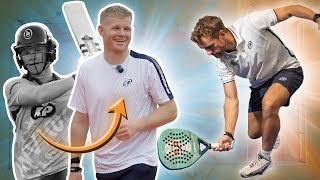
Sam Billings joins a paddle training session on back glass technique. Sandy Farquharson coaches the group through the Chiquita shot and footwork, breaking down paddle skills with technical tips.
Hey, let's see what they take it though.
Get that on camera.
Hey, hey.
He's faking my technique as a winner though, lads.
It's the racket.
But then.
Yeah, I know, I know, I know, I know. Terrible technique, but we'll take it. You want to see me bat.
Excited to get on court with Sam Billings this morning. A very well known cricketer for England. Great batsman with wicketkeeper for the international side. No doubt. Has amazing coordination and ball striking ability. Let's see if he can do that on the paddle court. We will be checking out a couple of different areas of his game and undoubtedly starting with the defensive work and looking at that back glass.
Yeah.
And then come. And you need to go a tiny bit further back.
Yeah.
Because you're not letting it drop.
Yeah, yeah.
And flicking.
So you've got to go a tiny bit further, further back on that, but that up shoulder height.
So.
So let's start. I'm going to start using.
That feels so weird, by the way.
Yeah, it feels restricted, right.
It feels like I'm like I can only jab it back, if that makes sense.
But you still hit that pretty hard. Yeah, I was still going at a fair pay. Like that's most people's like 90% got you. Right, so what I want you to do is start side on, like facing Tom there. So let's take the racket back here. Yeah. So face side on. Yeah, There. Okay. You're not allowed to raise the racket above that height.
Okay.
Okay.
I'm just gonna throw it and you're gonna, you're going to like scoot it back and hit softly into my hands.
Right.
So you go back with the ball. Back, back, back, back, back. No, but, but sorry, you. You shuffle back.
Yep.
Yeah.
So rack it back. So shuffle back, shuffle back, shuffle back. And softly into my hands.
Yeah.
Imagine I'm like 7 years old and you're trying to hit it. There we go.
Yeah.
And again. Rock it back, take it back, go back. But instead of going like, like that, like, like shuffle back.
So I need to hit the ball here.
Yeah, yeah, got you.
All right.
So you're not allowed to touch my racket.
Yep.
Well, you can even press it down, Tom, to stop him here.
Good. There we go. And again. Good.
Nice. That's much more like much simpler. Start now from ready position.
Yeah.
So basically. And now you're going to go back, like into that position. Same thing.
Yeah. Good. Better.
Racket first. Think of the racket like you're opening a door. Like that's going first and then the ball passes.
Yeah.
So open the door. Open the door. Open the door. You open the door for the ball. Okay. So racket goes first, then it goes.
Yeah.
Nice.
See, but the problem is I'm not following through. You know what I mean? Like, there, I'm just stopping. Whereas actually I still need to.
You still need to go through. The problem is, is, like when you're on your contact, if your contact is not front hip, like, if it's not here, then, then. Then you end up like. Like almost scoopy on it. So what you need to do is almost get slightly further back so your contact is in. Is in front.
Yeah, yeah.
You see how that dropped? And then you've got to anchor.
It's just the complete opposite to squash.
Complete.
And that's. And like, I'd say this is my strength, so God knows what you're going to say about my.
You have lovely contact.
You know what I mean, though? Like, I've got such confidence in the back. It just feels bizarre.
Yeah.
You know what I mean?
Yeah, it feels. But the thing is, your level now, the way you hit, you hit. Lovely strike, but it will get you to here, right?
Yeah.
It just needs more control.
Yeah. Someone that volleys against the tennis player, volleying, I'm sure that that gets fired back in your corner because you can't. You can't take the speed. Like, you can't control the speed and the height.
Got you.
Yeah.
We always talk about, from tennis and squash, like you're. You actually want to push the ball.
Yeah.
In paddle. Like, we came from tennis and we were used to hitting it.
Yeah.
Like squash, you're used to hitting it. But actually here, you want to push it.
Yeah.
It should feel like you've got no, like, flick. Like you want to just push the ball.
So it's.
It's a different feel.
Yes, Very different feel.
Yeah. Just.
Yeah, just kind of move.
Just using that.
Yeah, yeah.
There's different ways as well.
Yeah.
That's the only thing, like, you know, it's like batting.
Yeah, yeah, yeah.
You know what I mean? There's not just one way.
Yeah. So.
No, no, it's interesting.
Try and hit the same speed. You just hit to me.
Yeah.
But now obviously clearing the net down to my feet.
Yeah.
So. So back, back.
Sorry.
That's still nice. That was good. That came away as well. Racket back down. Keep that racket down.
It fell down.
Racket down.
Good.
Back, back, back. Good, that's nice. You see, now I'm having. Now I'm Having to hit below the height of the net to hit up.
I think I can do that with my other technique though.
Not like, not, not effectively. Like at the moment you're doing that with your other technique. It's clearing like this.
Yeah.
But you see what we want. Can you demo like Tom? Because what we want is, is when it's short take back, you can almost do it. So it loops down to my toes.
Yes.
And then if you want. So like, like what? If you watch Tom here, for example, if it's low, he's taking that racket.
Back there and hitting down like a mixed speed.
Yeah.
I'm here.
So that's what, that's, that's how you almost want to play off that. But you can only, you can only redo it when with the racket down the moment, like do a couple Tom. Where you lift the racket like the, like there, there. It can only be like. That's the thing is he, he can do it.
I see it.
Yeah.
The margin for error is so, so tight.
Yeah. Ah, yeah.
I'm just not actually like following through. Like I'm keeping the racket there and I'm doing that basically. As opposed to you still gotta, still gotta get the momentum through. I'm just stopping it.
You got it.
Good.
That was nice. Yeah. Rack it down.
You see, Just hit the ball, man.
Nice. That's a better speed though.
Much better.
Yeah.
You're not that rocket. I'd argue it's more mental though, because it just triggers you mentally. It's about shot selection at the end of the day.
Yeah.
Because you can still, like I said to you, like one of my best shots is when it's slightly higher off the wall and I chiquita into that side.
Yeah.
You know what I mean? So it's more of a mental selection point of view.
I'd argue, I'd argue that that feels comfortable for you because of the contact is behind you. Because the contact is back.
Hip.
Got ya. Okay.
Do you know what I mean? And that's the problem now with you hitting here is that you're trying to. And that's why you're saying you can't follow through, is because the contact is still here.
So I need to get there and then push it.
Yeah.
Almost like guide it.
There.
That's the one. And again behind.
Good.
But that's like. Tell me if I'm wrong. But that's nothing to do with the take back. It's about contact point.
They come together.
Okay.
Because, because like, sorry, I'm Asking too many questions because you're doing almost the squash way is like elbow high. Rack it up.
Yeah.
Contact, contact behind. Right.
Like that. Yeah.
So they come together. So that's almost what we're fixing. Next is after the take back here is like take back here and then behind it. And here you can control the ball.
However you want it. Small contact point.
Well, here there's more time to come down. If he started hitting faster volleys at you, the second you're here, you wouldn't be able to, like. Because you're hitting quite.
I'm hitting at a nice pace.
Slow.
Yeah, yeah.
The second it goes faster, if you're here, you're not gonna have time.
Go for it.
Yeah, yeah.
No, no.
I'll pick the speed up. Exactly that.
Good. That was a nice one. Yeah, Nice, nice. That was good, though.
It's just not letting it get too far. Back hip.
Yeah.
I think that's even more important because I can't fix two things at once.
Yeah, yeah.
That's the thing. It's like, bang.
Yeah, yeah.
If I'm thinking about something technical, batting.
Yeah.
My head scrambled, so I'm thinking about my feet and my hands. To lift my hands up. Sorry. Move my feet and then get my hands up. I can't do two things at once. I'm a sportsman. I've got two brain cells. Can't engage in both.
So you can see there with Sam working on the Chiquita from the back of the court, it's interesting, and this is a note to coaches, that for him, it was much easier to focus on the footwork first and then think.
About where he's taking the racket back. Now, to hit an effective Chiquita, he needs both.
He needs to be able to contact the ball in front, and he needs to shorten his take back and start it lower, particularly to play the ball softer off more difficult volleys. Now, for the extended version of this video, we're going to go into the backhand side of that back glass. We're going to put that in our community, on our membership. Thepaddleschool.com you can head there.
You'll be able to see the rest.
Of this video, but you'll also be able to see our library of content, step by step, guide how to improve your game, regardless of your level. I will put a link up here if you want to go to thepuzzschool.com.
And check out the rest of the video.
And I'll put a link down here for how to play the Chiquita effectively. The technique for that always had a.
Way to make it work and find another route.
More from Sandy





Want to finish more points? 🎾 #padel #padeltips #padeltennis #sports #coaching


Want more side spin on your Vibora? #padel #padeltips #padeltennis #sports #coaching



Your partner can’t read your mind #padel #padeltips #padeltennis #sports #coaching

Struggling with your bandeja? #padel #padeltips #padeltennis #sports #coaching