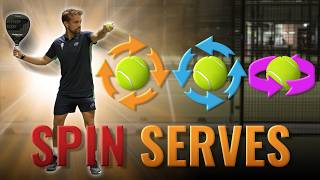
In this instructional video Sandy Farquharson explains how to handle spin serves in padel. He first breaks down the three basic spins—slice, topspin, and sidespin—describing the racket path and how each spin affects the ball’s trajectory and rebound height. He then shows how to read the spin by watching the server’s racket position and point of contact, allowing the returner to anticipate the spin before the ball is hit. The impact of each spin on the glass rebound is detailed: slice keeps the ball low, topspin makes it kick up, and sidespin alters the rebound angle, with variations depending on the server’s handedness and side of the court. Farquharson stresses the importance of proper footwork (split‑step, early preparation) and a continental grip to control the return. He concludes by promoting his training resources—the Faster Footwork for Paddle videos, ball‑control drills, and the “Instant Advantage Bundle” available at thepaddleschool.com—offering players a way to practice the described techniques.
Chapters
It can be really difficult if your opponent has a tricky spin serve, and I know so many players that struggle on the return against certain types of serves. So in this video, we're gonna cover how to understand the spin, how to read the type of spin you're going to receive, and what to do to deal with it. It can be really frustrating to deal with this because it might be something that actually is the best part of their game, and the rest of the game, if you could just get the return back in, then you could actually challenge their serve, but they get so many free points because you don't know how to deal with their tricky spin. Then you start losing confidence in your return, and annoyingly, the server knows they are causing you problems, so they keep doing the same type of serve. So we're going to break this down into 3 areas. Firstly, understanding the spin. Secondly, how to read it, how to tell what type of spin it's going to have on it, and then how you can deal with it properly as the returner. So before we look at the return, let's look at the mechanics of the spin first so we can actually understand the spin. There are 3 types of spin that a player can put on the ball. They can put the slice on the ball, which means the racket comes from above the ball, it is a slightly open racket face, and they brush down, creating the revolutions that keeps it low at the other end, and that affects the height of the ball. You can have topspin, which is brushing up the back of the ball, and that means it comes from the other angle, essentially, of slice, in that the racket face is slightly closed, they brush up the top of the ball, and it creates revolutions in order to create a higher rebound at the other end. And then the other spin that you will likely see is sidespin, and this is when the ball is passing across the side of the racket. The racket face goes across the ball, and therefore the revolutions are creating a sidespin on the ball. So if I was going to hit the 3 of these, I would hit my slice with the racket starting above the ball, and I would come down creating slice on that ball. My topspin would go low to high, and I would brush up the back of the ball, and my sidespin would come across the ball to create those revolutions going around the side. Now, without wanting to complicate it more, you can have combinations of spin. So a good serve will have a slice and a little bit of sidespin, so it's brushing down but coming around the ball slightly. You can't mix spins like slice and topspin because slice is down the back of the ball, topspin is over the top, and if you were to mix them, that would actually end up just being a flat serve. But you can mix slice and sidespin, and that is often a very tricky serve to deal with. So now we understand how the spin is created, we know what to look for. Yeah, that's the next bit, is reading the spin. So I'm going to look at my opponent, I'm going to see the position that they have with their racket, and as they swing down to the ball, I'm looking at their racket and their contact with the ball to determine what type of spin this is going to have on it. Yeah, and as they meet the contact, I will be able to tell you on contact what type of spin that has. I'll go, "Right, okay, slice," and that means the ball will stay lower at my end. Or I'll look at the way they're coming across the ball, and I'm gonna say, "Okay, that's a sidespin," and therefore I'm expecting a side rotation. Or they've brushed up and they're hitting one of these heavy topspins, and I can tell by the time they contact the ball what type of spin it is going to have. And I'm almost saying it to myself under my breath. I'm going, Okay, slice. And then I prepare and react. It's important that you are reading the type of shot your opponent's going to hit, particularly on the serve, because you have to deal with some quite difficult shots with the glass. So understanding it and reading it is key. Okay, now let's talk about what that reaction means when the ball contacts the glass, for example. So slice and topspin will not change the angle of the rebound, okay? Slice will mean that the ball contacts and it stays lower. It will follow the same angles and it will go like a flat ball in the same direction, but it will just mean that it bounces and it stays lower off the glass. Yeah. Topspin will do the same, same angle, but this time it's gonna kick up off the glass. So for example, as a returner, if it's a slice serve, it means that I need to go closer to the glass because the ball is going to hit and go down. So I need to be closer to that glass in order to play it. If it has topspin, I can step further away from the glass because I know it's going to kick up off the glass and therefore I have more space to play. Sidespin is the tricky one because this is the one where it will change the angle of the rebound. But I always say to players learning the serve, a sidespin serve works well at a beginner level 'cause it catches your opponents out, but as they get up to level and they read the rebound, it becomes easy. Easy. Yeah, but what happens with the sidespin is the ball comes in and let's assume they are right-handed. If they are right-handed, the ball will come in and it will kick more towards the center, more towards your body. Yeah, if they're right-handed, it's gonna come in here and it's gonna bounce further away, which at the beginning catches you out. But once you understand that, it's actually great because it gives you more space space to play this ball. Yeah, if they are left-handed and they are doing the same thing with sidespin from the left side court with a left-hander, it's going to bounce and it's going to stay closer to the glass. So it's difficult— it's more difficult for a player to return against a left-hander hitting sidespin on the left side because the ball will stay close to the glass. The right-hander the sidespin will kick out, giving you lots of space, making it a lot easier. If we shift to the right-hand side now, it's going to be the opposite. So a right-hander hitting sidespin from the right-hand side of the court means that the ball is going to hug the glass a little bit more. It's going to stay closer to the glass if they're using sidespin. If a left-hander is using sidespin from the right side, it's going to kick more towards the center. So actually, a sidespin is more effective on this side because it is forcing the player closer to the glass. But at a beginner level, it catches people out more often when the rebound comes away. But as soon as you get comfortable returning and giving yourself space, you will find that a lot easier. So just to recap on this side, again around slice and topspin, remember Slice means the ball stays low, so it's going to come in, it's not going to change the angle, but slice will mean the ball stays low. If it's topspin, the ball will come in and it will kick up. So all that will really change for slice or topspin will be how close you need to get to the glass in order to play. Sidespin changes the rebound angle, slice and topspin change the height and therefore the distance that you need to be. Very often we have players in our clinics that say, "Well, my friend Bob down the club has an impossible serve. It stays so low and I can't return it." No serve is unreturnable, otherwise the pros would be having aces and winning serves in their matches, which is very, very rare, right? So what you want to do is you want to make sure that you are reading the serve. So at this stage, we've talked about the types of spin, reading the spin, and how to deal with it, like what the rebound is going to happen, but to deal with it, you need good footwork. So like a split step when they contact, early preparation with the racket, opening the feet to the correct position from the rebound, and you need to be in a continental grip. If your grip is off here, it's very difficult to return. And that's why when members join our platform, thepadelschool.com, we provide them with the Faster Footwork for Paddle It's a course of follow-along videos, 4-minute, 8-minute, 12-minute videos you can follow along, get faster. You can do it at home, in your garden, wherever you want, outside the court, and get faster on the court. We also provide a ball control exercise so you can control in continental, because returning a difficult serve is a combination of the two. It's a split step and turn with the position, it's keeping continental and then controlling a ball the ball is going to come at an angle towards you, so you need to manipulate the direction of the ball, and you can only do that with keeping a nice grip and control on your racket head. So those things really need practicing. If you want to start improving your game from today, you can get access to the Instant Advantage Bundle, which is the footwork, the ball control, and your consistent confidence course when you sign up to the membership. I'll put a link up here thepaddleschool.com. You can check it out, get a free trial, go and check it out, start doing those exercises and improving your game.