Why Your Padel Game Starts With Your Feet
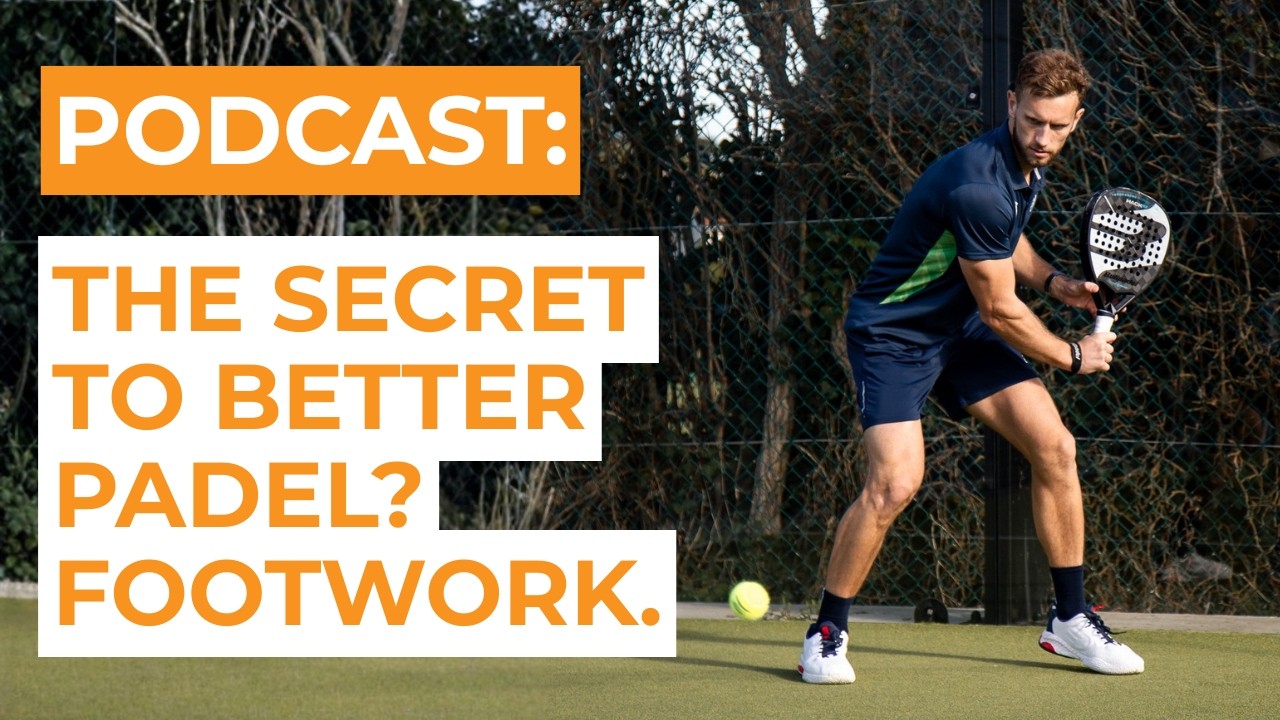
Sandy Farquharson argues footwork is the single most impactful skill for recreational padel players, underpinning every shot. The split-step, trained off-court in short frequent drills, becomes automatic and improves court positioning and anticipation.
Chapters
Sandy, in today's episode we're going to talk about the number one skill that recreational padel players can train to have an immediate impact on their game.
Yeah, and I think it keeps players focused, right? So many recreational players think about 20 parts of their game they want to improve, and quite often the, the kick smashes and finishing the points, but this is really core to all of the shots.
Yeah, it's fundamental to every single shot, and what that skill is, is footwork.
Yeah. And whether you are working on the defense or the attack in the game, different shots, the footwork is, is really the, the key building block to all of those techniques, to understanding how to unlock your defense game or how you can be more effective in attack. I mean, we see it on our, our membership, don't we? When people send in videos and they say, or, or if someone says to you, hey Tom, I wanna work on my bandeja. Like, what is the first thing that, that you think?
Yeah, it's footwork. It's, it's. And, and the, the players, and maybe players listening to this have, have the same feeling, that feeling rushed on the court, late to the ball, not reacting, not being able to recover, all of this is footwork. And I think a lot of the time players put that down to maybe anticipation, um, but really for, for so many players out there, I'd say the majority of technical mistakes that players make on the court, it's really to do with the footwork.
Yeah, and I don't think it's just recreational level. If I think of, of us playing now, and I don't play anywhere near as much as I would like I'd like to play more, but if we go on and play a match now, it's almost the stumbling block for me. Like, I watch that match back and I see, I'm just like, I'm just not moving as fast as I should. I'm not anticipating well. I'm not, I'm not as light on my feet as I, as I should be. And the same at like a pro level. Like, that's the reason the pros do so much off-court training and ladder work and gym work and getting fast. on their feet is it's, it's really, really important for every level of the game.
Yeah, and the number one word I think for today when it comes to, to footwork is it has to be automatic. I think for a lot of players, they, they go on the court and they know they need to work on footwork, which is already a victory in a way because they, they know what the solution is. They have to improve their footwork. But if you're consciously thinking about footwork, it's never going to happen. It has to be automatic and You talked about there, like, the pros. I know that you commentate for Red Bull TV, and a lot of videos that I see online is the pros doing footwork exercises before they warm up. And I think that isn't just to get the body warm, is it? It's, it's, it's actually that they're consciously doing that to train that part of the game because they know how important it is.
Yeah, they're building key skills that they can then repeat on the court and If they do it off court in their own time, it's, it's almost easier because they're not thinking about other technical things or tactically what's happening in a game. They're essentially practicing footwork patterns so that when they go on the court, it's, it's easier. And I think a major advantage to coming from tennis is that you have learned the split step. Like we talk about the split step a lot for those learning, and it's a bounce on your toes when your opponent contacts. Well, you and, you and me, we came from tennis. So we did that on the padel court without even thinking. It's automatic as a kid, like growing up learning tennis, you, you do that automatically. It's muscle memory. And, and so when you go onto the padel court now and we're trying to teach recreational players to do that, it's very difficult to do that in a match, don't you? We've done lots of sessions on the split step and people concentrate on it for, for 2 minutes or 5 minutes because they're in a game and then suddenly the ball goes here and ball goes there and they, they almost lose that concentrated focus. Whereas Working on the split step off the court, it's so much easier to build up the repetitions.
Well, even when you say in a match, but even on court in a coaching session, if I think of a lot of coaching sessions I see out there, the coach is there with the basketballs feeding the shot that the player wants to work on. And I know that we see this when we, we visit clubs and we look at a lesson like that and think, well, actually the fundamental error Or the thing that needs fixing here is actually the footwork.
Mm-hmm.
And you can focus on the elbow and the swing and everything else, but it's a bit like that castle built on sand, isn't it? Is that you, you need, you need those foundations strong. And, and if anything, if you can build those foundations off the court with your footwork, the coaching sessions that you have on the court, you're going to maximize every single minute. But on the flip side, if you don't have those, those foundations and you go on to a coaching session In a way, you're potentially even ingraining bad habits still because you're trying to work on the swing, you're trying to work on the shot, but the footwork isn't there. And until you fix that, the rest of the swing is, is not gonna get fixed.
And quite honestly, you could be wasting time in your lesson because really we see players when they play go to the, to the coach, and really the coach should work on a basket of split steps, you know, like when he bounces and they split step when he contacts, but A coach is not going to do that, mainly because it's boring for the player. The coach also gets a bit bored themselves, and they feel like they need to do more. But really, if they did a basket of working on the split step, the player would improve their preparation, they would improve the technique on their shot. But it's, as a coach, you don't feel like you're maximizing the session. You really feel like saying to a player, look, just go and practice this off the court. Come back when you are, you know, light on your feet and bouncing on your toes. And we can make so much more progress in the lesson on your technique if your footwork is already in a better place. So I think it's, it's really core, and coaches know it as well. They look at it and they say, right, I can see the footwork is, is not fast enough, not sharp enough. So the racket preparation is slow, the body position to the ball is, is not right, too close, too far. Often based on footwork, the swing path, the contact is not quite in the right place. This all goes back to the footwork and not being like light enough and sharp enough.
And I think that the beauty of this, or the best thing about this, is that players can actually— they can do this off the court. And I know you talked about there being the boring stuff, but actually, like, I personally, I really enjoy doing these exercises because I know I know how much value there is to them. I think sometimes when it, when it comes to exercises like this, if you know how important they are, if you can see the benefit of them, you, you know that you're putting in the strong foundation, so you spend the time to do it. And, and really, the best approach with footwork and these types of movement patterns is, is a little and often. So you don't have to do an hour of footwork exercises. In fact, the best thing to do is to, to put a 5-minute warm-up footwork exercises in just before you play. I know that our members on, on our platform, we have a Faster Feet for Padel course on there, and it's— I think it's about 4 minutes. And players do that, the members do that on the platform, and they, they go and do that on the court in the warm-up. And they said immediately that the first ball, from the first ball they hit, they see a massive impact. And that's what's so amazing about footwork exercises like this, is that you can see an instant impact if you do them.
Yeah. And I mean, we've had so much good feedback from the members about those courses. And, and on there you've got your 4-minute, 8-minute, 12-minute sessions that you can make as part of your warmup. It can be a standalone session. There's also a warmup follow along on there as well. And like you say, the impact is almost instant. Like you can really work on the footwork, get faster, and then the next time you play, you will feel sharper. You'll be moving better on the court. It, it really is a bit of a game changer. Yeah.
And I think the, the flip side of it is that there's an instant impact. And, and really, the, the sooner you can start implementing the right footwork patterns, the better, because it is a bit of a habit, isn't it? Bad footwork, uh, inefficient footwork. And the longer you leave it without training that part of the game, the, the more it's going to get ingrained. Like, just, just as much as the good footwork and the good habits are going to get ingrained over time. the bad footwork and the bad habits do. And every moment that you're not putting those right foundations in, it's going to be detrimental to your game.
And I've got a bit of a, a controversial link for you here, Tom, of like— and I think this is true— that I think footwork is so linked to court position as well. Like, when we talk about court position, we're always seeing players get in no man's land and they end up being a bit stationary, they get on their heels. And I think that When they watch the pros, they go, oh, look at that. Well, Tappy is in the transition zone, he's in no man's land, but they are so sharp to move in and out of no man's land. And I think that at a recreational player level, if you said to a player, you know, is this the right position? They know, they know, they know they should be in a net position or the back position. And they know that middle bit is either no man's land if they don't want to get caught there, or if they're a higher level, then they use it as a transition. But either way, if they have good footwork, They can move in and out of that zone so much easier. At the moment, when the footwork is bad, people go in there and they, they put their heels down and you might as well put roots into the ground because they don't end up moving and then they end up being in a really awkward position. So I, I think footwork is also really linked to good court position.
Oh, 100%. I think, and, and anticipation. I mean, it, it, it's a chain, isn't it? And it, and it all connects if you think of, well, so both our backgrounds was, was in professional tennis and. I thought that court position and tactics was a big thing in tennis, and I came to padel and I was like, wow, this is completely different level. So you might be in a different court position depending on varying small degrees of the height of your lob, or maybe the racket position that someone is playing, and you've got to be in one position, maybe a foot to the left or a foot to the right, or maybe you've got to take a step just as they make impact with the ball. I mean, that These are absolutely tiny, tiny decisions that you have to make. But like you say, if you don't have that footwork, it doesn't allow you to, to do any of that because it's really what, what connects it. And like you said about court position, I also think with anticipation is that you— if you don't have the footwear that allows you to make those small changes, you're really going to struggle to go up the levels because that, that is really the difference, I think, in all of the different levels is court position, anticipation, footwork, tactics. And footwork connects all of them.
And it reminds me, you just talking about your tennis there, because I remember having this conversation when we were going up through tennis and you look, you watch Federer, for example, and he's so graceful on the court and you, you watch him and it's a bit like watching a Tapia, for example. They don't take as many steps because they are so in tune with where the ball is going and the anticipation. And there's a, an image that as a recreational player, you watch them and you think, oh, well, I don't need to take the steps. Either. But unfortunately, they didn't learn that way. They learned by taking lots of little steps, getting themselves in good positions. You know, for example, let's say they take 8 steps to move around the ball— Tapia in the corner— and then actually, as he gets better and he goes up levels, he knows that actually 6 will get him there, and then 3 gets him there because he knows and he steps in exactly the right place because he's judging the ball perfectly. And I think that that is something that recreational players need to realize, that when they are learning a skill, they need more steps in order order to adjust their body position so it is in the right place. And when they get better, they may take less steps because their judgment is better and they know where the ball will go.
Yeah, and I think to almost, you know, a bit of a controversial, you know, I say comment from, from my side as well, is that the danger with a player knowing that they need to work on the footwork, taking that onto court, and then just moving their feet for the sake of it I think in a way defeats, defeats the object of it a little bit because suddenly they're, they're thinking about their, their feet and they're not necessarily taking efficient steps. Like, I think for, for me that the goal is to— if you can train, if you can train all of those footwork patterns, and like you say, if you can exaggerate the speed of your, your footwork off the court, the goal really is then to go on the court and, and not think about it. Because I, I just think that consciously thinking about your feet when you're on the court Is, is it's just going to slow you down. You're going to go into the wrong part of your brain. You're going to be in thinking mode when really you want to be in automatic mode. So absolutely, I think that you need to work on the footwork, and if you can exaggerate it. But has— for me, it has to be done off the court. The majority has to be done off the court in exercises, in drills, so that when you go on the court, your body is— you're doing it, you're automatic, and then you can focus on the tactics and everything else that you really should be focusing on on court.
Yeah, and part of the reason that we've split it up on our Faster Feet for Padel, so that's part of our instant advantage that our members get access to straight away, is that we split up the footwork exercises into patterns, into movement patterns, like your bandeja, when you turn with the hip, you pivot, you cross-step, you, you move, like it's split up so that you get that muscle memory and you get that repetition, or the split step and lunging forward to a volley, like these are all things that You can practice the exact movements off the court so that when you go on the court again, it just makes, just makes life so much easier. And we're going to put a link down in the show notes if you want to go and check that out. If you sign up as a member today, you get access to the Instant Advantage, which is the footwork. There's ball control in there. There's also a confidence, consistent confidence course. And all of these are designed to accelerate the learning as fast as possible.
More from Sandy





Want to finish more points? 🎾 #padel #padeltips #padeltennis #sports #coaching


Want more side spin on your Vibora? #padel #padeltips #padeltennis #sports #coaching



Your partner can’t read your mind #padel #padeltips #padeltennis #sports #coaching

Struggling with your bandeja? #padel #padeltips #padeltennis #sports #coaching