Transform Your Business: Unleash Growth & Profit with Jeff Koziatek's Insights
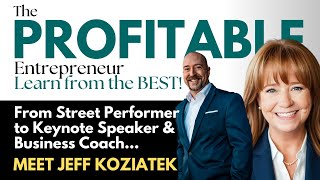
A recorded YouTube interview (Mar 10, 2024) between host Sandy Wardenburg Waggett and guest Jeff Koziatek. Jeff recounts his origin story from performing arts into entrepreneurship (event management, video/photo production) and later into keynote speaking, coaching, and running an Academy (with Dallas Amsten) focused on communication and mindset. Central themes: shifting from externally-defined worth to intrinsic worth, using values as a decision filter, focusing/learning to say no, building healthy company culture, three revenue streams (coaching, keynotes, Academy), and practical pricing advice grounded in valuing impact rather than performance. Memorable anecdotes include throwing out a first pitch at a St. Louis Cardinals game and how lack of internal worth made him miss the moment.
Chapters
Hey, everyone. Welcome to another episode of the Profitable Entrepreneur Lessons from the Best. And today I have got one of the most incredible and dynamic humans that I've had the pleasure to meet in the past year. Jeff Cozy, tech and. Okay, did I pronounce it right?
Yeah, yeah, that sounds good.
Awesome. So, you know, the purpose of this show is really to talk to entrepreneurs just like you, just like us, and, you know, learn from people from different backgrounds, different journeys, what their challenges were, what their successes have been, and how they have navigated that journey. So welcome, Jeff.
Thanks for having me. And if we were talking about learning from mistakes, I made a lot of mistakes, so this could be a long episode.
Hey, you're the expert, the mistakes expert, right?
Well, yeah, yeah, we're going to go out, we're going to, we're going to fail often and quick so we can learn those lessons fast and, and get some traction.
So let's do it for sure. Okay. So I like to just going to start with your origin stories, tell us about you and how you got to where you are today, which is, you know, very well known speaker, coach, friend, mentor, guru, and all things values. And so start from the beginning and get us there.
Did you just say guru?
I did.
That's a big word.
Let's.
Let's not go that. Okay. Holy cow.
He's also very humble, man.
Oh, so there I was.
My parents said, find something you love to do and make that your job. I loved art and people. So they were all in. They were the crazy parents that said, yes, you want to be an actor, go be an actor. We'll totally, totally support that. I also got an unintended message, not necessarily from them, but from, from everybody, that I was what I did, that my performance defined who I was. And it seemed like if I wasn't performing well in school or in sports or making a piece of art, that people didn't really want to pay attention to me. So I quickly became a massive workaholic, defined myself by my performance and worked nonstop. And then I fell into entrepreneurship because, Sandy, I was going to be an actor. I was going to act and make art and, you know, impact lives that way As a, as a film actor in la, however, I found myself in the Midwest and I was not.
Was not getting booked as much as I would like. So I realized that I had to make my own work if I was going to work. So that's when the entrepreneur stuff started to happen. So I created an entertainment company, I started writing shows, I started producing videos. Next thing you know, actor Jeff is producer, writer, director Jeff. And then I'm owning my own business. And then because work is me, I am what I do. I could not say no to stuff. So people would start calling, saying, hey, do you know anybody that could do this? I can't book you for a show. Doing a comedy juggling show over here. Do you know any magicians? Do you know any, you know, balloon twisters? Like, oh, sure. So next thing you know, I've got a booking agency. And then they're like, hey, Jeff, not only do you know all of these entertainers and stuff, but can you help us out with catering? And what do you think about lights and sound and can you help us book a band? So next thing you know, I have an event management company.
Wow.
We're doing full service event management. And then I've got people calling me to produce videos to promote their, their businesses. So we're doing promotional videos, we're doing instructional industrial videos. So now I'm video production company. I'm managing national touring acts. I've got an event management company. We're doing the booking agency bit. I'm still performing, I'm still doing the acting. Who. Um, and it was a lot, but I, I fell into that. It wasn't something that I chose. And it was all from this perspective of I have to do more to prove to everybody that I'm worth their time. It was not a sustainable way to, to start a business. And. And I did that with my business partner who was also a performer. We got together because we were two actors that hung out.
Now, is this your, your current business partner, the one that I'm aware of that you're talking about?
No. Oh, no, this, this was back in the, in the early 2000s.
Okay.
And it didn't. Well, we started in the late 19. In the late 1900s.
But it. Yeah, but we, we just fell into business doing it together. So we were learning all the lessons the hard way. Neither one of us went to business school. Neither one of us had a business coach. We, we didn't really know where we were going. We were so busy saying yes to everything. It was like playing whack a mole. So we got very busy very fast and we had no direction.
And, and we were, we were making a lot of mistakes, so we had a lot of turnover with talent. We. Yeah, yeah. And, and we were bleeding cash. We spent a lot of money learning lessons that we could have spent a lot less. And you know, the whole adage of you spend 20% of your time, you know, on 80% of your income and 80% of your time on the other 20%. That was definitely us. And eventually I'm monologuing, but we're. That's. That's.
This is. This is the story of many entrepreneurs. I mean, so I'm sure a lot of people resonate with exactly what you're saying.
Well, all right, then, I'll continue my villain monologue.
Yeah, no, it's great. I. Look, I'll. I'll just even. I'll reinforce what you have said so far. I mean, that's my journey too, in a weird way. I was working as a senior engineer at Lockheed Martin, built a wedding site because I knew how to code websites back in the mid-90s when nobody did, and decided to make a business of it. And then people said, well, I would like to advertise on your site, but I don't have a website. Oh, well, I can build you one. And then it, you know, so we. We rise to, you know, the level of what people ask us to do, and then all of a sudden, we have this weird business that's around us.
Yeah.
So again, and.
And that's. And that's where. That's where I was. And it. It was not working. It wasn't working for me on a. On a psychological level.
There was something that just felt off, but I couldn't really put my finger on it, so I ended up closing that business down. I gave all of our clients to my old business partner, and I went out on my own, and I really doubled down on myself as a. As a solo performer. And I started my own video production company, and then I started my own photography company, and I continued to work in casting for music videos and commercials and feature films and. And doing all of.
And for four years, I was managing these. Basically these three different businesses, and neither one. None of them could grow beyond where they were because There was only 24 hours in the day.
There was a finite amount of my available resources, and I was maxed out. So everybody said, jeff, you should focus. Pick one. I'm like, I. I don't know how to do that. Because of those two guiding principles I'd picked up as a kid. Find something you love to do and make that your job. And you are what you do. Your performance defines who you are. So I was doing everything that I loved, so I could not say no to anything. And then I had a conversation with a coach, and he said, I can help you in an hour. To which I challenged him for, like, 15 minutes we kept going back and forth. I'm like, there's no way you can help me in an hour. I've been working on this for four years. Four, four years. And finally he goes, okay, how about two hours? Like, oh, well that, that makes, that makes more sense. So we get together and he does exactly what he says. He helps me out, he gives me a new filter. I can say no to things finally. And I can say yes to things that make sense. And I really doubled down on the performing and what that did for people. Offering a safe space for people to drop the mask, to stop pretending and have a genuine laugh next to a total stranger. Like that kind of comfortability and confidence with who they are as a person.
And I love that. But it didn't feel like enough because it was, you know, a 45 minute show. So how do we help people experience that for more than just 30 minutes, even if they allow themselves to go that far? So I started speaking, created my keynote speaking business and then I got certified to do coaching so that I could actually walk people through this change to help them to create that sustainable change so that they could stay in that space long after we stopped working together. So having gone down the road of being overwhelmed and stressed out and the constant second guessing and doubting what I was doing, the cycles of burnout, because that got really intense, and then constantly navigating those transitions and feeling, you know, untethered, just floating around, not in control through a change. Having gone through all of that and then having led my business and having produced films where the culture was not, we'll just say, not healthy.
And then turning around and creating cultures that are healthy and creating films that do go on to win awards and, and succeed not only in terms of out outcome, right, in the performance, in the presentation of the film, but also on the production side. So because of all of that, I love being able to come around and help people do more of what they want, less of what they don't, and really love the results that they get. It's, it's not, it's not theoretical for me. It's real.
I love that. So I've got two questions around what you just talked about. Talked about. The first one is the, the coach that you sat with for two hours, how did he reframe that for you that suddenly gave you the, the power or confidence or whatever it was to focus and learn to say no? Because I, I know a lot of people have a problem with that.
Yeah, it's, it's not easy. It Is not easy. I'm going to boil it down to worth.
You know, for me, I did not see any worth in myself as a human being. The only thing that made me worthy as a, as a person was what I could do. It was something external. And sitting down with my coach, he helped me shift that from looking for worth out here to seeing worth and significance internally. And by making that subtle shift.
If it's out here, that automatically means that I don't have enough, that I'm coming up short and I have to, I have to go get it. And then once I get it, I have to protect it at all costs. And when I'm doing that, I'm like, well, did I get enough? The only way I know that is if I'm walking around with a judgment stick, comparing myself to everybody else. So it makes me really judgy, less generous. And I'm. And I miss the moments. Oh, my gosh, we should talk about the, the first pitch at the Cardinals game. But I, I, I, I missed a lot of moments in my life because I was constantly thinking about the next thing, the next to do. And when he said, you know, that my worth was internal, that it was an intrinsic thing, if it's inside, it can't change because it's not tied to my performance. It's not tied to what I own or who I know. It's not even tied to my relationships with other people as a father or son or friend or, you know, boss or employee. It's not tied to any of that. So it doesn't change. And if it doesn't change and it's always full all the time, well, wait a minute. Now I can say no. And I'm not less.
Now I, now I don't have to do everything. Now I can sit back and say, all right, well, do I want to do that? And then how do we answer that question? It was the values. My coach.
Is Jeff Arthur with the values conversation, no surprise, huge into values. And so to be able to stand on that cornerstone of worth and then make decisions based on what I valued personally, professionally, relationally, now I had a filter, and I could, I could say, okay, does my work as a videographer and a photographer and a stilt walker and a juggler, like, what. What of this really fits into my value system and who I am as a human being? And then I could say, well, you know, these are nice hobbies that write checks. This really aligns. Let's, let's dig into that, and let's make sure that my Behavior and the choices that I make align with my values.
Love that. So I do want to talk about the first pitch of the Cardinals game before I have you go into that and share that story. How for the audience, how would you define the work you do now? So what are you. What do you do?
Wait, I'm sorry. How would I define what.
The work that you do now? So you talked about movies, producing movies. You talked about the whole journey. And so if someone wanted to look you up right now and work with you, what. What exactly are you doing now? What have you settled into? And what's your. What's your work?
Well, the short answer to that question is I help people do more of what they want, less of what they don't, and love their results. I run into a lot of people that say, I know I'm supposed to do this, but I'm not. I know what I need to do, but I'm not doing it, and I don't know why I keep doing this. Well, I help them uncover the root of that, so they have a choice, and they can choose to do something about the root to get different results or not. So if people are done guessing, if they're done rolling the dice and hoping for the best, if they are ready to have confidence.
Before the decision is made that it is the right decision before the results come in, then. Then I help. And I do that with three services. So I have an academy, I've got my keynotes, and then I have my coaching. So people would come to me for coaching as an individual if they want help overcoming feelings of overload or stress or doubt, or they're tired of going through cycles of burnout, or they want to thrive through a transition. And company would come to me and say, hey, Jeff, we want your help to improve our culture, to create a culture of champions that communicate well, collaborate effectively, can think critically and creatively so that we've got this culture that people want to be a part of that, that we're attracting top talent, that our turnover is going down, that people are genuinely happy. I mean, we can. We can talk about all the studies out there that say that companies with a culture of happiness.
Deliver profits that are always at the top of the stock market. But that's a. That's a whole other conversation. So that's what I do there. And also with companies that are going through M and A, if they're looking to improve their culture for sale, if they just bought something and then looked under the hood and went, oh, my gosh, it Looked so great out here. But we need to do something about the culture. Then I come in and do that. Or if they are taking two cultures and merging them together, how do we do that in a. In an intentional way and not just throw them into Thunderdome and say, fight it out. We'll see whoever comes out on top. So that's what I do with the coaching people bring me in as a keynote to inspire and encourage their people from the stage. And I usually speak on six different topics there and then. The Academy. The Academy is something that I run with Dallas Amsten. He and I teach communication, skill set and mindset, how we talk to ourselves and how we talk to other people. And that's a monthly subscription service. So it's something that we can do for individuals, something we can do at a. At a group rate for organizations. And then we can also offer an exclusive academy just within an organization that says, hey, we, we like this, but we want you to tailor it specifically to our values and our goals. So that's. That's what I do over@core authenticity.com.
Well, I, you know, I just wanted to bring some clarity to exactly what you're doing today. For a lot of reasons. We're going to go into some conversations around business challenges, like entrepreneur challenges. And so I wanted to have some context. The fact that you're. You're really running. It's. It's Core Authenticity, but it's three different major deliverables, and there's a lot to that. So before we dive into the questions around business, business operations and getting profitable with your company, talk to us about the story that you wanted to bring up with the Cardinals game.
I loved baseball as a kid. I played it all the time. I had dreams of being a professional baseball player. I had. I was a pitcher, Sandy. And I could throw a fastball. The fastball is really good. But the curveball I could throw right at your head, and it would curve right back over the heart of the plate.
Wow.
Every time. Every time. Oh, my gosh, it was so awesome. You'd throw that and you'd watch kids just bail out of the batter's box. I mean, it was. It was great. And then sometimes we would hit people just to keep them honest. I don't recommend that today, but. But that's what we did. I loved baseball. Ate, slept, breathed baseball, dreamed of being a baseball player. Then one day, my friend at the wise old age of 14 said, Jeff, we will never make it. We're never going to play in the majors. And because he was 14 years old and so wise, so wise, so knowledgeable and so prophetic. I said, okay, well, he must be right. And I let go of my dream. I let go of pursuing my dream. But inside, I was so frustrated. I did not like myself for letting that go. And I was full of all this regret and resentment and anger. And I thought, someday, someday I will make a film all about baseball. I'll cast myself as a pitcher. I'll put myself on the mound in the ninth inning with two outs, the game on the line, and people will cheer because it'll be in the script. It will have 40,000 screaming fans chanting my name because it will be in the script. And I will throw three perfect pitches to close out the ninth to win it for my team because of video editing. And it will be awesome. I will. I will make my childhood dream a reality. And then my client back in the late 2000s called me up and said, hey, Jeff, we want you to throw out the first pitch at a St. Louis Cardinals baseball game to Albert Pujols, who was a big hometown hero at the time.
Yeah.
And I said, okay. And they said, the only catch is you have to do it as a character that you created for us. Because I was managing national touring acts, it's like, you have to put on the wizard costume. That's fine. I can throw out the first pitch as a wizard, no problem. And so I'm like, this is. This is great. We get there that day, and then the CEO is like, actually, I'm going to take Albert. You can throw out to Robinson. Like, that's fine. I don't know who Robinson is, but it's going to be great. I'm going to be on the pit. It's. It's going to happen. It's going to be awesome. And so I get out there and Sandy, I can tell you it looks like I had a good time because I'm smiling in the photos, but I can't remember it.
I don't. I don't remember what it was like to be on the mound. I don't remember what I threw. I. I don't. I don't remember much about that particular event because at that time in my life, I was still looking for my worth outside of myself in my performance. And because of that, my mind was not present. My mind was always in the future. And. And even though I was there fulfilling a version of my childhood dream, I was thinking about the next project, the next to do item, and I missed it. And so when I get a Chance to work with employee, well, employers, business owners, entrepreneurs, and help them to catch the moments of their life so they don't have to pay that price so they can be present whether they're at work or whether they're at home with their spouse or with their kids or the people that they really care about. Like that. That means a lot to me.
Wow, that's a really powerful story. Thank you for sharing that. I love it. I mean, it's sad, but it's still, I love the story. And there's a lesson there for all of us. Let's dive in a little bit into the business side. So you got, you know, three.
Revenue driving mechanisms, so to speak. So you've got your coaching, you've got your keynote speaking, and you have your academies. So, you know, as an entrepreneur, one of the things that I've seen over the years, including myself, that we struggle with is, you know, how do you approach pricing your services?
That is a big question. And most of us undervalue our time and our expertise. What's your, what's your approach on that, on pricing services?
I get this question a lot from other keynote speakers coming up and other coaches. And we used to get it a lot as a performer, like, hey, what are you charging for this? What are you charging for that? And at the end of the day, I feel like we have to charge something that we're comfortable with.
I mean, it's, it's really that simple. I mean, if I'm showing up standing on my cornerstone of intrinsic worth, then I don't have to prove myself to you or to anybody else by matching whatever you're charging. I won't feel like I'm losing out. Oh my gosh. I only charged, you know, $10,000 for that. And so, and so did the same thing and, and she got 15,000. I totally missed it because it's all about my performance and my income. I feel like if we're standing on our intrinsic worth cornerstone, I can show up and say, you know what, here is the price. It's, it's $30,000, you know, and, and that's the value I'm bringing. And, and to be honest with you, if you work with me, you're going to get way more than that. But that's, that's what I'm going to charge you. And if somebody comes back and says, well, you know, we can't do that, you know, we, we only have this much or whatever, like, well then, then I've got a choice to make. And either I Can. If I really want to work with that person.
I can offer up some value trades or I can say no. And I can say no.
Right.
Because I'm more than my performance. And I now I have that ability. So I, I think, you know, I don't really look at the. I agree with you. We often don't charge what we're worth. And along with that, I think there's a tendency to look at everybody else and think we have to match their prices. And I would rather not play that game. Find a number that I need to meet my lifestyle and that I feel comfortable with, and I go with that. And a lot of that comes from my values and my worth.
Yeah, I completely agree with, you know, how you outlined that. I, I recall back when I first started my company.
I went to a conference and it was for web developers and I was charging at the time 25amonth for website hosting. But you could get it for, I think, $2.95 at GoDaddy. And so this is back in 1999, so GoDaddy was in its infancy. And the CEO of this tech company, I was talking to him about this. He's like, I don't understand how you can charge that. Nobody's gonna pay that. Like, well, I, I've got 400 people that are.
I mean, I back down from that and I put that story in my book. And now we, you know, charge as high as 90, 95amonth with services.
What?
No, seriously? I, Yeah, I. But people say, well, why shouldn't I just go over here and do that? Well, it's because we do this. And if this isn't for you, that's okay. You should go over there, then it's okay. So it took years, honestly, for, you know, the pricing structure that I have to settle in on it and not compare like you said. And it took me, a coach, to talk me through actually having the courage to raise my prices when way underpriced in the market.
So. So you were able to. To raise your rates and charge what you charge and feel comfortable about it because you had a coach that outside perspective.
I mean, that was part of it. So the coach talked me through it. The coach showed. And to your point, the coach, you know, made me see the value in what I brought to the table. And if I believed it was worth that, then I feel comfortable charging that. And then it's up to the person on the other side to see, you know, if they value it or not. And if they don't, then I'm not for them. And that's perfectly okay. And I should be comfortable with that. And that's a hard place to get to, you know.
Oh, my gosh. Yeah. Well, it, it makes me think of when I was in the photography business.
I would tell them, here's the rate. And they'd be like, what? It's that much? You're only taking a few. You're just snapping, like, how hard is your finger working to take the photos? And we're only there for like an hour and you're only giving me these images. How can you charge so much? Like, well, do we want to go into all the education, we want to go into all the practice, we want to go into all the investment on, on composition and equipment. And like, all of the. There's all of this. It's the iceberg right underneath the water that nobody else sees. Like, you're paying and you think that you're just paying for this, but you're paying for the. The whole enchilada. And I know when, when we don't, when we don't trust.
We don't trust the value that we're bringing our, our clients. And it is hard to confidently charge appropriate value. And then it can be easy to just fixate on the top part of the iceberg and miss all of this. So we don't see that. And then we often get focused on ourselves and we stop looking at the impact that we're causing that we're having on our clients, on either the person or their whole company. And, and if we start looking at the impact on them, if we stop focusing on ourselves, we start looking at the service part and the results, I think it's a whole lot easier to say, yes, this is worth what I'm charging. And if we're going to be honest, it's probably worth a whole lot more.
Exactly. Yeah, for sure. You know, and it's interesting to me, just as part of this conversation, you know, if you have a team of a small business owner, I found over the years that if you put a prospective client in front of me versus a team member to close a deal, I can close the deal so much easier and faster than a team member can. Simply from the perspective that I believe, and I'm confident in the value and the service and what it is that. That we're offering, whereas the team member doesn't have that internal value for the services. So I found that spending a lot of time coaching and teaching team members on it makes the team more powerful from a sales perspective. So I'm talking early on I was learning that, and now I have a very powerful team. I can put any one of my team members in front of a perspective clients, and I'm confident that they would have nearly or equal to the close rate that I have with clients.
So.
How did you train them up to do that?
Well, it's just a matter of educating from this perspective to me of why it matters, what we do and how we do it differently. And so it's not just here's what we do, the list of stuff, it's why, why we do it this way and when we believe that why, and the importance of it with conviction, it comes across confidently. And then when you can back it up with, you know, results, then it's an easy. It's an easy deal. But I think, as you know, small business owners, a lot of times we don't take the time to educate our team on that. And, you know, the team that doesn't buy into that is not necessarily a great fit for your company then. Right. So, you know, I think we've had this conversation before, like, I will hire for fit over.
More from Sandy

Calm is your best strategist. Market with intention, not emotion. #MarketingTips #MSWInteractive






Show up with the kind of energy you want YOUR business to receive - every single day! ❤️



